weight HONDA PASSPORT 2002 2.G Owners Manual
[x] Cancel search | Manufacturer: HONDA, Model Year: 2002, Model line: PASSPORT, Model: HONDA PASSPORT 2002 2.GPages: 294, PDF Size: 3.97 MB
Page 29 of 294
Driver and Passenger Safety26
3.Secure the child in the child
seat. Make sure the child is
properly strapped in the child
seat according to the child seat
maker ’ s instructions. A child
who is not properly secured in
a child seat can be thrown out
of the seat in a crash and
seriously injured.
Storing a Child Seat
When you are not using a child
seat, either remove it and store it
in a safe place, or make sure it is
properly secured. An unsecured
child seat can be thrown around
the vehicle during a crash or
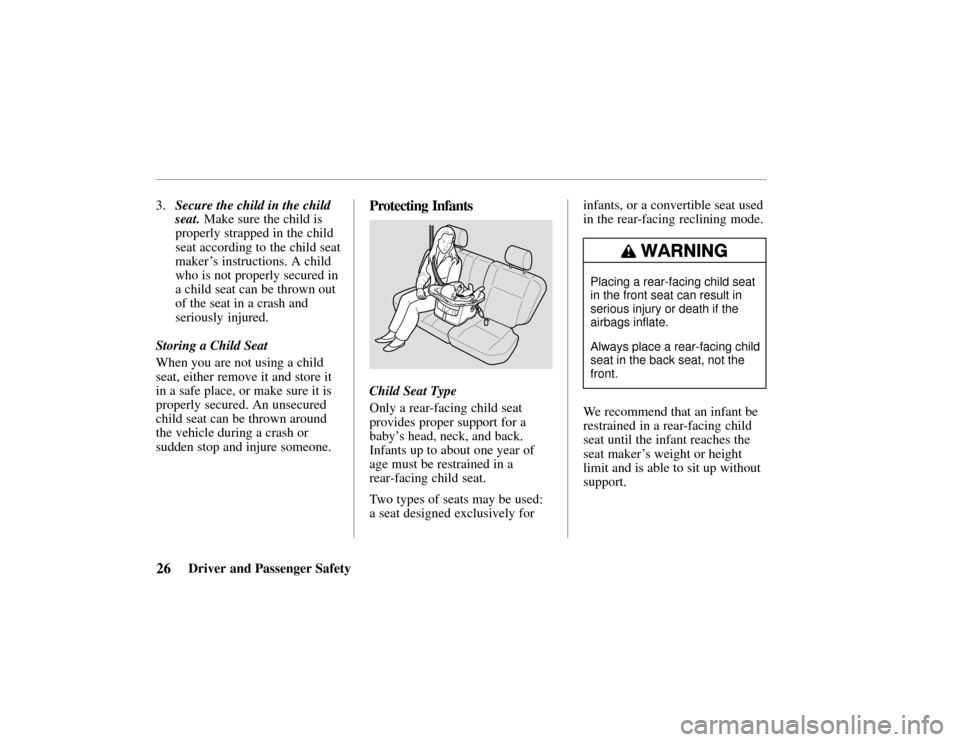
sudden stop and injure someone.Protecting Infants
Child Seat Type
Only a rear-facing child seat
provides proper support for a
baby’ s head, neck, and back.
Infants up to about one year of
age must be restrained in a
rear-facing child seat.
Two types of seats may be used:
a seat designed exclusively for infants, or a convertible seat used
in the rear-facing reclining mode.
Placing a rear-facing child seat
in the front seat can result in
serious injury or death if the
airbags inflate.
Always place a rear-facing child
seat in the back seat, not the
front.
We recommend that an infant be
restrained in a rear-facing child
seat until the infant reaches the
seat maker
’s weight or height
limit and is able to sit up without
support.
Page 32 of 294
Driver and Passenger Safety29
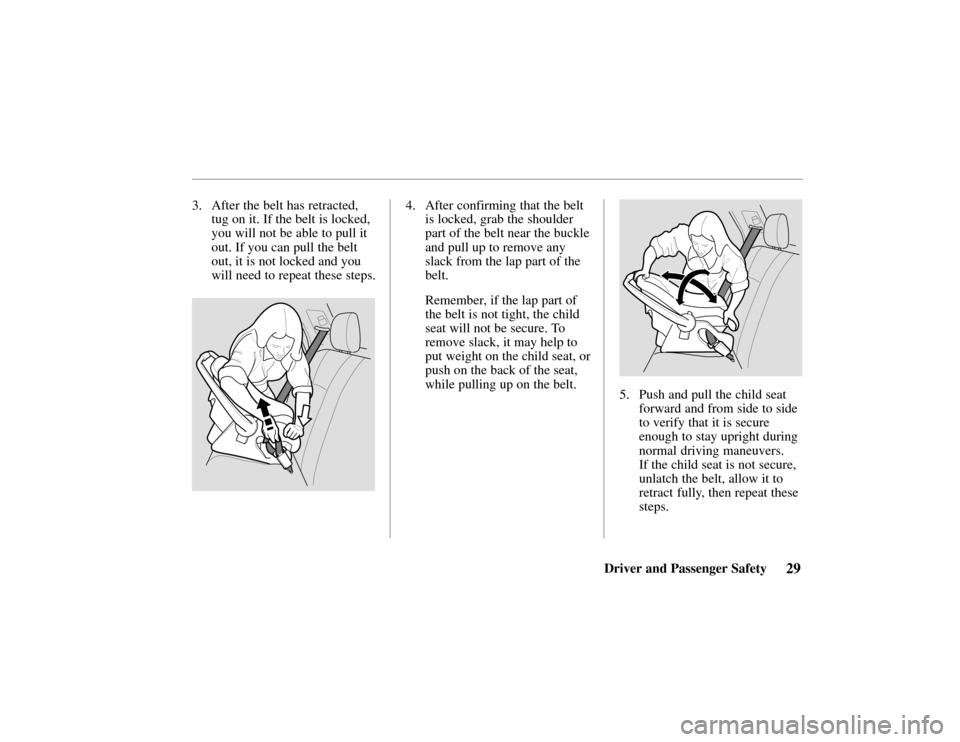
3. After the belt has retracted,tug on it. If the belt is locked,
you will not be able to pull it
out. If you can pull the belt
out, it is not locked and you
will need to repeat these steps.4. After confirming that the beltis locked, grab the shoulder
part of the belt near the buckle
and pull up to remove any
slack from the lap part of the
belt.
Remember, if the lap part of
the belt is not tight, the child
seat will not be secure. To
remove slack, it may help to
put weight on the child seat, or
push on the back of the seat,
while pulling up on the belt.
5. Push and pull the child seat
forward and from side to side
to verify that it is secure
enough to stay upright during
normal driving maneuvers.
If the child seat is not secure,
unlatch the belt, allow it to
retract fully, then repeat these
steps.
Page 33 of 294
Driver and Passenger Safety30
To deactivate the locking
mechanism and remove a child
seat, unlatch the buckle, unroute
the seat belt, and let the belt fully
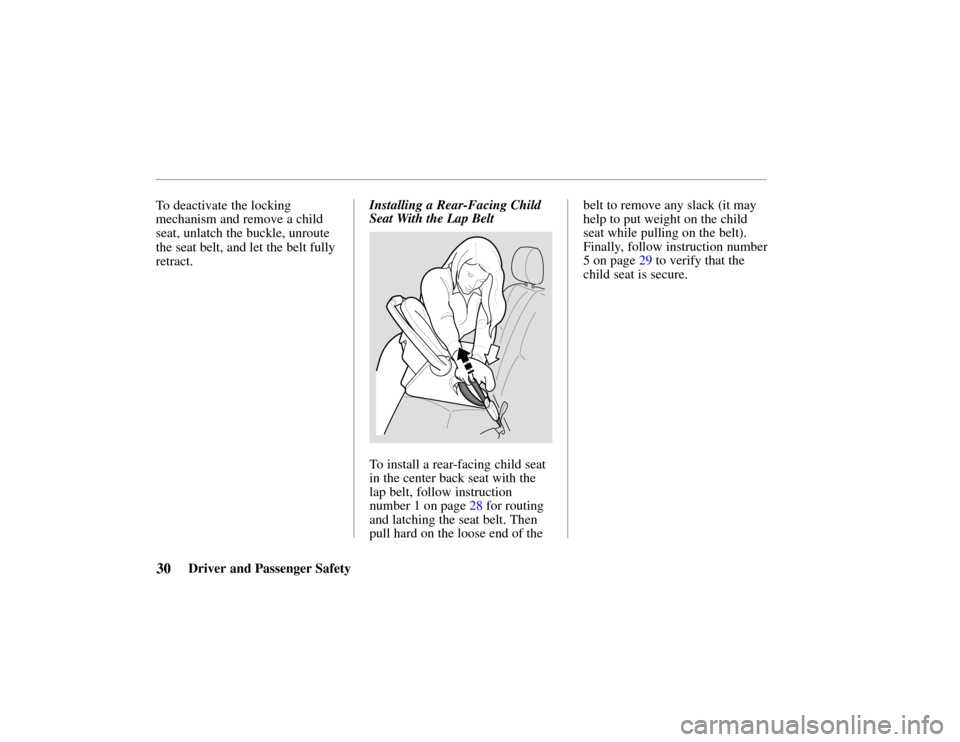
retract. Installing a Rear-Facing Child
Seat With the Lap Belt
To install a rear-facing child seat
in the center back seat with the
lap belt, follow instruction
number 1 on page 28 for routing
and latching the seat belt. Then
pull hard on the loose end of the belt to remove any slack (it may
help to put weight on the child
seat while pulling on the belt).
Finally, follow instruction number
5 on page 29 to verify that the
child seat is secure.
Page 34 of 294
Driver and Passenger Safety31
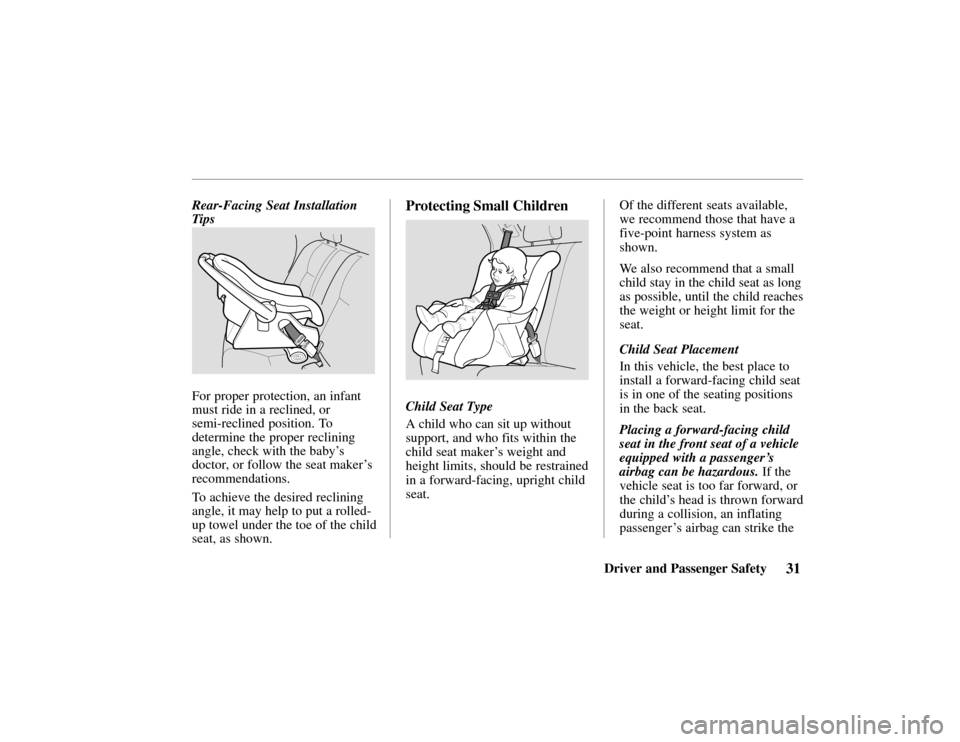
Rear-Facing Seat Installation
Tips
For proper protection, an infant
must ride in a reclined, or
semi-reclined position. To
determine the proper reclining
angle, check with the baby’s
doctor, or follow the seat maker’s
recommendations.
To achieve the desired reclining
angle, it may help to put a rolled-
up towel under the toe of the child
seat, as shown.
Protecting Small Children
Child Seat Type
A child who can sit up without
support, and who fits within the
child seat maker ’s weight and
height limits, should be restrained
in a forward-facing, upright child
seat. Of the different seats available,
we recommend those that have a
five-point harness system as
shown.
We also recommend that a small
child stay in the child seat as long
as possible, until the child reaches
the weight or height limit for the
seat.
Child Seat Placement
In this vehicle, the best place to
install a forward-facing child seat
is in one of the seating positions
in the back seat.
Placing a forward-facing child
seat in the front seat of a vehicle
equipped with a passenger
’s
airbag can be hazardous. If the
vehicle seat is too far forward, or
the child’ s head is thrown forward
during a collision, an inflating
passenger ’ s airbag can strike the
Page 36 of 294
Driver and Passenger Safety33
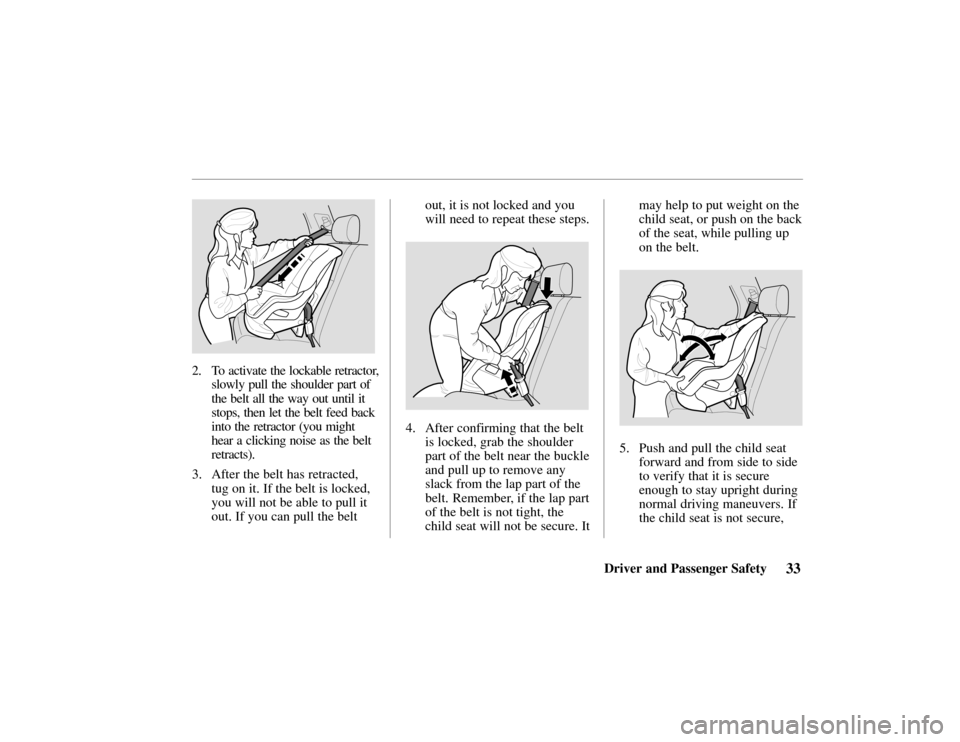
2. To activate the lockable retractor,slowly pull the shoulder part of
the belt all the way out until it
stops, then let the belt feed back
into the retractor (you might
hear a clicking noise as the belt
retracts).
3. After the belt has retracted, tug on it. If the belt is locked,
you will not be able to pull it
out. If you can pull the belt out, it is not locked and you
will need to repeat these steps.
4. After confirming that the belt
is locked, grab the shoulder
part of the belt near the buckle
and pull up to remove any
slack from the lap part of the
belt. Remember, if the lap part
of the belt is not tight, the
child seat will not be secure. It may help to put weight on the
child seat, or push on the back
of the seat, while pulling up
on the belt.
5. Push and pull the child seat
forward and from side to side
to verify that it is secure
enough to stay upright during
normal driving maneuvers. If
the child seat is not secure,
Page 37 of 294
Driver and Passenger Safety34
unlatch the belt, allow it to
retract fully, then repeat these
steps.
To deactivate the locking
mechanism in order to remove a
child seat, unlatch the buckle,
unroute the seat belt, and let the
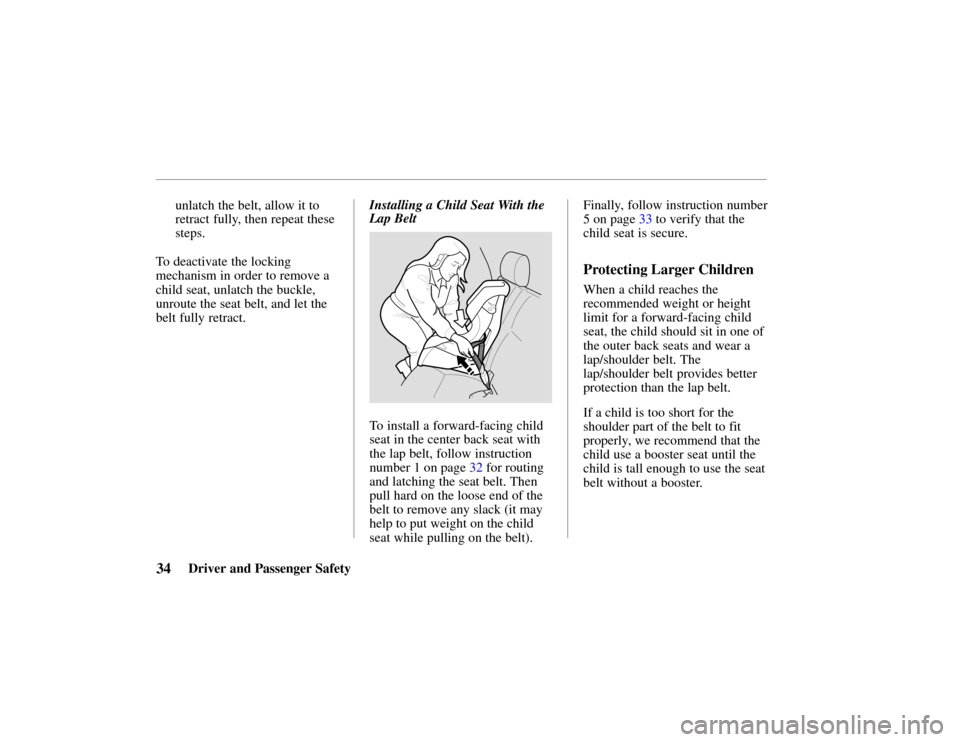
belt fully retract. Installing a Child Seat With the
Lap Belt
To install a forward-facing child
seat in the center back seat with
the lap belt, follow instruction
number 1 on page 32 for routing
and latching the seat belt. Then
pull hard on the loose end of the
belt to remove any slack (it may
help to put weight on the child
seat while pulling on the belt). Finally, follow instruction number
5 on page 33 to verify that the
child seat is secure.
Protecting Larger Children
When a child reaches the
recommended weight or height
limit for a forward-facing child
seat, the child should sit in one of
the outer back seats and wear a
lap/shoulder belt. The
lap/shoulder belt provides better
protection than the lap belt.
If a child is too short for the
shoulder part of the belt to fit
properly, we recommend that the
child use a booster seat until the
child is tall enough to use the seat
belt without a booster.
Page 89 of 294
86Instruments and Controls
Operation
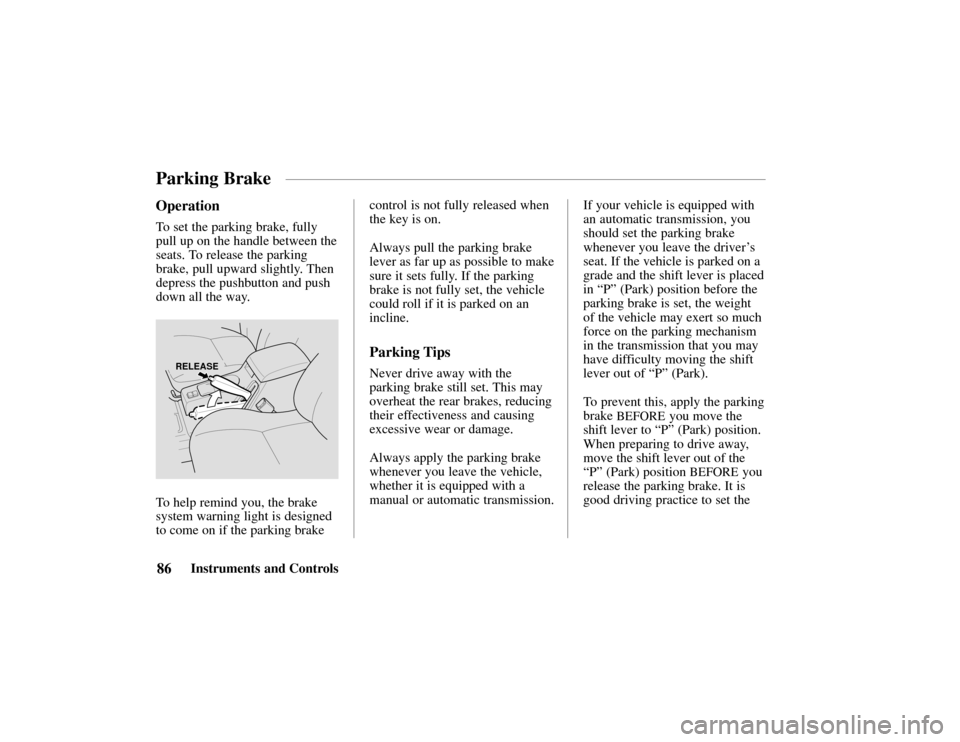
To set the parking brake, fully
pull up on the handle between the
seats. To release the parking
brake, pull upward slightly. Then
depress the pushbutton and push
down all the way.
RELEASE
To help remind you, the brake
system warning light is designed
to come on if the parking brakecontrol is not fully released when
the key is on.
Always pull the parking brake
lever as far up as possible to make
sure it sets fully. If the parking
brake is not fully set, the vehicle
could roll if it is parked on an
incline.
Parking Tips
Never drive away with the
parking brake still set. This may
overheat the rear brakes, reducing
their effectiveness and causing
excessive wear or damage.
Always apply the parking brake
whenever you leave the vehicle,
whether it is equipped with a
manual or automatic transmission.
If your vehicle is equipped with
an automatic transmission, you
should set the parking brake
whenever you leave the driver
’s
seat. If the vehicle is parked on a
grade and the shift lever is placed
in “P” (Park) position before the
parking brake is set, the weight
of the vehicle may exert so much
force on the parking mechanism
in the transmission that you may
have difficulty moving the shift
lever out of “P” (Park).
To prevent this, apply the parking
brake
BEFORE you move the
shift lever to “P” (Park) position.
When preparing to drive away,
move the shift lever out of the
“P” (Park) position
BEFORE you
release the parking brake. It is
good driving practice to set the
Parking Brake
Page 94 of 294
91Seats
The
EX–L model has a power
adjustable driver’s seat. On the
other models, the driver’s seat
adjusts manually.
The front passenger’s seat and the
rear seat in all models adjust
manually.
Manual Front Seat
Adjustments
See pages 10-11 for important
safety information and warnings
about how to properly position
seats and seat-backs.
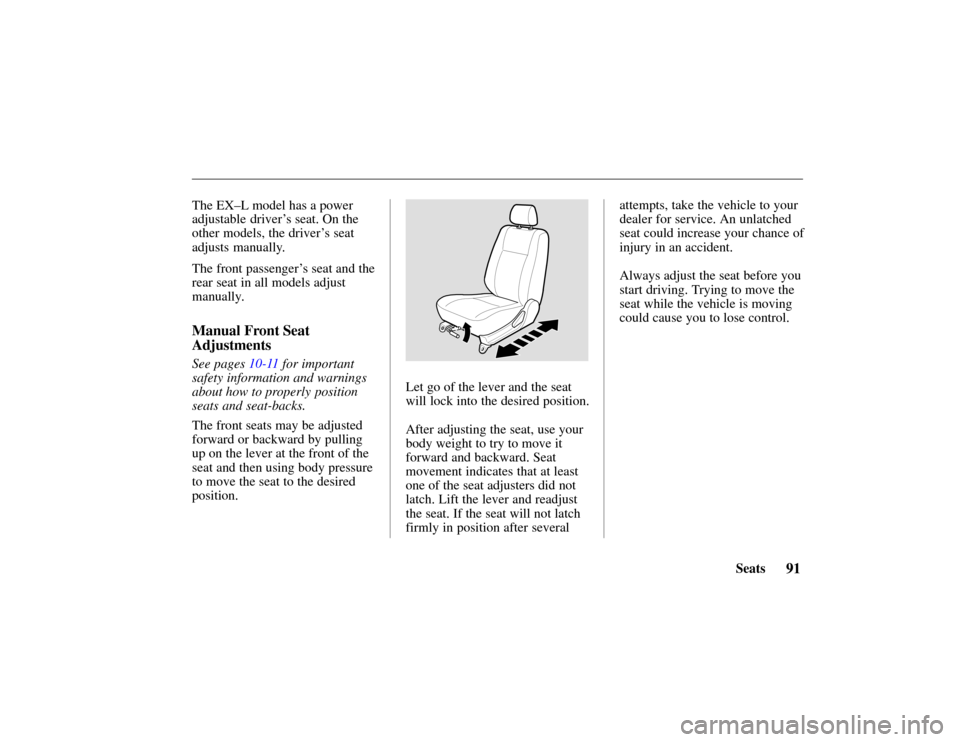
The front seats may be adjusted
forward or backward by pulling
up on the lever at the front of the
seat and then using body pressure
to move the seat to the desired
position.
Let go of the lever and the seat
will lock into the desired position.
After adjusting the seat, use your
body weight to try to move it
forward and backward. Seat
movement indicates that at least
one of the seat adjusters did not
latch. Lift the lever and readjust
the seat. If the seat will not latch
firmly in position after several attempts, take the vehicle to your
dealer for service. An unlatched
seat could increase your chance of
injury in an accident.
Always adjust the seat before you
start driving. Trying to move the
seat while the vehicle is moving
could cause you to lose control.
Page 162 of 294
159Driving Tips
•If your vehicle is equipped with
an automatic transmission, set
the parking brake before you
leave the driver’s seat. If the
vehicle is parked on a grade
and the transmission shift lever
is placed in “P” (Park) position
before you set the parking
brake, the weight of the vehicle
may exert so much force on the
transmission that you may have
difficulty moving the shift
lever out of “P” (Park)
position. To prevent this, apply
the parking brake
BEFORE
moving the shift lever to “P”
(Park). When you want to drive
away, move the shift lever out
of the “P” (Park) position
BEFORE releasing the parking
brake. It is good driving
practice to set the parking
brake first, then place the
transmission in “
PA R K” position, even on level
surfaces.
•If the parking brake does not
seem to hold the vehicle as
well as before, have the vehicle
serviced by your Honda dealer.
•Do not park your vehicle over
high grass, dry leaves or other
combustible materials. The
catalytic converter gets very
hot and could set fire to these
materials.
Anti-Lock Brakes
Your vehicle has an Anti-lock
Brake System (
ABS) as standard
equipment.
ABS helps to prevent
the wheels from locking up and
skidding during hard braking,
allowing you to retain steering
control.
When the front tires skid, you
lose steering control; the vehicle
continues straight ahead even
though you turn the steering
wheel. The
ABS helps to prevent
lock-up and retain steering control
by pumping the brakes rapidly;
much faster than a person can do it.
You should never pump the
brake pedal, this defeats the
purpose of the
ABS. Let the ABS
work for you by always keeping
firm, steady pressure on the brake
pedal as you steer away from the
Brakes
Page 174 of 294

171Driving Tips
air cleaner, so it’
s important to
replace the air cleaner filter at
required intervals. See “Care and
Maintenance.” A dirty air cleaner
filter reduces engine performance
and can waste fuel.
Air Conditioning
Turn off the air conditioning when
it is not needed. The air
conditioning compressor is not on
in this position and the reduced
engine load can improve fuel
economy.
Tuned Engine
An engine that is properly
maintained will provide better
fuel economy than one that is not.
One misfiring spark plug will cut
fuel economy significantly, and
will make a difference in the
amount of pollution emitted from
your vehicle. Excessive Weight
Fuel economy is related to the
work the engine must do. The
heavier the load, the more fuel it
takes to run your vehicle. Keep
weight to a minimum by removing
unnecessary luggage or cargo.
Tire Inflation
Underinflation not only causes
needless tire wear but can also
waste fuel. It’
s a good idea to
check tire pressure often and keep
your tires inflated to the pressures
shown on the tire placard located
on the driver ’s doorjamb. Wheel Alignment
Improper alignment will cause the
front tires to roll at an angle that
will result in faster tire wear. It
takes power to overcome this
improper alignment, which, in
turn, wastes fuel.
Use of 4-Wheel Drive
In normal driving, put the
4WD-2WD switch in the 2WD
position.