steering HONDA PASSPORT 2002 2.G Owner's Manual
[x] Cancel search | Manufacturer: HONDA, Model Year: 2002, Model line: PASSPORT, Model: HONDA PASSPORT 2002 2.GPages: 294, PDF Size: 3.97 MB
Page 162 of 294

159Driving Tips
•If your vehicle is equipped with
an automatic transmission, set
the parking brake before you
leave the driver’s seat. If the
vehicle is parked on a grade
and the transmission shift lever
is placed in “P” (Park) position
before you set the parking
brake, the weight of the vehicle
may exert so much force on the
transmission that you may have
difficulty moving the shift
lever out of “P” (Park)
position. To prevent this, apply
the parking brake
BEFORE
moving the shift lever to “P”
(Park). When you want to drive
away, move the shift lever out
of the “P” (Park) position
BEFORE releasing the parking
brake. It is good driving
practice to set the parking
brake first, then place the
transmission in “
PA R K” position, even on level
surfaces.
•If the parking brake does not
seem to hold the vehicle as
well as before, have the vehicle
serviced by your Honda dealer.
•Do not park your vehicle over
high grass, dry leaves or other
combustible materials. The
catalytic converter gets very
hot and could set fire to these
materials.
Anti-Lock Brakes
Your vehicle has an Anti-lock
Brake System (
ABS) as standard
equipment.
ABS helps to prevent
the wheels from locking up and
skidding during hard braking,
allowing you to retain steering
control.
When the front tires skid, you
lose steering control; the vehicle
continues straight ahead even
though you turn the steering
wheel. The
ABS helps to prevent
lock-up and retain steering control
by pumping the brakes rapidly;
much faster than a person can do it.
You should never pump the
brake pedal, this defeats the
purpose of the
ABS. Let the ABS
work for you by always keeping
firm, steady pressure on the brake
pedal as you steer away from the
Brakes
Page 163 of 294
160Driving Tips
hazard. This is sometimes referred
to as “stomp and steer
.”
You will feel a pulsation in the
brake pedal when the
ABS
activates, and you may hear some
noise. This is normal, it is the
ABS rapidly pumping the brakes.
Activation varies with the amount
of traction your tires have. On dry
pavement, you will need to press
on the brake pedal very hard
before you activate the
ABS.
However, you may feel the
ABS
activate immediately if you are
trying to stop on snow or ice.
Important Safety Reminders
ABS does not reduce the time
or distance it takes to stop the
vehicle, it only helps with steering
control during braking. You
should always maintain a safe following distance from other
vehicles.
ABS will not prevent a skid that
results from changing direction
abruptly, such as trying to take a
corner too fast or making a
sudden lane change. Always drive
at a safe, prudent speed for the
road and weather conditions.
ABS cannot prevent a loss of
stability. Always steer moderately
when you are braking hard.
Severe or sharp steering wheel
movement can still cause your
vehicle to veer into oncoming
traffic or off the road.
A vehicle with
ABS may require
a longer distance to stop on
loose or uneven surfaces, such as
gravel or snow, than a vehicle
without anti-lock. Slow down and allow a greater distance between
vehicles under those conditions.
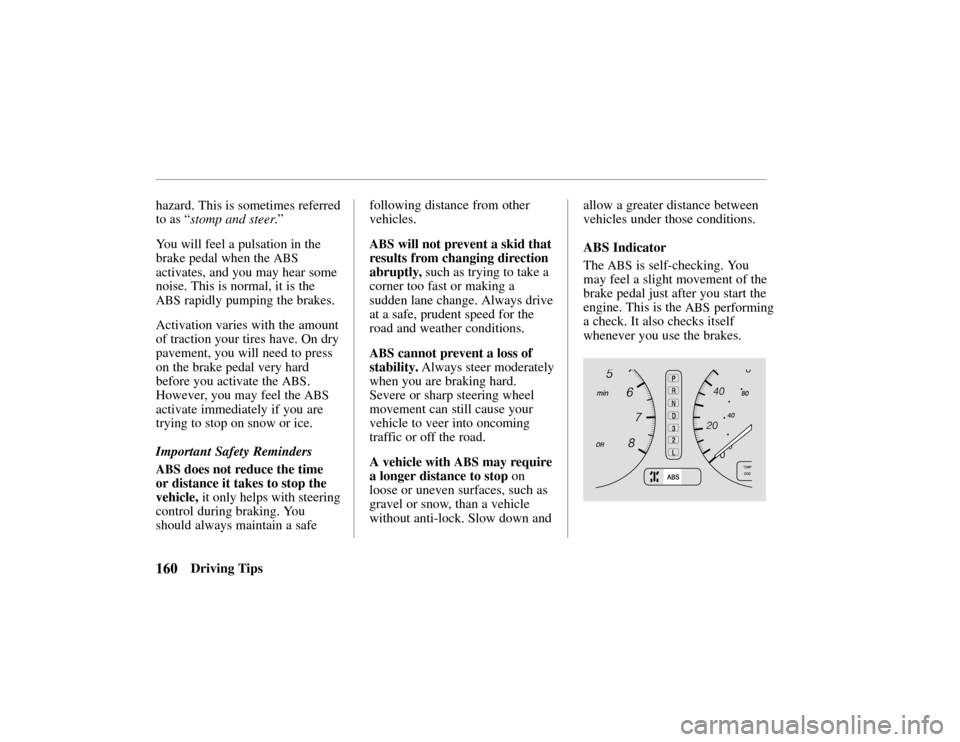
ABS Indicator
The
ABS is self-checking. You
may feel a slight movement of the
brake pedal just after you start the
engine. This is the
ABS performing
a check. It also checks itself
whenever you use the brakes.
Page 164 of 294

161Driving Tips
If anything goes wrong, the
ABS
indicator on the instrument panel
comes on (see page 67). This
means the anti-lock function of
the braking system has shut down.
The brakes still work like a
conventional system without
anti-lock, providing normal
stopping ability. You should have
the dealer inspect your vehicle as
soon as possible if this light stays
on after you start the engine, or
comes on while driving.
Driving With Wet Brakes
Driving through deep water may
get the brakes wet and reduce
their effectiveness. As a result, the
vehicle may not slow down
normally or may pull in one
direction or the other.
If you drive through deep water,
apply the brakes lightly to see if
the water has affected them. To
dry the brakes quickly, press
lightly on the brake pedal while
maintaining the same speed with
the accelerator pedal. Continue
this until the brakes operate
normally.
Power Brakes
The braking system uses engine
vacuum to provide power assist. If
the power assist fails because of a
stalled engine or other reason, the
reserve vacuum in the system will
usually allow you to apply the
brakes at least one time.
The reserve vacuum is partly used
up each time the brake pedal is
applied and released. Do not
pump the brakes when the power
assist has been lost, except when
needed to maintain steering
control on slippery surfaces.
You can still stop the vehicle
without the power assist by pushing
harder on the brake pedal.
However, the stopping distance
may be longer, even though the
brakes themselves remain fully
operational.
Page 165 of 294

162Driving Tips
Self-Adjusting Brakes
The brakes on this vehicle are
self-adjusting. They have been
designed so that periodic brake
adjustment is not needed.
The brakes adjust themselves each
time you firmly apply them.
Thus, if the brake pedal goes down
farther than normal due to a lack of
adjustment, drive backward and
forward a few times. Apply the
brakes intermittently.
See your Honda dealer if the
brake pedal height does not return
to normal or if there is a rapid
increase in pedal travel. Either is a
sign of other brake trouble. Also,
see your Honda dealer if the
parking brake needs adjustment.
Braking Tips
Control your vehicle’s speed on a
steep or long downhill grade by
shifting the transmission to a
lower gear. Constantly using the
brakes can cause them to overheat
and lose effectiveness.
Resting your foot on the brake
pedal when you are not intending
to brake (“riding the brakes”) can cause them to overheat. This
reduces their effectiveness, wears
them out faster, and can reduce
fuel mileage. It also causes your
brake lights to stay on all the time,
confusing drivers behind you.
Brake Wear Indicators
The front and rear brakes have
built-in wear indicators. These make a high-pitched squealing or
cricket-like warning sound when
the brake pads or linings are worn
to the point of replacement. The
sound may come and go or be
heard all the time when the vehicle
is moving, but may stop when the
brake pedal is pushed down firmly.
Expensive damage can result if
pads or linings are not replaced
immediately when needed.
Driving on Slippery Surfaces
Driving, steering, and braking
traction are reduced when the
road is coated with water, snow,
ice, gravel, or other materials.
Slow down and adjust your
driving to such conditions. It is
important to slow down when it is
slippery because stopping
Page 166 of 294
163Driving Tips
distances will be longer and
vehicle control more limited.
While driving on a surface with
reduced traction, avoid maneuvers
involving sudden steering,
acceleration, or braking (including
engine braking due to shifting to
lower gear), that could cause the
tires to skid.
Drivers may not realize the
surface is slippery until the
vehicle is skidding.
Learn to recognize warning
clues—such as enough water or
ice on the road to make a
“mirrored surface”—and slow
down when there is any doubt.
Also see “Traction” under “Tires”
in this section.
Rapid slowing down or
speeding-up can cause loss
of control on slippery
surfaces. If you crash, you
can be injured.
Use extra care when driving
on slippery surfaces.
To safely operate your vehicle,
your tires must be the proper type
and size, in good condition with
adequate tread, and correctly
inflated. The following pages give
more detailed information on how
and when to check air pressure,
how to inspect your tires for
damage and wear, and what to do
when your tires need to be
replaced.
Using tires that are excessively
worn or improperly inflated can
cause a crash in which you
can be seriously hurt or killed.
Follow all instructions in this
owner’s manual regarding tire
inflation and maintenance.
Tires
Page 169 of 294
166Driving Tips
indicator in three or more places
around the tire.
Maintenance
In addition to proper inflation,
correct wheel alignment helps to
decrease tire wear. You should get
your vehicle’
s suspension parts
inspected often, and aligned when
needed.
The tires were properly balanced
at the factory. They may need to
be rebalanced at some time before
they are worn out. Have your
dealer check the tires if you feel a
consistent vibration while driving.
A tire should always be
rebalanced if it is removed from
the wheel for repair.
Make sure the installer balances
the wheels when you have new
tires installed. This increases riding comfort and tire life. Your
vehicle’
s original tires were
dynamic or “spin” balanced at the
factory. For best results, have the
installer perform a dynamic
balance.
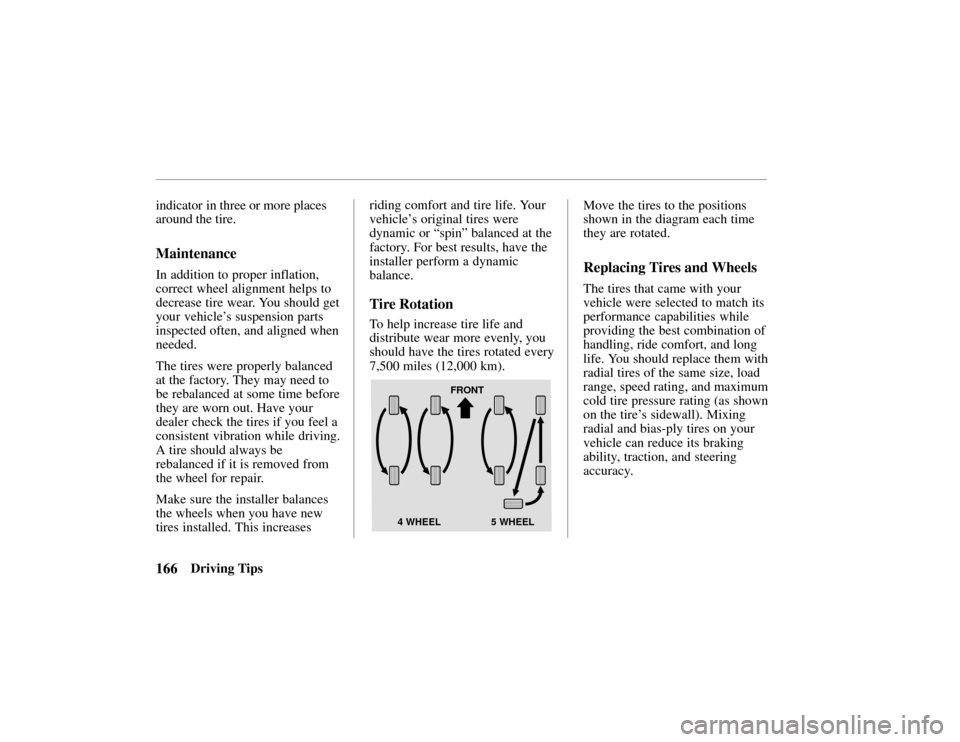
Tire Rotation
To help increase tire life and
distribute wear more evenly, you
should have the tires rotated every
7,500 miles (12,000 km).
FRONT
4 WHEEL 5 WHEEL
Move the tires to the positions
shown in the diagram each time
they are rotated.
Replacing Tires and Wheels
The tires that came with your
vehicle were selected to match its
performance capabilities while
providing the best combination of
handling, ride comfort, and long
life. You should replace them with
radial tires of the same size, load
range, speed rating, and maximum
cold tire pressure rating (as shown
on the tire’ s sidewall). Mixing
radial and bias-ply tires on your
vehicle can reduce its braking
ability, traction, and steering
accuracy.
Page 177 of 294

174 Driving Tips
systems, such as the
SRS
and
anti-lock brake system.
However, if electronic accessories
are improperly installed, or
exceed your vehicle ’s electrical
system capacity, they can interfere
with the operation of your vehicle,
or even cause the airbags to
deploy.
Before installing any accessory:
• Make sure the accessory does
not obscure any lights, or
interfere with proper vehicle
operation or performance.
• Be sure electronic accessories
do not overload electrical
circuits (see page 240).
•Have the installer contact your
Honda dealer for assistance
before installing any electronic
accessory. If possible, have your dealer
inspect the final installation.
Modifications
Do not remove any original
equipment or modify your vehicle
in any way that would alter its
design or operation. This could
make your vehicle unsafe and
illegal to drive.
For example, do not make any
modifications that would change
the ride height of your vehicle, or
install wheels and tires with a
different overall diameter.
Such modifications can adversely
affect handling, and interfere with
the operation of the vehicle
’s
anti-lock brakes and other
systems.
In addition, any modifications that
decrease ground clearance increase the chance of
undercarriage parts striking a
curb, speed bump, or other raised
object, which could cause your
airbags to deploy.
Do not modify your steering
wheel or any other part of your
Supplemental Restraint System.
Modifications could make the
system ineffective.
Additional Safety Precaution
Do not attach or place objects on
the airbag covers. Any object
attached to, or placed on, the
covers marked “
SRS,” in the
center of the steering wheel and
on top of the dashboard, could
interfere with the proper operation
of the airbags. Or, if the airbags
inflate, the objects could be
propelled inside the vehicle and
hurt someone.
Page 181 of 294

178Driving Tips
Your Honda vehicle is designed
for passenger and cargo
transportation. With the proper
equipment installed, your vehicle
can also tow a trailer under certain
conditions, as detailed in this
section. Be sure to read this entire
section and follow all
requirements.
Towing a trailer will have an
effect on handling, performance,
braking, durability and fuel
consumption.
Improperly loading your
vehicle and trailer can
seriously affect the steering
and braking performance,
causing a crash in which you
can be seriously injured.
Check the loading of your
vehicle and trailer carefully
before starting to drive.
Honda recommends that you do
not tow a trailer with a new
Honda vehicle or one with a new
powertrain component (engine,
transmission, differential) for the
first 500 miles.
For your safety and the safety
of others, use equipment
specifically designed for your
vehicle. Improper towing
equipment and improper
installation of same can cause
damage to your vehicle and may
also result in personal injury.
Additional care and cautious
driving habits are essential to
trailer towing.
Do not exceed 45 mph or the
posted towing speed limit,
whichever is lower. Higher speed
may cause loss of vehicle control.
Trailer Towing
Page 194 of 294

191In Case of Emergency
find a leak, it must be repaired
before you can continue
driving. (See Towing on page
191.)
•If you don’
t find an obvious
leak, check the coolant level in
the radiator reserve tank. If the
level is below the
MIN mark, add
coolant to halfway between the
MIN and MAX marks.
•If there was no coolant in the
reserve tank, you may also
have to add coolant to the
radiator.
Let the engine cool down until
the pointer reaches the middle
of the temperature gauge, or
lower, before checking the
radiator.
Removing the radiator cap
while the engine is hot can
cause the coolant to spray
out, seriously scalding you.
Always let the engine and
radiator cool down before
removing the radiator cap.
•
If needed, add coolant to the
radiator to bring the level up to
the filler neck, and to the
reservoir up to the level
indicated on the reservoir tank. Proper equipment must be used to
prevent damage to vehicles during
any towing. State and local laws
that apply to vehicles in tow must
be followed. Get detailed towing
instructions from your Honda
dealer.
Should it become necessary to
tow your vehicle, follow these
directions.Precautions
•Before towing, make sure that
the power train, axle,
transmission, wheels and
steering system are in good
condition.
If any of these items are
damaged, a flatbed trailer must
be used.
Towing
Page 196 of 294
193In Case of Emergency
Rear Wheels off the Ground
1.
Transfer case in 2
H (4WD
model only).
2. Transmission in Neutral
position.
3. Maximum speed 30 mph
(50 km/h).
4. Maximum distance 50 miles
(80 kilometers).
If you need to tow your vehicle by
this method, secure the steering
wheel to keep the front wheels
pointed straight ahead. Do not
rely on the steering column lock;
it is not strong enough to hold the
front wheels straight while
towing. The ignition switch must
be in the
OFF position. If you have electrical problems
without extreme damage to any
electrical parts, check for burned
out fuses, broken wires, poor
connections or poor grounding.
Correct as necessary.
The fuse boxes are located under
the left hand side of the
instrument panel and in the right
hand side of the engine
compartment. (See
“Fuses” on
page 240.)
Replacing a fuse with one that has
a higher rating greatly increases
the chances of damaging the
electrical system. If you do not
have a replacement fuse with the
proper rating for the circuit,
install one with a lower rating.
Inoperative Electrical Devices