belt HONDA PASSPORT 2002 2.G Owner's Guide
[x] Cancel search | Manufacturer: HONDA, Model Year: 2002, Model line: PASSPORT, Model: HONDA PASSPORT 2002 2.GPages: 294, PDF Size: 3.97 MB
Page 38 of 294
Driver and Passenger Safety 35
The following pages give
instructions on how to check
proper seat belt fit, what kind of
booster seat to use if one is
needed, and important precautions
for a child who must sit in the
front seat.
Allowing a larger child to sit
improperly in the front seat can
result in injury or death if the
airbags inflate.
If a larger child must sit in front,
make sure the child moves the
seat as far back as possible
and wears the seat belt
properly.
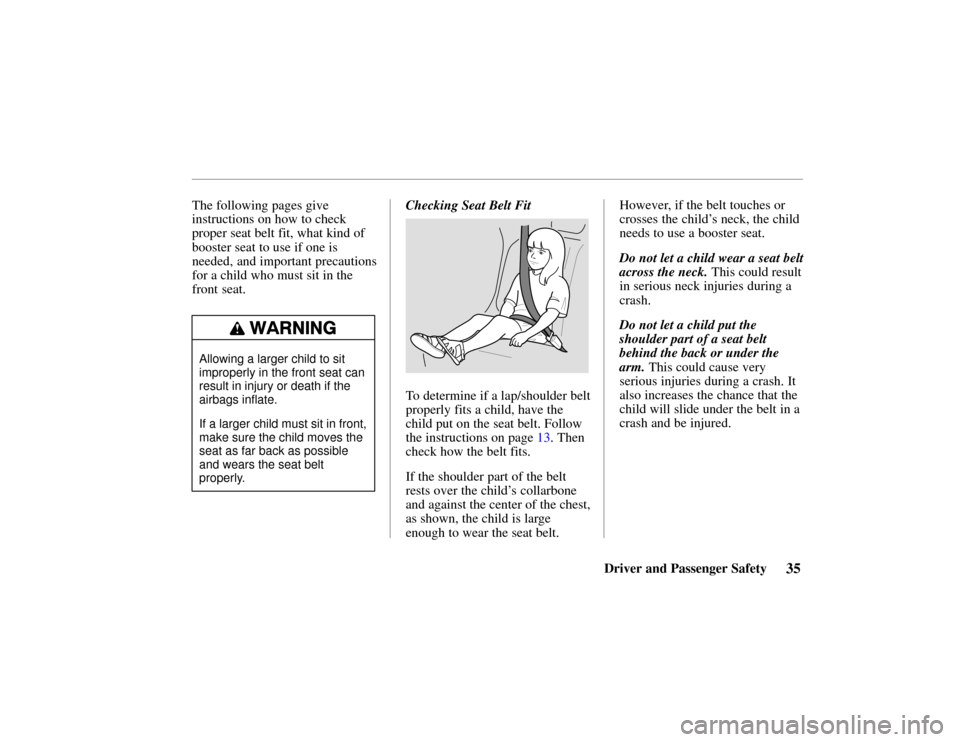
Checking Seat Belt Fit
To determine if a lap/shoulder belt
properly fits a child, have the
child put on the seat belt. Follow
the instructions on page 13. Then
check how the belt fits.
If the shoulder part of the belt
rests over the child’s collarbone
and against the center of the chest,
as shown, the child is large
enough to wear the seat belt. However, if the belt touches or
crosses the child’
s neck, the child
needs to use a booster seat.
Do not let a child wear a seat belt
across the neck. This could result
in serious neck injuries during a
crash.
Do not let a child put the
shoulder part of a seat belt
behind the back or under the
arm. This could cause very
serious injuries during a crash. It
also increases the chance that the
child will slide under the belt in a
crash and be injured.
Page 39 of 294
Driver and Passenger Safety36
Do not put any accessories on a
seat belt. Devices intended to
improve occupant comfort, or
reposition the shoulder part of a
seat belt, severely compromise the
protective capability of the seat
belt and increase the chance of
serious injury in a crash.
Two children should never use
the same seat belt. If they do,
they could be very seriously
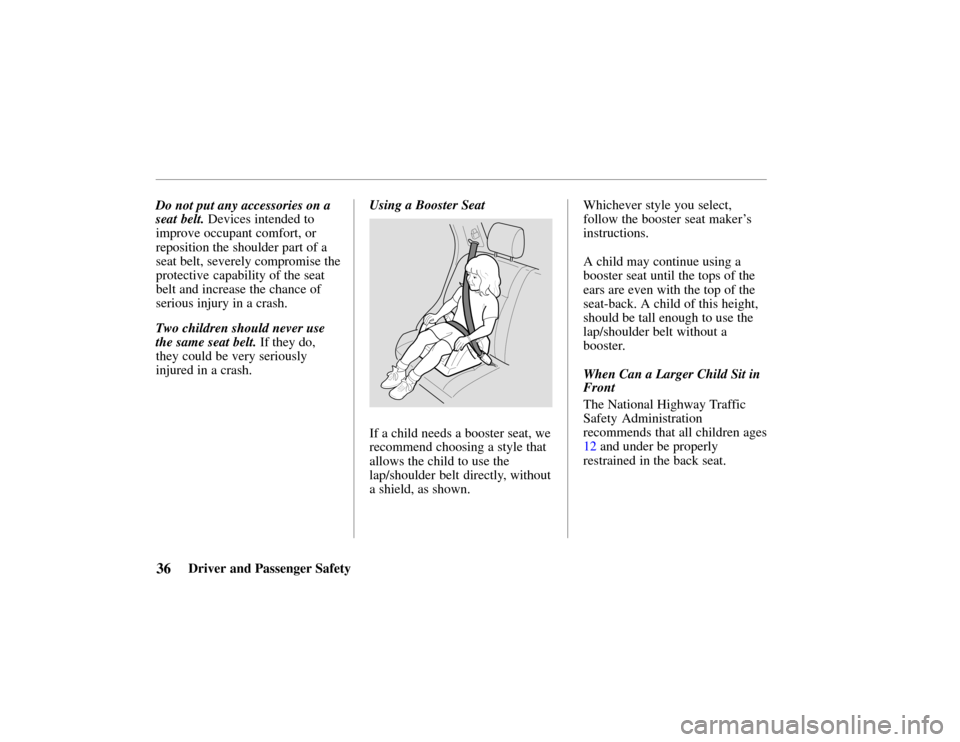
injured in a crash. Using a Booster Seat
If a child needs a booster seat, we
recommend choosing a style that
allows the child to use the
lap/shoulder belt directly, without
a shield, as shown. Whichever style you select,
follow the booster seat maker
’s
instructions.
A child may continue using a
booster seat until the tops of the
ears are even with the top of the
seat-back. A child of this height,
should be tall enough to use the
lap/shoulder belt without a
booster.
When Can a Larger Child Sit in
Front
The National Highway Traffic
Safety Administration
recommends that all children ages
12 and under be properly
restrained in the back seat.
Page 40 of 294

Driver and Passenger Safety 37
The back seat is the safest place
for a child of any age or size.
In addition, the passenger’s airbag
poses serious risks to children. If
the seat is too far forward, or the
child’s head is thrown forward
during a collision, or the child is
unrestrained or out of position, an
inflating airbag can kill or
seriously injure the child.
Of course, children vary widely.
And while age may be one
indicator of when a child can
safely ride in the front, there are
other important factors you should
consider. Physical Size – Physically, a child
must
be large enough for the
lap/shoulder belt to properly fit
over the hips, chest, and shoulder
(see page 13 and 36). If the seat
belt does not fit properly, the child
should not sit in the front.
Maturity – To safely ride in
front, a child must be able to
follow the rules, including sitting
properly, and wearing the seat belt
properly throughout a ride. If you decide that a child can
safely ride up front, be sure to:
•Carefully read the owner
’s
manual, and make sure you
understand all seat belt
instructions and all safety
information.
•Move the vehicle seat to the
rear-most position.
•Have the child sit up straight,
back against the seat, and feet
on or near the floor.
•Check that the child’ s seat belt
is properly positioned and
secured.
•Supervise the child. Even
mature children sometimes
need to be reminded to fasten
their seat belts or sit properly.
Page 42 of 294
Driver and Passenger Safety39
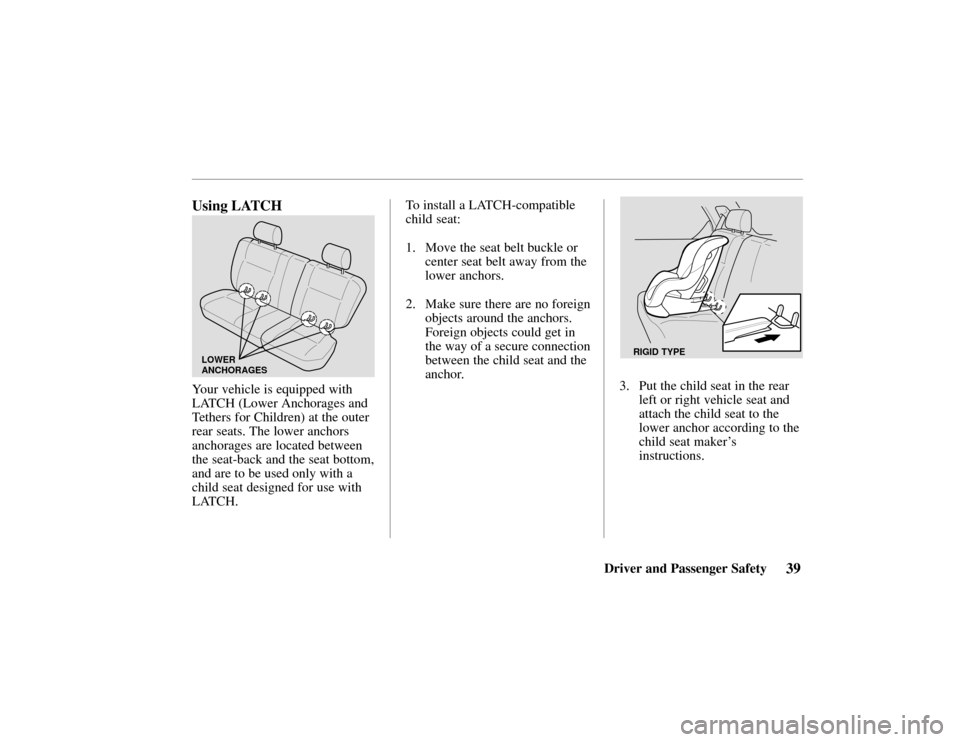
Using LATCH
LOWER
ANCHORAGES
Your vehicle is equipped with
LATCH (Lower Anchorages and
Tethers for Children) at the outer
rear seats. The lower anchors
anchorages are located between
the seat-back and the seat bottom,
and are to be used only with a
child seat designed for use with
LATCH.
To install a LATCH-compatible
child seat:
1. Move the seat belt buckle or
center seat belt away from the
lower anchors.
2. Make sure there are no foreign objects around the anchors.
Foreign objects could get in
the way of a secure connection
between the child seat and the
anchor.
RIGID TYPE
3. Put the child seat in the rear
left or right vehicle seat and
attach the child seat to the
lower anchor according to the
child seat maker ’s
instructions.
Page 44 of 294
41Driver and Passenger Safety
Seat Belt System
Components
Your seat belt system includes
lap/shoulder belts in the front
seats and the outer back seats, and
a lap belt in the center back seat.The system also includes
a light on the instrument
panel to remind you and your
passengers to fasten your belts. If
the driver ’s seat belt is not
fastened before the ignition is
turned
ON (II), the light will come
on and a beeper will also sound.
The beeper will stop after a few
seconds, but the light will stay on
until the driver ’s seat belt is
fastened.
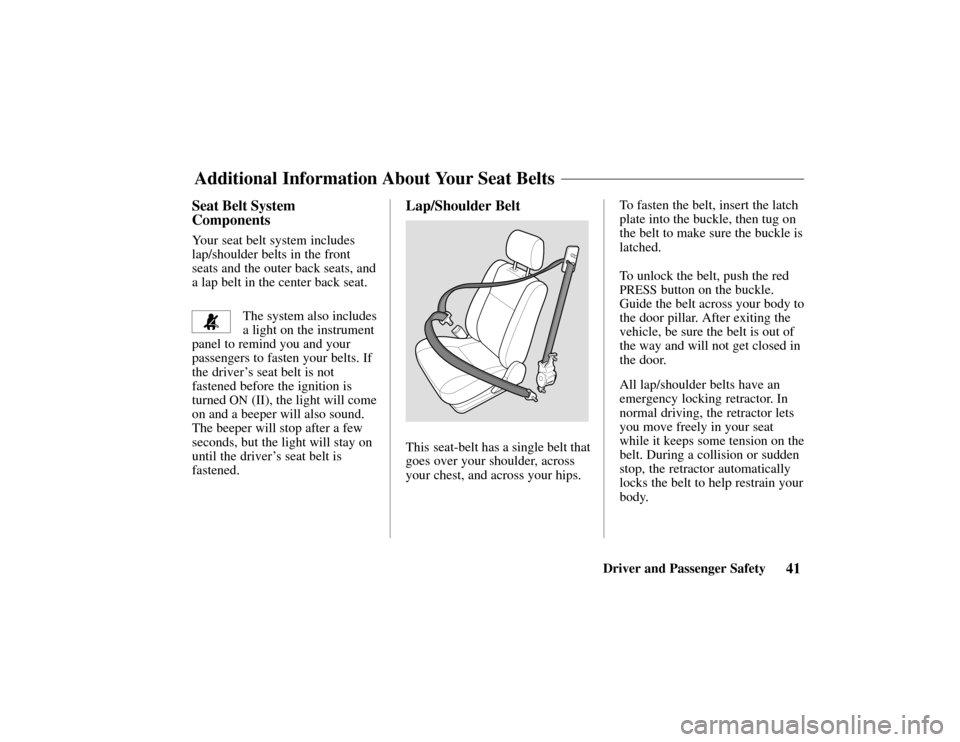
Lap/Shoulder Belt
This seat-belt has a single belt that
goes over your shoulder, across
your chest, and across your hips. To fasten the belt, insert the latch
plate into the buckle, then tug on
the belt to make sure the buckle is
latched.
To unlock the belt, push the red
PRESS button on the buckle.
Guide the belt across your body to
the door pillar. After exiting the
vehicle, be sure the belt is out of
the way and will not get closed in
the door.
All lap/shoulder belts have an
emergency locking retractor. In
normal driving, the retractor lets
you move freely in your seat
while it keeps some tension on the
belt. During a collision or sudden
stop, the retractor automatically
locks the belt to help restrain your
body.
Additional Information About Your Seat Belts
Page 45 of 294
42 Driver and Passenger Safety
All the lap/shoulder belts except
the driver’s have an additional
locking mechanism that must be
activated to secure a child seat.
(See pages 27 and 32 for
instructions on how to secure
child seats with this type of seat
belt.)
If the shoulder part of the belt is
pulled all the way out, the locking
mechanism will activate. The belt
will retract, but it will not allow a
passenger to move freely.
To deactivate the locking
mechanism, unlatch the buckle
and let the seat belt fully retract.
To refasten the belt, pull it out
only as far as needed.
See page 13 for instructions on
how to wear the lap/shoulder belt
properly.
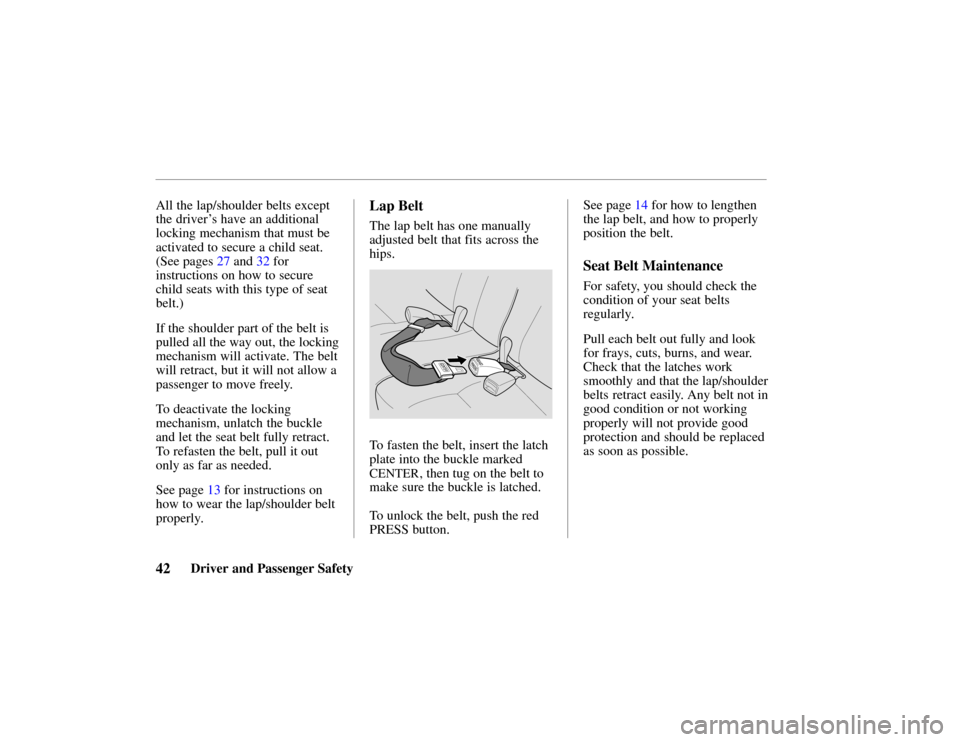
Lap
Belt
The lap belt has one manually
adjusted belt that fits across the
hips.
To fasten the belt, insert the latch
plate into the buckle marked
CENTER, then tug on the belt to
make sure the buckle is latched.
To unlock the belt, push the red
PRESS button. See page 14 for how to lengthen
the lap belt, and how to properly
position the belt.
Seat Belt Maintenance
For safety, you should check the
condition of your seat belts
regularly.
Pull each belt out fully and look
for frays, cuts, burns, and wear.
Check that the latches work
smoothly and that the lap/shoulder
belts retract easily. Any belt not in
good condition or not working
properly will not provide good
protection and should be replaced
as soon as possible.
Page 46 of 294
43Driver and Passenger Safety
Honda provides a lifetime
warranty on seat belts. Honda will
repair or replace any seat belt
component that fails to function
properly during normal use.
Please see your Honda Warranty
Information
booklet for details.
Not checking or maintaining
seat belts can result in serious
injury or death if the seat belts
do not work properly when
needed.
Check your seat belts regularly
and have any problem
corrected as soon as possible.
If a seat belt is worn during a
crash, you should have your
dealer inspect the belt, and replace
it if necessary. A belt that has
been worn during a crash may not
provide the same level of
protection in a subsequent crash.
The dealer should also inspect the
anchors for damage and replace
them if needed.
For information on how to clean
your seat belts, see page 229. The SRS is designed to provide
protection under a wide range of
driving conditions, including
off-road driving. When driving
off-road, it is important that
everyone wear their seat belts
properly, and that you drive at
speeds that are safe for the terrain
and conditions. Refer to the
Off-Road Driving Information
booklet for tips on proper
operation.
SRS Components
Your Supplemental Restraint
System (SRS) includes:
•Two frontal airbags. The
driver ’
s airbag is stored in the
center of the steering wheel;
the front passenger ’s airbag is
stored in the dashboard. Both
are marked “SRS AIRBAG.”
Additional Information
About Your SRS
Page 47 of 294
44 Driver and Passenger Safety
• Sensors that can detect a
moderate to severe frontal
collision.
• A sophisticated electronic
system that continually
monitors the sensors, control
unit, the airbag activators and
all related wiring when the
ignition is ON (II).
• An indicator light on the
instrument panel to alert you to
a possible problem with the
system (see page 45).
•Emergency backup power in
case your vehicle’ s electrical
system is disconnected in a
crash.
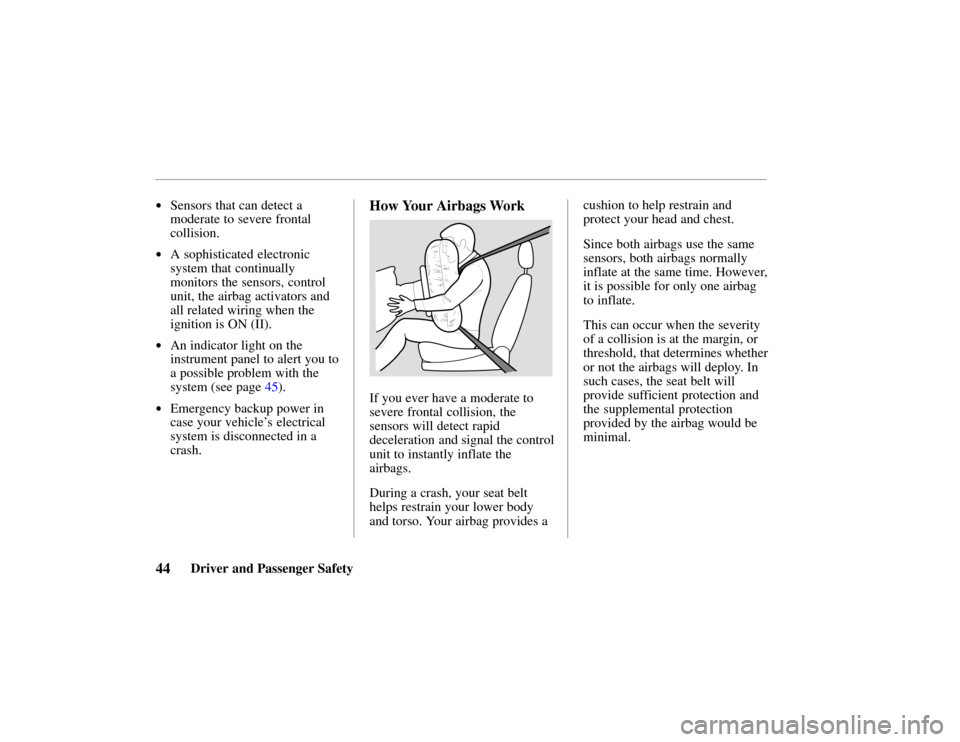
How Your Airbags Work
If you ever have a moderate to
severe frontal collision, the
sensors will detect rapid
deceleration and signal the control
unit to instantly inflate the
airbags.
During a crash, your seat belt
helps restrain your lower body
and torso. Your airbag provides a cushion to help restrain and
protect your head and chest.
Since both airbags use the same
sensors, both airbags normally
inflate at the same time. However,
it is possible for only one airbag
to inflate.
This can occur when the severity
of a collision is at the margin, or
threshold, that determines whether
or not the airbags will deploy. In
such cases, the seat belt will
provide sufficient protection and
the supplemental protection
provided by the airbag would be
minimal.
Page 49 of 294

46 Driver and Passenger Safety
• If the light stays on after the
engine starts.
• If the light comes on or flashes
on and off while you drive.
If you see any of these
indications, your airbags may not
deploy when you need them. See
your Honda dealer as soon as
possible.
Ignoring the SRS indicator light
can result in serious injury or
death if the airbags do not
inflate when needed.
Have your vehicle checked by a
dealer as soon as possible if
the SRS light alerts you to a
potential problem.
SRS Service
Your Supplemental Restraint
System is virtually maintenance-
free, and there are no parts you
can safely service. However, you
must have your vehicle serviced
if:
• Your airbags ever inflate. The
airbags and control unit must
be replaced. Do not try to
remove or replace the airbags
yourself. This must be done by
a Honda dealer or a
knowledgeable body shop.
• The SRS indicator light alerts
you to a problem. Take your
vehicle to an authorized Honda
dealer as soon as possible. If
you ignore this indication, the
airbags might not inflate when
you need them.
Additional Safety
Precautions
• Do not attempt to deactivate
your airbags. Together, airbags
and seat belts provide the best
protection in a moderate to
severe frontal collision.
• Do not tamper with SRS
components or wiring for any
reason. Tampering could cause
the airbags to deploy, possibly
causing very serious injury.
See page 174 for further
information and precautions
relating to your SRS.
Page 53 of 294
B – SEAT BELT
A – SEAT ADJUSTMENT
(LX and EX shown)
C – TILT STEERING WHEEL
50 Off
to a Good Start
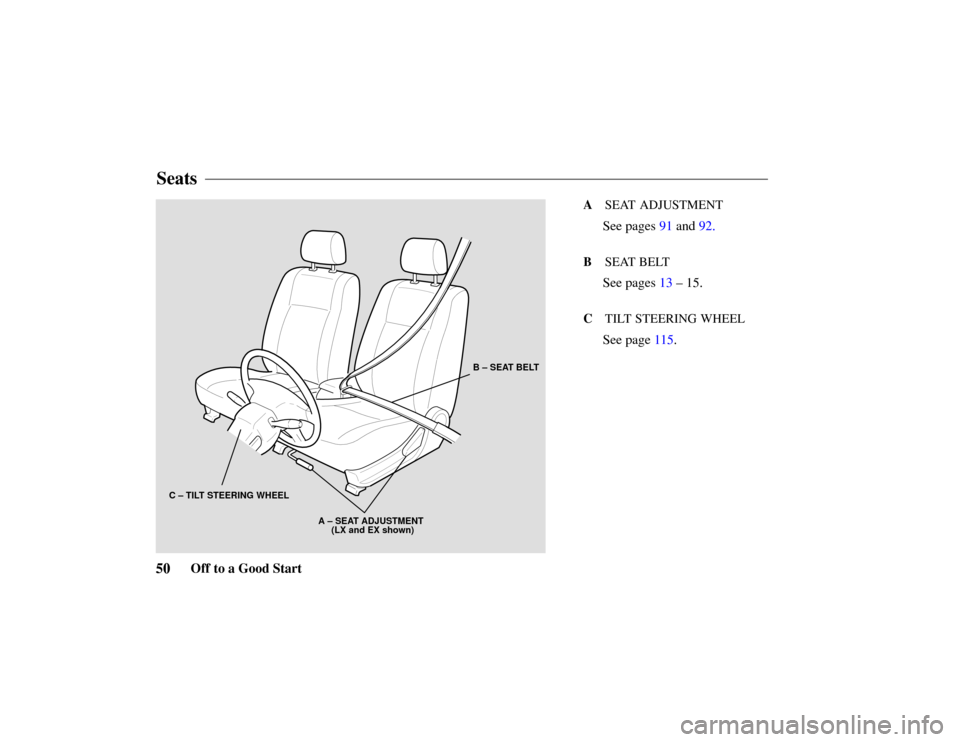
A SEAT ADJUSTMENT
See pages 91 and 92.
B SEAT BELT
See pages 13 – 15.
CTILT STEERING WHEEL
See page 115.
Seats