belt HONDA PASSPORT 2002 2.G Service Manual
[x] Cancel search | Manufacturer: HONDA, Model Year: 2002, Model line: PASSPORT, Model: HONDA PASSPORT 2002 2.GPages: 294, PDF Size: 3.97 MB
Page 60 of 294
57Instruments and Controls
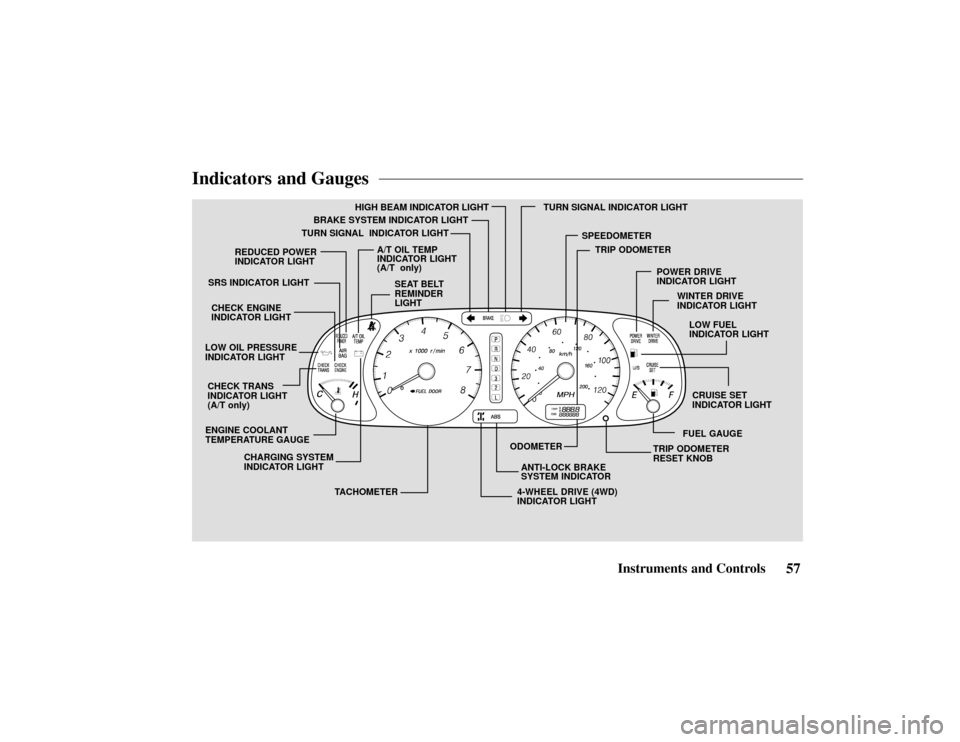
Indicators and Gauges
ENGINE COOLANT
TEMPERATURE GAUGEANTI-LOCK BRAKE
SYSTEM INDICATOR
A/T OIL TEMP
INDICATOR LIGHT
(A/T only)
CHECK TRANS
INDICATOR LIGHT
(A/T only) SRS INDICATOR LIGHT
CHECK ENGINE
INDICATOR LIGHT
TACHOMETER
TURN SIGNAL INDICATOR LIGHT
4-WHEEL DRIVE (4WD)
INDICATOR LIGHT
HIGH BEAM INDICATOR LIGHT
SPEEDOMETER
ODOMETER TRIP ODOMETER
RESET KNOB
CHARGING SYSTEM
INDICATOR LIGHT BRAKE SYSTEM INDICATOR LIGHT
LOW OIL PRESSURE
INDICATOR LIGHT TURN SIGNAL INDICATOR LIGHT
FUEL GAUGE
SEAT BELT
REMINDER
LIGHT
CRUISE SET
INDICATOR LIGHT
WINTER DRIVE
INDICATOR LIGHT
POWER DRIVE
INDICATOR LIGHT
TRIP ODOMETER
LOW FUEL
INDICATOR LIGHT
REDUCED POWER
INDICATOR LIGHT
Page 64 of 294
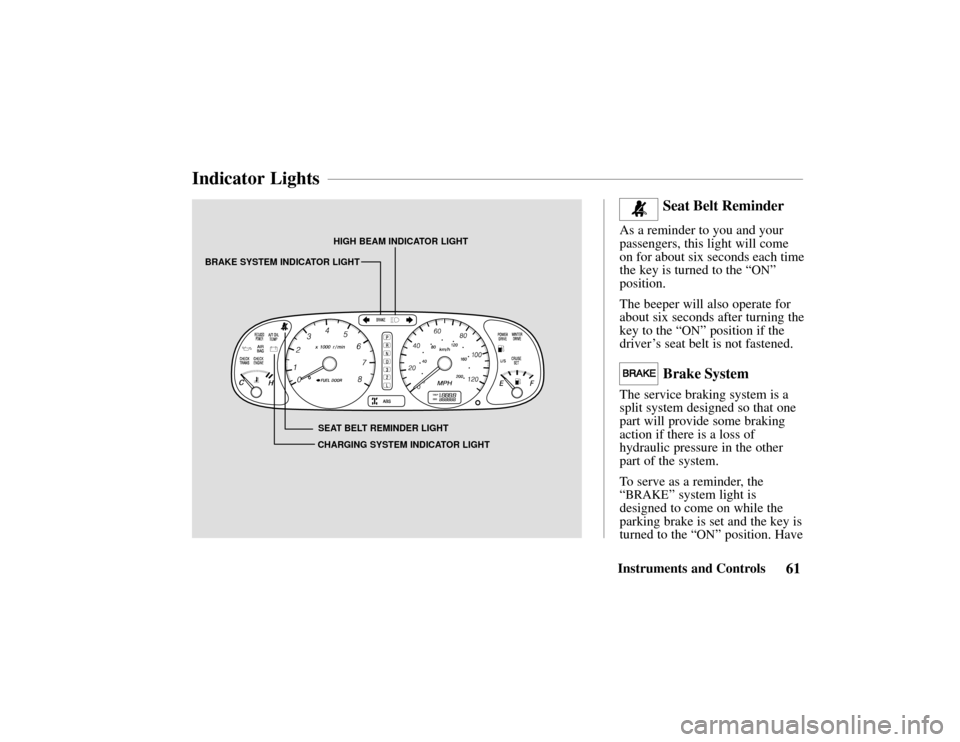
HIGH BEAM INDICATOR LIGHT
SEAT BELT REMINDER LIGHT
BRAKE SYSTEM INDICATOR LIGHT
CHARGING SYSTEM INDICATOR LIGHT
61Instruments and Controls
Seat Belt Reminder
As a reminder to you and your
passengers, this light will come
on for about six seconds each time
the key is turned to the “
ON”
position.
The beeper will also operate for
about six seconds after turning the
key to the “
ON” position if the
driver ’ s seat belt is not fastened.
Brake System
The service braking system is a
split system designed so that one
part will provide some braking
action if there is a loss of
hydraulic pressure in the other
part of the system.
To serve as a reminder, the
“
BRAKE” system light is
designed to come on while the
parking brake is set and the key is
turned to the “
ON” position. Have
Indicator Lights
Page 65 of 294

62Instruments and Controls
the system repaired if the light
does not come on when the key is
turned to the “
ON” position
without the engine running or
when the parking brake is set.
This light does not eliminate the
need for brake inspection and
maintenance. The brake fluid
level must be checked regularly.
See the maintenance section of
this manual for other brake
checks.
If the light remains on after
engine start up with the parking
brake released, or comes on
during operation of the vehicle, it
may mean that there is something
wrong with the brake system.
What to do?
1. Check to see if the parking brake has been fully released. 2. If it has, pull off the road and
stop carefully. Remember that:
•Stopping distances may be
longer.
•You may have to push
harder on the pedal.
•The pedal may go down
farther than normal.
3. Have the vehicle towed to the nearest Honda dealer for
repair.
Do not continue to drive with the
brake system light on. There may
be a serious problem with the
braking system. Driving under
this condition is hazardous and
could lead to an accident.
The brake system light does not
indicate that the parking brake is
fully set. When applying the
parking brake, always pull it up as
far as possible.
High Beam
The headlight high beam indicator
lights up when the headlights are
on high beam.
Charging System
This light should come on when
the key is turned to the “
ON”
position and the alternator is not
charging. The light may stay on at
engine idle; however, it should go
off and stay off above the normal
engine idle speed. If the light
comes on while driving, the
charging system should be
checked at once so the battery will
not completely discharge. Stop the
engine, and check for a broken
drive belt. If it is broken, or if the
drive belt is not responsible for
the trouble, have your Honda
dealer inspect and correct the
fault. If the drive belt is broken,
Page 93 of 294
90Seats
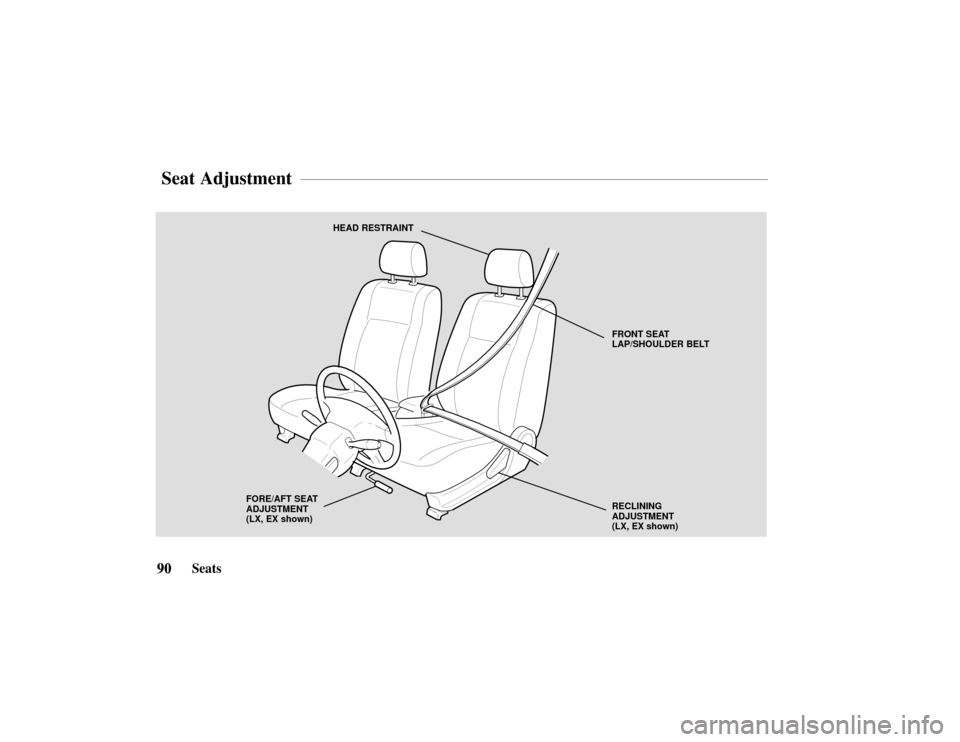
FRONT SEAT
LAP/SHOULDER BELT
RECLINING
ADJUSTMENT
(LX, EX shown)
FORE/AFT SEAT
ADJUSTMENT
(LX, EX shown)
HEAD RESTRAINT
Seat Adjustment
Page 95 of 294
92 Seats
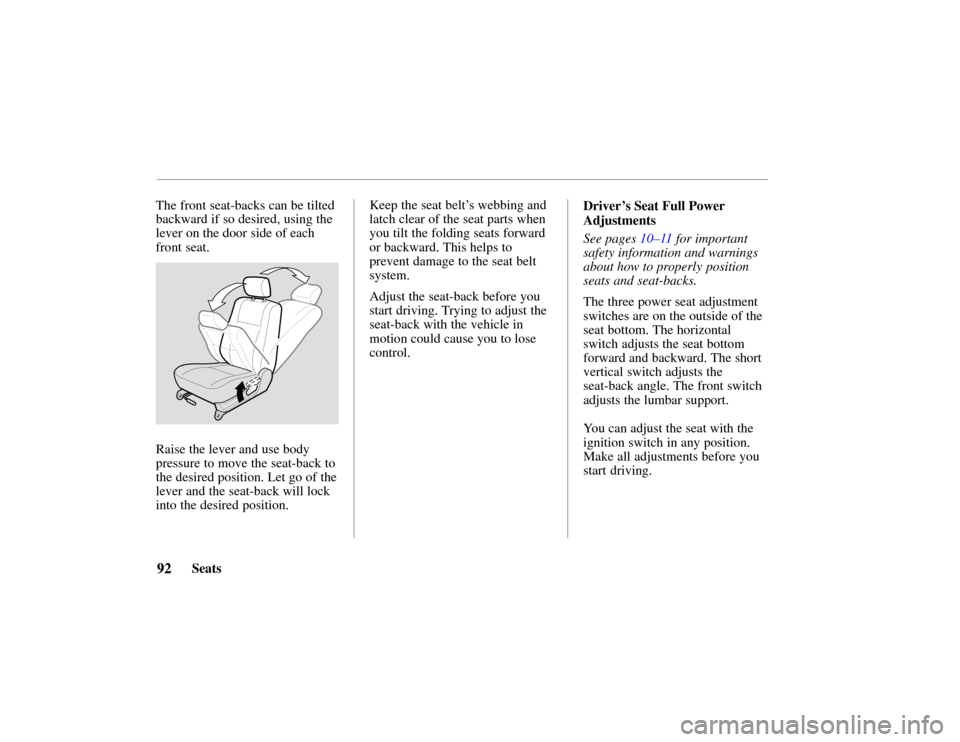
The front seat-backs can be tilted
backward if so desired, using the
lever on the door side of each
front seat.
Raise the lever and use body
pressure to move the seat-back to
the desired position. Let go of the
lever and the seat-back will lock
into the desired position.
Keep the seat belt
’s webbing and
latch clear of the seat parts when
you tilt the folding seats forward
or backward. This helps to
prevent damage to the seat belt
system.
Adjust the seat-back before you
start driving. Trying to adjust the
seat-back with the vehicle in
motion could cause you to lose
control. Driver’s Seat Full Power
Adjustments
See pages 10–11 for important
safety information and warnings
about how to properly position
seats and seat-backs.
The three power seat adjustment
switches are on the outside of the
seat bottom. The horizontal
switch adjusts the seat bottom
forward and backward. The short
vertical switch adjusts the
seat-back angle. The front switch
adjusts the lumbar support.
You can adjust the seat with the
ignition switch in any position.
Make all adjustments before you
start driving.
Page 99 of 294
96Seats
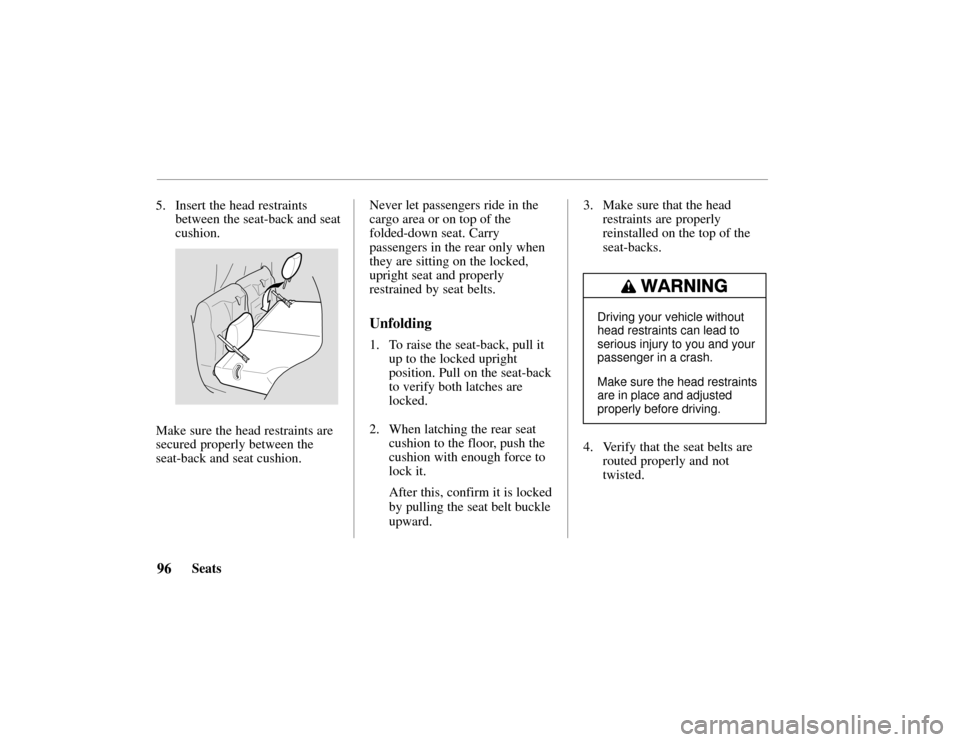
5. Insert the head restraints
between the seat-back and seat
cushion.
Make sure the head restraints are
secured properly between the
seat-back and seat cushion. Never let passengers ride in the
cargo area or on top of the
folded-down seat. Carry
passengers in the rear only when
they are sitting on the locked,
upright seat and properly
restrained by seat belts.
Unfolding
1. To raise the seat-back, pull it
up to the locked upright
position. Pull on the seat-back
to verify both latches are
locked.
2. When latching the rear seat cushion to the floor, push the
cushion with enough force to
lock it.
After this, confirm it is locked
by pulling the seat belt buckle
upward. 3. Make sure that the head
restraints are properly
reinstalled on the top of the
seat-backs.
Driving your vehicle without
head restraints can lead to
serious injury to you and your
passenger in a crash.
Make sure the head restraints
are in place and adjusted
properly before driving.
4. Verify that the seat belts arerouted properly and not
twisted.
Page 117 of 294
11 4Interior Features
Be careful when you are using the
beverage holder. A spilled liquid
that is very hot can scald you or
your passengers. Spilled liquids
can also damage the upholstery,
carpeting, and electrical
components in the interior.
Sun Visor
The sun visor can be pivoted to
the side when unhooked.
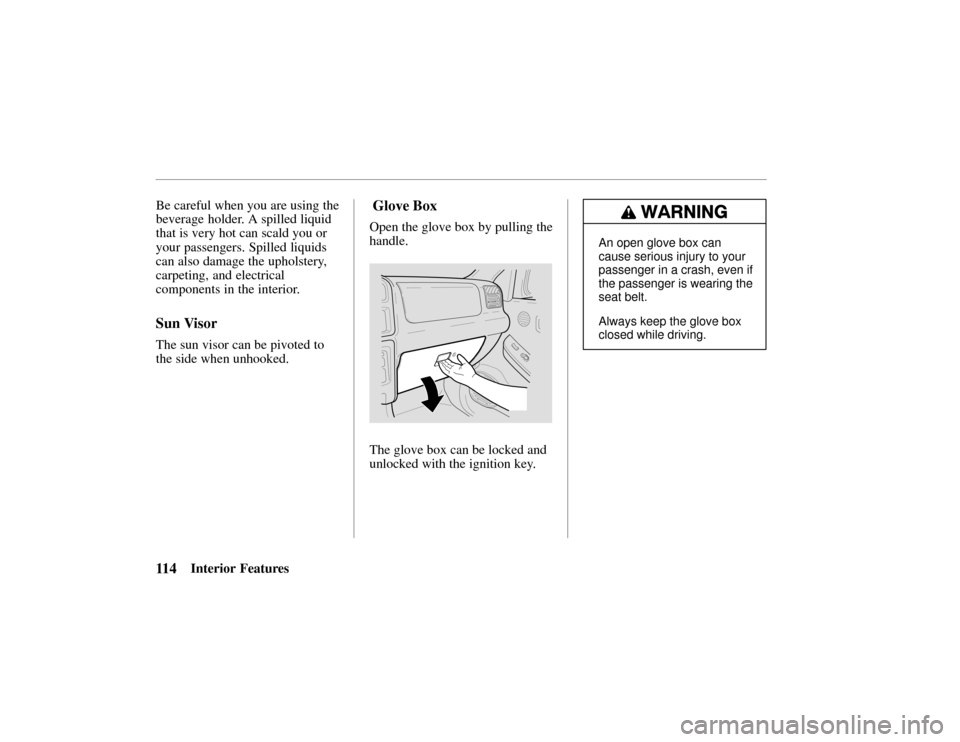
Glove Box
Open the glove box by pulling the
handle.
The glove box can be locked and
unlocked with the ignition key.
An open glove box can
cause serious injury to your
passenger in a crash, even if
the passenger is wearing the
seat belt.
Always keep the glove box
closed while driving.
Page 199 of 294
196Care and Maintenance
Front (4
WD Only) and
Rear Propeller Shaft 222
. . .
Exhaust System 222
. . . . . . .
Fuel Line and Fuel
Tank/Cap 222
. . . . . . . . . . . .
Drive Belt 222
. . . . . . . . . . . .
Timing Belt 222
. . . . . . . . . . .
Valve Clearance 222
. . . . . . . .
Spark Plugs 223
. . . . . . . . . . .
Clutch 223
. . . . . . . . . . . . . . .
Fluid or Lubricant Levels 223
Power Steering 223
. . . . . . . .
Wheel Alignment 224
. . . . . .
Exterior 224 . . . . . . . . . . . . . . . .
Washing Your Vehicle 224
. .
Polishing and Waxing
Your Vehicle 224
. . . . . . . . .
Protection of Exterior
Bright Metal Parts 224
. . . .
Care of Aluminum Wheels 224Foreign Material Deposits
224
Finish Damage 225
. . . . . . . .
Corrosion Protection 225
. . . .
Sheet Metal Damage 225
. . . .
Underbody Maintenance 225
Interior 226 . . . . . . . . . . . . . . . .
Basic Steps
Before Cleaning 226
. . . . . .
Cleaning Fabric 227
. . . . . . . .
Cleaning General Soilage
or Water Spots From
Fabric Trim 227
. . . . . . . .
Spot Cleaning Fabric
With Solvent Cleaner 227
Removal of
Specific Stains 228
. . . . . .
Cleaning Vinyl
or Leather Trim 229
. . . . . . .
Seat Belt Care 229
. . . . . . . . .
Cleaning Glass Surfaces 230
.
Page 207 of 294
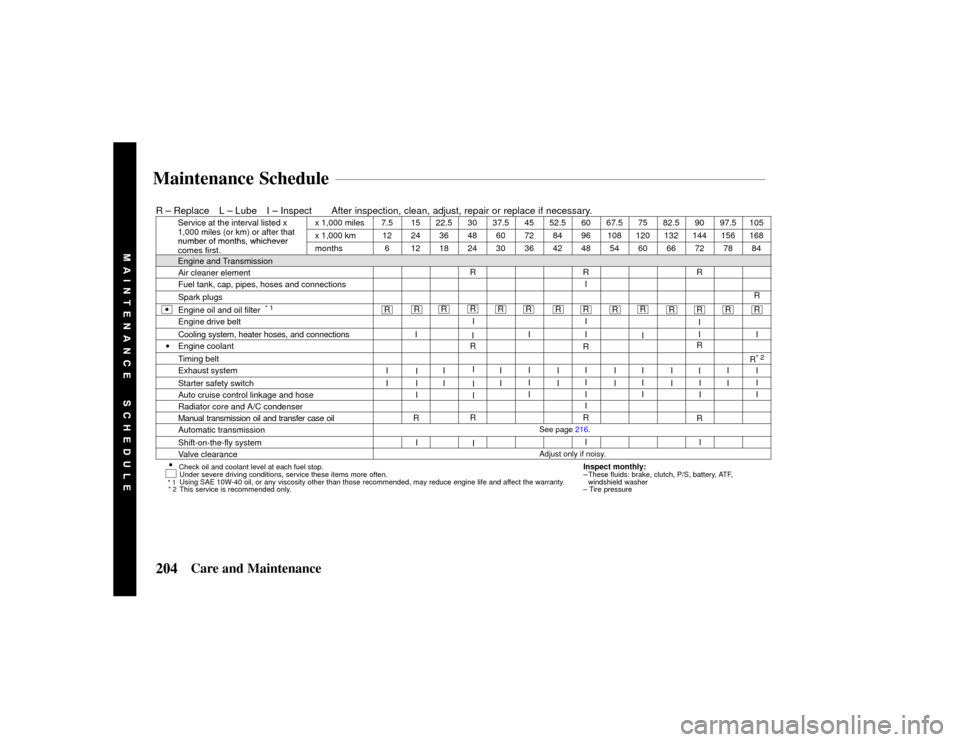
•
* 1
* 2Under severe driving conditions, service these items more often. –These fluids: brake, clutch, P/S, battery, ATF,
Using SAE 10W-40 oil, or any viscosity other than those recommended, may reduce engin\
e life and affect the warranty. windshield washer
This service is recommended only. – Tire pressure
204 Care and Maintenance
R – Replace L – Lube I – Inspect After inspection, clean, adjust, repair or replace if necessary.Service at the interval listed x1 000 il ( k ) ft th tx 1,000 miles7.51522.53037.54552.56067.57582.59097.5105Service at the interval listed x1,000 miles (or km) or after thatnumber of months whicheverx 1,000 km1224364860728496108120132144156168number of months, whichever
comes first.months612182430364248546066727884
Engine and TransmissionAir cleaner elementRRR
Fuel tank, cap, pipes, hoses and connectionsI
Spark plugsR
•Engine oil and oil filter * 1RRRRRRRRRRRRRREngine drive beltIII
Cooling system, heater hoses, and connectionsIIIIIII•Engine coolantRRR
Timing beltR*
2
Exhaust systemIIIIIIIIIIIIII
Starter safety switchIIIIIIIIIIIIII
Auto cruise control linkage and hoseIIIIIII
Radiator core and A/C condenserI
Manual transmission oil and transfer case oilRRRRAutomatic transmissionSee page 216.
Shift-on-the-fly systemIIIIValve clearanceAdjust only if noisy.
Check oil and coolant level at each fuel stop.Inspect monthly:
Maintenance Schedule
Page 212 of 294

209Care and Maintenance
Sit in the driver
’s seat and
perform these checks:
1. With the engine stopped,
depress the brake pedal several
times; the travel distance and
effective pedal stroke should
remain unchanged.
2. Start the engine with the brake pedal fully depressed.
The brake pedal should go down
a little as the engine starts.
3. Depress the brake pedal, stop the engine and hold the pedal
depressed for about 30
seconds; the brake pedal
should remain in position
without rising or going down.
4. Restart the engine and run it for about a minute, then turn it
off and depress the brake
pedal firmly several times; the
brake pedal travel should decrease each time the brake
pedal is depressed.
If the brakes do not operate
normally, have them checked and
corrected by your Honda dealer.
Exhaust system — Be alert to any
changes in the sound of the exhaust
system or any smell of fumes.
These are signs the system may be
leaking or overheating. Have the
system checked and/or repaired at
once if these conditions exist. (Also
see “Carbon Monoxide Hazard” in
the “Driver and Passenger Safety ”
section and “ Three-Way Catalytic
Converter ” in the “Driving Tips ”
section.)
Windshield wipers and
washers —
Check the operation
and condition of the wiper blades.
Check the flow and aim of the
washer spray.
Defrosters — Check performance
by moving the controls to the
defrost setting and noting the
amount of air directed against the
windshield.
Rear view mirrors and sun
visors —
Check that the friction
joints hold the mirrors and sun
visors firmly in place.
Horn — Blow the horn now and
then to be sure it works.
Lap and shoulder belts — Check
the belt system, including
webbing, buckles, latch plates,
retractors, guide loops and
anchors for proper operation and
damage.
Seat adjusters — When adjusting
a seat, be sure the seat adjusters
latch securely by pushing the seat
forward and backward.