wheel HONDA PASSPORT 2002 2.G Repair Manual
[x] Cancel search | Manufacturer: HONDA, Model Year: 2002, Model line: PASSPORT, Model: HONDA PASSPORT 2002 2.GPages: 294, PDF Size: 3.97 MB
Page 278 of 294
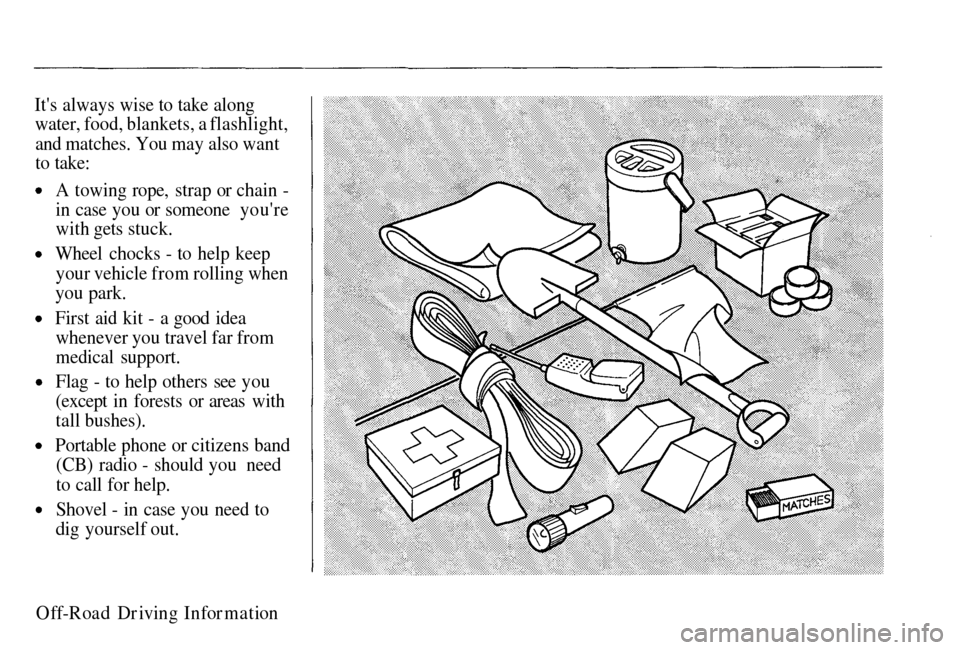
It's always wise to take along
water,
food, blankets, a flashlight,
and
matches. You may also want
to take:
A towin
g rope, strap or chain -
in case you or someone you're
with
gets stuck.
Wheel chocks - to help keep your vehicle from rolling when
you
park.
First aid kit - a good idea whenever you travel far from
medical
support.
Flag - to help others see you
(except
in forests or areas with
tall bushes).
Portable phone or citizens band (CB
) radio - should you need
to
call for help.
Shovel
- in case you need to
dig yourself out. Off-Road Driving Information
Page 281 of 294
Test your brakes from time to
time
to make sure they are
operating properly. This will also
give you a feel for how much
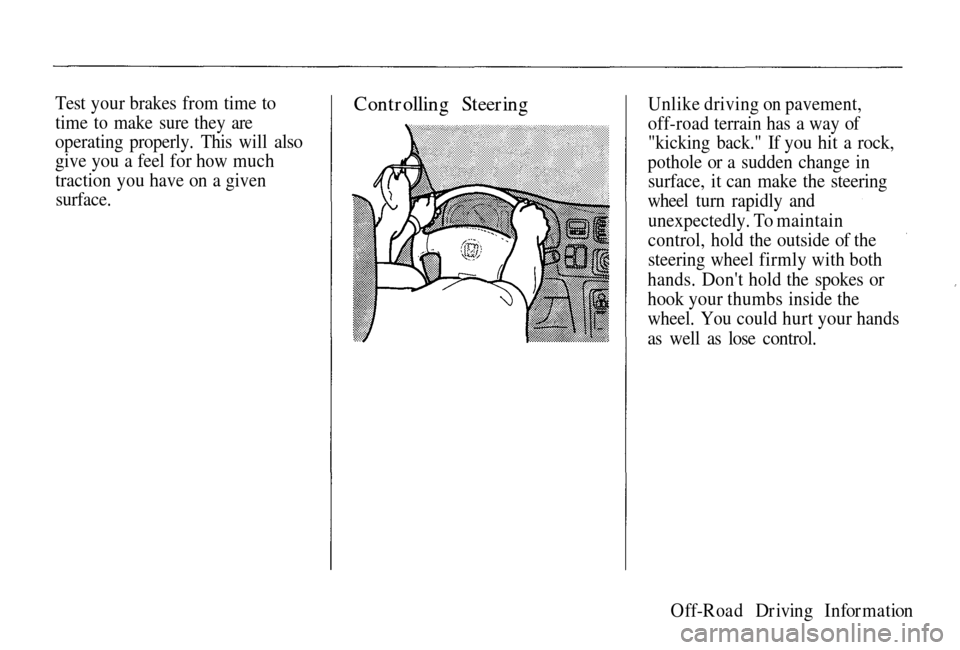
traction you have on a given surface. Controllin
g Steering
Unlike driving on pavement,
off-road
terrain has a way of
"kicking back." If you hit a rock,
pothole
or a sudden change in
surface
, it can make the steering
wheel
turn rapidly and
unexpectedly. To maintain
control, hold the outside of the
steering wheel firmly with both
hands.
Don't hold the spokes or
hook your thumbs inside the wheel.
You could hurt your hands
as well as lose control. Off-Road Driving Information
Page 285 of 294
If you don't know the answers to
these questions before beginning
an ascent, stop, walk up the hill
and find out.
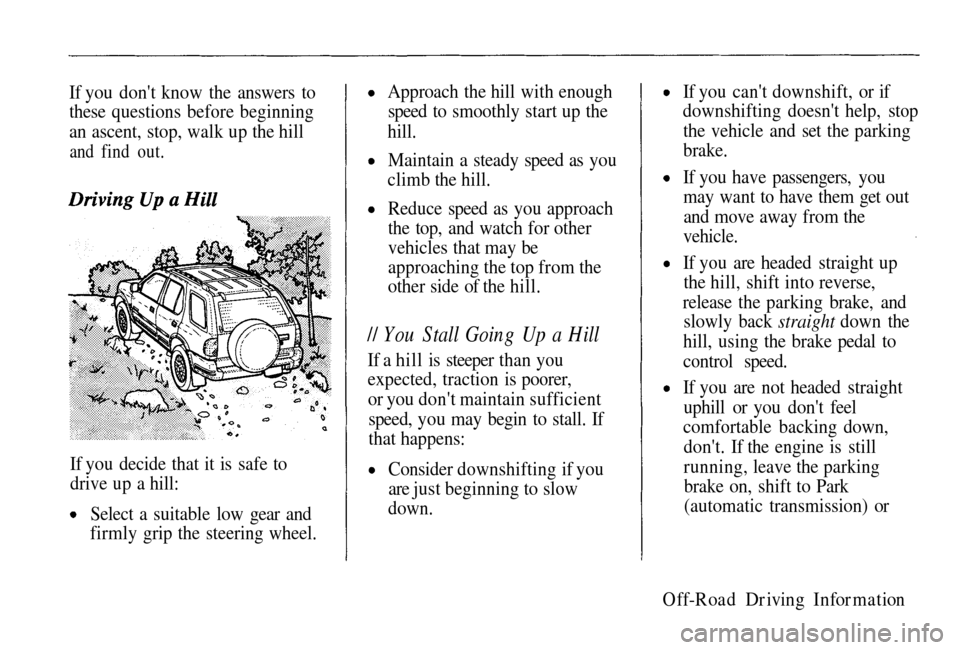
If you decide that it is safe to drive up a hill:
Selec
t a suitable low gear and
firmly grip the steering wheel. Approach
the hill with enough
speed to smoothly start up the
hill.
Maintain a steady speed as you
climb the hill.
Reduce
speed as you approach
the
top, and watch for other
vehicle
s that may be
approaching
the top from the
other
side of the hill.
// You Stall Going Up a Hill
If a hill is steeper than you
expected,
traction is poorer,
or you don't maintain sufficient speed,
you may begin to stall. If
that happens:
Consider downshifting if you
are just beginning to slow
down. If you can't downshift, or if
downshifting
doesn't help, stop
the vehicle and set the parking
brake.
I
f you have passengers, you
may want to have them get out
and
move away from the
vehicle.
I
f you are headed
straight up
the hill, shif
t into reverse,
release the parking brake, and slowly back straight down the
hill,
using the brake pedal to
control
speed.
If you
are not headed straight
uphill or you don't feel
comfortable backing down,
don't. If the engine is still
running,
leave the parking
brake
on, shift to Park
(automatic transmission) or Off-Road Driving Information
Page 286 of 294
First (manual transmission),
then
turn the engine off. See
that any passengers carefully
get
out and clear of the vehicle,
then go get help.
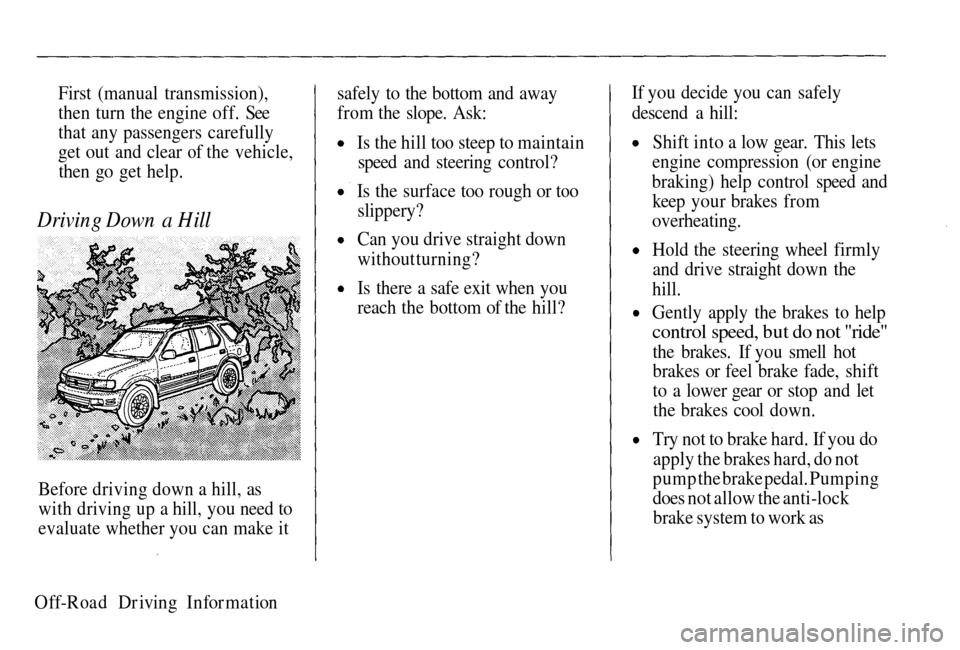
Before
driving down a hill, as
wit
h driving up a hill, you need to
evaluate whether you can
make it safely to the bottom and away
from the slope. Ask:
Is the hill too steep to maintainspeed
and steering control?
Is the surface too rough or too slippery?
Ca
n you drive straight down
withou
t turning?
Is there a safe exit when you
reach
the bottom of the hill? If you decide you can safely
descend a hill:
Shift
into a low gear. This lets
engine compression (or engine
braking) help control speed and keep your brakes from
overheating.
Hol
d the steering wheel firmly
and
drive straight down the
hill.
Gentl
y apply the brakes to help
control speed, but do not "ride"
the brakes. If you smell hotbrakes
or feel brake fade, shift
to a lower gear or stop and let the
brakes cool down.
Try not to brake hard. If you do apply
the brakes hard, do not
pump
the brake pedal. Pumping
does
not allow the anti-lock
brake system to work as
Driving
Down a Hill
Off-Road Driving Information
Page 287 of 294
efficiently, which may increase
your stopping distance.
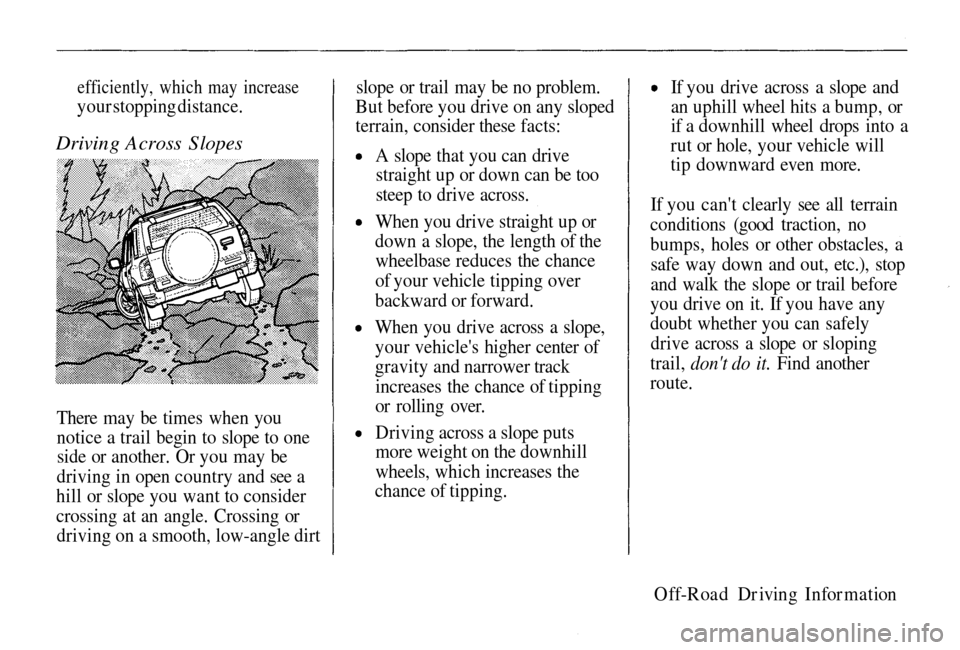
Driving Across Slopes
There may be times when you
notice
a trail begin to slope to one
side
or another. Or you may be
driving in open country and see a
hill or slope you want to consider
crossing
at an angle. Crossing or
driving
on a smooth, low-angle dirt slope or trail may be no problem.
But
before you drive on any sloped
terrain,
consider these facts:
A slope that you can drive straight
up or down can be too
steep to drive across.
When you drive straight up or
down
a slope, the length of the
wheelbase
reduces the chance
of your vehicle tipping over
backward
or forward.
When you drive across a slope,
your
vehicle's higher center of
gravity and narrower track
increases
the chance of tipping
or rolling over.
Driving
across a slope puts
more weight on the downhill
wheels,
which increases the
chance of tipping. If you drive across a slope and
an uphill wheel hits a bump, or
if a downhill wheel drops into a
rut or hole, your vehicle will
tip downward even more.
If
you can't clearly see all terrain
conditions
(good traction, no
bumps, holes or other obstacles, a safe way down and out, etc.), stop
and walk the slope or trail before
you drive on it. If you have any
doubt
whether you can safely
drive across a slope or sloping
trail, don't do it. Find another
route. Off-Road Driving Information
Page 289 of 294
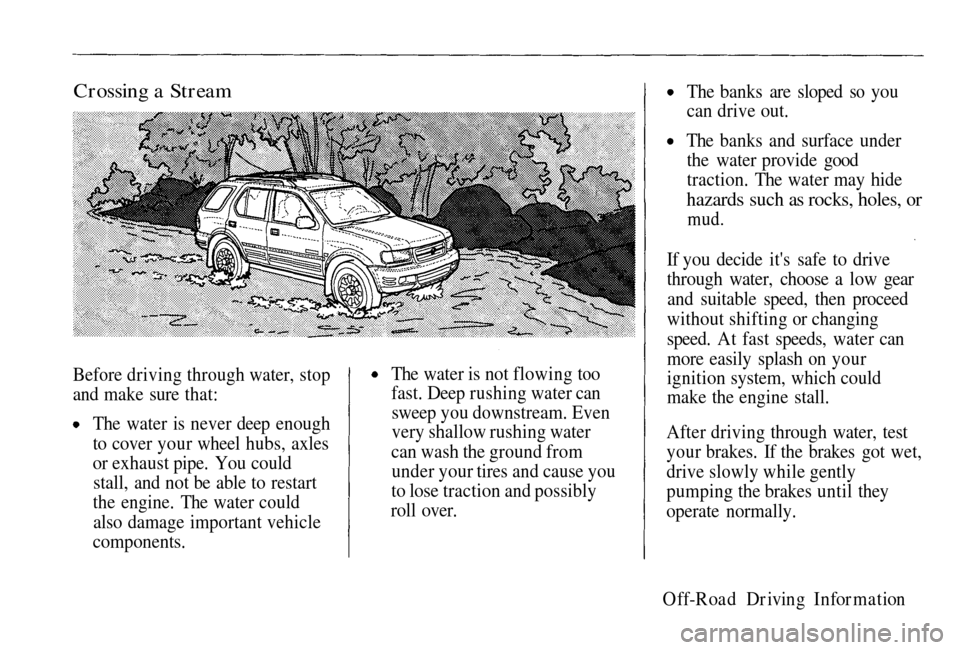
Crossing a Stream
Before driving through water, stop
and
make sure that:
The water is never deep enough
to cover your wheel hubs, axles
or exhaust pipe. You could stall
, and not be able to restart
the engine. The water could
also
damage important vehicle
components. The water is not flowing too
fast. Deep rushing water can
sweep
you downstream. Even
very
shallow rushing water
can wash the ground from under
your tires and cause you
to lose traction and possibly
roll
over. The banks are sloped so you
can
drive out.
The
banks and surface under
the water provide good
traction.
The water may hide
hazards such as rocks, holes, or
mud.
If you decide it's safe to drive
through
water, choose a low gear
and suitable speed, then proceed
without shifting or changing
speed. At fast speeds, water can
more easily splash on your
ignition system, which could
make the engine stall.
After driving through water, test
your brakes. If the brakes got wet,
drive
slowly while gently
pumping
the brakes until they
operate
normally. Off-Road Driving Information
Page 291 of 294
If you Get Stuck
If you ever get stuck off-road, stop,
assess the situation, consider
all
your options, then choose a
safe and appropriate course of
action.
Alway
s put your safety and your
passengers' safety first. There may be times when quick action is
necessary,
but it's generally best if
you do not over-react. Trying to
muscle
your way out by
continuing
to spin the wheels
rarely helps, and it can make it
even
harder to get out. Other
things you should not do
are:
Do not use a jack. A jack only
works
on firm, level terrain.
Also, your vehicle could easily slip off the jack and hurt you or
someone
else.
Do not "rock" the vehicle
forward
and backward by
shifting back and forth between
First
and Reverse. This can
damage your transmission.
Following are a few tips on how
you
might deal with three
different
situations. Stuck in Mud or Loose
Terrain
Here are some options for you to
consider if you get stuck in softsand,
loose soil or gravel, or deep
mud:
Shift into 4-wheel drive if you
have 4-wheel drive and aren't
already in it. If you aren't in
too
deep, this may be all you
need
to get going.
Letting some air out of the tires may help you get better
traction.
Yo
u may want to use a shovel
to dig out some soil around the
tires.
If you do, keep a safe
distance from the vehicle in
case
it moves. Off-Road Driving Information
Page 293 of 294
Parking
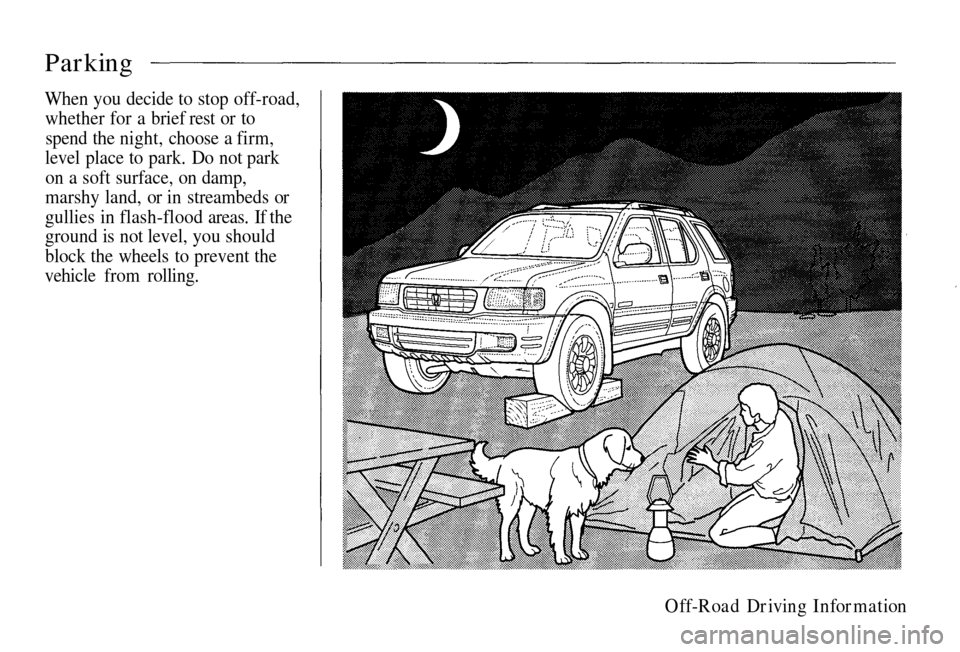
When you decide to stop off-road,
whether for a brief rest or to
spend the night, choose a firm,
level
place to park. Do not park
on a soft surface, on damp,
marshy
land, or in streambeds or
gullies in flash-flood areas. If the
ground
is not level, you should
block the wheels to prevent the
vehicle
from rolling. Off-Road Driving Information
Page 294 of 294
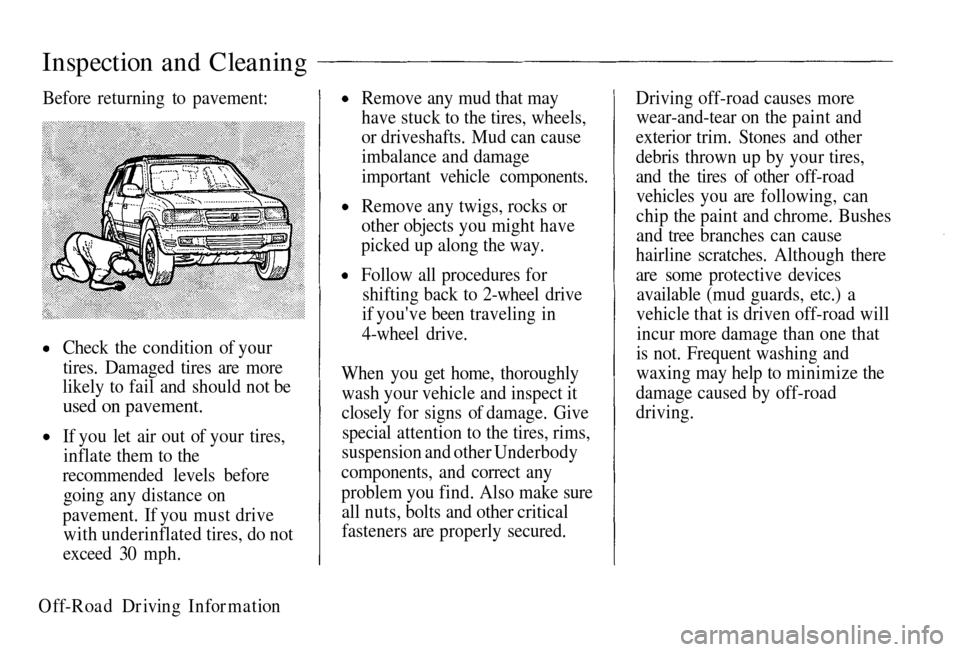
Inspection and Cleaning
Check the condition of your
tires. Damaged tires are more
likely to fail and should not be
used on pavement.
If you let air out of your tires,inflate them to the
recommended
levels before
going
any distance on
pavement.
If you must drive
wit
h underinflated tires, do not
exceed
30 mph. Remove
any mud that may
have
stuck to the tires, wheels,
or driveshafts. Mud can cause
imbalance
and damage
important vehicle components.
Remove any twigs, rocks or
other objects you might have
picked up along the way.
Follow
all procedures for
shifting back to 2-wheel drive
if you've been traveling in
4-wheel
drive.
When you get home, thoroughly wash your vehicle and inspect it
closely
for signs of damage. Give
special attention to the tires, rims,
suspension and other Underbody
components, and correct any
problem you find. Also make sure all
nuts, bolts and other critical
fasteners
are properly secured. Driving off-road causes more
wear-and-tear
on the paint and
exterior trim. Stones and other debris
thrown up by your tires,
and
the tires of other off-road
vehicles you are following, can
chip
the paint and chrome. Bushes
and tree branches can cause
hairline
scratches. Although there
are some protective devices available
(mud guards, etc.) a
vehicle that is driven off-road will
incur
more damage than one that
is not. Frequent washing and
waxing may help to minimize the
damage caused by off-road
driving.
Befor
e returning to pavement:
Off-Road Driving Information