heating HONDA PASSPORT 2002 2.G Owners Manual
[x] Cancel search | Manufacturer: HONDA, Model Year: 2002, Model line: PASSPORT, Model: HONDA PASSPORT 2002 2.GPages: 294, PDF Size: 3.97 MB
Page 50 of 294

47Driver and Passenger Safety
Your vehicle’
s exhaust contains
carbon monoxide gas. You should
have no problem with carbon
monoxide entering the vehicle in
normal driving if you maintain
your vehicle properly. Have the
exhaust system inspected for leaks
whenever:
•The vehicle is raised for an oil
change.
•You notice a change in the
sound of the exhaust.
•The vehicle was in an accident
that may have damaged the
underside.
Carbon monoxide gas is toxic.
Breathing it can cause
unconsciousness and even kill
you.
Avoid any enclosed areas or
activities that expose you to
carbon monoxide.
High levels of carbon monoxide
can collect rapidly in enclosed
areas, such as a garage. Do not
run the engine with the garage
door closed. Even with the door
open, run the engine only long
enough to move the vehicle out of
the garage.
With the tailgate glass open, air
flow can pull exhaust gas into the
interior. This can create a
hazardous condition. If you must drive with the tailgate glass open,
open all the windows and set the
heating and cooling system as
shown below.
If you must sit in your parked
vehicle, even in an unconfined
area, with the engine running,
adjust the heating and cooling
system as follows:
1. Slide the lever to .
2. Turn the dial to
mode.
3. Turn the fan on high speed.
4. Set the temperature control to a comfortable setting.
Carbon Monoxide Hazard
Page 63 of 294
60 Instruments and Controls
• The needle may move during
turning, stopping and
acceleration.
Gauge
ReadingRe maining Amount
Approx. Gallons (Liters)
F19.5 (75.0)
1/210.8 (41.0)
E3.6 (13.5)
Fuel Door
This is a reminder that the fuel fill
door is on the left side of the
vehicle. Always park with that
side closest to the service station
pumps.
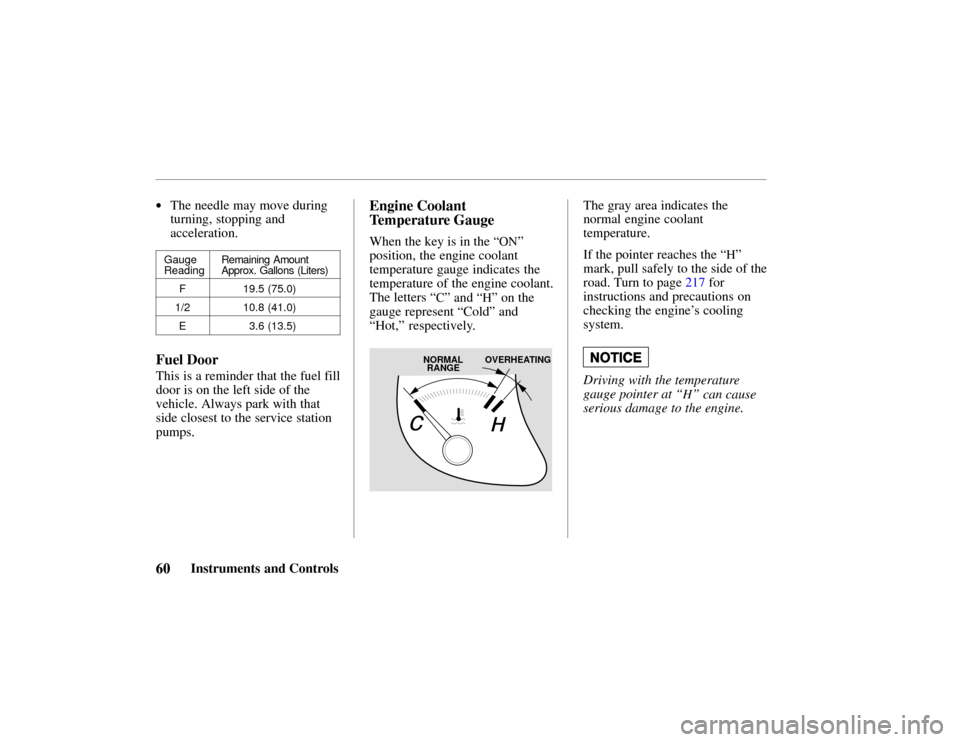
Engine Coolant
Temperature Gauge
When the key is in the “ON”
position, the engine coolant
temperature gauge indicates the
temperature of the engine coolant.
The letters “
C” and “H” on the
gauge represent “Cold” and
“Hot,” respectively.
NORMAL RANGE OVERHEATING
The gray area indicates the
normal engine coolant
temperature.
If the pointer reaches the
“
H”
mark, pull safely to the side of the
road. Turn to page 217 for
instructions and precautions on
checking the engine ’s cooling
system.
Driving with the temperature
gauge pointer at “
H” can cause
serious damage to the engine.
Page 66 of 294
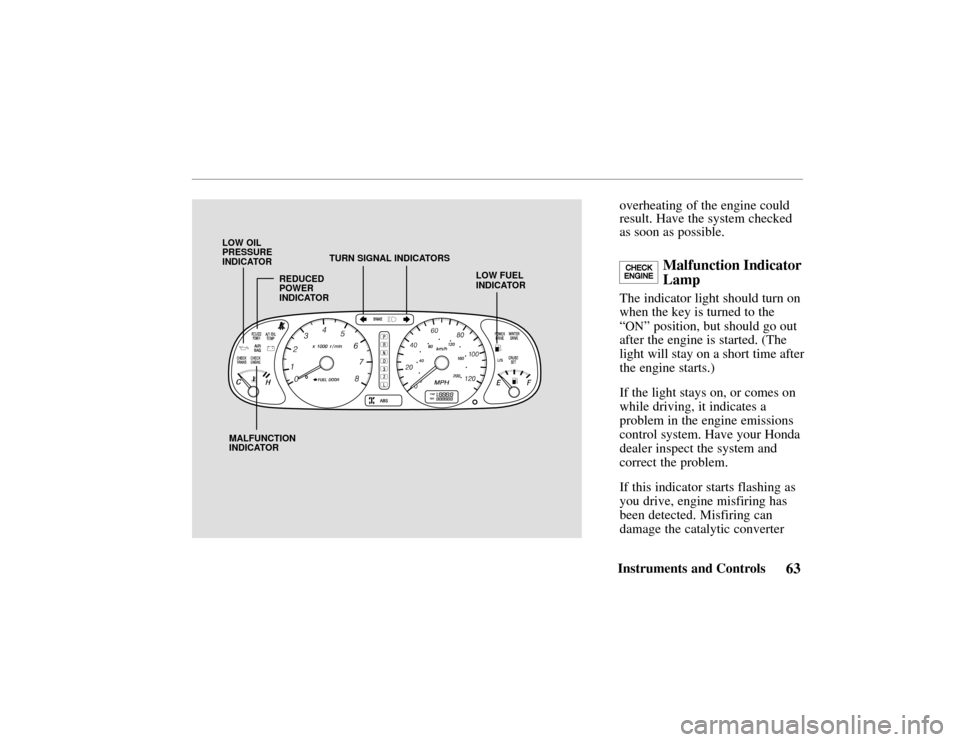
LOW FUEL
INDICATOR
MALFUNCTION
INDICATOR TURN SIGNAL INDICATORS
LOW OIL
PRESSURE
INDICATOR
REDUCED
POWER
INDICATOR
63Instruments and Controls
overheating of the engine could
result. Have the system checked
as soon as possible.
Malfunction Indicator
Lamp
The indicator light should turn on
when the key is turned to the
“
ON” position, but should go out
after the engine is started. (The
light will stay on a short time after
the engine starts.)
If the light stays on, or comes on
while driving, it indicates a
problem in the engine emissions
control system. Have your Honda
dealer inspect the system and
correct the problem.
If this indicator starts flashing as
you drive, engine misfiring has
been detected. Misfiring can
damage the catalytic converter
Page 119 of 294
11 6Interior Features
positions. Move the steering
wheel to the desired position, then
release the lever. Try to move the
steering wheel up and down to
make sure it is locked in position.
Make sure the steering wheel does
not block your view of any of the
instrument panel gauges or
indicators.
Adjusting the steering wheel
position while driving may
cause you to lose control of
the vehicle and be seriously
injured in a crash.
Adjust the steering wheel only
when the vehicle is stopped.
Cigarette Lighter
The cigarette lighter is on the
instrument panel. The ignition
switch must be in
ACCESSORY
or ON for the cigarette lighter to
work. To operate, push it in.
When it heats, it automatically
pops out ready for use. Avoid
holding the lighter in by hand
while it is heating, as damage to
the heating element may result.
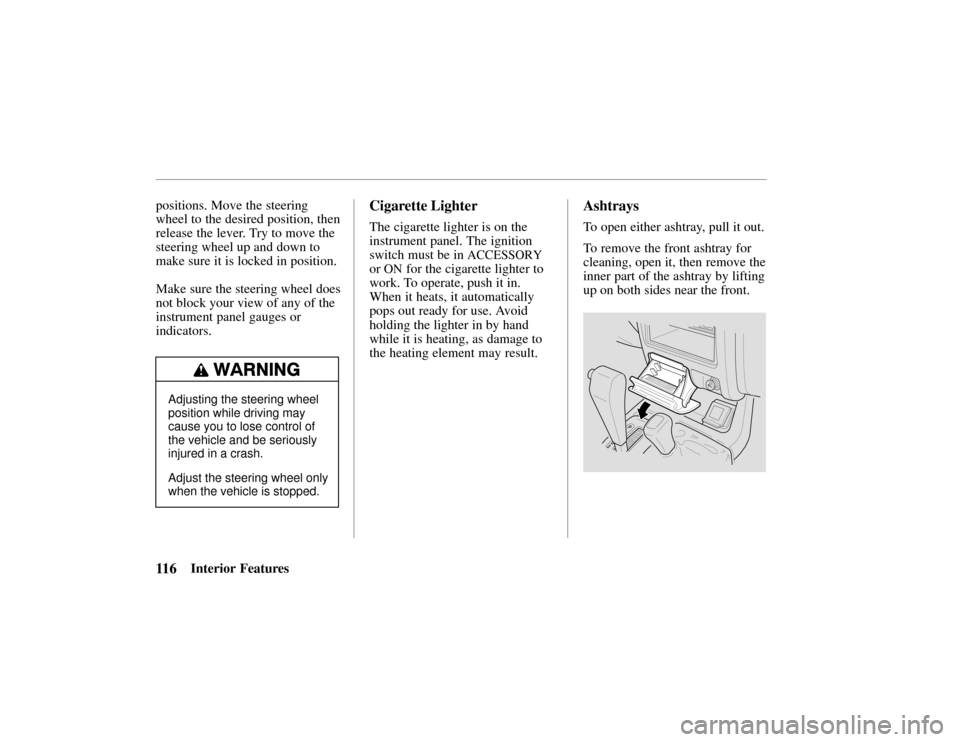
Ashtrays
To open either ashtray, pull it out.
To remove the front ashtray for
cleaning, open it, then remove the
inner part of the ashtray by lifting
up on both sides near the front.
Page 122 of 294
11 9Comfort and Convenience Features
The heating and air conditioning
system in your vehicle provides a
comfortable driving environment
in all weather conditions.
The audio system has many
features. This section describes
those features and how to use
them.
Heating and Cooling 120
. . . . . .
Ventilation 122 . . . . . . . . . . . . . .
Audio System125 . . . . . . . . . . . .
AM/FM/Cassette Stereo
Audio System (LX, EX)125 Operating the Radio 125 . .
Adjusting the Sound 127 . .
Operating the
Cassette Player 128 . . . . .
Caring for the
Cassette Player 130 . . . . .
Operating the Optional
CD Changer131 . . . . . . . .
AM/FM/Cassette/
CD Changer Stereo
Audio System (EX-L)133 . .
Operating the Radio 133 . .
Adjusting the Sound 135 . .
Radio Frequencies 136 . . .
Operating the
Cassette Player 138 . . . . .
Caring for the
Cassette Player 141 . . . . . Operating the
CD Changer142
. . . . . . . .
Protecting
Compact Discs146 . . . . . .
Cruise Control 147 . . . . . . . . . . .
Keyless Entry 151 . . . . . . . . . . .
Anti-Theft System 152 . . . . . . . .
Digital Clock 153 . . . . . . . . . . . .
Comfort and Convenience Features
Page 123 of 294
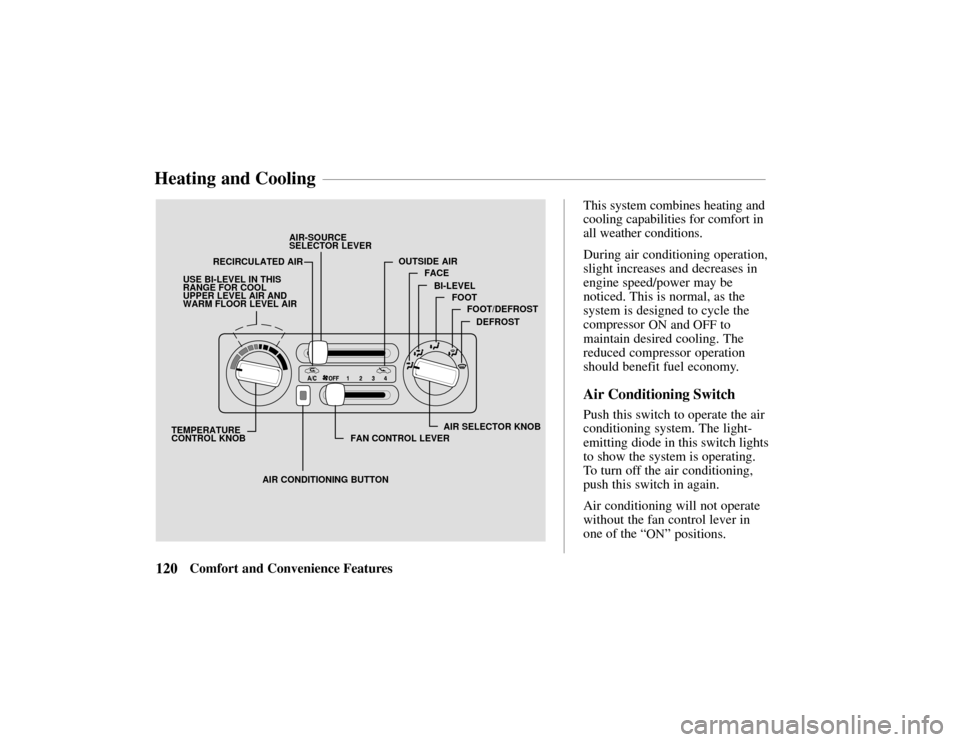
FACEFOOT
DEFROST
FOOT/DEFROST
AIR SELECTOR KNOB
BI-LEVEL
AIR-SOURCE
OUTSIDE AIR
FAN CONTROL LEVER
AIR CONDITIONING BUTTON
TEMPERATURE
SELECTOR LEVER
USE BI-LEVEL IN THIS
RANGE FOR COOL
UPPER LEVEL AIR AND
WARM FLOOR LEVEL AIR
CONTROL KNOB
RECIRCULATED AIR
120Comfort and Convenience Features This system combines heating and
cooling capabilities for comfort in
all weather conditions.
During air conditioning operation,
slight increases and decreases in
engine speed/power may be
noticed. This is normal, as the
system is designed to cycle the
compressor
ON and OFF to
maintain desired cooling. The
reduced compressor operation
should benefit fuel economy.
Air Conditioning Switch
Push this switch to operate the air
conditioning system. The light-
emitting diode in this switch lights
to show the system is operating.
To turn off the air conditioning,
push this switch in again.
Air conditioning will not operate
without the fan control lever in
one of the “
ON” positions.
Heating and Cooling
Page 125 of 294

122Comfort and Convenience FeaturesFoot/Defrost — Air
comes from the floor
outlets, windshield defroster
outlets and side window defroster
outlets. When you select
Foot/Defrost, the A/C turns on (if
it is not already on), and outside
air is selected automatically.
Because of the automatic
operation, you will not see the
light in the A/C button. The
system goes back to your former
settings when you move the knob
to any other position.
When the windshield glass and
door glass are foggy or frosty, use
this Foot/Defrost mode to clear
off the glass while maintaining the
heating performance.
Defrost — Air is
conditioned and
delivered from the windshield
defroster outlets with a small amount delivered from the side
window defroster outlets. This
position is recommended for
conditions of severe fogging and
icing only. When you select
Defrost, the A/C turns on (if it is
not already on), and outside air is
selected automatically. Because of
the automatic operation, you will
not see the light in the A/C button.
The system goes back to your
former settings when you move
the knob to any other position.
Operating Tips – Use the heater
with the air-source selector lever
at the outside air position. This
will minimize windshield
clouding while quickly warming
the interior of the vehicle. For
best results, engage the A/C
compressor to minimize
windshield clouding. Your vehicle has a flow-through
ventilation system that provides
a supply of outside air into the
vehicle when it is moving and the
air-source selector lever is in the
outside air position. When the
vehicle is not in motion, you can
get a steady flow of outside air
with the heater or air conditioning
blower running.
With the side windows closed and
the air-source selector lever in the
outside air position, the flow-
through ventilation system
provides outside air flow into the
front air inlet grilles, through the
vehicle and out the rear air
exhaust outlet.
Ventilation
Page 186 of 294
183In Case of Emergency
This section covers the most
common problems that motorists
experience with their vehicles. It
gives you information on how to
safely evaluate those problems,
with tips to help get you going
again. Lastly, it tells you how to
have your vehicle towed.
Jump Starting184
. . . . . . . . . . . .
Changing a Tire186 . . . . . . . . . .
Lifting Points187 . . . . . . . . . .
Tool Locations188 . . . . . . . . . . .
Engine Overheating190 . . . . . . .
Towing 191 . . . . . . . . . . . . . . . .
Precautions191 . . . . . . . . . . .
Towing Tips192 . . . . . . . . . . .
All Four Wheels
on the Ground192 . . . . . .
Front Wheels
off the Ground192 . . . . . .
Rear Wheels
off the Ground193 . . . . . .
Inoperative Electrical
Devices193 . . . . . . . . . . . . . . . .
In Case of Emergency
Page 193 of 294

190In Case of Emergency
Reverse this procedure to store
the spare tire. Connect the spare
tire to the bracket with the outside
of the wheel facing up. Make sure
the tire does not catch on any part
of the underbody of the vehicle as
you are raising it, and that the
spare tire is stored securely before
driving.
If the engine overheats:
•The engine coolant temperature
gauge pointer will move up to
the
“
H” or higher.
•Engine “ping” will become
excessive.
•Loss of engine power will be
noticed.
•Either steam or boiling water
will squirt out of the radiator.
If you find that the engine is
overheating:
•Stop the vehicle, and turn on
the hazard warning lights.
•If you see or hear steam or
coolant coming from the
engine compartment, turn off
the engine immediately.
Steam and spray from an
overheated engine can
seriously scald you.
Do not open the hood if steam
is coming out.
•
If you do not see or hear steam
or spray, turn off the
A/C (if
on) and run the engine at a
speed slightly higher than idle
speed (about 1,500 rpm) for
several minutes. Watch the
coolant temperature gauge. If it
remains at the “
H” mark, turn
off the engine.
•Open the hood only after all
signs of steam or hot coolant
spray have stopped. Look for
signs of an obvious leak, such
as a split radiator hose. If you
Engine Overheating
Page 212 of 294

209Care and Maintenance
Sit in the driver
’s seat and
perform these checks:
1. With the engine stopped,
depress the brake pedal several
times; the travel distance and
effective pedal stroke should
remain unchanged.
2. Start the engine with the brake pedal fully depressed.
The brake pedal should go down
a little as the engine starts.
3. Depress the brake pedal, stop the engine and hold the pedal
depressed for about 30
seconds; the brake pedal
should remain in position
without rising or going down.
4. Restart the engine and run it for about a minute, then turn it
off and depress the brake
pedal firmly several times; the
brake pedal travel should decrease each time the brake
pedal is depressed.
If the brakes do not operate
normally, have them checked and
corrected by your Honda dealer.
Exhaust system — Be alert to any
changes in the sound of the exhaust
system or any smell of fumes.
These are signs the system may be
leaking or overheating. Have the
system checked and/or repaired at
once if these conditions exist. (Also
see “Carbon Monoxide Hazard” in
the “Driver and Passenger Safety ”
section and “ Three-Way Catalytic
Converter ” in the “Driving Tips ”
section.)
Windshield wipers and
washers —
Check the operation
and condition of the wiper blades.
Check the flow and aim of the
washer spray.
Defrosters — Check performance
by moving the controls to the
defrost setting and noting the
amount of air directed against the
windshield.
Rear view mirrors and sun
visors —
Check that the friction
joints hold the mirrors and sun
visors firmly in place.
Horn — Blow the horn now and
then to be sure it works.
Lap and shoulder belts — Check
the belt system, including
webbing, buckles, latch plates,
retractors, guide loops and
anchors for proper operation and
damage.
Seat adjusters — When adjusting
a seat, be sure the seat adjusters
latch securely by pushing the seat
forward and backward.