ECU HONDA PILOT 2003 1.G User Guide
[x] Cancel search | Manufacturer: HONDA, Model Year: 2003, Model line: PILOT, Model: HONDA PILOT 2003 1.GPages: 392, PDF Size: 5.06 MB
Page 44 of 392
Of course, children vary widely. And
while age may be one indicator of
when a child can saf ely ride in the
f ront, there are other important
f actors you should consider.
Whichever style you select, f ollow
the booster seat maker’s instructions. The back seat is the safest place for
a child of any age or size.
In addition, the passenger’s f ront
airbag poses serious risks to children.
If the seat is too f ar f orward, or the
child’s head is thrown f orward
during a collision, or the child is
unrestrained or out of position, an
inf lating f ront airbag can kill or
seriously injure the child.
The side airbag also poses risks. If
any part of a larger child’s body is in
the path of a deploying airbag, the
child could receive possibly serious
injuries.
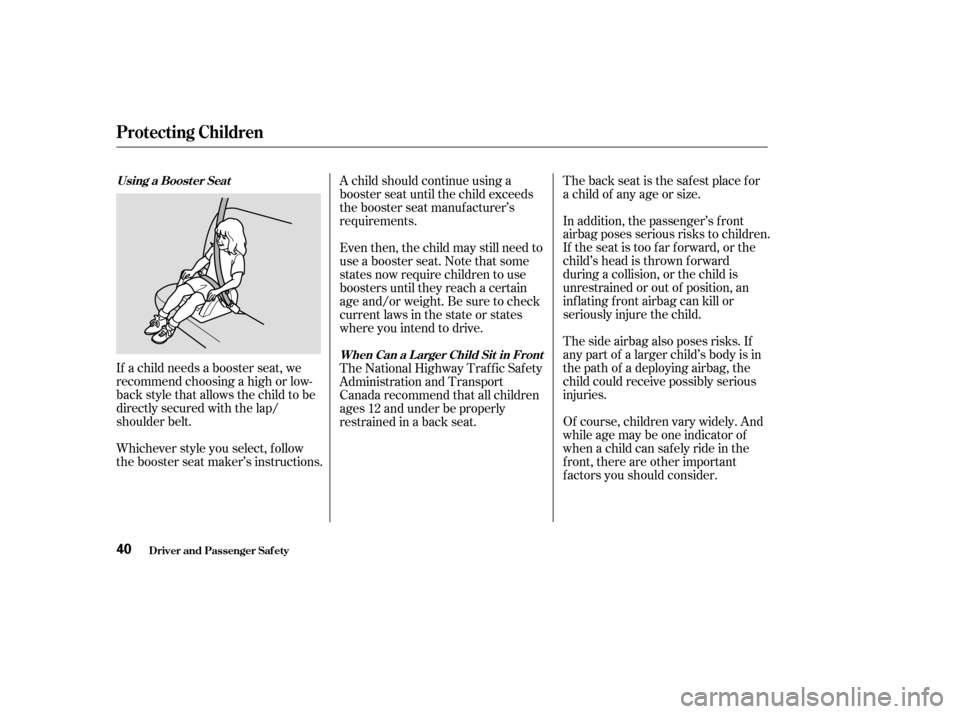
If a child needs a booster seat, we
recommend choosing a high or low-
back style that allows the child to be
directly secured with the lap/
shoulder belt. A child should continue using a
booster seat until the child exceeds
the booster seat manufacturer’s
requirements.
Even then, the child may still need to
use a booster seat. Note that some
states now require children to use
boosters until they reach a certain
ageand/orweight.Besuretocheck
current laws in the state or states
where you intend to drive.
The National Highway Traffic Safety
Administration and Transport
Canada recommend that all children
ages 12 and under be properly
restrained in a back seat.
Using a Boost er Seat
When Can a Larger Child Sit in Front
Protecting Children
Driver and Passenger Saf ety40
Page 45 of 392

If you decide that a child can saf ely
ride up f ront, be sure to:Caref ully read the owner’s manual
and make sure you understand all
seat belt instructions and all saf ety
inf ormation.
Move the vehicle seat to the rear-
most position.
Have the child sit up straight, back
against the seat, and feet on or
near the f loor.
Check that the child’s seat belt is
properly positioned and secured.
Physically, a child must be large
enough f or the lap/shoulder belt to
properly f it over the hips, chest, and
shoulder (see pages and ). If
the seat belt does not f it properly,
the child should not sit in the f ront.
To saf ely ride in f ront, a child must
be able to f ollow the rules, including
sitting properly and wearing the seat
belt properly throughout a ride.
Supervise the child. Even mature
children sometimes need to be
reminded to f asten the seat belts
or sit properly. Remind the child not to lean
toward the door because of the
side airbag.
15 39Physical Size
Maturity
Protecting Children
Driver and Passenger Saf ety41
Page 46 of 392
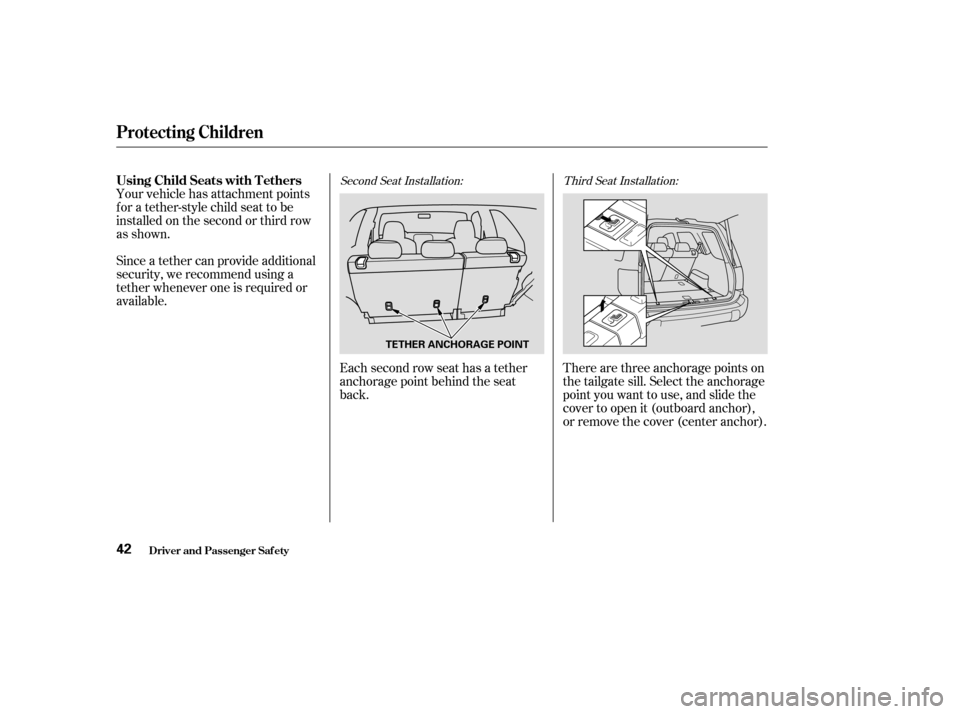
Your vehicle has attachment points
for a tether-style child seat to be
installed on the second or third row
as shown.
Since a tether can provide additional
security, we recommend using a
tether whenever one is required or
available.Each second row seat has a tether
anchorage point behind the seat
back.There are three anchorage points on
the tailgate sill. Select the anchorage
point you want to use, and slide the
cover to open it (outboard anchor),
or remove the cover (center anchor).
Second Seat Installation:
Third Seat Installation:Using Child Seats with T ethers
Protecting Children
Driver and Passenger Saf ety42
TETHER ANCHORAGE POINT
Page 48 of 392
Put the child seat in a second row
vehicle seat and attach the child
seat to the lower anchors
according to the child seat maker’s
instructions.
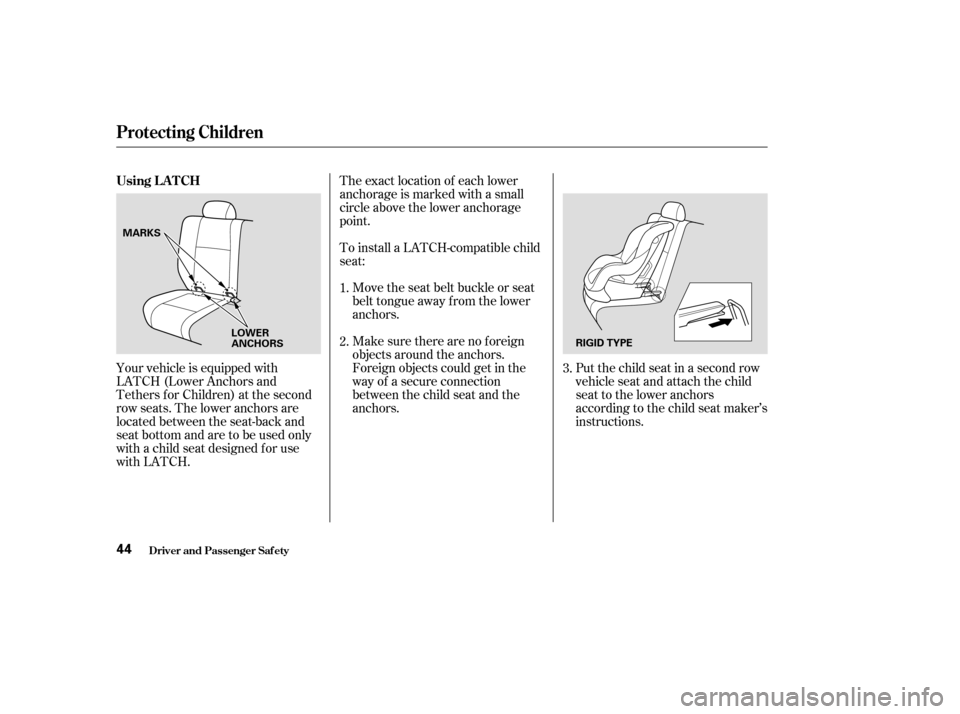
Your vehicle is equipped with
LATCH (Lower Anchors and
Tethers f or Children) at the second
row seats. The lower anchors are
located between the seat-back and
seat bottom and are to be used only
with a child seat designed f or use
with LATCH. The exact location of each lower
anchorage is marked with a small
circle above the lower anchorage
point.
Move the seat belt buckle or seat
belt tongue away f rom the lower
anchors.
To install a LATCH-compatible child
seat:
Make sure there are no f oreign
objects around the anchors.
Foreign objects could get in the
way of a secure connection
between the child seat and the
anchors.
1.
2.
3.
Using L A T CH
Protecting Children
Driver and Passenger Saf ety44
LOWER
ANCHORS
RIGID TYPE
MARKS
Page 49 of 392
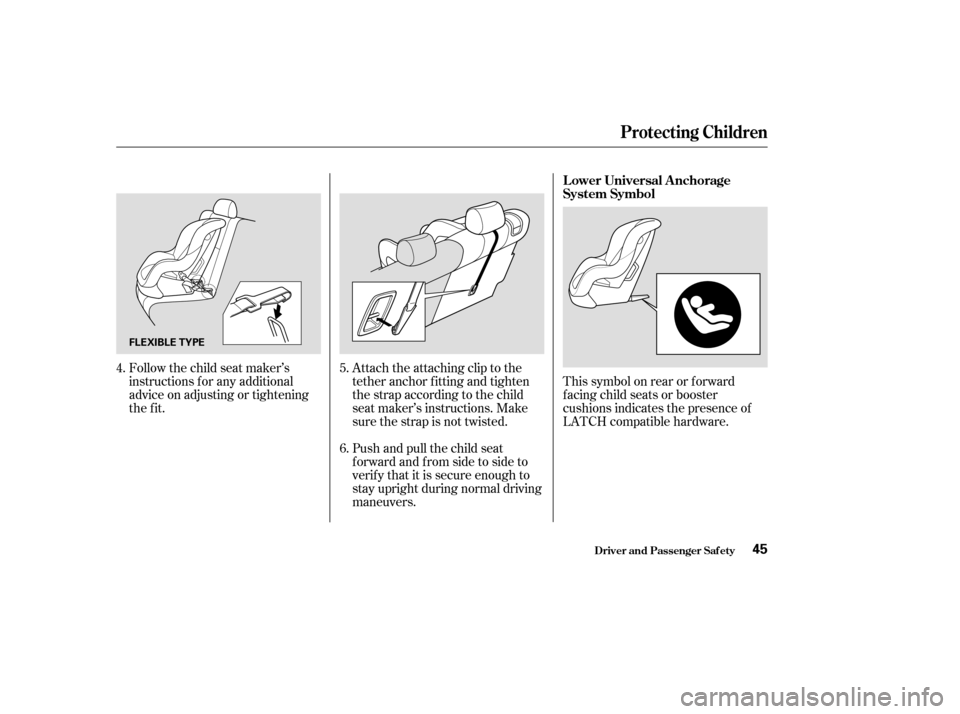
Follow the child seat maker’s
instructions f or any additional
advice on adjusting or tightening
the fit.Attach the attaching clip to the
tether anchor fitting and tighten
the strap according to the child
seat maker’s instructions. Make
sure the strap is not twisted.
Push and pull the child seat
f orward and f rom side to side to
verif y that it is secure enough to
stay upright during normal driving
maneuvers.This symbol on rear or f orward
f acing child seats or booster
cushions indicates the presence of
LATCH compatible hardware.
4.
5.
6.
Protecting Children
Driver and Passenger Saf ety
L ower Universal Anchorage
System Symbol
45
FLEXIBLE TYPE
Page 51 of 392

The seat belts in all seating positions
except the driver’s have an additional
locking mechanism that must be
activated to secure a child seat. (See
pages and f or instructions on
how to secure child seats with this
type of seat belt.)
If the shoulder part of the belt is
pulled all the way out, the locking
mechanism will activate. The belt
will retract, but it will not allow the
passenger to move f reely.
To deactivate the locking
mechanism, unlatch the buckle and
let the seat belt f ully retract. To
ref asten the belt, pull it out only as
f ar as needed.
See page f or instructions on how
to wear the lap/shoulder belt
properly.
To fasten the belt, insert the latch
plate into the buckle, then tug on the
belt to make sure the buckle is
latched.
To unlock the belt, push the red
PRESSbuttononthebuckle.
Guide the belt across your body so
that it retracts completely. After
exiting the vehicle, be sure the belt
is out of the way and will not get
closed in the door.
All seat belts have an emergency
locking retractor. In normal driving,
the retractor lets you move f reely in
your seat while it keeps some
tension on the belt. During a collision
or sudden stop, the retractor
automatically locks the belt to help
restrain your body.
15
31 36
Additional Inf ormation About Your Seat Belts
Driver and Passenger Saf ety47
Page 82 of 392
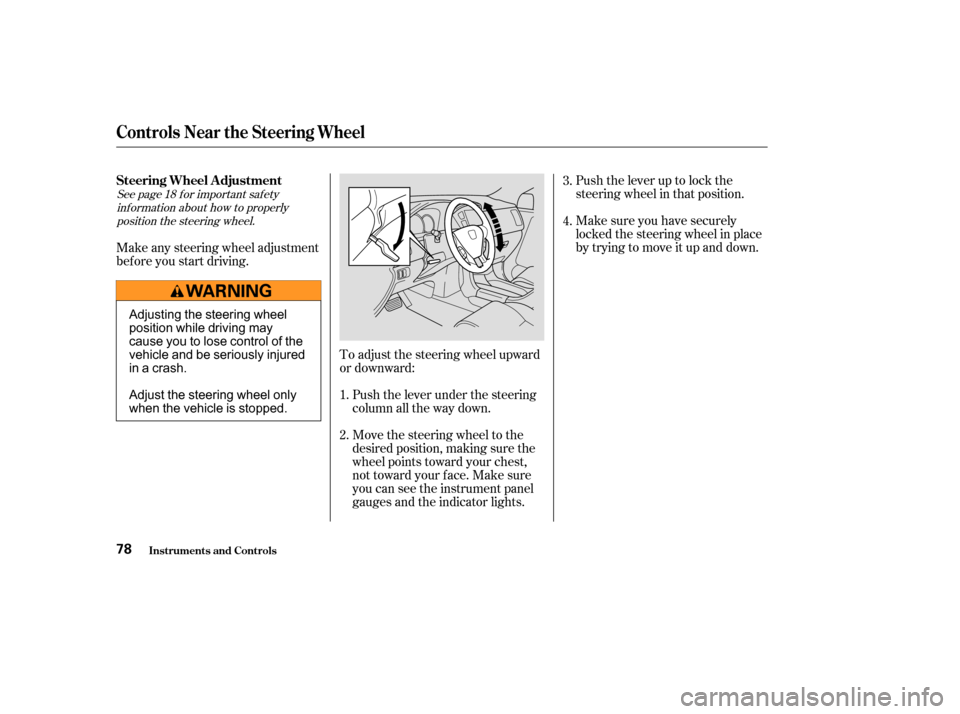
Push the lever up to lock the
steering wheel in that position.
Make sure you have securely
locked the steering wheel in place
by trying to move it up and down.
To adjust the steering wheel upward
or downward: Push the lever under the steering
column all the way down.
Move the steering wheel to the
desired position, making sure the
wheel points toward your chest,
not toward your f ace. Make sure
you can see the instrument panel
gauges and the indicator lights.
Make any steering wheel adjustment
bef ore you start driving.
3.
4.
1.
2.
See page f or important saf ety inf ormation about how to properlyposition the steering wheel. 18
Controls Near the Steering Wheel
Inst rument s and Cont rols
Steering Wheel A djustment
78
Adjusting the steering wheel
position while driving may
cause you to lose control of the
vehicle and be seriously injured
inacrash.
Adjust the steering wheel only
when the vehicle is stopped.
Page 88 of 392
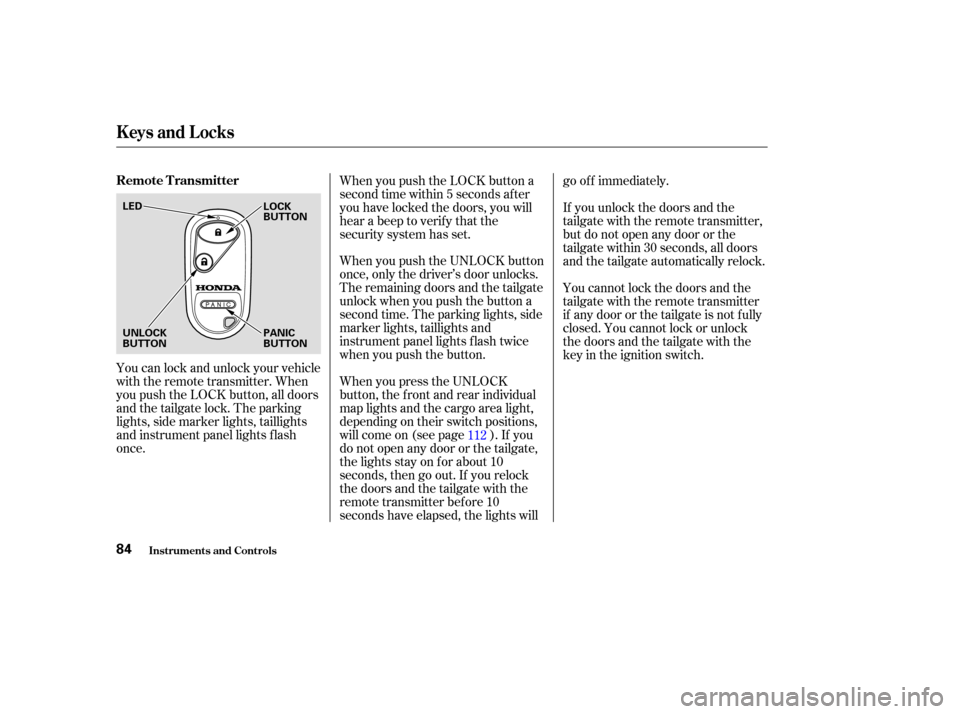
You can lock and unlock your vehicle
with the remote transmitter. When
you push the LOCK button, all doors
and the tailgate lock. The parking
lights, side marker lights, taillights
and instrument panel lights f lash
once.When you push the LOCK button a
second time within 5 seconds after
you have locked the doors, you will
hear a beep to verify that the
security system has set.
When you push the UNLOCK button
once, only the driver’s door unlocks.
The remaining doors and the tailgate
unlock when you push the button a
second time. The parking lights, side
marker lights, taillights and
instrument panel lights f lash twice
when you push the button.
When you press the UNLOCK
button, the f ront and rear individual
map lights and the cargo area light,
depending on their switch positions,
will come on (see page ). If you
do not open any door or the tailgate,
the lights stay on for about 10
seconds, then go out. If you relock
thedoorsandthetailgatewiththe
remote transmitter before 10
seconds have elapsed, the lights willgo of f immediately.
If you unlock the doors and the
tailgate with the remote transmitter,
but do not open any door or the
tailgate within 30 seconds, all doors
and the tailgate automatically relock.
You cannot lock the doors and the
tailgate with the remote transmitter
if any door or the tailgate is not f ully
closed. You cannot lock or unlock
thedoorsandthetailgatewiththe
key in the ignition switch.
112
Keys and Locks
Inst rument s and Cont rols
Remote Transmitter
84
LED LOCK
BUTTON
UNLOCK
BUTTON PANIC
BUTTON
Page 98 of 392
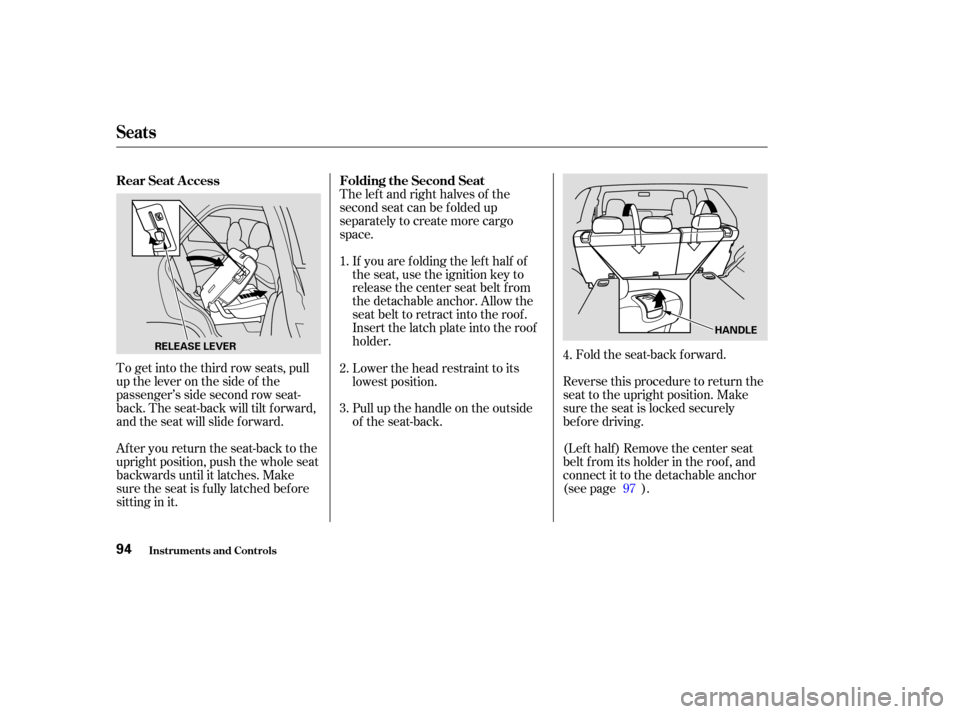
To get into the third row seats, pull
uptheleveronthesideof the
passenger’s side second row seat-
back. The seat-back will tilt f orward,
and the seat will slide f orward.
After you return the seat-back to the
upright position, push the whole seat
backwards until it latches. Make
sure the seat is f ully latched bef ore
sitting in it.The lef t and right halves of the
second seat can be f olded up
separately to create more cargo
space.
If you are f olding the lef t half of
the seat, use the ignition key to
release the center seat belt from
the detachable anchor. Allow the
seat belt to retract into the roof.
Insert the latch plate into the roof
holder. Fold the seat-back forward.
Reverse this procedure to return the
seat to the upright position. Make
sure the seat is locked securely
bef ore driving.
(Lef t half ) Remove the center seat
belt f rom its holder in the roof , and
connect it to the detachable anchor
(see page ).
Pull up the handle on the outside
of the seat-back. Lower the head restraint to its
lowest position.
2.
3. 1.
4.
97
Rear Seat A ccess
Folding the Second Seat
Seats
Inst rument s and Cont rols94
HANDLE
RELEASE LEVER
Page 100 of 392
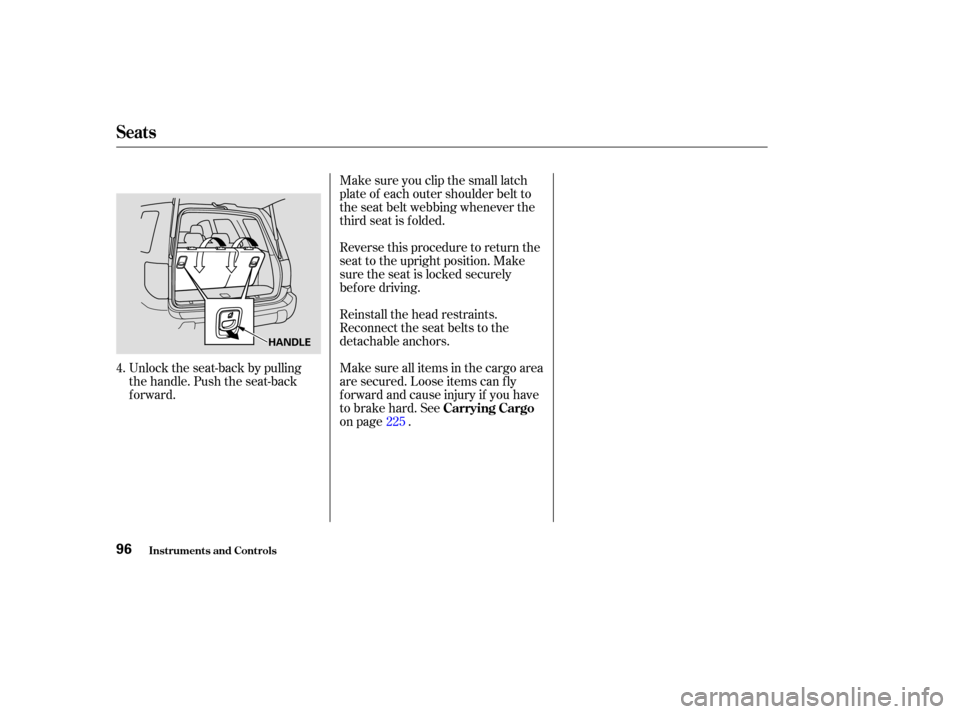
Unlock the seat-back by pulling
the handle. Push the seat-back
forward.Make sure you clip the small latch
plate of each outer shoulder belt to
the seat belt webbing whenever the
third seat is f olded.
Reverse this procedure to return the
seat to the upright position. Make
sure the seat is locked securely
bef ore driving.
Reinstall the head restraints.
Reconnect the seat belts to the
detachable anchors.
Make sure all items in the cargo area
are secured. Loose items can f ly
f orward and cause injury if you have
to brake hard. See
on page .
4.
225
Seats
Inst rument s and Cont rols
Carrying Cargo
96
HANDLE