lock HONDA PILOT 2006 1.G Repair Manual
[x] Cancel search | Manufacturer: HONDA, Model Year: 2006, Model line: PILOT, Model: HONDA PILOT 2006 1.GPages: 316, PDF Size: 3.95 MB
Page 211 of 316

If the brake pads need replacing, you
will hear a distinctive, metallic
screeching sound when you apply
the brake pedal. If you do not have
the brake pads replaced, they will
screech all the time. It is normal f or
the brakes to occasionally squeal or
squeak when you apply them.The anti-lock brake system (ABS)
helps prevent the brakes f rom
locking up, and helps you retain
steering control by pumping the
brakes rapidly, much f aster than a
person can do it.
You will f eel a pulsation in the brake
pedal when the ABS activates, and
you may hear some noise. This is
normal: it is the ABS rapidly
pumpingthebrakes.Ondry
pavement, you will need to press on
thebrakepedalveryhardbeforethe
ABS activates. However, you may
feel the ABS activate immediately if
you are trying to stop on snow or ice.
The ABS also balances the f ront-to-
rear braking distribution according
to vehicle loading.
Let the ABS work f or you by always
keeping f irm, steady pressure on the
brake pedal. This is sometimes
ref erred to as ‘‘stomp and steer.’’
You should never pump the brake pedal.
Anti-lock Brakes (ABS)
Brake Pad Wear Indicators
Braking System, Anti-lock Brakes (ABS)
Driving
209
Page 212 of 316
It only helps with the
steering control during braking.
such as trying to take a
corner too f ast or making a sudden
lane change. Always drive at a safe
speed f or the road and weather
conditions.
Always steer moderately
when you are braking hard. Severe
or sharp steering wheel movement
can still cause your vehicle to veer
into oncoming traffic or off the road. on loose or
uneven surf aces, such as gravel or
snow, than a vehicle without anti-
lock. Slow down, and allow a greater
distance between vehicles under
those conditions.
If this indicator comes on, the anti-
lock f unction of the braking system
has shut down. The brakes still work
like a conventional system, but
without anti-lock. You should have
your dealer inspect your vehicle as
soon as possible.
If the ABS indicator and the brake
system indicator come on together,
and the parking brake is f ully
released, the front-to-rear braking
distribution system may also be shut
down.
Test your brakes as instructed on
page . If the brakes f eel normal,
drive slowly and have your vehicle
repaired by your dealer as soon as
possible. Avoid sudden hard braking
which could cause the rear wheels to
lock up and possibly lead to a loss of
control. 278
Anti-lock Brakes (ABS)
A BS does not reduce the time or
distance it takes to stop the
vehicle.
A BS will not prevent a skid that
results f rom changing direction
abruptly,
A BS cannot prevent a loss of
stability. A vehicle with A BS may require a
longer distance to stop
ABS Indicator
Important Saf ety Reminders
210
Page 224 of 316

222
If the vehicle’s wheels slip when
retrieving a boat f rom the water,
shif t to f irst gear, and turn on VTM-4
lock (see page ). Disengage
VTM-4 lock as soon as the boat is
out of the water to prevent damage
to the VTM-4 system. Follow all normal precautions when
parking, including putting the
transmission in Park and f irmly
setting the parking brake. Also, place
wheel chocks at each of the trailer’s
tires. Always drive slowly and have
someone guide you when backing up.
Grip the of the steering
wheel; then turn the wheel to the lef t
to get the trailer to move to the lef t,
andturnthewheelrighttomovethe
trailer to the right.204
bottom
Ret rieving a Boat
Parking
Backing Up
Trailer Driving Tips
Page 226 of 316
Before you leave the pavement, be
sure to do all scheduled maintenance
and service, and inspect your vehicle
f or any problems. Pay special
attention to the condition of the tires,
and check the tire pressures.
After you return to the pavement,
caref ully inspect your vehicle to
make sure there is no damage that
could make driving it unsaf e.
Recheck the condition of the tires
and the tire pressures.
The route presents limits (too steep
or bumpy roads). You have limits
(driving skill and comfort). And your
vehicle has limits (traction, stability,
and power).
Driving of f -highway can be
hazardous if you f ail to recognize
limits and take the proper
precautions.Forbettertractiononallsurfaces,
accelerate slowly and gradually build
up speed. If you try to start too fast
on wet soil, mud, snow, or ice, you
might not have enough traction to
get underway, and you may dig
yourself a hole. Starting with the
shif t lever in second (2) gear will
help you have a smoother start on
snow or ice.
Debris in the road can damage your
suspension or other components.
Because your vehicle has a high
center of gravity, driving over a large
obstacle, or allowing a wheel to drop
into a deep hole can cause your
vehicle to tip or roll over.
If you can’t clearly see all conditions
or obstacles on a slope, walk the
slope bef ore you drive on it. If you
have any doubt whether or not you
can saf ely drive on the slope, don’t
do it. Find another route.
If you are driving up a hill and f ind
that you cannot continue,
. Your vehicle could roll
over. Slowly back down the hill,
f ollowing the same route you took up
the hill.
Keep in mind that you will usually
need more time and distance to
brake to a stop on unpaved surf aces.
Avoid hard braking. Do not ‘‘pump’’
the brakes; let the anti-lock braking
system pump them f or you.
do not try to
turn around
Check Out Your Vehicle
Remember A ccelerating and Braking
A voiding Obstacles
Driving on Slopes
Of f -Highway Driving Guidelines
224
Page 227 of 316
If you get stuck, engage the VTM-4
Lock (see page ). Caref ully try to
go in the direction (f orward or
reverse) that you think will get you
unstuck. Do not spin the tires at high
speeds. It will not help you get out
and may cause damage to the
transmission or VTM-4 system.
If you are still unable to f ree yourself ,
your vehicle is equipped with f ront
and rear tow hooks designed f or this
purpose.
Use a nylon strap to attach the Pilot
to the recovery vehicle and caref ully
take out the slack in the strap. Once
the strap is tight, the recovery
vehicle should apply f orce.
Remember that the recovery vehicle
needs good traction to avoid
becoming stuck, too.
Bef ore driving through water, stop,
get out if necessary, and make sure
that:
The water is not deep enough to
cover your wheel hubs, axles, or
exhaust pipe. You could stall and
not be able to restart your engine.
The water can also damage
important vehicle components.
The banks are sloped so you can
drive out.
The water is not f lowing too f ast.
Deep rushing water can sweep you
downstream. Even very shallow
rushingwatercanwashthe
ground f rom under your tires and
cause you to lose traction and
possibly roll over.
The banks and surf ace under the
water provide good traction. The
water may hide hazards such as
rocks, holes, or mud. If you decide it is saf e to drive
through water, choose a suitable
speed and engage the VTM-4 Lock.
Proceed without shif ting or changing
speeds, and do not stop the vehicle
or shut of f the engine.
After driving through water, test
your brakes. If they got wet, gently
‘‘pump’’ them while driving slowly
until they operate normally.
If the water is deeper than the wheel
hubs, some additional service may
be required. This service is not
covered by your warranties.
204
CONT INUED
If You Get Stuck
Crossing a Stream
Of f -Highway Driving Guidelines
Driving
225
Page 243 of 316
Put a new washer on the drain bolt,
then reinstall the drain bolt.
Tighten it to:
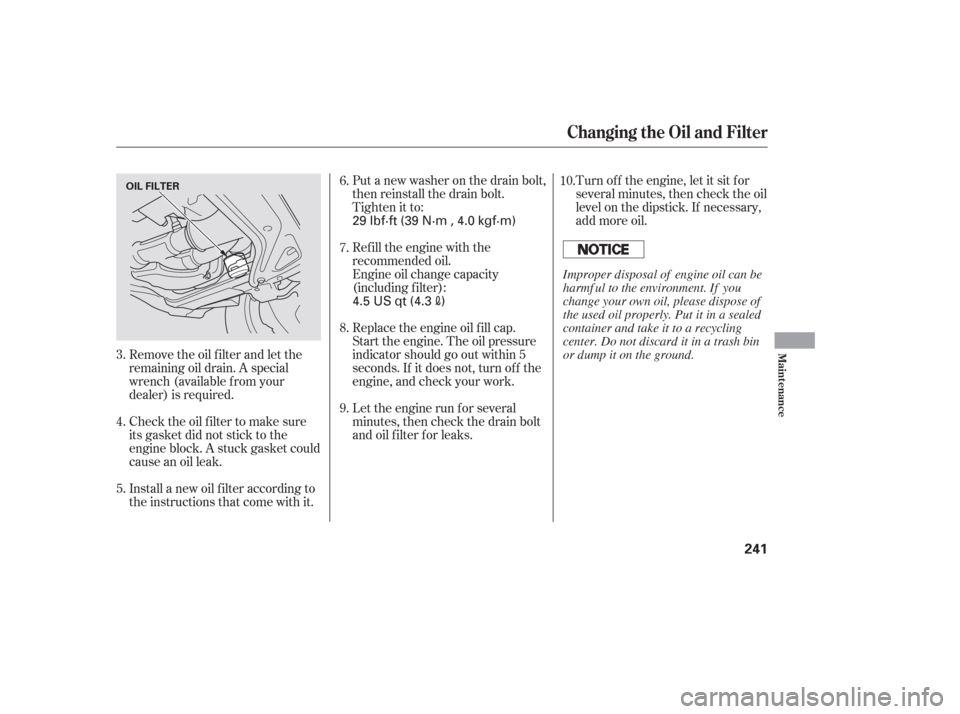
Remove the oil f ilter and let the
remaining oil drain. A special
wrench (available from your
dealer) is required. Turn of f the engine, let it sit f or
several minutes, then check the oil
level on the dipstick. If necessary,
add more oil.
Refill the engine with the
recommended oil.
Engine oil change capacity
(including f ilter):
Replace the engine oil f ill cap.
Start the engine. The oil pressure
indicator should go out within 5
seconds. If it does not, turn of f the
engine, and check your work.
Let the engine run f or several
minutes, then check the drain bolt
and oil f ilter f or leaks.
Install a new oil f ilter according to
the instructions that come with it. Check the oil f ilter to make sure
its gasket did not stick to the
engine block. A stuck gasket could
cause an oil leak.
3.
4.
5. 6.
7.
8.
9.
10.
Changing the Oil and Filter
Maint enance
241
OIL FILTER
29 lbf·ft (39 N·m , 4.0 kgf·m)
4.5 US qt (4.3
)
Improper disposal of engine oil can be
harmf ul to the environment. If you
change your own oil, please dispose of
the used oil properly. Put it in a sealed
container and take it to a recycling
center. Do not discard it in a trash bin
or dump it on the ground.
Page 245 of 316
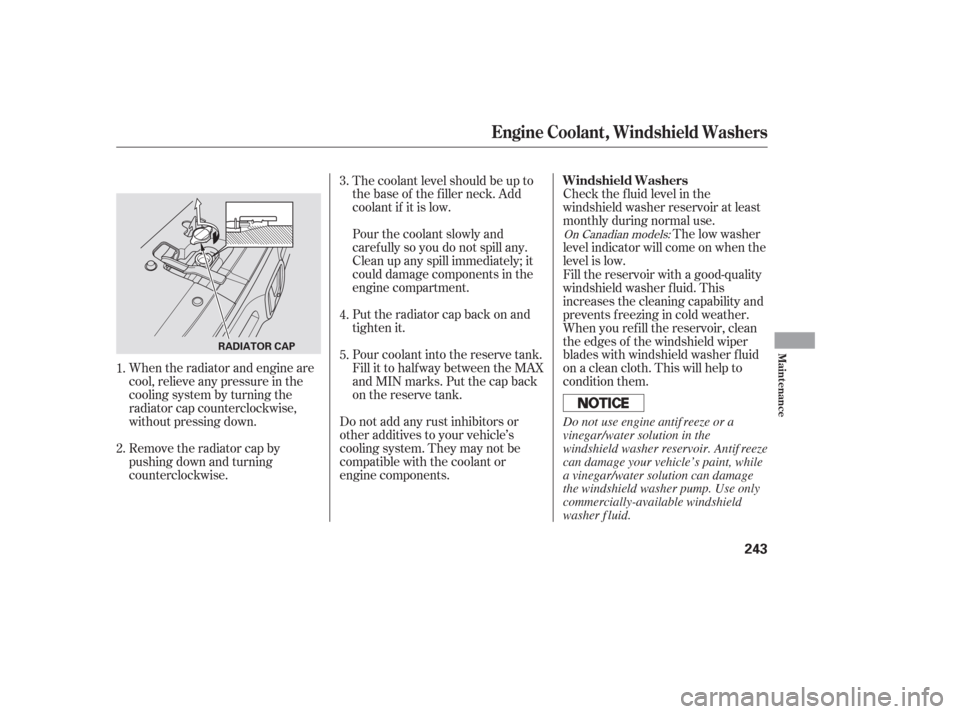
When the radiator and engine are
cool, relieve any pressure in the
cooling system by turning the
radiator cap counterclockwise,
without pressing down.
Remove the radiator cap by
pushing down and turning
counterclockwise.The coolant level should be up to
the base of the f iller neck. Add
coolant if it is low.
Check the f luid level in the
windshield washer reservoir at least
monthly during normal use.
The low washer
level indicator will come on when the
level is low.
Pourthecoolantslowlyand
caref ully so you do not spill any.
Clean up any spill immediately; it
could damage components in the
engine compartment.
Put the radiator cap back on and
tighten it.
Pour coolant into the reserve tank.
Fill it to half way between the MAX
and MIN marks. Put the cap back
on the reserve tank.
Do not add any rust inhibitors or
other additives to your vehicle’s
cooling system. They may not be
compatible with the coolant or
engine components. Fill the reservoir with a good-quality
windshield washer f luid. This
increases the cleaning capability and
prevents f reezing in cold weather.
When you ref ill the reservoir, clean
the edges of the windshield wiper
blades with windshield washer f luid
on a clean cloth. This will help to
condition them.
2. 3.
4.
5.
1.
On Canadian models:
Windshield Washers
Engine Coolant, Windshield Washers
Maint enance
243
RADIATOR CAP
Do not use engine antif reeze or a
vinegar/water solution in the
windshield washer reservoir. Antif reeze
can damage your vehicle’s paint, while
a vinegar/water solution can damage
the windshield washer pump. Use only
commercially-available windshield
washer f luid.
Page 249 of 316
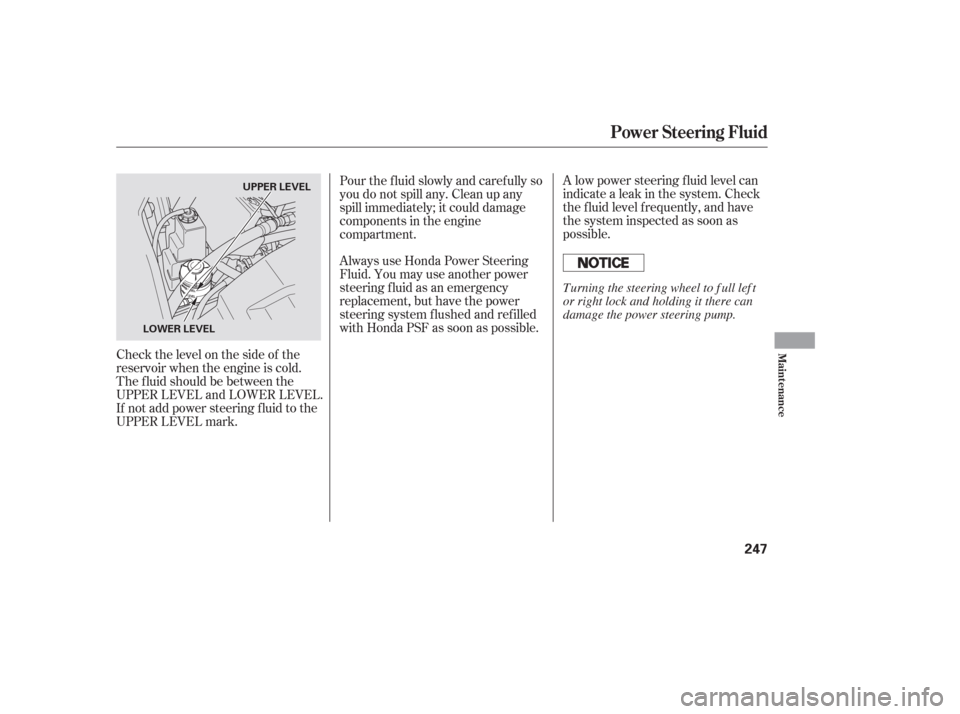
Check the level on the side of the
reservoir when the engine is cold.
The f luid should be between the
UPPER LEVEL and LOWER LEVEL.
If not add power steering f luid to the
UPPER LEVEL mark.A low power steering f luid level can
indicate a leak in the system. Check
the f luid level f requently, and have
the system inspected as soon as
possible.
Always use Honda Power Steering
Fluid. You may use another power
steering f luid as an emergency
replacement, but have the power
steering system f lushed and ref illed
with Honda PSF as soon as possible. Pour the f luid slowly and caref ully so
you do not spill any. Clean up any
spill immediately; it could damage
components in the engine
compartment.
Power Steering Fluid
Maint enance
247
UPPER LEVEL
LOWER LEVEL
Turning the steering wheel to f ull lef t
or right lock and holding it there can
damage the power steering pump.
Page 250 of 316
Theheadlightswereproperlyaimed
when your vehicle was new. If you
regularly carry heavy items in the
trunk, readjustment may be required.
Adjustments should be perf ormed by
your dealer or other qualif ied
mechanic.
Your vehicle has halogen headlight
bulbs. Handle a bulb by its steel base,
and protect the glass from contact
with your skin or hard objects. If you
touch the glass, clean it with
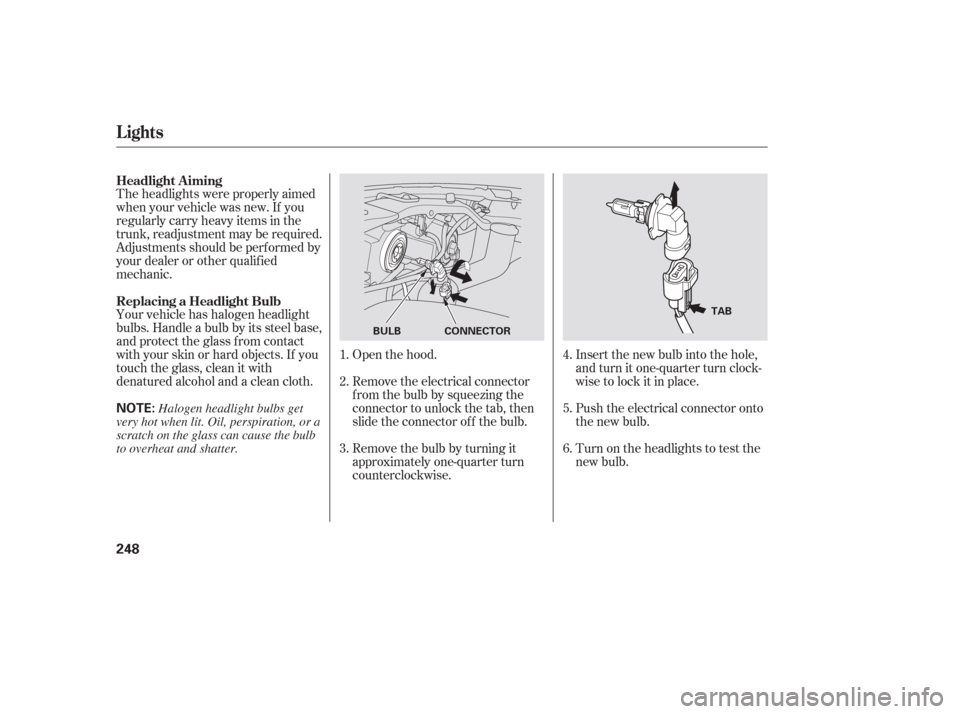
denaturedalcoholandacleancloth.Open the hood.
Remove the electrical connector
f rom the bulb by squeezing the
connector to unlock the tab, then
slide the connector of f the bulb.
Remove the bulb by turning it
approximately one-quarter turn
counterclockwise.Insert the new bulb into the hole,
and turn it one-quarter turn clock-
wise to lock it in place.
Push the electrical connector onto
the new bulb.
Turn on the headlights to test the
new bulb.
1.
2.
3.
4.
5.
6.
Headlight A iming
Replacing a Headlight Bulb
Lights
248
NOTE:
TAB
BULB CONNECTOR
Halogen headlight bulbs get
very hot when lit. Oil, perspiration, or a
scratch on the glass can cause the bulb
to overheat and shatter.
Page 251 of 316

To remove the f ront turn signal
bulb, push it in slightly and turn it
counterclockwise.
Install the new bulb into the
socket and reinstall it.Insert the socket back into the
headlight assembly. Turn it
clockwise to lock it in place.
Turn on the lights to make sure
the new bulb is working.
Remove the socket from the
headlight assembly by turning it
one-quarter turn counterclockwise. To remove a bulb, pull it straight
out of its socket.
Install the new bulb into the
socket.
Remove the socket from the
headlight assembly by turning it
one-quarter turn counterclockwise. Insert the socket back into the
headlight assembly. Turn it
clockwise to lock it in place.
Turn on the lights to make sure
the new bulb is working.
1. 4.
5.
3. 2. 1.2.
3.
4.
5.
Lights
Replacing a Front T urn Signal
Bulb
Replacing a Parking L ight/Front
Side Marker L ight Bulbs
Maint enance
249