fuel pressure HONDA PILOT 2022 Owners Manual
[x] Cancel search | Manufacturer: HONDA, Model Year: 2022, Model line: PILOT, Model: HONDA PILOT 2022Pages: 737, PDF Size: 28.84 MB
Page 16 of 737
14
Quick Reference Guide
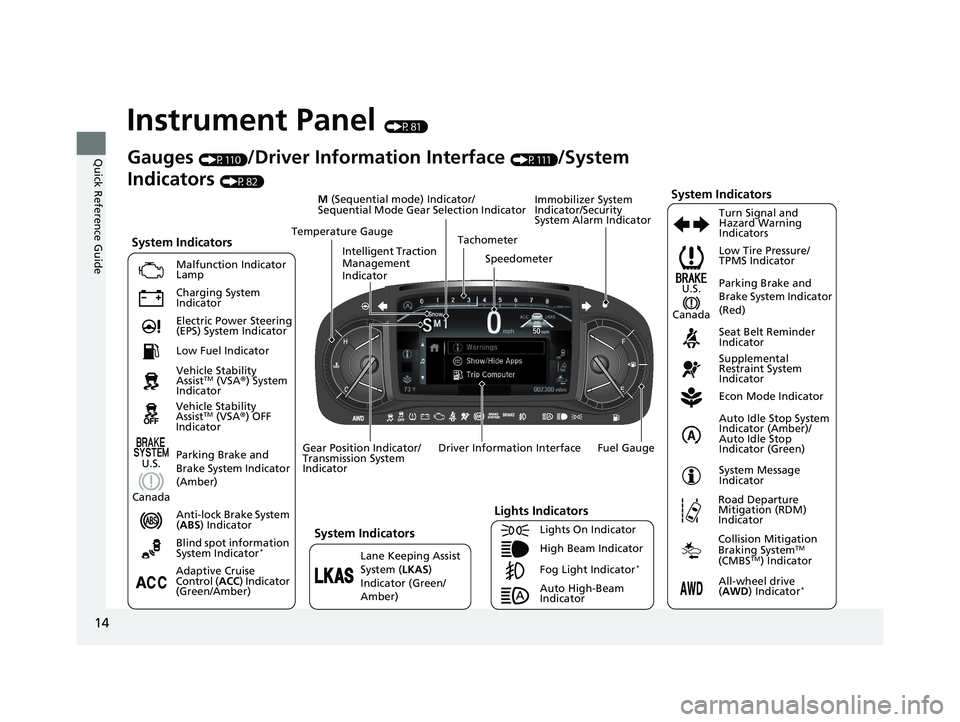
Instrument Panel (P81)
System Indicators
Malfunction Indicator
Lamp
Charging System
Indicator
Anti-lock Brake System
(ABS ) Indicator
Vehicle Stability
Assist
TM (VSA
®) System
Indicator Low Tire Pressure/
TPMS Indicator
Immobilizer System
Indicator/Security
System Alarm Indicator
Lights Indicators
Lights On Indicator
High Beam Indicator
Fog Light Indicator
*Lane Keeping Assist
System (
LKAS)
Indicator (Green/
Amber) Seat Belt Reminder
Indicator
System Indicators
Econ Mode Indicator
System Message
Indicator Parking Brake and
Brake System Indicator
(Red)
Supplemental
Restraint System
Indicator
Driver Information Interface Tachometer
M
(Sequential mode) Indicator/
Sequential Mode Gear Selection Indicator
Speedometer
Fuel Gauge
Gear Position Indicator/
Transmission System
Indicator Auto Idle Stop System
Indicator (Amber)/
Auto Idle Stop
Indicator (Green)
Gauges (P110)/Driver Information Interface (P111)/System
Indicators
(P82)
Adaptive Cruise
Control ( ACC) Indicator
(Green/Amber) Turn Signal and
Hazard Warning
Indicators
Electric Power Steering
(EPS) System Indicator
Blind spot information
System Indicator
*
Temperature Gauge
Parking Brake and
Brake System Indicator
(Amber)U.S.
Canada
System Indicators
U.S.
Canada
Low Fuel Indicator
Auto High-Beam
Indicator
Road Departure
Mitigation (RDM)
Indicator
Collision Mitigation
Braking SystemTM
(CMBSTM) Indicator
All-wheel drive
( AWD ) In
dicator*
Intelligent Traction
Management
Indicator
Vehicle Stability
AssistTM (VSA®) OFF
Indicator
22 PILOT-31TG76600.book 14 ページ 2021年6月11日 金曜日 午後4時40分
Page 27 of 737
25
Quick Reference Guide
VSA® On and Off (P547)
●The Vehicle Stability AssistTM (VSA® )
system helps stabilize the vehicle during
cornering, and helps maintain traction
while accelerating on loose or slippery
road surfaces.
●VSA ® comes on automatically every time
you start the engine.
●To partially disable or fully restore VSA®
function, press and ho ld the button until
you hear a beep.
CMBSTM On and Off
(P565)
●When a possible frontal collision is likely
unavoidable, the CMBSTM can help you to
reduce the vehicle speed and the severity
of the collision.
●The CMBSTM is turned on every time you
start the engine.
●To turn the CMBSTM on or off, press and
hold the button until you hear a beep.
Tire Pressure Monitoring System (TPMS) with Tire
Fill Assist
(P555, 700)
●The TPMS monitors tire pressure.●TPMS is turned on automatically every time you start the engine.●TPMS fill assist provides audible and visual guidance during tire pressure adjustment.
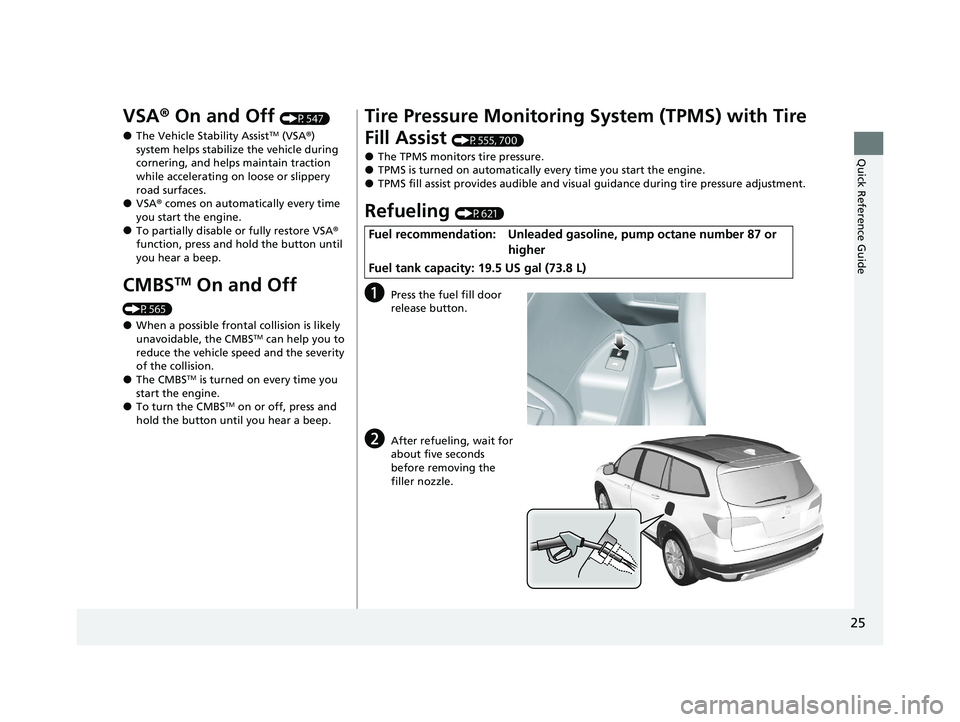
Refueling (P621)
aPress the fuel fill door
release button.
bAfter refueling, wait for
about five seconds
before removing the
filler nozzle.
Fuel recommendation: Unleaded gaso line, pump octane number 87 or
higher
Fuel tank capacity: 19.5 US gal (73.8 L)
22 PILOT-31TG76600.book 25 ページ 2021年6月11日 金曜日 午後4時40分
Page 505 of 737
503
Driving
This chapter discusses driving and refueling.
Before Driving................................... 504
Towing a Trailer ................................ 510
Off-Highway Driving Guidelines ..... 520
When Driving Starting the Engine .......................... 522
Automatic Transmission ................... 529
Shifting ............................................ 530
Auto Idle Stop .................................. 538
ECON Mode .................................... 543
Intelligent Trac tion Management
*.... 544Vehicle Stability AssistTM (VSA®), aka Electronic
Stability Control (ESC), System ..............546
Agile Handling Assist ....................... 548
Blind spot information System*........ 549
LaneWatchTM*.................................. 552 Intelligent Variable To
rque Management (i-
VTM4
TM) AWD System*.................. 554
Tire Pressure Monitoring System (TPMS) with Tire Fill Assist .......................... 555
Tire Pressure Monitoring System (TPMS) -
Required Federal Explanation ......... 557
Honda Sensing ®................................ 559
Collision Mitigati on Braking System
TM
(CMBSTM) ....................................... 562
Adaptive Cruise Control (ACC)......... 574
Lane Keeping Assist System (LKAS) .. 587
Road Departure Mitigation (RDM)
System ....................................... 596
Front Sensor Camera ....................... 601
Radar Sensor.................................... 603 Braking
Brake System ................................... 604
Anti-lock Brake System (ABS) ........... 606
Brake Assist System ......................... 607
Parking Your Vehicle
When Stopped ................................ 608
Parking Sensor System
*................... 610
Cross Traffic Monitor*..................... 615
Multi-View Rear Camera .................. 619
Refueling Fuel Information .............................. 621
How to Refuel ................................. 622
Fuel Economy and CO
2 Emissions
Improving Fuel Economy and Reducing CO
2 Emissions ................................ 624
* Not available on all models
22 PILOT-31TG76600.book 503 ページ 2021年6月11日 金曜日 午後4時40分
Page 534 of 737
uuWhen Driving uShifting
532
Driving
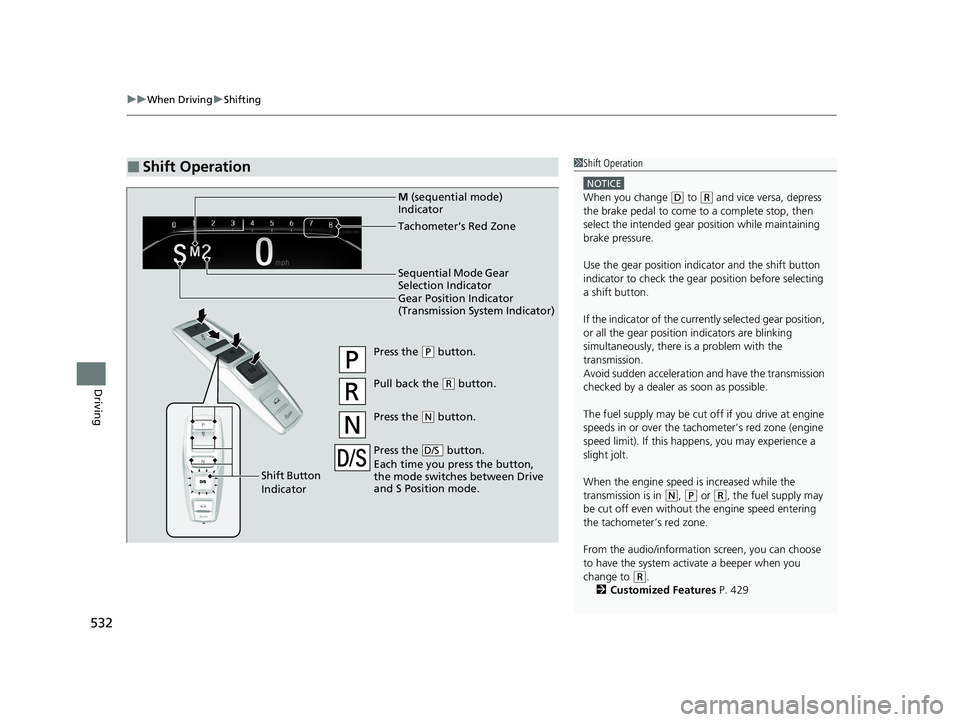
■Shift Operation1Shift Operation
NOTICE
When you change (D to (R and vice versa, depress
the brake pedal to come to a complete stop, then
select the intended gear position while maintaining
brake pressure.
Use the gear position indicator and the shift button
indicator to check the gear position before selecting
a shift button.
If the indicator of the currently selected gear position,
or all the gear position indicators are blinking
simultaneously, there is a problem with the
transmission.
Avoid sudden acceleration and have the transmission
checked by a dealer as soon as possible.
The fuel supply may be cut of f if you drive at engine
speeds in or over the tac hometer’s red zone (engine
speed limit). If this happe ns, you may experience a
slight jolt.
When the engine speed is increased while the
transmission is in
( N, (P or (R, the fuel supply may
be cut off even without the engine speed entering
the tachometer’s red zone.
From the audio/information screen, you can choose
to have the system activate a beeper when you
change to
( R.
2 Customized Features P. 429
Gear Position Indicator
(Transmission System Indicator) Tachometer’s Red Zone
Press the (P button.
Pull back the (R button.
Press the
( N button.
Press the button.
Each time you press the button,
the mode switches between Drive
and S Position mode.
D/S
Shift Button
Indicator M
(sequential mode)
Indicator
Sequential Mode Gear
Selection Indicator
22 PILOT-31TG76600.book 532 ページ 2021年6月11日 金曜日 午後4時40分
Page 559 of 737
557
uuWhen Driving uTire Pressure Monitoring System (TPMS) - Required Federal Explanation
Continued
Driving
Tire Pressure Monitoring System (TPMS) - Required
Federal Explanation
Each tire, including the spare (if provided), should be checked
monthly when cold and inflated to the inflation pressure
recommended by the vehicle manufa cturer on the vehicle placard
or tire inflation pressure label.
(If your vehicle has tires of a diff erent size than the size indicated
on the vehicle placard or tire inflation pressure label, you should
determine the proper tire inflat ion pressure for those tires.)
As an added safety feature, your vehicle has been equipped with
a tire pressure monitoring system (TPMS) that illuminates a low
tire pressure telltale
when one or more of your tires is significantly under-inflated.
Accordingly, when the low tire pressure telltale illuminates, you
should stop and check your tires as soon as possible, and inflate
them to the proper pressure.
Driving on a significantly under-inf lated tire causes the tire to
overheat and can lead to tire fail ure. Under-inflation also reduces
fuel efficiency and tire tread life, and may affect the vehicle’s
handling and stopping ability.
22 PILOT-31TG76600.book 557 ページ 2021年6月11日 金曜日 午後4時40分
Page 626 of 737
624
Driving
Fuel Economy and CO2 Emissions
Improving Fuel Economy and Reducing CO2 Emissions
Achieving fuel economy and reducing CO2 emissions is dependent on several
factors, including driving conditions, load weight, idling time, driving habits, and
vehicle condition. Depending on these and other factors, you may not achieve the
rated fuel economy of this vehicle.
You can optimize your fuel economy with proper maintenance of your vehicle.
Always maintain your vehicle in accord ance with the messages displayed on the
driver information interface.
• Use engine oil with the viscosity recommended.
2 Recommended Engine Oil P. 638
•Maintain the specified tire pressure.
• Do not load the vehicl e with excess cargo.
• Keep your vehicle clean. A buildup of snow or mud on your vehicle’s underside
adds weight and increases wind resistance.
■Maintenance and Fuel Economy
1Improving Fuel Economy and Reducing CO2 Emissions
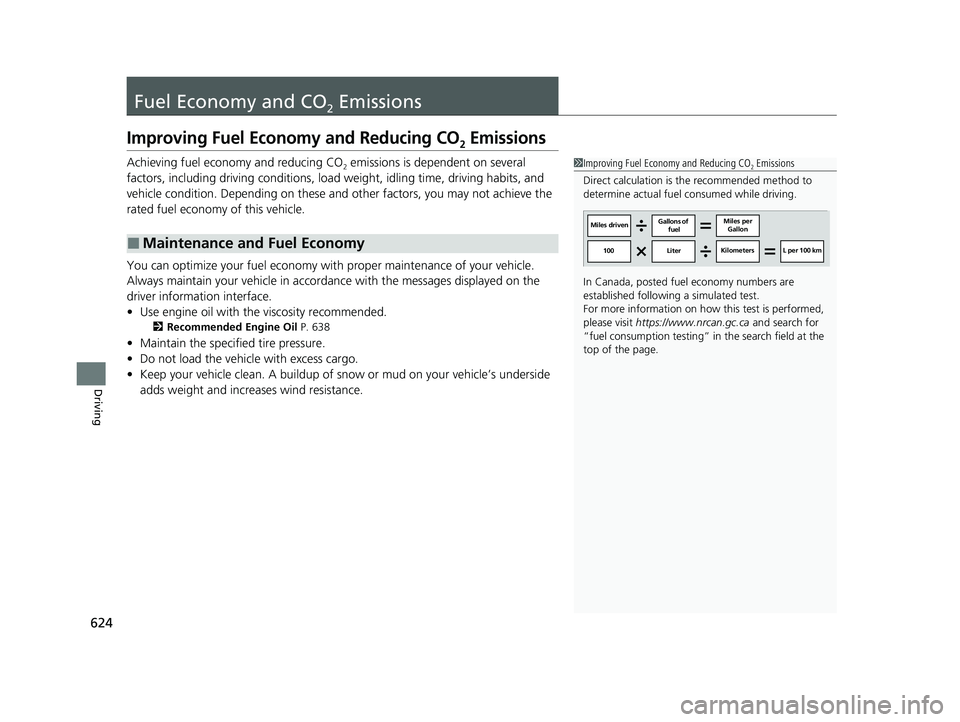
Direct calculation is the recommended method to
determine actual fuel consumed while driving.
In Canada, posted fuel economy numbers are
established following a simulated test.
For more information on how this test is performed,
please visit https://www.nrcan.gc.ca and search for
“fuel consumption testing” in the search field at the
top of the page.
Miles driven Gallons of
fuel Miles per
Gallon
100 Liter Kilometers L per 100 km
22 PILOT-31TG76600.book 624 ページ 2021年6月11日 金曜日 午後4時40分
Page 628 of 737
626
Maintenance
Before Performing Maintenance
Inspection and Maintenance
For your safety, perform all listed inspections and maintenance to keep your vehicle
in good condition. If you become aware of an y abnormality (noise, smell, insufficient
brake fluid, oil residue on the ground, etc.), have your vehicle inspected by a dealer.
(Note, however, that service at a dealer is not mandatory to keep your warranties in
effect.)
■Routine inspections
Perform inspections before long distance tri ps, when washing the vehicle, or when
refueling.
2 Maintenance P. 27
■Periodic inspections
• Check the brake fluid level monthly.
2 Checking the Brake Fluid P. 646
•Check the tire pressure monthly. Examin e the tread for wear and foreign objects.
2Checking and Maintaining Tires P. 656
•Check the operation of the exterior lights monthly.
2 Replacing Light Bulbs P. 647
•Check the condition of the wiper bl ades at least every six months.
2Checking and Maintaining Wiper Blades P. 652
■Types of Inspection and Maintenance
1Inspection and Maintenance
Maintenance, replacement, or repair of
emissions control devices and systems may be
done by any automotive repair establishment or
individuals using parts that are “certified” to
EPA standards.
According to state and fede ral regulations, failure to
perform maintenance on the maintenance main
items marked with # will not void your emissions
warranties. However, all ma intenance services should
be performed in accordan ce with the intervals
indicated by the driver information interface.
2 Maintenance Service Items P. 632
If you want to perform complex maintenance tasks
that require more skills a nd tools, you can purchase a
subscription to the Service Express website at
www.techinfo.honda.com .
2 Authorized Manuals P. 722
If you want to perform ma intenance yourself, make
sure that you have the necessary tools and skills first.
After performing maintenanc e, update the records in
the separate maintenance booklet.
U.S. models
22 PILOT-31TG76600.book 626 ページ 2021年6月11日 金曜日 午後4時40分
Page 658 of 737
656
Maintenance
Checking and Maintaining Tires
Checking Tires
To safely operate your vehicle, your tires must be of the proper type and size, in
good condition with adequate tread, and properly inflated.
■Inflation guidelines
Properly inflated tires provide the best combination of handling, tread life, and comfort.
Refer to the driver’s doorjamb label or spec ifications page for the specified pressure.
Underinflated tires wear unevenly, adversely affect handling and fuel economy, and
are more likely to fail from overheating.
Overinflated tires make your vehicle ride harshly, are more prone to road hazards,
and wear unevenly.
Every day before you drive, look at each of the tires. If one looks lower than the
others, check the pressure with a tire gauge.
At least once a month or before long trips, use a gauge to measure the pressure in
all tires, including the spare. Even tires in good condition can lose 1-2 psi (10-20 kPa,
0.1-0.2 kgf/cm
2) per month.
■Inspection guidelines
Every time you check inflation, also examine the tires and valve stems.
Look for:
• Bumps or bulges on the side or in the tread. Replace the tire if you find any cuts,
splits, or cracks in the si de of the tire. Replace it if you see fabric or cord.
• Remove any foreign objects and inspect for air leaks.
• Uneven tread wear. Have a deal er check the wheel alignment.
• Excessive tread wear.
2 Wear Indicators P. 661
•Cracks or other damage around valve stem.
1Checking Tires
Measure the air pressure when tires are cold. This
means the vehicle has been parked for at least three
hours, or driven less than 1 mile (1.6 km). If
necessary, add or releas e air until the specified
pressure is reached.
If checked when hot, tire pressure can be as much as
4–6 psi (30–40 kPa, 0.3–0.4 kgf/cm
2) higher than if
checked when cold.
Have a dealer check the tires if you feel a consistent
vibration while driving. Ne w tires and any that have
been removed and reinst alled should be properly
balanced.
Check the spare tire pressu re once a month or before
long trips.
3WARNING
Using tires that are excessively worn or
improperly inflated can cause a crash in
which you can be seriously hurt or killed.
Follow all instruction s in this owner’s
manual regarding ti re inflation and
maintenance.
22 PILOT-31TG76600.book 656 ページ 2021年6月11日 金曜日 午後4時40分
Page 676 of 737
674
uuCleaning uExterior Care
Maintenance
Exterior Care
Dust off the vehicle body after you drive.
Regularly inspect your vehi cle for scratches on painted surfaces. A scratch on a
painted surface can result in body rust. If you find a scratch, promptly repair it.
Wash the vehicle regularly. Wash more frequently when driving in the following
conditions:
• If driving on roads with road salt.
• If driving in coastal areas.
• If tar, soot, bird droppings, insects, or tree sap are stuck to painted surfaces.
• Fold in the door mirrors.
• For models equipped with automatic inte rmittent wipers, turn the wipers off.
• Make sure to follow the instructions indicated on the automated car wash.
• Keep sufficient distance between the cleaning nozzl e and the vehicle body.
• Take particular care around the windows. St anding too close may cause water to
enter the vehicle interior.
• Do not spray high pressure water directly into the engine compartment. Instead,
use low pressure water and a mild detergent.
■Washing the Vehicle
■Using an Automated Car Wash
■Using High Pressure Cleaners
1 Washing the Vehicle
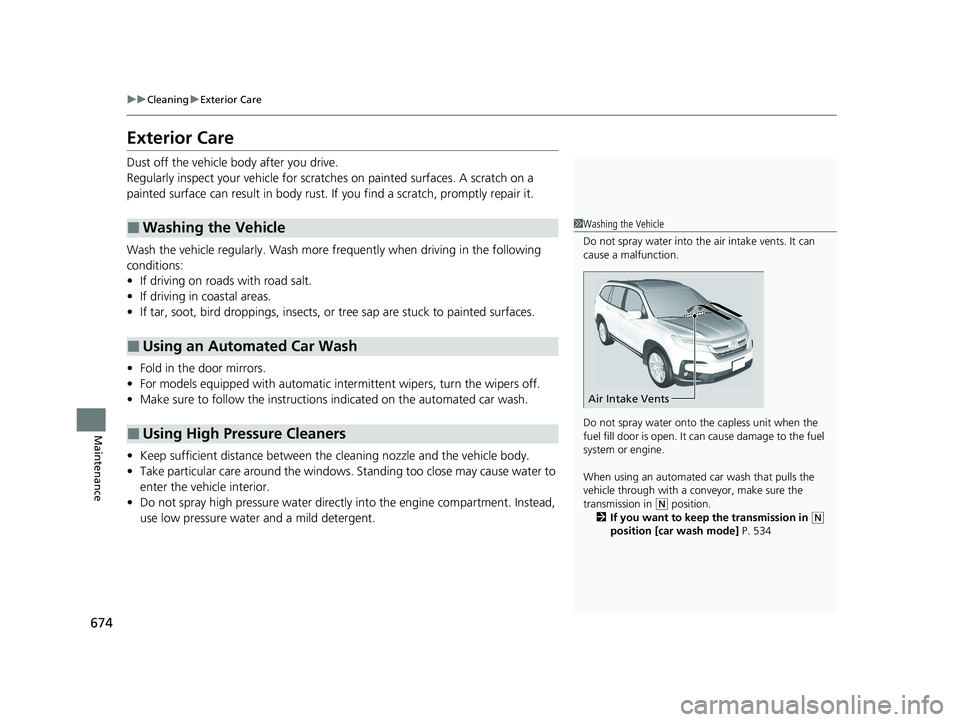
Do not spray water into the air intake vents. It can
cause a malfunction.
Do not spray water onto the capless unit when the
fuel fill door is open. It ca n cause damage to the fuel
system or engine.
When using an automated car wash that pulls the
vehicle through with a c onveyor, make sure the
transmission in
( N position.
2 If you want to keep the transmission in
(N
position [car wash mode] P. 534
Air Intake Vents
22 PILOT-31TG76600.book 674 ページ 2021年6月11日 金曜日 午後4時40分
Page 681 of 737
679
Handling the Unexpected
This chapter explains how to handle unexpected troubles.
ToolsTypes of Tools .................................. 680
If a Tire Goes Flat Changing a Flat Tire ......................... 681
Engine Does Not Start Checking the Engine ........................ 689
If the Keyless Remote Battery is Weak .. 690
Emergency Engine Stop ................... 691
If the Battery Is Dead ....................... 692
Overheating How to Handle Overheating ............. 695 Indicator, Coming On/Blinking
If the Low Oil Pressure Warning Appears ... 697If the Charging System Indicator Comes
On ................................................. 697
If the Malfunction Indicator Lamp Comes On or Blinks ................................... 698
If the Brake System Indicator (Red) Comes
On ................................................. 699
If the Electric Power Steering (EPS) System Indicator Comes On ....................... 699
If the Low Tire Pressure/Tire Pressure Monitoring System (TPMS) Indicator
Comes On or Blinks........................ 700
If the Transmission System Indicator Blinks
along with the Warning Message ....... 700
Fuses Fuse Locations ................................. 701
Inspecting and Changing Fuses ........ 705
Emergency Towing ........................... 706
If You Cannot Unlock the Fuel Fill Door.. 707
Refueling
Refueling From a Portable Fuel
Container ................................... 708
If You Cannot Open the Tailgate .... 709
22 PILOT-31TG76600.book 679 ページ 2021年6月11日 金曜日 午後4時40分