ECU HONDA PRELUDE 1990 User Guide
[x] Cancel search | Manufacturer: HONDA, Model Year: 1990, Model line: PRELUDE, Model: HONDA PRELUDE 1990Pages: 143, PDF Size: 2.07 MB
Page 85 of 143

5. Reinstall the drain bolt with a new washer and tighten it securely.
Refill the engine with the recommended oil, to the upper mark on
the dipstick.
ENGINE OIL CHANGE CAPACITY (including filter):
3.8 l (4,0 US qt, 3.3 Imp qt)
6. Start the engine and make sure oil is not leaking from the drain
bolt or filter.
7. Shut off the engine and recheck the oil level.
NOTE:
Please dispose of used motor oil in a manner that is compatible with
the environment. We suggest you take it in a sealed container to
your local service station for reclamation. Do not throw it in the
trash or pour it on the ground.
CAUTION:
Used motor oil may cause skin cancer if repeatedly left in contact
with the skin for prolonged periods. Although this is unlikely unless you handle used oil on a daily basis, it is still advisable to
thoroughly wash your hands with soap and water as soon as possible after handing used oil.ProCarManuals.comMain Menu t s
Page 86 of 143
Transmission Oil/Fluid Check
Transmission oil/fluid must be checked with the engine off and the
car on level ground.
If the engine has been running, some engine components may
be hot enough to burn you. Keep hands away from the radiator fan. The fan may start
automatically without warning and run for up to 15 minutes,
even after the engine is turned off.
CAUTION:
If the oil/fluid level is low, check for possible leaks before adding
oil. Do not overfill.
Since the transmission and differential are in the same housing, you
are actually checking both oil/fluid levels in one procedure. Change
transmission oil/fluid according to the Maintenance Schedule on
page 78 .
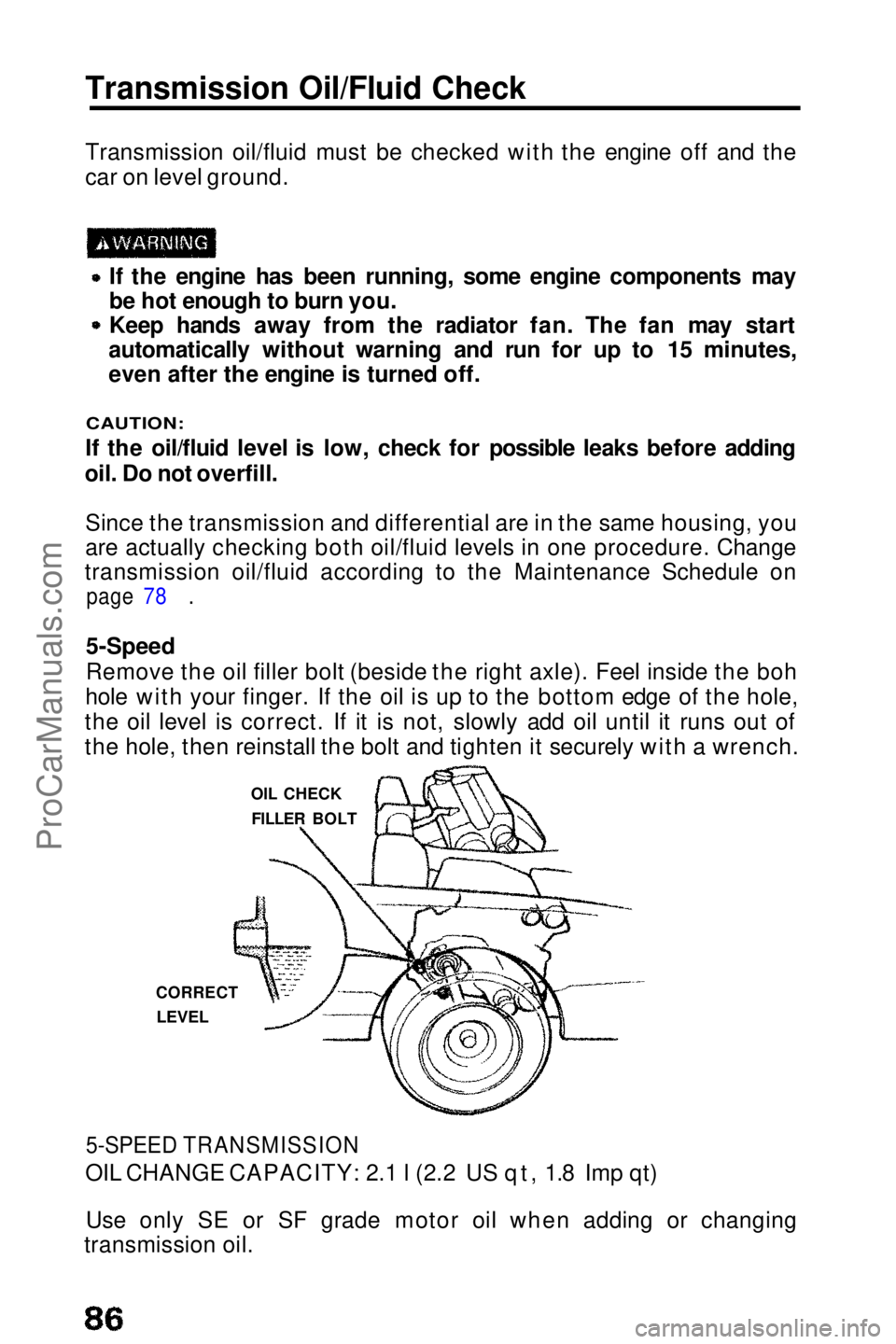
5-Speed
Remove the oil filler bolt (beside the right axle). Feel inside the boh
hole with your finger. If the oil is up to the bottom edge of the hole,
the oil level is correct. If it is not, slowly add oil until it runs out of
the hole, then reinstall the bolt and tighten it securely with a wrench.
CORRECT
LEVEL
5-SPEED TRANSMISSION
OIL CHANGE CAPACITY: 2.1 l (2.2 US qt, 1.8 Imp qt)
Use only SE or SF grade motor oil when adding or changing
transmission oil. OIL CHECK
FILLER BOLTProCarManuals.comMain Menu t s
Page 87 of 143
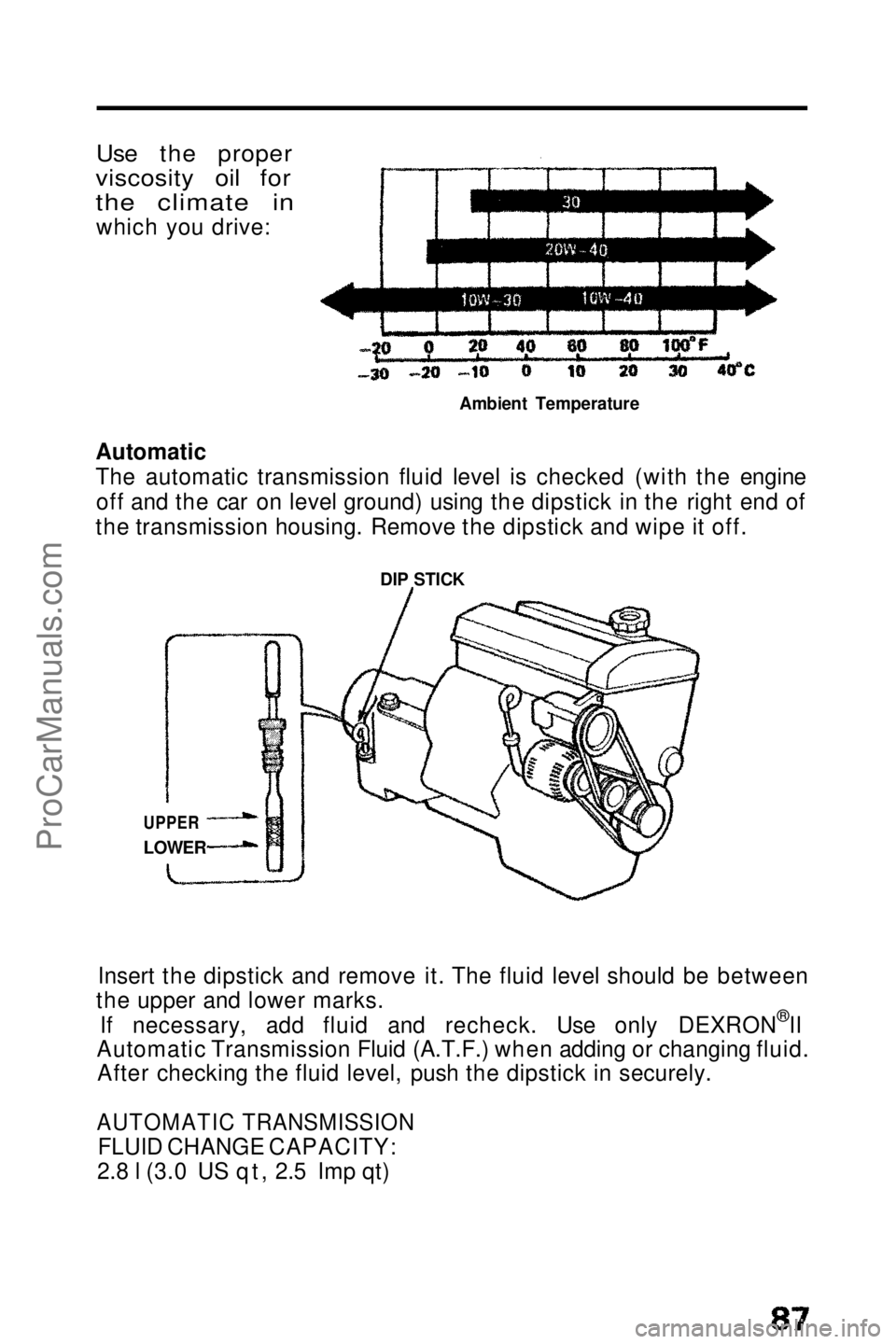
Use the proper
viscosity oil for
the climate in
which you drive:
Ambient Temperature
Automatic
The automatic transmission fluid level is checked (with the engine off and the car on level ground) using the dipstick in the right end of
the transmission housing. Remove the dipstick and wipe it off.
Insert the dipstick and remove it. The fluid level should be between
the upper and lower marks.
If necessary, add fluid and recheck. Use only DEXRON ®
II
Automatic Transmission Fluid (A.T.F.) when adding or changing fluid. After checking the fluid level, push the dipstick in securely.
AUTOMATIC TRANSMISSION
FLUID CHANGE CAPACITY:
2.8 l (3.0 US qt, 2.5 Imp qt) DIP STICK
UPPER
LOWERProCarManuals.comMain Menu t s
Page 89 of 143
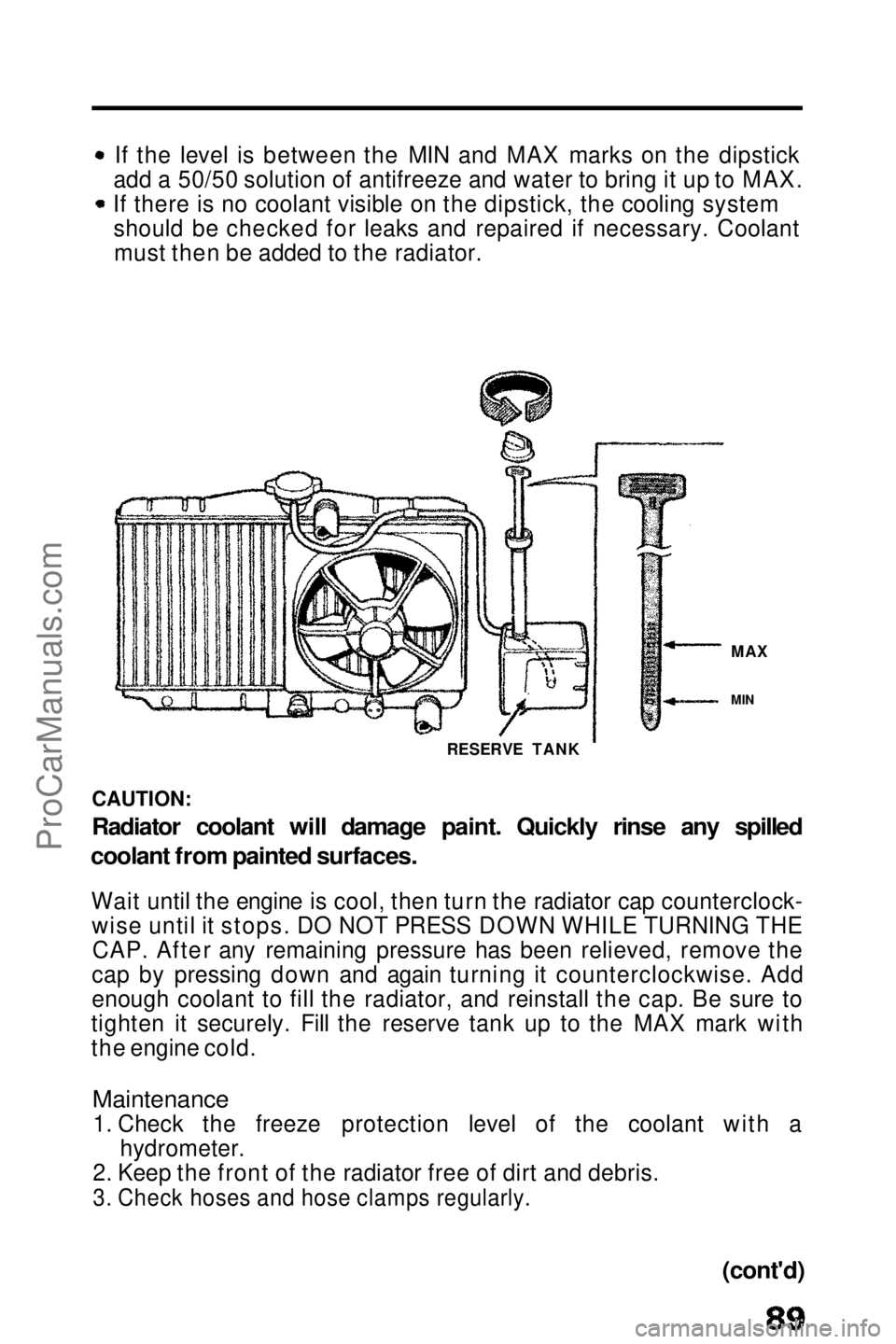
If the level is between the MIN and MAX marks on the dipstick
add a 50/50 solution of antifreeze and water to bring it up to MAX. If there is no coolant visible on the dipstick, the cooling system
should be checked for leaks and repaired if necessary. Coolantmust then be added to the radiator.
CAUTION:
Radiator coolant will damage paint. Quickly rinse any spilled
coolant from painted surfaces.
Wait until the engine is cool, then turn the radiator cap counterclock-wise until it stops. DO NOT PRESS DOWN WHILE TURNING THECAP. After any remaining pressure has been relieved, remove the
cap by pressing down and again turning it counterclockwise. Add
enough coolant to fill the radiator, and reinstall the cap. Be sure to
tighten it securely. Fill the reserve tank up to the MAX mark with
the engine cold.
Maintenance
1. Check the freeze protection level of the coolant with a hydrometer.
2. Keep the front of the radiator free of dirt and debris.
3. Check hoses and hose clamps regularly.
(cont'd)
MAX
MIN
RESERVE TANKProCarManuals.comMain Menu t s
Page 90 of 143
Cooling System (cont'd)
Thermostat The thermostat in the cooling system does not need to be changedfor summer or winter operation. However, for extremely cold
climates, an optional thermostat is available from your Honda dealer.
Replacing CoolantReplace coolant at 36 months or 45,000 miles (72,000 km),
whichever comes first. Thereafter, replace every 2 years or 30,000
miles (48,000 km), whichever comes first.
RADIATOR COOLANT
REFILL CAPACITY:
including reserve tank 0.75 l (0.198 US gal, 0.165 Imp gal)
Manual transmission 2.0 S: 5.15 l (1.361 US gal, 1.133 Imp gal)
2.0 Si,Si: 6.15 l (1.625 US gal, 1.353 Imp gal)
Automatic transmission 2.0S:5.85 l (1.546 US gal, 1.287 Imp gal)
2.0 Si,Si: 6.15 l (1.625 US gal, 1.353 Imp gal)
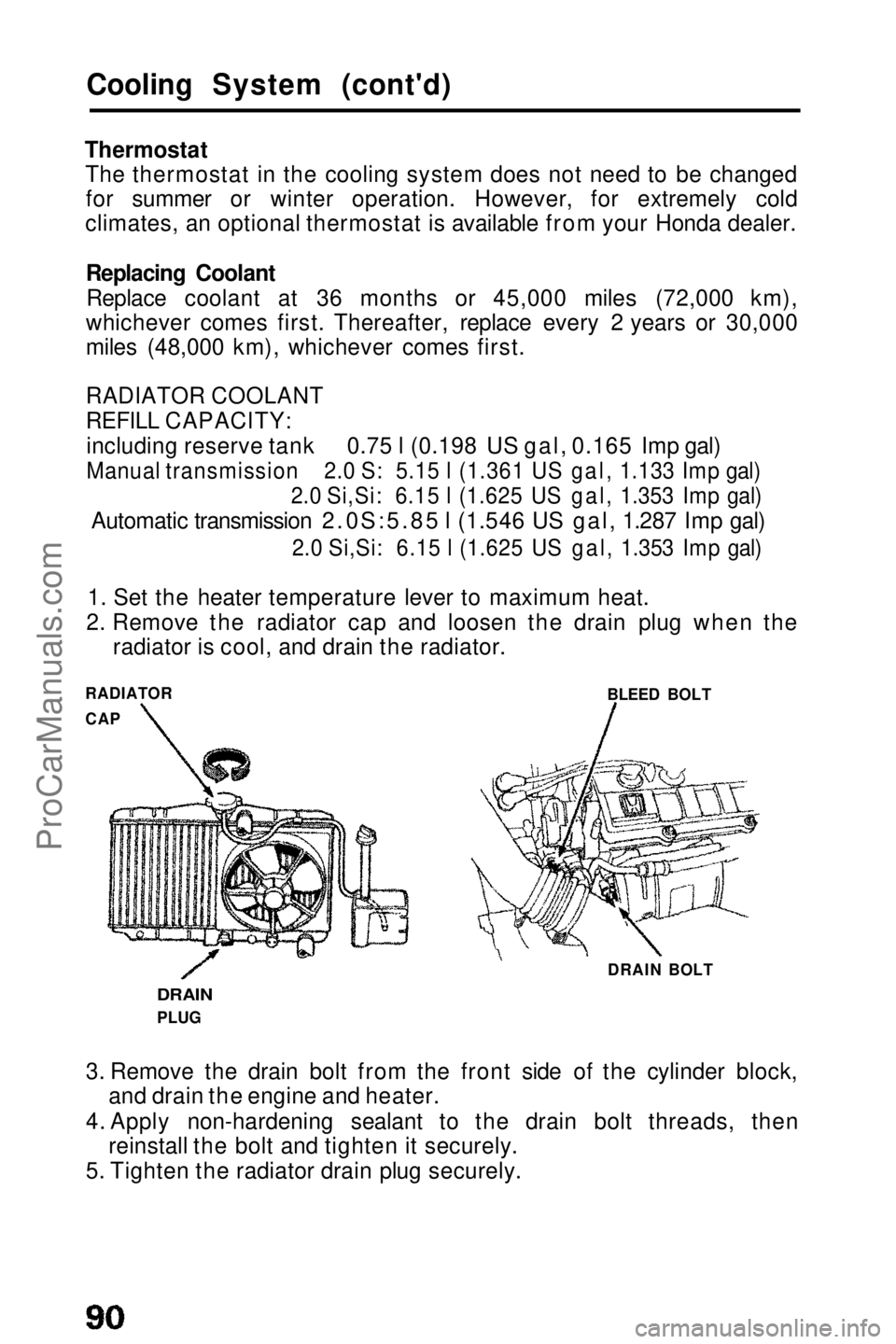
1. Set the heater temperature lever to maximum heat.
2. Remove the radiator cap and loosen the drain plug when the radiator is cool, and drain the radiator.
RADIATOR
CAP BLEED BOLT
DRAIN BOLT
3. Remove the drain bolt from the front side of the cylinder block, and drain the engine and heater.
4. Apply non-hardening sealant to the drain bolt threads, then reinstall the bolt and tighten it securely.
5. Tighten the radiator drain plug securely.
DRAIN
PLUGProCarManuals.comMain Menu t s
Page 93 of 143
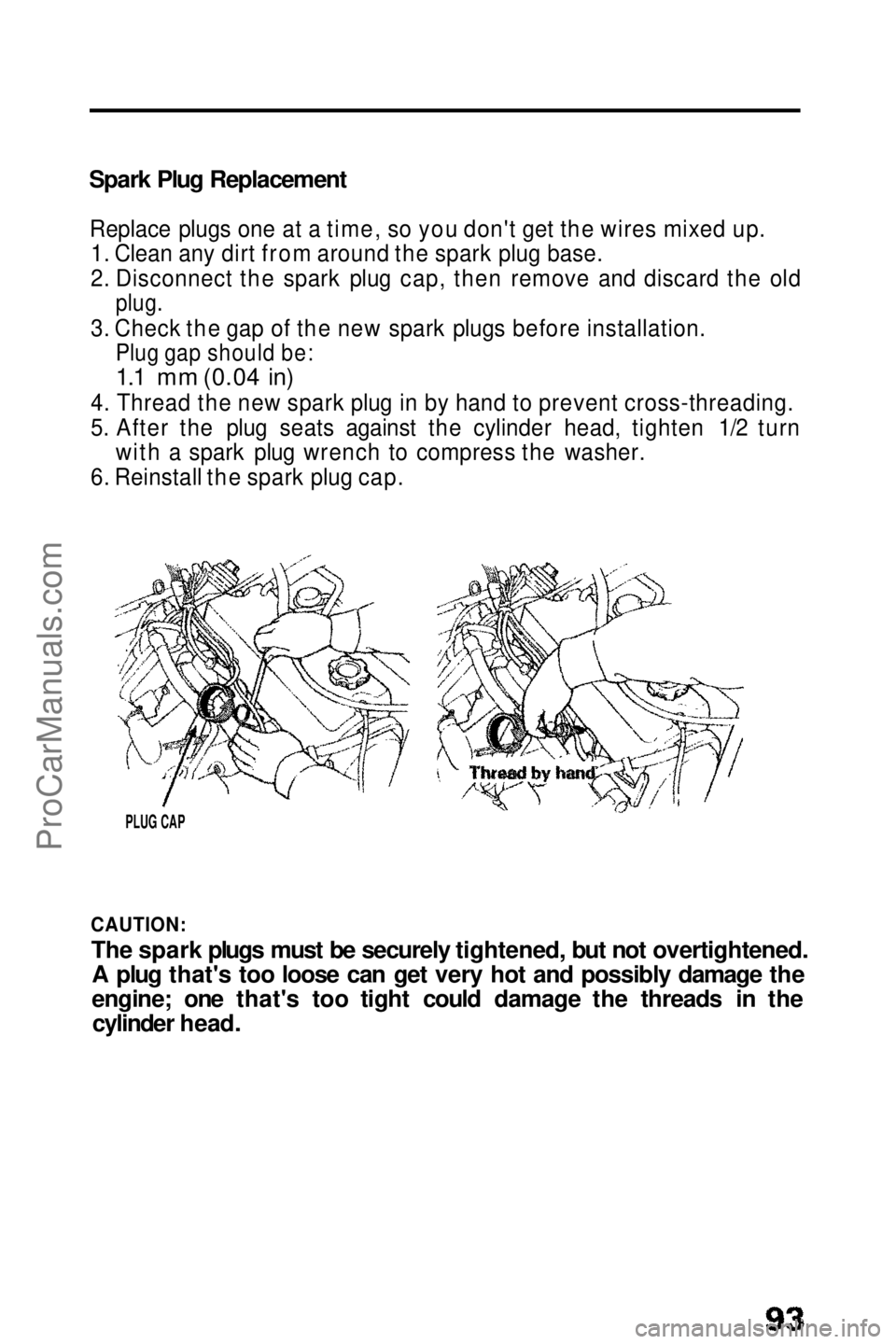
Spark Plug Replacement
Replace plugs one at a time, so you don't get the wires mixed up. 1. Clean any dirt from around the spark plug base.
2. Disconnect the spark plug cap, then remove and discard the old
plug.
3. Check the gap of the new spark plugs before installation.
Plug gap should be:
1.1 mm (0.04 in)
4. Thread the new spark plug in by hand to prevent cross-threading.
5. After the plug seats against the cylinder head, tighten 1/2 turn with a spark plug wrench to compress the washer.
6. Reinstall the spark plug cap.
CAUTION:
The spark plugs must be securely tightened, but not overtightened.A plug that's too loose can get very hot and possibly damage the
engine; one that's too tight could damage the threads in thecylinder head.
PLUG CAPProCarManuals.comMain Menu t s
Page 95 of 143
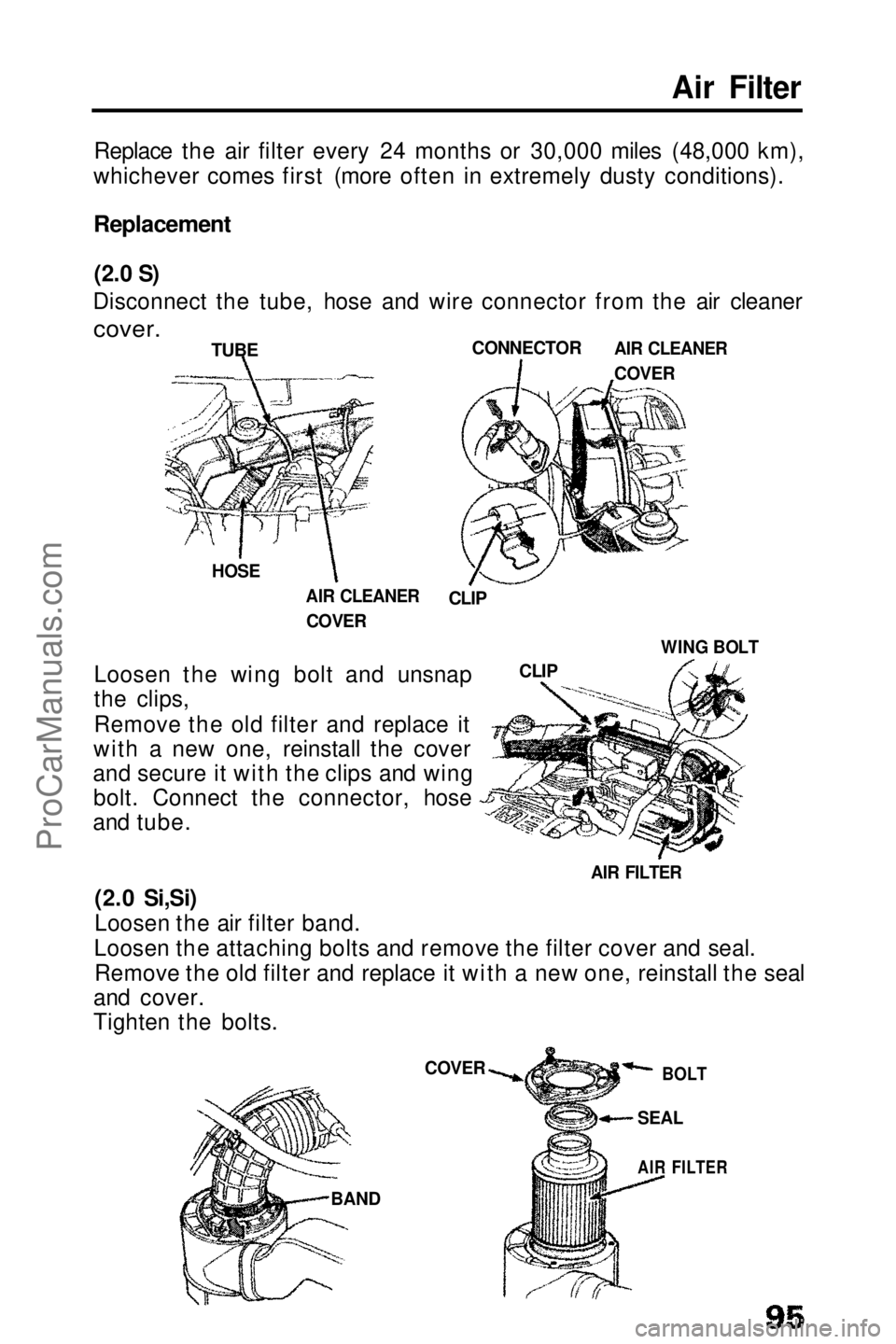
Air Filter
Replace the air filter every 24 months or 30,000 miles (48,000 km),
whichever comes first (more often in extremely dusty conditions).
Replacement
(2.0 S)
Disconnect the tube, hose and wire connector from the air cleaner
cover.
WING BOLT
CLIP
Loosen the wing bolt and unsnap
the clips,
Remove the old filter and replace it
with a new one, reinstall the cover
and secure it with the clips and wing bolt. Connect the connector, hose
and tube.
(2.0 Si,Si)
Loosen the air filter band.
Loosen the attaching bolts and remove the filter cover and seal. Remove the old filter and replace it with a new one, reinstall the seal
and cover.
Tighten the bolts.
TUBE
CLIP
AIR CLEANER
COVER
CONNECTOR
AIR CLEANER
COVER
HOSE
AIR FILTER
BAND COVER
BOLT
SEAL
AIR FILTERProCarManuals.comMain Menu t s
Page 118 of 143
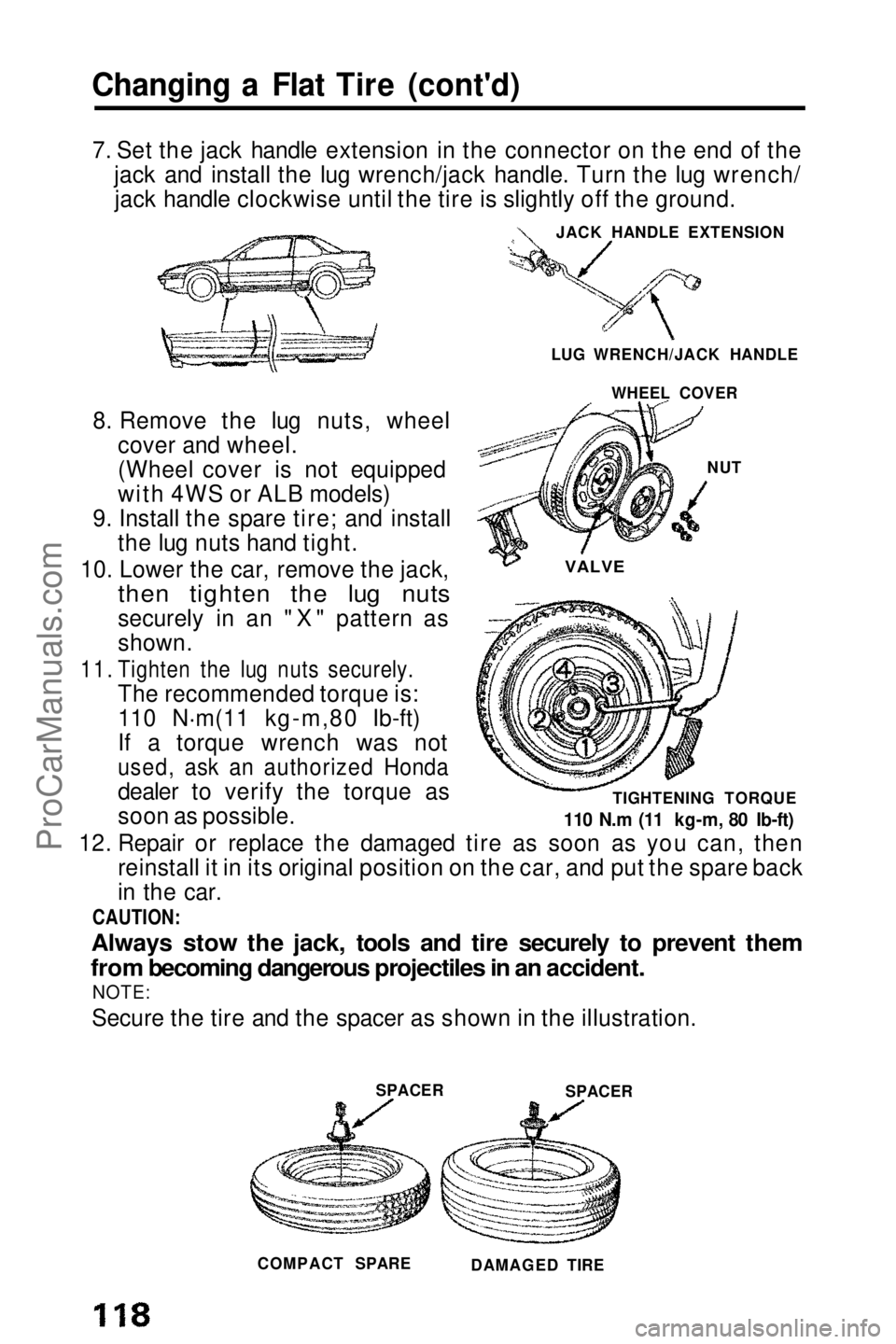
Changing a Flat Tire (cont'd)
7. Set the jack handle extension in the connector on the end of the jack and install the lug wrench/jack handle. Turn the lug wrench/jack handle clockwise until the tire is slightly off the ground.
8. Remove the lug nuts, wheel cover and wheel.
(Wheel cover is not equipped
with 4WS or ALB models)
9. Install the spare tire; and install the lug nuts hand tight.
10. Lower the car, remove the jack,
then tighten the lug nuts
securely in an "X" pattern as
shown.11. Tighten the lug nuts securely.
The recommended torque is:
110 N .
m(11 kg-m,80 Ib-ft)
If a torque wrench was not
used, ask an authorized Honda
dealer to verify the torque as
soon as possible.
12. Repai
r or replace the damaged tire as soon as you can, then
reinstall it in its original position on the car, and put the spare back
in the car.
CAUTION:
Always stow the jack, tools and tire securely to prevent them
from becoming dangerous projectiles in an accident.
NOTE:
Secure the tire and the spacer as shown in the illustration.
COMPACT SPARE
DAMAGED TIRESPACER
SPACER TIGHTENING TORQUE
110 N.m (11 kg-m, 80 Ib-ft)
VALVE
NUT
WHEEL COVER
LUG WRENCH/JACK HANDLE JACK HANDLE EXTENSIONProCarManuals.comMain Menu t s
Page 131 of 143

Evaporative Emission Control System
The Evaporative Emission Control System is designed to prevent
fuel vapors from escaping into the atmosphere.
(2.0 Si,Si)
Fuel vapors from the fuel tank are directed into the charcoal
canister where they are adsorbed and stored while the engine is
stopped or idling. When the coolant temperature rises to a certain
value, the vapors are drawn into the engine through the throttle body and the intake manifold during normal engine operation.
(2.0 S)Fuel vapors from the fuel tank and carburetor are directed into the
charcoal canister where they are adsorbed and stored while the
engine is stopped.
When the engine is running and engine coolant temperature is above
the set temperature of the thermo sensor, the purge control diaphragm valve is open so that fuel vapors in the charcoal canister may be drawn into the engine through the carburetor and the intake
manifold.
Engine Exhaust Controls
The engine exhaust emission control systems are designed to
control combustion during idle, acceleration, cruise, and deceleration.
These systems are entirely separate from the crankcase and evaporative emission control systems described previously. HONDA PGM-FI System (2.0 Si,Si)
The PGM-FI system consists of three independent sub-systems; Air intake, Electronic Control and Fuel Control, thus allowing moreaccurate control of air/fuel ratios under all operating conditions.
The Electronic Control Unit (ECU) detects the amount of air
drawn into the cylinders and determines the amount of fuel to be injected to provide the optimum air/fuel ratio for all engine needs.
(cont'd)ProCarManuals.comMain Menu t s