lock HONDA PRELUDE 1990 Owners Manual
[x] Cancel search | Manufacturer: HONDA, Model Year: 1990, Model line: PRELUDE, Model: HONDA PRELUDE 1990Pages: 143, PDF Size: 2.07 MB
Page 3 of 143
Keys and Locks
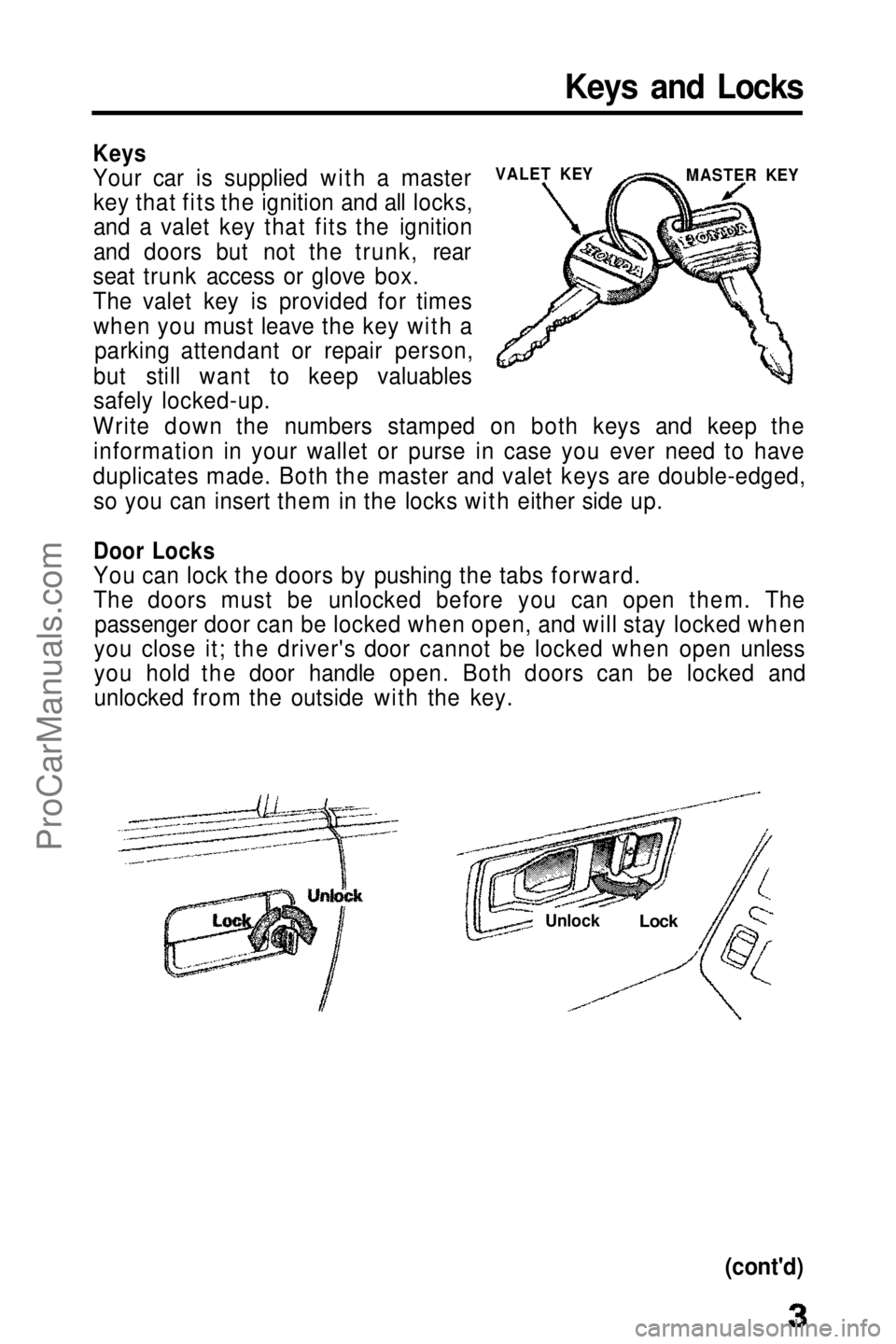
VALET KEY
MASTER KEY
Keys
Your car is supplied with a master
key that fits the ignition and all locks,
and a valet key that fits the ignition
and doors but not the trunk, rear
seat trunk access or glove box.
The valet key is provided for times
when you must leave the key with a parking attendant or repair person,
but still want to keep valuables
safely locked-up.
Write down the numbers stamped on both keys and keep the information in your wallet or purse in case you ever need to have
duplicates made. Both the master and valet keys are double-edged, so you can insert them in the locks with either side up.
Door Locks
You can lock the doors by pushing the tabs forward.
The doors must be unlocked before you can open them. The passenger door can be locked when open, and will stay locked when
you close it; the driver's door cannot be locked when open unless
you hold the door handle open. Both doors can be locked and
unlocked from the outside with the key.
(cont'd)
Lock
Unlock
ProCarManuals.comMain Menu t s
Page 4 of 143
Keys and Locks (cont'd)
Power Door Locks (Si with 4WS)
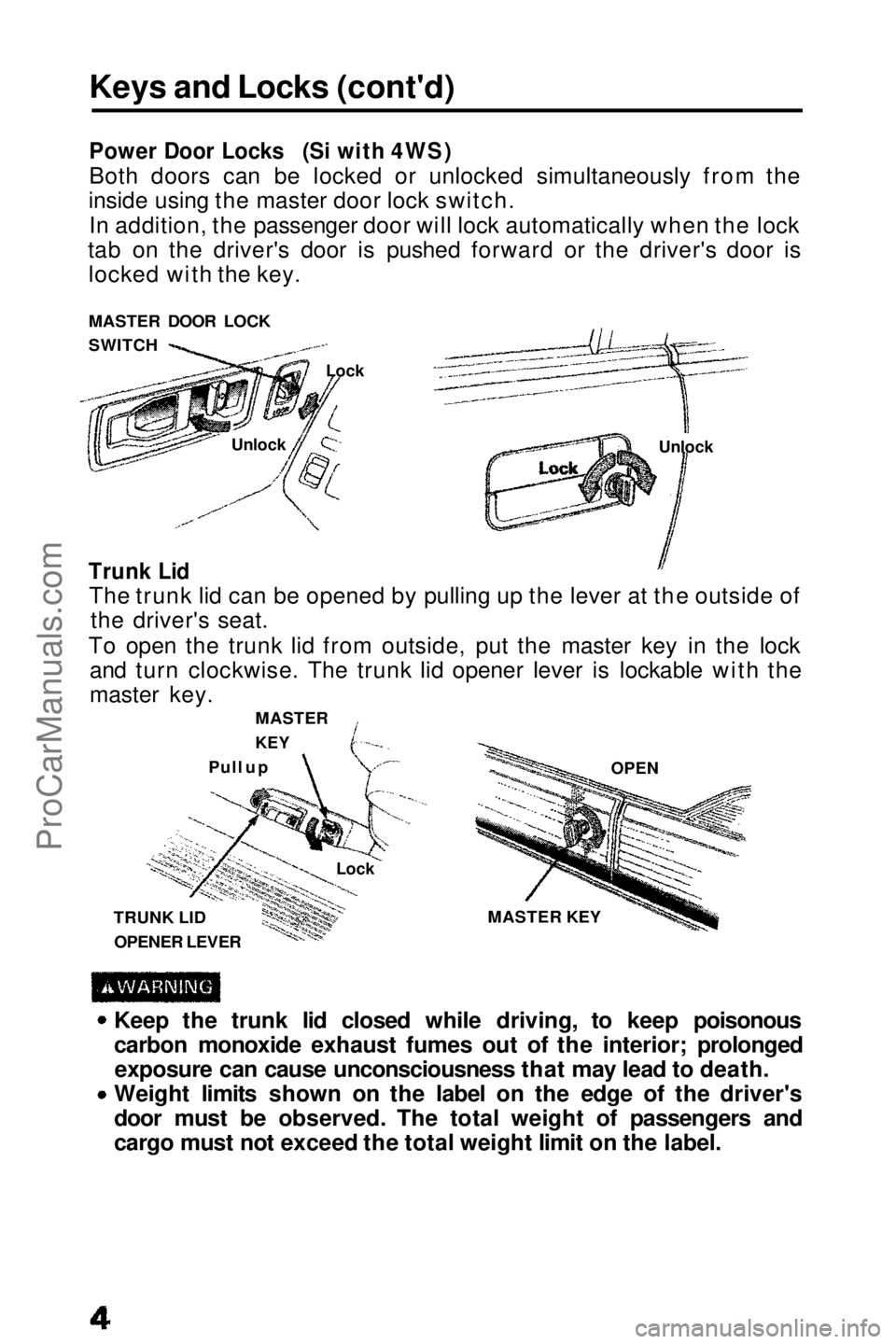
Both doors can be locked or unlocked simultaneously from the
inside using the master door lock switch.
In addition, the passenger door will lock automatically when the lock
tab on the driver's door is pushed forward or the driver's door is locked with the key.
MASTER DOOR LOCK
SWITCH
Trunk Lid
The trunk lid can be opened by pulling up the lever at the outside of the driver's seat.
To open the trunk lid from outside, put the master key in the lock and turn clockwise. The trunk lid opener lever is lockable with the
master key.
Keep the trunk lid closed while driving, to keep poisonous
carbon monoxide exhaust fumes out of the interior; prolongedexposure can cause unconsciousness that may lead to death. Weight limits shown on the label on the edge of the driver's
door must be observed. The total weight of passengers and
cargo must not exceed the total weight limit on the label.
Unlock
OPEN
MASTER KEY
MASTER
KEY
Pull up
Lock
TRUNK LID
Lock
Unlock
OPENER LEVERProCarManuals.comMain Menu t s
Page 5 of 143
Seats
Front Seat
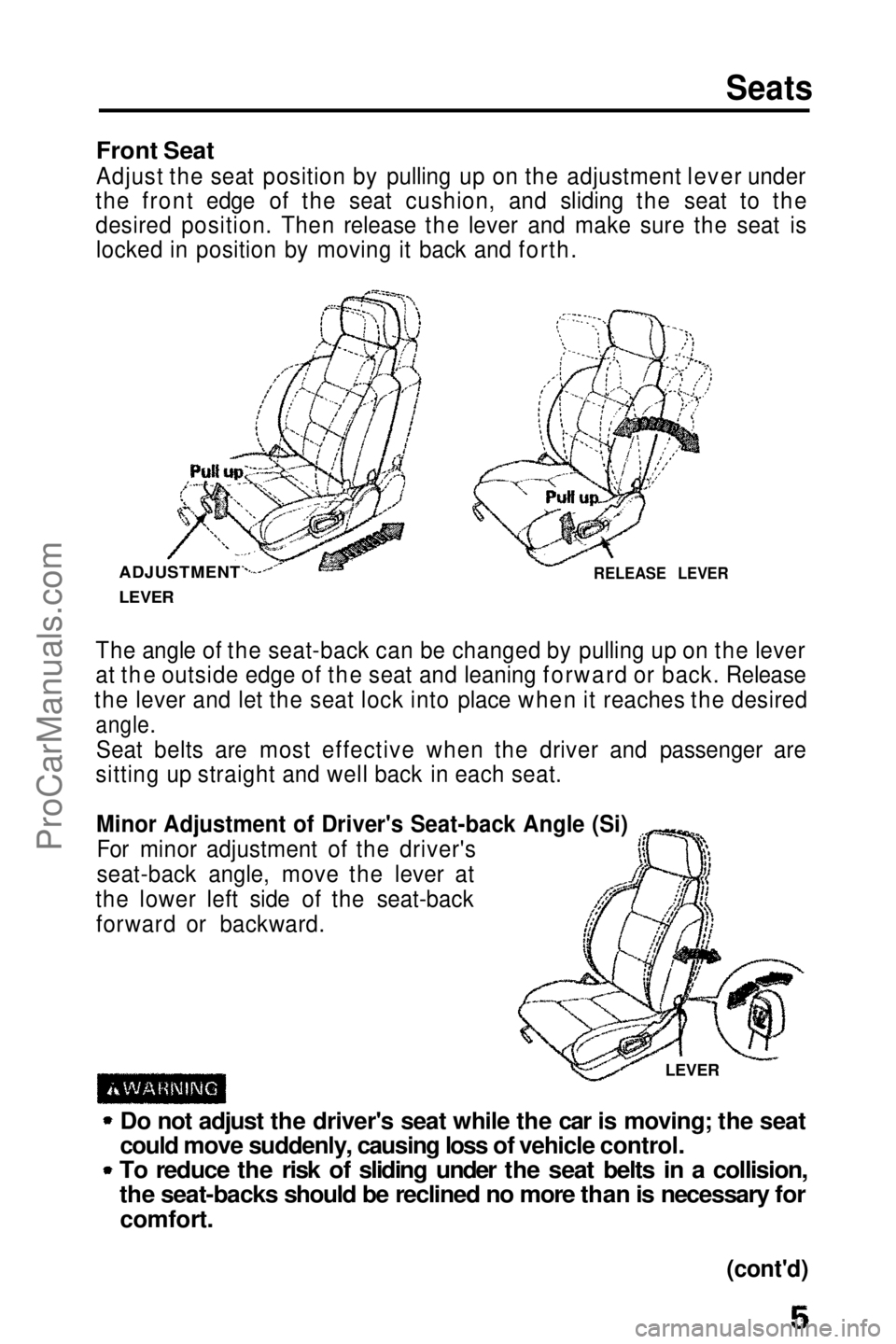
Adjust the seat position by pulling up on the adjustment lever under
the front edge of the seat cushion, and sliding the seat to the
desired position. Then release the lever and make sure the seat is locked in position by moving it back and forth.
ADJUSTMENT
LEVER
RELEASE LEVER
The angle of the seat-back can be changed by pulling up on the lever
at the outside edge of the seat and leaning forward or back. Release
the lever and let the seat lock into place when it reaches the desired
angle.
Seat belts are most effective when the driver and passenger are
sitting up straight and well back in each seat.
Minor Adjustment of Driver's Seat-back Angle (Si)
For minor
adjustment of the driver's
seat-back angle, move the lever at
the lower left side of the seat-back forward or backward.
Do not adjust the driver's seat while the car is moving; the seat
could move suddenly, causing loss of vehicle control.
To reduce the risk of sliding under the seat belts in a collision,
the seat-backs should be reclined no more than is necessary for
comfort.
(cont'd)
LEVERProCarManuals.comMain Menu t s
Page 9 of 143
Trunk Access from Rear Seat
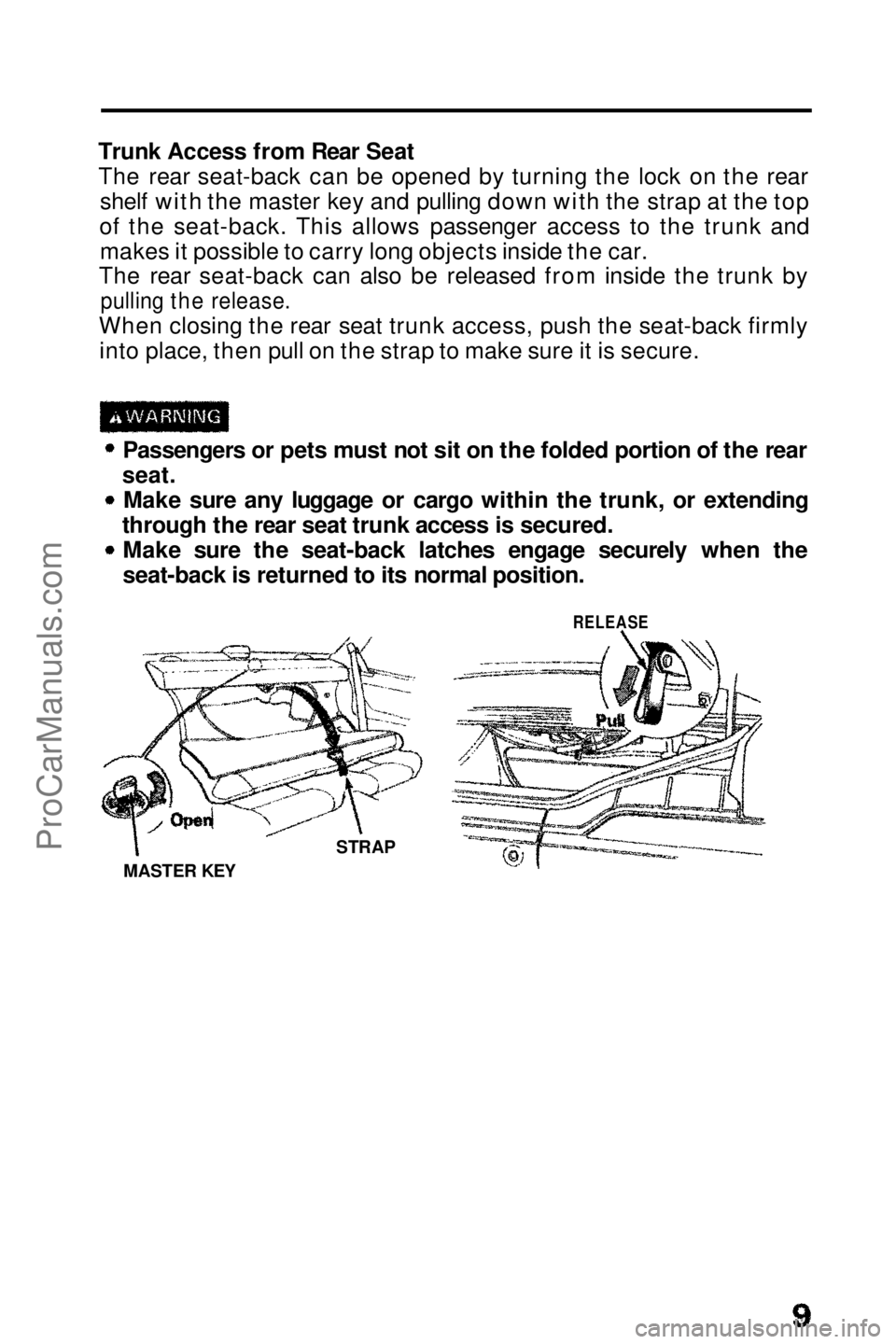
The rear seat-back can be opened by turning the lock on the rear
shelf with the master key and pulling down with the strap at the top
of the seat-back. This allows passenger access to the trunk and makes it possible to carry long objects inside the car.
The rear seat-back can also be released from inside the trunk by
pulling the release.
When closing the rear seat trunk access, push the seat-back firmly into place, then pull on the strap to make sure it is secure.
Passengers or pets must not sit on the folded portion of the rear
seat. Make sure any luggage or cargo within the trunk, or extending
through the rear seat trunk access is secured. Make sure the seat-back latches engage securely when the
seat-back is returned to its normal position.
RELEASE
MASTER KEY STRAPProCarManuals.comMain Menu t s
Page 10 of 143
Seat Belts
Your Honda is provided with seat belts to minimize the chance ofinjury to yourself and your passengers in a sudden stop or accident.
For precautions on using seat belts for children, babies and pregnantwomen, see pages 14 through 16.
Seat belts are most effective when the driver and passengers are
sitting up straight and well back in the seat.
In the event of a collision, occupants not wearing seat belts could
be seriously or fatally injured. Make sure you and all your passengers ALWAYS put on the seat belts before driving away.
CAUTION:
Be careful the seat belts are not damaged by catching or
entangling in the door or seat mechanism.
Wearing the Front Seat Belts The automatic ("passive") lap/shoulder belt system with emergency locking retractors are designed to lock only during a sudden stop or
impact. Otherwise, they allow you some freedom of movement in
the seat.
NOTE:
The motion-sensing lock mechanisms for the front belts are located in the doors, therefore, if you open the door too quickly, the belt
may lock and the door cannot be opened further. If this happens,
close the door and open it again more slowly.
1. Enter the car and close the door completely. If the door is not closed completely, the belt will not function properly, the warning
light on the instrument panel will come on and the beeper will
sound when the ignition switch is in the ON position. See page
13
Never drive the car with the doors ajar. The doors must be closed
completely for the front seat belts to function properly.
2. Move the seat a comfortable distance from the steering wheel, sit as straight up as possible and well back in the seat.
3. Position the belt across your lap, not your abdomen, as low on your hips as possible. Be sure the belt is not twisted.ProCarManuals.comMain Menu t s
Page 12 of 143
Seat Belts (cont'd)
Buckling the Rear Lap/Shoulder Belts
The rear seat belts are one-piece combination lap/shoulder belts
with emergency locking retractors designed to lock only during a
sudden stop or impact. Otherwise, they allow you some freedom of
movement in the seat.
NOTE:
The emergency locking system of the rear seat belts will also be
activated if you pull the belt too fast. If this happens, release the belt slightly then pull it out more slowly.
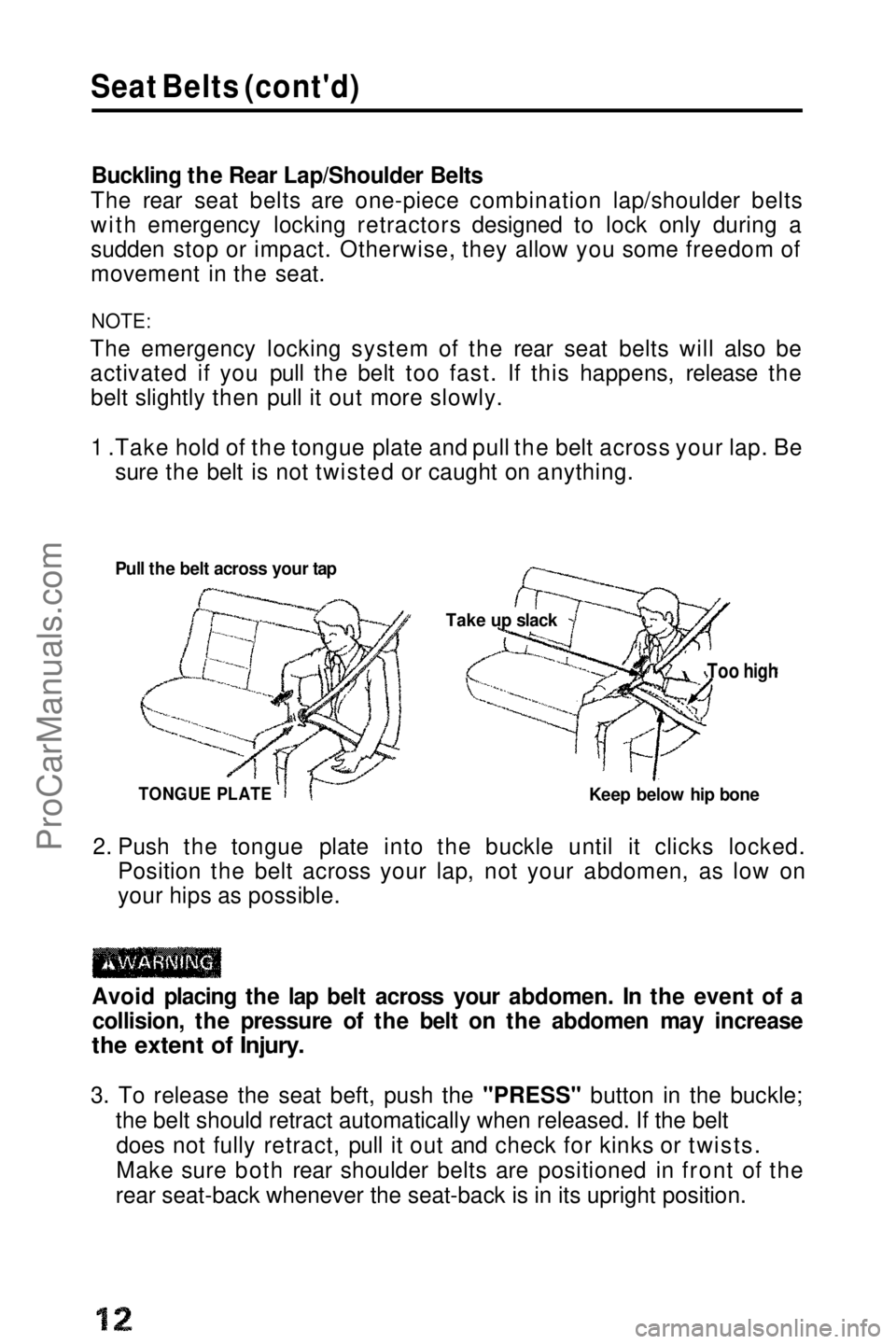
1 .Take hold of the tongue plate and pull the belt across your lap. Be sure the belt is not twisted or caught on anything.
Pull the belt across your tap
2. Push the tongue plate into the buckle until it clicks locked. Position the belt across your lap, not your abdomen, as low on
your hips as possible.
Avoid placing the lap belt across your abdomen. In the event of a collision, the pressure of the belt on the abdomen may increase
the extent of Injury.
3. To release the seat beft, push the "PRESS" button in the buckle;
the belt should retract automatically when released. If the belt
does no
t fully retract, pull it out and check for kinks or twists.
Make sure both rear shoulder belts are positioned in front of the
rear seat-back whenever the seat-back is in its upright position.
Too high
Keep below hip bone
Take up slack
TONGUE PLATEProCarManuals.comMain Menu t s
Page 18 of 143
ALB (Anti Lock Brakes) help to maintain the road holding and
tractability of your car during severe braking, and under slippery road conditions. The ALB system prevents the wheels from locking(thus reducing the chance of skidding) to ensure controllable
deceleration. When sudden braking might otherwise lock one or more wheels, the ALB system temporarily reduces the braking
pressure to the wheel or wheels about to lock to ensure continued
braking efficiency.
When the ALB is regulating the braking pressure, the brake pedal pulsates slightly to make the driver aware that the system is
compensating for critical braking conditions. The pulsating brake pedal can be an indication of hazardous road condition, and to
remind you to take extra care.
Don't mix different diameter tires; it will confuse the ALB
computer which monitors the road speed of each wheel. For
example, if one or more tires are larger than the others, the computer will think they are rolling more slowly (as if they are
about to lock up) and reduce brake pressure to those wheels.On loose or uneven surfaces (gravel, ruts etc.) where all four
wheels loss traction intermittently, the ALB system may require
a longer stopping distance than an equivalent car with a conventional braking system.
The ALB system cannot make up for extreme road conditions or driver misjudgement, It is still the driver's responsibility to drive
at a suitable speed and provide a margin of safety for the road,
weather and traffic conditions at hand.
CAUTION:
Be careful not to damage the wiring or the speed sensors at the
back of each wheel when removing mud or snow from the wheel
housings.
NOTE:
You may hear a sound like a small motor running, coming from the engine while driving or after the ALB is applied. This indicates theALB pump is in service and the system is working properly.
Ant
i
Lock Brake (Si with ALB)
ProCarManuals.comMain Menu t s
Page 19 of 143
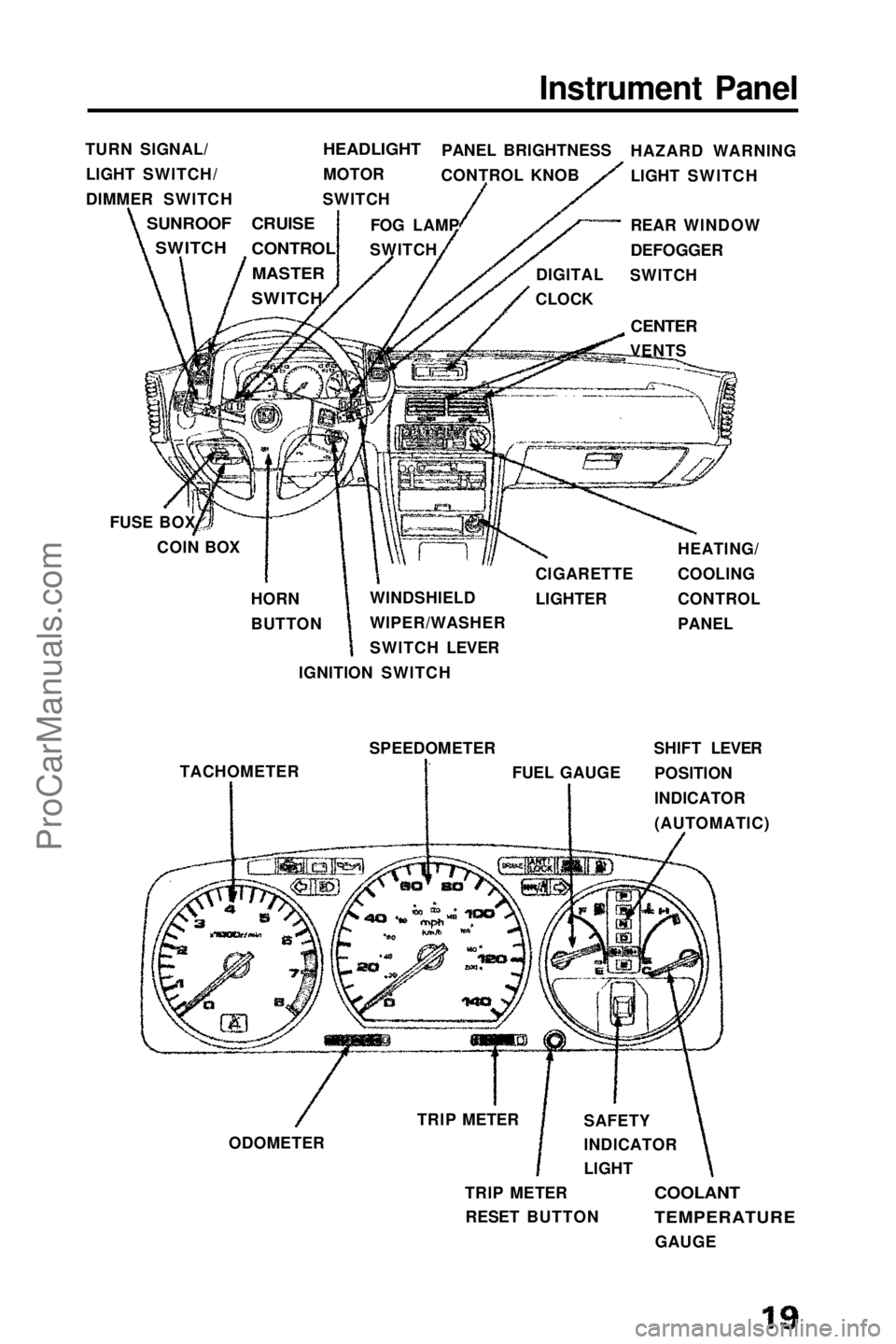
Instrument Panel
TURN SIGNAL/ LIGHT SWITCH/
DIMMER SWITCH
SUNROOFSWITCH
HEADLIGHT
MOTOR
SWITCH PANEL BRIGHTNESS
CONTROL KNOB HAZARD WARNING
LIGHT SWITCH
FOG LAMP
SWITCH REAR WINDOW
DEFOGGER
SWITCH
DIGITAL
CLOCK
CENTER
VENTS
CRUISE
CONTROL
MASTER
SWITCH
FUSE BOX COIN BOX
HORN
BUTTON WINDSHIELD
WIPER/WASHER
SWITCH LEVER
IGNITION SWITCH CIGARETTE
LIGHTER
HEATING/
COOLING
CONTROL
PANEL
TACHOMETER SPEEDOMETER
FUEL GAUGESHIFT LEVER
POSITION
INDICATOR
(AUTOMATIC)
ODOMETER TRIP METER
TRIP METERRESET BUTTON SAFETY
INDICATOR
LIGHT
COOLANT
TEMPERATURE
GAUGEProCarManuals.comMain Menu t s
Page 24 of 143
Warning and indicator Lights (cont'd)
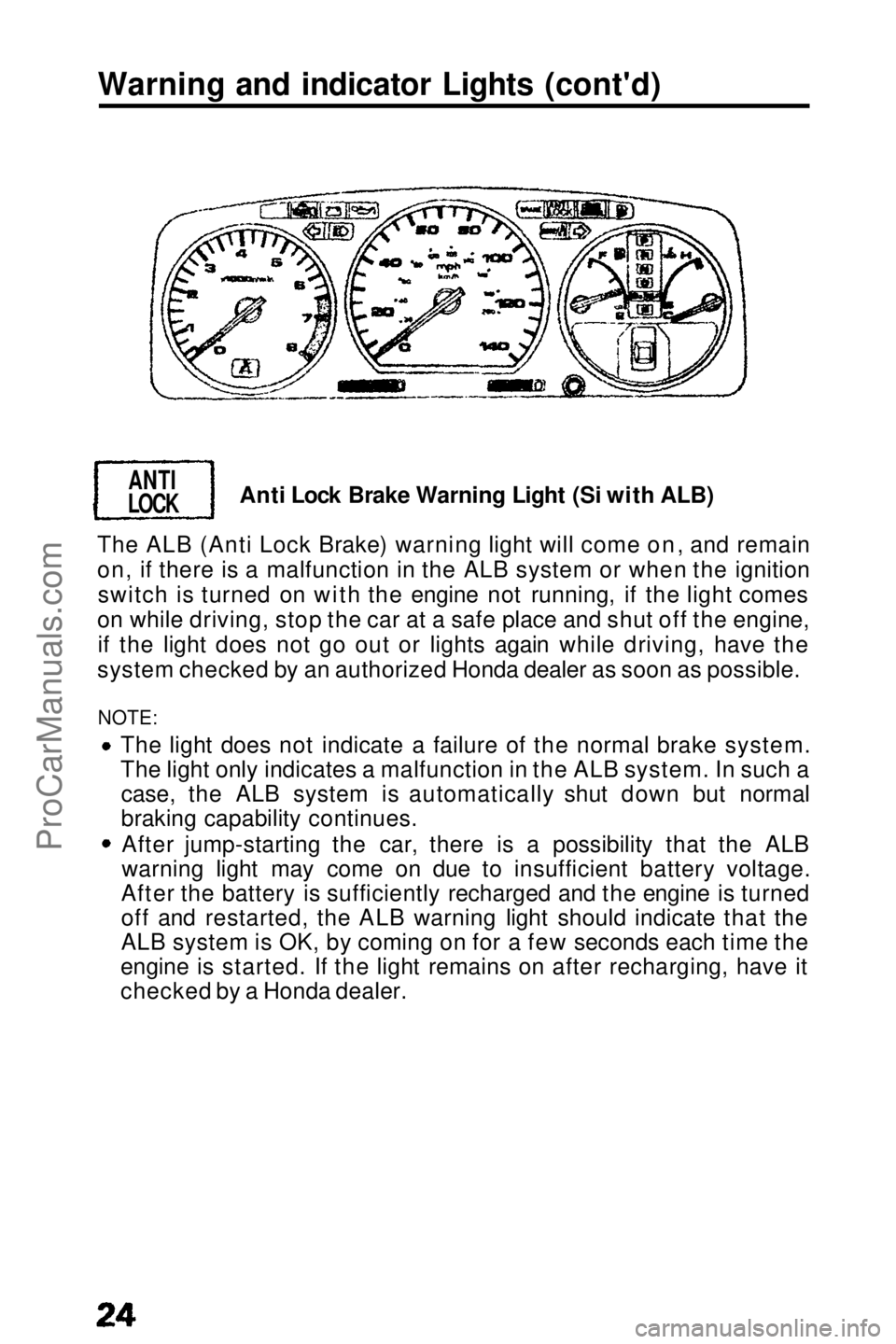
Anti Lock Brake Warning Light (Si with ALB)
The ALB (Anti Lock Brake) warning light will come on, and remain
on, if there is a malfunction in the ALB system or when the ignition switch is turned on with the engine not running, if the light comes
on while driving, stop the car at a safe place and shut off the engine, if the light does not go out or lights again while driving, have the
system checked by an authorized Honda dealer as soon as possible.
NOTE:
The light does not indicate a failure of the normal brake system.
The light only indicates a malfunction in the ALB system. In such acase, the ALB system is automatically shut down but normal
braking capability continues.
After jump-starting the car, there is a possibility that the ALB
warning light may come on due to insufficient battery voltage.
After the battery is sufficiently recharged and the engine is turned
off and restarted, the ALB warning light should indicate that the
ALB system is OK, by coming on for a few seconds each time the
engine is started. If the light remains on after recharging, have it
checked by a Honda dealer.
ANTI
LOCKProCarManuals.comMain Menu s t
Page 25 of 143
Safety Indicator Lights
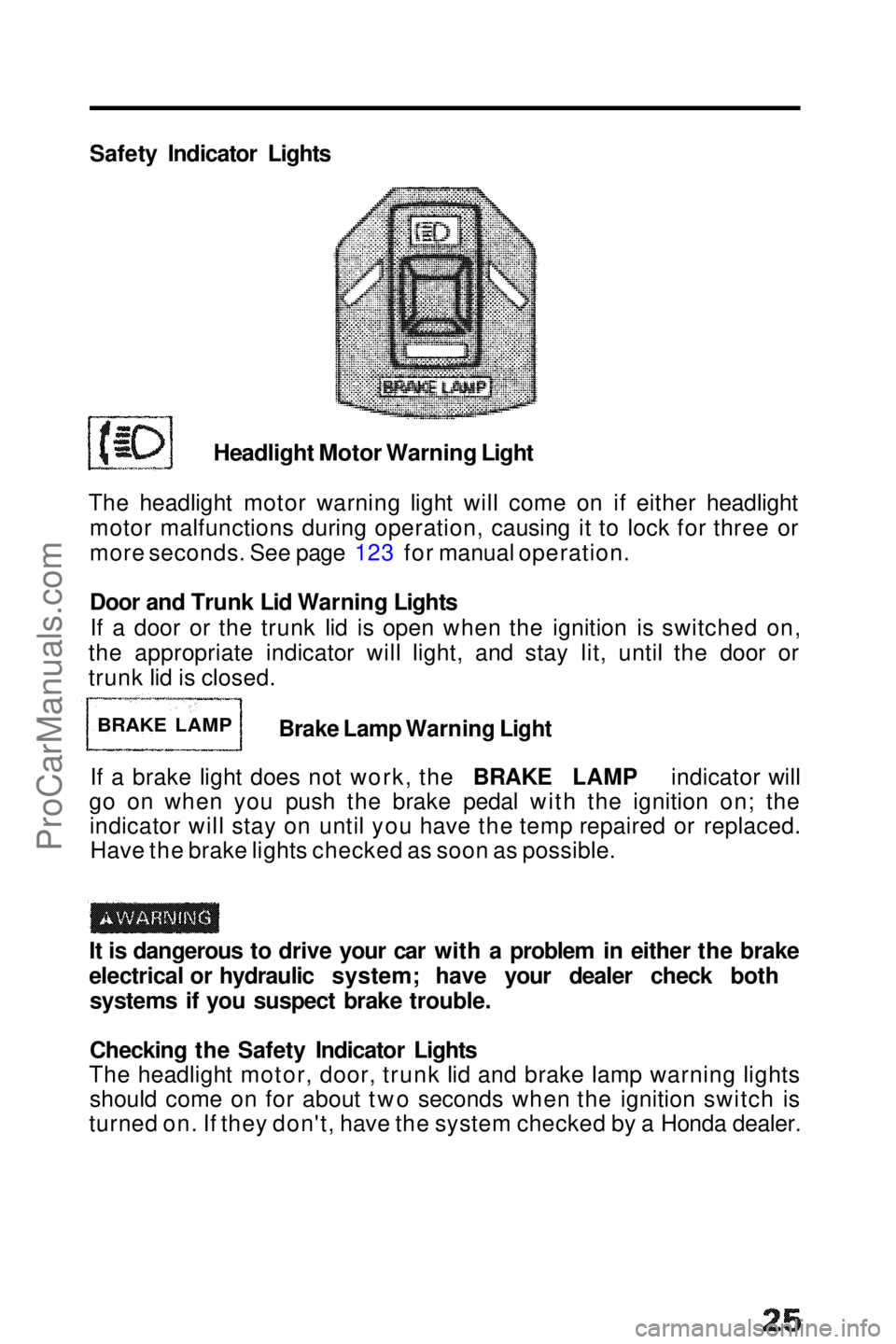
Headlight Motor Warning Light
The headlight motor warning light will come on if either headlight motor malfunctions during operation, causing it to lock for three or
more seconds. See page 123 for manual operation.
Door and Trunk Lid Warning Lights
If a door or the trunk lid is open when the ignition is switched on,
the appropriate indicator will light, and stay lit, until the door or
trunk lid is closed.
Brake Lamp Warning Light
If a brake light does not work, the BRAKE LAMP indicator will
go on when you push the brake pedal with the ignition on; the indicator will stay on until you have the temp repaired or replaced.Have the brake lights checked as soon as possible.
It is dangerous to drive your car with a problem in either the brake
electrical or hydraulic system; have your dealer check both systems if you suspect brake trouble.
Checking the Safety Indicator Lights
The headlight motor, door, trunk lid and brake lamp warning lights should come on for about two seconds when the ignition switch is
turned on. If they don't, have the system checked by a Honda dealer.
BRAKE LAMPProCarManuals.comMain Menu s t