fuel HONDA PRELUDE 1992 User Guide
[x] Cancel search | Manufacturer: HONDA, Model Year: 1992, Model line: PRELUDE, Model: HONDA PRELUDE 1992Pages: 225, PDF Size: 2.1 MB
Page 103 of 225
Fuel Economy
The condition of your car and your
driving habits are the two most
important things that affect the
fuel mileage you get.
Vehicle Condition
Always maintain your car accord-
ing to the maintenance schedule.
This will keep it in top operating
condition.
An important part of that mainte-
nance is the Periodic Checks
(see page
133). For example an
underinflated tire causes more "rolling resistance," which uses
fuel. It also wears out faster, so check the tire pressure at least
monthly. In winter, the build-up of
snow on your car's underside adds
weight and rolling resistance.
Frequent cleaning helps your fuel
mileage and reduces the chance of
corrosion.
Driving
Habit
s
You can improve fuel economy by
driving moderately. Rapid acceler-
ation, abrupt cornering, and hard
braking use more fuel. Always
drive in the highest gear that al-
lows the engine to run and acceler-
ate smoothly. Depending on traffic
conditions, try to maintain a con-
stant speed. Every time you slow
down and speed up, your car uses
extra fuel. Use the cruise control,
when appropriate, to increase fuel
economy.
A cold engine uses more fuel than a
warm engine. It is not necessary to "warm-up" a cold engine by letting
it idle for a long time. You can
drive away in about a minute, no
matter how cold it is outside. The
engine will warm up faster, and you
get better fuel economy. To cut
down on the number of "cold starts,"
try to combine several short trips
into one. The air conditioner puts an extra
load on the engine which makes it
use more fuel. Turn off the A/C to
cut down on air conditioner use.
Use the flow-through ventilation
when the outside air temperature is moderate.
Before DrivingProCarManuals.comMain Menu Table of Contents s t
Page 104 of 225
Accessories
Your Honda dealer has many acces-
sories available to personalize your
car. Some of these are audio sys-
tems, alloy wheels, air conditioning, and color-coordinated carpet floor
mats. All Genuine Honda Acces-
sories have been approved by our
engineers for installation and use
on your car, and are covered by
warranty. For a complete guide to the Genuine Honda Accessories
available, see your dealer for a 1992
Accessories brochure.
Some non-Honda accessories you
can buy in the "aftermarket" are designed for universal applications.
Although they may fit your Honda,
they may not be within factory specifications. For example, after-
market wheels may not meet
Honda's specifications for width
and offset. They could cause sus-
pension problems which would not
be covered by your warranty. Im- properly-designed accessories can
adversely affect your car's han-
dling and stability.
Your car has several computer-
controlled systems, including the
SRS system, the engine's fuel
injection, and the Anti-lock brake
system. Strong electronic inter-
ference can affect their operation. Electronic communications equip-
ment, such as cellular telephones
and two-way radios are regulated
by the FCC and should not inter-
fere with your car's systems. Improper installation, or using
electrical equipment not intended
for mobile use may interfere with
your car's operation. If you want to
install a cellular telephone, other
mobile communications equipment
or even add-on stereo amplifiers,
please discuss it first with your
Honda dealer.
In many cases, improper instal-
lation is the real cause of problems
with aftermarket accessories. Have
these accessories installed by quali- fied technicians who are familiar
with your Honda. If possible, have
your Honda dealer inspect the final installation.
Before DrivingProCarManuals.comMain Menu Table of Contents s t
Page 110 of 225
5-speed Manual Transmission
The manual
transmission is syn-
chronized in all forward gears for smooth operation. It has a lockout
so you cannot shift directly from
Fifth to Reverse. When shifting up
or down, make sure you push the
clutch pedal down all the way, shift
to the next gear, and let the pedal
up gradually. When you are not shifting, do not rest your foot on
the clutch pedal. This can cause
your clutch to wear out faster. Come to a full stop before you shift
into reverse. You can damage the
transmission by trying to shift into
reverse with the car moving.
Depress the clutch pedal and pause
for a few seconds before putting it in reverse, or shift into one of the
forward gears for a moment. This
stops the gears so they won't
"grind".
You can get extra braking from the
engine when slowing down by
shifting to a lower gear. This extra
braking can help you maintain a safe speed and prevent your brakes
from overheating while going down a steep hill. Before downshifting,
make sure engine speed will not go
into the red zone in the lower gear.
Refer to the Maximum Speeds
chart.
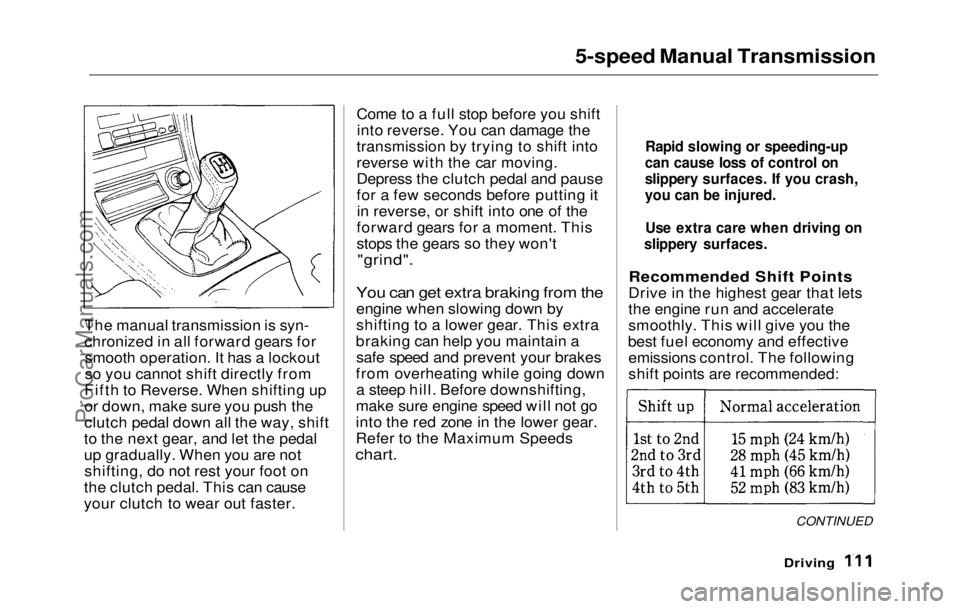
Recommended Shift Points
Drive in the highest gear that lets
the engine run and accelerate
smoothly. This will give you the
best fuel economy and effective emissions control. The following
shift points are recommended:
CONTINUED
Driving
Rapid slowing or speeding-up
can cause loss of control on
slippery surfaces. If you crash,
you can be injured.
Use extra care when driving on
slippery surfaces.ProCarManuals.comMain Menu Table of Contents s t
Page 111 of 225
5-speed Manual Transmission, Automatic Transmission
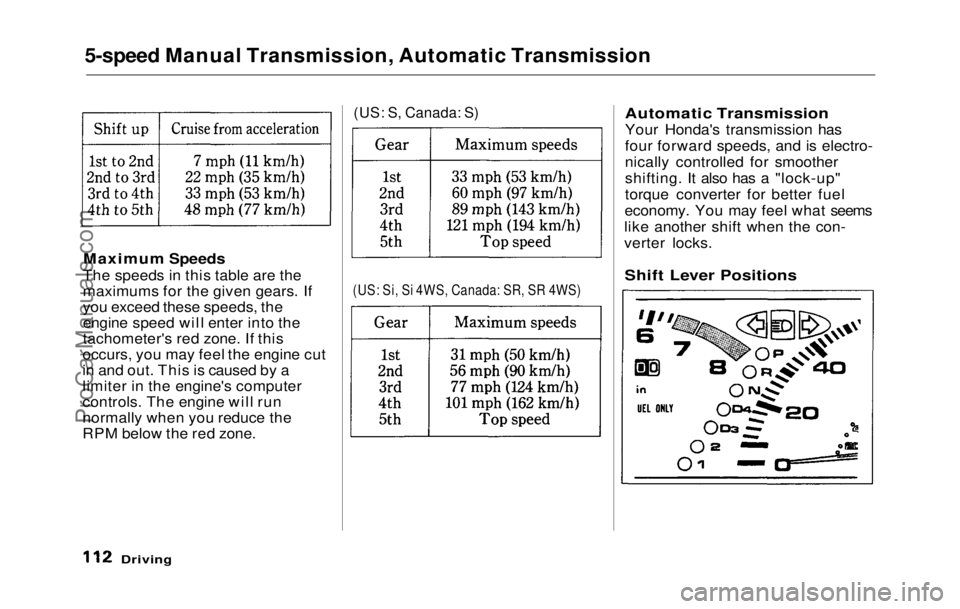
Maximum Speeds
The speeds in this table are the
maximums for the given gears. If
you exceed these speeds, the
engine speed will enter into the
tachometer's red zone. If this
occurs, you may feel the engine cut
in and out. This is caused by a
limiter in the engine's computer
controls. The engine will run
normally when you reduce the
RPM below the red zone.
(US: S, Canada: S)
(US: Si, Si 4WS, Canada: SR, SR 4WS)
Automatic Transmission
Your Honda's transmission has
four forward speeds, and is electro-
nically controlled for smoother
shifting. It also has a "lock-up"
torque converter for better fuel
economy. You may feel what seems
like another shift when the con-
verter locks.
Driving
Shift Lever PositionsProCarManuals.comMain Menu Table of Contents s t
Page 125 of 225
Maintenance
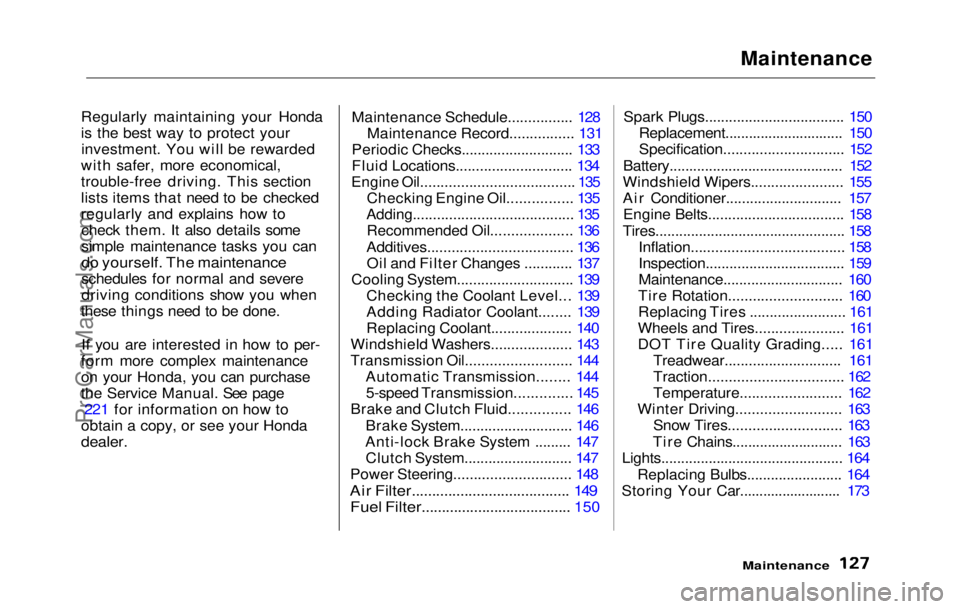
Regularly maintaining your Honda
is the best way to protect your investment. You will be rewarded
with safer, more economical,
trouble-free driving. This section
lists items that need to be checked
regularly and explains how to check them. It also details some
simple maintenance tasks you can
do yourself. The maintenance
schedules for normal and severe
driving conditions show you when
these things need to be done.
If you are interested in how to per-
form more complex maintenance
on your Honda, you can purchase
the Service Manual. See page 221 for information on how to
obtain a copy, or see your Honda
dealer.
Maintenance Schedule................ 128
Maintenance Record................ 131
Periodic Checks............................ 133
Fluid Locations............................. 134
Engine Oil...................................... 135
Checking Engine Oil................ 135
Adding........................................ 135
Recommended Oil.................... 136
Additives.................................... 136 Oil and Filter Changes ............ 137
Cooling System............................. 139 Checking the Coolant Level... 139
Adding Radiator Coolant........ 139
Replacing Coolant.................... 140
Windshield Washers.................... 143
Transmission Oil.......................... 144
Automatic Transmission........ 144
5-speed Transmission.............. 145
Brake and Clutch Fluid............... 146
Brake System............................ 146
Anti-lock Brake System ......... 147 Clutch System........................... 147
Power Steering............................. 148
Air Filter....................................... 149
Fuel Filter..................................... 150
Spark Plugs.................................. .
150
Replacement.............................. 150
Specification.............................. 152
Battery............................................ 152
Windshield Wipers....................... 155
Air Conditioner............................. 157 Engine Belts.................................. 158
Tires................................................ 158 Inflation...................................... 158
Inspection................................... 159
Maintenance.............................. 160
Tire Rotation............................ 160
Replacing Tires ........................ 161
Wheels and Tires...................... 161
DOT Tire Quality Grading..... 161 Treadwear............................. 161
Traction................................. 162
Temperature......................... 162
Winter Driving.......................... 163 Snow Tires............................ 163
Tire Chains............................ 163
Lights.............................................. 164
Replacing Bulbs........................ 164
Storing Your Car.......................... 173
MaintenanceProCarManuals.comMain Menu s t
Page 129 of 225
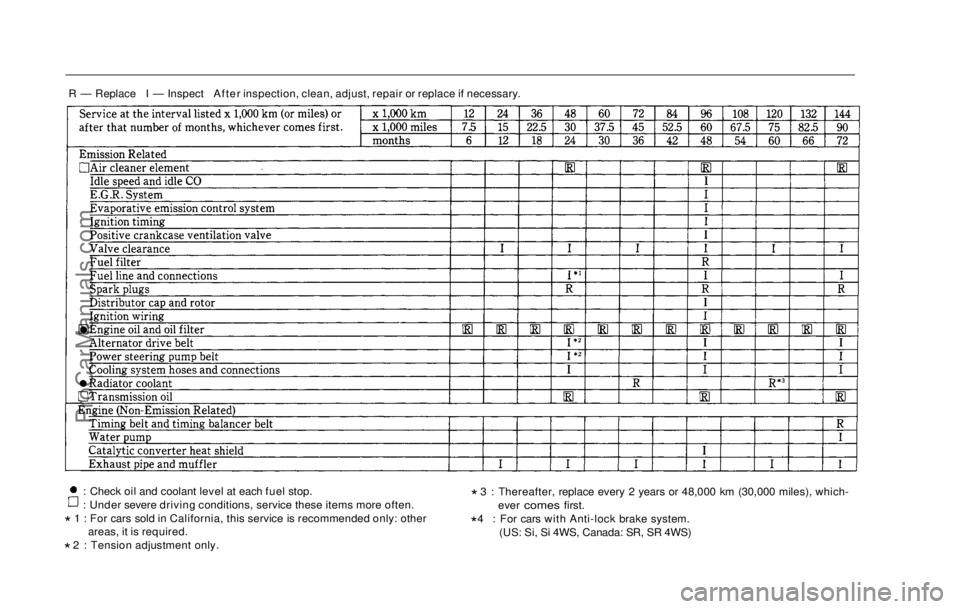
R — Replace I — Inspect After inspection, clean, adjust, repair or replace if necessary.
: Check oil and coolant level at each fuel stop.
: Under severe driving conditions, service these items more often.
* 1 : For cars sold in California, this service is recommended only: other
areas, it is required.
* 2 : Tension adjustment only. *
3 : Thereafter, replace every 2 years or 48,000 km (30,000 miles), which
-
ever comes first.
* 4 : For
cars with Anti-lock brake system.
(US: Si, Si 4WS, Canada
: SR, SR 4WS)
ProCarManuals.comMain Menu Table of Contents s t
Page 134 of 225
Engine Oil
Recommended Oil
Oil is a major contributor to your
engine's performance and longevity.
Always use a premium-grade deter-
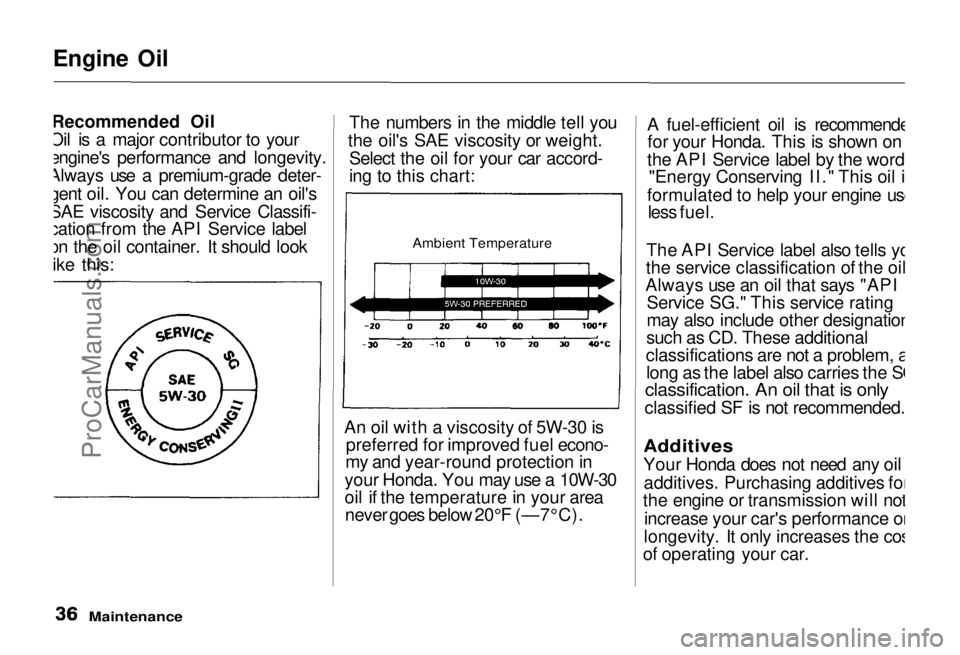
gent oil. You can determine an oil's
SAE viscosity and Service Classifi-
cation from the API Service label
on the oil container. It should look
like this: The numbers in the middle tell you
the oil's SAE viscosity or weight. Select the oil for your car accord-
ing to this chart:
Ambient Temperature
An oil with a viscosity of 5W-30 is preferred for improved fuel econo-
my and year-round protection in
your Honda. You may use a 10W-30
oil if the temperature in your area never goes below 20°F (—7°C). A fuel-efficient oil is recommended
for your Honda. This is shown on
the API Service label by the words "Energy Conserving II." This oil is
formulated to help your engine use less fuel.
The API Service label also tells you
the service classification of the oil.
Always use an oil that says "API
Service SG." This service rating
may also include other designations,
such as CD. These additional
classifications are not a problem, as long as the label also carries the SG
classification. An oil that is only
classified SF is not recommended.
Additives
Your Honda does not need any oil additives. Purchasing additives for
the engine or transmission will not
increase your car's performance or
longevity. It only increases the cost
of operating your car.
MaintenanceProCarManuals.comMain Menu Table of Contents s t
Page 148 of 225
Fuel Filter, Spark Plugs
Fuel Filter
The fuel filter should be replaced
every 4 years or 96,000 km (60,000
miles), whichever comes first.
Have a qualified technician change
the fuel filter. Since the fuel system is under pressure, gasoline can
spray out and create a hazard if all
fuel line connections are not han- dled correctly.
The filter may require replacement sooner if you happen to buy one ormore tankfuls of contaminated
gasoline. Have the filter tested or
replaced if you suspect it has been
clogged by contaminants.
Spark Plugs
The original spark plugs in your
car need to be replaced every 2
years or 48,000 km (30,000 miles),
whichever comes first.
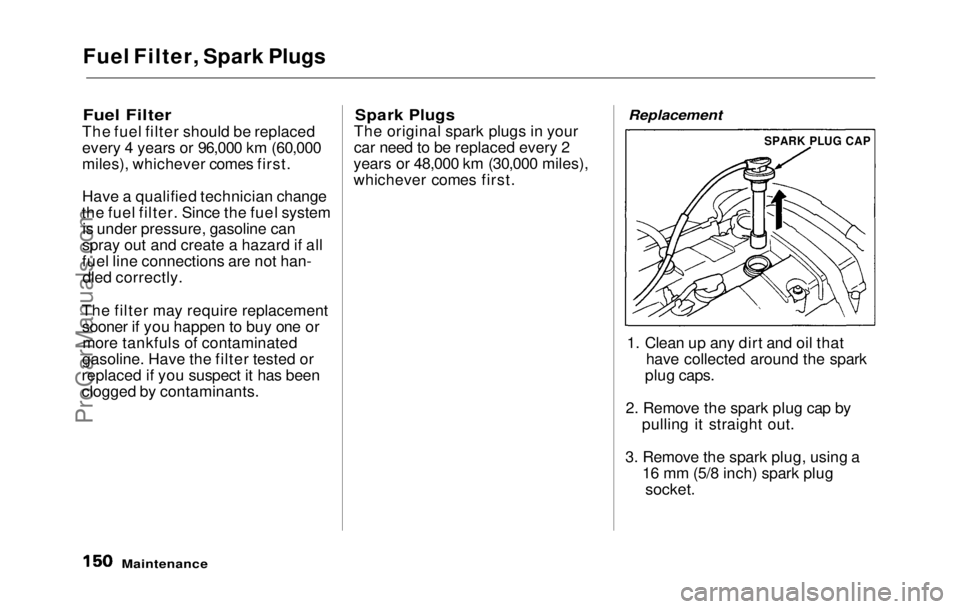
Replacement
1. Clean up any dirt and oil that have collected around the spark
plug caps.
2. Remove the spark plug cap by pulling it straight out.
3. Remove the spark plug, using a 16 mm (5/8 inch) spark plug
socket.
Maintenance
SPARK PLUG CAPProCarManuals.comMain Menu Table of Contents s t
Page 187 of 225
If Your Engine Won't Start, Jump Starting
The Starter Operates
Normally
In this case, the starter motor
sounds normal when you turn the
ignition switch to START (III), but
the engine does not run. Are you using the proper starting
procedure? Refer to Starting
the Engine on page 109 . Do you have gas? Turn the
ignition switch to ON (II) for a
minute and watch the fuel gauge.
There may be an electrical
problem, such as no power to the
fuel pump. Check all the fuses
(see page 199 ).
If you find nothing wrong, you will
need a qualified technician to find
the problem. See Towing on page
202.
Jump Starting
If your car's battery has run down,
you may be able to start the engine
by using a booster battery. Although this seems like a simple
procedure, there are several precau-
tions you should take. Follow the
directions closely.
You cannot start a Honda with an
automatic transmision by pushingor pulling it. To jump start your car:
1. Open the hood and check the physical condition of the battery
(see page 152 ). In very cold
weather, check the condition of the electrolyte. If it seems slushy
or like ice, do not try jump
starting until it thaws.
If a battery sits in extreme cold, the
electrolyte inside can freeze.
Attempting to jump start with a frozen battery can cause it to
rupture or explode.
2. Turn off all the electrical acces- sories: heater, A/C, stereo system,
lights, etc. Put the transmission in Neutral
or Park and set the parking
brake.
Taking Care of the Unexpected
CONTINUED
A battery can explode if you
do not follow the correct
procedure, seriously injuring
anyone nearby.
Keep all sparks, open flames,
and smoking materials away
from the battery.
NOTICE
ProCarManuals.comMain Menu Table of Contents s t
Page 193 of 225
Check Engine Light
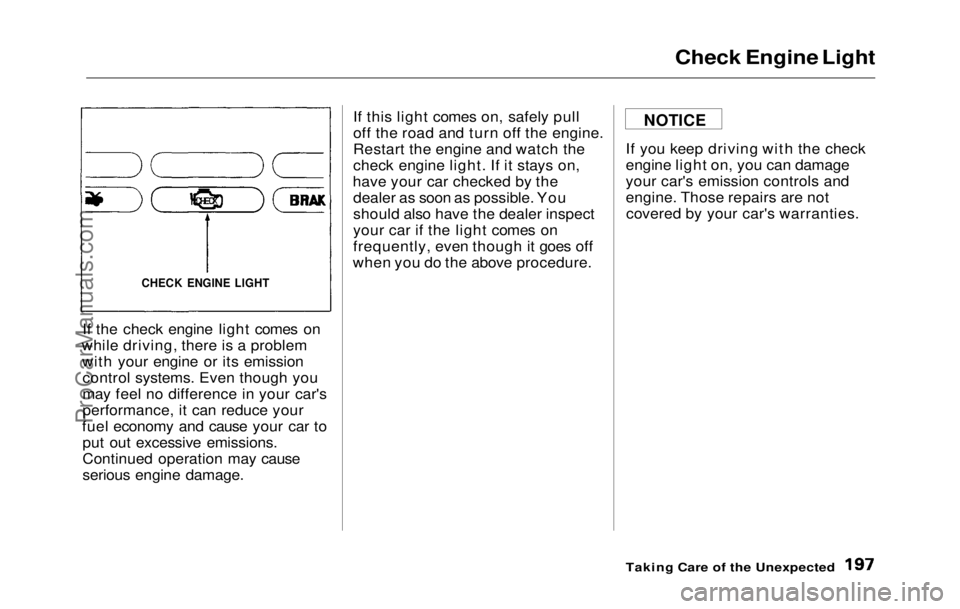
If the
check engine light comes on
while driving, there is a problem with your engine or its emissioncontrol systems. Even though you
may feel no difference in your car's
performance, it can reduce your
fuel economy and cause your car to put out excessive emissions.
Continued operation may cause
serious engine damage. If this light comes on, safely pull
off the road and turn off the engine.
Restart the engine and watch the
check engine light. If it stays on,
have your car checked by the dealer as soon as possible. You
should also have the dealer inspect
your car if the light comes on
frequently, even though it goes off
when you do the above procedure. If you keep driving with the check
engine light on, you can damage
your car's emission controls and
engine. Those repairs are not
covered by your car's warranties.
Taking Care of the Unexpected
CHECK ENGINE LIGHT
NOTICEProCarManuals.comMain Menu Table of Contents s t