light HONDA PRELUDE 1992 Owners Manual
[x] Cancel search | Manufacturer: HONDA, Model Year: 1992, Model line: PRELUDE, Model: HONDA PRELUDE 1992Pages: 225, PDF Size: 2.1 MB
Page 4 of 225
Driver and Passenger Safety
This section gives you important
information about occupant protection. It shows how to use seat
belts properly. It explains the Supplemental Restraint System.
And it gives useful information about how to protect infants and
children in your car. Your Occupant Protection
System........................................ 4
The Seat Belt System
and How It Works.................... 5
Why Wear Seat Belts................... 5 Important Safety Reminders..... 5
Seat Belt System Components... 6
Lap/Shoulder Belt........................ 6
Wearing Seat Belts Properly...... 6
Wearing a Lap/Shoulder
Belt ............................................. 7
Advice for Pregnant Women..... 8 Seat Belt Maintenance................ 9
Supplemental Restraint System.. 10 Important Safety Reminder..... 11
How the Driver's Airbag
Works........................................ 12
How the Passenger's Airbag
Works........................................ 13
How the SRS Indicator Light
Works ...................................... 14
System Service.......................... .
14
System Service Precautions..... 15
Additional Safety Information .... 16 Seat-back Position..................... 16
Door Locks.................................. 16 Storing Cargo Safely ................
17
Driving wit
h
Pets....................... 17
Child Safety..................................... 18
Where Should Children Sit?..... 18
Important Safety Reminders... 19
General Guidelines
for Restraining Children Under 18 kg (40 Ibs)............... 19
Restraining an Infant Who Weighs Less Than 9 kg (20 Ibs)......... 20
Restraining a Child Who Weighs Between
9 and 18 kg (20 and 40 Ibs).... 20
Using Child Restraints with Tethers............................
21
Using a
Seat Belt
Locking Clip............................ 22
Restraining a Child Who Weigh
s
Over 1 8
kg (40 Ibs)..................
23
Storing a
Chil
d Seat...................
23
Alcohol and Drugs..........................
24
Carbon Monoxid
e
Hazard ............
25
Reporting Safet
y
Defects
(US Cars)......................................
26
Safety Labels .................................
27
Driver an d
Passenger SafetyProCarManuals.comMain Menu s t
Page 5 of 225
Your Occupant Protection System
Your Honda is equipped with seat
belts and other features that work
together to protect you and your
passengers during a crash.
Seat belts are the most important
part of your occupant protection
system. When worn properly, seat
belts can reduce the chance of serious injury or death in a crash.
For added protection during a
severe frontal collision, all Preludes
sold in the U.S. and the SR and SR
4WS models in Canada have a Supplemental Restraint System
(SRS) with a driver's airbag. The Si
4WS model sold in the U.S also hasa passenger's airbag. Two indicator lights are also part
of your safety system. One reminds
you to make sure you and your passengers wear your seat belts.
The other alerts you to a possible
problem with your supplemental
restraint system (see page 14).
The seats, head restraints, and door
locks also play a role in occupant safety. For example, reclining the
seat back can decrease the effec-
tiveness of your seat belt. Head
restraints can help protect your neck and head, especially during
rear-end impacts. Door locks help
keep your doors from being acciden-
tally opened during a crash. To get the maximum protection
from your occupant protection
system, check the following before
you drive away:
Everyone in the car is wearing a
seat belt properly (see page 6).
Both doors are closed and locked
(see page 16).
Seat backs are upright (see page
16).
There are no loose items that
could be thrown around and hurt
someone during a crash or
sudden stop (see page 17).
By following these guidelines, you
can reduce injuries to yourself and
your passengers in many crash
situations. Remember, however,
that no safety system can prevent all injuries or deaths that can occur
in severe crashes.
Driver and Passenger SafetyProCarManuals.comMain Menu Table of Contents s t
Page 7 of 225
The Seat Belt System and How It Works
Seat Belt System Components
Your Honda has lap/shoulder seat
belts in all four seating positions.
Your seat belt system also includes a light on the instrument panel to
remind you to fasten your seat belt,
and to make sure your passengers
fasten theirs. This light comes on
when you turn on the ignition if
you have not fastened your seat
belt. A beeper also sounds for several seconds (see page 33).
The following pages cover more
about the seat belt components and
how they work.
Lap/Shoulder Belt
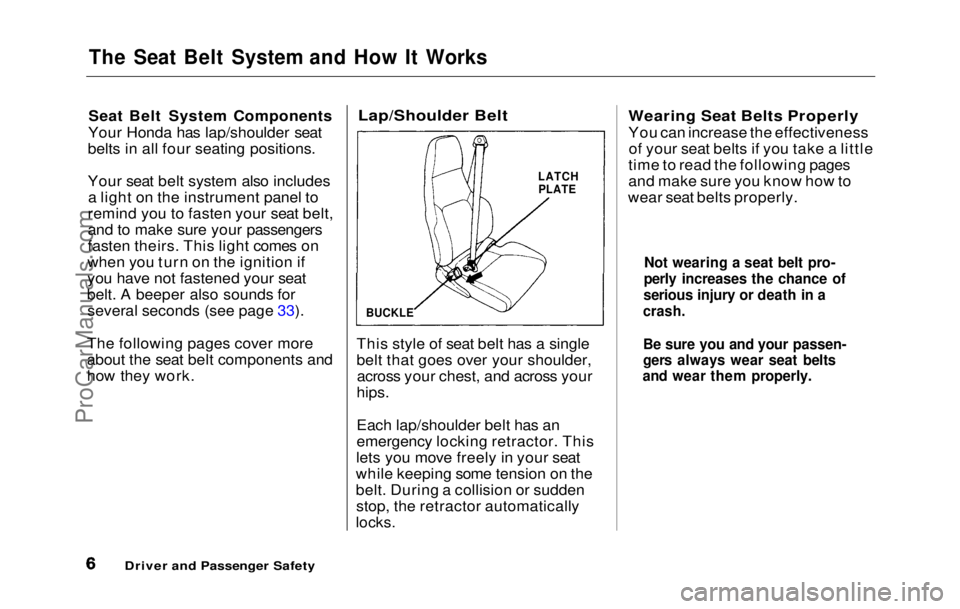
This style of seat belt has a single
belt that goes over your shoulder, across your chest, and across your
hips.
Each lap/shoulder belt has an
emergency locking retractor. This
lets you move freely in your seat
while keeping some tension on the
belt. During a collision or sudden stop, the retractor automatically
locks.
Wearing Seat Belts Properly
You can increase the effectiveness
of your seat belts if you take a little
time to read the following pages
and make sure you know how to
wear seat belts properly.
Driver and Passenger Safety
Not wearing a seat belt pro-
perly increases the chance of
serious injury or death in a
crash.
Be sure you and your passen-
gers always wear seat belts
and wear them properly.
LATCH
PLATE
BUCKLEProCarManuals.comMain Menu Table of Contents s t
Page 12 of 225
Supplemental Restraint System
An indicator light to warn you of a possible problem with the
system.
Emergency power backup in case
your car's electrical system is
disconnected in a crash.
Important Safety Reminder
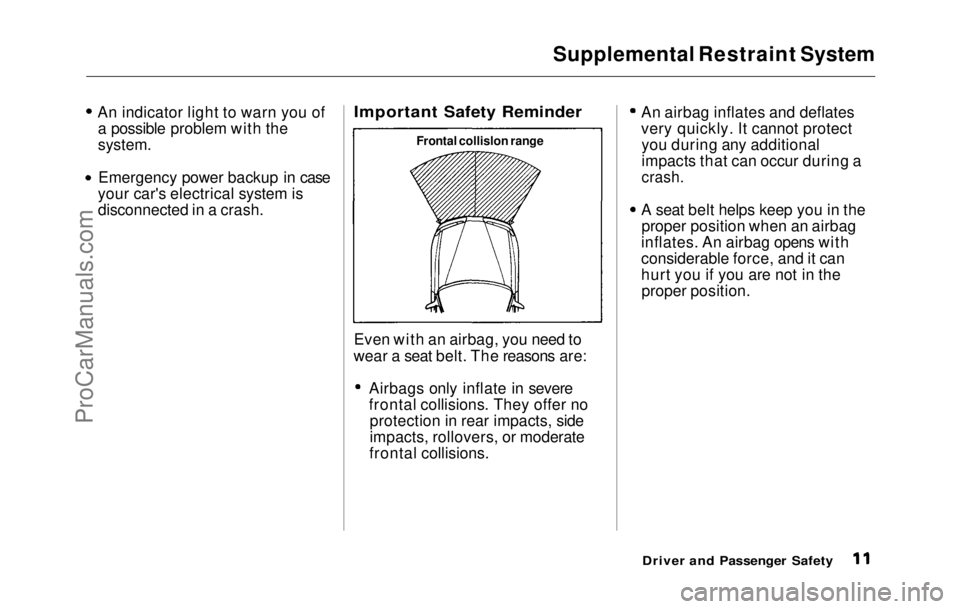
Even with an airbag, you need to
wear a seat belt. The reasons are: Airbags only inflate in severe
frontal collisions. They offer no
protection in rear impacts, side
impacts, rollovers, or moderate
frontal collisions. An airbag inflates and deflates
very quickly. It cannot protect
you during any additional
impacts that can occur during a
crash.
A seat belt helps keep you in the
proper position when an airbag
inflates. An airbag opens with
considerable force, and it can
hurt you if you are not in the proper position.
Driver and Passenger Safety
Frontal collislon rangeProCarManuals.comMain Menu Table of Contents s t
Page 15 of 225
Supplemental Restraint System
The passenger's airbag is stored
near the top of the dashboard,
under a lid marked SRS. Do not
place any objects on top of this lid. If the airbag inflates, those objects
can be propelled inside the car and possibly hurt someone.
How the SRS
Indicator Light Works
The purpose of the SRS light on
your instrument panel is to alert
you of a potential problem with
your supplemental restraint system.
Have the system checked if:
The light does not come on when
you turn the ignition ON (II). The light stays on after the
engine starts.
The light comes on or flashes
while you are driving.
System Service
Your supplemental restraint
system is virtually maintenance-
free. There are no parts you can
safely service.
You must have the system serviced
by an authorized Honda dealer in the following situations: If your airbag ever inflates. The
bag must be replaced. Do not try
to remove or discard the airbag
by yourself. This must be done by a Honda dealer.
If the SRS indicator light alerts
you of a problem. Have the
supplemental restraint system
checked as soon as possible.
Otherwise, your airbag might not
inflate when you need it. When the car is ten years old, get
the system inspected. The
production date is on the driver's
door jamb for your convenience.
Driver and Passenger Safety
SRS
ProCarManuals.comMain Menu Table of Contents s t
Page 29 of 225
Instruments and Controls
This section gives information
about the controls and displays that
contribute to the daily operation of
your Honda. All the essential
controls are within easy reach.
Control Locations......................... 30
Indicator Lights.............................. 31
Gauges............................................. 37
Speedometer
.............................
37
Tachometer................................. 37
Odometer
.................................... 37
Trip Meter................................... 37
Fuel Gauge..................................
38
Temperature Gauge
..................
38
Controls Near the
Steering
Wheel
....................................... 39
Headlights................................... 40
Daytime Running Lights.......... 40
Instrument Panel Brightness... 41
Turn Signals................................ 41
Windshield Wipers.....................
42
Windshield Washers.................
42
Steering Wheel Adjustment ....
. 43
Steering Wheel Controls............... 44
Cruise Control............................ 44
Horn ............................................ 47
Keys and Locks.............................. 47
Keys.............................................. 47
Ignition Switch........................... 47
Door Locks.................................. 48
Power Door Locks ..................... 48
Trunk.......................................... 50
Seat Adjustments........................... 51
Rear Seat Access........................ 52
Additional Driver' s
Seat
Adjustments...........................
53
Seat Heaters.................................... 54
Folding Rea r
Seat.......................... 55
Hazard Warning............................ 56
Rear Window Defogger ................ 56
Power Windows.............................. 57
Sunroof ...........................................
58
Mirrors ........................................... 59
Parking Brake................................ .
61
Glove Box........................................
.
62
Digital Clock..................................
.
63
Center Console Compartment .... 64
Vanity
Mirror
..............................
64
Cigarette Lighter
..........................
.
65
Ashtray........................................... 65
Interior Lights...............................
.
66
Instruments an
d
ControlsProCarManuals.comMain Menu s t
Page 31 of 225
Indicator Lights
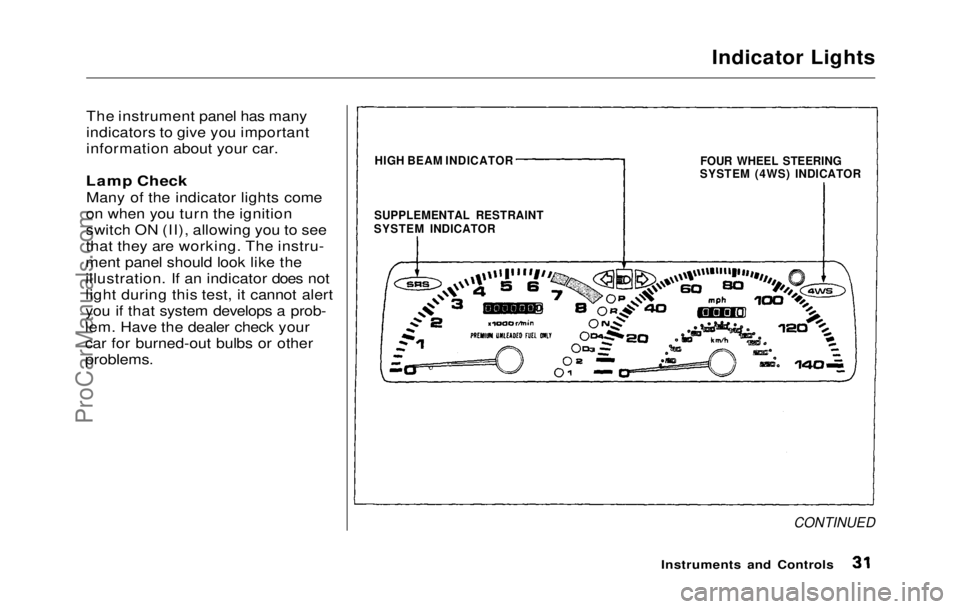
The instrument panel has many
indicators to give you important
information about your car.
Lamp Check
Many of the indicator lights come
on when you turn the ignition
switch ON (II), allowing you to see
that they are working. The instru-
ment panel should look like the
illustration. If an indicator does not
light during this test, it cannot alert
you if that system develops a prob-
lem. Have the dealer check your
car for burned-out bulbs or other
problems.
CONTINUED
HIGH BEAM INDICATOR
FOUR WHEEL STEERING
SYSTEM (4WS) INDICATOR
Instruments and Controls
SUPPLEMENTAL RESTRAINT
SYSTEM INDICATORProCarManuals.comMain Menu Table of Contents s t
Page 32 of 225
Indicator Lights
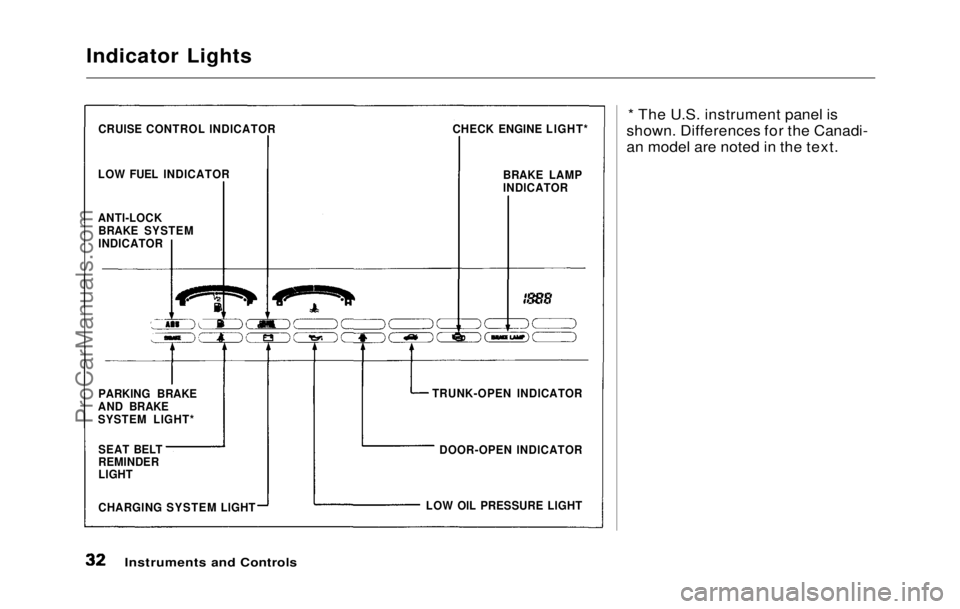
* The U.S. instrument panel is
shown. Differences for the Canadi-
an model are noted in the text.
Instruments and Controls
CRUISE CONTROL INDICATOR
LOW FUEL INDICATOR CHECK ENGINE LIGHT*
BRAKE LAMP
INDICATOR
TRUNK-OPEN INDICATOR DOOR-OPEN INDICATOR
LOW OIL PRESSURE LIGHT
CHARGING SYSTEM LIGHT SEAT BELT
REMINDER
LIGHT PARKING BRAKE
AND BRAKE
SYSTEM LIGHT* ANTI-LOCK BRAKE SYSTEM
INDICATORProCarManuals.comMain Menu Table of Contents s t
Page 33 of 225
Indicator Lights
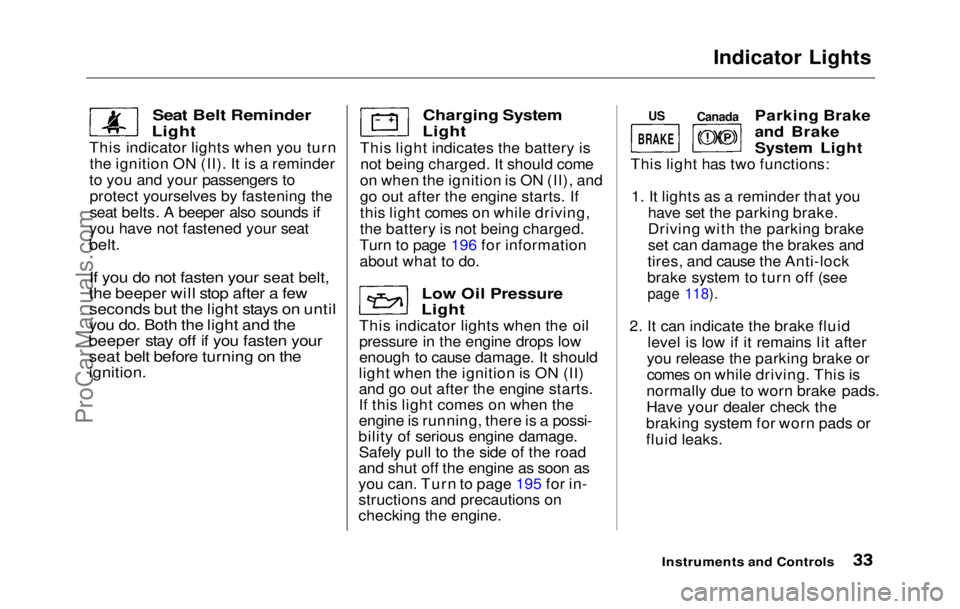
Seat Belt Reminder
Light
This indicator lights when you turn the ignition ON (II). It is a reminder
to you and your passengers to protect yourselves by fastening the
seat belts. A beeper also sounds if
you have not fastened your seat
belt.
If you do not fasten your seat belt,
the beeper will stop after a few seconds but the light stays on until
you do. Both the light and the
beeper stay off if you fasten your seat belt before turning on the
ignition.
Charging System
Light
This light indicates the battery is not being charged. It should come
on when the ignition is ON (II), and
go out after the engine starts. If
this light comes on while driving,
the battery is not being charged.
Turn to page 196 for information
about what to do.
Low Oil Pressure
Light
This indicator lights when the oil
pressure in the engine drops low
enough to cause damage. It should
light when the ignition is ON (II)
and go out after the engine starts.
If this light comes on when the
engine is running, there is a possi-
bility of serious engine damage. Safely pull to the side of the road
and shut off the engine as soon as
you can. Turn to page 195 for in-
structions and precautions on
checking the engine.
Canada
Parking Brake
and Brake
System Light
This light has two functions:
1. It lights as a reminder that you
have set the parking brake.
Driving with the parking brake
set can damage the brakes and
tires, and cause the Anti-lock
brake system to turn off (see
page 118).
2. I t
can indicate the brake fluid
level is low if it remains lit after
you release the parking brake or
comes on while driving. This is
normally due to worn brake pads.
Have your dealer check the
braking system for worn pads o r
flui d
leaks.
Instruments an d
Controls
US
BRAKEProCarManuals.comMain Menu Table of Contents s t
Page 34 of 225
Indicator Lights
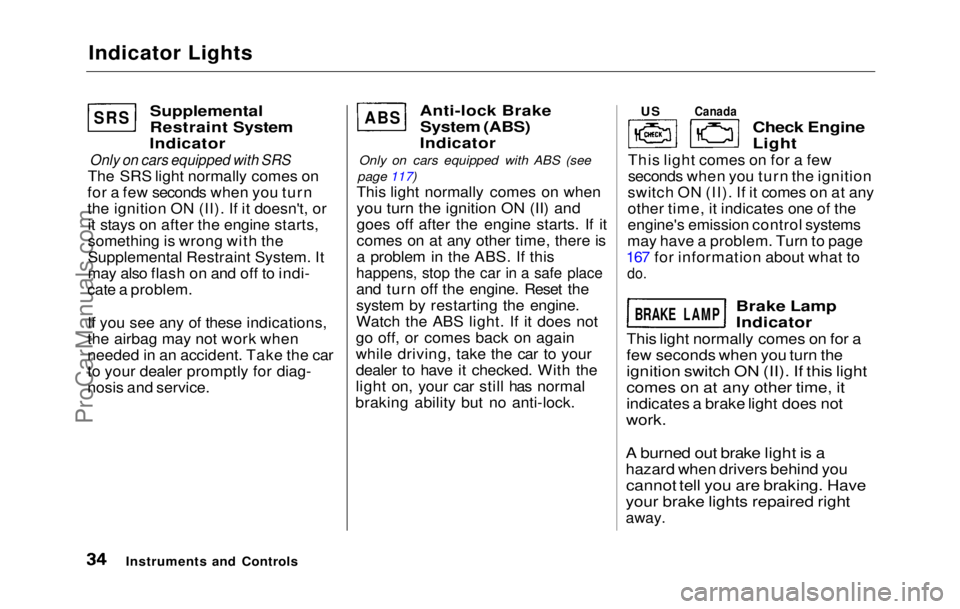
Supplemental
Restraint System
Indicator
Only on cars equipped with SRS
The SRS light normally comes on
for a few seconds when you turn
the ignition ON (II). If it doesn't, or it stays on after the engine starts,
something is wrong with the
Supplemental Restraint System. It
may also flash on and off to indi-
cate a problem.
If you see any of these indications,
the airbag may not work when
needed in an accident. Take the car
to your dealer promptly for diag-
nosis and service.
Anti-lock Brake
System (ABS)
Indicator
Only on cars equipped with ABS (see
page 117)
This light normally comes on whenyou turn the ignition ON (II) and
goes off after the engine starts. If it
comes on a
t any other time, there is
a problem in the ABS. If this
happens, stop the car in a safe place
and tur n
off the engine. Reset the
system by restarting the engine.
Watch the ABS light. If it does not
go off, or comes back on again
while driving, take the car to your
dealer to have it checked. With the
light on, your car still has normal
braking ability but no anti-lock.
Check Engine
Light
This light comes on for a few
seconds when you turn the ignition
switch ON (II). If it comes on at any
other time, it indicates one of the
engine's emission control systems
may have a problem. Turn to page
167 fo r
information about what to
do.
Brake Lam
p
Indicator
This light normally comes on for a
few seconds when you turn the
ignition switc h
ON (II). If this light
comes on at any other time, it
indicates a brake light does not
work.
A burned out brake light is a
hazard when drivers behind you
cannot tell you are braking. Have
your brake lights repaired right
away.
Instruments an d
Controls
SRS ABS US
Canada
BRAKE LAMP
ProCarManuals.comMain Menu Table of Contents s t