Gas HONDA PRELUDE 1992 Owners Manual
[x] Cancel search | Manufacturer: HONDA, Model Year: 1992, Model line: PRELUDE, Model: HONDA PRELUDE 1992Pages: 225, PDF Size: 2.1 MB
Page 1 of 225
 to navigate through\
this reference.
For a printed owners manual, click on authorized manuals or go")
1992 Prelude Online Reference Owner's Manual
Use these links (and links throughout this manual) to navigate through\
this reference.
For a printed owner's manual, click on authorized manuals or go to www.h\
elminc.com.
Contents
Owner's Identification Form
Introduction ........................................................................\
................................................................. i
A Few Words About Safet y........................................................................\
.........................................ii
Driver and Passenger Safety ........................................................................\
......................................3
Proper use and care of your vehicle's seat belts, and Supplemental Restr\
aint System.
Instruments and Controls........................................................................\
.........................................29
Instrument panel indicator and gauge, and how to use dashboard and steering colu\
mn controls.
Comfort and Convenience Features ........................................................................\
...................... 67
How to operate the climate control system, the audio system, and other c\
onvenience features.
Before Driving........................................................................\
.......................................................... 97
What gasoline to use, how to break-in your new vehicle, and how to load luggage and other cargo.
Driving ........................................................................\
......................................................................107
The proper way to start the engine, shift the transmission, and park, pl\
us towing a trailer.
Maintenance........................................................................\
.............................................................127
The Maintenance Schedule shows you when you need to take your vehicle to the dealer.
Appearance Care........................................................................\
......................................................175
Tips on cleaning and protecting your vehicle. Things to look for if your\
vehicle ever needs body repairs.
Taking Care of the Unexpected........................................................................\
..............................183
This section covers several problems motorists sometimes experience, and how to handle them.
Technical Information........................................................................\
.............................................203
ID numbers, dimensions, capacities, and technical information.
Warranty and Customer Relations (U.S. and Canada)................................................................215
A summary of the warranties covering your new Acura, and how to contact \
us.
Authorized Manuals (U.S. only)........................................................................\
..............................221
How to order manuals and other technical literature.
Index ........................................................................\
........................ ......................................................
I
Gas Station Information
A summary of information you need when you pull up to the gas pump.
ProCarManuals.com
Page 26 of 225
Carbon Monoxide Hazard
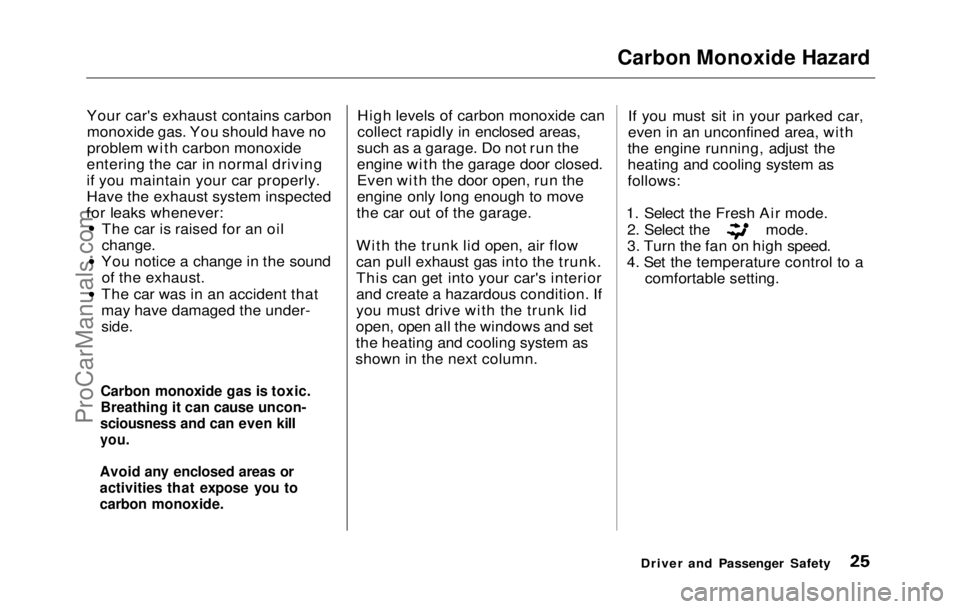
Your car's exhaust contains carbon monoxide gas. You should have no
problem with carbon monoxide
entering the car in normal driving
if you maintain your car properly.
Have the exhaust system inspected
for leaks whenever: The car is raised for an oil
change.
You notice a change in the sound
of the exhaust.
The car was in an accident that
may have damaged the under-
side.
High levels of carbon monoxide can
collect rapidly in enclosed areas,
such as a garage. Do not run the
engine with the garage door closed.
Even with the door open, run the
engine only long enough to move
the car out of the garage.
With the trunk lid open, air flow
can pull exhaust gas into the trunk.
This can get into your car's interior
and create a hazardous condition. If
you must drive with the trunk lid
open, open all the windows and set
the heating and cooling system as
shown in the next column. If you must sit in your parked car,
even in an unconfined area, with
the engine running, adjust the
heating and cooling system as
follows:
1. Select the Fresh Air mode. 2. Select the mode.
3. Turn the fan on high speed.
4. Set the temperature control to a comfortable setting.
Driver and Passenger Safety
Carbon monoxide gas is toxic.
Breathing it can cause uncon-
sciousness and can even kill
you.
Avoid any enclosed areas or
activities that expose you to
carbon monoxide.ProCarManuals.comMain Menu Table of Contents s t
Page 50 of 225
Keys and Locks
Both doors lock when you push in
the lock tab on the driver's door, or
lock the driver's door from the outside with the key. Only the
driver's door unlocks when you use
the key or lock tab. To unlock the
passenger's door, use the master
door lock switch or pull out the
lock tab on passenger's door.
Lockout Prevention
If you forget and leave the key in
the ignition switch, Lockout
Prevention will not allow you to
lock the driver's door. With either
door open and the key in the
ignition, the master door lock
switches are disabled. If you try to
lock the driver's door by pushing in
the lock tab, the tabs on both doors immediately pop up.
Trunk
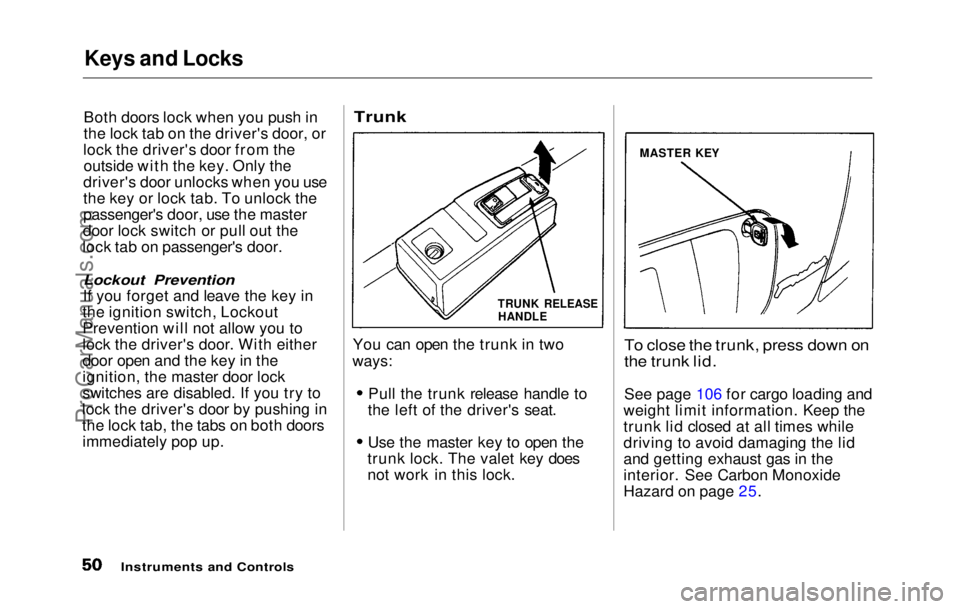
You can open the trunk in two
ways:
Pull the trunk release handle to
the left of the driver's seat. Use the master key to open the
trunk lock. The valet key does
not work in this lock.
To close the trunk, press down on
the trunk lid.
See page 106 fo
r cargo loading and
weight limit
information. Keep the
trunk lid closed at all times while
driving to avoid damaging the lid
and getting exhaust gas in the
interior. See Carbon Monoxide
Hazard on page 25.
Instruments and Controls
MASTER KEY
TRUNK RELEASE
HANDLEProCarManuals.comMain Menu Table of Contents s t
Page 96 of 225

Before Driving
Before you begin driving your
Honda, you should know what gaso-
line to use, and that your car is full
of oil and other important fluids.
You also need to know how to pro-
perly stow luggage or packages.
This section will help you. If you plan to add any accessories to your
car, please read the informatio n in
this section
first.
Break-in Period .............................. 98
Gasoline........................................... 98
Oxygenated Fuels...................... 98
Driving in Foreign Countries... 99
Service Station Procedures........ 100 Filling the Gas Tank ............... 100
Opening the Hood....................
101
Fuel Economy
.............................. 104
Vehicle Condition..................... 104
Driving Habits.......................... 104
Accessories................................... 105
Loading Cargo.............................. 106
Before DrivingProCarManuals.comMain Menu s t
Page 97 of 225
Break-in Period, Gasoline
Break-in Period
Help assure your car's future
reliability and performance by
paying extra attention to how you
drive during the first 1,000 km (600
miles).
During thi
s period:
Avoid full-throttle starts and
rapid acceleration.
If you need to add oil, use the
engine oil recommended in this
owner's manual.
Avoid hard braking. New brakes need to be broken-in by moderate
use for the first 300 km (200
miles).
You should follow these same re-
commendations with an overhauled
or exchanged engine, or when the
brakes are relined. Gasoline
Your Honda is designed to operate
most effectively on unleaded
gasoline.
Using gasoline containing lead will
damage your car's emission
controls. Thi s
contributes to air
pollution and can void certain parts
of your warranty.
(S model)
Use an unleaded gasoline with a
pump octane number of 86 or
higher.
Use of a lower octane gasoline can
cause a persistent, heavy metallic
rapping noise that can lead to
engine damage.
(All other models)
Use a
premium unleaded gasoline
with a pump octane number of
91
or higher .
I
f you are unable to find premium
unleaded, you may substitute an
unleaded regular gasoline. The engine will compensate for the
lower octane, but you may notice a
slight decrease in power as a result.
Oxygenated Fuels
Some conventional gasolines are
being blended with alcohol or an
ether compound to increase the
gasoline's octane. These gasolines
are collectively referred to as
oxygenated fuels. Some areas of
the United States and Canada use
oxygenated fuels to help meet clean
air standards.
If you use an oxygenated fuel, be
sure it meets the minimum octane
rating requirement as recom-
mended.
Before DrivingProCarManuals.comMain Menu Table of Contents s t
Page 98 of 225
Gasoline
ETHANOL (ethyl or grain alcohol) — Gasoline containing more than
10% ethanol by volume may cause
starting and/or performance
problems. Gasoline containing
ethanol may be marketed under the name "Gasohol."
METHANOL (methyl or woodalcohol) — Gasoline containing
methanol must contain cosolvents
and corrosion inhibitors to protect
the fuel system. Gasoline contain-
ing more than 5% methanol by
volume may cause starting and/orperformance problems and may
damage metal, rubber and plastic
parts o f
your fuel system.
MTBE (Methyl Tertiary Butyl
Ether) — You may use gasoline containing up to 15% MTBE by
volume.
Before using an oxygenated fuel,
try to confirm the fuel's contents.
Some states and provinces require
this information to be posted on the
pump. If you notice any undesirable
operating symptoms, switch to a
conventional unleaded gasoline.
Fuel system damage or perform-
ance problems resulting from the
use of an oxygenated fuel are not
the responsibility of Honda and are not covered under warranty.
Oxygenated fuels can damage paint and plastic. Be careful not to spill
fuel when filling your fuel tank.
Damage caused by spilled fuel is
not covered under warranty. Driving in Foreign Countries
Using any type of leaded gasoline
in your Honda will affect perform-
ance and damage its emission con-
trols. Unleaded gasoline may not be
available i
n
other countries. If you
are planning to take your car out-
side the U.S. or Canada, write to
Honda at the address shown for
information about any modifica-
tions your car may need. Be sure to include the year and model of your
car.
U.S. Owners:
American Honda Motor Co., Inc. Consumer Affairs
1919 Torrance Blvd.
Torrance, CA 90501-2746
Canadian Owners:
Honda Canada Inc.
715 Milner Ave.
Scarborough, Ontario M1B 2K8
Before Driving
NOTICEProCarManuals.comMain Menu Table of Contents s t
Page 99 of 225
Service Station Procedures
Filling the Gas Tank
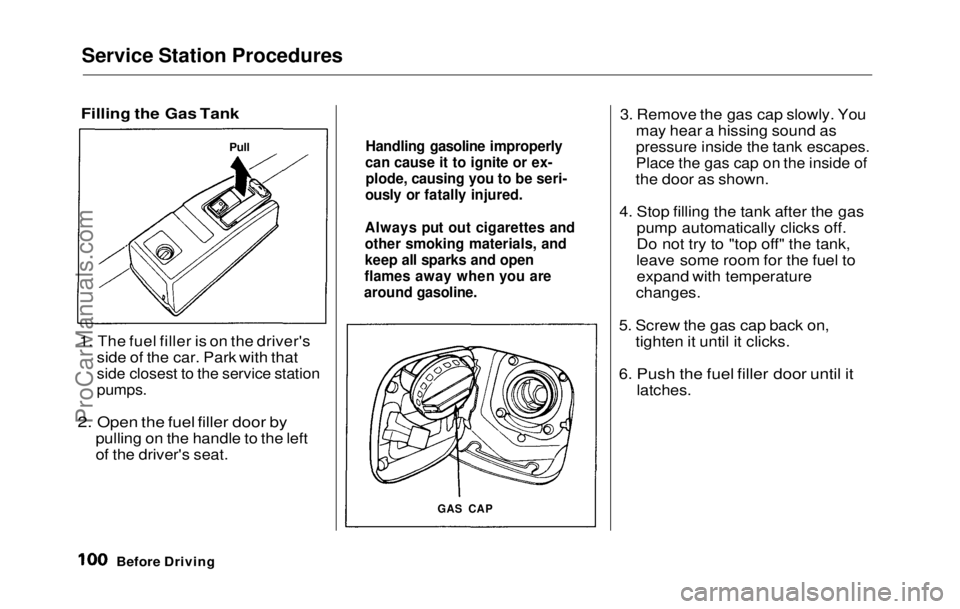
1. The fuel filler is on the driver's
side of the car. Park with that
side closest to the service station
pumps.
2. Open the fuel filler door by
pulling on the handle to the left
of the driver's seat.
3. Remove
the gas cap slowly. You
may hear a hissing sound as
pressure inside the tank escapes.
Place the gas cap on the inside of
the door as shown.
4. Stop
filling the tank after the gas
pump automatically clicks off.
Do not try to "top off" the tank,
leave some room for the fuel to expand with temperature
changes.
5. Screw
the gas cap back on,
tighten it until it clicks.
6. Push the fuel filler door until it
latches.
Before Drivin
g
Handlin
g gasoline improperly
can cause it to ignite or ex- plode, causing you to be seri-
ously or fatally injured.
Always put out cigarettes and
other smoking materials, and
keep all sparks and open
flames away when you are
around gasoline.
GAS CAP
PullProCarManuals.comMain Menu Table of Contents s t
Page 101 of 225
Service Station Procedures
Oil Check
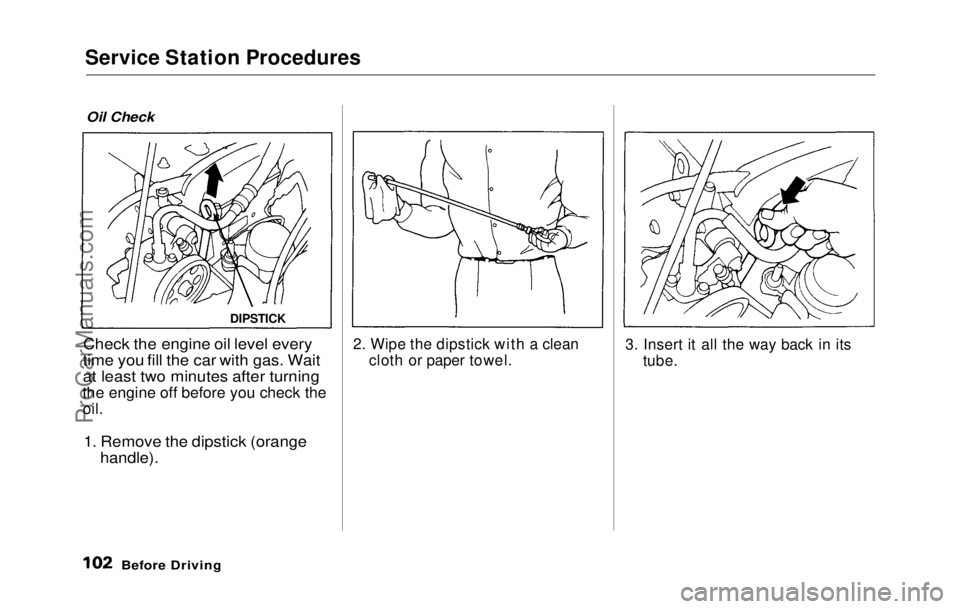
Check the engine oil level every
time you fill the car with gas. Wait
at least two minutes after turningthe engine off before you check the
oil.
1.
Remove the dipstick (orange
handle).
2. Wipe
the dipstick with a clean
cloth or paper towel. 3. Insert it all the way back in its
tube.
Before Drivin
g
DIPSTIC
KProCarManuals.comMain Menu Table of Contents s t
Page 105 of 225
Loading Cargo
The maximum load you can carry
in your Honda is 325 kg (700 Ibs). It
includes the total weight of all
passengers and their belongings,
any accessories, and the tongue
weight of a trailer. This 325 kg (700
Ibs) figure
is shown as the Vehicle
Capacity Weight on the tire infor-
mation label attached to the driver's
door jamb.
To figure out how much cargo you
can carry:
Figure the total "occupant
weight" you will be transporting.
To do this, multiply the number
of people (driver and all passen-
gers) by 70 kg (150 Ibs). Subtract this number from the
Vehicle Capacity Weight (325 kg/
700 Ibs).
If you are towing a trailer,
subtract the tongue weight. See
Towing a Trailer on page 121.
This final number is the total
weight of cargo you can load in or on the car. With four occupants
(driver and three passengers), the
maximum recommended weight
for cargo is 45 kg (100 Ibs). Where you store this cargo, and
how well you secure it, are just as
important as how much it weighs.
Make sure you load cargo so it will
not shift while driving. Items
stored in the trunk should be placed as far forward as possible.
You could store additional items on
the floor behind the front seats. Make sure they cannot roll under
the front seat and interfere with
the pedals.
If you must carry large objects that
prevent you from closing the trunk
lid, be aware that exhaust gas can enter the interior. See Carbon
Monoxide Hazard on page 25 .
Never place items on the shelf
behind the back seat. Those items
can fly forward and injure you or
your passengers if you brake hard
or are involved in a collision.
Before DrivingProCarManuals.comMain Menu Table of Contents s t
Page 126 of 225
Maintenance Schedule
The Required Maintenance Schedule specifies how often you
should have your car serviced, and
what things need attention. It is
essential that your car be serviced
as scheduled to retain its high level of safety, dependability, and
emission control performance.
The services and time or mileage intervals shown in the maintenance
schedule assume you will use your
car as normal transportation for
passengers and their possessions.
You should:
Avoid exceeding your car's loadlimit. This puts excess strain on
the engine, brakes, and many
other parts of your car. The load
limit is shown on the label in the
glove box. Operate your car on reasonable
roads within the legal speed limit. Drive your car regularly over a
distance of several miles.
Always use unleaded gasoline
with the proper octane (see page
98).
Your authorized Honda dealer
knows your car best, and can provide competent, efficient
service. However, service at a
dealer is not mandatory to keep
your warranties in effect. Mainte-
nance may be done by any qualified
service facility or person who is
skilled in this type of automotive
service. Keep all the receipts as
proof of completion, and have the
person who does the work fill out
the maintenance record on page 131. Check your warranty booklet
for more information. We recommend the use of Genuine
Honda parts and fluids or their
equivalent whenever you have
maintenance done. These are the
same high-quality items that went
into your car when it was new, so you can be sure they fit and
perform flawlessly.
U.S. Cars:
Maintenance, replacement or
repair of emission control
devices and systems may be
done by any automotive re-
pair establishment or indi-
vidual using parts that are "certified" to EPA standards.
Vehicles sold in California have
slightly different maintenance
requirements. These are noted in
the Required Maintenance Sche-
dule. Other maintenance operations
are required by California regula-
tions, and condition the emission
warranty.
MaintenanceProCarManuals.comMain Menu Table of Contents s t