Gas HONDA PRELUDE 1992 User Guide
[x] Cancel search | Manufacturer: HONDA, Model Year: 1992, Model line: PRELUDE, Model: HONDA PRELUDE 1992Pages: 225, PDF Size: 2.1 MB
Page 131 of 225
Periodic Checks
You should check the following items at the specified intervals. If
you are unsure of how to perform
any check, turn to the page given. Engine oil level — Check every
time you fill the gas tank. See
page 102.
Engine coolant level — Check
the radiator reserve tank every
time you fill the gas tank. See
page 103.
Windshield washer fluid —
Check the level in the reservoir
monthly. If weather conditions
cause you to use the washers
frequently, check the reservoir each time you stop for gas. See
page 143 .
Automatic transmission — Check the fluid level monthly.
See page 144. Brakes, clutch and power
steering — Check the fluid level
monthly. See page 146.Tires — Check the tire pressure
monthly. Examine the tread for
wear and foreign objects. See
page 159.
Battery — Check its condition
and the terminals for corrosion
monthly. See page 152.
Air conditioner — Check its operation weekly. See page 157.
Lights — Check the operation of
the headlights, parking lights,
taillights, high-mount brake light,
turn signals, brake lights, and
license plate lights monthly. See
page 164.
MaintenanceProCarManuals.comMain Menu Table of Contents s t
Page 141 of 225
Cooling System, Windshield Washers
10.Turn off the engine. Check the
level in the radiator, add coolant
if needed. Install the radiator cap,
tighten it fully.
11.Fill the
reserve tank to the MAX
mark. Install the reserve tank
cap.
Windshield Washers
Chec
k the level in the windshield
washer reservoir at least monthly
during normal usage. In bad
weather, when you use the washers often, check the level every time
you stop for gas.
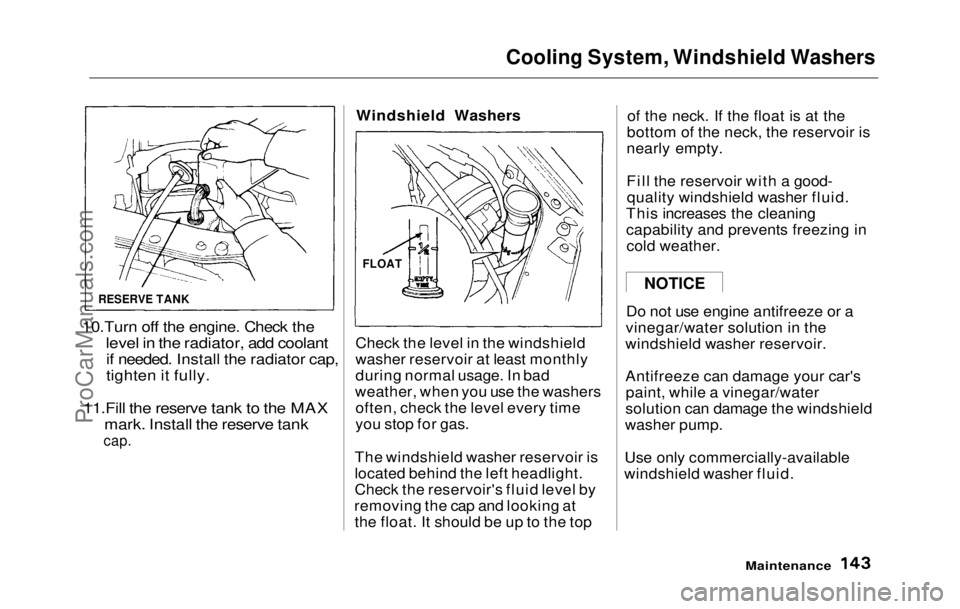
The windshield washer reservoir is
located behind the left headlight.
Check the reservoir's fluid level by
removing the cap and looking at the float. It should be up to the top of the neck. If the float is at the
bottom of the neck, the reservoir is
nearly empty.
Fill the reservoir with a good- quality windshield washer fluid.
This increases the cleaning
capability and prevents freezing in cold weather.
Do not use engine antifreeze or a
vinegar/water solution in the
windshield washer reservoir.
Antifreeze can damage your car's paint, while a vinegar/water
solution can damage the windshield
washer pump.
Use only commercially-available
windshield washer fluid.
Maintenance
NOTICE
RESERVE TANK
FLOATProCarManuals.comMain Menu Table of Contents s t
Page 147 of 225
Air Filter
The air filter element should be
replaced every 2 years or 48,000 km
(30,000 miles), whichever comes
first. Under severe driving condi-
tions, it should also be cleaned every 12 months or 24,000 km
(15,000 miles), whichever comes
first.
Cleaning (Severe Conditions)
Clean the air cleaner element by
blowing compressed air through it in the opposite direction to normal
air flow. If you do not have access
to compressed air (such as a gas station), ask your Honda dealer to
do this service.
Follow the replacement procedure
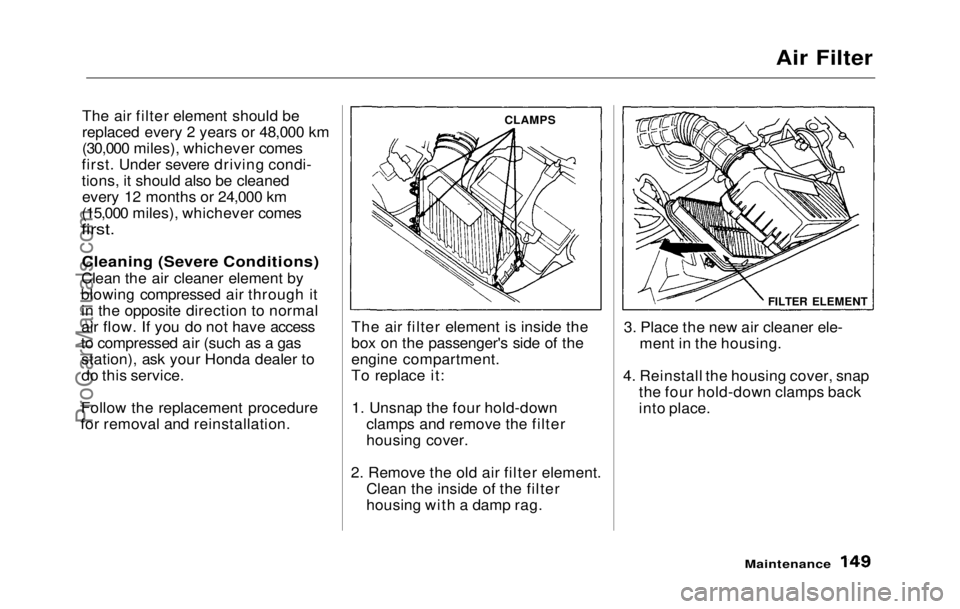
for removal and reinstallation. The air filter element is inside the
box on the passenger's side of the
engine compartment.
To replace it:
1. Unsnap the four hold-down clamps and remove the filter
housing cover.
2. Remove the old air filter element. Clean the inside of the filter
housing with a damp rag. 3. Place the new air cleaner ele-
ment in the housing.
4. Reinstall the housing cover, snap the four hold-down clamps back
into place.
Maintenance
FILTER ELEMENT
CLAMPSProCarManuals.comMain Menu Table of Contents s t
Page 148 of 225
Fuel Filter, Spark Plugs
Fuel Filter
The fuel filter should be replaced
every 4 years or 96,000 km (60,000
miles), whichever comes first.
Have a qualified technician change
the fuel filter. Since the fuel system is under pressure, gasoline can
spray out and create a hazard if all
fuel line connections are not han- dled correctly.
The filter may require replacement sooner if you happen to buy one ormore tankfuls of contaminated
gasoline. Have the filter tested or
replaced if you suspect it has been
clogged by contaminants.
Spark Plugs
The original spark plugs in your
car need to be replaced every 2
years or 48,000 km (30,000 miles),
whichever comes first.
Replacement
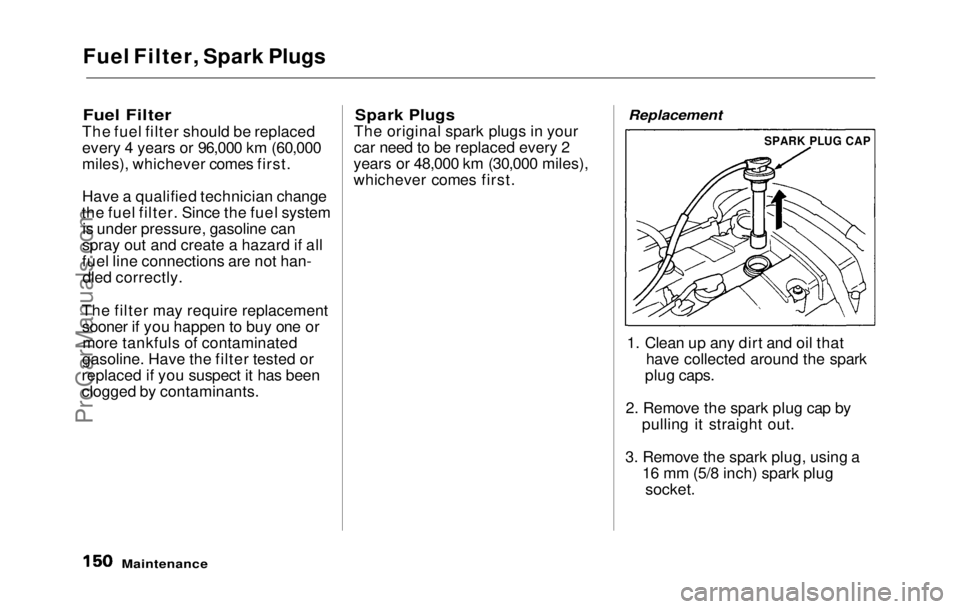
1. Clean up any dirt and oil that have collected around the spark
plug caps.
2. Remove the spark plug cap by pulling it straight out.
3. Remove the spark plug, using a 16 mm (5/8 inch) spark plug
socket.
Maintenance
SPARK PLUG CAPProCarManuals.comMain Menu Table of Contents s t
Page 150 of 225

Spark Plugs, Battery
Specifications:
Battery
Check the condition of your car's
battery monthly. You should check
for proper electrolyte level and
corrosion on the terminals.
Maintenance
The battery gives off explo-
sive hydrogen gas during nor-
mal operation. A spark or open
flame can cause the battery to
explode with enough force to
kill or seriously hurt you.
Wear protective clothing and a
face shield, or have a skilled mechanic do the battery main-
tenance. The battery contains sulfuric
acid (electrolyte) which is
highly corrosive and poisonous.
Getting electrolyte in your
eyes or on your skin can cause
serious burns. Wear protective
clothing and eye protection
when working near the battery.
Swallowing electrolyte can
cause fatal poisoning if immedi- ate action is not taken.
KEEP OUT OF THE REACH OF
CHILDREN
(US: S, Canada: S)
Normal driving conditions
NGK:
Nippondenso:
Hot climates, or continuous high
speed driving NGK:
Nippondenso:
(US: Si, Si 4WS, Canada: SR, SR 4WS)
Normal driving conditions NGK:
Nippondenso:
Hot climates, or continuous high
speed driving NGK:
Nippondenso:
ZFR5F-11
KJ16CR-L11
ZFR6F-11
KJ20CR-L11
ZFR6F-11
KJ20CR-L11
ZFR7F-11
KJ22CR-L11ProCarManuals.comMain Menu Table of Contents s t
Page 171 of 225
Storing Your Car
If you need to park your car for an
extended period (more than 1
month), there are several things
you should do to prepare it for
storage. Proper preparation helps
prevent deterioration and makes it
easier to get your car back on the
road. It is best to store your car indoors if at all possible. Fill the gas tank.
Change the engine oil and filter
(see page 137).
Wash and dry the exterior
completely.
Clean the interior. Make sure the
carpeting, floor mats, etc. are
completely dry.
Leave the parking brake off. Put
the transmission in Reverse (5-
speed) or Park (automatic). Block the rear wheels.
If the car is to be stored for a
longer period, it should be
supported on jackstands so the
tires are off the ground.
Leave one window open slightly
(if the car is being stored indoors).
Disconnect the battery.
Cover the car with a "breathable" car cover, one made
from a porous material such as
cotton. Nonporous materials,
such as plastic sheeting, trap
moisture which can damage the
paint. If possible, run the engine for a
while periodically (preferably once a month). If you store your car for 12 months
or longer, have your Honda dealer
perform the inspections called for
in the 24 months/48,000 km (30,000
miles) maintenance schedule as
soon as you take it out of storage
(see page 133). The replacements
called for in the maintenance
schedule are not needed unless the
car has actually reached that time or mileage.
MaintenanceProCarManuals.comMain Menu Table of Contents s t
Page 187 of 225
If Your Engine Won't Start, Jump Starting
The Starter Operates
Normally
In this case, the starter motor
sounds normal when you turn the
ignition switch to START (III), but
the engine does not run. Are you using the proper starting
procedure? Refer to Starting
the Engine on page 109 . Do you have gas? Turn the
ignition switch to ON (II) for a
minute and watch the fuel gauge.
There may be an electrical
problem, such as no power to the
fuel pump. Check all the fuses
(see page 199 ).
If you find nothing wrong, you will
need a qualified technician to find
the problem. See Towing on page
202.
Jump Starting
If your car's battery has run down,
you may be able to start the engine
by using a booster battery. Although this seems like a simple
procedure, there are several precau-
tions you should take. Follow the
directions closely.
You cannot start a Honda with an
automatic transmision by pushingor pulling it. To jump start your car:
1. Open the hood and check the physical condition of the battery
(see page 152 ). In very cold
weather, check the condition of the electrolyte. If it seems slushy
or like ice, do not try jump
starting until it thaws.
If a battery sits in extreme cold, the
electrolyte inside can freeze.
Attempting to jump start with a frozen battery can cause it to
rupture or explode.
2. Turn off all the electrical acces- sories: heater, A/C, stereo system,
lights, etc. Put the transmission in Neutral
or Park and set the parking
brake.
Taking Care of the Unexpected
CONTINUED
A battery can explode if you
do not follow the correct
procedure, seriously injuring
anyone nearby.
Keep all sparks, open flames,
and smoking materials away
from the battery.
NOTICE
ProCarManuals.comMain Menu Table of Contents s t
Page 199 of 225

Technical Information
The diagrams in this section give
you the dimensions and capacities
of your Honda, and the locations of
the identification numbers. The explanations of several electronic
and mechanical systems on your Honda are for the more technically-
oriented owner. Identification Numbers............... 204
Specifications................................ 206
Anti-lock Brake System ............. 208
Supplemental Restraint
System........................................ 209
Four Wheel Steering ................... 210
Emission Controls......................... 211 The Clean Air Act.................... 211
Crankcase Emission Control
System.................................... 211
Evaporative Emission Control
System.................................... 211
Exhaust Emission Controls.... 212 PGM-FI System.................... 212
Ignition Timing Control
System................................ 212
Exhaust Gas
Recirculation..................... 212
Catalytic Converter............. 212
Replacement Parts................... 212
Catalytic Converter..................... 213
Technical InformationProCarManuals.comMain Menu s t
Page 205 of 225

Supplemental Restraint System
The Honda
Supplemental Restraint
System (SRS) is standard on all
Preludes sold in the U.S. and the
SR, SR 4WS sold in Canada.
The SRS includes the steering
wheel airbag assembly, sensors in the dashboard, and a control unit
with sensors behind the center
console.
(On Si 4WS model)
The system also has a dashboard-
mounted airbag assembly for the
passenger.
The sensors are decelerometers,
set to trigger in a frontal impact that generates more force than a 10
mile per hour barrier crash. For the
SRS to activate, at least two sen-
sors must trigger. This duplication
is to prevent accidental activation. When the control unit receives
trigger signals from at least two
sensors, it sends voltage to the
airbag. The control unit stores this
charge in capacitors to insure
reliability even if a severe impact damages the car's battery or
electrical connections.
The electrical charge sent to the
airbag assembly ignites its propel-
lant, which burns instantaneously.
The gas produced by the burning propellant inflates the airbag in
about 40 milliseconds (1/25 of a
second).
The airbag is vented so it stays inflated for only an instant and
does not block the driver's vision.
Smoke from the burned propellant
comes out of the airbag and into
the car's interior. This is normal
and does not mean there is a fire.
The airbag collapses onto the driver's lap. The airbag unit can inflate only one
time. After use, your Honda dealer
must check the complete Supple-
mental Restraint System and re-
place the airbag assembly.
To ensure long-term reliability, the
SRS uses gold-plated electrical
connections throughout. Exposed
components are sealed with epoxy.
The control unit monitors the SRS circuitry whenever the ignition is
ON (II). If the control unit senses
any faults, it turns on the SRS
indicator light on the instrument
panel. Take the car to your Honda
dealer to diagnose and repair the system as soon as possible.
The SRS needs no regular mainte-
nance other than an inspection by
your Honda dealer ten years after
manufacture.
Technical InformationProCarManuals.comMain Menu Table of Contents s t
Page 207 of 225
Emission Controls
The burning of gasoline in your
car's engine produces several by-
products. Some of these are carbon
monoxide (CO), oxides of nitrogen
(NOx) and hydrocarbons (HC).
Gasoline evaporating from the tank
also produces hydrocarbons. Con-
trolling the production of NOx, CO,
and HC is important to the environ-
ment. Under certain conditions of
sunlight and climate, NOx and HC
react to form photochemical "smog."
Carbon monoxide does not contri-
bute to smog creation, but it is a
poisonous gas.
The Clean Air Act
The United States Clean Air Act*
sets standards for automobile
emissions. It also requires that
automobile manufacturers explain
to owners how their emission
controls work and what to do to
maintain them. This section
summarizes how the emission con-
trols work. Scheduled maintenance
is on page 129 .
* In Canada, Honda vehicles
comply with the Canadian Motor
Vehicle Safety Standards (CMVSS)
for Emissions valid at the time they
are manufactured.
Crankcase Emission Control
System
Your car has a Positive Crankcase
Ventilation (PCV) System. This
keeps gasses that build up in the engine's Crankcase from going into
the atmosphere. The PCV valve
routes them from the crankcase
back to the intake manifold. They
are then drawn into the engine and
burned.
Evaporative Emission
Control SystemAs gasoline evaporates in the fuel
tank, a canister filled with charcoal
adsorbs the vapor. It is stored in
this canister while the engine is off.
After the engine is started and
warmed up, the vapor is drawn into the engine and burned during
driving.
Technical Informatio n
ProCarManuals.comMain Menu Table of Contents s t