seats HONDA PRELUDE 1992 Owners Manual
[x] Cancel search | Manufacturer: HONDA, Model Year: 1992, Model line: PRELUDE, Model: HONDA PRELUDE 1992Pages: 225, PDF Size: 2.1 MB
Page 5 of 225
Your Occupant Protection System
Your Honda is equipped with seat
belts and other features that work
together to protect you and your
passengers during a crash.
Seat belts are the most important
part of your occupant protection
system. When worn properly, seat
belts can reduce the chance of serious injury or death in a crash.
For added protection during a
severe frontal collision, all Preludes
sold in the U.S. and the SR and SR
4WS models in Canada have a Supplemental Restraint System
(SRS) with a driver's airbag. The Si
4WS model sold in the U.S also hasa passenger's airbag. Two indicator lights are also part
of your safety system. One reminds
you to make sure you and your passengers wear your seat belts.
The other alerts you to a possible
problem with your supplemental
restraint system (see page 14).
The seats, head restraints, and door
locks also play a role in occupant safety. For example, reclining the
seat back can decrease the effec-
tiveness of your seat belt. Head
restraints can help protect your neck and head, especially during
rear-end impacts. Door locks help
keep your doors from being acciden-
tally opened during a crash. To get the maximum protection
from your occupant protection
system, check the following before
you drive away:
Everyone in the car is wearing a
seat belt properly (see page 6).
Both doors are closed and locked
(see page 16).
Seat backs are upright (see page
16).
There are no loose items that
could be thrown around and hurt
someone during a crash or
sudden stop (see page 17).
By following these guidelines, you
can reduce injuries to yourself and
your passengers in many crash
situations. Remember, however,
that no safety system can prevent all injuries or deaths that can occur
in severe crashes.
Driver and Passenger SafetyProCarManuals.comMain Menu Table of Contents s t
Page 6 of 225
The Seat Belt System and How It Works
Why Wear
Seat Belts
Wearing seat belts, and wearing
them properly, is fundamental to your safety and the safety of your
passengers.
During a crash or emergency stop,
seat belts can help keep you from
being thrown against the inside of the car, against other occupants, orout of the car.
Of course, seat belts cannot
completely protect you in every crash. But, in most cases, seat belts
reduce your chance of serious injury. They can even save your
life. That is why many states and all Canadian provinces require you
to wear seat belts.
Important Safety Reminders
Seat belts are designed for adults
and larger children. All infants and
small children must be properly
restrained in child safety seats (see
page 18).
A pregnant woman needs to wear a seat belt to protect herself and her
unborn child (see page 9).
Two people should never use the same seat belt. If they do, they
could be very seriously injured in a
crash.
Do not put shoulder belt pads or
other accessories on seat belts.
They can reduce the effectiveness of the belts and increase the chance
of injury.
Driver and Passenger Safety
Not wearing a seat belt in-
creases the chance of being killed or seriously hurt in a
crash.
Be sure you and your passen-
gers always wear seat belts
and wear them properly.ProCarManuals.comMain Menu Table of Contents s t
Page 20 of 225
Child Safety
Important Safety Reminders
Never hold
a baby or child on your
lap when riding in a car. If you are
wearing your seat belt, the violent
forces created during a crash will
tear the child from your arms. The
child could be seriously hurt or
killed.
If you are holding a child and not
wearing a seat belt in a crash, you could crush the child against the
car's interior.
Never put your seat belt over
yourself an d
a child. During a crash,
the belt could press deep into the
child; causin
g
serious internal
injuries.
Two children should never use the same seat belt. If they do, they
could be very seriously injured in a
crash.
General Guidelines for
Restraining Children Under
18 kg (40 Ibs)
Use an approved child seat. The
seat must meet Federal Motor
Vehicle Safety Standard 213 (FMVSS-213) or Canadian Motor
Vehicle Safety Standards. Look for
the manufacturer's statement of compliance on the box and seat.
Use a seat of the right size. Make
sure the seat fits your child. Check
the seat manufacturer's instruc-
tions and labels for height and
weight limits.
Secure the child seat to the car. All
approved child seats are designed
to be secured in the car seat by the
lap belt or the lap belt portion of a
lap/shoulder belt. A child whose
seat is not properly secured to the
car can be endangered in a crash.
To properl y
route a seat belt
through a child seat, follow the seat
maker's instructions. Be sure you
install a locking clip on a lap/
shoulder belt (see page 22).
Secure the child in the child seat.
Make sure the infant or child is
firmly secured to the child seat.
Use the straps provided, and
carefully follow the manufacturer's
instructions.
Driver an d
Passenger SafetyProCarManuals.comMain Menu Table of Contents s t
Page 21 of 225
Child Safety
Restraining an Infant Who
Weighs Less Than 9 kg
(20 Ibs)
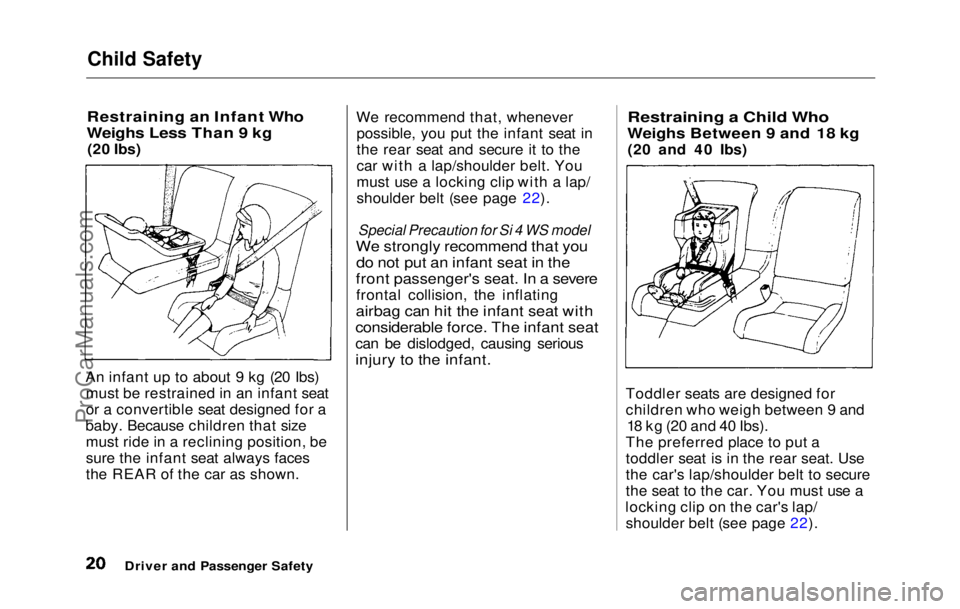
An infant up to about 9 kg (20 Ibs) must be restrained in an infant seat
or a convertible seat designed for a
baby. Because children that size must ride in a reclining position, be
sure the infant seat always faces
the REAR of the car as shown. We recommend that, whenever
possible, you put the infant seat in
the rear seat and secure it to the
car with a lap/shoulder belt. You
must use a locking clip with a lap/
shoulder belt (see page 22).
Special Precaution for Si 4 WS model
We strongly recommend that you do not put an infant seat in the
front passenger's seat. In a severe
frontal collision, the inflating
airbag can hit the infant seat with
considerable force. The infant seat
can be dislodged, causing serious
injury to the infant.
Restraining a Child Who
Weighs Betwee n
9 and 18 kg
(20 and 40 Ibs)
Toddler seats are designed for
children who weigh between 9 and 18 kg (20 and 40 Ibs).
The preferred place to put a
toddler seat is in the rear seat. Use
the car's lap/shoulder belt to secure
the seat to the car. You must use a
locking clip on the car's lap/ shoulder belt (see page 22).
Driver and Passenger SafetyProCarManuals.comMain Menu Table of Contents s t
Page 22 of 225
Child Safety
Using Child Restraints with
Tethers
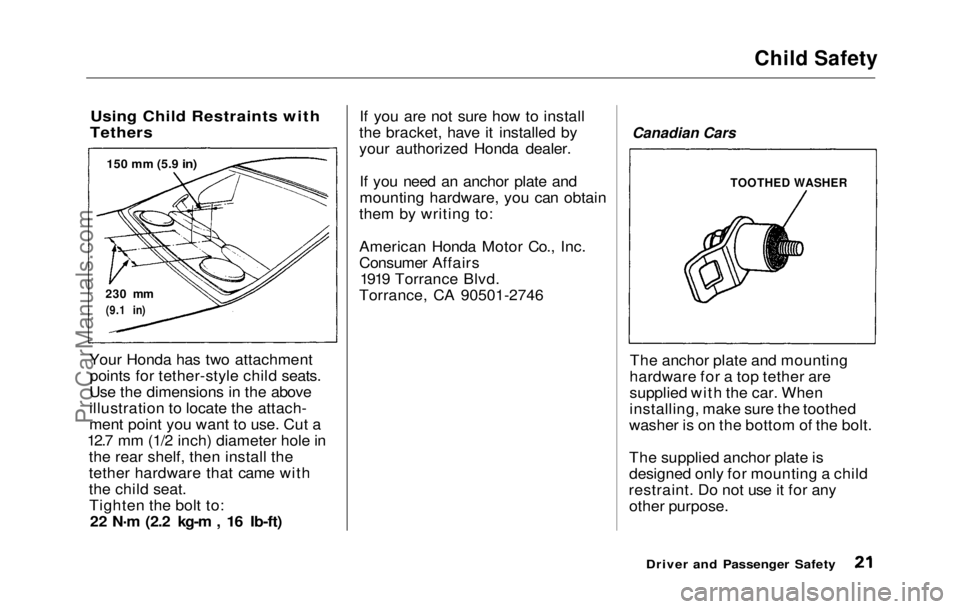
Your Honda has two attachment points for tether-style child seats.
Use the dimensions in the above
illustration to locate the attach-
ment point you want to use. Cut a
12.7 mm (1/2 inch) diameter hole in the rear shelf, then install the
tether hardware that came with
the child seat.Tighten the bolt to: 22 N .
m (2.2 kg-m , 16 Ib-ft) If you are not sure how to install
the bracket, have it installed by
your authorized Honda dealer.
If you need an anchor plate and
mounting hardware, you can obtain
them by writing to:
American Honda Motor Co., Inc.
Consumer Affairs 1919 Torrance Blvd.
Torrance, CA 90501-2746
Canadian Cars
The anchor plate and mounting
hardware for a top tether are
supplied with the car. When
installing, make sure the toothed
washer is on the bottom of the bolt.
The supplied anchor plate is
designed only for mounting a child
restraint. Do not use it for any other purpose.
Driver and Passenger Safety
TOOTHED WASHER
150 mm (5.9
in)
230 mm
(9.1 in)ProCarManuals.comMain Menu Table of Contents s t
Page 24 of 225
Child Safety
Restraining a Chil
d Who
Weighs Over 18 kg (40 Ibs)
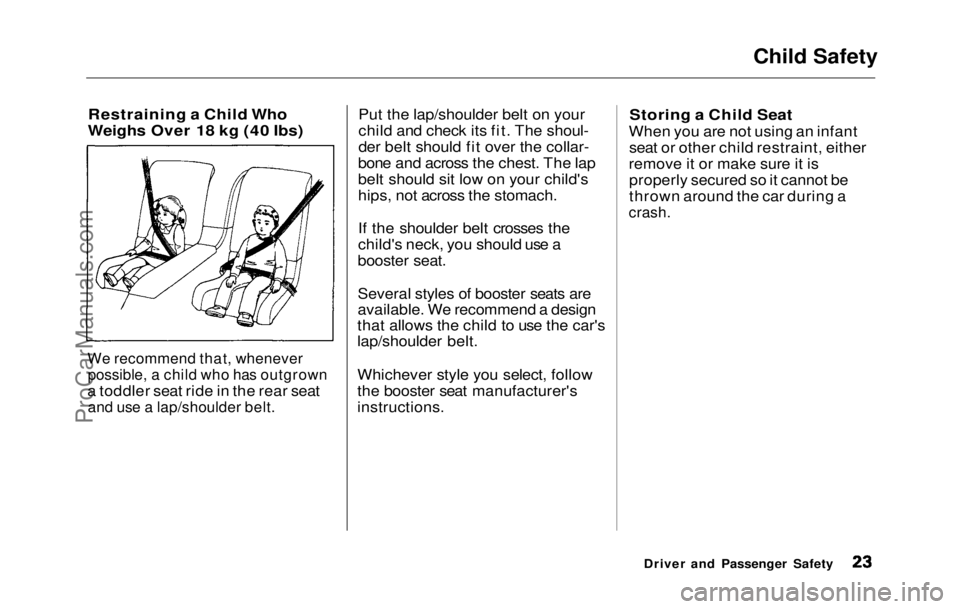
We recommend that, whenever
possible, a child who has outgrown
a toddler seat ride in the rear seat
and use a lap/shoulder belt.
Put the lap/shoulder belt on your
child and check its fit. The shoul-
der belt should fit over the collar-
bone and across the chest. The lap
belt should sit low on your child's
hips, not across the stomach.
If the shoulder belt crosses the
child's neck, you should use a
booster seat.
Several styles of booster seats are
available. We recommend a design
that allows the child to use the car's
lap/shoulder belt.
Whichever style you select, follow
the booster seat manufacturer's
instructions.
Storing a Child Seat
When you are not using an infant seat or other child restraint, either
remove it or make sure it is properly secured so it cannot be
thrown around the car during a
crash.
Driver and Passenger SafetyProCarManuals.comMain Menu Table of Contents s t
Page 54 of 225
Seat Adjustments, Seat Heaters
Seat-back Angle Memory
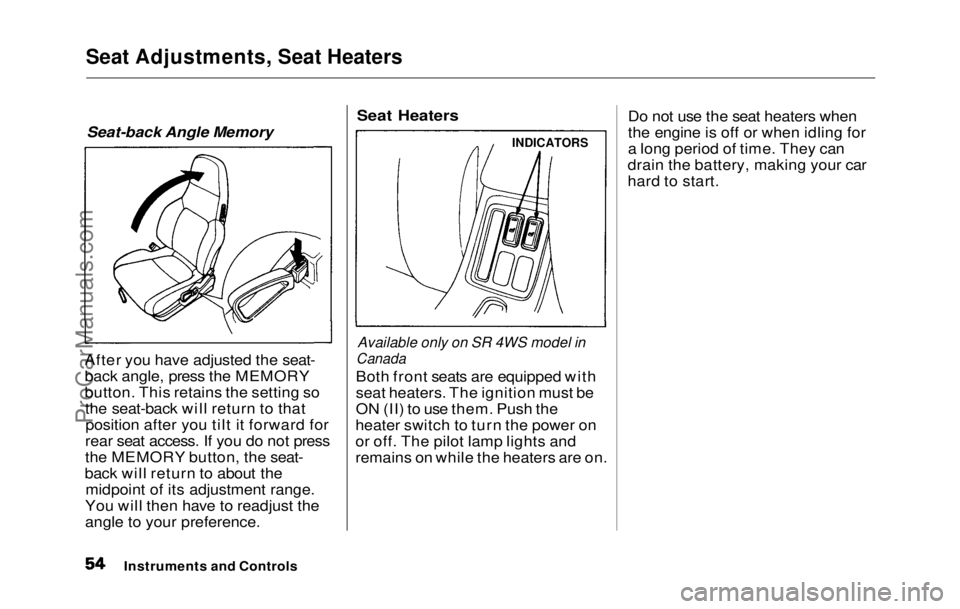
After you have adjusted the seat-
back angle, press the MEMORY
button. This retains the setting so the seat-back will return to thatposition after you tilt it forward for
rear seat access. If you do not press
the MEMORY button, the seat-
back will return to about the midpoint of its adjustment range.
You will then have to readjust the
angle to your preference.
Seat Heaters
Available only on SR 4WS model in
Canada
Both fron
t
seats are equipped with
seat heaters. The ignition must be
ON (II) to use them. Push the
heater switch to turn the power on
or off. The pilot lamp lights and
remains on while the heaters are on. Do not use the seat heaters when
the engine is off or when idling for
a long period of time. They can
drain the battery, making your car
hard to start.
Instruments and Controls
INDICATORSProCarManuals.comMain Menu Table of Contents s t
Page 105 of 225
Loading Cargo
The maximum load you can carry
in your Honda is 325 kg (700 Ibs). It
includes the total weight of all
passengers and their belongings,
any accessories, and the tongue
weight of a trailer. This 325 kg (700
Ibs) figure
is shown as the Vehicle
Capacity Weight on the tire infor-
mation label attached to the driver's
door jamb.
To figure out how much cargo you
can carry:
Figure the total "occupant
weight" you will be transporting.
To do this, multiply the number
of people (driver and all passen-
gers) by 70 kg (150 Ibs). Subtract this number from the
Vehicle Capacity Weight (325 kg/
700 Ibs).
If you are towing a trailer,
subtract the tongue weight. See
Towing a Trailer on page 121.
This final number is the total
weight of cargo you can load in or on the car. With four occupants
(driver and three passengers), the
maximum recommended weight
for cargo is 45 kg (100 Ibs). Where you store this cargo, and
how well you secure it, are just as
important as how much it weighs.
Make sure you load cargo so it will
not shift while driving. Items
stored in the trunk should be placed as far forward as possible.
You could store additional items on
the floor behind the front seats. Make sure they cannot roll under
the front seat and interfere with
the pedals.
If you must carry large objects that
prevent you from closing the trunk
lid, be aware that exhaust gas can enter the interior. See Carbon
Monoxide Hazard on page 25 .
Never place items on the shelf
behind the back seat. Those items
can fly forward and injure you or
your passengers if you brake hard
or are involved in a collision.
Before DrivingProCarManuals.comMain Menu Table of Contents s t
Page 217 of 225
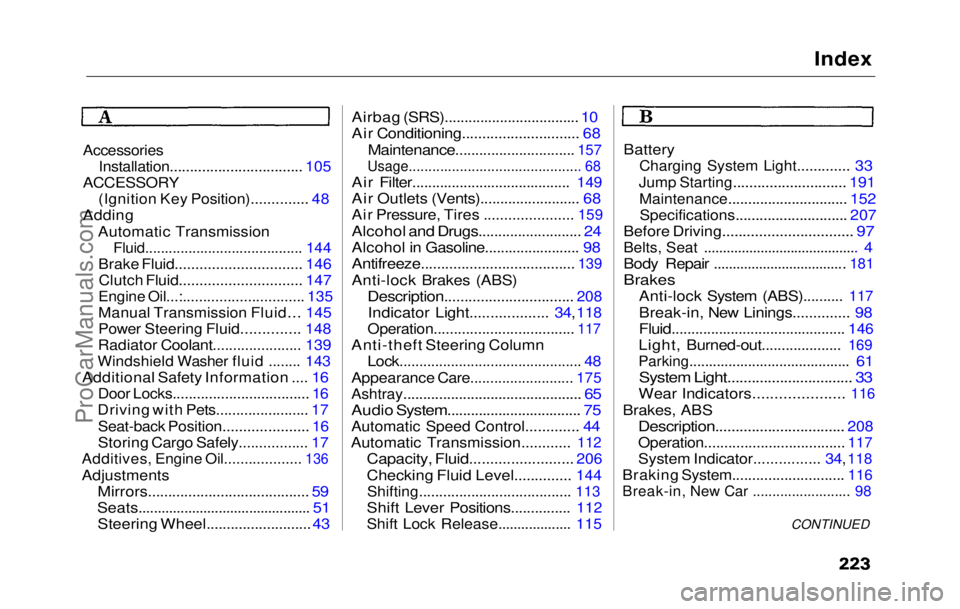
Index
Accessories
Installation................................. 105
ACCESSORY
(Ignition Key Position).............. 48
Adding
Automatic Transmission
Fluid........................................ 144
Brake Fluid............................... 146 Clutch Fluid.............................. 147
Engine Oil...:.............................. 135
Manual Transmission Fluid... 145
Power Steering Fluid.............. 148
Radiator Coolant...................... 139
Windshield Washer fluid ........ 143
Additional Safety Information .... 16
Door Locks.................................. 16
Driving with Pets....................... 17
Seat-back Position..................... 16
Storing Cargo Safely................. 17
Additives, Engine Oil................... 136
Adjustments
Mirrors....................................... .
59
Seats............................................. 51
Steering Wheel..........................
43
Airbag (SRS).................................. 1
0
Air Conditioning............................. 68
Maintenance..............................
157
Usage............................................ 6 8
Ai
r Filter........................................
149
Air Outlet
s
(Vents)......................... 68
Air Pressure, Tires ......................
159
Alcohol an d
Drugs.......................... 24
Alcohol in Gasoline........................ 98
Antifreeze......................................
139
Anti-lock Brake s
(ABS)
Description................................
208
Indicator Light.................. .
34,
118
Operation................................... 117
Anti-theft Steerin
g
Column
Lock.............................................. 48
Appearance Care..........................
175
Ashtray............................................. 65
Audio System................................. .
75
Automatic Speed Control............. 44
Automatic Transmission............ 112
Capacity, Fluid........................
.
206
Checking Fluid Level.............. 144
Shifting
...................................... 113
Shift Leve r
Positions...............
112
Shift Lock Release................... 115
Battery
Charging System Light............. 33
Jump Starting............................ 191
Maintenance.............................. 152
Specifications............................ 207
Before Driving
................................ 97
Belts, Seat ......................................... 4
Body Repair
...................................
181
Brakes
Anti-lock Syste
m (ABS)..........
117
Break-in, Ne
w
Linings.............. 98
Fluid............................................
146
Light, Burned-out................... .
169
Parking......................................... 61
System Light.............................. .
33
Wear Indicators.....................
116
Brakes, AB S
Description...............................
.
208
Operation................................... 117
System Indicator...............
.
34,
118
Braking System...........................
.
116
Break-in, Ne
w
Car ......................... 98
CONTINUEDProCarManuals.comMain Menu s t
Page 223 of 225
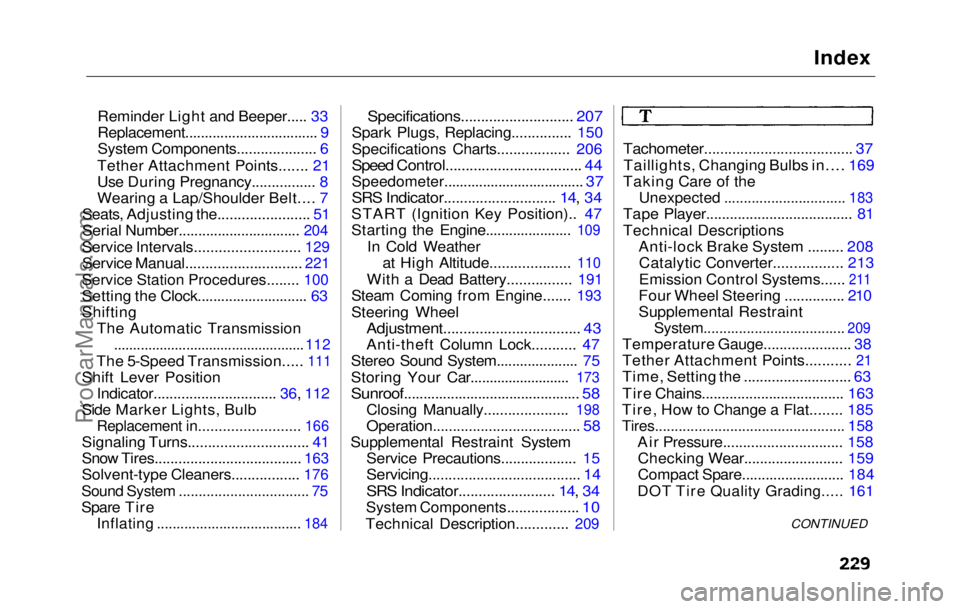
Index
Reminder Light and Beeper..... 33
Replacement.................................. 9
System Components.................... 6
Tether Attachment Points....... 21
Use During Pregnancy................ 8
Wearing a Lap/Shoulder Belt.... 7
Seats, Adjusting the....................... 51
Serial Number............................... 204
Service Intervals..........................
129
Service Manual............................
.
221
Service Station Procedures........ 100
Setting th
e
Clock............................ 63
Shifting The Automatic Transmission
..................................................
112
The 5- Speed
Transmission.....
111
Shift Leve
r
Position
Indicator...............................
36, 112
Side Marke r
Lights, Bulb
Replacement in.........................
166
Signaling Turns............................. .
41
Snow Tires.....................................
163
Solvent-type Cleaners................ .
176
Sound Syste
m
................................. 75
Spare Tire
Inflating .....................................
184
Specifications............................ 207
Spar
k Plugs, Replacing............... 150
Specifications Charts.................. 206
Speed Control.................................. 44
Speedometer.................................... 37
SRS Indicator........................... .
14, 34
START (Ignition Key Position)..
47
Starting th e
Engine......................
109
In Col
d
Weather
at High Altitude....................
110
With a Dea
d Battery................
191
Steam Comin
g
from Engine.......
193
Steering Whee
l
Adjustment.................................
. 43
Anti-theft Column Lock........... 47
Stereo Sound System..................... 75
Storing Your Car..........................
173
Sunroof............................................. 58
Closin
g Manually.....................
198
Operation.....................................
58
Supplementa
l Restraint System
Service Precautions................... 15
Servicing...................................... 14
SRS Indicator........................ 14, 34
System Components.................. 10
Technical Description............ .
209
Tachometer.....................................
37
Taillights
, Changing Bulbs in.... 169
Taking Care of the
Unexpected ...............................
183
Tape Player.................................... .
81
Technical Descriptions Anti-lock Brake System ......... 208Catalytic Converter................. 213
Emission Control Systems......
211
Four Whee l
Steering ............... 210
Supplemental Restraint
System....................................
209
Temperature Gauge..................... .
38
Tether Attachment Points...........
21
Time, Settin g
the ........................... 63
Tire Chains.................................... 163
Tire, How to Change a Flat........ 185
Tires................................................ 158
Air Pressure.............................. 158Checking Wear......................... 159
Compact Spare.......................... 184
DOT Tire Quality Grading..... 161
CONTINUEDProCarManuals.comMain Menu s t