towing HONDA PRELUDE 1998 User Guide
[x] Cancel search | Manufacturer: HONDA, Model Year: 1998, Model line: PRELUDE, Model: HONDA PRELUDE 1998Pages: 278, PDF Size: 2.61 MB
Page 165 of 278
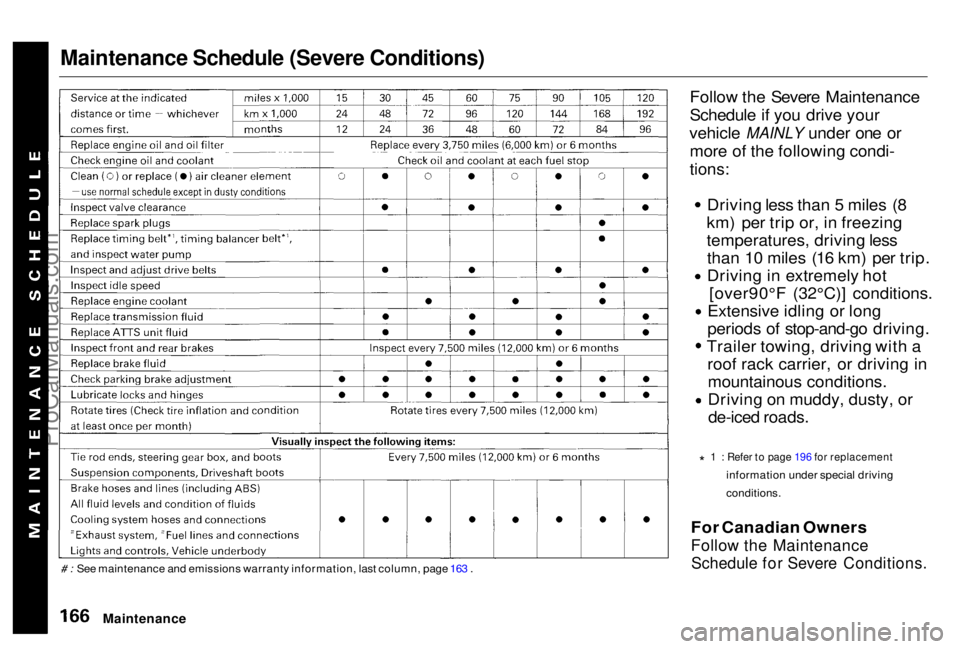
Maintenance Schedule (Severe Conditions)
# : See maintenance and emissions warranty information, last column, page 163 . Follow the Severe Maintenance
Schedule if you drive your
vehicle MAINLY under one or
more of the following condi-
tions:
Driving less than 5 miles (8
km) per trip or, in freezing
temperatures, driving less than 10 miles (16 km) per trip. Driving in extremely hot
[over90°F (32°C)] conditions. Extensive idling or long
periods of stop-and-go driving.
Trailer towing, driving with a
roof rack carrier, or driving inmountainous conditions. Driving on muddy, dusty, or
de-iced roads.
* 1: Refer to page 196 for replacement
information under special driving
conditions.
For Canadian Owners
Follow the Maintenance
Schedule for Severe Conditions.
Maintenance
ProCarManuals.comMain Menu Table of Contents s t
Page 166 of 278
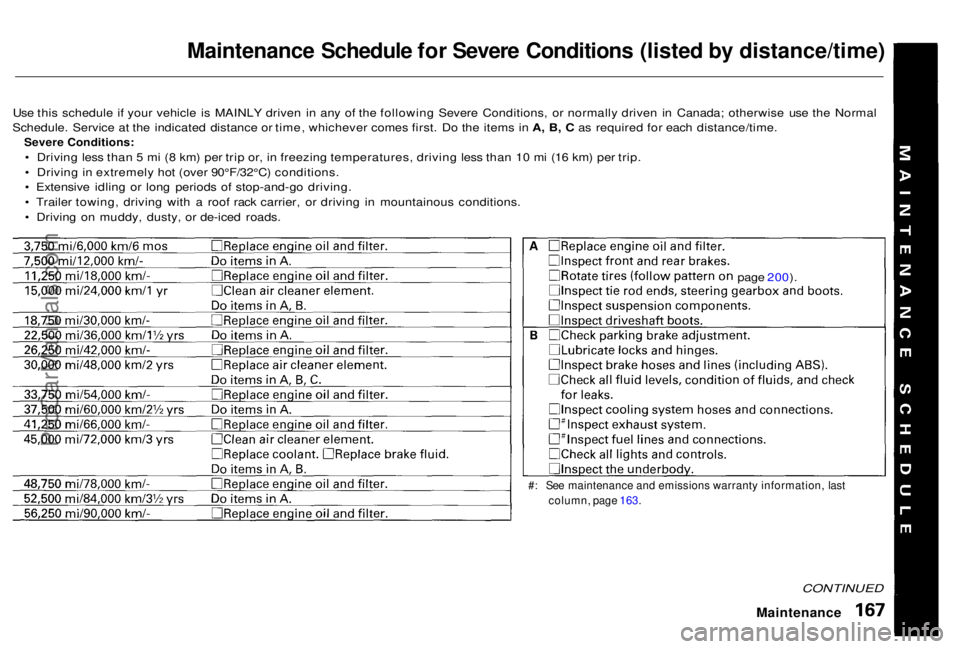
Maintenance Schedule for Severe Conditions (listed by distance/time)
Use this schedule if your vehicle is MAINLY driven in any of the following Severe Conditions, or normally driven in Canada; otherwise use the Normal
Schedule. Service at the indicated distance or time, whichever comes first. Do the items in A, B, C as required for each distance/time.
Severe Conditions:
• Driving less than 5 mi (8 km) per trip or, in freezing temperatures, driving less than 10 mi (16 km) per trip.
• Driving in extremely hot (over 90°F/32°C) conditions.
• Extensive idling or long periods of stop-and-go driving.
• Trailer towing, driving with a roof rack carrier, or driving in mountainous conditions.
• Driving on muddy, dusty, or de-iced roads.
CONTINUED
Maintenance
#: See maintenance and emissions warranty information, last
column, page 163.
page 200).ProCarManuals.comMain Menu Table of Contents s t
Page 224 of 278
Taking Care of the Unexpected
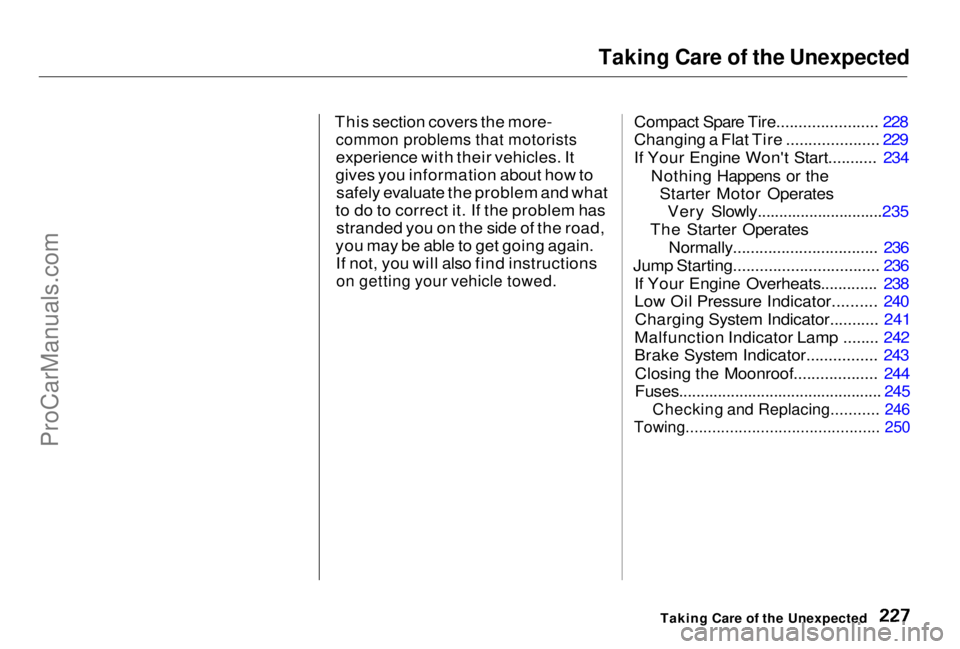
This section covers the more-
common problems that motorists
experience with their vehicles. It
gives you information about how to safely evaluate the problem and what
to do to correct it. If the problem has stranded you on the side of the road,
you may be able to get going again. If not, you will also find instructions
on getting your vehicle towed.
Compact Spare Tire....................... 228
Changing a Flat Tire ..................... 229
If Your Engine Won't Start........... 234
Nothing Happens or theStarter Motor OperatesVery Slowly.............................235
The Starter Operates Normally................................. 236
Jump Starting................................. 236 If Your Engine Overheats............. 238
Low Oil Pressure Indicator.......... 240Charging System Indicator........... 241
Malfunction Indicator Lamp ........ 242
Brake System Indicator................ 243
Closing the Moonroof................... 244
Fuses............................................... 245
Checking and Replacing........... 246
Towing............................................ 250
Taking Care of the UnexpectedProCarManuals.comMain Menu s t
Page 232 of 278
If Your Engine Won't Start
Nothing Happens or the Starter
Motor Operates Very Slowly
When you turn the ignition switch to START (III), you do not hear the
normal noise of the engine trying tostart. You may hear a clicking sound
or series of clicks, or nothing at all. Check these things: Your vehicle has the Immobilizer
System. You should use a
properly-coded master or valet key
to start the engine (see page 69).
A key that is not properly coded will cause the immobilizer systemindicator in the dash panel to blinkrapidly. Check the transmission interlock.
If you have a manual transmission,
the clutch pedal must be pushed all the way to the floor or the
starter will not operate. With an
automatic transmission, it must be
in Park or Neutral. Turn the ignition switch to ON (II).
Turn on the headlights and check
their brightness. If the headlightsare very dim or don't light at all,
the battery is discharged. See
Jump Starting on page 236.
Turn the ignition switch to START
(III). If the headlights do not dim,
check the condition of the fuses. If
the fuses are OK, there is proba-
bly something wrong with the electrical circuit for the ignitionswitch or starter motor. You will
need a qualified technician to
determine the problem. (See
Towing on page 250.) If the headlights dim noticeably or
go out when you try to start the
engine, either the battery is dis-
charged or the connections are
corroded. Check the condition of
the battery and terminal connec- tions (see page 190). You can
then try jump starting the vehicle
from a booster battery (see page
236).
Taking Care of the UnexpectedProCarManuals.comMain Menu Table of Contents s t
Page 233 of 278
If Your Engine Won't Start, Jump Starting
The Starter Operates Normally In this case, the starter motor'sspeed sounds normal, or even faster
than normal, when you turn the
ignition switch to START (III), but
the engine does not run. Are you using the proper starting
procedure? Refer to Starting the
Engine on page 133.
Do you have fuel? Turn the
ignition switch to ON (II) for a
minute and watch the fuel gauge.
The low fuel level warning light
may not be working, so you were
not reminded to fill the tank.
There may be an electrical
problem, such as no power to the
fuel pump. Check all the fuses
(see page 245).
If you find nothing wrong, you will
need a qualified technician to find
the problem. See Towing on page
250. Jump Starting
If your vehicle's battery has rundown, you may be able to start the
engine by using a booster battery.
Although this seems like a simple procedure, you should take several
precautions.
You cannot start a Honda with an automatic transmission by pushing
or pulling it. To jump start your vehicle, follow
these directions closely:
1. Open the hood and check the physical condition of the battery(see page 190). In very cold
weather, check the condition of
the electrolyte. If it seems slushy or like ice, do not try jump starting
until it thaws.
If a battery sits in extreme cold, the
electrolyte inside can freeze.
Attempting to jump start with a frozen
battery can cause it to rupture.
2. Turn off all the electrical acces- sories: heater, A/C, stereo system,
lights, etc.
Put the transmission in Neutral or
Park and set the parking brake.
Taking Care of the Unexpected
NOTICE
A battery can explode if you do
not follow the correct procedure,
seriously injuring anyone nearby.
Keep all sparks, open flames,
and smoking materials away
from the battery.ProCarManuals.comMain Menu Table of Contents s t
Page 236 of 278
If Your Engine Overheats
6. Look for any obvious coolant leaks, such as a split radiator hose.
Everything is still extremely hot, so use caution. If you find a leak, it
must be repaired before you continue driving (see Towing on
page 250).
7. If you don't find an obvious leak, check the coolant level in the
radiator reserve tank (see page 124). If the level is below the
MIN mark, add coolant to halfway
between the MIN and MAX marks.
8. If there was no coolant in the reserve tank, you may also have to
add coolant to the radiator. Let the
engine cool down until the pointer
reaches the middle of the tempera-
ture gauge, or lower, before check-
ing the radiator. 9. Using gloves or a large heavy
cloth, turn the radiator cap
counterclockwise, without pushingdown, to the first stop. This
releases any remaining pressure in
the cooling system. After the pressure releases, push down on
the cap and turn it until it comesoff. 10. Start the engine and set the
temperature control lever to
maximum. Add coolant to the
radiator up to the base of the filler
neck. If you do not have the
proper coolant mixture available,
you can add plain water.
Remember to have the cooling
system drained and refilled with
the proper mixture as soon as you
can.
11. Put the radiator cap back on tightly. Run the engine and watch
the temperature gauge. If it goes
back to the red mark, the engine
needs repair. (See Towing on
page 250.)
12. If the temperature stays normal, check the coolant level in the
radiator reserve tank. If it has
gone down, add coolant to the
MAX mark. Put the cap back on
tightly.
Taking Care of the Unexpected
Removing the radiator cap
while the engine is hot can
cause the coolant to spray out,
seriously scalding you.
Always let the engine and radiator cool down before
removing the radiator cap.ProCarManuals.comMain Menu Table of Contents s t
Page 237 of 278
Low Oil Pressure Indicator
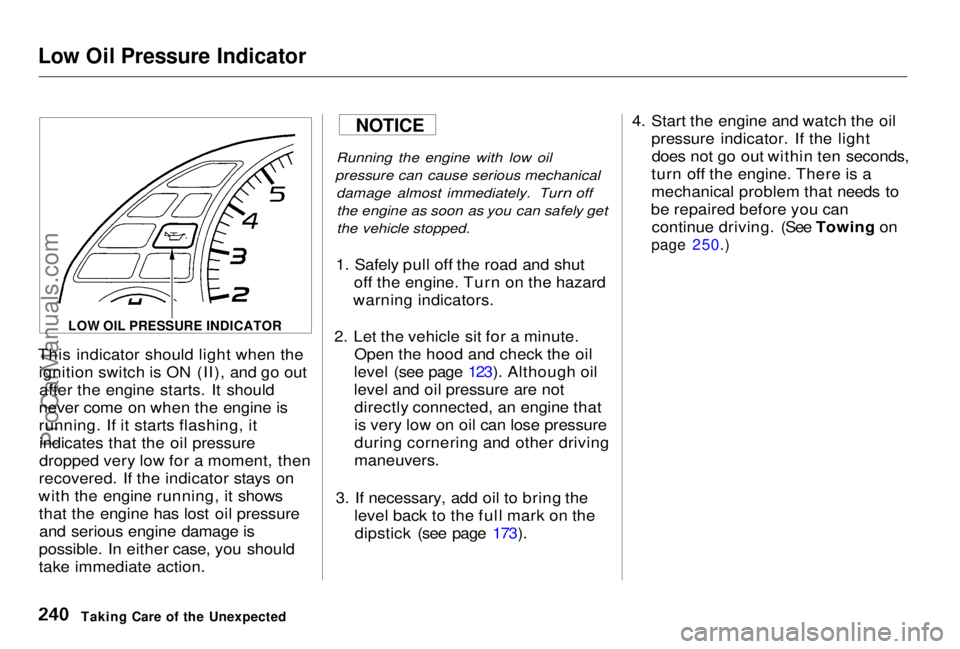
This indicator should light when the
ignition switch is ON (II), and go outafter the engine starts. It should
never come on when the engine is
running. If it starts flashing, it indicates that the oil pressure
dropped very low for a moment, then
recovered. If the indicator stays on
with the engine running, it shows that the engine has lost oil pressureand serious engine damage is
possible. In either case, you should
take immediate action.
Running the engine with low oil
pressure can cause serious mechanical damage almost immediately. Turn off
the engine as soon as you can safely get
the vehicle stopped.
1. Safely pull off the road and shut off the engine. Turn on the hazard
warning indicators.
2. Let the vehicle sit for a minute. Open the hood and check the oil
level (see page 123). Although oil
level and oil pressure are not directly connected, an engine that
is very low on oil can lose pressure
during cornering and other driving
maneuvers.
3. If necessary, add oil to bring the level back to the full mark on thedipstick (see page 173). 4. Start the engine and watch the oil
pressure indicator. If the lightdoes not go out within ten seconds,
turn off the engine. There is a
mechanical problem that needs to
be repaired before you can continue driving. (See Towing on
page 250.)
Taking Care of the Unexpected
NOTICE
LOW OIL PRESSURE INDICATOR
ProCarManuals.comMain Menu Table of Contents s t
Page 247 of 278
Towing
If your vehicle needs to be towed,
call a professional towing service or,
if you belong to one, an organization
that provides roadside assistance. Never tow your vehicle behindanother vehicle with just a rope or
chain. It is very dangerous.
Emergency Towing
There are three popular methods of towing a vehicle:
Flat-bed Equipment — The operator
loads your vehicle on the back of a truck. This is the best way of trans-
porting your Honda.
Wheel Lift Equipment — The tow
truck uses two pivoting arms that go
under the tires (front or rear) and lift
them off the ground. The other two
tires remain on the ground. Sling-type Equipment The tow
truck uses metal cables with hooks
on the ends. These hooks go around
parts of the frame or suspension and
the cables lift that end of the vehicle off the ground. Your vehicle's sus-
pension and body can be seriously damaged if this method of towing is
attempted.
If your Honda cannot be transported
by flat-bed, it should be towed withthe front wheels off the ground. Ifdue to damage, your vehicle must be
towed with the front wheels on the ground, do the following:
5-speed Manual Transmission
Release the parking brake.
Shift the transmission to Neutral.
Automatic Transmission:
Release the parking brake.
Start the engine.
Shift to D4, then to N.
Turn off the engine.
Improper towing preparation will
damage the transmission. Follow the
above procedure exactly. If yon cannot
shift the transmission or start the
engine (automatic transmission), yourvehicle must be transported on a flat-
bed.
It is best to tow the vehicle no far-
ther than 50 miles (80 km), and
keep the speed below 35 mph (55
km/h).
If your vehicle is equipped with an
optional front air spoiler, remove it
before towing so it is not damaged.
Trying to lift or tow your vehicle by the
bumpers will cause serious damage. The bumpers are not designed to
support the vehicle's weight.
Taking Care of the Unexpected
NOTICE
NOTICE
ProCarManuals.comMain Menu Table of Contents s t
Page 271 of 278
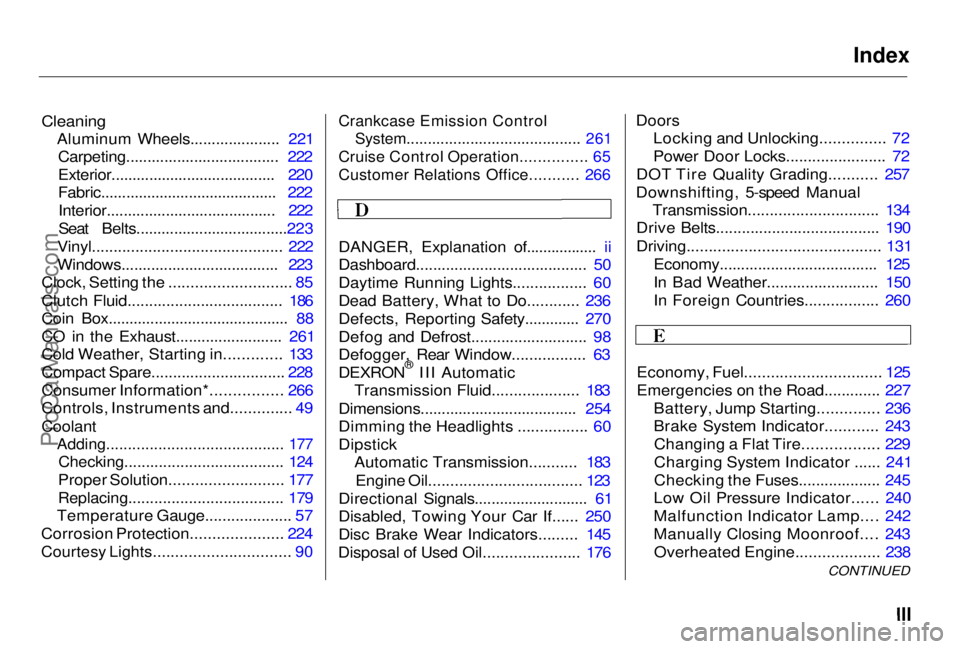
Index
Cleaning
Aluminum Wheels..................... 221Carpeting.................................... 222
Exterior....................................... 220
Fabric.......................................... 222
Interior........................................ 222
Seat Belts....................................223
Vinyl............................................ 222
Windows..................................... 223
Clock, Setting the ............................ 85
Clutch Fluid.................................... 186
Coin Box........................................... 88
CO in the Exhaust......................... 261
Cold Weather, Starting in............. 133
Compact Spare............................... 228
Consumer Information*................ 266
Controls, Instruments and.............. 49
Coolant
Adding......................................... 177
Checking..................................... 124
Proper Solution.......................... 177
Replacing.................................... 179
Temperature Gauge.................... 57
Corrosion Protection..................... 224
Courtesy Lights............................... 90
Crankcase Emission Control
System......................................... 261
Cruise Control Operation............... 65
Customer Relations Office........... 266
DANGER, Explanation of................. ii
Dashboard........................................ 50
Daytime Running Lights................. 60
Dead Battery, What to Do............ 236
Defects, Reporting Safety............. 270
Defog and Defrost........................... 98
Defogger, Rear Window................. 63
DEXRON ®
III Automatic
Transmission Fluid.................... 183
Dimensions..................................... 254
Dimming the Headlights ................ 60
Dipstick Automatic Transmission........... 183
Engine Oil................................... 123
Directional Signals........................... 61
Disabled, Towing Your Car If...... 250
Disc Brake Wear Indicators......... 145
Disposal of Used Oil...................... 176 Doors
Locking and Unlocking............... 72
Power Door Locks....................... 72
DOT Tire Quality Grading........... 257
Downshifting, 5-speed Manual Transmission.............................. 134
Drive Belts...................................... 190
Driving............................................ 131
Economy..................................... 125
In Bad Weather.......................... 150
In Foreign Countries................. 260
Economy, Fuel............................... 125
Emergencies on the Road............. 227 Battery, Jump Starting.............. 236
Brake System Indicator............ 243Changing a Flat Tire................. 229
Charging System Indicator ...... 241
Checking the Fuses................... 245
Low Oil Pressure Indicator...... 240
Malfunction Indicator Lamp.... 242
Manually Closing Moonroof.... 243
Overheated Engine................... 238 CONTINUEDProCarManuals.comMain Menu s t
Page 272 of 278
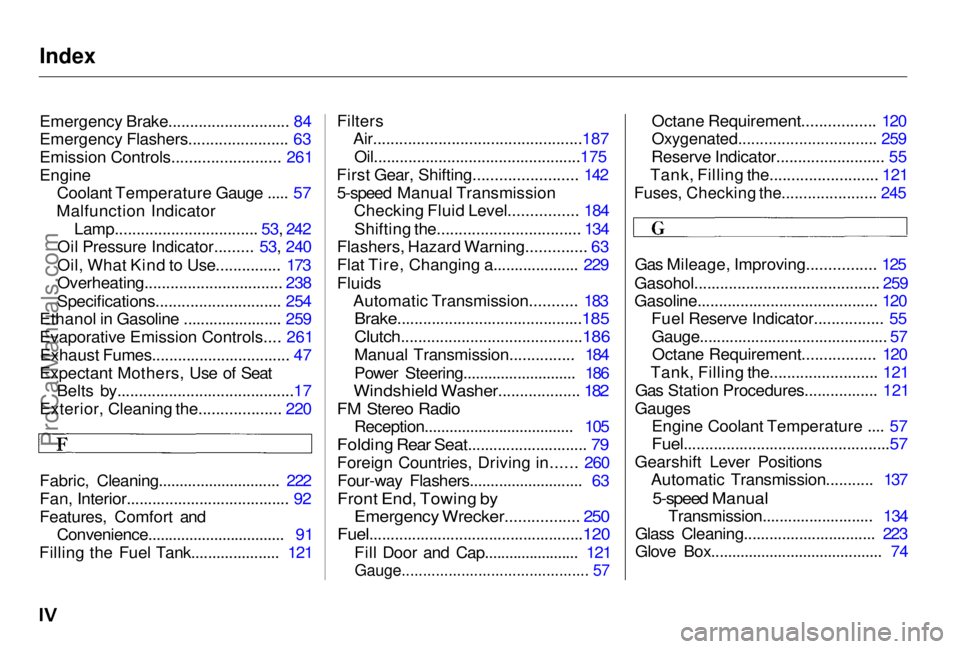
Index
Emergency Brake............................ 84
Emergency Flashers....................... 63
Emission Controls......................... 261
Engine
Coolant Temperature Gauge ..... 57
Malfunction Indicator Lamp................................. 53, 242
Oil Pressure Indicator......... 53, 240
Oil, What Kind to Use............... 173
Overheating................................ 238
Specifications............................. 254
Ethanol in Gasoline ....................... 259
Evaporative Emission Controls.... 261
Exhaust Fumes................................ 47
Expectant Mothers, Use of Seat Belts by.........................................17
Exterior, Cleaning the................... 220
Fabric, Cleaning............................. 222
Fan, Interior...................................... 92
Features, Comfort and Convenience................................. 91
Filling the Fuel Tank..................... 121 Filters
Air................................................187
Oil................................................175
First Gear, Shifting........................ 142 5-speed Manual Transmission Checking Fluid Level................ 184
Shifting the................................. 134
Flashers, Hazard Warning.............. 63
Flat Tire, Changing a.................... 229
Fluids Automatic Transmission........... 183
Brake...........................................185
Clutch..........................................186
Manual Transmission............... 184
Power Steering........................... 186
Windshield Washer................... 182
FM Stereo Radio
Reception.................................... 105
Folding Rear Seat............................ 79
Foreign Countries, Driving in...... 260 Four-way Flashers........................... 63
Front End, Towing by
Emergency Wrecker................. 250
Fuel..................................................120
Fill Door and Cap....................... 121
Gauge............................................ 57
Octane Requirement................. 120
Oxygenated................................ 259
Reserve Indicator......................... 55
Tank, Filling the......................... 121
Fuses, Checking the...................... 245
Gas Mileage, Improving................ 125
Gasohol........................................... 259
Gasoline.......................................... 120 Fuel Reserve Indicator................ 55
Gauge............................................ 57Octane Requirement................. 120
Tank, Filling the......................... 121
Gas Station Procedures................. 121
Gauges
Engine Coolant Temperature .... 57
Fuel................................................57
Gearshift Lever Positions Automatic Transmission........... 137
5-speed Manual
Transmission.......................... 134
Glass Cleaning............................... 223
Glove Box......................................... 74ProCarManuals.comMain Menu s t