steering HONDA PRELUDE 1998 Owner's Guide
[x] Cancel search | Manufacturer: HONDA, Model Year: 1998, Model line: PRELUDE, Model: HONDA PRELUDE 1998Pages: 278, PDF Size: 2.61 MB
Page 150 of 278
Driving in Bad Weather
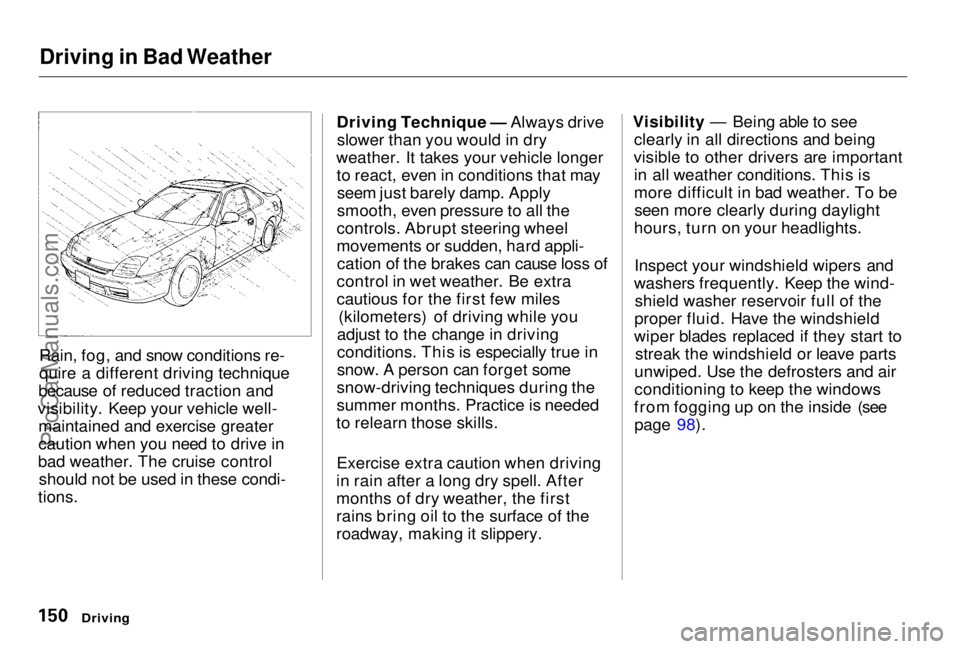
Rain, fog, and snow conditions re-
quire a different driving technique
because of reduced traction and
visibility. Keep your vehicle well- maintained and exercise greater
caution when you need to drive in
bad weather. The cruise control should not be used in these condi-
tions. Driving Technique — Always drive
slower than you would in dry
weather. It takes your vehicle longer to react, even in conditions that mayseem just barely damp. Apply
smooth, even pressure to all the
controls. Abrupt steering wheel
movements or sudden, hard appli- cation of the brakes can cause loss of
control in wet weather. Be extra
cautious for the first few miles (kilometers) of driving while you
adjust to the change in driving
conditions. This is especially true in
snow. A person can forget some
snow-driving techniques during the
summer months. Practice is needed
to relearn those skills.
Exercise extra caution when driving
in rain after a long dry spell. After
months of dry weather, the first
rains bring oil to the surface of the
roadway, making it slippery. Visibility — Being able to see
clearly in all directions and being
visible to other drivers are important in all weather conditions. This is
more difficult in bad weather. To beseen more clearly during daylight
hours, turn on your headlights.
Inspect your windshield wipers and
washers frequently. Keep the wind- shield washer reservoir full of the
proper fluid. Have the windshield
wiper blades replaced if they start to streak the windshield or leave parts
unwiped. Use the defrosters and air
conditioning to keep the windows
from fogging up on the inside (see page 98).
DrivingProCarManuals.comMain Menu Table of Contents s t
Page 153 of 278
Towing a Trailer
The best way to confirm that your total towing package is within thesespecifications is to get it weighed.
Load the vehicle and trailer as you
normally would while towing, and
take them to a public scale. Have
them check the total weight and the
weight at each axle, then compare the weights to the specifications.
Trailer Hitches
The trailer hitch must be the proper size and construction for your
vehicle and the trailer you intend to tow. Consult with an expert before
you purchase a trailer hitch, andhave it installed by a qualifiedmechanic.
The hitch should bolt to the underbody of the vehicle, anddistribute the load over a wide area.
Never use a hitch that mounts only
to the rear bumper. The bumper is
not designed to handle that type of
load.
A trailer hitch that is not adequate for the size of the trailer, or a hitch that is
improperly installed, can cause damage
to the underside of your vehicle.
Driving
Improperly loading your vehicle
and trailer can seriously affect
its steering and braking
performance, causing a crash
in which you can be seriously
injured.
Check the loading of your
vehicle and trailer carefully before starting to drive.
NOTICEProCarManuals.comMain Menu Table of Contents s t
Page 157 of 278

Towing a Trailer
When towing a trailer in the Sequential SportShift mode, select
Third, Second, or First gear; depending on the vehicle speeds and
road condition. Do not use Fourth
gear. The recommended speed
range for each gear position is shown in the table. When parking your vehicle and
trailer, especially on a hill, be sure to
follow all the normal precautions.
Turn your front wheels into the curb, set the parking brake firmly, and put
the transmission in 1st or Reverse (manual) or Park (automatic). In
addition, place wheel chocks at each
of the trailer's tires.
Backing up with a trailer is difficult and takes practice. Drive slowly,
make small movements with thesteering wheel, and have someone
stand outside to guide you. Grip the
steering wheel on the bottom (rather
than the usual position near the top). Move your hand to the left to get the
trailer to move to the left, and right
to move the trailer right.
DrivingProCarManuals.comMain Menu Table of Contents s t
Page 158 of 278
Maintenance
This section explains why it is important to keep your vehicle wellmaintained and to follow basic
maintenance safety precautions.
This section also includes Maintenance Schedules for normaldriving and severe driving conditions,
a Maintenance Record, and instruc-
tions for simple maintenance tasks
you may want to take care of
yourself.
If you have the skills and tools to per-
form more complex maintenance
tasks on your Honda, you may want to purchase the Service Manual. See
page 271 for information on how toobtain a copy, or see your Honda
dealer.
Maintenance Safety....................... 160
Important Safety Precautions ..161
Maintenance Schedule.................. 162
Required Maintenance Record.... 169 Owner Maintenance Checks........ 171
Fluid Locations............................... 172
Engine Oil.......................................173
Adding Oil................................... 173Recommended Oil..................... 173Synthetic Oil............................... 174
Additives..................................... 174
Changing the Oil and Filter...... 175
Cooling System.............................. 177
Adding Engine Coolant............. 177Replacing Engine Coolant........ 179
Windshield Washers..................... 182
Transmission Fluid........................ 183 AutomaticTransmission.......................... 183
5-speed Manual Transmission.......................... 184
Brake and Clutch Fluid................. 185 Brake System............................. 185
Clutch System............................ 186
Power Steering............................... 186
Air Cleaner Element...................... 187 Spark Plugs..................................... 188
Replacement............................... 188
Specifications............................. 190
Battery............................................ 190
Wiper Blades.................................. 193
Air Conditioning System............... 195 Drive Belts...................................... 196
Timing Belt..................................... 196
Tires................................................ 197
Inflation....................................... 197
Inspection................................... 198
Maintenance............................... 199
Tire Rotation.............................. 200 Replacing Tires and Wheels .... 200
Wheels and Tires....................... 201
Winter Driving...........................201
Snow Tires.............................. 202
Tire Chains............................. 202
Lights.............................................. 203
Headlight Aimimg..................... 205
Replacing Bulbs......................... 206
Storing Your Vehicle..................... 217
MaintenanceProCarManuals.comMain Menu s t
Page 171 of 278
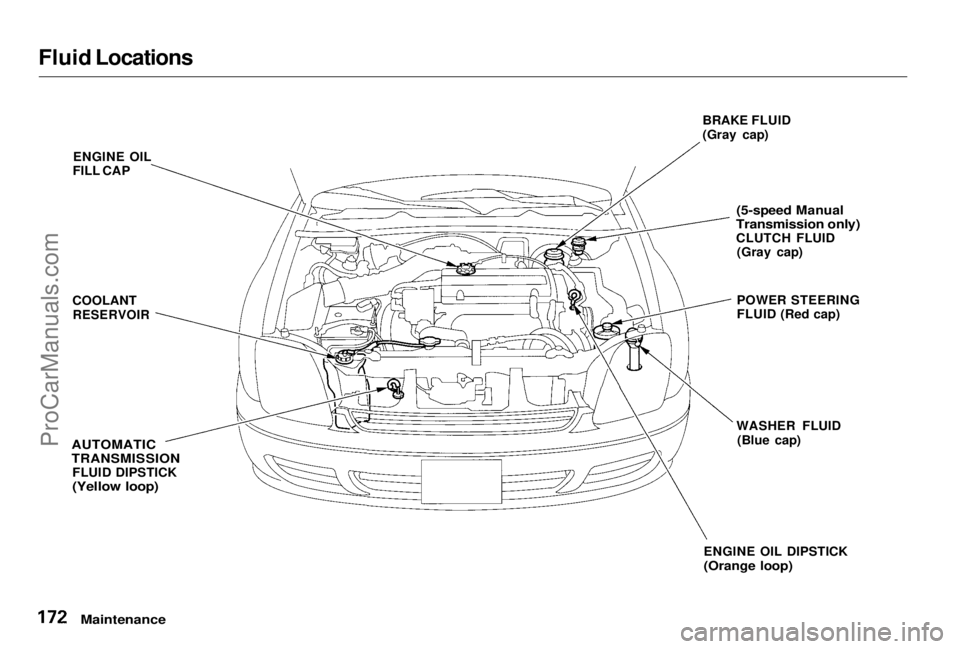
Fluid Locations
ENGINE OIL
FILL CAP
COOLANT
RESERVOIR
AUTOMATIC
TRANSMISSION
FLUID DIPSTICK
(Yellow loop)
BRAKE FLUID
(Gray cap)
(5-speed Manual
Transmission only)
CLUTCH FLUID (Gray cap)
POWER STEERING
FLUID (Red cap)
WASHER FLUID (Blue cap)
ENGINE OIL DIPSTICK
(Orange loop)
MaintenanceProCarManuals.comMain Menu Table of Contents s t
Page 185 of 278
Brake and Clutch Fluid, Power Steering
Clutch System
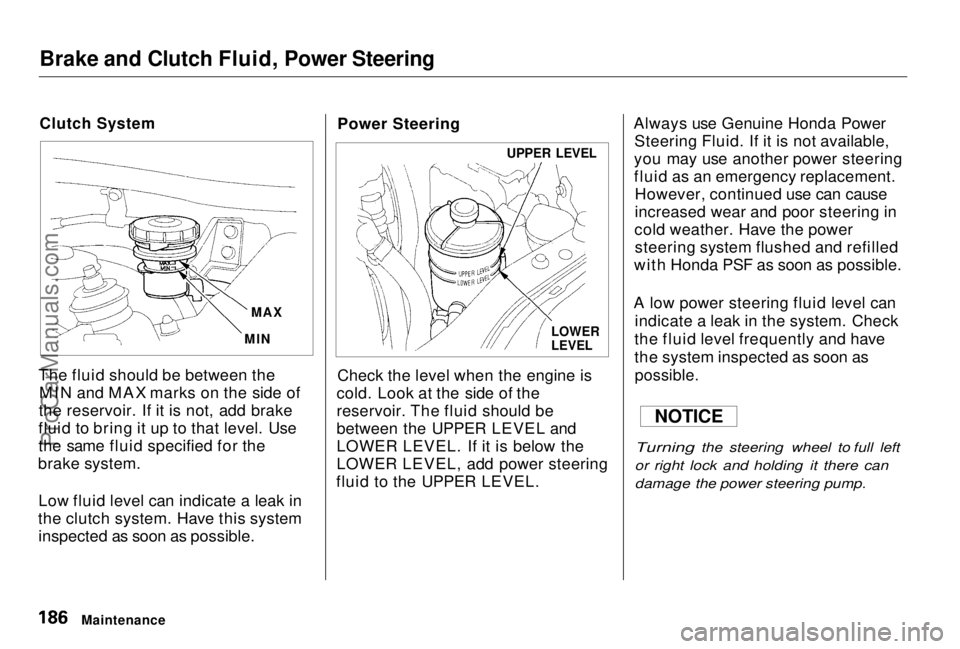
The fluid should be between the MIN and MAX marks on the side of
the reservoir. If it is not, add brake
fluid to bring it up to that level. Use
the same fluid specified for the
brake system.
Low fluid level can indicate a leak in
the clutch system. Have this system inspected as soon as possible. Power Steering
Check the level when the engine is
cold. Look at the side of the
reservoir. The fluid should be
between the UPPER LEVEL and
LOWER LEVEL. If it is below the
LOWER LEVEL, add power steering
fluid to the UPPER LEVEL. Always use Genuine Honda Power
Steering Fluid. If it is not available,
you may use another power steering
fluid as an emergency replacement. However, continued use can cause
increased wear and poor steering in
cold weather. Have the power steering system flushed and refilled
with Honda PSF as soon as possible.
A low power steering fluid level can indicate a leak in the system. Check
the fluid level frequently and have
the system inspected as soon as
possible.
Turning the steering wheel to full left
or right lock and holding it there can
damage the power steering pump.
Maintenance
MAX
MIN
LOWER
LEVEL
UPPER LEVEL
NOTICE
ProCarManuals.comMain Menu Table of Contents s t
Page 195 of 278
Drive Belts, Timing Belt
Drive Belts
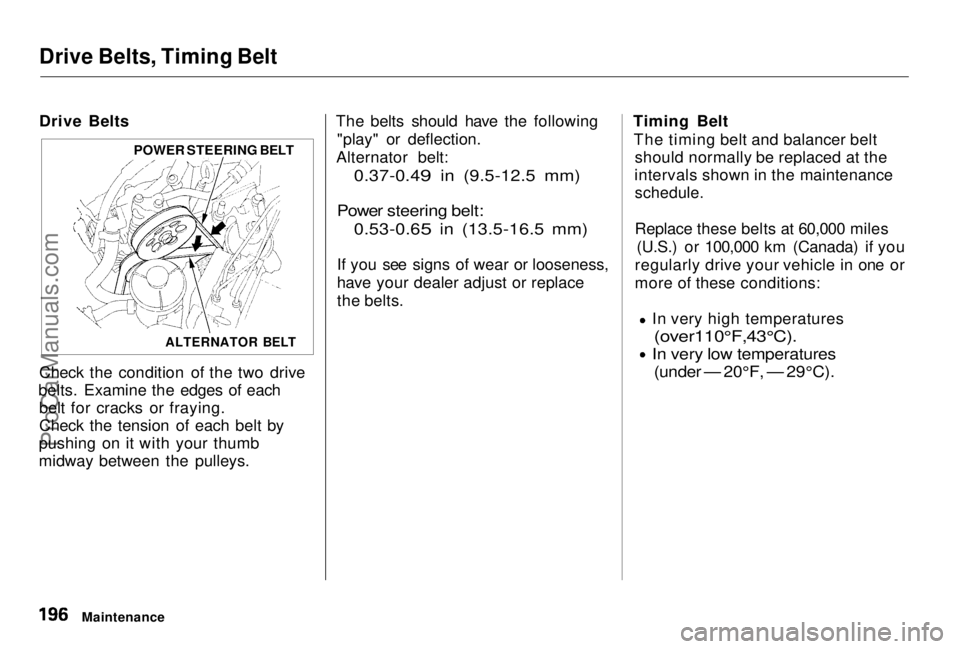
Check the condition of the two drive
belts. Examine the edges of each belt for cracks or fraying.
Check the tension of each belt by
pushing on it with your thumb
midway between the pulleys. The belts should have the following
"play" or deflection.
Alternator belt:
0.37-0.49 in (9.5-12.5 mm)
Power steering belt:
0.53-0.65 in (13.5-16.5 mm)
If you see signs of wear or looseness,
have your dealer adjust or replace
the belts. Timing Belt
The timing belt and balancer belt should normally be replaced at the
intervals shown in the maintenance
schedule.
Replace these belts at 60,000 miles
(U.S.) or 100,000 km (Canada) if you
regularly drive your vehicle in one or
more of these conditions:
In very high temperatures
(over110°F,43°C).
In very low temperatures
(under — 20°F, — 29°C).
Maintenance
POWER STEERING BELT
ALTERNATOR BELT
ProCarManuals.comMain Menu Table of Contents s t
Page 199 of 278
Tires
Tire Rotation
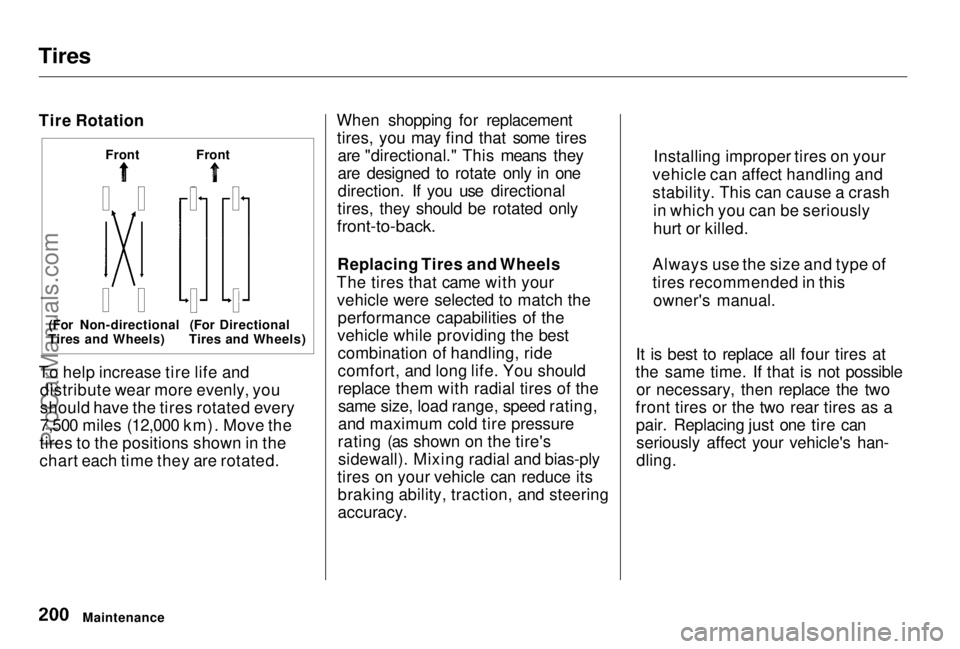
To help increase tire life and distribute wear more evenly, you
should have the tires rotated every
7,500 miles (12,000 km). Move the
tires to the positions shown in the
chart each time they are rotated. When shopping for replacement
tires, you may find that some tires are "directional." This means they
are designed to rotate only in one
direction. If you use directional
tires, they should be rotated only
front-to-back.
Replacing Tires and Wheels
The tires that came with your vehicle were selected to match the performance capabilities of the
vehicle while providing the best combination of handling, ride
comfort, and long life. You should
replace them with radial tires of thesame size, load range, speed rating,
and maximum cold tire pressure
rating (as shown on the tire's sidewall). Mixing radial and bias-ply
tires on your vehicle can reduce its braking ability, traction, and steering
accuracy.
It is best to replace all four tires at
the same time. If that is not possible or necessary, then replace the two
front tires or the two rear tires as a pair. Replacing just one tire canseriously affect your vehicle's han-
dling.
Maintenance Installing improper tires on your
vehicle can affect handling and
stability. This can cause a crash in which you can be seriously
hurt or killed.
Always use the size and type of
tires recommended in this owner's manual.
Front
Front
(For Non-directional
Tires and Wheels) (For Directional
Tires and Wheels)ProCarManuals.comMain Menu Table of Contents s t
Page 269 of 278
Index
Accessories and Modifications.... 126 Accessories................................. 126
Additional Safety Precautions.. 127Modifications............................. 127
ACCESSORY (Ignition Key Position)........................................ 71
Accessory Power Socket................ 88
Active Torque Transfer System
(ATTS)
Indicator................................ 54, 149
Operation.................................... 149
Adding Automatic Transmission
Fluid........................................ 183
Brake Fluid................................. 185
Clutch Fluid................................ 186
Engine Coolant........................... 177
Engine Oil...................................173
Manual Transmission Fluid ..... 184
Power Steering Fluid................. 186
Windshield Washer Fluid......... 182
Additional Information About Your Seat Belts........................ 40
Lap/Shoulder Belt....................... 40
Seat Belt Maintenance................ 42
Seat Belt System Components... 40
Additional Information About
YourSRS................................... 43
Additional Safety Precautions.... 46
How Your Airbags Work............ 43
How Your SRS Indicator Light
Works........................................45
SRS Components......................... 43
Additives, Engine Oil..................... 174
Adjustments
Headlights.................................. 205
Head Restraints........................... 77
Mirrors..........................................
83
Seats.............................................. 7 5
Steerin
g Wheel............................ 64
Airbag (SRS).................................... 43
Air Cleaner Element...................... 187
Air Conditioning............................... 92 Maintenance............................... 195
Usage.............................................92
Air Outlets (Vents).......................... 94
Air Pressure, Tires........................ 197 High Speed Driving................... 257
Normal Driving.......................... 198
Alcohol in Gasoline........................ 259 Antifreeze....................................... 177
Anti-lock Brakes (ABS) Indicator Eight..................... 54, 148Operation.................................... 146
Anti-theft Steering Column
Lock............................................... 71
Appearance Care........................... 219 Ashtrays (Optional)......................... 89
Audio System................................. 100
Automatic Speed Control................ 65
Automatic Transmission............... 136
Capacity, Fluid........................... 254
Checking Fluid Level................ 183
Sequential SportShift Mode..... 139
Shifting........................................ 137
Shift Lever Position Indicator.. 136
Shift Lever Positions................. 137
Shift Lock Release..................... 143
CONTINUEDProCarManuals.comMain Menu s t
Page 270 of 278
Index
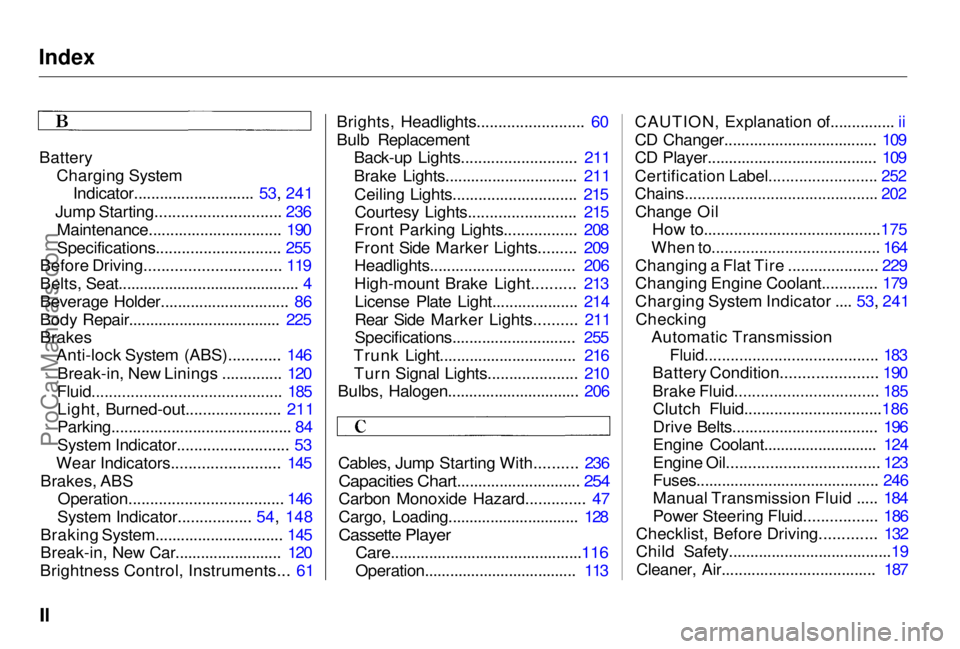
Battery Charging SystemIndicator............................ 53, 241
Jump Starting............................. 236 Maintenance............................... 190
Specifications............................. 255
Before Driving............................... 119
Belts, Seat........................................... 4
Beverage Holder.............................. 86
Body Repair.................................... 225
Brakes
Anti-lock System (ABS)............ 146
Break-in, New Linings .............. 120
Fluid............................................ 185
Light, Burned-out...................... 211
Parking.......................................... 84
System Indicator.......................... 53
Wear Indicators......................... 145
Brakes, ABS Operation.................................... 146
System Indicator................. 54, 148
Braking System.............................. 145
Break-in, New Car......................... 120
Brightness Control, Instruments... 61 Brights, Headlights......................... 60
Bulb Replacement
Back-up Lights........................... 211
Brake Lights............................... 211
Ceiling Lights............................. 215Courtesy Lights......................... 215
Front Parking Lights................. 208
Front Side Marker Lights......... 209
Headlights.................................. 206
High-mount Brake Light.......... 213
License Plate Light.................... 214
Rear Side Marker Lights.......... 211
Specifications............................. 255
Trunk Light................................ 216 Turn Signal Lights..................... 210
Bulbs, Halogen............................... 206
Cables, Jump Starting With.......... 236
Capacities Chart............................. 254
Carbon Monoxide Hazard.............. 47
Cargo, Loading...............................
128
Cassette Playe r
Care.............................................
116
Operation....................................
113
CAUTION, Explanatio n
of...............
ii
CD Changer...................................
.
109
CD Player........................................ 109
Certification Label......................... 252
Chains............................................. 202
Change Oil How to.........................................175
When to....................................... 164
Changing a Flat Tire ..................... 229
Changing Engine Coolant............. 179
Charging System Indicator .... 53, 241 Checking Automatic Transmission
Fluid........................................ 183
Battery Condition...................... 190
Brake Fluid................................. 185
Clutch Fluid................................186
Drive Belts.................................. 196
Engine Coolant........................... 124
Engine Oil................................... 123
Fuses........................................... 246
Manual Transmission Fluid ..... 184
Power Steering Fluid................. 186
Checklist, Before Driving............. 132
Child Safety......................................19
Cleaner, Air.................................... 187ProCarManuals.comMain Menu s t