wheel HONDA PRELUDE 1998 Service Manual
[x] Cancel search | Manufacturer: HONDA, Model Year: 1998, Model line: PRELUDE, Model: HONDA PRELUDE 1998Pages: 278, PDF Size: 2.61 MB
Page 219 of 278
Exterior Care
Waxing
Always wash and dry the whole vehicle before waxing it. You should
wax your vehicle, including the metal
trim, whenever water sits on the surface in large patches. It should
form into beads or droplets after
waxing.
You should use a quality liquid or paste wax. Apply it according to theinstructions on the container. In
general, there are two types of
products:
Waxes — A wax coats the finish and protects it from damage by exposure
to sunlight, air pollution, etc. Youshould use a wax on your Honda
when it is new.
Polishes — Polishes and cleaner/
waxes can restore the shine to paint
that has oxidized and lost some of its shine. They normally contain mild
abrasives and solvents that remove the top layer of the finish. You
should use a polish on your Honda if
the finish does not have its original shine after using a wax.
Cleaning tar, insects, etc. with
removers also takes off the wax. Remember to re-wax those areas,
even if the rest of the vehicle does
not need waxing.
Aluminum Wheels Clean your Honda's aluminum alloy
wheels as you do the rest of the exterior. Wash them with the same
solution, and rinse them thoroughly.
The wheels have a protective clear- coat that keeps the aluminum from
corroding and tarnishing. Using
harsh chemicals, including some
commercial wheel cleaners, or stiff
brushes can damage this clear-coat. Only use a mild detergent and soft
brush or sponge to clean the wheels.
Paint Touch-up
Your dealer has touch-up paint to match your vehicle's color. The color
code is printed on a sticker on the
driver's doorjamb. Take this code to
your dealer so you are sure to get the correct color.
Inspect your vehicle frequently for
chips or scratches in the paint.
Repair them right away to prevent corrosion of the metal underneath.
Use the touch-up paint only on small
chips and scratches. More extensive
paint damage should be repaired by
a professional.
Appearance CareProCarManuals.comMain Menu Table of Contents s t
Page 222 of 278
Interior Care, Corrosion Protection
Air Fresheners If you want to use an air freshener/
deodorizer in the interior of your
vehicle, it is best to use a solid type. Some liquid air fresheners contain
chemicals that may cause parts of
the interior trim and fabric to crack or discolor.
If you use a liquid air freshener,
make sure you fasten it securely so it does not spill as you drive. Corrosion Protection
Two factors normally contribute to causing corrosion in your vehicle:
1. Moisture trapped in body cavities. Dirt and road salt that collects in
hollows on the underside of the
vehicle stays damp, promoting corrosion in that area.
2. Removal of paint and protective coatings from the exterior and
underside of the vehicle.
Many corrosion-preventive measures
are built into your Honda. You can
help keep your vehicle from corroding by performing somesimple periodic maintenance: Repair chips and scratches in the
paint as soon as you discover them.Inspect and clean out the drain
holes in the bottom of the doors and body.
Check the floor coverings for
dampness. Carpeting and floor
mats may remain damp for a long
time, especially in winter. This dampness can eventually cause
the floor panels to corrode.
Use a high-pressure spray to clean
the underside of your vehicle. This is especially important in areas
that use road salt in winter. It isalso a good idea in humid climates
and areas subject to salt air. Be
careful of the ABS wheel sensors
and wiring at each wheel.
Have the corrosion-preventive
coatings on the underside of your
vehicle inspected and repaired periodically.
Appearance CareProCarManuals.comMain Menu Table of Contents s t
Page 225 of 278
Compact Spare Tire
Your vehicle has a compact spare tire that takes up less space. Use thisspare tire as a temporary replace-
ment only. Get your regular tire
repaired or replaced and put back on
your vehicle as soon as you can.
Check the inflation pressure of the
compact spare tire every time you
check the other tires. It should be
inflated to: 60 psi (420 kPa , 4.2 kgf/cm2) Follow these precautions whenever
you are using the compact spare tire: Do not exceed 50 mph (80 km/h)
under any circumstances.
This tire gives a harsher ride and
less traction on some road sur-
faces than the regular tire. Use
greater caution while driving on
this tire.
Do not mount snow chains on the
compact spare.
The wheel of the compact spare
tire is designed especially to fit
your vehicle. Do not use your
spare tire on another vehicle
unless it is the same make and
model.
The compact spare tire has a shorter
tread life than a regular tire. Replace
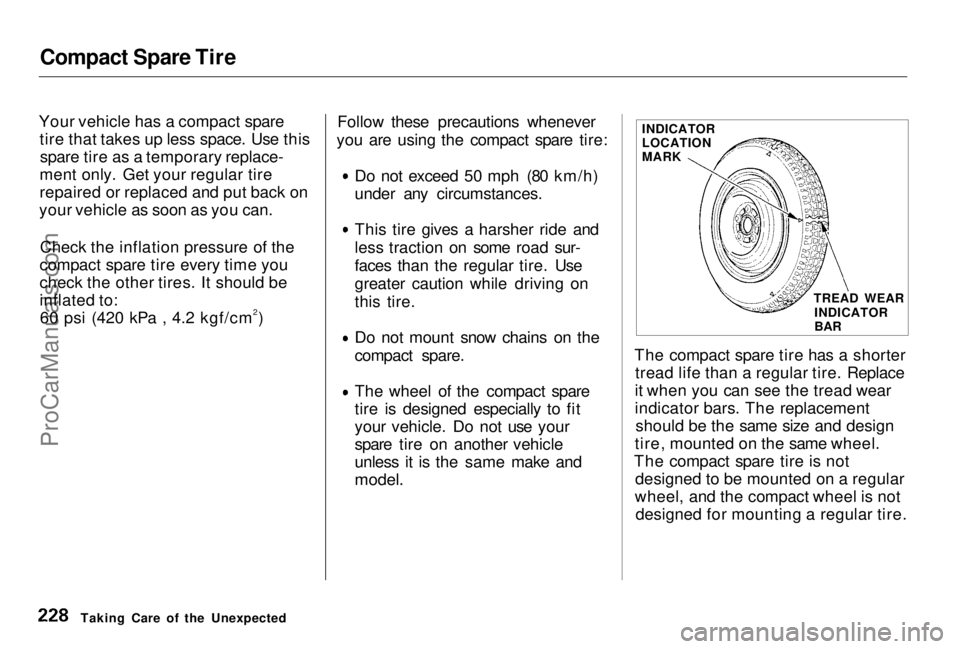
it when you can see the tread wear
indicator bars. The replacement should be the same size and design
tire, mounted on the same wheel.
The compact spare tire is not designed to be mounted on a regular
wheel, and the compact wheel is not designed for mounting a regular tire.
Taking Care of the Unexpected INDICATOR
LOCATION
MARK
TREAD WEARINDICATOR
BARProCarManuals.comMain Menu Table of Contents s t
Page 227 of 278
Changing a Flat Tire
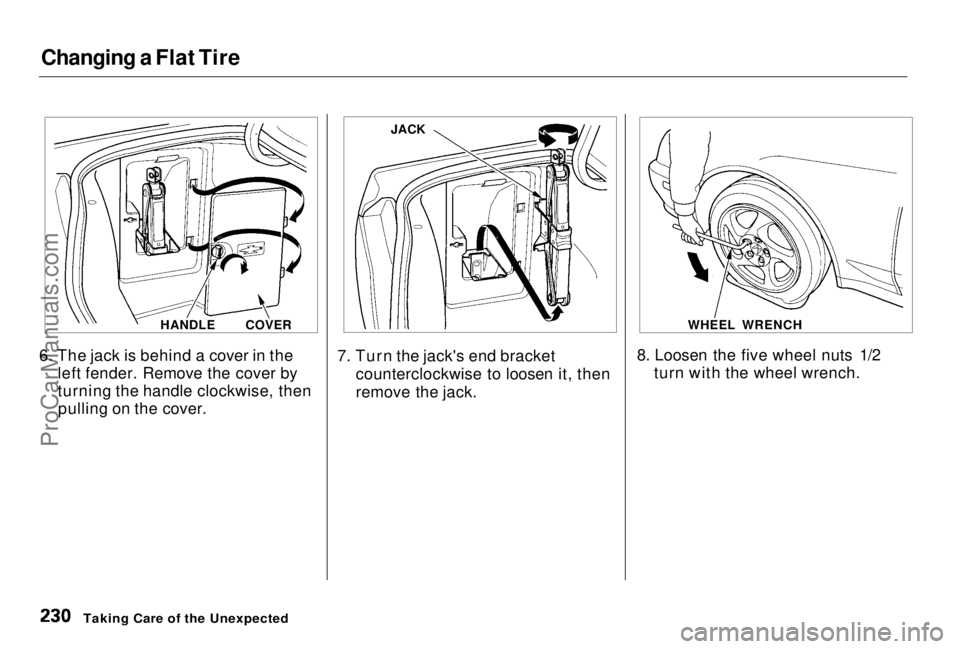
6. The jack is behind a cover in the left fender. Remove the cover by
turning the handle clockwise, thenpulling on the cover. 7. Turn the jack's end bracket
counterclockwise to loosen it, then
remove the jack. 8. Loosen the five wheel nuts 1/2
turn with the wheel wrench.
Taking Care of the Unexpected
HANDLE
COVER JACK
WHEEL WRENCHProCarManuals.comMain Menu Table of Contents s t
Page 228 of 278
Changing a Flat Tire
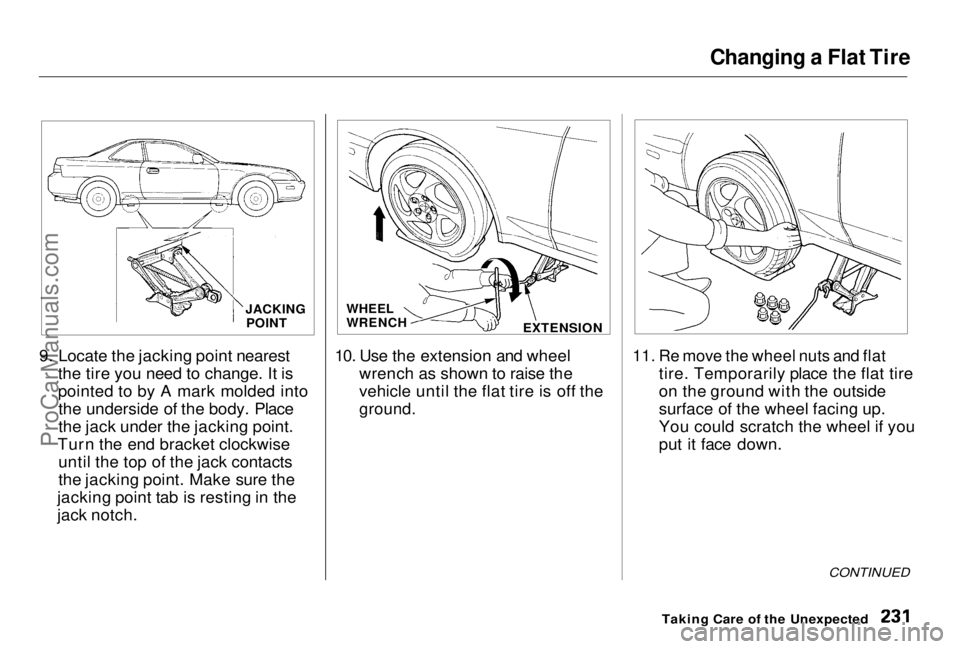
9. Locate the jacking point nearest the tire you need to change. It is
pointed to by A mark molded intothe underside of the body. Place
the jack under the jacking point.
Turn the end bracket clockwise until the top of the jack contacts
the jacking point. Make sure the
jacking point tab is resting in the
jack notch. 10. Use the extension and wheel
wrench as shown to raise the
vehicle until the flat tire is off the
ground.
11. Re move the wheel nuts and flat
tire. Temporarily place the flat tire
on the ground with the outside
surface of the wheel facing up.
You could scratch the wheel if you
put it face down.
CONTINUED
Taking Care of the Unexpected
JACKING
POINT WHEEL
WRENCH
EXTENSIONProCarManuals.comMain Menu Table of Contents s t
Page 229 of 278
Changing a Flat Tire
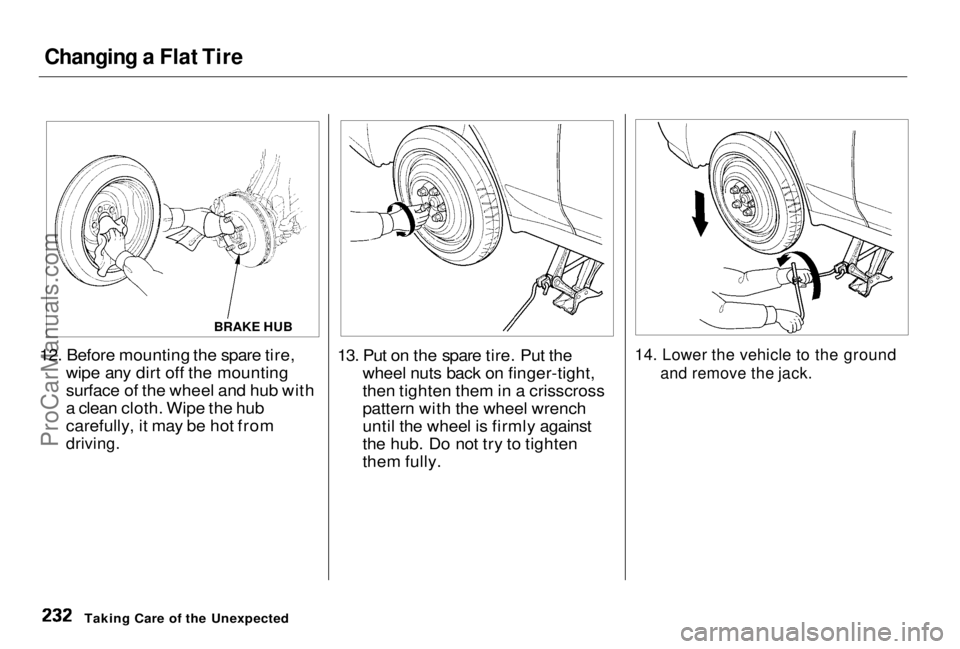
12. Before mounting the spare tire, wipe any dirt off the mounting
surface of the wheel and hub with
a clean cloth. Wipe the hub
carefully, it may be hot from
driving.
13. Put on the spare tire. Put the
wheel nuts back on finger-tight,
then tighten them in a crisscross
pattern with the wheel wrench
until the wheel is firmly against
the hub. Do not try to tighten
them fully.
14. Lower the vehicle to the ground
and remove the jack.
Taking Care of the Unexpected BRAKE HUBProCarManuals.comMain Menu Table of Contents s t
Page 230 of 278
Changing a Flat Tire
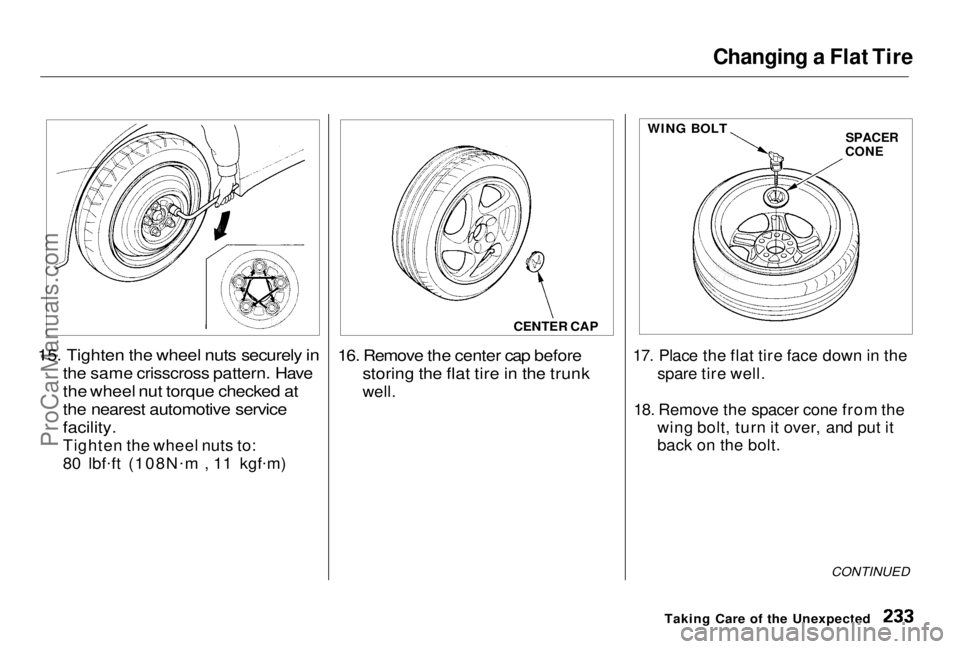
15. Tighten the wheel nuts securely in
the same crisscross pattern. Have
the wheel nut torque checked at
the nearest automotive service
facility.
Tighten the wheel nuts to:
80 lbf .
ft (108N .
m , 11 kgf .
m)
16. Remove the center cap before
storing the flat tire in the trunk
well. 17. Place the flat tire face down in the
spare tire well.
18. Remove the spacer cone from the wing bolt, turn it over, and put it
back on the bolt.
CONTINUED
Taking Care of the Unexpected
CENTER CAP
WING BOLT
SPACER
CONEProCarManuals.comMain Menu Table of Contents s t
Page 231 of 278
Changing a Flat Tire, If Your Engine Won't Start
19. Secure the flat tire by screwing the win
g bolt back into its hole.
20. Store the jack in its holder. Turn the jack's end bracket to lock it in
place.
Replace the cover. Store the
tool kit. 21. Stor
e the center cap in the trunk.
Make
sure it does not get scratch-
ed
or damaged.
22.
Lower the trunk floor, then close
the trunk lid.
Type SH only
If yo
u mount the compact spare on
either front or rear tire, it may cause
the
ATTS indicator light in the
instrument
panel to come on due to
the
difference in tire diameter. The
light
will go out when the proper tire
is installed.
If Your Engine Won't Start
Diagnosing
why your engine won't
start falls into two areas, depending
on what you hear when you turn the
key to START (III):
You hear nothing, or almostnothing. The engine's starter
motor does not operate at all, oroperates
very slowly. You can hear the starter motor
operating normally, or the starter
motor
sounds like it is spinning
faster than normal, but the engine does
not start up and run.
Taking Car
e of the Unexpected
Loose items can fly around the
interior i
n a crash and could
seriously injure the occupants.
Store th
e wheel, jack and tools
securely before driving.
ProCarManuals.comMain Menu Table of Contents s t
Page 240 of 278
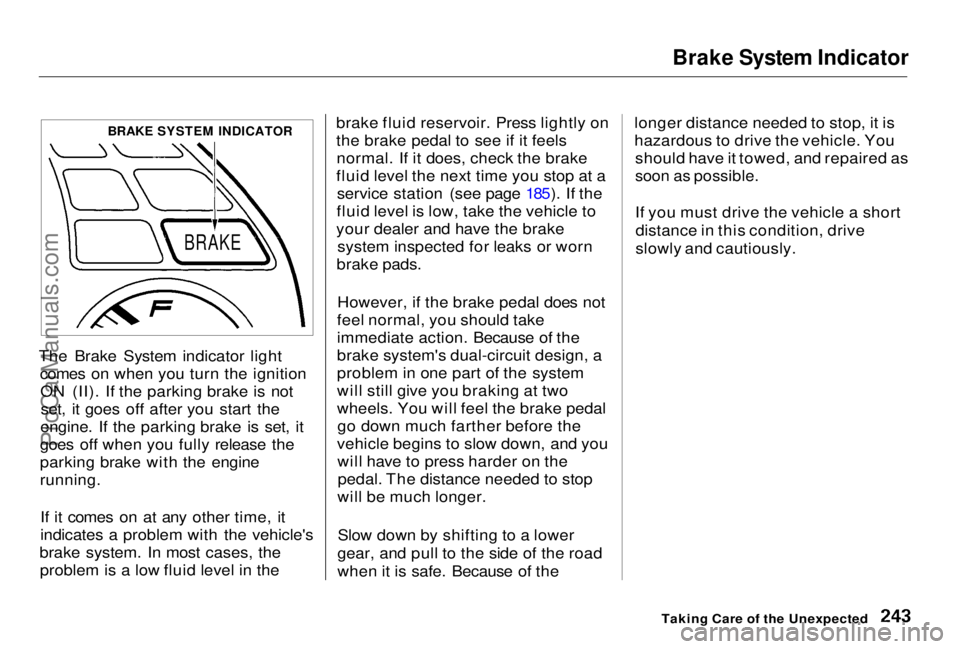
Brake System Indicator
The Brake System indicator light comes on when you turn the ignitionON (II). If the parking brake is notset, it goes off after you start the
engine. If the parking brake is set, it
goes off when you fully release the
parking brake with the engine
running.
If it comes on at any other time, it
indicates a problem with the vehicle's
brake system. In most cases, the problem is a low fluid level in the brake fluid reservoir. Press lightly on
the brake pedal to see if it feels
normal. If it does, check the brake
fluid level the next time you stop at a service station (see page 185). If the
fluid level is low, take the vehicle to
your dealer and have the brake system inspected for leaks or worn
brake pads.
However, if the brake pedal does not
feel normal, you should take
immediate action. Because of the
brake system's dual-circuit design, a
problem in one part of the system
will still give you braking at two
wheels. You will feel the brake pedal go down much farther before the
vehicle begins to slow down, and you will have to press harder on thepedal. The distance needed to stop
will be much longer.
Slow down by shifting to a lower
gear, and pull to the side of the road
when it is safe. Because of the longer distance needed to stop, it is
hazardous to drive the vehicle. You
should have it towed, and repaired as
soon as possible.
If you must drive the vehicle a short
distance in this condition, drive
slowly and cautiously.
Taking Care of the Unexpected
BRAKE SYSTEM INDICATOR
BRAKEProCarManuals.comMain Menu Table of Contents s t
Page 247 of 278
Towing
If your vehicle needs to be towed,
call a professional towing service or,
if you belong to one, an organization
that provides roadside assistance. Never tow your vehicle behindanother vehicle with just a rope or
chain. It is very dangerous.
Emergency Towing
There are three popular methods of towing a vehicle:
Flat-bed Equipment — The operator
loads your vehicle on the back of a truck. This is the best way of trans-
porting your Honda.
Wheel Lift Equipment — The tow
truck uses two pivoting arms that go
under the tires (front or rear) and lift
them off the ground. The other two
tires remain on the ground. Sling-type Equipment The tow
truck uses metal cables with hooks
on the ends. These hooks go around
parts of the frame or suspension and
the cables lift that end of the vehicle off the ground. Your vehicle's sus-
pension and body can be seriously damaged if this method of towing is
attempted.
If your Honda cannot be transported
by flat-bed, it should be towed withthe front wheels off the ground. Ifdue to damage, your vehicle must be
towed with the front wheels on the ground, do the following:
5-speed Manual Transmission
Release the parking brake.
Shift the transmission to Neutral.
Automatic Transmission:
Release the parking brake.
Start the engine.
Shift to D4, then to N.
Turn off the engine.
Improper towing preparation will
damage the transmission. Follow the
above procedure exactly. If yon cannot
shift the transmission or start the
engine (automatic transmission), yourvehicle must be transported on a flat-
bed.
It is best to tow the vehicle no far-
ther than 50 miles (80 km), and
keep the speed below 35 mph (55
km/h).
If your vehicle is equipped with an
optional front air spoiler, remove it
before towing so it is not damaged.
Trying to lift or tow your vehicle by the
bumpers will cause serious damage. The bumpers are not designed to
support the vehicle's weight.
Taking Care of the Unexpected
NOTICE
NOTICE
ProCarManuals.comMain Menu Table of Contents s t