oil HONDA PRELUDE 2000 (in English) User Guide
[x] Cancel search | Manufacturer: HONDA, Model Year: 2000, Model line: PRELUDE, Model: HONDA PRELUDE 2000Pages: 293, PDF Size: 3.43 MB
Page 187 of 293
Engin
e Oi l
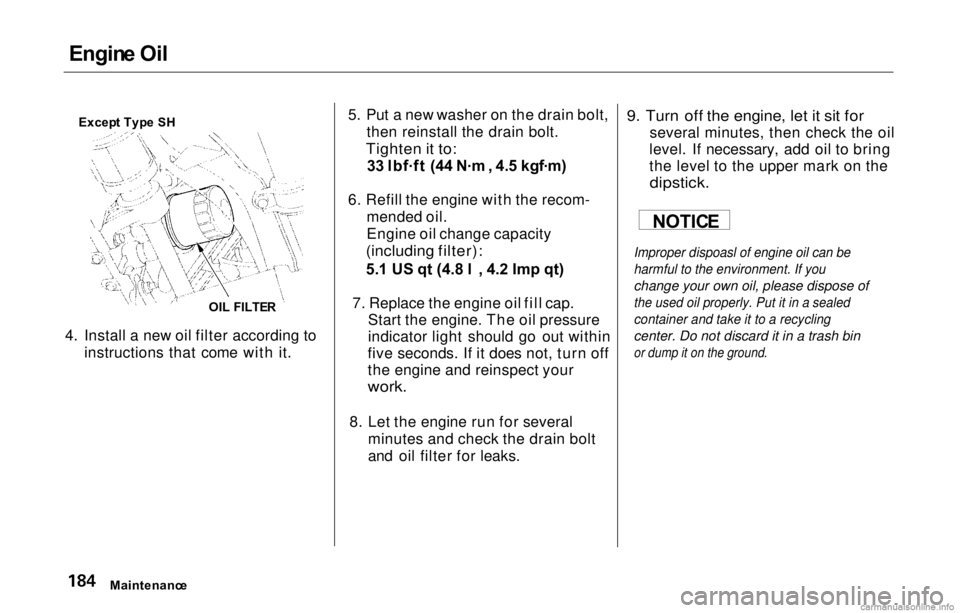
4. Install a new oil filter according to instructions that come with it. 5. Put a new washer on the drain bolt,
then reinstall the drain bolt.
Tighten it to:
33 lbf .
ft (44 N.
m , 4. 5 kgf .
m)
6. Refill the engine with the recom-
mended oil.
Engine oil change
capacity
(including filter):
5. 1 US qt (4.8 l , 4.2 Imp qt)
7. Replace the engine oil fill cap.
Start the engine. The oil pressure
indicator light should go out within
five seconds. If it does not, turn off
the engine and reinspect your
work.
8. Let the engine run for several minutes and check the drain bolt
and oil filter for leaks.
9. Turn off the engine, let it sit for
several minutes, then check the oil
level. If necessary, add oil to bring
the level to the upper mark on the
dipstick.
Improper dispoasl of engine oil can be
harmful to the environment. If you
change your own oil, please dispose of
the used oil properly. Put it in a sealed
container and take it to a recycling
center. Do not discard it in a trash bin
or dump it on the ground.
Maintenanc e
Excep
t Typ e S H
OIL FILTE R NOTIC
E
Page 195 of 293
Transmissio
n Flui d
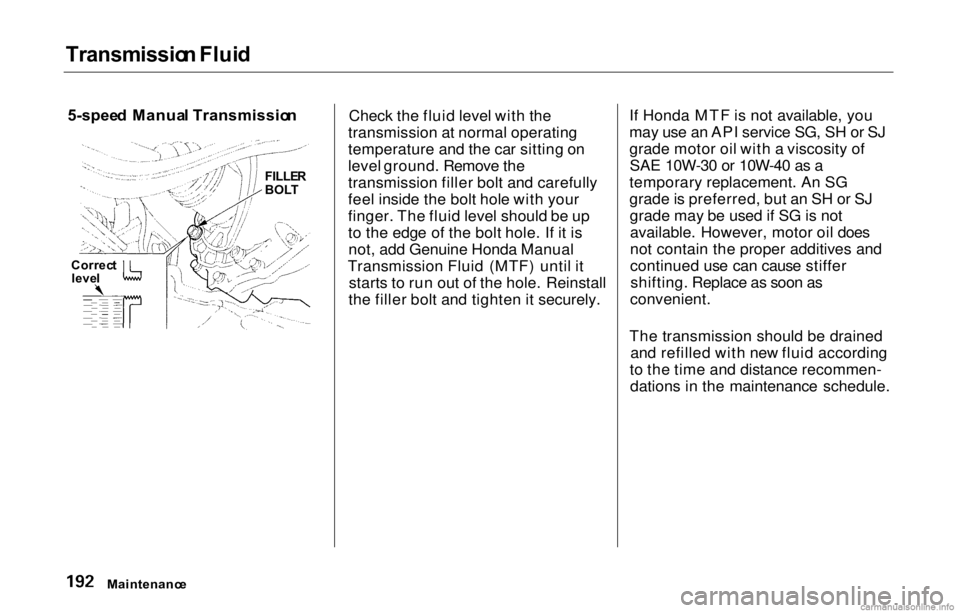
5-spee d Manua l Transmissio n
Check the fluid level with the
transmission at normal operating
temperature and the car sitting on
level ground. Remove the
transmission filler bolt and carefully
feel inside the bolt hole with your
finger. The fluid level should be up
to the edge of the bolt hole. If it is not, add Genuine Honda Manual
Transmission Fluid (MTF) until it starts to run out of the hole. Reinstall
the filler bolt and tighten it securely. If Honda MTF is not available, you
may use an API service SG, SH or SJ
grade motor oil with a viscosity of
SAE 10W-30 or 10W-40 as a
temporary replacement. An SG
grade is preferred, but an SH or SJ grade may be used if SG is notavailable. However, motor oil does
not contain the proper additives and
continued use can cause stiffershifting. Replace as soon as
convenient.
The transmission should be drained and refilled with new fluid according
to the time and distance recommen- dations in the maintenance schedule.
Maintenanc e
FILLE
R
BOL T
Correc t
leve l
Page 199 of 293
Hoo
d Latch , Spar k Plug s
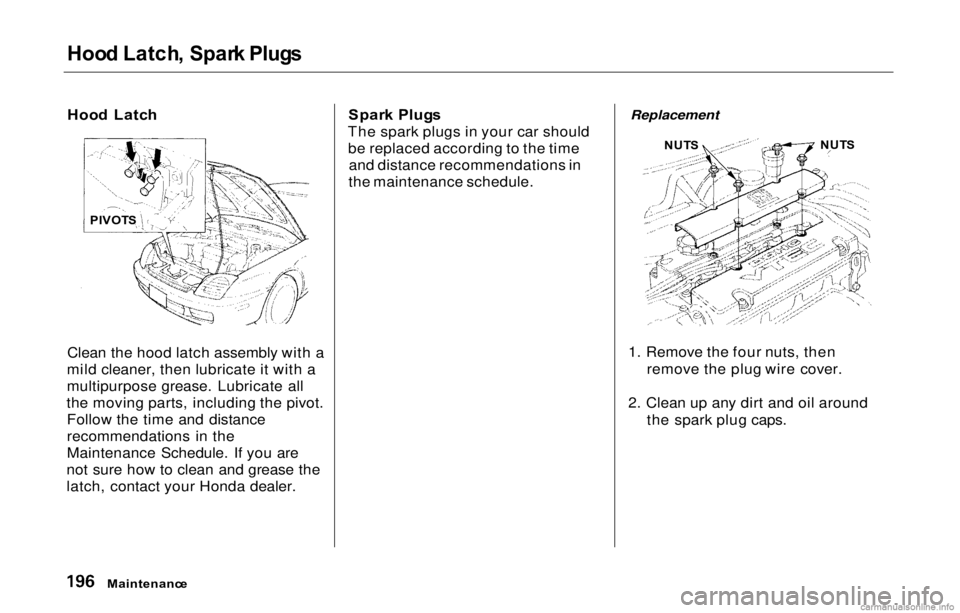
Hoo d Latc h
Clean the hood latch assembly with a
mild cleaner, then lubricate it with a
multipurpose grease. Lubricate all
the moving parts, including the pivot. Follow the time and distance
recommendations in the
Maintenance Schedule. If you are
not sure how to clean and grease the
latch, contact your Honda dealer. Spar
k Plug s
The spark plugs in your car should be replaced according to the time and distance recommendations in
the maintenance schedule.
Replacement
1. Remove the four nuts, then remove the plug wire cover.
2. Clean up any dirt and oil around the spark plug caps.
Maintenanc e
PIVOT
S NUT
S NUT
S
Page 206 of 293
Ai
r Conditionin g System , Ai r Conditionin g Filte r
Periodically check the engine's
radiator and air conditioning condenser for leaves, insects, and
dirt stuck to the front surface. These
block the air flow and reduce cooling efficiency. Use a light spray from a
hose or a soft brush to remove them.
The. condenser and radiator fins bend
easily. Only use a low-pressure spray
or soft-bristle brush to clean them.
Run the air conditioning at least once
a week during the cold weather
months. Run it for at least ten
minutes while you are driving at a steady speed with the engine at
normal operating temperature. This
circulates the lubricating oil con-
tained in the refrigerant. If the air conditioning does not get as
cold as before, have your dealer
check the system. Recharge the
system with Refrigerant HFC-134a
(R-134a). (See Specifications on page
265.)
Whenever you have the air conditioning
system serviced, make sure the service
facility uses a refrigerant recycling
system. This system captures the
refrigerant for reuse. Releasing
refrigerant into the atmosphere can
damage the environment.
Ai
r Conditionin g Filte r
The air conditioning filter removes pollen and dust from the outside air
the climate control system brings
into the interior.
This filter should be replaced every 30,000 miles (48,000 km) under
normal conditions. It should be
replaced every 15,000 miles (24,000
km) if you drive primarily in urban areas that have high concentrations
of soot in the air from industry and
diesel-powered vehicles. Replace it
more often if air flow from the
heating and cooling system becomes
less than usual. Have the air conditioning filter replaced by your
Honda dealer.
Maintenance
NOTIC
E NOTIC
E
Page 217 of 293
Light
s
HORIZONTA L ADJUSTMEN T
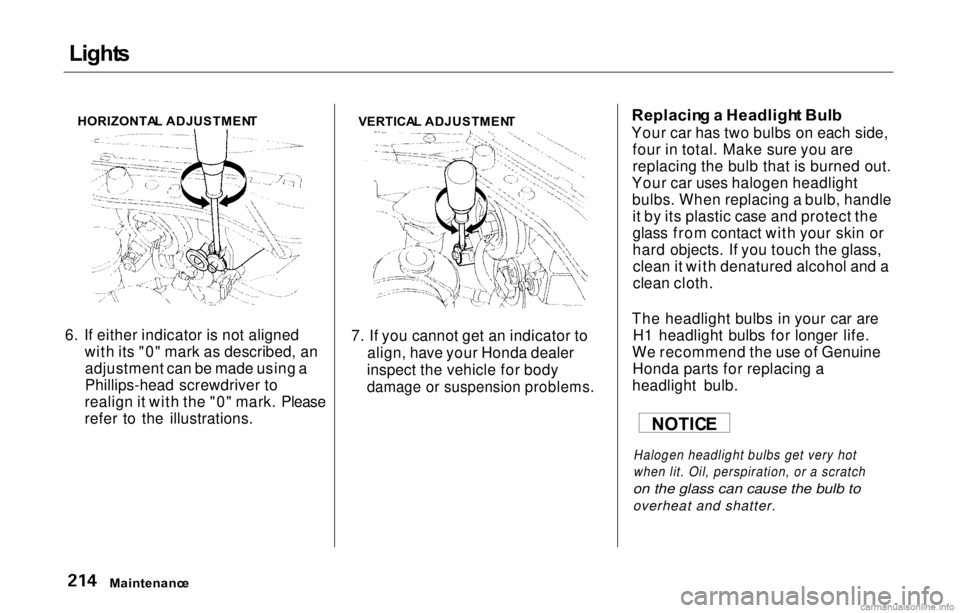
6. If either indicator is not aligned with its "0" mark as described, anadjustment can be made using a
Phillips-head screwdriver to
realign it with the "0" mark. Please
refer to the illustrations.
VERTICA
L ADJUSTMEN T
7. If you cannot get an indicator to align, have your Honda dealer
inspect the vehicle for body
damage or suspension problems.
Replacin
g a Headligh t Bul b
Your car has two bulbs on each side, four in total. Make sure you are
replacing the bulb that is burned out.
Your car uses halogen headlight bulbs. When replacing a bulb, handleit by its plastic case and protect the
glass from contact with your skin or
hard objects. If you touch the glass,clean it with denatured alcohol and a
clean cloth.
The headlight bulbs in your car are H1 headlight bulbs for longer life.
We recommend the use of Genuine Honda parts for replacing a
headlight bulb.
Halogen headlight bulbs get very hot
when lit. Oil, perspiration, or a scratch
on the glass can cause the bulb to
overheat and shatter.
Maintenanc e
NOTIC
E
Page 228 of 293
Storin
g You r Ca r
If you need to park your car for an
extended period (more than one
month), there are several things you should do to prepare it for storage.
Proper preparation helps prevent deterioration and makes it easier to
get your car back on the road. If possible, store your car indoors. Fill the fuel tank.
Change the engine oil and filter
(see page 183 ). Wash and dry the exterior
completely. Clean the interior. Make sure the
carpeting, floor mats, etc. are
completely dry. Leave the parking brake off. Put
the transmission in Reverse (5- speed manual) or Park (automatic). Block the rear wheels.
If the car is to be stored for a
longer period, it should be
supported on jackstands so the
tires are off the ground. Leave one window open slightly (if
the car is being stored indoors). Disconnect the battery.
Support the front wiper blade
arms with a folded towel or rag so
they do not touch the windshield. To minimize sticking, apply a
silicone spray lubricant to all door
and trunk seals. Also, apply a
vehicle body wax to the painted surfaces that mate with the door
and trunk seals. Cover the car with a "breathable"
cover, one made from a porous
material such as cotton.
Nonporous materials, such as
plastic sheeting, trap moisture,
which can damage the paint. If possible, run the engine for a
while periodically (preferably once a month).
If you store your car for 12 months or longer, have your Honda dealer
perform the inspections called for in
the 24 months/30,000 miles (48,000
km) maintenance schedule (Normal Conditions) as soon as you take it
out of storage (see page 172). The
replacements called for in the
maintenance schedule are not
needed unless the car has actually
reached that time or mileage.
Maintenance
Page 238 of 293
Takin
g Car e o f th e Unexpecte d
This section covers the more- common problems that motorists
experience with their vehicles. It
gives you information about how to safely evaluate the problem and what
to do to correct it. If the problem has stranded you on the side of the road,
you may be able to get going again. If not, you will also find instructions
on getting your car towed. Compact Spare Tire....................... 236
Changing a Flat Tire ..................... 237
If Your Engine Won't Start........... 242
Nothing Happens or theStarter Motor OperatesVery Slowly............................. 243
The Starter Operates Normally................................. 244
Jump Starting................................. 244 If Your Engine Overheats............. 246Low Oil Pressure Indicator.......... 248
Charging System Indicator........... 249
Malfunction Indicator Lamp ........ 250
Brake System Indicator................ 251
Closing the Moonroof................... 252
Fuses...............................................253
Checking and Replacing........... 254
Emergency Towing....................... 258
Takin g Car e o f th e Unexpecte d
Page 251 of 293
Lo
w Oi l Pressur e Indicato r
LO W OI L PRESSUR E INDICATO R
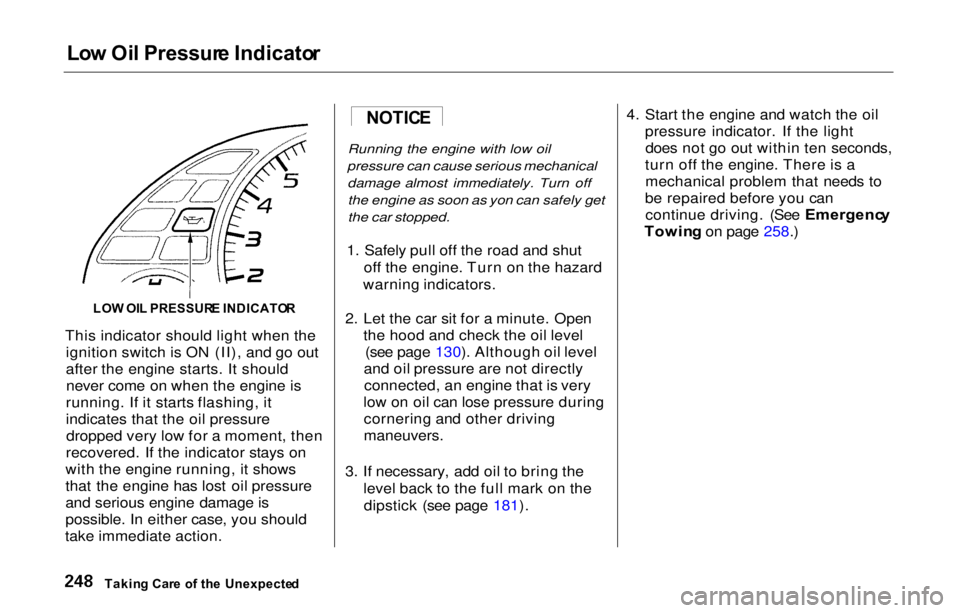
This indicator should light when the ignition switch is ON (II), and go out
after the engine starts. It shouldnever come on when the engine is
running. If it starts flashing, it
indicates that the oil pressure dropped very low for a moment, then
recovered. If the indicator stays on
with the engine running, it shows
that the engine has lost oil pressure
and serious engine damage is
possible. In either case, you should
take immediate action.
Running the engine with low oil
pressure can cause serious mechanical damage almost immediately. Turn offthe engine as soon as yon can safely get
the car stopped.
1. Safely pull off the road and shut off the engine. Turn on the hazard
warning indicators.
2. Let the car sit for a minute. Open the hood and check the oil level(see page 130). Although oil level
and oil pressure are not directly connected, an engine that is very
low on oil can lose pressure during cornering and other driving
maneuvers.
3. If necessary, add oil to bring the level back to the full mark on thedipstick (see page 181). 4. Start the engine and watch the oil
pressure indicator. If the lightdoes not go out within ten seconds,
turn off the engine. There is a mechanical problem that needs to
be repaired before you can continue driving. (See Emergenc y
Towin g on page 258.)
Takin g Car e o f th e Unexpecte d NOTIC
E
Page 267 of 293
Specifications
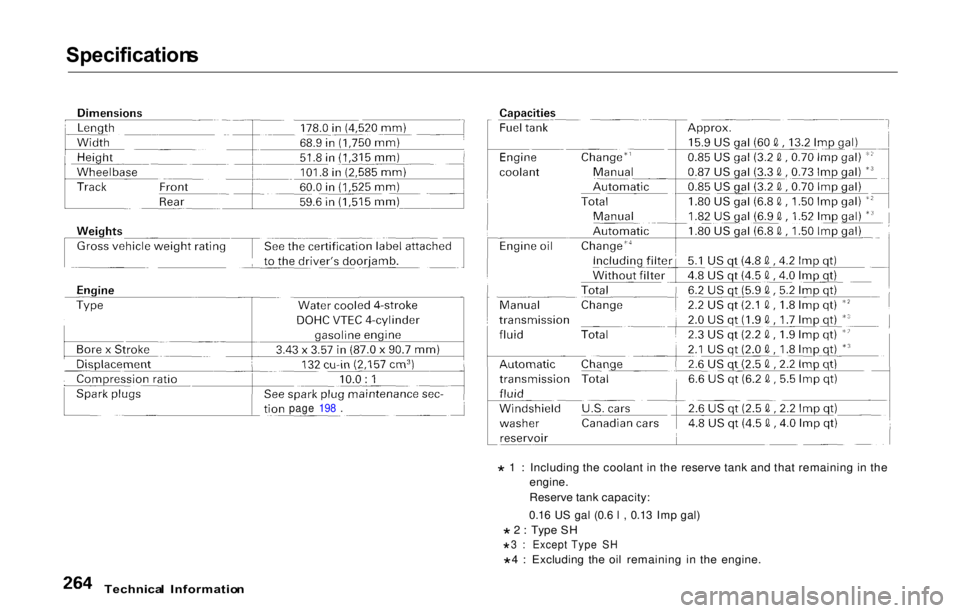
* 1 : Including the coolant in the reserve tank and that remaining in the
engine.
Reserve tank capacity:
0.16 US gal (0.6 l , 0.13 Imp gal)
*2: Type SH
*3 : Except Type SH
*4 : Excluding the oil remaining in the engine.
Technical Informatio n
page 198 .
Page 268 of 293
Specification
s
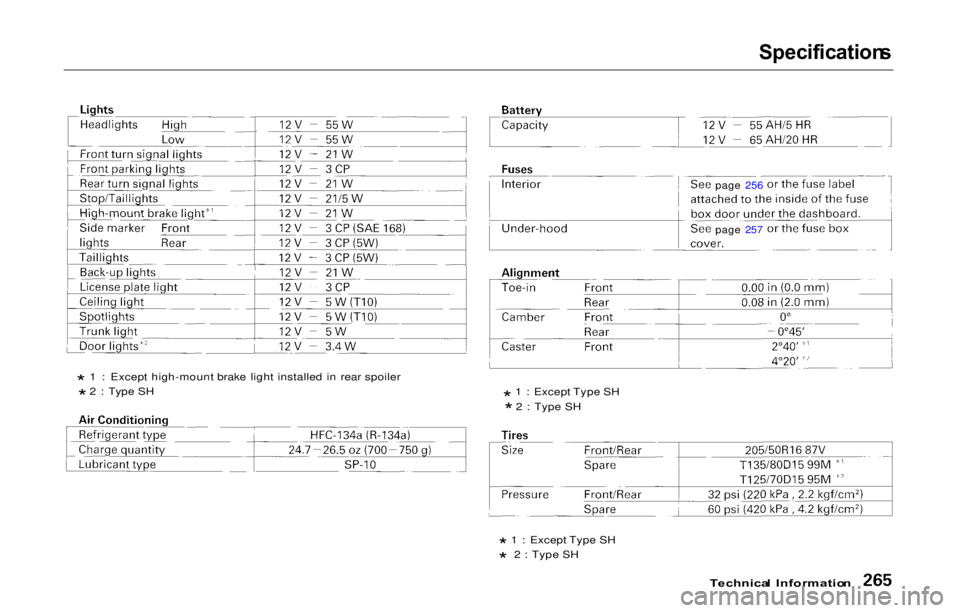
* 1 : Except Type SH
* 2 : Type SH
Technical Informatio n
page 256
page 257
* 1 : Except high-mount brake light installed in rear spoiler
* 2 : Type SH
* 1 : Except Type SH
* 2 : Type SH