maintenance schedule HONDA PRELUDE 2000 (in English) Owner's Guide
[x] Cancel search | Manufacturer: HONDA, Model Year: 2000, Model line: PRELUDE, Model: HONDA PRELUDE 2000Pages: 293, PDF Size: 3.43 MB
Page 199 of 293
Hoo
d Latch , Spar k Plug s
Hoo d Latc h
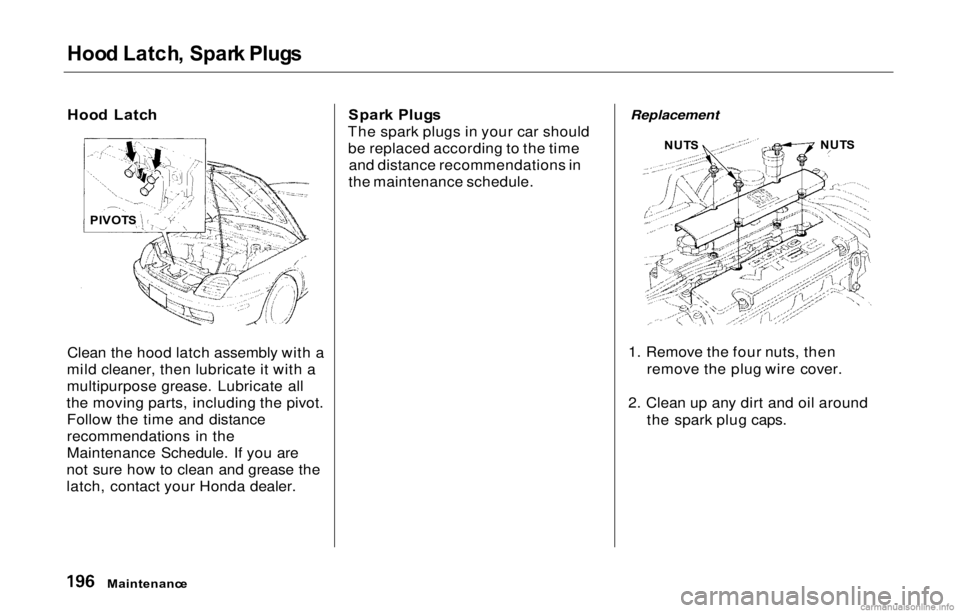
Clean the hood latch assembly with a
mild cleaner, then lubricate it with a
multipurpose grease. Lubricate all
the moving parts, including the pivot. Follow the time and distance
recommendations in the
Maintenance Schedule. If you are
not sure how to clean and grease the
latch, contact your Honda dealer. Spar
k Plug s
The spark plugs in your car should be replaced according to the time and distance recommendations in
the maintenance schedule.
Replacement
1. Remove the four nuts, then remove the plug wire cover.
2. Clean up any dirt and oil around the spark plug caps.
Maintenanc e
PIVOT
S NUT
S NUT
S
Page 207 of 293

Driv
e Belts , Timin g Bel t
Driv e Belt s
Check the condition of the two drive
belts. Examine the edges of each belt for cracks or fraying.Check the tension of each belt by
pushing on it with your thumb
midway between the pulleys. The belts should have the following
"play" or deflection.
Alternator belt:
0.37 — 0.49 in (9.5 — 12.5 mm)
Power steering belt:
0.53 — 0.65 in (13.5 — 16.5 mm)
If you see signs o
f wear or looseness,
have your dealer adjust or replace the belts.
Timin
g Bel t
The timing belt and balancer belt should normally be replaced at the
intervals shown in the maintenance schedule.
Replace these belts at 60.000 miles (U.S.) or 100,000 km (Canada) if you
regularly drive your car in one or
more of these conditions: In very high temperatures
(over 110°F,43°C).
In very low temperatures
(under — 20°F, — 29°C).
Maintenanc e
POWE
R STEERIN G BEL T
ALTERNATO R BEL T
Page 228 of 293
Storin
g You r Ca r
If you need to park your car for an
extended period (more than one
month), there are several things you should do to prepare it for storage.
Proper preparation helps prevent deterioration and makes it easier to
get your car back on the road. If possible, store your car indoors. Fill the fuel tank.
Change the engine oil and filter
(see page 183 ). Wash and dry the exterior
completely. Clean the interior. Make sure the
carpeting, floor mats, etc. are
completely dry. Leave the parking brake off. Put
the transmission in Reverse (5- speed manual) or Park (automatic). Block the rear wheels.
If the car is to be stored for a
longer period, it should be
supported on jackstands so the
tires are off the ground. Leave one window open slightly (if
the car is being stored indoors). Disconnect the battery.
Support the front wiper blade
arms with a folded towel or rag so
they do not touch the windshield. To minimize sticking, apply a
silicone spray lubricant to all door
and trunk seals. Also, apply a
vehicle body wax to the painted surfaces that mate with the door
and trunk seals. Cover the car with a "breathable"
cover, one made from a porous
material such as cotton.
Nonporous materials, such as
plastic sheeting, trap moisture,
which can damage the paint. If possible, run the engine for a
while periodically (preferably once a month).
If you store your car for 12 months or longer, have your Honda dealer
perform the inspections called for in
the 24 months/30,000 miles (48,000
km) maintenance schedule (Normal Conditions) as soon as you take it
out of storage (see page 172). The
replacements called for in the
maintenance schedule are not
needed unless the car has actually
reached that time or mileage.
Maintenance
Page 273 of 293
Emission
s Control s
The burning of gasoline in your car's engine produces several byproducts.
Some of these are carbon monoxide (CO), oxides of nitrogen (NOx) and
hydrocarbons (HC). Gasoline evaporating from the tank also
produces hydrocarbons. Controlling
the production of NOx, CO, and HC is important to the environment.
Under certain conditions of sunlight and climate, NOx and HC react to
form photochemical "smog." Carbon monoxide does not contribute tosmog creation, but it is a poisonous
gas.
Th
e Clea n Ai r Ac t
The United States Clean Air Act* sets standards for automobile
emissions. It also requires that
automobile manufacturers explain to owners how their emissions controls
work and what to do to maintain
them. This section summarizes how
the emissions controls work.
Scheduled maintenance is on page 172.
* In Canada, Honda vehicles comply
with the Canadian Motor Vehicle Safety Standards (CMVSS) for
Emissions valid at the time they are
manufactured.
Crankcas e Emission s Contro l
Syste m
Your car has a Positive Crankcase
Ventilation System. This keeps gasses that build up in the engine'scrankcase from going into the
atmosphere. The Positive Crankcase
Ventilation valve routes them from the crankcase back to the intake
manifold. They are then drawn into
the engine and burned.
Evaporativ e Emission s Contro l
Syste m
As gasoline evaporates in the fuel tank, an evaporative emissionscontrol canister filled with charcoal
adsorbs the vapor. It is stored in this
canister while the engine is off. After
the engine is started and warmed up,
the vapor is drawn into the engineand burned during driving.
Onboar d Refuelin g Vapo r
Recover y
The Onboard Refueling Vapor Recovery (ORVR) system captures
the fuel vapors during refueling. The
vapors are adsorbed in a canister filled with activated carbon. While driving, the fuel vapors are drawn
into the engine and burned off.
Technica l Informatio n
Page 289 of 293

Index
Locks
Anti-theft Steering Column........ 73
Fuel Fill Door............................. 127Glove Box..................................... 79
Power Door.................................. 74
Trunk............................................ 78
Low Coolant Level......................... 131
Lower Gear, Downshifting to a.... 142
Low Fuel Indicator .......................... 57
Low Oil Pressure Indicator.... 55, 248
Lubricant Specifications
Chart........................................... 264
Luggage.......................................... 135
Maintenance................................... 167
Owner Maintenance Checks.... 179
Record.................................. 177-178
Required Indicator....................... 60
Schedule.............................. 170-176
Malfunction Indicator Lamp .. 55, 250
Manual Transmission.................... 142
Manual Transmission Fluid ......... 192
Maximum Allowable Speeds................................. 143, 150
Meters, Gauges................................ 58
Methanol in Gasoline.................... 268
Mirrors, Adjusting........................... 88
Moonroof.......................................... 87
Closing Manually....................... 252
Operation...................................... 87
Neutral Gear Position.................... 147
New Vehicle Break-in ................... 126
Normal Shift Speeds...................... 143
NOTICE, Explanation of.................... i
Numbers, Identification................ 262
Octane Requirement, Gasoline.... 126
Odometer.......................................... 58
Odometer, Trip................................ 58
Oil Change, How to ......................... 183
Change, When to....................... 172
Checking Engine....................... 130
Pressure Indicator............... 55, 248
Selecting Proper Viscosity
Chart....................................... 182
ON (Ignition Key Position) ............ 73
Opening the Hood ......................... 128
Opening the Trunk.......................... 78
Operation in Foreign Countries... 269
Outside Mirrors............................... 88
Overheating, Engine..................... 246
Panel Brightness Control............... 63
Park Gear Position......................... 146
Parking............................................ 152
Parking Brake.................................. 89 Parking Lights.................................. 62
Parking Over Things that Burn... 272
PGM-FI System.............................. 271
Polishing and Waxing................... 229
Power
Door Locks................................... 74
Mirrors.......................................... 88
Steering....................................... 194
Windows....................................... 85
Pregnancy, Using Seat Belts.......... 19
Page 290 of 293

Inde
x
Protecting Adults............................. 12 Additional Safety Precautions.... 19
Advice for Pregnant Women...... 19
Protecting Children......................... 21 Protecting Infants........................ 29
Protecting Larger Children........ 37
Protecting Small Children.......... 33
Using Child Seats with Tethers...................................... 40
Radiator Overheating.................... 246 Radio/CD Sound System.............. 106
Rear End Towing........................... 258
Rear Lights, Bulb Replacement... 219
Rear Seat Access ............................. 81
Rear Seat, Folding........................... 84
Rear View Mirror............................. 88
Rear Window Defogger.................. 65
Reclining the Seat Backs................ 80
Recommended Shift Speeds ........ 143
Reminder Lights.............................. 53
Remote Transmitter........................ 75
Replacement Information Air Cleaner Element.................. 195
Coolant........................................ 187
Engine Oil and Filter................. 183
Fuses...........................................254
Light Bulbs................................. 214
Schedule..................................... 170
Spark Plugs................................. 196
Timing Belt................................. 204
Tires............................................ 208
Wiper Blades.............................. 200
Replacing Seat Belts After a
Crash.............................................44
Reserve Tank, Engine Coolant.... 131
Restraint, Child................................ 21
Reverse Gear Position................... 146
Rotation, Tire................................. 208
Safety Belts......................................... 8
Safety Features.................................. 7
Airbags............................................ 9Door Locks................................... 1
1
Head Restraints........................... 10
Seat Belts........................................
8
Seats & Seat-Backs...................... 10
Safety Labels, Location of.............. 50
Safety Messages................................
ii
Seat Belt, Additional Information..
4
2
Lap/Shoulder Belt....................... 42
Seat Belt Maintenance................ 44
Seat Belt System Components... 42
Seat Belts............................................8
Cleaning...................................... 231
Maintenance................................. 44
Reminder Light and Beeper....... 54
System Components.................... 42
Tether Attachment Points.......... 40
Use During Pregnancy................ 19
Seat Heaters..................................... 83
Seats, Adjusting the......................... 80
Sequential SportShift Mode ......... 147
Serial Number................................ 262
Service Intervals............................ 172
Service Manual* ............................ 279
Service Station Procedures .......... 127
Setting the Clock............................. 90
Shifting The Automatic Transmission .. 144
The 5-speed Manual
Transmission.......................... 142
Shift Lever Position Indicator...... 144
CONTINUED