lock HONDA RIDGELINE 2007 1.G Repair Manual
[x] Cancel search | Manufacturer: HONDA, Model Year: 2007, Model line: RIDGELINE, Model: HONDA RIDGELINE 2007 1.GPages: 331, PDF Size: 5.45 MB
Page 208 of 331

If the tire is f lat, or if the tire
pressure is too low to continue
driving, replace the tire with the
compact spare tire. If you think you can saf ely drive a
short distance to a service station,
proceed slowly, and inf late the tire to
the recommended pressure shown
on the driver’s doorjamb. When this indicator is on, one or
more of your tires is signif icantly
under inf lated. You should stop and
check your tires as soon as possible.
The VTM-4 Lock will temporarily
disengage when the vehicle speed
exceeds 18 mph (30 km/h). The
indicator in the button will remain on.
do
any of the f ollowing: Press the VTM-4 LOCK button. Each tire has its own pressure
sensor. If the air pressure of a tire
becomes signif icantly low, the
sensor in that tire immediately sends
a signal that causes the low tire
pressure indicator and the
appropriate tire on the tire pressure
monitor to come on. Your vehicle is equipped with a tire
pressure monitoring system (TPMS)
that turns on every time you start the
engine and monitors the pressure in
your tires while driving.
Move the shift lever to D.
Turn the ignition switch to the
LOCK (0) position. Low Tire Pressure
Indicator
To Disengage the VTM-4 L ock, Tire Pressure Monitoring System
(T PMS)
VTM-4 System, Tire Pressure Monitoring System (TPMS)
204
Do not continuously spin the f ront tires
of your vehicle. Continuously spinning
the f ront tires can cause transmission
or rear dif f erential damage.
Page 210 of 331

Make sure the moonroof (if
equipped) and the windows are
closed.
Turn of f the lights.
Place any packages, valuables, etc.
in the cargo area in your vehicle or
the In-Bed Trunk, or take them
with you.
Lock the doors.
Check the indicator on the driver’s
door to verify that the security
system is set.
Never park over dry leaves, tall
grass, or other f lammable
materials. The hot three way
catalytic converter could cause
these materials to catch on fire.
Set the parking brake bef ore you put
the transmission in Park. This keeps
the vehicle from moving and putting
pressure on the parking mechanism
in the transmission. Always use the parking brake when
you park your vehicle. Make sure
the parking brake is set f irmly, or
your vehicle may roll if it is parked
on an incline.
On vehicles with security system
As required by the FCC:
This device complies with Part 15 of theFCC rules. Operation is subject to thef ollowing two conditions: (1) This devicemay not cause harmf ul interf erence, and(2) this device must accept anyinterf erence received, includinginterf erence that may cause undesiredoperation.
Changes or modif ications not expresslyapproved by the party responsible f orcompliance could void the user’sauthority to operate the equipment.
This device complies with IndustryCanada Standard RSS-210.Operation is subject to the f ollowing twoconditions: (1) this device may not causeinterf erence, and (2) this device mustaccept any interf erence that may causeundesired operation of the device.
Parking T ips
Parking
Tire Pressure Monitoring System (TPMS), Parking
206
Page 211 of 331

If the brake pads need replacing, you
will hear a distinctive, metallic
screeching sound when you apply
the brake pedal. If you do not have
the brake pads replaced, they will
screech all the time. It is normal f or
the brakes to occasionally squeal or
squeak when you apply them. The hydraulic system that operates
the brakes has two separate circuits.
Each circuit works diagonally across
the vehicle (the lef t-f ront brake is
connected with the right-rear brake,
etc.). If one circuit should develop a
problem, you will still have braking
at two wheels.
Your vehicle is equipped with disc
brakes at all f our wheels. A power
assist helps reduce the ef f ort needed
on the brake pedal. The anti-lock
brake system (ABS) helps you retain
steering control when braking very
hard.
Constant application of the brakes
when going down a long hill builds
up heat and reduces their ef f ective-
ness. Use the engine to assist the
brakes by taking your f oot of f the
accelerator and downshif ting to a
lower gear.
If the vehicle is f acing uphill, turn
the front wheels away from the
curb, and set the parking brake.
If the vehicle is f acing downhill,
turn the front wheels toward the
curb, and set the parking brake.
Make sure the parking brake is
f ully released bef ore driving away.
Driving with the parking brake
partially set can overheat or
damage the rear brakes.
Resting your f oot on the pedal keeps
the brakes applied lightly, builds up
heat, and reduces their ef f ectiveness.
It also keeps your brake lights on all
the time, conf using drivers behind
you. Check the brakes after driving
through deep water. Apply the
brakes moderately to see if they f eel
normal. If not, apply them gently and
f requently until they do. Be extra
cautious and alert in your driving.
Braking System Design
Braking System
Brake Pad Wear Indicators
Parking, Braking System
Driving
207
Page 212 of 331

The anti-lock brake system (ABS)
helps prevent the brakes from
locking up, and helps you retain
steering control by pumping the
brakes rapidly, much faster than a
person can do it.
The ABS also balances the front-to-
rear braking distribution according
to vehicle loading.
Let the ABS work for you by always
keeping firm, steady pressure on the
brake pedal. This is sometimes
referred to as ‘‘stomp and steer.’’ If
this indicator comes on, the anti-
lock function of the braking system
has shut down. The brakes still work
like a conventional system, but
without anti-lock. You should have
your dealer inspect your vehic le as
soon as possible.
If the indicator comes on while
driving, test the brakes as instructed
on page .
You will f eel a pulsation in the brake
pedal when the ABS activates, and
you may hear some noise. This is
normal: it is the ABS rapidly
pumpingthebrakes.Ondry
pavement, you will need to press on
thebrakepedalveryhardbeforethe
ABS activates. However, you may
feel the ABS activate immediately if
you are trying to stop on snow or ice.
290
You should never pump the brake pedal.
ABS Indicator
Anti-lock Brakes (ABS)
208
Page 213 of 331

If the ABS indicator and the brake
system indicator come on together
and the parking break is fully
released, the front-to-rear braking
distribution system may also shut
down.
Test your brakes as instructed on
page . If the brakes f eel normal,
drive slowly and have your vehicle
repaired by your dealer as soon as
possible. Avoid sudden hard braking
which could cause the rear wheels to
lock up and possibly lead to a loss of
control.
The VSA indicator will come on
alongwiththeABSindicator. Always steer moderately
when you are braking hard. Severe
or sharp steering wheel movement
can still cause your vehicle to veer
into oncoming traffic or off the road. such as trying to take a
corner too f ast or making a sudden
lane change. Always drive at a safe
speed f or the road and weather
conditions. on loose or
uneven surf aces, such as gravel or
snow, than a vehicle without anti-
lock. Slow down, and allow a greater
distance between vehicles under
those conditions.
It only helps with the
steering control during braking.
290 Important Saf ety Reminders
A BS cannot prevent a loss of
stability. A BS will not prevent a skid that
results f rom changing direction
abruptly, A vehicle with A BS may require a
longer distance to stop
A BS does not reduce the time or
distance it takes to stop the
vehicle.
Anti-lock Brakes (ABS)
Driving
209
Page 230 of 331

Always drive slowly and have
someone guide you when backing up.
Grip the of the steering wheel,
then turn the wheel to the left to get
the trailer to move to the left. Turn
the wheel to the right to move the
trailer to the right.
Do not park on an incline unless it is
unavoidable. If you must park on an
incline, follow the steps below to
help prevent the vehicle and trailer
from rolling and possibly injuring
someone. Turn
the front wheels toward the
cu rb on a downhill, and away from
the curb on an uphill.
With the foot brake fully pressed,
have some one place wheel chocks
on the downhill side of the vehicle
and trailer wheels.
Firmly apply the parking brake
before you put the transmission in
Park. This keeps the vehicle from
putting pressure on the parking
mechanism in the transmission. It
also makes it easier to move the
shift lever out of Park when you
want to drive away.
When
parking on level ground,
follow all normal precautions (see
page ) including putting the
transmission in Park, and firmly
setting the parking brake. If
the vehicle’s tires slip when
retr ieving a boat from the water,
shift to first gear, and turn on VTM-4
lock (see page ). Disengage
VTM-4 lock as soon as the boat is
out of the water to prevent damage
to the VTM-4 system.
1.
2.
3.
206 203
bottom
Backing Up
Parking Ret rieving a Boat
Towing a Trailer
226
Page 233 of 331

Forbettertractiononallsurfaces,
accelerate slowly and gradually build
up speed. If you try to start too fast
on wet soil, mud, snow, or ice, you
might not have enough traction to
get underway, and you may dig
yourself a hole. Starting with the
shif t lever in second (2) gear will
help you have a smoother start on
snow or ice.
Keep in mind that you will usually
need more time and distance to
brake to a stop on unpaved surf aces.
Avoid hard braking. Do not ‘‘pump’’
the brakes; let the anti-lock braking
system pump them f or you.Your vehicle is not equipped with
undercarriage guards to protect key
components, so take care to avoid
rocks, tree stumps, and other
obstacles in your path.
Because your vehicle has a higher
center of gravity than a conventional
passenger vehicle, driving a wheel
over a tall object, or allowing a wheel
to drop into a deep hole, can cause
your vehicle to tip or roll over.
If you can’t clearly see all conditions
or obstacles on a slope, walk the
slope bef ore you drive on it. If you
have any doubt whether or not you
can saf ely drive on the slope, don’t
do it. Find another route.
If you are driving up a hill and f ind
that you cannot continue,
. Your vehicle could roll
over. Slowly back down the hill,
f ollowing the same route you took up
the hill.
do not try to
turn around
A ccelerating and Braking A voiding ObstaclesDriving on Slopes
Of f -Highway Driving Guidelines
Driving
229
Page 234 of 331

The banks and surface under the
water provide good traction. The
water may hide hazards such as
rocks, holes, or mud.
Before
driving through water, stop,
get out if necessary, and make sure
that:
If you decide it is safe to drive
through water, choose a suitable
speed, and proceed without shifting,
changing speed s, stopping, or
shutting off the engine.
Do not try to cross water at high
speeds, as this may cause severe
damage to the cooling system or
result in loss of control.
After driving through water, test
your brakes. If they got wet, gently
‘‘pump’’ them while driving slowly
until they operate normally.
If the water is deeper than the wheel
hubs, some additional service may
be required. This service is not
covered by your warranties.
The
water is not flowing too fast.
Deep rushing water can sweep you
downstream. Even very shallow
rushingwatercanwashthe
ground from under your tires and
cause you to lose traction and
possibly roll over.
The
ban ks are sloped so you can
drive out.
The
water is not deep enough to
cover your wheel hubs, axles, or
exhaust pipe. You could stall and
not be able to restart your engine.
The water can also damage
important vehicle components. If
you get stuck, and cannot get
unstuck with the VTM-4 system,
engage the VTM-4 Lock (see page
), and carefully try to go in the
direction (forward or reverse) that
you think will get you unstuck. Do
notspinthetiresathighspeeds.It
will not help you get out and may
cause damage to the transmission or
VTM-4 system.
If you are still unable to free yourself,
your vehicle is equipped with front
and rear tow hooks designed f or this
purpose (see page ). 297
203
If You Get Stuck
Crossing a Stream
Of f -Highway Driving Guidelines
230
Page 252 of 331
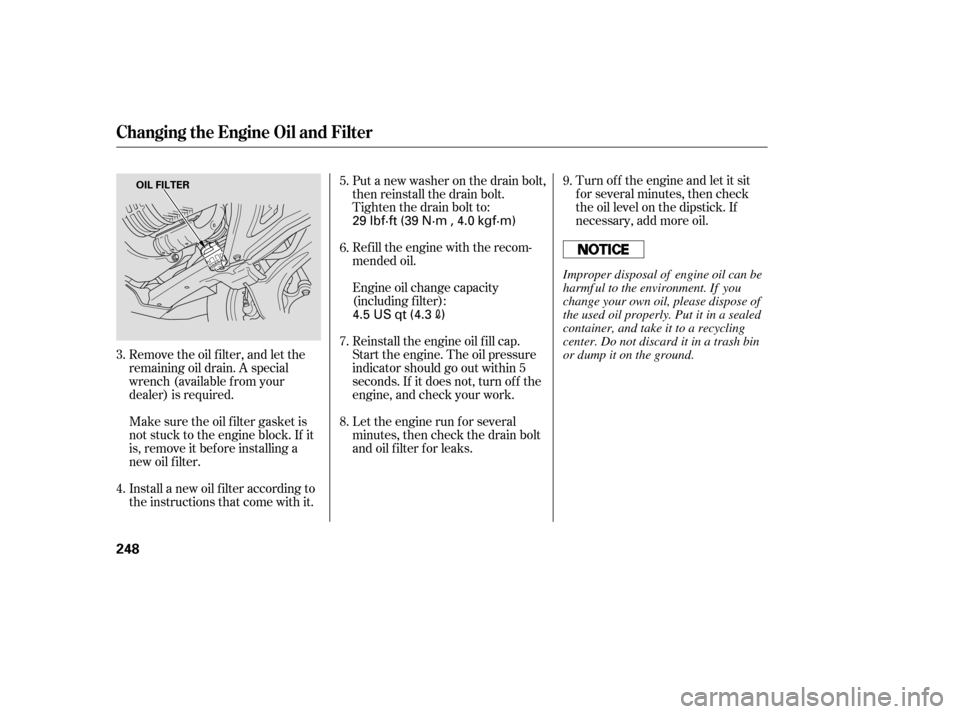
Remove the oil f ilter, and let the
remaining oil drain. A special
wrench (available from your
dealer) is required.Turn of f the engine and let it sit
f or several minutes, then check
the oil level on the dipstick. If
necessary, add more oil.
Put a new washer on the drain bolt,
then reinstall the drain bolt.
Tighten the drain bolt to:
Refill the engine with the recom-
mended oil.
Engine oil change capacity
(including f ilter):
Let the engine run f or several
minutes, then check the drain bolt
and oil f ilter f or leaks.
Make sure the oil f ilter gasket is
not stuck to the engine block. If it
is, remove it bef ore installing a
new oil f ilter.
Install a new oil f ilter according to
the instructions that come with it. Reinstall the engine oil f ill cap.
Start the engine. The oil pressure
indicator should go out within 5
seconds. If it does not, turn of f the
engine, and check your work.9.
8. 7. 6.
4. 5.
3.
Changing the Engine Oil and Filter
248
OIL FILTER
29 lbf·ft (39 N·m , 4.0 kgf·m)
4.5 US qt (4.3
) Improper disposal of engine oil can be
harmf ul to the environment. If you
change your own oil, please dispose of
the used oil properly. Put it in a sealed
container, and take it to a recycling
center. Do not discard it in a trash bin
or dump it on the ground.
Page 254 of 331
Make sure the engine and radiator
are cool.
Wh en the radiator and engine are
cool, relieve any pressu re in the
cooling system by turning the
radiator cap counterclockwise,
without pressing down.
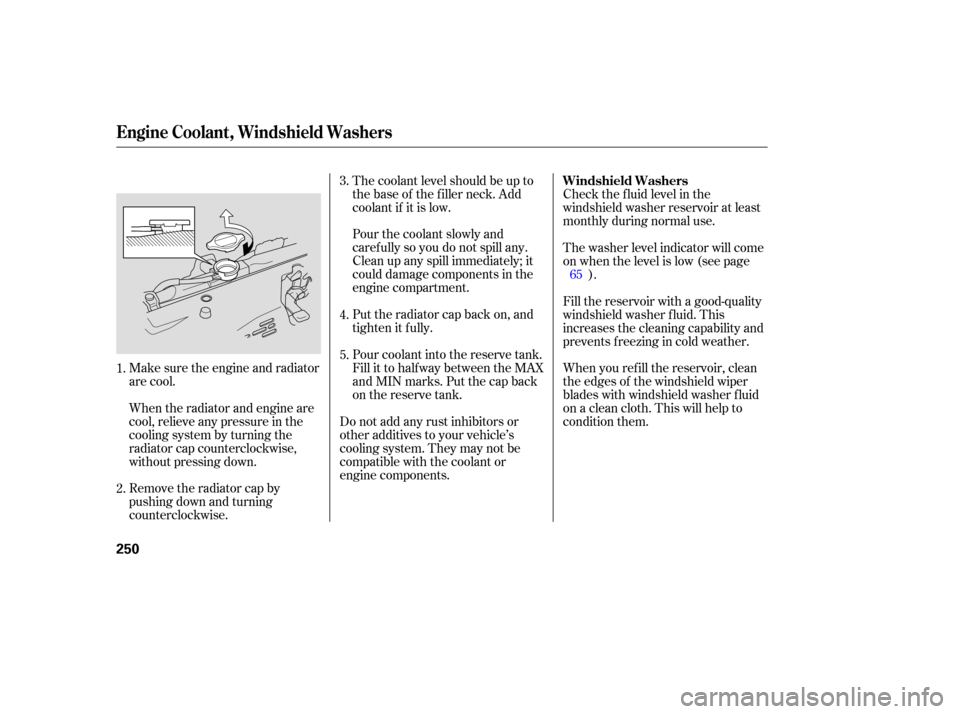
Remove the radiator cap by
pushing down and turning
counterclockwise. The
coolant level should be up to
the base of the filler neck. Add
coolant if it is low.
Pourthecoolantslowlyand
carefully so you do not spill any.
Clean up any spill imme diately; it
could damage componen ts in the
engine compartm ent.
Put the radiator cap back on, and
tighten it fully.
Pour coolant into the reserve tank.
Fill it to halfway between the MAX
and MIN marks. Put the cap back
on the reserve tank.
Do not add any rust inhibitors or
other additives to your vehicle’s
cooling system. They may not be
compatible with the coolant or
engine components. Check
the fluid level in the
windshield washer reservoir at least
monthly during normal use.
The washer level indicator will come
on when the level is low (see page ).
Fill the reservoir with a good-quality
windshield washer f luid. This
increases the cleaning capability and
prevents f reezing in cold weather.
When you ref ill the reservoir, clean
the edges of the windshield wiper
blades with windshield washer f luid
on a clean cloth. This will help to
condition them.
3.
4.
5.
1.
2. 65
Windshield Washers
Engine Coolant, Windshield Washers
250