weight HONDA RIDGELINE 2017 2.G Quick Guide
[x] Cancel search | Manufacturer: HONDA, Model Year: 2017, Model line: RIDGELINE, Model: HONDA RIDGELINE 2017 2.GPages: 85, PDF Size: 8.35 MB
Page 68 of 85
HANDLING THE UNEXPECTED
128 || 129
H
ANDLING THE UNEXPECTED
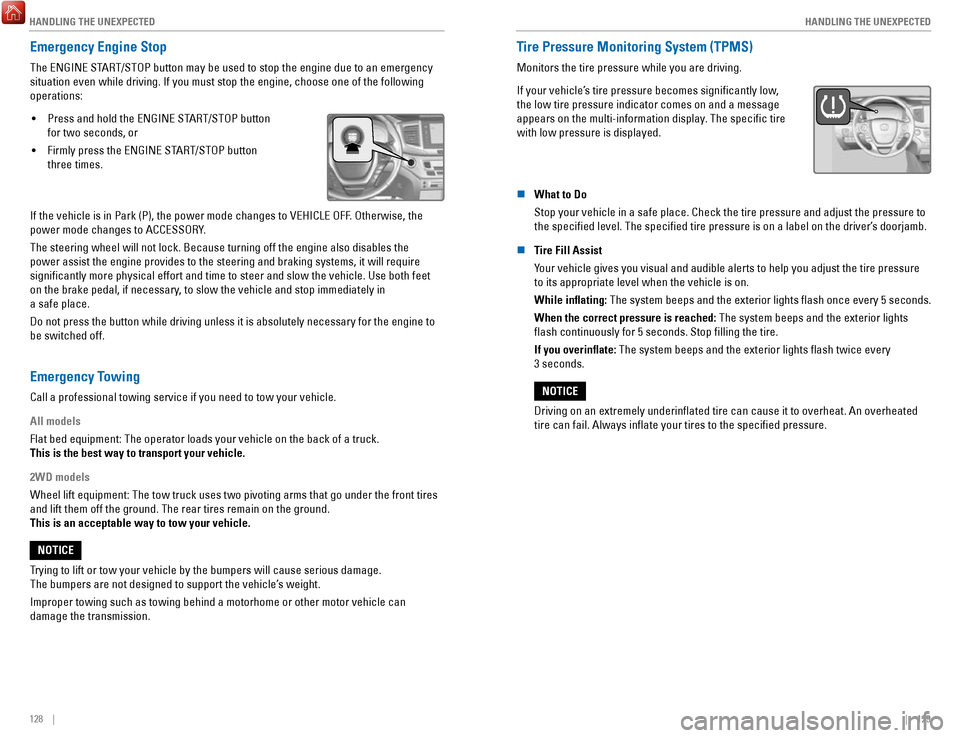
Emergency Engine Stop
The ENGINE START/STOP button may be used to stop the engine due to an emergency
situation even while driving. If you must stop the engine, choose one of\
the following
operations:
•
Press and hold the ENGINE START/STOP button
for two seconds, or
•
Firmly press the ENGINE START/STOP button
three times.
If the vehicle is in Park (P), the power mode changes to VEHICLE OFF. Otherwise, the
power mode changes to ACCESSORY.
The steering wheel will not lock. Because turning off the engine also di\
sables the
power assist the engine provides to the steering and braking systems, it\
will require
significantly more physical effort and time to steer and slow the vehi\
cle. Use both feet
on the brake pedal, if necessary, to slow the vehicle and stop immediately in
a safe place.
Do not press the button while driving unless it is absolutely necessary \
for the engine to
be switched off.
Emergency Towing
Call a professional towing service if you need to tow your vehicle.
All models
Flat bed equipment: The operator loads your vehicle on the back of a tru\
ck.
This is the best way to transport your vehicle.
2WD models
Wheel lift equipment: The tow truck uses two pivoting arms that go under the front tires
and lift them off the ground. The rear tires remain on the ground.
This is an acceptable way to tow your vehicle.
Trying to lift or tow your vehicle by the bumpers will cause serious dama\
ge.
The bumpers are not designed to support the vehicle’s weight.
Improper towing such as towing behind a motorhome or other motor vehicle\
can
damage the transmission.
NOTICE
Tire Pressure Monitoring System (TPMS)
Monitors the tire pressure while you are driving.
If your vehicle’s tire pressure becomes significantly low,
the low tire pressure indicator comes on and a message
appears on the multi-information display. The specific tire
with low pressure is displayed.
n What to Do
Stop your vehicle in a safe place. Check the tire pressure and adjust th\
e pressure to
the specified level. The specified tire pressure is on a label on th\
e driver’s doorjamb.
n
Tire Fill Assist
Your vehicle gives you visual and audible alerts to help you adjust the t\
ire pressure to its appropriate level when the vehicle is on.
While inflating: The system beeps and the exterior lights flash once every 5 seconds.
When the correct pressure is reached:
The system beeps and the exterior lights
flash continuously for 5 seconds. Stop filling the tire.
If you overinflate: The system beeps and the exterior lights flash twice every
3 seconds.
Driving on an extremely underinflated tire can cause it to overheat. A\
n overheated
tire can fail. Always inflate your tires to the specified pressure.
NOTICE
Page 78 of 85

MAINTENANCE
148 || 149
M
AINTENANCE
Using tires that are excessively worn or improperly inflated can cause\
a
crash in which you can be seriously hurt or killed.
Follow all instructions in this owner’s manual regarding tire inflation and
maintenance
.
WARNING
n Tire and Loading Information Label
The label attached to the driver’s doorjamb provides necessary tire and
loading information.
Original
tire sizes
Number of people your
vehicle can carry
Proper cold tire pressure Total weight your
vehicle can carry
(do not exceed)
n Tire and Wheel Replacement
Replace your tires with radials of the same size, load range, speed rati\
ng, and
maximum cold tire pressure rating (as shown on the tire’s sidewall). Using tires of a
different size or construction can cause certain vehicle systems to work\
incorrectly
.
It is best to replace all four tires at the same time. If that isn’t possible, replace the
front or rear tires in pairs.
If you change or replace a wheel, make sure that the wheel’s specifications match
those of the original wheels. Only use TPMS-specified wheels approved \
for your
vehicle.
Installing improper tires on your vehicle can affect handling and stabil\
ity.
This can cause a crash in which you can be seriously hurt or killed.
Always use the size and type of tires recommended in the Owner’s
Manual.
WARNING
n Tire Service Life
The life of your tires is dependent on many factors, including driving h\
abits, road
conditions, vehicle loading, inflation pressure, maintenance history, speed, and
environmental conditions (even when the tires are not in use).
In addition to regular inspections and inflation pressure maintenance,\
it is
recommended that you have annual inspections performed once the tires re\
ach five
years old. All tires, including the spare, should be removed from servic\
e after
10 years from the date of manufacture, regardless of their condition or \
state of wear
.
n
Winter Tires
If driving on snowy or frozen roads, mount all season tires marked “M\
+S”, snow tires, or tire chains; reduce speed; and maintain sufficient distance \
between
vehicles when driving. For winter tires, select the size and load ranges\
that are the same as the original tires, and mount them to all four wheels.
n
Tire Chains
Install tire chains on the front tires only. Because your vehicle has limited tire
clearance, we strongly recommend using the following chains:
Cable type: SCC Super Z LT-ZT735
Mount chains as tightly as you can, and make sure that they do not touch\
the brake
lines or suspension.
Traction devices that are the wrong size or improperly installed can
damage your vehicle’s brake lines, suspension, body, and wheels. Stop
driving if they are hitting any part of the vehicle.
NOTICE
Using the wrong chains, or not properly installing chains, can damage th\
e
brake lines and cause a crash in which you can be seriously injured or
killed.
Follow all instructions in this guide regarding the selection and use of\
tire
chains.
WARNING
Page 81 of 85
SPECIFICATIONS
154 || 155
S
PECIFICATIONS
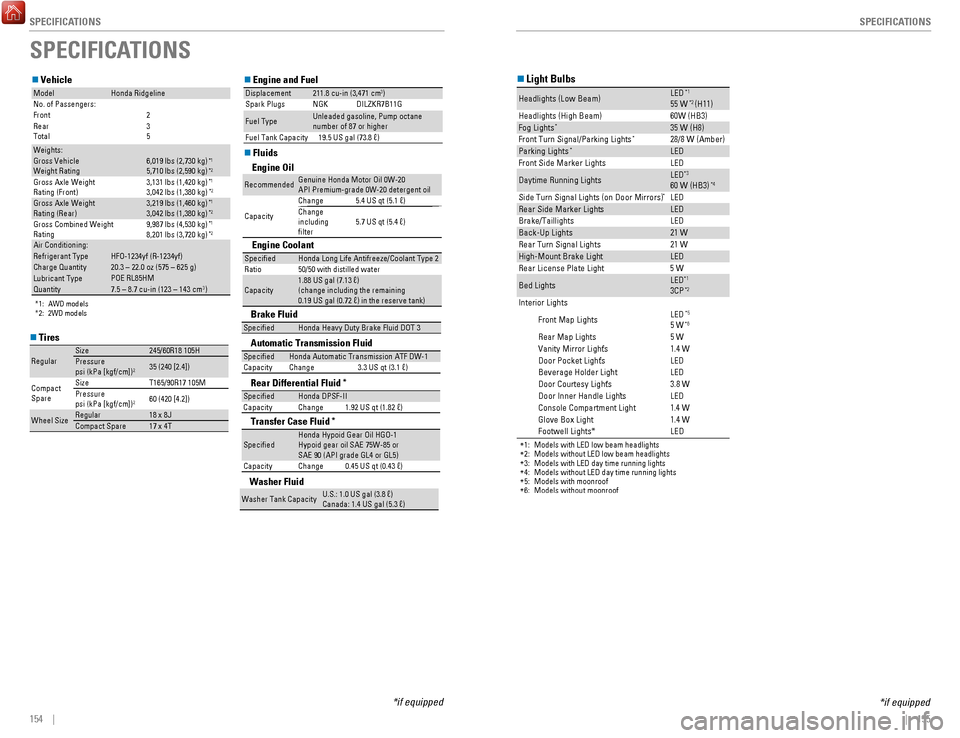
SPECIFICATIONS
*if equipped
* *
Vehicle
2: 2WD models
1: AWD models
ModelHonda Ridgeline
Front No. of Passengers: 2
Rear 3
6,019 lbs (2,730 kg)*25,710 lbs (2,590 kg)*1
3,131 lbs (1,420 kg)*13,042 lbs (1,380 kg)*2
3,219 lbs (1,460 kg)*13,042 lbs (1,380 kg)*2
9,987 lbs (4,530 kg)*18,201 lbs (3,720 kg)*2
Air Conditioning:
Weights:
Gross Vehicle
Weight Rating
Gross Axle Weight
Rating (Front)
Gross Axle Weight
Rating (Rear)
Gross Combined Weight
Rating
Refrigerant TypeCharge Quantit yLubricant TypeQuantity
HFO-1234yf (R-1234yf )
20.3 – 22.0 oz (575 – 625 g)
POE RL85HM
7.5 – 8.7 cu-in (123 – 143 cm
3)
Engine and Fuel
Fluids
Displacemen t211.8 cu-in (3,471 cm3)
Spark Plugs NGKDILZKR7B11GUnleaded gasoline, Pump octane
Fuel Type
Washer Tank Capacity
number of 87 or higher
Fuel Tank Capacity 19.5 US gal (73.8 )
U.S.: 1.0 US gal (3.8 )
Canada: 1.4 US gal (5.3 )
Light Bulbs
*
*1: Models with LED low beam headlights
* 2: Models without LED low beam headlights
* 3: Models with LED day time running lights
*
* 4: Models without LED day time running lights
5: Models with moonroof
6: Models without moonroof
Headlights (L
ow Beam) LE
D*155 W*2 (H11)
60W (HB3 )
35 W (H8)
28/8 W (Amber)
LE D
LE D
LE D
*3Daytime Running Lights
60 W (HB3)*4
Headlights (High Beam)
Fog Lights*
Front Turn Signal/Parking Light s*
Parking Lights*
Front Side Marker Lights
LED
LE D
LE D
21 W
21 W
LE D
5 W
Bed Lights LE
D
*13C P*2
Front Map Lights LE
D*55 W*6
In teri or Lights
5 W
1.4 W
LE D
Side Turn Signal Lights (on Door Mirrors)
*
Rear Side Marker Light
s
Brake/Taillights
Back-Up Lights
Rear Turn Signal Lights
High-M ount Brake Ligh t
Rear License Plate Ligh t
LED
3.8 W
LE D
1.4 W
1.4 W
Rear Map Lights
Vanity Mirror Lights
*
Door Pocket Lights*
Beverage Holder Light*
Door Courtesy Light
s*
Door Inner Handle Light s*
Console Compartment Light
Glove Box Light
Engine Oil
Recommende d·
Engine Coolan
t
·
Genuine Honda Motor Oil 0W-20
Change
Capacity API Premium-grade 0W-20 detergent oi
l
5.4 US qt (5.1 )
Change
lter including
5.7 US qt (5.4 )
Specie d
Ratio
Capacity
Honda Long Life Antifreeze/Coolant Type 2
50/50 with distilled wate r
1.88 US gal (7.13 )
(change including the remaining
0.19 US gal (0.72 ) in the reserve tank )
Brake Fluid
Automatic Transmission Fluid
Rear Differential Fluid*
Transfer Case Fluid*
SpeciedHonda Heavy Duty Brake Fluid DOT 3
Specied
CapacityHonda Automatic Transmission ATF DW- 1
Chang e3 .3 US qt (3.1 )
Specied Honda DPSF-II
Capacit yC hange
1.92 US qt (1.82 )
·
Specie d· Honda Hypoid Gear Oil HGO-1
SAE 90 (API grade GL4 or GL5)
Capacit y Hypoid gear oil SAE 75W-85 or
Change
0.45 US qt (0.43 )
Washer Flui d
Tires
RegularSize245/60R18 105 H
Pressure
35 (240 [2.4])
psi (kPa [kgf/cm2])
Spar e
Compact
Size
T165/90R17 105M
Pressure 60 (420 [4.2])
psi (kPa [kgf/cm2])
Wheel SizeRegular18 x 8J17 x 4TCompact Spare
Total5
LED
Footwell Lights*
*if equipped
* *
Vehicle
2: 2WD models
1: AWD models
Model Honda Ridgeline
Front No. of Passengers: 2
Rear 3
6,019 lbs (2,730 kg)
*25,710 lbs (2,590 kg)*1
3,131 lbs (1,420 kg)*1
3,042 lbs (1,380 kg)*2
3,219 lbs (1,460 kg)*1
3,042 lbs (1,380 kg)*2
9,987 lbs (4,530 kg)*1
8,201 lbs (3,720 kg)*2
Air Conditioning: Weights :
Gross Vehicle
Weight Rating
Gross Axle Weight
Rating (Front)
Gross Axle Weight
Rating (Rear)
Gross Combined Weight
Rating
Refrigerant Type
Charge Quantit y
Lubricant Type
Quantity
HFO-1234yf (R-1234yf )
20.3 – 22.0 oz (575 – 625 g)
POE RL85HM
7.5 – 8.7 cu-in (123 – 143 cm
3)
Engine and Fuel
Fluids
Displacemen t211.8 cu-in (3,471 cm3)
Spark Plugs NGK DILZKR7B11G
Unleaded gasoline, Pump octane
Fuel Type
Washer Tank Capacity number of 87
or higher
Fuel Tank Capacity 19.5 US gal (73.8 )
U.S.: 1.0 US gal (3.8 )
Canada: 1.4 US gal (5.3 )
Light Bulbs
*
*1: Models with LED low beam headlights
* 2: Models without LED low beam headlights
* 3: Models with LED day time running lights
*
*
4: Models without LED day time running lights
5: Models with moonroof
6: Models without moonroof
Headlights (L ow Beam) LE
D*1
55 W*2 (H11)60W (HB3 )35 W (H8)28/8 W (Amber)LEDLEDLE D*3Daytime Running Lights
60 W (HB3)*4
Headlights (High Beam)
Fog Lights*
Front Turn Signal/Parking Light s*
Parking Lights*
Front Side Marker Lights
LEDLED
LE D
21 W21 WLED5 W
Bed LightsLE D*1
3C P*2
Front Map Lights LE
D*5
5 W*6
In teri or Lights
5 W
1.4 W
LE D
Side Turn Signal Lights (on Door Mirrors)
*
Rear Side Marker Light
s
Brake/Taillights
Back-Up Lights
Rear Turn Signal Lights
High-M ount Brake Ligh t
Rear License Plate Ligh t
LED
3.8 W
LE D
1.4 W
1.4 W
Rear Map Lights
Vanity Mirror Lights*
Door Pocket Lights*
Beverage Holder Light*
Door Courtesy Light s*
Door Inner Handle Light s*
Console Compartment Light
Glove Box Light
Engine Oil
Recommende d·
Engine Coolan
t
·
Genuine Honda Motor Oil 0W-20
Change
Capacity API Premium-grade 0W-20 detergent oi
l
5.4 US qt (5.1 )
Change
lter including 5.7 US qt (5.4 )
Specie d
Ratio
Capacity Honda Long Life Antifreeze/Coolant Type
2
50/50 with distilled wate r
1.88 US gal (7.13 )
(change including the remaining
0.19 US gal (0.72 ) in the reserve tank )
Brake Fluid
Automatic Transmission Fluid
Rear Differential Fluid
*
Transfer Case Flui d*
SpeciedHonda Heavy Duty Brake Fluid DOT 3
Specied
Capacit yHonda Automatic Transmission ATF DW-
1
Chang e3 .3 US qt (3.1 )
Specied Honda DPSF-II
Capacit yC hange 1.92 US qt (1.82 )
·
Specie d· Honda Hypoid Gear Oil HGO-1
SAE 90 (API grade GL4 or GL5)
Capacit y Hypoid gear oil SAE 75W-85 or
Change 0.45 US qt (0.43 )
Washer Fluid
Tire s
Regular Size
245/60R18 105H
Pressure 35 (240 [2.4])
psi (kPa [kgf/cm2])
Spar e
Compact
Size
T165/90R17 105M
Pressure 60 (420 [4.2])
psi (kPa [kgf/cm
2])
Wheel Size Regular
18 x 8J
17 x 4T
Compact Spar e
Total5LED
Footwell Lights*
Page 85 of 85
INDEX
162 |
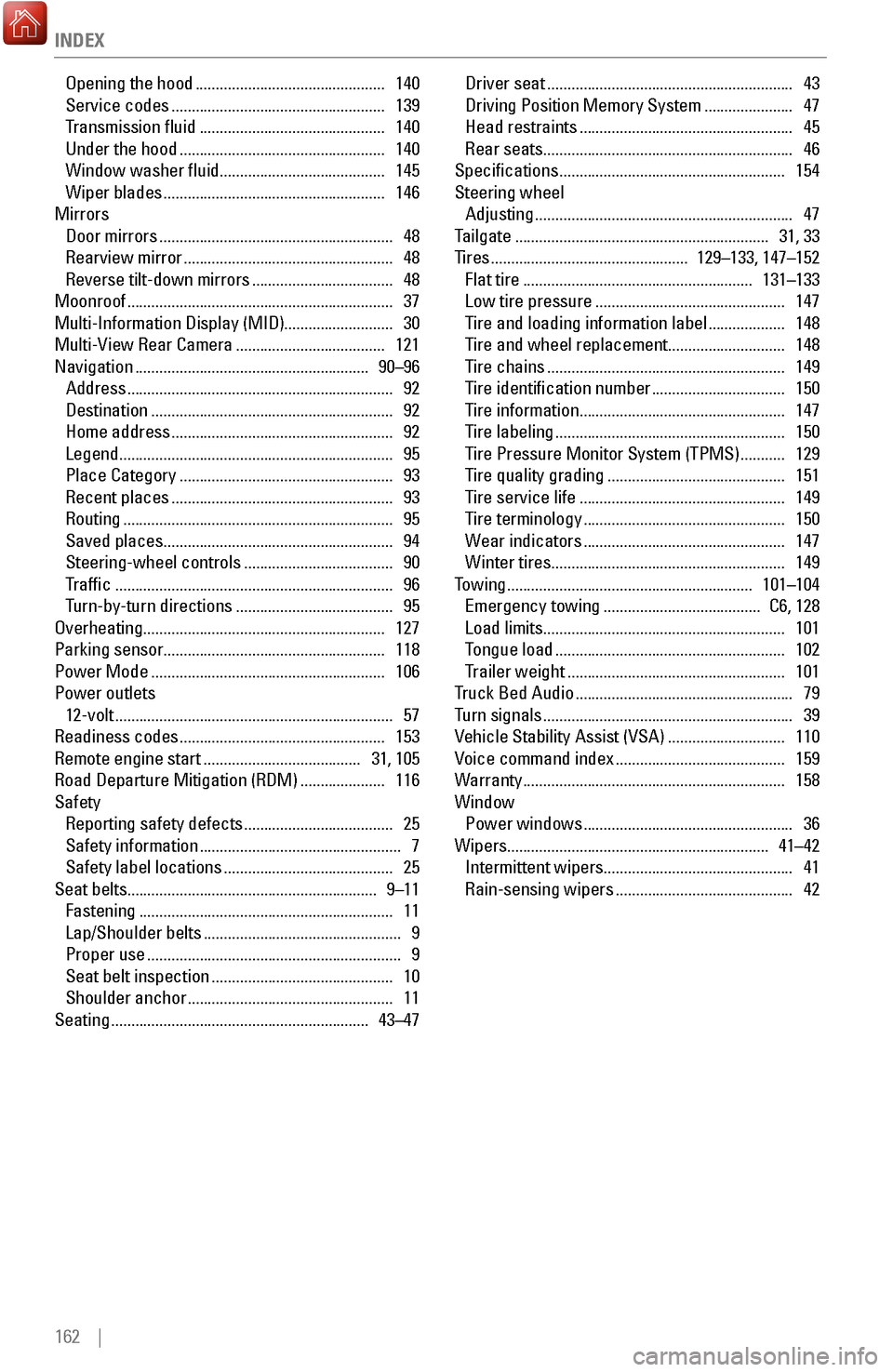
Opening the hood ............................................... 140
Service codes ..................................................... 139
Transmission fluid .............................................. 140
Under the hood ................................................... 140
Window washer fluid ......................................... 145
Wiper blades ....................................................... 146
Mirrors Door mirrors
.......................................................... 48
Rearview mirror .................................................... 48
Reverse tilt-down mirrors ................................... 48
Moonroof .................................................................. 37
Multi-Information Display (MID)........................... 30
Multi-View Rear Camera
..................................... 121
Navigation .......................................................... 90–96
Address .................................................................. 92
Destination ............................................................ 92
Home address ....................................................... 92
Legend .................................................................... 95
Place Category ..................................................... 93
Recent places ....................................................... 93
Routing ................................................................... 95
Saved places ......................................................... 94
Steering-wheel controls ..................................... 90
Traffic ..................................................................... 96
Turn-by-turn directions ....................................... 95
Overheating............................................................ 127 Parking sensor.......................................................
118
Power Mode
.......................................................... 106
Power outlets 12-volt
..................................................................... 57
Readiness codes ................................................... 153
Remote engine start ....................................... 31, 105
Road Departure Mitigation (RDM) ..................... 116
Safety Reporting safety defects
..................................... 25
Safety information .................................................. 7
Safety label locations .......................................... 25
Seat belts.............................................................. 9–11 Fastening
............................................................... 11
Lap/Shoulder belts ................................................. 9
Proper use ............................................................... 9
Seat belt inspection ............................................. 10
Shoulder anchor ................................................... 11
Seating ................................................................ 43–47Driver seat
.............................................................
43
Driving Position Memory System ...................... 47
Head restraints ..................................................... 45
Rear seats .............................................................. 46
Specifications ........................................................ 154
Steering wheel Adjusting
................................................................ 47
Tailgate ............................................................... 31, 33
Tires ................................................. 129–133, 147–152
Flat tire ......................................................... 131–133
Low tire pressure ............................................... 147
Tire and loading information label ................... 148
Tire and wheel replacement ............................. 148
Tire chains ........................................................... 149
Tire identification number ................................. 150
Tire information ................................................... 147
Tire labeling ......................................................... 150
Tire Pressure Monitor System (TPMS) ........... 129
Tire quality grading ............................................ 151
Tire service life ................................................... 149
Tire terminology .................................................. 150
Wear indicators .................................................. 147
Winter tires .......................................................... 149
Towing ............................................................. 101–104
Emergency towing ....................................... C6, 128
Load limits ............................................................ 101
Tongue load ......................................................... 102
Trailer weight ...................................................... 101
Truck Bed Audio ...................................................... 79
Turn signals .............................................................. 39
Vehicle Stability Assist (VSA) ............................. 110
Voice command index .......................................... 159
Warranty ................................................................. 158
Window Power windows
.................................................... 36
Wipers................................................................. 41–42 Intermittent wipers
............................................... 41
Rain-sensing wipers ............................................ 42