air condition HONDA S2000 2000 1.G User Guide
[x] Cancel search | Manufacturer: HONDA, Model Year: 2000, Model line: S2000, Model: HONDA S2000 2000 1.GPages: 273, PDF Size: 21.58 MB
Page 124 of 273
The condition of your car and your
driving habits are the two most
important things
that affect the fuel
mileage you get.
Car Condition
Always maintain your car according
to the maintenance schedule. This
will keep it in top operating condition.
An important part of that mainte
nance is the
Owner Maintenance
Checks
(see page 155 ). For
example, an underinflated tire
causes more
"rolling resistance,"
which uses fuel. It also wears out
faster, so check the tire pressure
at
least monthly.
In winter, the build-up of snow on
your car's underside adds weight and
rolling resistance. Frequent cleaning
helps your fuel mileage and reduces
the chance of corrosion.
Driving Habits
You can improve fuel economy by
driving moderately. Rapid acceler
ation, abrupt cornering, and hard
braking use more fuel.
Always drive
in the highest gear that
allows the engine to run and acceler
ate smoothly.
Depending on traffic conditions, try
to maintain a constant speed. Every
time you slow down and speed up,
your car uses extra fuel.
Use the
cruise control, when appropriate, to
increase fuel economy.
A cold engine uses more fuel than a
warm engine.
It is not necessary to
"warm-up" a cold engine by letting it
idle for a long time. You can drive
away
in about a minute, no matter
how cold it is outside.
The engine
will warm up faster, and you get
better fuel economy. To cut down on
the number of
"cold starts," try to
Fuel Economy
combine several short trips into one.
The air conditioning puts an extra
load on the engine which makes it
use more fuel.
Turn off the A/C to
cut down on air conditioning use.
Use the flow-through ventilation
when the outside air temperature is
moderate.
Before Driving 121
Page 143 of 273
Driving in Bad Weather
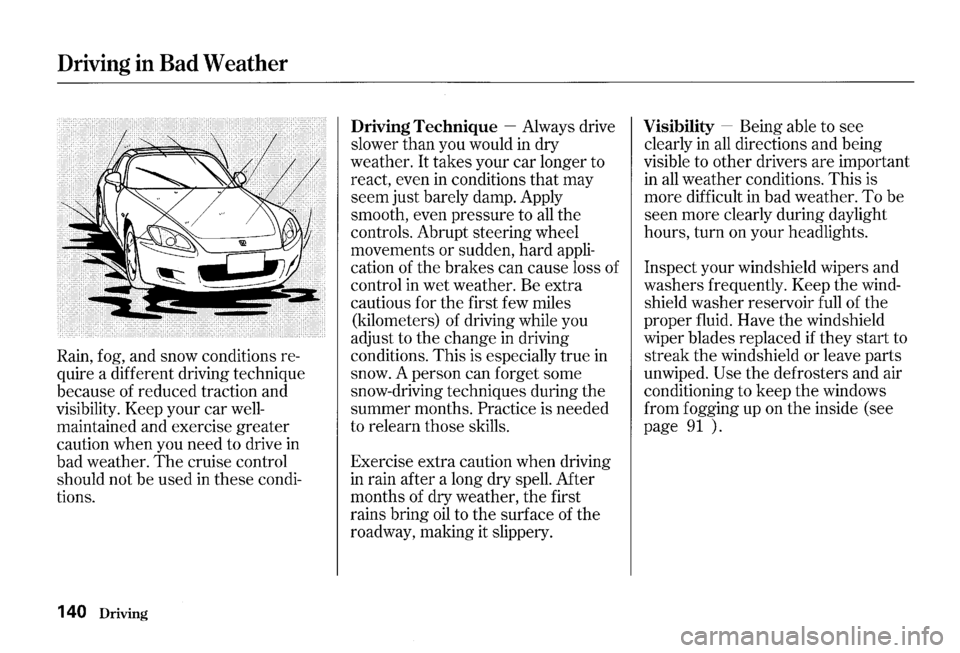
Rain, fog, and snow conditions re
quire a different driving technique
because of reduced traction and
visibility. Keep your car well
maintained and exercise greater
caution when you need to drive in
bad weather.
The cruise control
should not be used in these condi
tions.
140 Driving
Driving Technique -Always drive
slower than you would
in dry
weather.
It takes your car longer to
react, even
in conditions that may
seem just barely damp. Apply
smooth, even pressure to
all the
controls. Abrupt steering wheel
movements or sudden, hard appli
cation of the brakes can cause loss of
control in wet weather. Be extra
cautious for the first few miles
(kilometers) of driving while you
adjust to the change in driving
conditions.
This is especially true in
snow. A person can forget some
snow-driving techniques during the
summer months.
Practice is needed
to relearn those skills.
Exercise extra caution when driving
in rain after a long dry spell. After
months of dry weather, the first
rains bring
oil to the surface of the
roadway, making it slippery.
Visibility -Being able to see
clearly in
all directions and being
visible to other drivers are important
in all weather conditions. This is
more difficult
in bad weather. To be
seen more clearly during daylight
hours, turn on your headlights.
Inspect your windshield wipers and
washers frequently. Keep the wind
shield washer reservoir full of the
proper fluid. Have the windshield
wiper blades replaced
if they start to
streak the windshield or leave parts
unwiped.
Use the defrosters and air
conditioning to keep the windows
from fogging up on
the inside (see
page
91 ).
Page 146 of 273
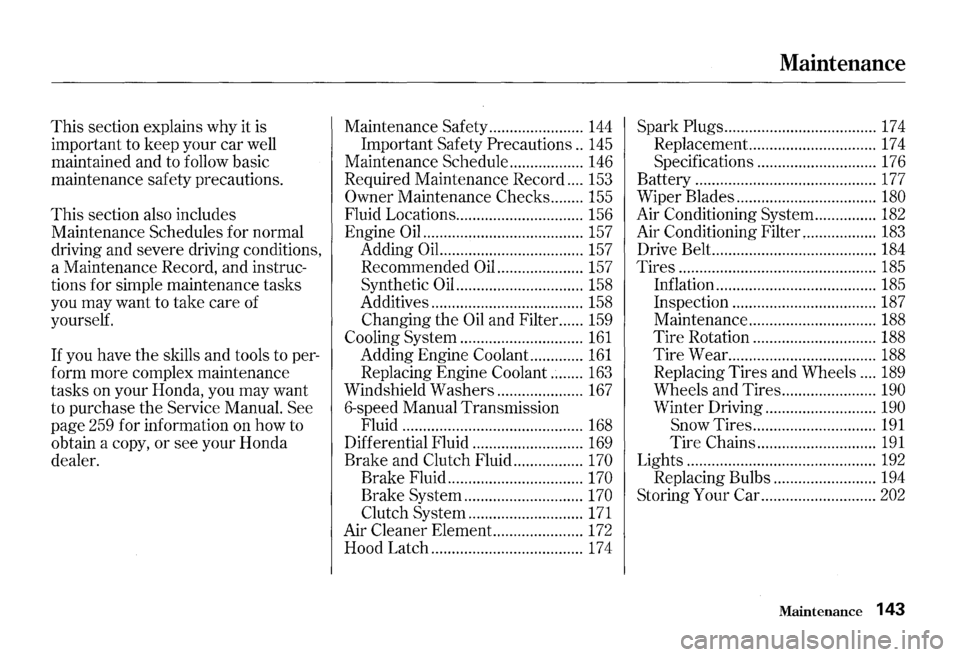
This section explains why it is
important to keep your car well
maintained and to follow basic
maintenance safety precautions.
This section also includes
Maintenance Schedules for normal
driving and severe driving conditions,
a Maintenance Record, and instruc
tions for simple maintenance tasks
you may want to take care of
yourself.
If you have the skills and tools to per
form more complex maintenance
tasks on your Honda, you may want
to purchase
the Service Manual. See
page 259 for information on how to
obtain a copy,
or see your Honda
dealer. Maintenance
Safety .......................
144
Important
Safety Precautions .. 145
Maintenance Schedule .................. 146
Required Maintenance Record
.... 153
Owner Maintenance Checks ........ 155
Fluid Locations ............................... 156
Engine Oil ....................................... 157
Adding Oil... ................................ 157
Recommended Oil ..................... 157
Synthetic
Oil ............................... 158
Additives ..................................... 158
Changing the Oil and Filter.. .... 159
Cooling System .............................. 161
Adding Engine Coolant ............. 161
Replacing Engine Coolant ........ 163
Windshield Washers ..................... 167
6-speed Manual Transmission
Fluid ............................................
168
Differential Fluid ........................... 169
Brake and Clutch Fluid ................. 170
Brake Fluid ................................. 170
Brake System ............................. 170
Clutch System ............................ 171
Air Cleaner Element.. .................... 172
Hood Latch ..................................... 174
Maintenance
Spark Plugs ..................................... 174
Replacement ............................... 17 4
Specifications ............................. 176
Battery ............................................
177
Wiper Blades .................................. 180
Air Conditioning System ............... 182
Air Conditioning Filter, ................. 183
Drive Belt ........................................ 184
Tires ................................................ 185
Inflation ....................................... 185
Inspection ................................... 187
Maintenance ............................... 188
Tire Rotation .............................. 188
Tire Wear .................................... 188
Replacing Tires and Wheels .... 189
Wheels and Tires ....................... 190
Winter Driving ........................... 190
Snow
Tires .............................. 191
Tire Chains ............................. 191
Lights .............................................. 192
Replacing Bulbs ......................... 194
Storing Your Car ............................ 202
Maintenance 143
Page 151 of 273
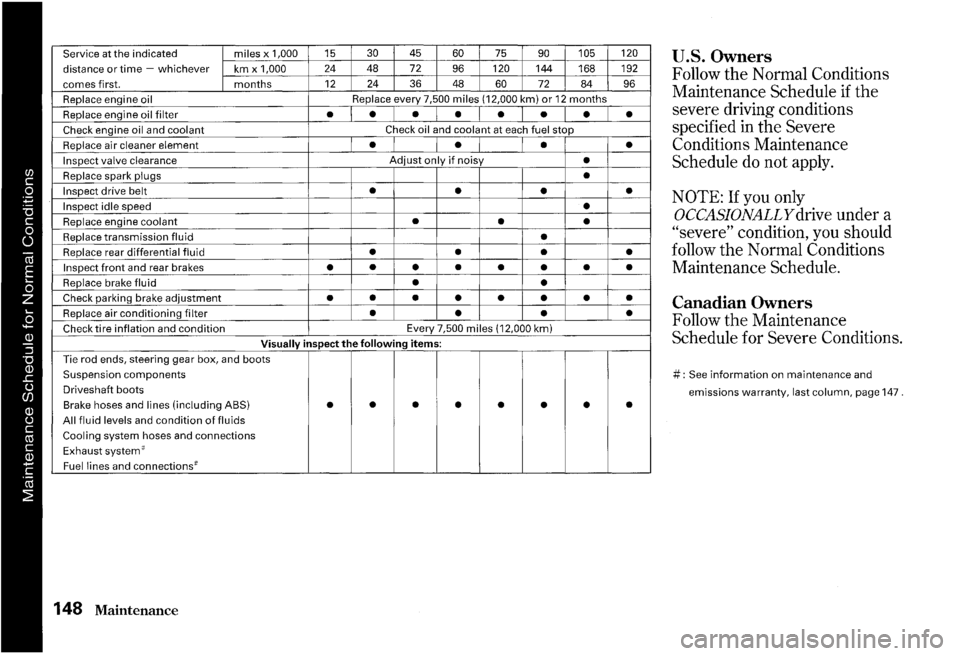
Service at the indicated miles x 1,000 15 30 45 60 75 90 105
distance ortime -whichever kmx 1,000 24 48 72 96 120 144 168
comes first.
months 12 24 36 48 60 72 84
Replace engine oil Replace every 7,500
miles (12,000 km) or 12 months
Replace engine oil filter • •
• • • • • Check engine oil and coolant Check oil and coolant at each fuel stop
Replace air cleaner element • • • Inspect valve clearance Adjust only if noisy • Replace spark plugs • Inspect drive belt • • • Inspect idle speed • Replace engine coolant • • • Replace transmission fluid • Replace rear differential fluid • • • Inspect front and rear brakes • • • • • •
• Replace brake fluid • • Check parking brake adjustment • • • •
• • • Replace air conditioning filter • • • Check tire inflation and condition Every 7,500
miles (12,000 km)
Visually inspect the following items:
Tie rod ends, steering gear box, and boots
Suspension components
Driveshaft boots
Brake hoses and
lines (including ABS) • • • • • • • All fluid levels and condition of fluids
Cooling
system hoses and connections
Exhaust system•
Fuel lines and connections•
148 Maintenance
120 192
96
•
•
•
•
•
•
•
•
U.S. Owners
Follow the Normal Conditions
Maintenance Schedule
if the
severe driving conditions
specified in
the Severe
Conditions Maintenance
Schedule do not apply.
NOTE: If you only
OCCASIONALLY drive under a
"severe" condition, you should
follow
the Normal Conditions
Maintenance Schedule.
Canadian Owners
Follow the Maintenance
Schedule for Severe Conditions.
#: See information on maintenance and
emissions warranty,
last column, page 147.
Page 152 of 273
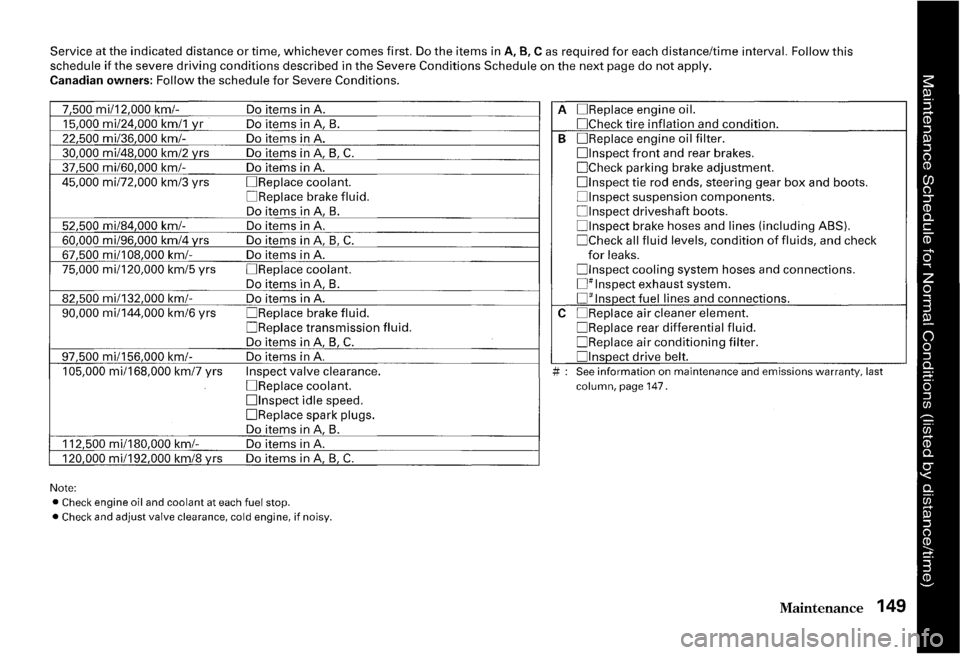
Service at the indicated distance or time, whichever comes first. Do the items in A, B, Cas required for each distance/time interval. Follow this schedule if the severe driving conditions described in the Severe Conditions Schedule on the next page do not apply. Canadian owners: Follow the schedule for Severe Conditions.
7,500 mi/12,000
km/- Do items in A. 15,000 m i/24,000 km/1 yr Do items in A, B. 22,500 mi/36,000 km/-
Do items in A. 30,000 mi/48,000 km/2 yrs Do items in A, B, C. 37,500 mi/60,000 km/- Do items in A. 45,000 mi/72,000 km/3 yrs DReplace coolant. DReplace brake fluid. Do items in A, B. 52,500 mi/84,000 km/- Do items in A. 60,000 mi/96,000 km/4 yrs Do items in A, B, C. 67,500 mi/108,000 km/- Do items in A. 75,000 mi/120,000 km/5 yrs DReplace coolant. Do items in A, B. 82,500 mi/132,000 km/- Do items in A. 90,000 mi/144,000 km/6 yrs DReplace brake fluid. DReplace transmission fluid. Do items in A, B, C. 97,500 mi/156,000 km/- Do items in A. 1 05,000 m i/168,000 km/7 yrs Inspect valve clearance. DReplace coolant. Dlnspect idle speed. DReplace spark plugs. Do items in A, B. 112,500 mi/180,000 km/-Do items in A. 120,000 mi/192,000 km/8 yrs Do items in A, B, C.
Note: • Check engine oil and coolant at each fuel stop. • Check and adjust valve clearance, cold engine, if noisy.
A DReplace engine oil. DCheck tire inflation and condition. B DReplace engine oil filter. Dlnspect front and rear brakes. CCheck parking brake adjustment. Dlnspect tie rod ends, steering gear box and boots. Dlnspect suspension components. Dlnspect driveshaft boots. Dlnspect brake hoses and lines (including ABS). DC heck all fluid levels, condition of fluids, and check for leaks. Dlnspect cooling system hoses and connections. D"lnspect exhaust system. D"lnspect fuel lines and connections. c DReplace air cleaner element. DReplace rear differential fluid. DReplace air conditioning filter. Dlnspect drive belt. # : See information on maintenance and emissions warranty, last
column, page 147.
Maintenance 149
Page 153 of 273
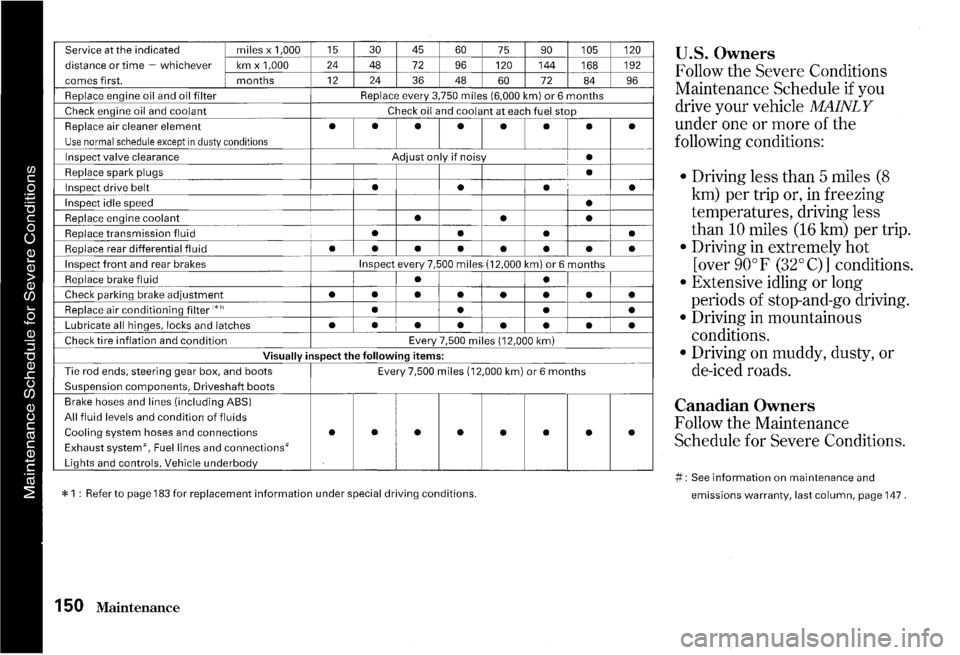
Service at the indicated miles x 1,000 15 30 45 60 75 90 105 120 distance or time -whichever km x 1,000 24 48 72 96 120 144 168 192 --~-~ comes first. months 12 24
36 48 60 72 84
96 Replace engine oil and oil filter Replace every 3,750 miles (6,000 km) or 6 months
Check engine oil and coolant Check oil and coolant at each fuel stop Replace air cleaner element • • r-·-. . . ·~ • • Use normal schedule except in dusty
conditions Inspect valve clearance Adjust only if noisy • Replace spark plugs • -·~-~-·-· ~~-~ f-----Inspect drive belt •
• • • Inspect idle speed I • --Replace engine coolant • • • -----Replace transmission fluid • •
• • Replace rear differential fluid • • • •
• •
• • Inspect front and rear brakes Inspect every 7,500 miles. (12,000 km) or 6 months
Replace brake fluid • -+-• Check parking brake adjustment • •
• • • • • • Replace air conditioning filter 1
" 1 •
•
• • i -~I-Lubricate al_~!lir1J:JeS, locks and latches • • • • • • • • Check tire inflation and condition Every 7,500 miles (12,000 km) Visually inspect the following items:
Tie rod ends, steering gear box, and boots Every 7,500 miles (12,000 km) or 6 months Suspension components, Drives haft boots -----r----~~ Brake hoses and lines (including ABS)
All fluid levels and condition of fluids
Cooling system hoses and connections • • • • • • • • Exhaust system", Fuel lines and connections'
1 Lights and controls, Vehicle underbody
* 1: Refer to page183 for replacement information under special driving conditions.
150 Maintenance
U.S. Owners
Follow the Severe Conditions
Maintenance Schedule if you
drive your vehicle
MAINLY
under one or more of the
following conditions:
• Driving less than 5 miles (8
km) per trip or, in freezing
temperatures, driving less
than
10 miles (16 km) per trip.
• Driving in extremely hot
[over
90° F (32° C)] conditions.
• Extensive idling or long
periods of stop-and-go driving.
• Driving in mountainous
conditions.
• Driving on muddy, dusty, or
de-iced roads.
Canadian Owners
Follow the Maintenance
Schedule for Severe Conditions.
#: See information on maintenance and
emissions warranty, last column, page 147.
Page 154 of 273
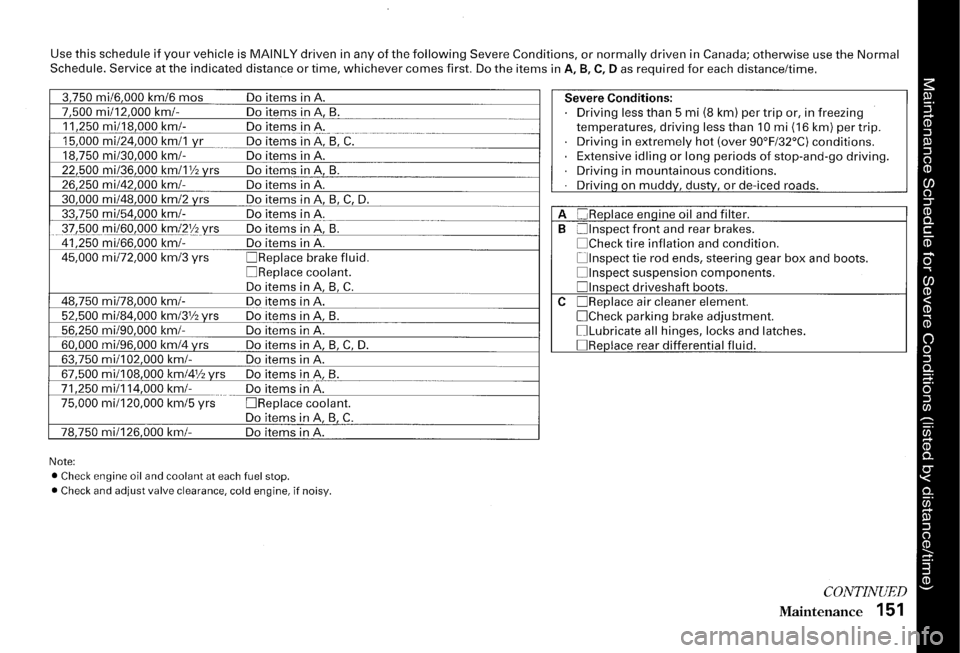
Use this schedule if your vehicle is MAINLY driven in any of the following Severe Conditions, or normally driven in Canada; otherwise use the Normal Schedule. Service at the indicated distance or time, whichever comes first. Do the items in A, B, C, D as required for each distance/time.
3,750 mi/6,000 km/6 mos Do items in A. 7,500 mi/12,000 km/- Do items in A, B. 11,250 mi/18,000 km/-
Do items in A. 15,000 mi/24,000 km/1 yr Do items in A, B, C. 18,750 mi/30,000 km/- Do items in A. 22,500 mi/36,000 km/1% yrs Do items_in_A,Jt .. ~--------· ---~~---26,250 mi/42,000 km/-Do items in A. 30,000 mi/48,000 km/2 vrs Do items in A, B, C, D. 33,750 mi/54,000 km/-
Do items in A. 37,500 mi/60,000 km/2'/z vrs
Do items in A, B. 41,250 mi/66,000 km/-
Do items in A. 45,000 mi/72,000 km/3 yrs DReplace brake fluid. DReplace coolant. Do items in A, B, C. 48,750 mi/78,000 km/- Do items in A. 52,500 mi/84,000 km/3'/z vrs Do items in A, B. 56,250 mi/90,000 km/-
Do items in A. 60,000 mi/96,000 km/4 vrs _Do items in A, B, C, D. 63,750 mi/102,000 km/-
Do items in A. 67,500 mi/108,000 km/41!2 yrs Do items in A, B. 71,250 mi/114,000 km/-
Do items in A. 75,000 mi/120,000 km/5 yrs ']Replace coolant. Do itefY!S_lll_ A,_B_,_(:, -~--~--78,750 mi/126,000 km/-
Do items in A.
Note: • Check engine oil and coolant at each fuel stop. • Check and adjust valve clearance, cold engine, if noisy.
·--~
··-
Severe Conditions:
A
B
c
Driving less than 5 mi (8 km) per trip or, in freezing
temperatures, driving less than 10 mi (16 km) per trip.
Driving in extremely hot (over 90°F/32°C) conditions.
Extensive idling or long periods of stop-and-go driving. Driving in mountainous conditions.
Drivin_gon muddy, dusty, or de-iced roads.
[]Replace enqine oil and filter. Dlnspect front and rear brakes. DC heck tire inflation and condition. Dlnspect tie rod ends, steering gear box and boots. Dlnspect suspension components. Dlnspect driveshaft boots. ORe place air cleaner element. ']Check parking brake adjustment. ']Lubricate all hinges, locks and latches. ']Replace rear differential fluid.
CONTINUED
Maintenance 151
Page 155 of 273
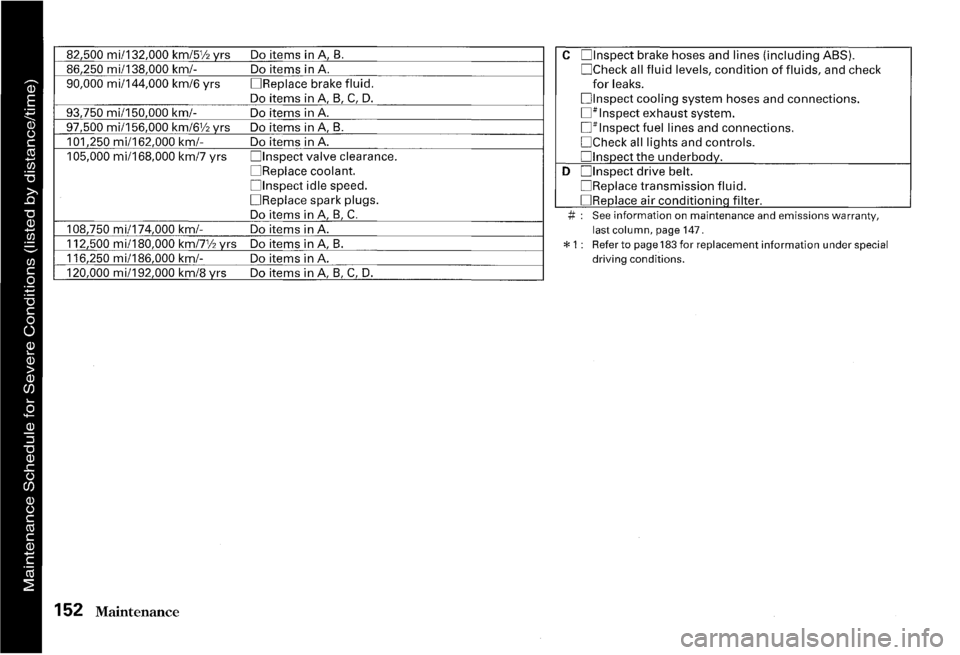
82,500 mi/132,000 km/51/z vrs Do items in A, B. 86,250 mi/138,000 km/-Do items in A. 90,000 mi/144,000 km/6 yrs ORe place brake fluid. Do items in A, B, C, D. 93,750 mi/150,000 km/-Do items in A. 97,500 mi/156,000 km/61/z yrs Do items in A. B. 101,250 mi/162,000 km/-Do items in A. 105,000 mi/168,000 km/7 yrs Dlnspect valve clearance. DReplace coolant. Dlnspect idle speed. DReplace spark plugs. Do items in A, B, C. 108,750 mi/174,000 km/-Do items in A. 112,500 mi/180,000 km/71/z yrs Do items in A, B. 116,250 mi/186,000 km/-Do items in A. 120,000 mi/192,000 km/8 vrs Do items in A, B, C D.
152 Maintenance
C Dlnspect brake hoses and lines (including ABS). DC heck all fluid levels, condition of fluids, and check for leaks. Dlnspect cooling system hoses and connections. D"lnspect exhaust system. D"lnspect fuel lines and connections. DCheck all lights and controls. Dlnspect the underbody.
D Dlnspect drive belt. DReplace transmission fluid. DReplace air conditioning filter. # : See information on maintenance and emissions warranty, last column, page 147. * 1: Refer to page183 for replacement information under special driving conditions.
Page 185 of 273
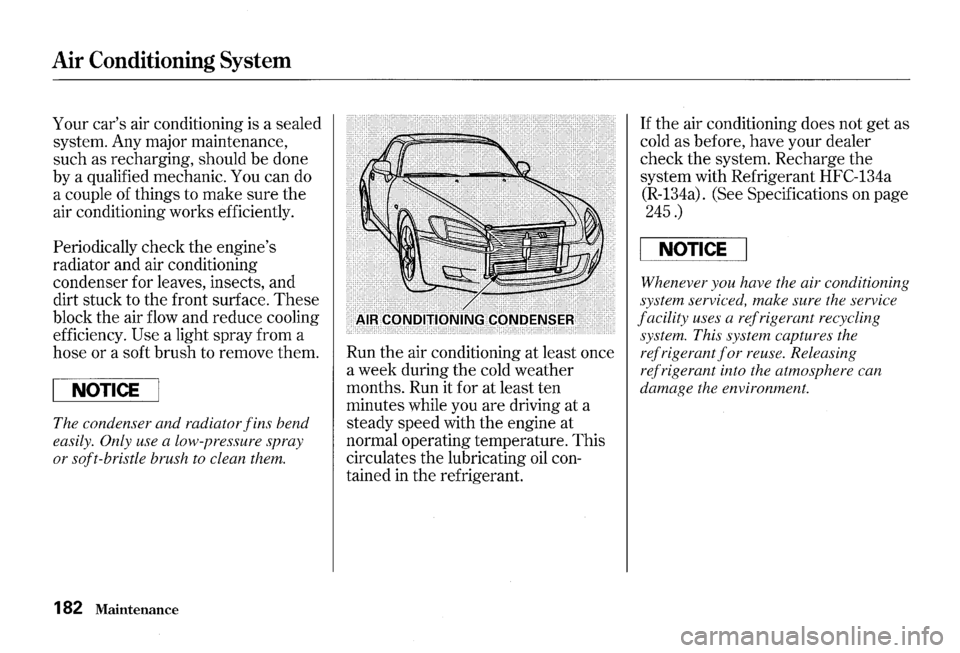
Air Conditioning System
Your car's air conditioning is a sealed
system. Any major maintenance,
such as recharging, should
be done
by a qualified mechanic. You can do
a couple of things to
make sure the
air conditioning works efficiently.
Periodically
check the engine's
radiator and air conditioning
condenser for leaves, insects, and
dirt
stuck to the front surface. These
block the air flow and reduce cooling
efficiency.
Use a light spray from a
hose or a soft
brush to remove them.
NOTICE
The condenser and radiator fins bend
easily. Only use a low-pressure
~pray
or soft-bristle brush to clean them.
182 Maintenance
Run the air conditioning at least once
a
week during the cold weather
months. Run it for at least ten
minutes while you are driving at a
steady speed with
the engine at
normal operating temperature. This
circulates the lubricating oil con
tained in
the refrigerant.
If the air conditioning does not get as
cold
as before, have your dealer
check the system. Recharge the
system with Refrigerant HFC-134a
(R-134a). (See Specifications on page
245.)
NOTICE
Whenever you have the air conditioning
system serviced, make sure the service
facility uses a refrigerant recycling
system. This system captures the
refrigerant
for reuse. Releasing
refrigerant into the atmosphere can
damage the environment.
Page 186 of 273
The air conditioning filter removes
pollen and dust from outside air the
heating and cooling system brings
into the interior.
It should be
replaced according to the time and
distance recommendations
in the
maintenance schedule.
This filter should be replaced every
30,000 miles (48,000 km) under
normal conditions.
It should be
replaced every
15,000 miles (24,000
km) if you drive primarily in urban
areas that have high concentrations
of soot in the air from industry and
diesel-powered vehicles. Replace it
more often
if air flow from the
climate control system becomes less
than usual. Have the air conditioning
filter replaced by your Honda dealer.
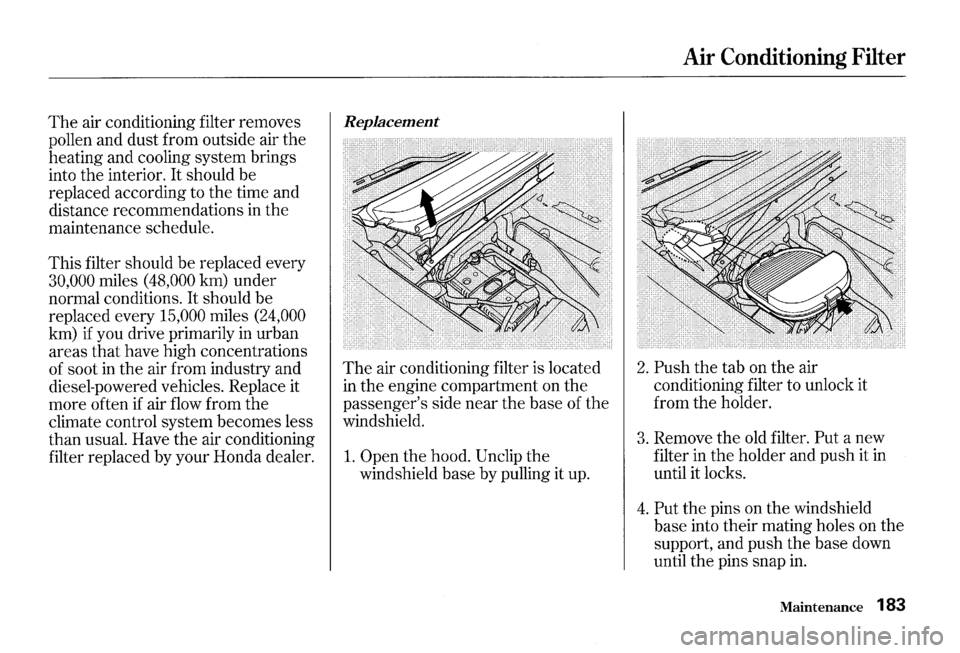
Replacement
The air conditioning filter is located
in the engine compartment on the
passenger's side near the base of the
windshield.
1. Open the hood. Unclip the
windshield base by pulling it
up.
Air Conditioning Filter
2. Push the tab on the air
conditioning filter to unlock it
from the holder.
3. Remove the old filter. Put a new
filter in the holder and push it in
until it locks.
4. Put the pins on the windshield
base into their mating holes on the
support, and push the base down
until the pins snap
in.
Maintenance 183