tires HONDA S2000 2000 1.G User Guide
[x] Cancel search | Manufacturer: HONDA, Model Year: 2000, Model line: S2000, Model: HONDA S2000 2000 1.GPages: 273, PDF Size: 21.58 MB
Page 189 of 273
Tires
Use a gauge to measure the air
pressure at least once a month. Even
tires that are
in good condition may
lose one to two psi
(10 to 20 kPa, 0.1
to 0.2 kgf/ cm2
) per month.
Remember to check the spare tire at
the same
time you check all the
other tires.
Check the pressure in the tires when
they are cold. This means the car
has been parked for at least three
hours. If you have to drive the car
before checking the tire pressure,
the tires can still be considered
"cold" if you drive less than 1 mile
(1.6 km).
186 Maintenance
If you check the pressure when the
tires are hot (the car has been driven
several miles), you
will see readings
4 to 6 psi
(30 to 40 kPa, 0.3 to 0.4
kgf/cm2
) higher than the cold
reading. This is normal. Do not let
air out to match the specified cold
pressure.
The tire will be
underinflated.
You should get your own tire
pressure gauge and use it whenever
you check your tire pressures. This
will make it easier for you to tell if a
pressure loss is due to a tire problem
and not due to a variation between
gauges.
Recommended Tire Pressures for
Normal Driving
The following chart shows the
recommended cold tire pressures for
most normal driving conditions and
speeds. Tire pressures for high
speed driving are
the same as for
normal driving.
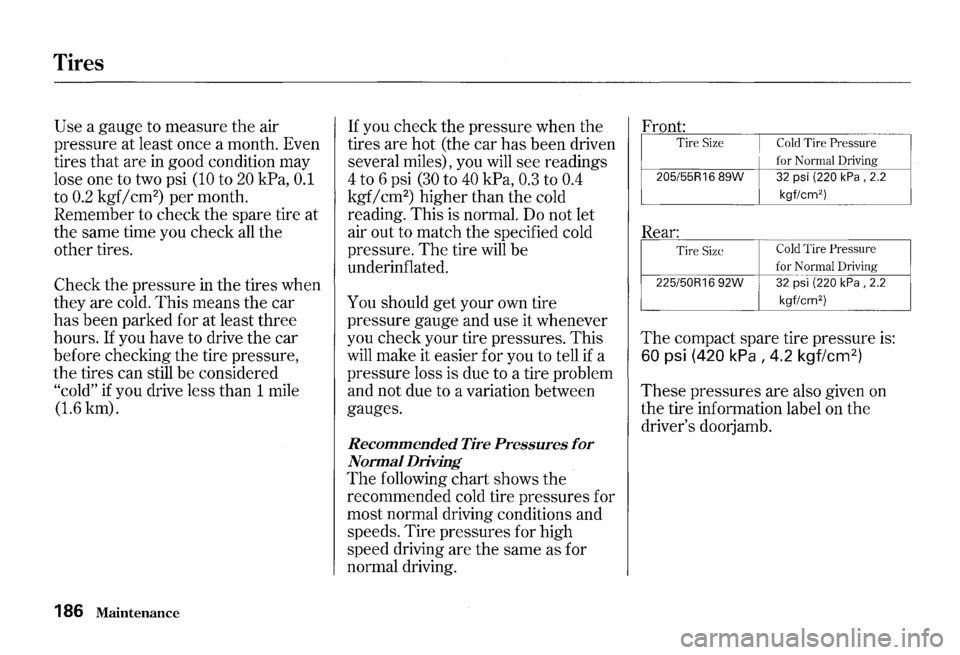
Fro=n~t:~~---,--~~---------, Tire Size Cold Tire Pressure
205/55R16 89W
Rear:
Tire Size
225/50R16 92W
for Normal Driving
32 psi (220 kPa , 2.2
kgf/cm2
)
I Cold Tire Pressure
for Normal Driving
! 32 psi (220 kPa , 2.2
L_ ___________ .L.I __ k.=..gf_lc_m_2_) _ --·-·-·-·-·-
The compact spare tire pressure is:
60 psi (420 kPa , 4.2 kgf/cm2
)
These pressures are also given on
the tire information label on the
driver's doorjamb.
Page 190 of 273
Tubeless tires have some ability to
self-seal
if they are punctured.
However, because leakage is often
very slow, you should look closely
for punctures if a tire starts losing
pressure.
Inspection
Every time you check inflation, you
should also examine the tires for
damage, foreign objects, and wear.
You should look for:
• Bumps or bulges in the tread or
side of the tire. Replace the tire
if
you find either of these conditions.
• Cuts, splits, or cracks in the side
of the tire. Replace the tire
if you
can see fabric or cord.
• Excessive tread wear.
Tires
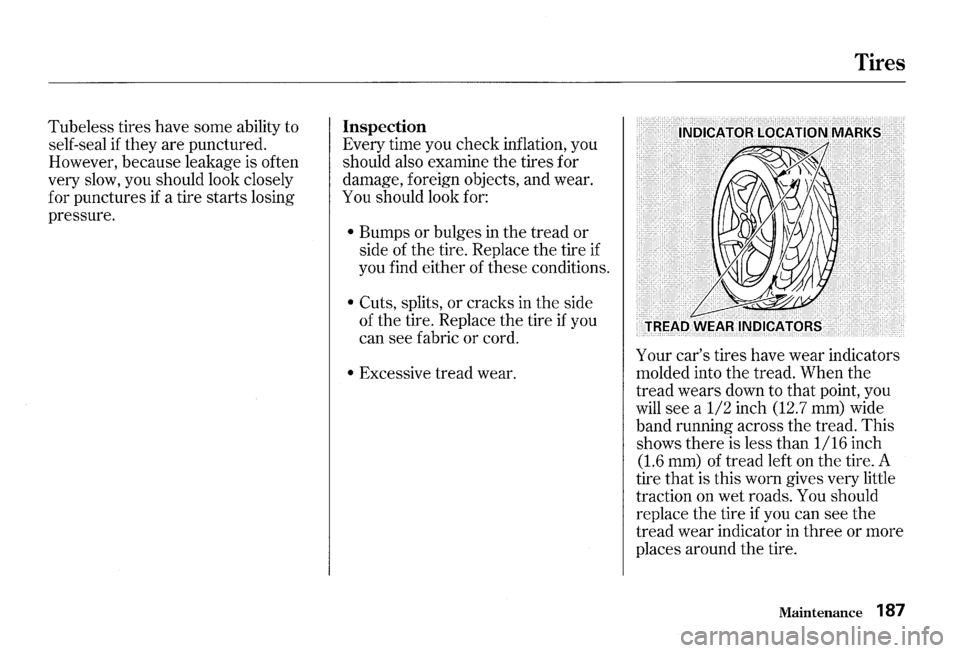
Your car's tires have wear indicators
molded into the tread. When the
tread wears down to that point, you
will see a
1/2 inch (12.7 mm) wide
band running across the tread.
This
shows there is less than 1/16 inch
(1.6 mm) of tread left on the tire. A
tire
that is this worn gives very little
traction on wet roads. You should
replace
the tire if you can see the
tread wear indicator in three or more
places around the tire.
Maintenance 187
Page 191 of 273
Tires
Maintenance
In addition to proper inflation,
correct wheel alignment helps to
decrease tire wear.
If you find a tire
is worn unevenly, have your dealer
check the wheel alignment.
The tires were properly balanced by
the factory.
They may need to be
rebalanced at some time before they
are worn out. Have your dealer
check the tires
if you feel a consis
tent vibration while driving. A tire
should always be rebalanced if it is
removed from
the wheel for repair.
188 Maintenance
Make sure the installer balances the
wheels when you have new tires
installed. This increases riding
comfort and tire life.
Your car's
original tires were dynamic or
"spin"
balanced at the factory. For best
results, have the installer perform a
dynamic balance.
NOTICE
Improper wheel weights can damage
your vehicle's aluminum wheels.
Use
only Genuine Honda wheel weights for
balancing.
Tire Rotation
You should not rotate your Honda's
tires.
The front and rear tires are
different sizes, so they cannot be
rotated front-to-rear.
The original
equipment tires on your Honda have
a unidirectional tread pattern, so
they cannot be rotated side-to-side.
Tire Wear
The tires that came on your car were
designed and constructed to provide
superior grip during acceleration,
braking, and cornering. As a trade
off, they
will wear more rapidly than
tires used on ordinary passenger
cars. Because of the car's weight
distribution, and the fact that they
are the driving wheels, you may
expect the
rear tires to wear more
rapidly than the front tires.
Page 192 of 273
You should carefully inspect your
car's tires for wear, damage, and
proper inflation every
7,500 miles
(12,000 km) (see page 186 ) .
Replacing Tires and Wheels
The tires that came with your car
were selected to match the perform
ance capabilities of the car while
providing the best combination of
handling, ride comfort, and long life.
You should replace them with radial
tires of the same size, load range,
speed rating, and maximum cold tire
pressure rating (as shown on the
tire's sidewall). Mixing radial and
bias-ply tires on your car can reduce
its braking ability, traction, and
steering accuracy.
Tires
Installing improper tires on your
car can affect
handling and
stability. This can cause a crash
in which you can be seriously
hurt or killed.
Always
use the size and type of
tires recommended
in this
owner's
manual.
It is best to replace all four tires at
the same time. If that is not possible
or necessary, then replace the two
front tires or the two
rear tires as a
pair. Replacing just one tire can
seriously affect your car's handling.
CONTINUED
Maintenance 189
Page 193 of 273
Tires
The ABS works by comparing the
speed of the wheels. When replacing
tires, use the same size originally
supplied with the car. Tire size and
construction can affect wheel speed
and may cause the system to work
in
consistently.
If you ever need to replace a wheel,
make sure the wheel's specifications
match those of the original wheel
that came on your car. Replacement
wheels are available at your Honda
dealer.
190 Maintenance
Wheels and Tires
Wheels:
Front:
16x61/2JJ
Rear:
16x71/2JJ
Tires: Front:
205/55R16 89W
Rear:
225/50R16 92W
See page 246 for information about
DOT Tire Quality Grading.
Winter Driving
Tires that are marked "M + S" on the
sidewall have an all-weather tread
design.
They should be suitable for
most winter driving conditions. Tires
without these markings are designed
for optimum traction in dry
conditions.
They may not provide
adequate performance in winter
driving.
For the best performance in snowy
or icy conditions, you should install
snow tires or tire chains.
They may
be required by local laws under
certain conditions.
Page 194 of 273
Snow Tires
If you mount snow tires on your
Honda, make sure they are radial
tires of the same size and load range
as
the original tires. Mount snow
tires on
all four wheels to balance
your vehicle's handling in all weather
conditions. Keep
in mind the traction
provided by snow tires on dry roads
may not be as high as your vehicle's
original equipment tires. You should
drive cautiously even when the roads
are clear. Check with the tire dealer
for maximum speed recommenda
tions.
Tire Chains
Because your Honda has limited tire
clearance, mount only
SAE Class "S"
cable-type traction devices on the
rear tires.
Use traction devices only
when required by driving conditions
or local laws. Make sure they are the
correct size for your tires.
Metal link-type
"chains" should not
be used.
No matter how tight they
seem to be installed, they can come
into contact with the body and
suspension, causing serious damage.
When installing
the cables, follow
the manufacturer's instructions and
mount
them as tightly as you can.
Drive slowly with them installed.
If
you hear them coming in contact
with the body or chassis, stop and
investigate. Make sure the cables are
installed tightly, and
that they are
not contacting the brake lines
or
suspension. Remove them as soon as
you start driving on cleared roads.
Tires
NOTICE
Cables that are the wrong size or
improperly installed can damage your ·
car's brake lines, suspension, body, and
wheels. Stop driving (l they are hitting
any part
of the car.
Maintenance 191
Page 205 of 273
Storing Your Car
If you need to park your car for an
extended period (more than one
month), there are several things you
should
do to prepare it for storage.
Proper preparation helps prevent
deterioration and makes it easier to
get your car back on the road.
If
possible, store your car indoors.
• Fill the fuel tank.
• Change the engine oil and filter
(see page 159).
• Wash and dry the exterior
completely.
• Clean the interior. Make sure the
carpeting, floor mats, etc. are
completely dry.
• Raise the convertible top cover.
• Leave the parking brake off. Put
the transmission in Reverse.
202 Maintenance
• Block the rear wheels.
• If the car is to be stored for a
longer period, it should be
supported on jackstands so the
tires are off the ground.
• Leave one window open slightly (if
the car is being stored indoors).
• Disconnect the battery.
• Support the front wiper blade
arms with a folded towel or rag so
they
do not touch the windshield.
• To minimize sticking, apply a
silicone spray lubricant to
all door
and trunk seals. Also, apply a
vehicle body wax to the painted
surfaces that mate with the door
and trunk seals.
• Cover the car with a "breathable"
cover, one made from a porous
material such as cotton.
Nonporous materials, such as
plastic sheeting, trap moisture,
which can damage
the paint.
• If possible, run the engine for a
while periodically (preferably once
a month).
If you store your car for 12 months
or longer, have your Honda dealer
perform the inspections called for
in
the 24 months/30,000 miles (48,000
km) maintenance schedule as soon
as you take it out of storage (see
page
148 ). The replacements called
for
in the maintenance schedule are
not needed unless the car has
actually reached that time or mileage.
Page 215 of 273
Compact Spare Tire
Your car has a compact spare tire
that takes up less space.
Use this
spare tire as a temporary replace
ment only. Get your regular tire
repaired or replaced and put back on
your car as soon as you can.
Check the inflation pressure of the
compact spare tire every time you
check the other tires.
It should be
inflated
to:
60 psi (420 kPa , 4.2 kgf/cm2
)
212 Taking Care of the Unexpected
Follow these precautions whenever
you are using the compact spare tire:
• Do not exceed 50 mph (80 km/h)
under any circumstances.
• This tire gives a harsher ride and
less traction on some road sur
faces than the regular tire.
Use
greater caution while driving on
this tire.
• Do not mount snow chains on the
compact spare.
• The wheel of the compact spare
tire is designed especially to fit
your car.
Do not use your spare
tire on another vehicle unless it is
the same make and model.
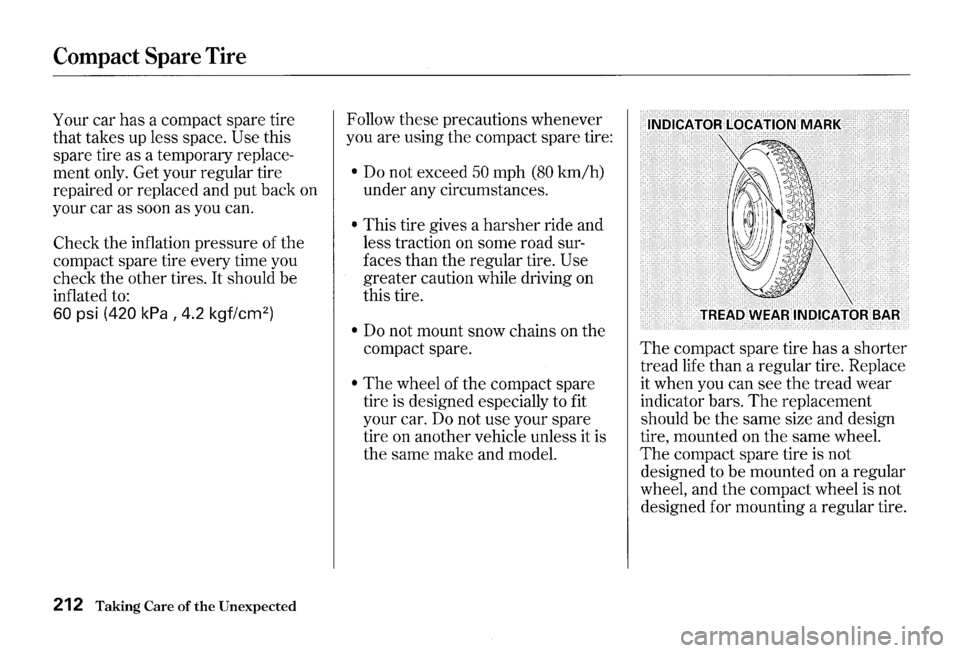
The compact spare tire has a shorter
tread life than a regular tire. Replace
it when you can see
the tread wear
indicator bars.
The replacement
should be the same size and design
tire, mounted on
the same wheel.
The compact spare tire is not
designed to be mounted on a regular
wheel, and
the compact wheel is not
designed for mounting a regular tire.
Page 241 of 273
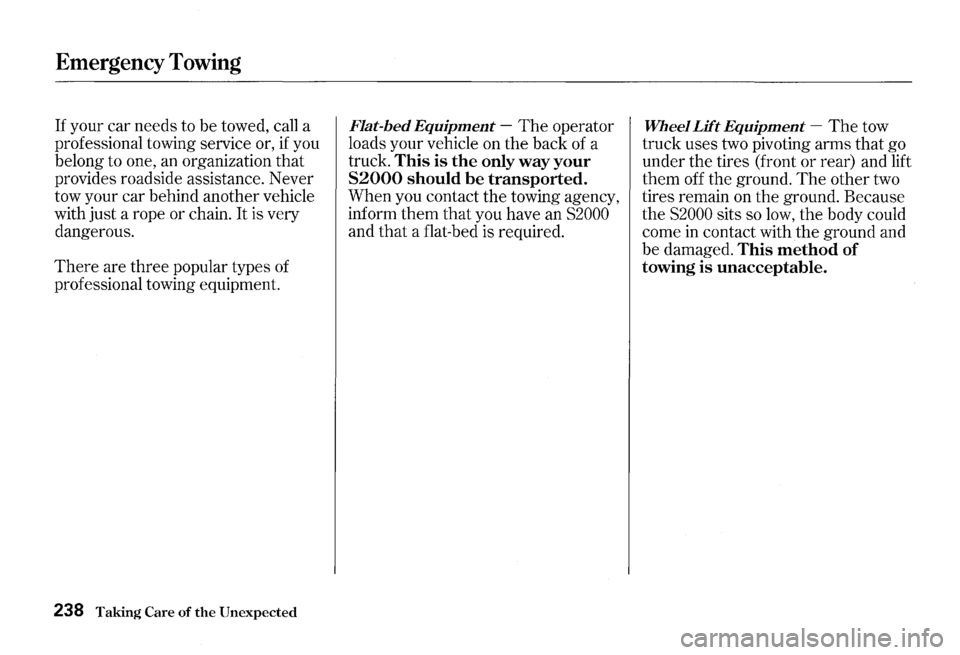
Emergency Towing
If your car needs to be towed, call a
professional towing service or,
if you
belong to one, an organization that
provides roadside assistance. Never
tow your car behind another vehicle
with just a rope or chain.
It is very
dangerous.
There are three popular types of
professional towing equipment.
238 Taking Care of the Unexpected
Flat-bed Equipment -The operator
loads your vehicle on the back of a
truck.
This is the only way your
S2000 should be transported.
When you contact the towing agency,
inform
them that you have an S2000
and that a flat-bed is required.
Wheel Lift Equipment -The tow
truck uses two pivoting arms that go
under the tires (front or rear) and lift
them off the ground. The other two
tires remain on the ground. Because
the
S2000 sits so low, the body could
come
in contact with the ground and
be damaged.
This method of
towing is unacceptable.
Page 248 of 273
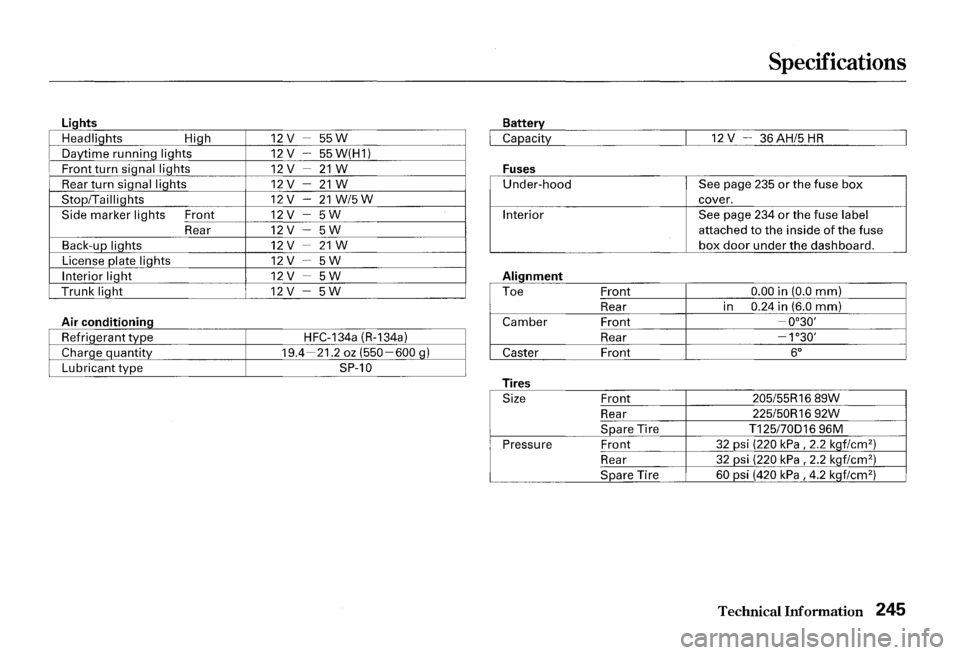
Specifications
Lights Battery Headlights Hi~h 12 v -55W Capacity 12 V -36 AH/5 H R
Daytime
runnin~ li~hts 12 v - 55W(H1)
Front
turn signal lights 12 v -21 w Fuses
Rear turn si~nalli~hts 12 v -21 w Under-hood See page 235 or the fuse box Stop/Taillights 12 v -21 W/5 W cover.
Side marker lights Front 12 v -5W Interior See page 234 or the fuse label
Rear
12 v -5W attached to the inside of the fuse
Back-up lights
12 v -21 w box door under the dashboard.
License plate
li~hts 12 v -5W Interior light 12 v -5W AI' 1gnment Trunk light 12 v -5W Toe Front 0.00 in (0.0 mm)
Rear in 0.24 in (6.0 mm)
Air
conditioning Camber Front -0°30'
Refrigerant type HFC-134a (R-134a)
Rear -F30'
Charge quantity 19.4-21.2 oz (550-600 ~) Caster Front 60
Lubricant type SP-10
Tires
Size Front
205/55R16 89W
Rear 225/50R16 92W
Spare Tire T125/70D16
96M
Pressure Front 32
psi (220 kPa , 2.2 kgf/cm2
)
Rear 32 psi (220 kPa , 2.2 kgf/cm2
)
Spare Tire 60 psi (420 kPa , 4.2 k~f/cm2)
Technical Information 245