transmission HONDA S2000 2000 1.G User Guide
[x] Cancel search | Manufacturer: HONDA, Model Year: 2000, Model line: S2000, Model: HONDA S2000 2000 1.GPages: 273, PDF Size: 21.58 MB
Page 161 of 273
Engine Oil
The oil container may also display
the
API Certification seal. Make sure
it says
"For Gasoline Engines."
158 Maintenance
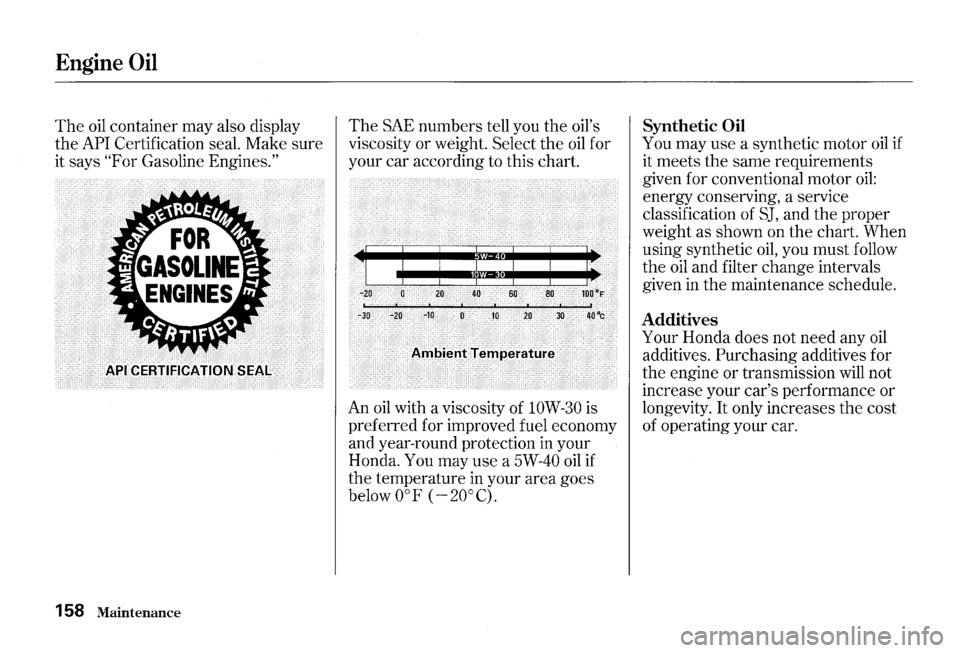
The SAE numbers tell you the oil's
viscosity or weight. Select the
oil for
your car according to this chart.
60
. 10 20
" ~ c" ' -c '
AnlbielltTertlperature
An oil with a viscosity of lOW-30 is
preferred for improved fuel economy
and year-round protection in your
Honda.
You may use a 5W-40 oil if
the temperature in your area goes
below oaF (
-20°C).
Synthetic Oil
You may use a synthetic motor oil if
it meets the same requirements
given for conventional motor
oil:
energy conserving, a service
classification of
SJ, and the proper
weight as shown on the chart. When
using synthetic
oil, you must follow
the
oil and filter change intervals
given
in the maintenance schedule.
Additives
Your Honda does not need any oil
additives. Purchasing additives for
the engine or transmission will not
increase your car's performance or
longevity.
It only increases the cost
of operating your car.
Page 171 of 273
6-speed Manual Transmission Fluid
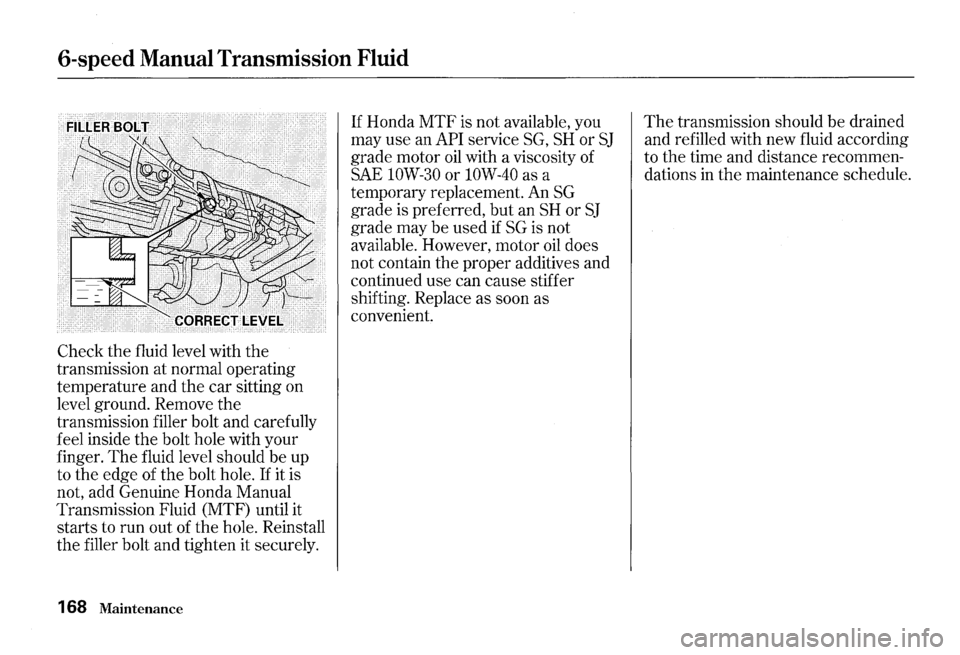
Check the fluid level with the
transmission at normal operating
temperature and the car sitting on
level ground. Remove the
transmission filler bolt and carefully
feel inside the bolt hole with your
finger.
The fluid level should be up
to the edge of the bolt hole.
If it is
not, add Genuine Honda Manual
Transmission Fluid (MTF) until it
starts to run out of the hole. Reinstall
the filler bolt and tighten it securely.
168 Maintenance
If Honda MTF is not available, you
may use an
API service SG, SH or SJ
grade motor oil with a viscosity of
SAE lOW-30 or lOW-40 as a
temporary replacement. An
SG
grade is preferred, but an SH or SJ
grade may be used if SG is not
available. However, motor
oil does
not contain the proper additives and
continued use can cause stiffer
shifting. Replace as soon as
convenient.
The transmission should be drained
and refilled with new fluid according
to the time and distance recommen
dations
in the maintenance schedule.
Page 205 of 273
Storing Your Car
If you need to park your car for an
extended period (more than one
month), there are several things you
should
do to prepare it for storage.
Proper preparation helps prevent
deterioration and makes it easier to
get your car back on the road.
If
possible, store your car indoors.
• Fill the fuel tank.
• Change the engine oil and filter
(see page 159).
• Wash and dry the exterior
completely.
• Clean the interior. Make sure the
carpeting, floor mats, etc. are
completely dry.
• Raise the convertible top cover.
• Leave the parking brake off. Put
the transmission in Reverse.
202 Maintenance
• Block the rear wheels.
• If the car is to be stored for a
longer period, it should be
supported on jackstands so the
tires are off the ground.
• Leave one window open slightly (if
the car is being stored indoors).
• Disconnect the battery.
• Support the front wiper blade
arms with a folded towel or rag so
they
do not touch the windshield.
• To minimize sticking, apply a
silicone spray lubricant to
all door
and trunk seals. Also, apply a
vehicle body wax to the painted
surfaces that mate with the door
and trunk seals.
• Cover the car with a "breathable"
cover, one made from a porous
material such as cotton.
Nonporous materials, such as
plastic sheeting, trap moisture,
which can damage
the paint.
• If possible, run the engine for a
while periodically (preferably once
a month).
If you store your car for 12 months
or longer, have your Honda dealer
perform the inspections called for
in
the 24 months/30,000 miles (48,000
km) maintenance schedule as soon
as you take it out of storage (see
page
148 ). The replacements called
for
in the maintenance schedule are
not needed unless the car has
actually reached that time or mileage.
Page 216 of 273
If you have a flat tire while driving,
stop in a safe place to change it.
Stopping in traffic
or on the shoulder
of a busy road is dangerous. Drive
slowly along
the shoulder until you
get to an exit or an area to stop that
is far away from the traffic lanes.
The car can easily roll off the
jack,
seriously injuring anyone
underneath.
Follow the directions for
changing a tire
exactly, and
never get under the car when it
is supported only by the jack.
The compact spare tire is smaller
than a standard tire, which
will affect
the vehicle's handling. Drive
cautiously when this spare is
mounted on your vehicle.
The size difference may also cause
damage to
the rear differential, so do
not mount
the compact spare on the
rear. If either rear tire goes flat,
remove
the front tire on that same
side, mount
the compact spare tire
on
the front, then mount the front
tire on
the rear.
1. Park the car on firm, level, non
slippery ground away from traffic.
Put the transmission in Reverse.
Apply
the parking brake.
2. Turn on the hazard warning lights
and turn
the ignition switch to
LOCK (O). Have your passenger
get out of the car while you
change
the tire.
Changing a Flat Tire
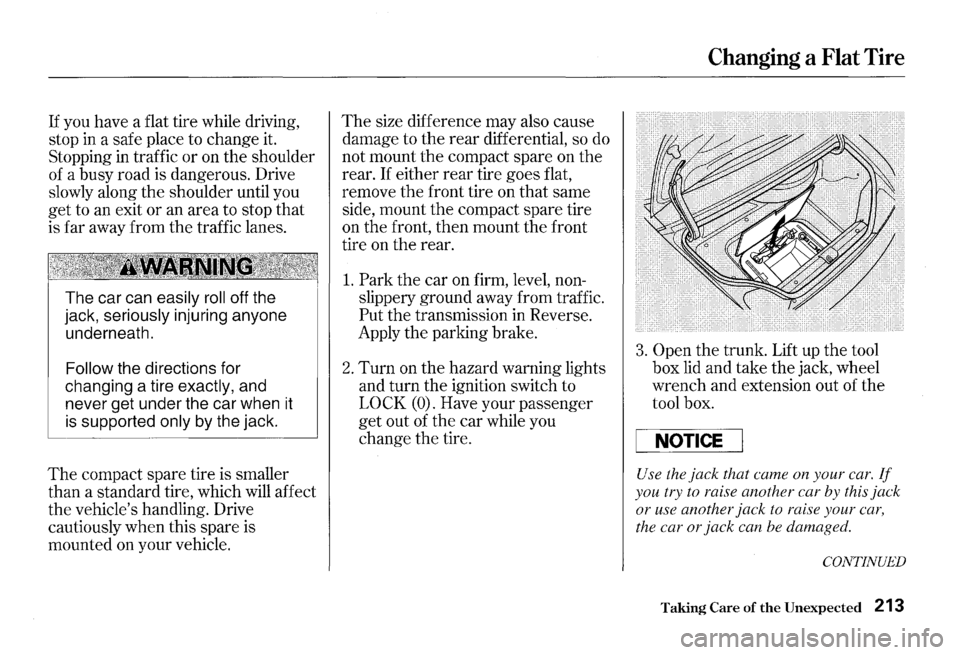
3. Open the trunk. Lift up the tool
box lid and take
the jack, wheel
wrench and extension out of
the
tool box.
NOTICE
Use the jack that came on your car. If
you try to raise another car by this jack
or use another jack to raise your car,
the car
or jack can be damaged.
CONTINUED
Taking Care of the Unexpected 213
Page 223 of 273
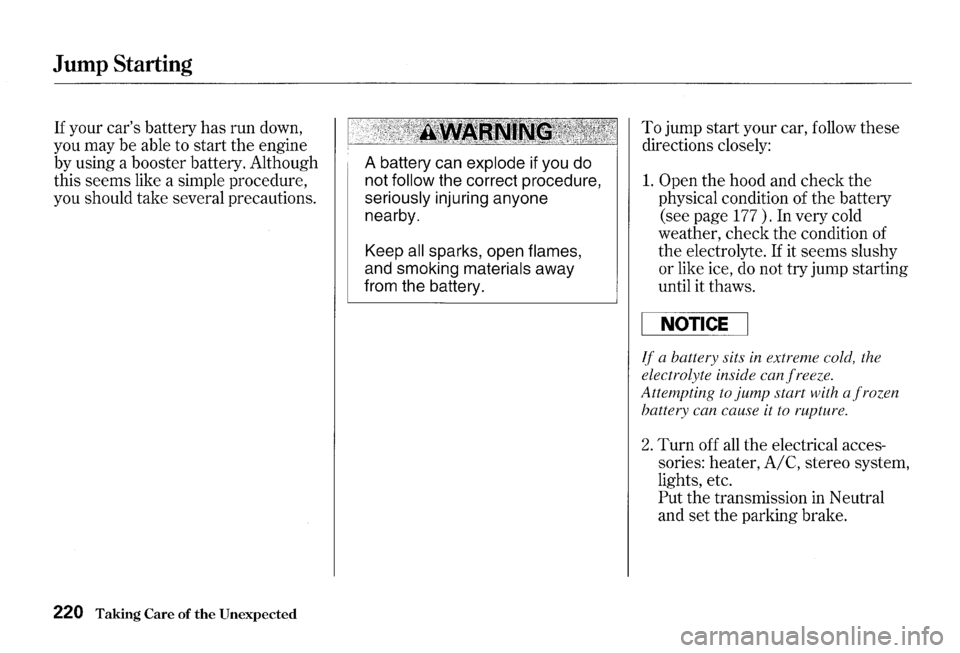
Jump Starting
If your car's battery has run down,
you may
be able to start the engine
by using a booster battery. Although
this
seems like a simple procedure,
you should take several precautions.
220 Taking Care of the Unexpected
A battery can explode if you do
not
follow the correct procedure,
seriously injuring anyone
nearby.
Keep
all sparks, open flames,
and smoking materials away
from the battery.
To jump start your car, follow these
directions closely:
1. Open the hood and check the
physical condition of the battery
(see page 177 ) . In very cold
weather,
check the condition of
the electrolyte. If it seems slushy
or like ice, do not
try jump starting
until it thaws.
NOTICE
if a battery sits in extreme cold, the
electrolyte inside can freeze.
Attempting
to jump start with a frozen
battery can cause it
to rupture.
2. Turn off all the electrical acces
sories: heater,
A/C, stereo system,
lights, etc.
Put the transmission in Neutral
and
set the parking brake.
Page 226 of 273
The reading on your car's
temperature gauge should stay in
the midrange under most conditions.
It may go higher if you are driving up
a long steep hill on a very
hot day. If
it climbs to the red mark, you should
determine
the reason.
NOTICE
Driving with the temperature gauge
reading
at the red mark can cause
serious damage to your engine.
Your car can overheat for several
reasons,
such as lack of coolant or a
mechanical problem.
The only
indication may be
the temperature
gauge climbing to or above
the red
mark. Or you may see steam or
spray coming from
under the car or
engine cover. In either case, you
should take immediate action.
Steam and spray from an
overheated engine can
seriously scald you.
Do not open the hood if steam
is coming out.
1. Safely pull to the side of the road.
Put the transmission in Neutral
and
set the parking brake. Turn
off the heating and cooling system
and all
other accessories. Turn on
the hazard warning indicators.
2. If you see steam and/ or spray
coming from
under the hood, turn
off
the engine.
If Your Engine Overheats
3. If you do not see steam or spray,
leave
the engine running and
watch
the temperature gauge. If
the high heat is due to overloading
(climbing a long, steep hill on a
hot day with
the A/C running, for
example),
the engine should start
to cool down almost immediately.
If it does, wait until the tempera
ture gauge comes down to
the mid
point
then continue driving.
4. If the temperature gauge stays at
the red mark, turn off the engine.
5. Wait until you see no more signs
of
steam or spray, then open the
hood.
CONTINUED
Taking Care of the Unexpected 223
Page 246 of 273
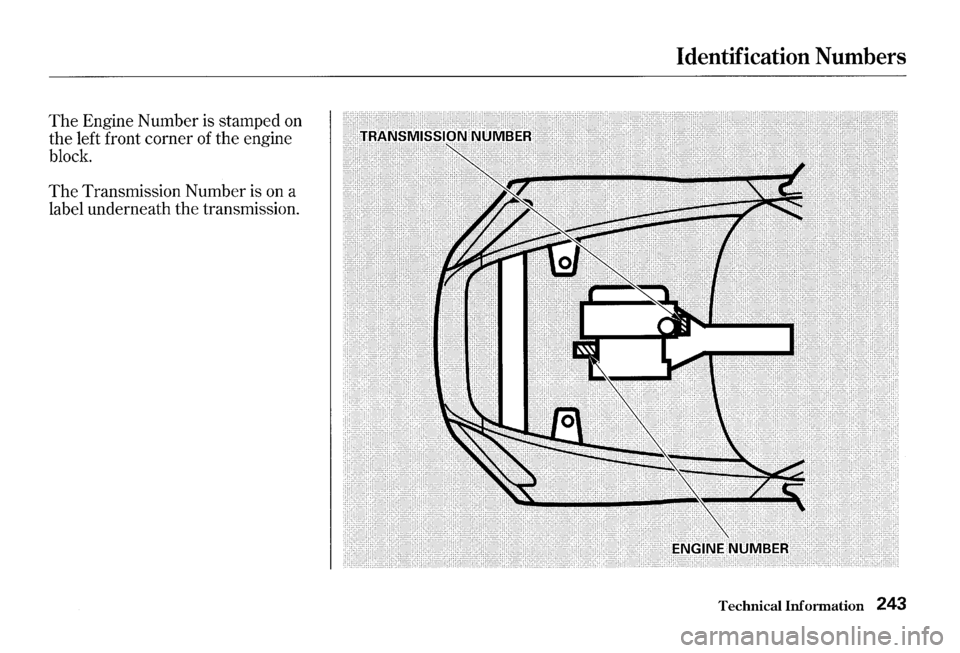
The Engine Number is stamped on
the left front corner of the engine
block.
The Transmission Number is on a
label underneath the transmission.
Identification Numbers
Technical Information 243
Page 247 of 273
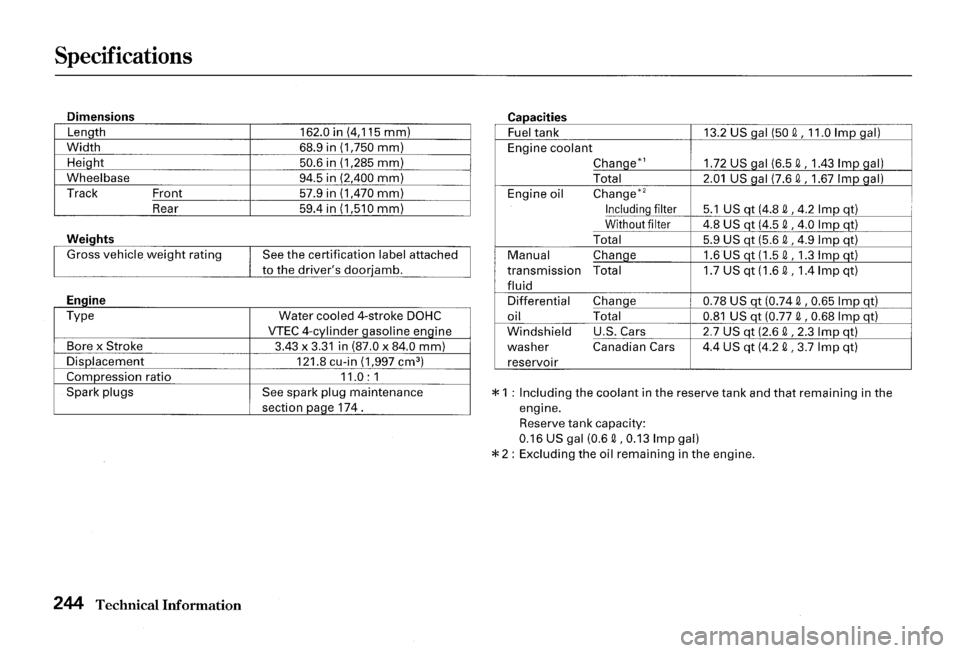
Specifications
Dimensions
Length
Width Height
Wheelbase Track Front
Rear
Engine
Type
Bore x Stroke
Displacement
Compression ratio
Spark plugs
244 Technical Information
162.0in(4,115mm) 68.9 in (1,750 mm)
50.6 in (1,285 mm) 94.5 in (2,400 mm)
57.9 in (1,470 mm)
59.4 in (1,510 mm)
See the certification label attached to the driver's door"amb.
Water cooled 4-stroke DOHC
VTEC 4-cylinder l=)asoline engine
3.43 x 3.31 in (87.0 x 84.0 mm)
121.8 cu-in (1,997 cm3
)
11.0 : 1 See spark plug maintenance
section page
174.
c apac1t1es
Fuel tank 13.2 US
aal (50 ll, 11.0 Imp qal)
Engine coolant
Change*'
1.72 US aal (6.51\, 1.43 Imp qal)
Total 2.01 US l=)al (7.61\, 1.67 Imp gal)
Engine oil Change*'
Including filter 5.1 US qt (4.81\, 4.2 Imp qt)
Without
filter 4.8 USgt (4.51\, 4.0 Imp qt)
Total 5.9 US qt (5.61\, 4.9 Imp qt)
Manual Chanl=)e 1.6 US_g_t (1.51\, 1.31mp qt)
transmission Total 1.7 US qt (1.61\, 1.41mp qt) fluid
Differential Chan_g_e 0.78 US qt (0.741\, 0.65 Imp qt)
oil Total 0.81 US qt (0.77 ll, 0.68 Imp at)
Windshield U.S. Cars 2.7 US qt (2.61\, 2.3 ImP at)
washer Canadian Cars 4.4 US qt (4.21\, 3.7 Imp qt)
reservoir
* 1 : Including the coolant in the reserve tank and that remaining in the
engine. Reserve tank capacity:
0.16 US gal (0.61\, 0.131mp gal)
* 2: Excluding the oil remaining in the engine.
Page 264 of 273
A
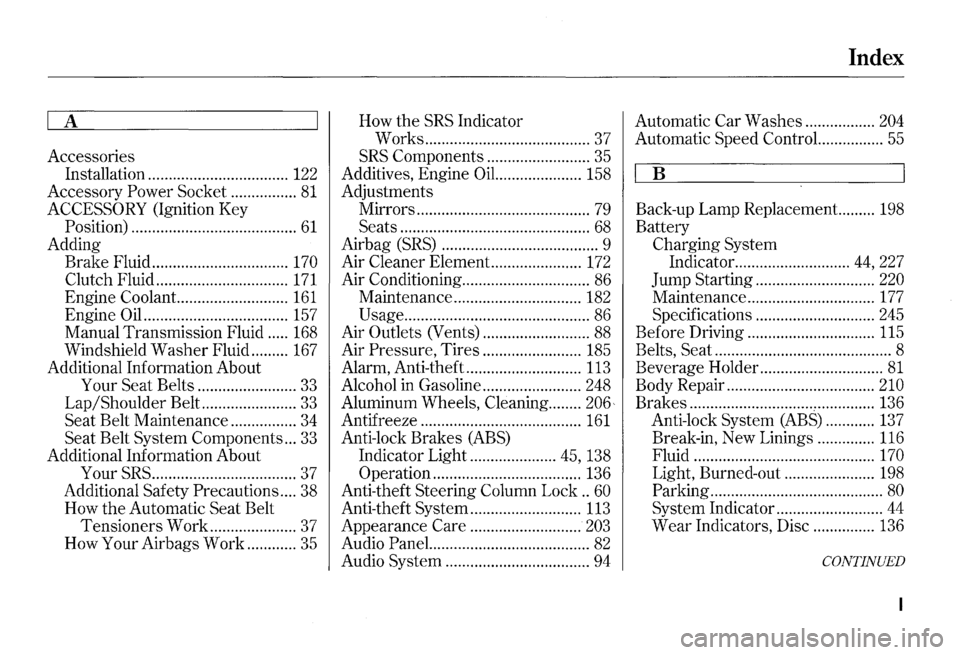
Accessories Installation .................................. 122
Accessory
Power Socket ................ 81
ACCESSORY (Ignition Key
Position) ........................................
61
Adding
Brake Fluid ................................. 170
Clutch Fluid ................................ 171
Engine Coolant.. ......................... 161
Engine
Oil ................................... 157
Manual Transmission Fluid ..... 168
Windshield
Washer Fluid ......... 167
Additional Information About
Your
Seat Belts ........................ 33
Lap/Shoulder Belt.. ..................... 33
Seat Belt Maintenance ................ 34
Seat Belt System Components
... 33
Additional Information About
Your SRS ...................................
37
Additional Safety Precautions .... 38
How
the Automatic Seat Belt
Tensioners Work ..................... 37
How Your Airbags Work ............ 35
How the SRS Indicator
Works ........................................ 37
SRS Components ......................... 35
Additives, Engine Oil... .................. 158
Adjustments
Mirrors ..........................................
79
Seats .............................................. 68
Airbag (SRS) ...................................... 9
Air Cleaner Element.. ....................
l72
Air Conditioning ............................... 86
Maintenance ............................... 182
Usage ............................................. 86
Air Outlets (Vents) .......................... 88
Air Pressure,
Tires ........................ 185
Alarm, Anti-theft.. .......................... 113
Alcohol in Gasoline ........................ 248
Aluminum Wheels, Cleaning ........
206-
Antifreeze ....................................... 161
Anti-lock
Brakes (ABS)
Indicator Light ..................... 45, 138
Operation .................................... 136
Anti-theft Steering Column Lock
.. 60
Anti-theft System ........................... 113
Appearance Care ...........................
203
Audio Panel. ...................................... 82
Audio System ................................... 94
Index
Automatic Car Washes ................. 204
Automatic Speed Control.. .............. 55
IB
Back-up Lamp Replacement.. ....... 198
Battery Charging System
Indicator.. .......................... 44, 227
Jump Starting ............................. 220
Maintenance ............................... 177
Specifications ............................. 245
Before Driving ............................... 115
Belts, Seat ........................................... 8
Beverage Holder ..............................
81
Body Repair .................................... 210
Brakes ............................................. 136
Anti-lock System (ABS) ............ 137
Break-in, New Linings .............. 116
Fluid ............................................
170
Light, Burned-out ...................... 198
Parking .......................................... 80
System Indicator .......................... 44
Wear Indicators, Disc ............... 136
CONTINUED
Page 265 of 273
Index
Brakes,ABS Certification Label ......................... 242
Vinyl ............................................ 207
Operation
.................................... 137 Chains ............................................. 191 Windows ..................................... 208
System
Indicator .................. 44, 139 Change Oil Climate Control System .................. 86
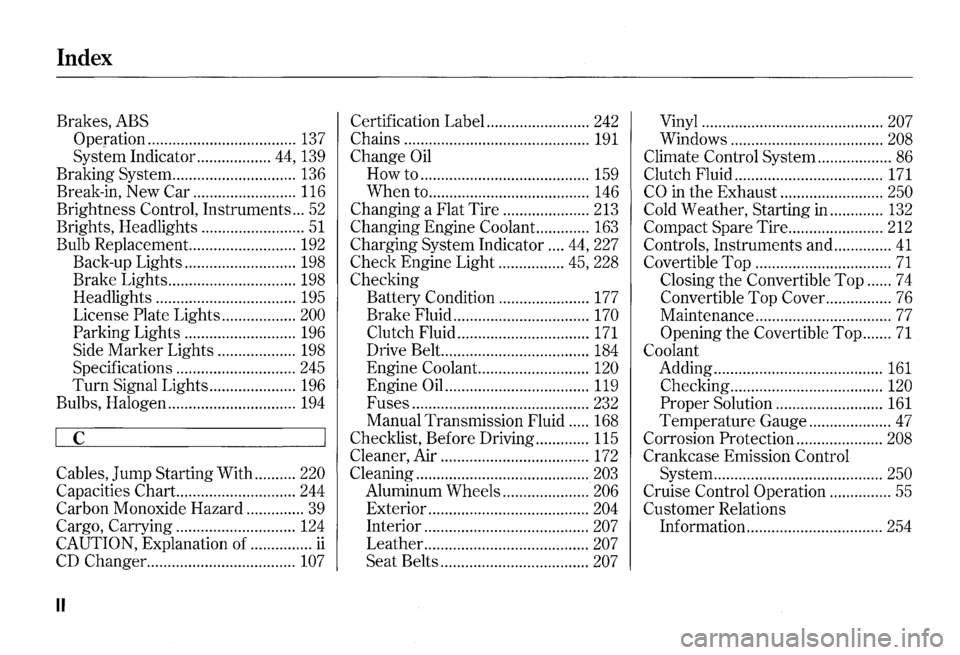
Braking System .............................. 136 Howto ......................................... 159 Clutch Fluid .................................... 171
Break-in, New Car ......................... 116 When to ....................................... 146 CO in the Exhaust ......................... 250
Brightness Control, Instruments ... 52 Changing a Flat Tire ..................... 213 Cold Weather, Starting in ............. 132
Brights, Headlights ......................... 51 Changing Engine Coolant.. ........... 163 Compact Spare Tire ....................... 212
Bulb Replacement... ....................... 192 Charging System Indicator .... 44, 227 Controls, Instruments and .............. 41
Back-up Lights ........................... 198 Check Engine Light ................ 45, 228
Covertible Top ................................. 71
Brake Lights ............................... 198 Checking
Closing the Convertible Top ...... 7 4
Headlights ..................................
195 Battery Condition ...................... 177 Convertible Top Cover. ............... 76
License Plate Lights .................. 200 Brake Fluid ................................. 170 Maintenance ................................. 77
Parking Lights ........................... 196 Clutch Fluid ................................ 171 Opening the Covertible Top ....... 71
Side Marker Lights ................... 198
Drive Belt.. .................................. 184 Coolant
Specifications .............................
245 Engine Coolant.. ......................... 120 Adding ......................................... 161
Turn Signal Lights ..................... 196 Engine Oil.. ................................. 119 Checking ..................................... 120
Bulbs, Halogen ............................... 194 Fuses ........................................... 232 Proper Solution .......................... 161
Manual Transmission Fluid ..... 168 Temperature Gauge .................... 47
c Checklist, Before Driving ............. 115 Corrosion Protection ..................... 208
Cleaner, Air .................................... 172 Crankcase Emission Control
Cables, Jump Starting With ..........
220 Cleaning .......................................... 203 System ......................................... 250
Capacities Chart. ............................ 244
Aluminum Wheels ..................... 206 Cruise Control Operation ............... 55
Carbon Monoxide Hazard .............. 39 Exterior ....................................... 204 Customer Relations
Cargo, Carrying .............................
124 Interior ........................................ 207 Information ................................. 254
CAUTION, Explanation of ............... ii Leather ........................................ 207
CD Changer. ................................... 107 Seat Belts .................................... 207
II