fuel HONDA S2000 2000 1.G Owner's Manual
[x] Cancel search | Manufacturer: HONDA, Model Year: 2000, Model line: S2000, Model: HONDA S2000 2000 1.GPages: 273, PDF Size: 21.58 MB
Page 161 of 273
Engine Oil
The oil container may also display
the
API Certification seal. Make sure
it says
"For Gasoline Engines."
158 Maintenance
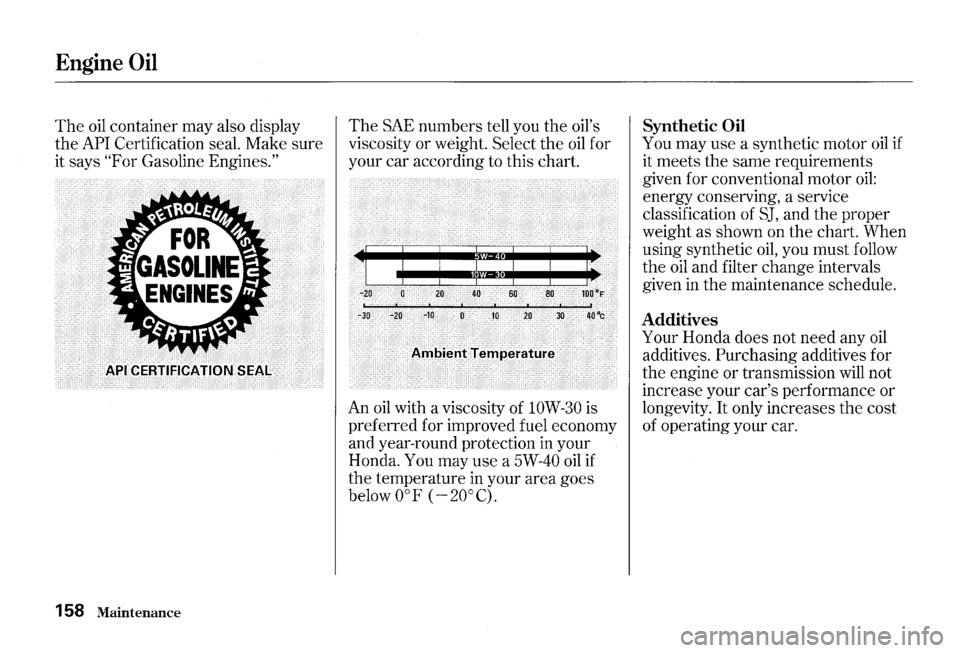
The SAE numbers tell you the oil's
viscosity or weight. Select the
oil for
your car according to this chart.
60
. 10 20
" ~ c" ' -c '
AnlbielltTertlperature
An oil with a viscosity of lOW-30 is
preferred for improved fuel economy
and year-round protection in your
Honda.
You may use a 5W-40 oil if
the temperature in your area goes
below oaF (
-20°C).
Synthetic Oil
You may use a synthetic motor oil if
it meets the same requirements
given for conventional motor
oil:
energy conserving, a service
classification of
SJ, and the proper
weight as shown on the chart. When
using synthetic
oil, you must follow
the
oil and filter change intervals
given
in the maintenance schedule.
Additives
Your Honda does not need any oil
additives. Purchasing additives for
the engine or transmission will not
increase your car's performance or
longevity.
It only increases the cost
of operating your car.
Page 170 of 273
Check the level in the windshield
washer reservoir at least monthly
during normal usage. In bad weather,
when you use the washers often,
check the level every time you stop
for fuel.
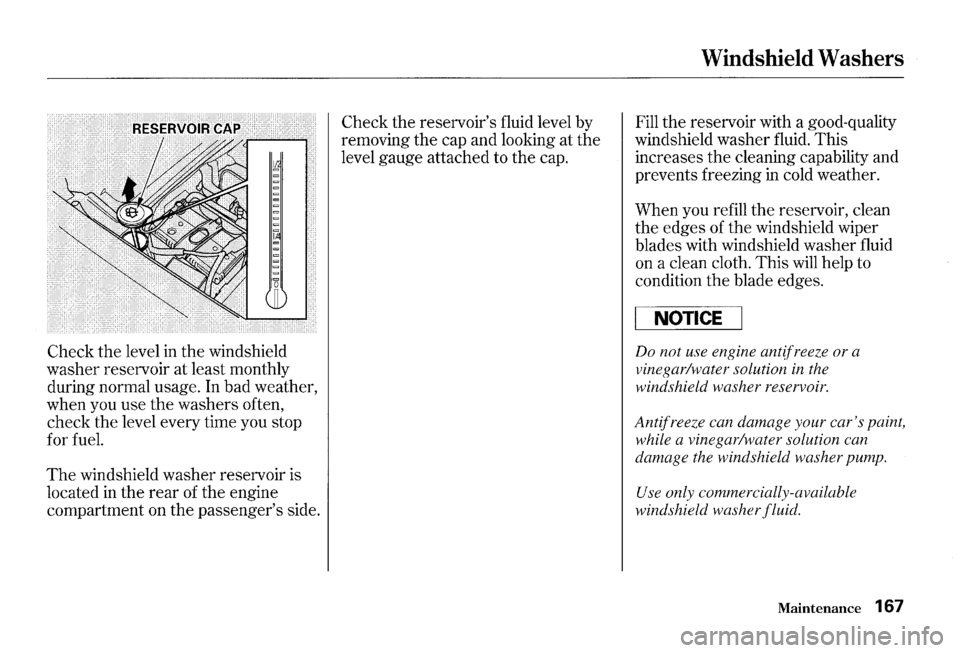
The windshield washer reservoir is
located
in the rear of the engine
compartment on the passenger's side. Check
the reservoir's fluid level by
removing the cap and looking at the
level gauge attached to the cap.
Windshield Washers
Fill the reservoir with a good-quality
windshield washer fluid. This
increases the cleaning capability and
prevents freezing
in cold weather.
When you refill the reservoir, clean
the edges of
the windshield wiper
blades with windshield washer fluid
on a clean cloth. This will help to
condition
the blade edges.
NOTICE
Do not use engine antifreeze or a
vinegar/water solution
in the
windshield washer reservoir.
Antifreeze can damage your car's paint,
while a vinegar/water solution can
damage the windshield washer pump.
Use only commercially-available
windshield washer fluid.
Maintenance 167
Page 188 of 273
To safely operate your car, your tires
must be
the proper type and size, in
good condition with adequate tread,
and correctly inflated.
The following
pages give more detailed information
on how and when to check air
pressure, how to inspect your tires
for damage and wear, and what to
do
when your tires need to be replaced.
Using tires that are excessively
worn or improperly inflated can
cause a crash
in which you can
be
seriously hurt or killed.
Follow all
instructions in this
owner's
manual regarding tire
inflation and maintenance.
Tires
Inflation
Keeping the tires properly inflated
provides the
best combination of
handling, tread life and riding
comfort. Underinflated tires wear
unevenly, adversely affect handling
and fuel economy, and are more
likely to fail from being overheated.
Overinflated tires can make your car
ride more harshly, are more prone to
damage from road hazards, and wear
unevenly.
We recommend that you visually
check your tires every day.
If you
think a tire might be
low, check it
immediately with a tire gauge.
CONTINUED
Maintenance 185
Page 205 of 273
Storing Your Car
If you need to park your car for an
extended period (more than one
month), there are several things you
should
do to prepare it for storage.
Proper preparation helps prevent
deterioration and makes it easier to
get your car back on the road.
If
possible, store your car indoors.
• Fill the fuel tank.
• Change the engine oil and filter
(see page 159).
• Wash and dry the exterior
completely.
• Clean the interior. Make sure the
carpeting, floor mats, etc. are
completely dry.
• Raise the convertible top cover.
• Leave the parking brake off. Put
the transmission in Reverse.
202 Maintenance
• Block the rear wheels.
• If the car is to be stored for a
longer period, it should be
supported on jackstands so the
tires are off the ground.
• Leave one window open slightly (if
the car is being stored indoors).
• Disconnect the battery.
• Support the front wiper blade
arms with a folded towel or rag so
they
do not touch the windshield.
• To minimize sticking, apply a
silicone spray lubricant to
all door
and trunk seals. Also, apply a
vehicle body wax to the painted
surfaces that mate with the door
and trunk seals.
• Cover the car with a "breathable"
cover, one made from a porous
material such as cotton.
Nonporous materials, such as
plastic sheeting, trap moisture,
which can damage
the paint.
• If possible, run the engine for a
while periodically (preferably once
a month).
If you store your car for 12 months
or longer, have your Honda dealer
perform the inspections called for
in
the 24 months/30,000 miles (48,000
km) maintenance schedule as soon
as you take it out of storage (see
page
148 ). The replacements called
for
in the maintenance schedule are
not needed unless the car has
actually reached that time or mileage.
Page 222 of 273
If the headlights dim noticeably or
go out when you try to start the
engine, either the battery is
dis
charged or the connections are
corroded.
Check the condition of the
battery and terminal connections
(see page 177). You can then try
jump starting the car from a booster
battery (see page 220).
The Starter Operates Normally
In this case, the starter motor's
speed sounds normal, or even faster
than normal, when you press the
ENGINE START button, but the
engine does not run.
• Are you using the proper starting
procedure? Refer to
Starting the
Engine on page 131 .
• Do you have fuel? Turn the
ignition switch to
ON (ID for a
minute and watch the fuel gauge.
The low fuel level warning light
may not be working, so you were
not reminded to
fill the tank.
If Your Engine Won't Start
• There may be an electrical
problem, such as
no power to the
fuel pump.
Check all the fuses
(see page
231 ) .
If you find nothing wrong, you will
need a qualified technician to find
the problem. See
Emergency
Towing on page 238.
Taking Care of the Unexpected 219
Page 231 of 273
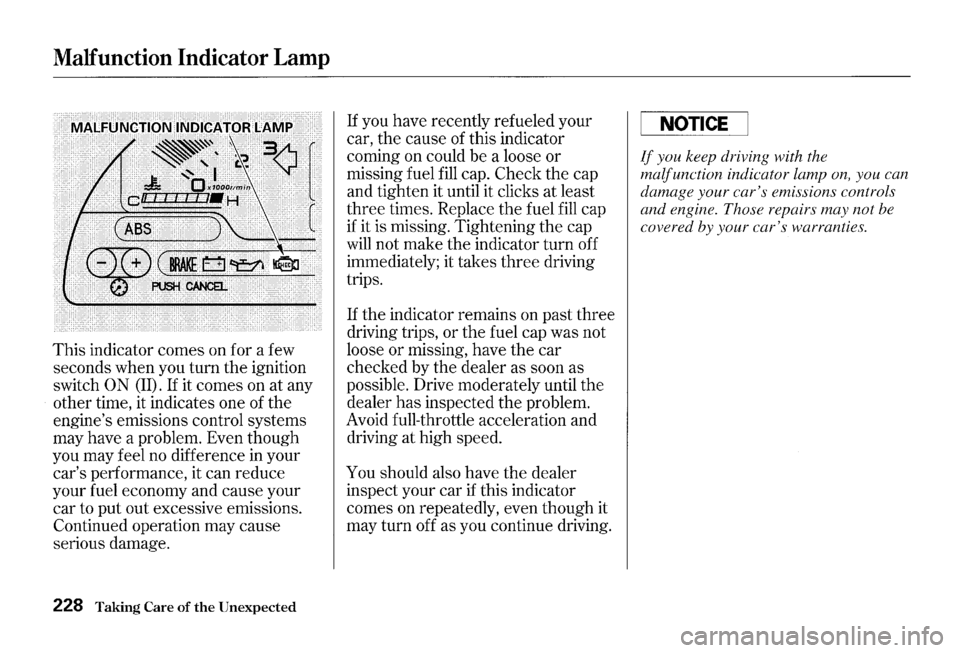
Malfunction Indicator Lamp
This indicator comes on for a few
seconds when you turn the ignition
switch
ON (II). If it comes on at any
other time, it indicates one of the
engine's emissions control systems
may have a problem. Even though
you may feel
no difference in your
car's performance, it can reduce
your fuel economy and cause your
car to put out excessive emissions.
Continued operation may cause
serious damage.
228 Taking Care of the Unexpected
If you have recently refueled your
car, the cause of this indicator
coming on could be a loose or
missing fuel
fill cap. Check the cap
and tighten it until it clicks at least
three times. Replace the fuel
fill cap
if it is missing. Tightening the cap
will not make the indicator turn off
immediately; it takes three driving
trips.
If the indicator remains on past three
driving trips, or the fuel cap was not
loose or missing, have the car
checked by the dealer as soon as
possible. Drive moderately until the
dealer has inspected the problem.
Avoid full-throttle acceleration and
driving at high speed.
You should also have the dealer
inspect your car
if this indicator
comes on repeatedly, even though it
may turn off as you continue driving.
NOTICE
If you keep driving with the
malfunction indicator lamp on, you can
damage your car's emissions controls
and engine. Those repairs may not be
covered by your car's warranties.
Page 237 of 273
Fuses
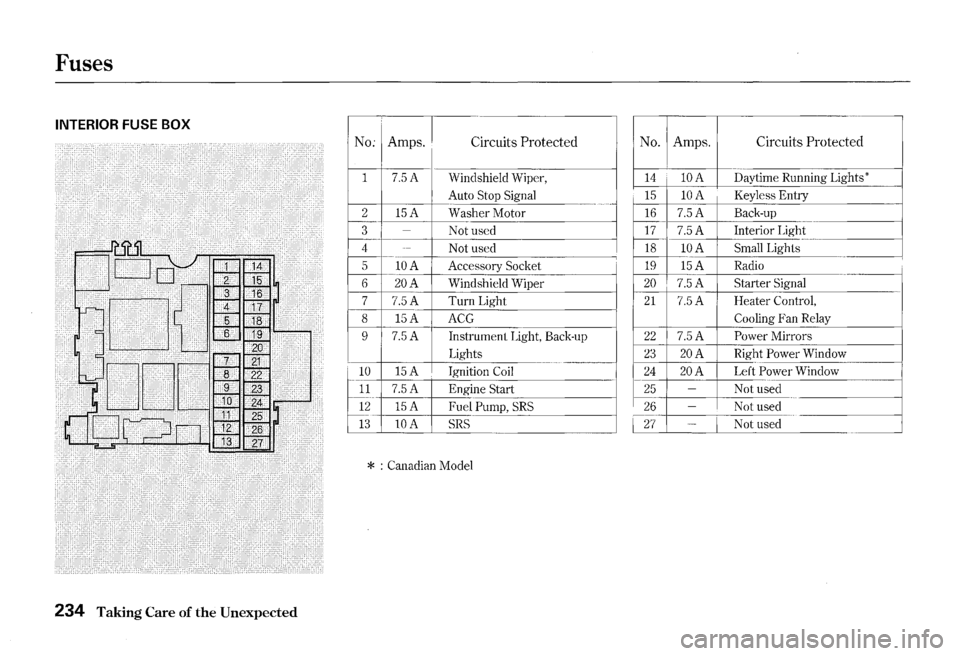
INTERIOR FUSE BOX
No: Amps. Circuits Protected No. Amps. Circuits Protected
1 7.5A Windshield Wiper, 14 lOA Daytime Running Lights*
Auto
Stop Signal 15 lOA Keyless Entry
2
15A Washer Motor 16 7.5A Back-up
3
-Not used 17 7.5A Interior Light
4
-Not used 18 lOA Small Lights
5
lOA Accessory Socket 19 15A Radio
6
20A Windshield Wiper 20 7.5A Starter Signal
7 7.5A Tum Light 21 7.5A Heater Control,
8 15A ACG Cooling Fan
Relay
9
7.5A Instrument Light, Back·up 22 7.5A Power Mirrors
Lights
23 20A Right Power Window
10 15A Ignition Coil 24 20A Left Power Window
11 7.5A Engine Start 25 -Not used
12 15A Fuel Pump, SRS 26 -Not used
13 lOA SRS 27 -Not used
* : Canadian Model
234 Taking Care of the Unexpected
Page 244 of 273
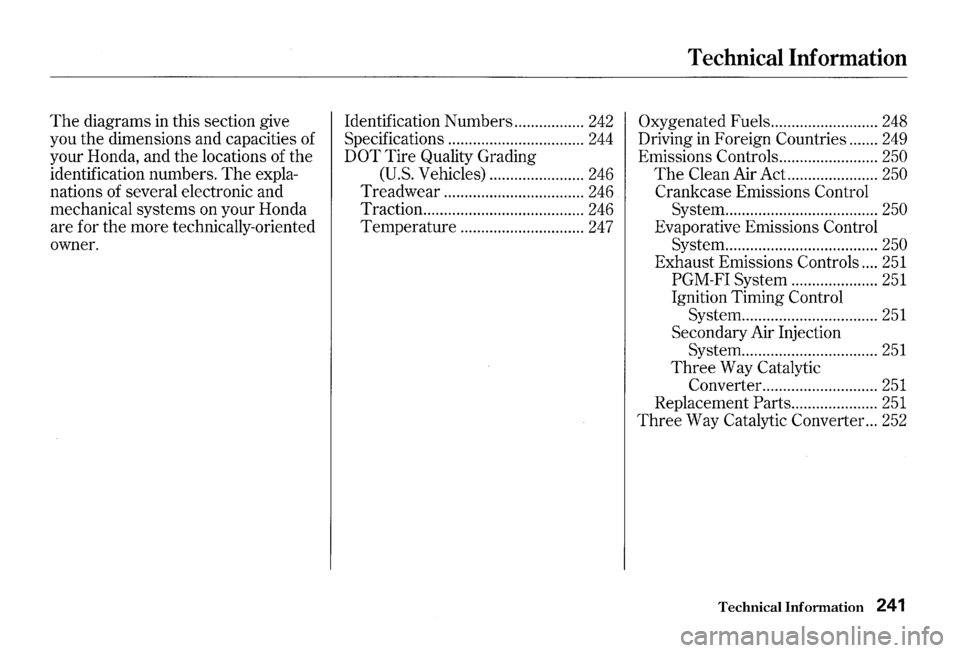
The diagrams in this section give
you the dimensions and capacities
of
your Honda, and the locations of the
identification numbers.
The expla
nations of several electronic and
mechanical systems on your Honda
are for the more technically-oriented
owner. Identification
Numbers .................
242
Specifications ................................. 244
DOT Tire Quality Grading
(U.S. Vehicles) ....................... 246
Treadwear .................................. 246
Traction ....................................... 246
Temperature .............................. 247
Technical Information
Oxygenated Fuels .......................... 248
Driving in Foreign Countries ....... 249
Emissions Controls ........................ 250
The Clean Air Act.. .................... 250
Crankcase Emissions Control
System .....................................
250
Evaporative Emissions Control
System .....................................
250
Exhaust Emissions Controls .... 251
PGM-FI System ..................... 251
Ignition Timing Control
System .................................
251
Secondary Air Injection
System .................................
251
Three Way Catalytic
Converter.. ..........................
251
Replacement Parts ..................... 251
Three Way Catalytic Converter ... 252
Technical Information 241
Page 247 of 273
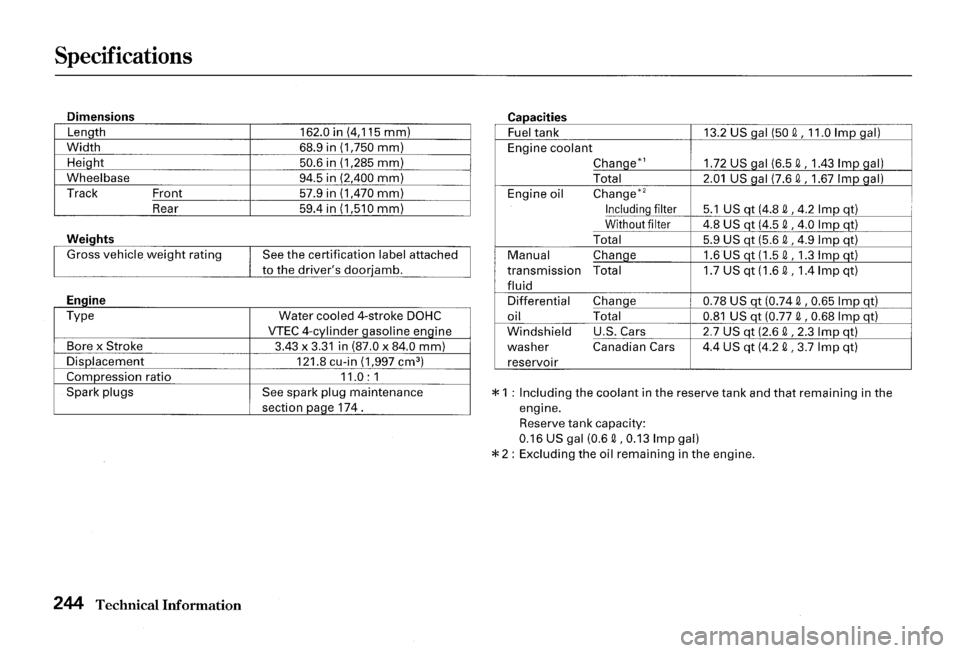
Specifications
Dimensions
Length
Width Height
Wheelbase Track Front
Rear
Engine
Type
Bore x Stroke
Displacement
Compression ratio
Spark plugs
244 Technical Information
162.0in(4,115mm) 68.9 in (1,750 mm)
50.6 in (1,285 mm) 94.5 in (2,400 mm)
57.9 in (1,470 mm)
59.4 in (1,510 mm)
See the certification label attached to the driver's door"amb.
Water cooled 4-stroke DOHC
VTEC 4-cylinder l=)asoline engine
3.43 x 3.31 in (87.0 x 84.0 mm)
121.8 cu-in (1,997 cm3
)
11.0 : 1 See spark plug maintenance
section page
174.
c apac1t1es
Fuel tank 13.2 US
aal (50 ll, 11.0 Imp qal)
Engine coolant
Change*'
1.72 US aal (6.51\, 1.43 Imp qal)
Total 2.01 US l=)al (7.61\, 1.67 Imp gal)
Engine oil Change*'
Including filter 5.1 US qt (4.81\, 4.2 Imp qt)
Without
filter 4.8 USgt (4.51\, 4.0 Imp qt)
Total 5.9 US qt (5.61\, 4.9 Imp qt)
Manual Chanl=)e 1.6 US_g_t (1.51\, 1.31mp qt)
transmission Total 1.7 US qt (1.61\, 1.41mp qt) fluid
Differential Chan_g_e 0.78 US qt (0.741\, 0.65 Imp qt)
oil Total 0.81 US qt (0.77 ll, 0.68 Imp at)
Windshield U.S. Cars 2.7 US qt (2.61\, 2.3 ImP at)
washer Canadian Cars 4.4 US qt (4.21\, 3.7 Imp qt)
reservoir
* 1 : Including the coolant in the reserve tank and that remaining in the
engine. Reserve tank capacity:
0.16 US gal (0.61\, 0.131mp gal)
* 2: Excluding the oil remaining in the engine.
Page 251 of 273
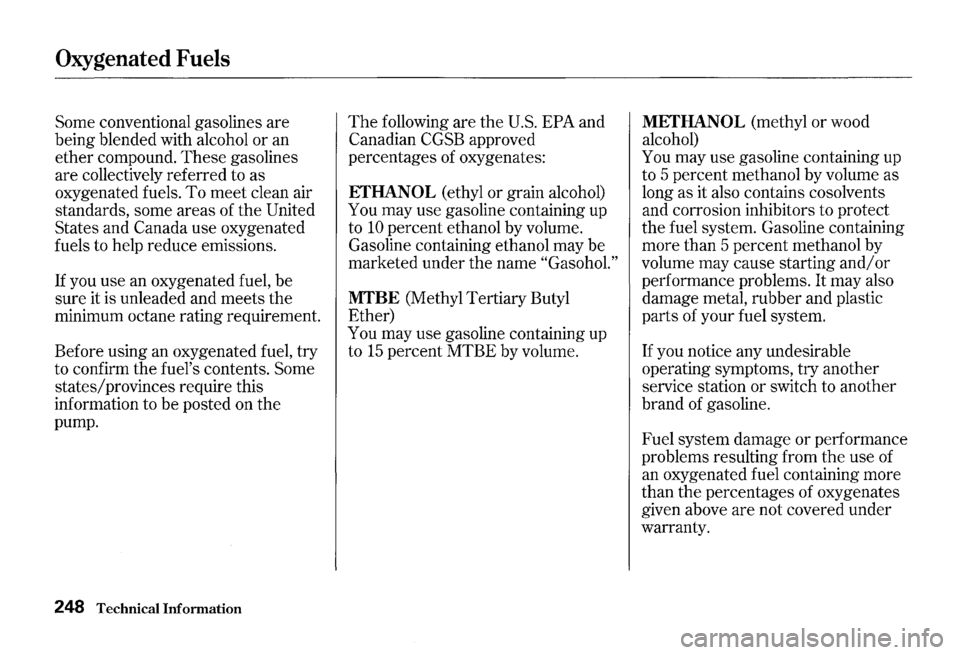
Oxygenated Fuels
Some conventional gasolines are
being blended with alcohol
or an
ether compound. These gasolines
are collectively referred to as
oxygenated fuels.
To meet clean air
standards, some areas of the United
States and
Canada use oxygenated
fuels to help reduce emissions.
If you use an oxygenated fuel, be
sure it is unleaded and meets the
minimum octane rating requirement.
Before using an oxygenated fuel, try
to confirm the fuel's contents. Some
states/provinces require this
information to be posted on the
pump.
248 Technical Information
The following are the U.S. EPA and
Canadian CGSB approved
percentages of oxygenates:
EfHANOL (ethyl or grain alcohol)
You may use gasoline containing up
to
10 percent ethanol by volume.
Gasoline containing ethanol may be
marketed under
the name "Gasohol."
MTBE (Methyl Tertiary Butyl
Ether)
You may use gasoline containing up
to
15 percent MTBE by volume.
MEfHANOL (methyl or wood
alcohol)
You may use gasoline containing up
to 5 percent methanol by volume as
long as it also contains cosolvents
and corrosion inhibitors to protect
the fuel system. Gasoline containing
more than 5 percent methanol by
volume may cause starting
and/ or
performance problems.
It may also
damage metal, rubber and plastic
parts of your fuel system.
If you notice any undesirable
operating symptoms, try another
service station or switch to another
brand
of gasoline.
Fuel system damage
or performance
problems resulting from
the use of
an oxygenated fuel containing more
than the percentages of oxygenates
given above are not covered under
warranty.