maintenance HONDA S2000 2000 1.G Owner's Manual
[x] Cancel search | Manufacturer: HONDA, Model Year: 2000, Model line: S2000, Model: HONDA S2000 2000 1.GPages: 273, PDF Size: 21.58 MB
Page 156 of 273
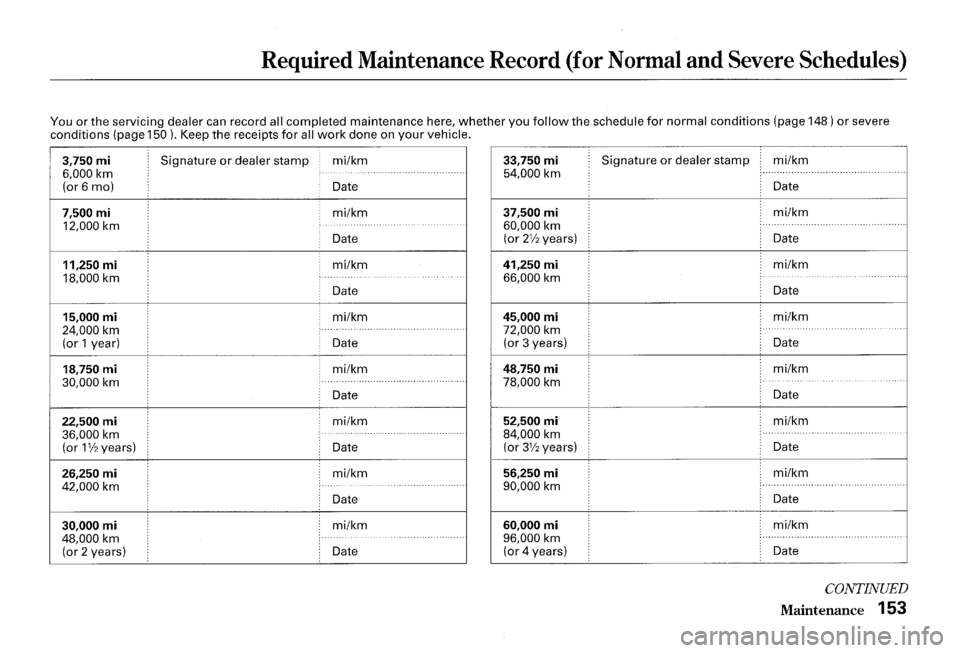
Required Maintenance Record (for Normal and Severe Schedules)
You or the servicing dealer can record all completed maintenance here, whether you follow the schedule for normal conditions (page 148) or severe conditions (page 150 ). Keep the receipts for all work done on your vehicle.
3,750 mi 6,000 km
(or 6 mo)
7,500 mi 12,000 km
11,250 mi 18,000 km
15,000 mi 24,000 km (or 1 year)
18,750 mi 30,000 km
22,500 mi 36,000 km
(or 1'12 years)
26,250 mi 42,000 km
30,000 mi 48,000 km
(or 2 years) Signature
or dealer stamp 33,750 mi 54,000 km
37,500 mi 60,000 km (or 2'12 years)
41,250 mi 66,000 km
45,000 mi 72,000 km
(or 3 years)
48,750 mi 78,000 km
52,500 mi 84,000 km
(or 3'12 years)
56,250 mi 90,000 km
60,000 mi 96,000 km
(or 4 years) Signature
or dealer stamp
CONTINUED
Maintenance 153
Page 157 of 273
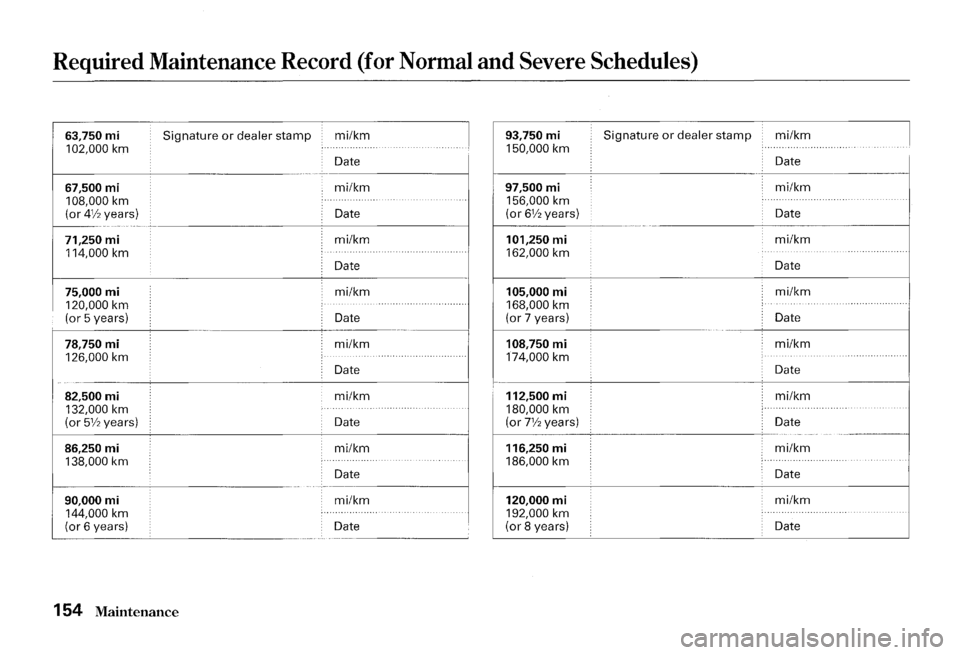
Required Maintenance Record (for Normal and Severe Schedules)
63,750 mi Signature or dealer stamp mi!km 93,750 mi Signature or dealer stamp 102,000 km 150,000 km
Date
97,500 mi 156,000 km
(or 6% years)
71,250 mi 101,250 mi 114,000 km 162,000 km
75,000 mi 105,000 mi 120,000 km 168,000 km (or 5 years) (or 7 years)
78,750 mi 108,750 mi 126,000 km 174,000 km
82,500 mi 112,500 mi 132,000 km 180,000 km
(or 5112 years) (or 7% years)
86,250 mi 116,250 mi 138,000 km 186,000 km
90,000 mi mi/km 120,000 mi 144,000 km 192,000 km
(or 6 years) Date (or 8 years)
154 Maintenance
Page 158 of 273
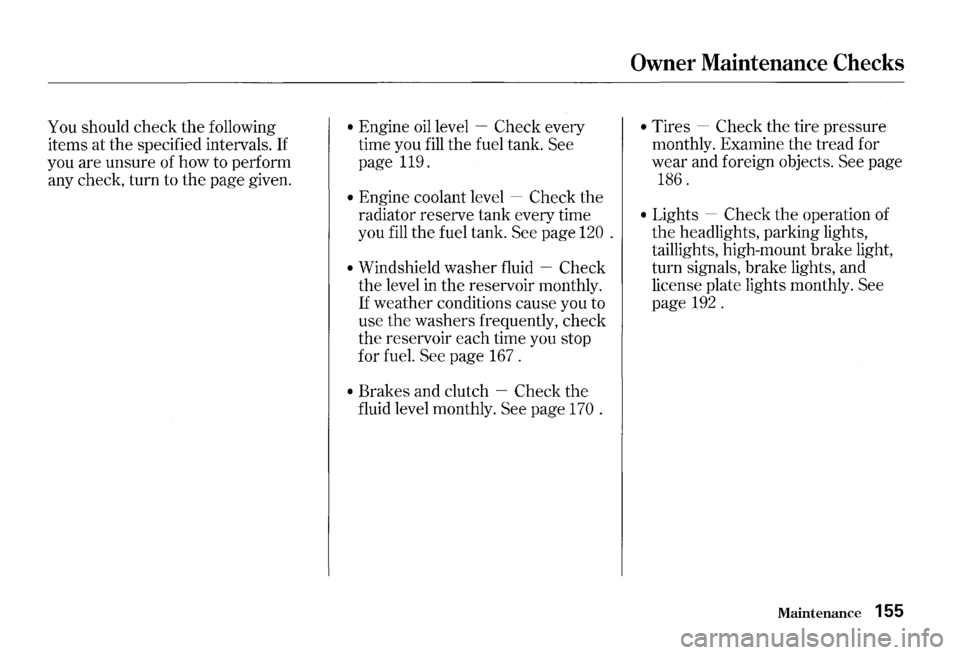
You should check the following
items at the specified intervals.
If
you are unsure of how to perform
any check, turn to the page given.
• Engine oil level -Check every
time you
fill the fuel tank. See
page 119.
• Engine coolant level -Check the
radiator reserve tank every time
you
fill the fuel tank. See page 120 .
• Windshield washer fluid -Check
the level in the reservoir monthly.
If weather conditions cause you to
use the washers frequently, check
the reservoir each time you stop
forfuel. See page 167.
• Brakes and clutch -Check the
fluid level monthly. See page
170 .
Owner Maintenance Checks
• Tires -Check the tire pressure
monthly. Examine the tread for
wear and foreign objects. See page
186.
• Lights -Check the operation of
the headlights, parking lights,
taillights, high-mount brake light,
turn signals, brake lights, and
license plate lights monthly. See
page 192.
Maintenance 155
Page 159 of 273
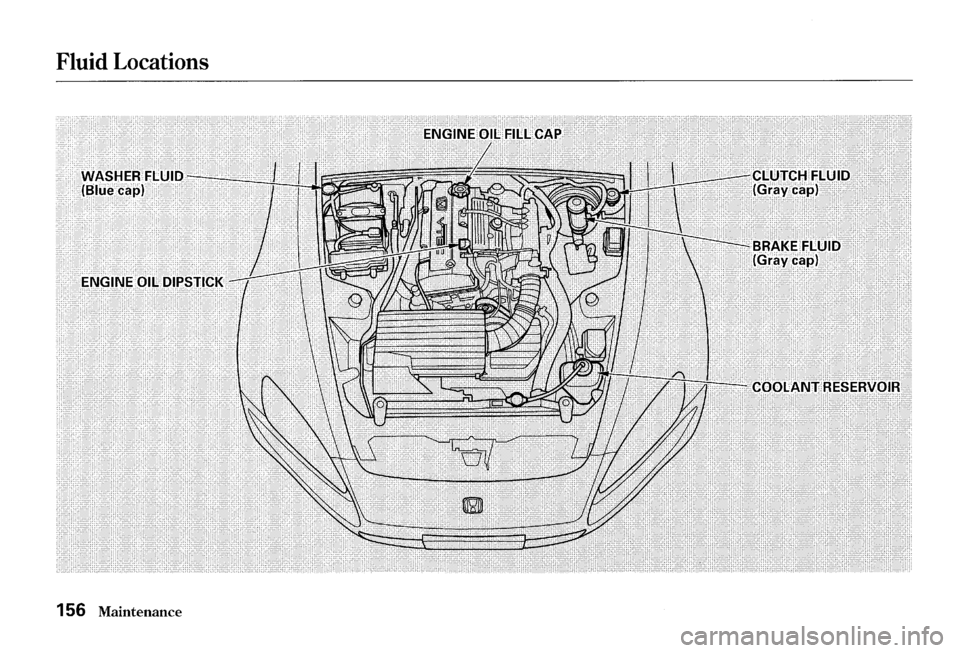
Fluid Locations
156 Maintenance
Page 160 of 273
Adding Oil
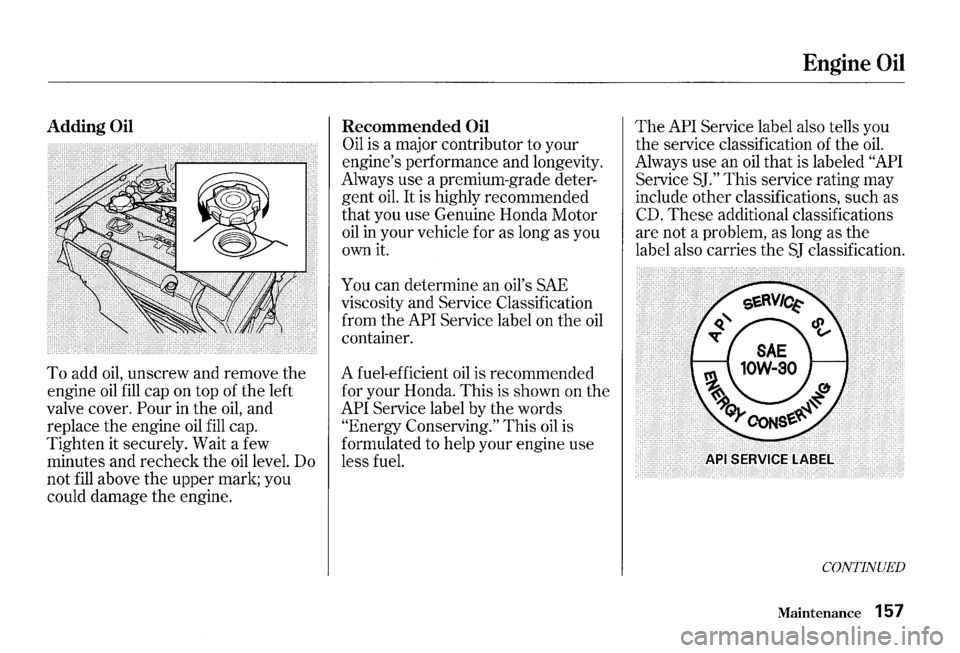
To add oil, unscrew and remove the
engine oil fill cap on top of the left
valve cover.
Pour in the oil, and
replace
the engine oil fill cap.
Tighten it securely. Wait a few
minutes and
recheck the oil level. Do
not
fill above the upper mark; you
could damage the engine.
Recommended Oil
Oil is a major contributor to your
engine's performance and longevity.
Always use a premium-grade deter
gent
oil. It is highly recommended
that you use Genuine Honda Motor
oil in your vehicle for as long as you
own it.
You can determine an oil's
SAE
viscosity and Service Classification
from
the API Service label on the oil
container.
A fuel-efficient oil is recommended
for your Honda.
This is shown on the
API Service label by the words
"Energy Conserving." This oil is
formulated to help your engine use
less fuel.
Engine Oil
The API Service label also tells you
the service classification of the oil.
Always use an oil that is labeled "API
Service SJ." This service rating may
include other classifications, such as
CD. These additional classifications
are not a problem, as long as the
label also carries
the SJ classification.
CONTINUED
Maintenance 15 7
Page 161 of 273
Engine Oil
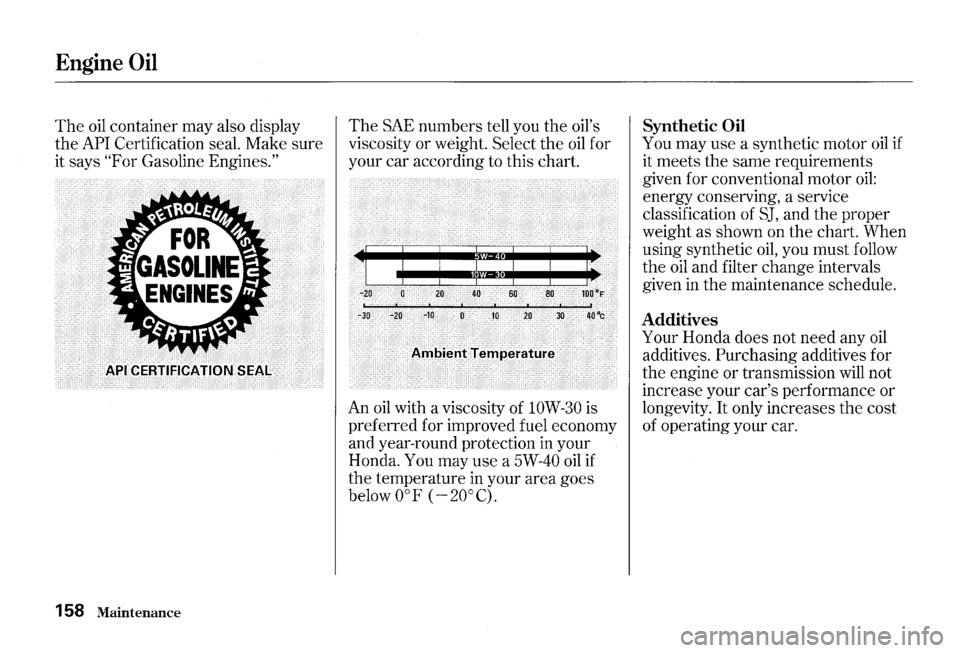
The oil container may also display
the
API Certification seal. Make sure
it says
"For Gasoline Engines."
158 Maintenance
The SAE numbers tell you the oil's
viscosity or weight. Select the
oil for
your car according to this chart.
60
. 10 20
" ~ c" ' -c '
AnlbielltTertlperature
An oil with a viscosity of lOW-30 is
preferred for improved fuel economy
and year-round protection in your
Honda.
You may use a 5W-40 oil if
the temperature in your area goes
below oaF (
-20°C).
Synthetic Oil
You may use a synthetic motor oil if
it meets the same requirements
given for conventional motor
oil:
energy conserving, a service
classification of
SJ, and the proper
weight as shown on the chart. When
using synthetic
oil, you must follow
the
oil and filter change intervals
given
in the maintenance schedule.
Additives
Your Honda does not need any oil
additives. Purchasing additives for
the engine or transmission will not
increase your car's performance or
longevity.
It only increases the cost
of operating your car.
Page 162 of 273
Changing the Oil and Filter
Always change the oil and filter
according to the time and distance
(miles/kilometers) recommenda
tions
in the maintenance schedule.
The oil and filter collect contami
nants that can damage your engine
if
they are not removed regularly.
Changing the
oil and filter requires
special tools and access from
underneath
the car. The car should
be raised on a service station-type
hydraulic lift for this service.
Unless
you have the knowledge and proper
equipment, you should have this
maintenance done by a skilled
mechanic.
1. Run the engine until it reaches
normal operating temperature,
then shut it off.
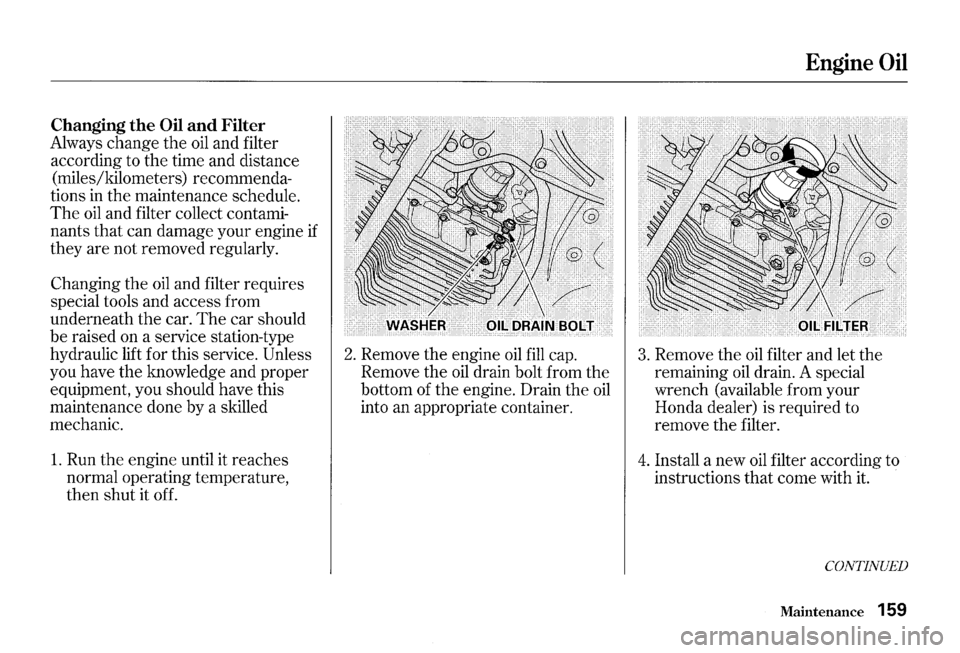
2. Remove the engine oil fill cap.
Remove the
oil drain bolt from the
bottom of
the engine. Drain the oil
into an appropriate container.
Engine Oil
3. Remove the oil filter and let the
remaining
oil drain. A special
wrench (available from your
Honda dealer) is required to
remove the filter.
4. Install a new oil filter according to
instructions that come with it.
CONTINUED
Maintenance 159
Page 163 of 273
Engine Oil
5. Put a new washer on the drain bolt,
then reinstall the drain bolt.
Tighten it to:
33 lbf.ft (45 N·m, 4.6 kgf·m)
6. Refill the engine with the recom
mended
oil.
Engine oil change capacity
(including filter):
5.1 US qt (4.8 Q, 4.2 Imp qt)
7. Install the engine oil fill cap. Start
the engine. The oil pressure
indicator light should go out within
five seconds. If it does not, turn off
the engine and reinspect your
work.
8. Let the engine run for several
minutes and check the drain bolt
and
oil filter for leaks.
160 Maintenance
9. Turn off the engine, let it sit for
several minutes, then check the
oil
level. If necessary, add oil to bring
the level to the upper mark on the
dipstick.
NOTICE
Improper disposal of engine oil can be
harmful
to the environment. If you
change your own oil, please dispose
of
the used oil properly. Put it in a sealed
container and take it
to a recycling
center. Do not discard it
in a trash bin
or dump it on the ground.
Page 164 of 273
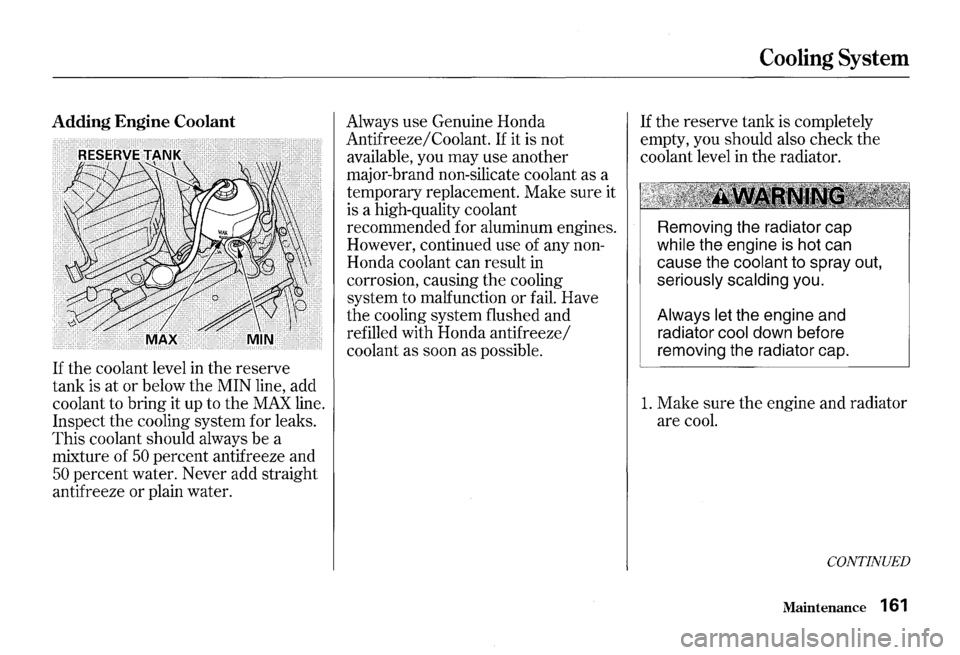
Adding Engine Coolant
If the coolant level in the reserve
tank is at or below the MIN line, add
coolant to bring it up to the
MAX line.
Inspect the cooling system for leaks.
This coolant should always be a
mixture of
50 percent antifreeze and
50 percent water. Never add straight
antifreeze
or plain water. Always
use Genuine Honda
Antifreeze/Coolant.
If it is not
available, you may use another
major-brand non-silicate coolant as a
temporary replacement. Make sure it
is a high-quality coolant
recommended for aluminum engines.
However, continued use of any non
Honda coolant can result in
corrosion, causing the cooling
system to malfunction or fail. Have
the cooling system flushed and
refilled with Honda antifreeze/
coolant as soon as possible.
Cooling System
If the reserve tank is completely
empty, you should also check the
coolant level
in the radiator.
Removing the radiator cap
while the engine is hot can
cause the
coolant to spray out,
seriously scalding you.
Always let the engine and
radiator
cool down before
removing the radiator cap.
1. Make sure the engine and radiator
are cool.
CONTINUED
Maintenance 161
Page 165 of 273
Cooling System
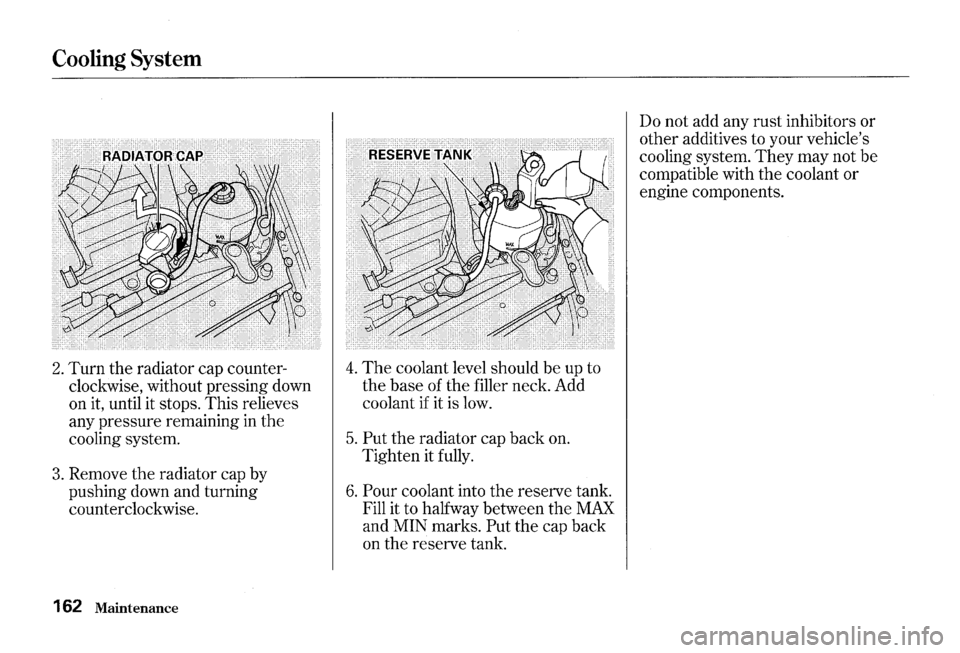
2. Turn the radiator cap counter
clockwise, without pressing down
on it, until it stops.
This relieves
any pressure remaining in the
cooling system.
3. Remove the radiator cap by
pushing down and turning
counterclockwise.
162 Maintenance
4. The coolant level should be up to
the base of the filler neck. Add
coolant
if it is low.
5. Put the radiator cap back on.
Tighten it fully.
6. Pour coolant into the reserve tank.
Fill it to halfway between the
MAX
and MIN marks. Put the cap back
on the reserve tank.
Do not add any rust inhibitors or
other additives to your vehicle's
cooling system.
They may not be
compatible with
the coolant or
engine components.