oil HONDA S2000 2000 1.G Owner's Manual
[x] Cancel search | Manufacturer: HONDA, Model Year: 2000, Model line: S2000, Model: HONDA S2000 2000 1.GPages: 273, PDF Size: 21.58 MB
Page 177 of 273

Hood Latch, Spark Plugs
Hood Latch
Clean the hood latch assembly with a
mild cleaner, then lubricate it with a
multipurpose grease. Lubricate
all
the moving parts, including the pivot.
Follow the time and distance
recommendations
in the
Maintenance Schedule.
If you are
not sure how to clean and grease the
latch, contact your Honda dealer.
17 4 Maintenance
Spark Plugs
The spark plugs in your car are a
special platinum-tipped design for
longer life.
They only need to be
replaced every 7 years or
105,000
miles (168,000 km), whichever
comes first.
Replacement
1. Remove the four hexagon socket
head cap bolts holding the ignition
coil cover.
2. Clean up any dirt and oil that have
collected around the ignition coils.
Page 178 of 273
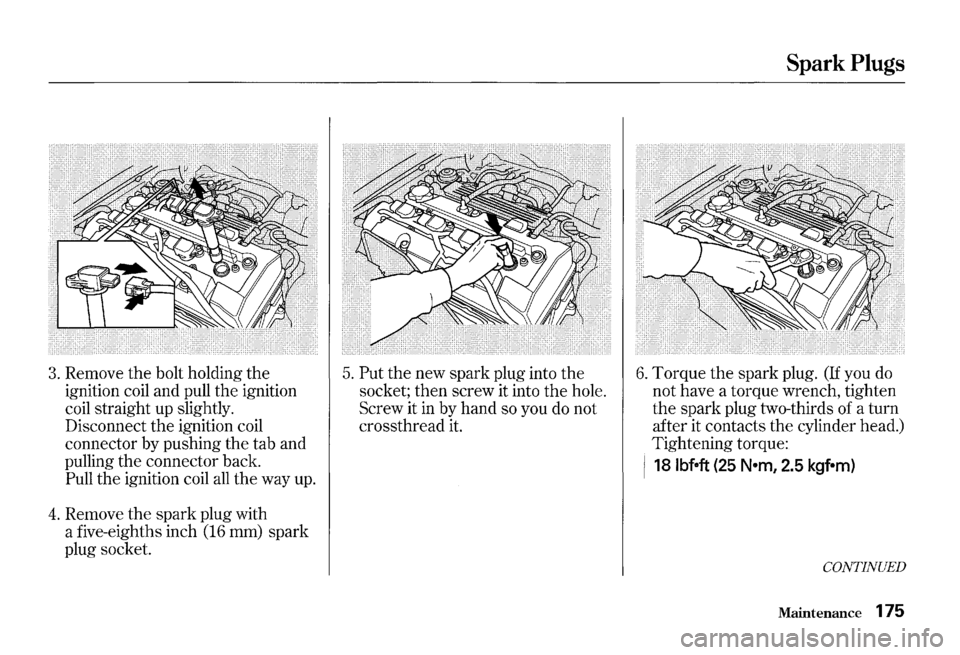
3. Remove the bolt holding the
ignition coil and pull the ignition
coil straight up slightly.
Disconnect
the ignition coil
connector by pushing the tab and
pulling the connector back.
Pull the ignition coil all the way up.
4. Remove the spark plug with
a five-eighths inch (16 mm) spark
plug socket.
5. Put the new spark plug into the
socket; then screw it into the hole.
Screw it
in by hand so you do not
crossthread it.
Spark Plugs
6. Torque the spark plug. (If you do
not have a torque wrench, tighten
the spark plug two-thirds of a turn
after it contacts the cylinder head.)
Tightening torque:
i 18 lbfeft (25 N•m, 2.5 kgf•m)
CONTINUED
Maintenance 175
Page 179 of 273
Spark Plugs
I NOTICE I
Tighten the spark plugs carefully. A
spark plug that is too loose can
overheat and damage the engine.
Overtightening can cause damage to
the threads
in the cylinder head.
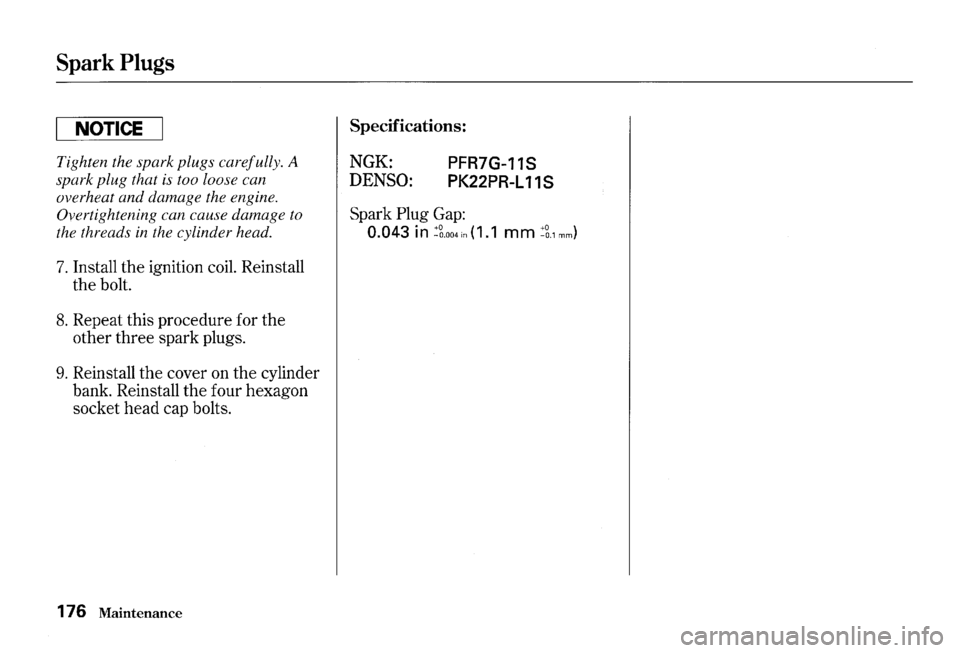
7. Install the ignition coil. Reinstall
the bolt.
8. Repeat this procedure for the
other three spark plugs.
9. Reinstall the cover on the cylinder
bank. Reinstall the four hexagon
socket head cap bolts.
176 Maintenance
Specifications:
NGK:
DENSO:
PFR7G-11S
PK22PR-L 11S
Spark Plug Gap:
0.043 in ~g004in(1.1 mm •g1mm)
Page 185 of 273
Air Conditioning System
Your car's air conditioning is a sealed
system. Any major maintenance,
such as recharging, should
be done
by a qualified mechanic. You can do
a couple of things to
make sure the
air conditioning works efficiently.
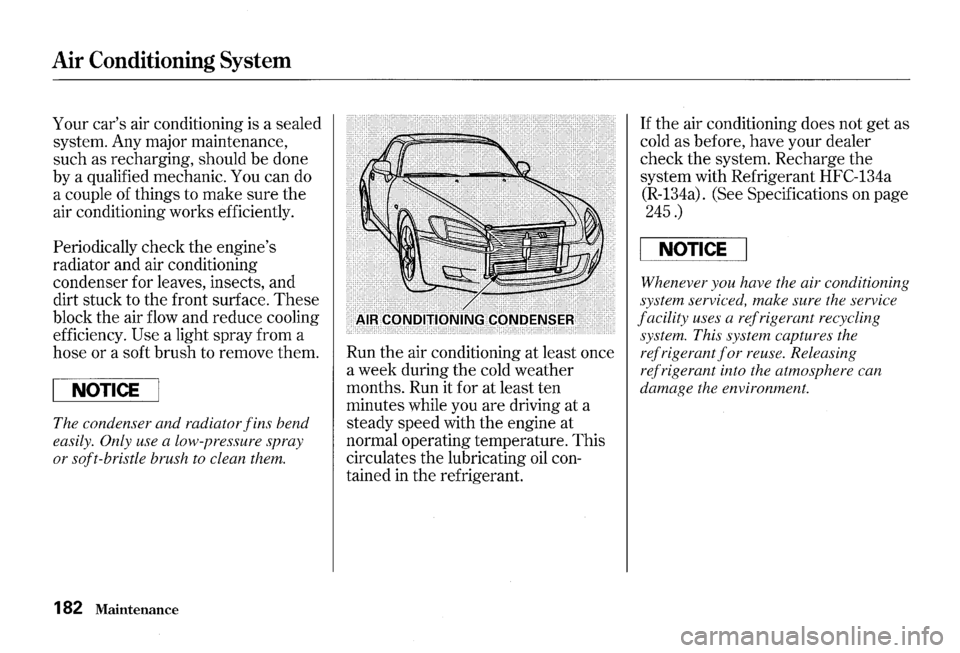
Periodically
check the engine's
radiator and air conditioning
condenser for leaves, insects, and
dirt
stuck to the front surface. These
block the air flow and reduce cooling
efficiency.
Use a light spray from a
hose or a soft
brush to remove them.
NOTICE
The condenser and radiator fins bend
easily. Only use a low-pressure
~pray
or soft-bristle brush to clean them.
182 Maintenance
Run the air conditioning at least once
a
week during the cold weather
months. Run it for at least ten
minutes while you are driving at a
steady speed with
the engine at
normal operating temperature. This
circulates the lubricating oil con
tained in
the refrigerant.
If the air conditioning does not get as
cold
as before, have your dealer
check the system. Recharge the
system with Refrigerant HFC-134a
(R-134a). (See Specifications on page
245.)
NOTICE
Whenever you have the air conditioning
system serviced, make sure the service
facility uses a refrigerant recycling
system. This system captures the
refrigerant
for reuse. Releasing
refrigerant into the atmosphere can
damage the environment.
Page 197 of 273
Lights
Replacing a Headlight Bulb
The low beam headlight bulbs are a
type of high voltage discharge tube.
High voltage can remain in
the
circuit even with the light switch off
and the key removed. Because of
this, you should not attempt to
examine or change a low beam
headlight bulb yourself.
If a low
beam headlight bulb fails, take the
car to your dealer to have it replaced.
194 Maintenance
Halogen bulbs are used for the high
beam headlight bulbs.
When
replacing a high beam headlight bulb,
handle it by its base and protect the
glass from contact with your skin or
hard objects.
If you touch the glass,
clean it with denatured alcohol and a
clean cloth.
NOTICE
Halogen headlight bulbs get very hot
when
lit. Oil, perspiration, or a scratch
on the glass can cause the bulb to
overheat and shatter.
Page 205 of 273
Storing Your Car
If you need to park your car for an
extended period (more than one
month), there are several things you
should
do to prepare it for storage.
Proper preparation helps prevent
deterioration and makes it easier to
get your car back on the road.
If
possible, store your car indoors.
• Fill the fuel tank.
• Change the engine oil and filter
(see page 159).
• Wash and dry the exterior
completely.
• Clean the interior. Make sure the
carpeting, floor mats, etc. are
completely dry.
• Raise the convertible top cover.
• Leave the parking brake off. Put
the transmission in Reverse.
202 Maintenance
• Block the rear wheels.
• If the car is to be stored for a
longer period, it should be
supported on jackstands so the
tires are off the ground.
• Leave one window open slightly (if
the car is being stored indoors).
• Disconnect the battery.
• Support the front wiper blade
arms with a folded towel or rag so
they
do not touch the windshield.
• To minimize sticking, apply a
silicone spray lubricant to
all door
and trunk seals. Also, apply a
vehicle body wax to the painted
surfaces that mate with the door
and trunk seals.
• Cover the car with a "breathable"
cover, one made from a porous
material such as cotton.
Nonporous materials, such as
plastic sheeting, trap moisture,
which can damage
the paint.
• If possible, run the engine for a
while periodically (preferably once
a month).
If you store your car for 12 months
or longer, have your Honda dealer
perform the inspections called for
in
the 24 months/30,000 miles (48,000
km) maintenance schedule as soon
as you take it out of storage (see
page
148 ). The replacements called
for
in the maintenance schedule are
not needed unless the car has
actually reached that time or mileage.
Page 214 of 273
Taking Care of the Unexpected
This section covers the more
common problems
that motorists
experience with their vehicles.
It
gives you information about how to
safely evaluate the problem and what
to
do to correct it. If the problem has
stranded you on the side of the road,
you may be able to get going again.
If not, you will also find instructions
on getting your car towed. Compact
Spare Tire .......................
212
Changing a Flat Tire ..................... 213
If Your Engine Won't Start ........... 218
Nothing Happens or the
Starter Motor
Operates
Very
Slowly ......................... 218
The Starter Operates
Normally ................................. 219
Jump Starting ................................. 220
If Your Engine Overheats ............. 223
Low Oil Pressure Indicator .......... 226
Charging System Indicator.. .........
227
Malfunction Indicator Lamp ........ 228
Brake System Indicator ................ 229
Closing the Convertible Top ........ 230
Fuses ............................................... 231
Checking and Replacing ........... 232
If Your Car Gets Stuck. ................. 236
Emergency Towing ....................... 238
Taking Care of the Unexpected 211
Page 229 of 273
Low Oil Pressure Indicator
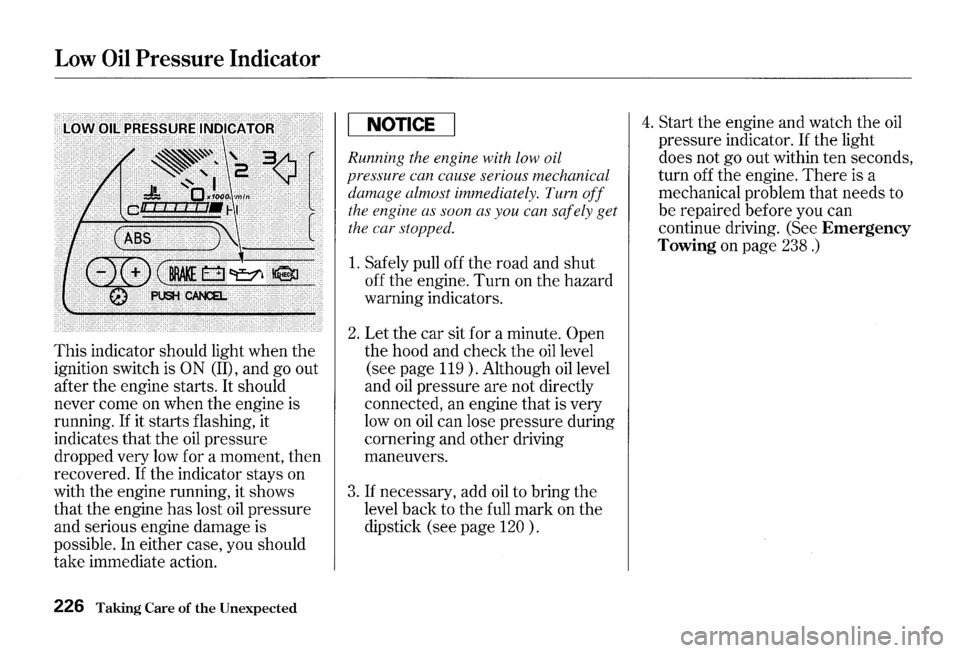
This indicator should light when the
ignition switch is ON (II), and go out
after
the engine starts. It should
never come on when
the engine is
running.
If it starts flashing, it
indicates
that the oil pressure
dropped very low for a moment,
then
recovered. If the indicator stays on
with
the engine running, it shows
that
the engine has lost oil pressure
and serious engine damage is
possible. In either case, you should
take immediate action.
226 Taking Care of the Unexpected
NOTICE
Running the engine with low oil
pressure can cause serious mechanical
damage almost immediately. Turn
off
the engine as soon as you can safely get
the car
stopped.
1. Safely pull off the road and shut
off the engine. Turn on the hazard
warning indicators.
2. Let the car sit for a minute. Open
the hood and check the oil level
(see page 119 ). Although oil level
and
oil pressure are not directly
connected, an engine
that is very
low on
oil can lose pressure during
cornering and
other driving
maneuvers.
3. If necessary, add oil to bring the
level back to the full mark on the
dipstick (see page 120 ) .
4. Start the engine and watch the oil
pressure indicator.
If the light
does not go out within
ten seconds,
turn off
the engine. There is a
mechanical problem
that needs to
be repaired before you can
continue driving.
(See Emergency
Towing on page 238 .)
Page 237 of 273
Fuses
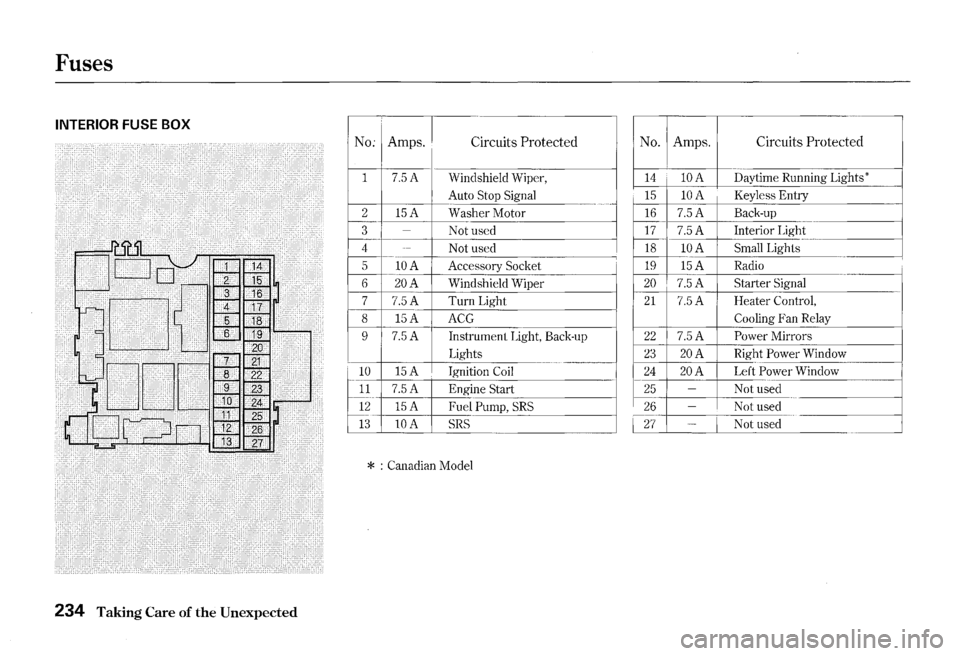
INTERIOR FUSE BOX
No: Amps. Circuits Protected No. Amps. Circuits Protected
1 7.5A Windshield Wiper, 14 lOA Daytime Running Lights*
Auto
Stop Signal 15 lOA Keyless Entry
2
15A Washer Motor 16 7.5A Back-up
3
-Not used 17 7.5A Interior Light
4
-Not used 18 lOA Small Lights
5
lOA Accessory Socket 19 15A Radio
6
20A Windshield Wiper 20 7.5A Starter Signal
7 7.5A Tum Light 21 7.5A Heater Control,
8 15A ACG Cooling Fan
Relay
9
7.5A Instrument Light, Back·up 22 7.5A Power Mirrors
Lights
23 20A Right Power Window
10 15A Ignition Coil 24 20A Left Power Window
11 7.5A Engine Start 25 -Not used
12 15A Fuel Pump, SRS 26 -Not used
13 lOA SRS 27 -Not used
* : Canadian Model
234 Taking Care of the Unexpected
Page 247 of 273
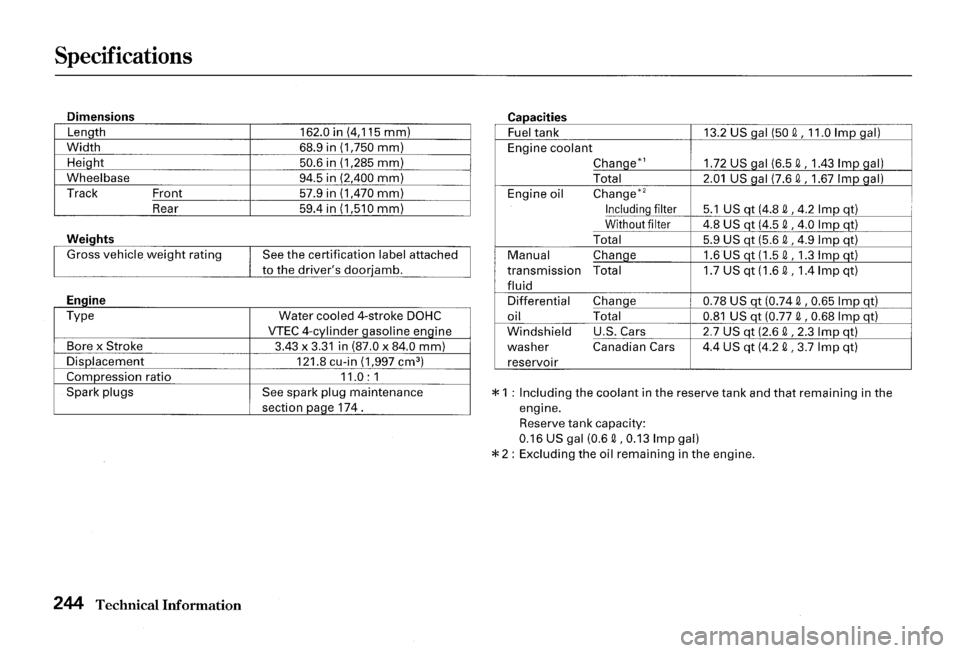
Specifications
Dimensions
Length
Width Height
Wheelbase Track Front
Rear
Engine
Type
Bore x Stroke
Displacement
Compression ratio
Spark plugs
244 Technical Information
162.0in(4,115mm) 68.9 in (1,750 mm)
50.6 in (1,285 mm) 94.5 in (2,400 mm)
57.9 in (1,470 mm)
59.4 in (1,510 mm)
See the certification label attached to the driver's door"amb.
Water cooled 4-stroke DOHC
VTEC 4-cylinder l=)asoline engine
3.43 x 3.31 in (87.0 x 84.0 mm)
121.8 cu-in (1,997 cm3
)
11.0 : 1 See spark plug maintenance
section page
174.
c apac1t1es
Fuel tank 13.2 US
aal (50 ll, 11.0 Imp qal)
Engine coolant
Change*'
1.72 US aal (6.51\, 1.43 Imp qal)
Total 2.01 US l=)al (7.61\, 1.67 Imp gal)
Engine oil Change*'
Including filter 5.1 US qt (4.81\, 4.2 Imp qt)
Without
filter 4.8 USgt (4.51\, 4.0 Imp qt)
Total 5.9 US qt (5.61\, 4.9 Imp qt)
Manual Chanl=)e 1.6 US_g_t (1.51\, 1.31mp qt)
transmission Total 1.7 US qt (1.61\, 1.41mp qt) fluid
Differential Chan_g_e 0.78 US qt (0.741\, 0.65 Imp qt)
oil Total 0.81 US qt (0.77 ll, 0.68 Imp at)
Windshield U.S. Cars 2.7 US qt (2.61\, 2.3 ImP at)
washer Canadian Cars 4.4 US qt (4.21\, 3.7 Imp qt)
reservoir
* 1 : Including the coolant in the reserve tank and that remaining in the
engine. Reserve tank capacity:
0.16 US gal (0.61\, 0.131mp gal)
* 2: Excluding the oil remaining in the engine.