steering wheel HONDA S2000 2004 2.G User Guide
[x] Cancel search | Manufacturer: HONDA, Model Year: 2004, Model line: S2000, Model: HONDA S2000 2004 2.GPages: 208, PDF Size: 2.91 MB
Page 119 of 208

Make sure the convertible top and
windows are closed.
Turn of f the lights.
Place any packages, valuables, etc.,
in the trunk or take them with you.
Lock the doors.
Never park over dry leaves, tall
grass, or other f lammable
materials. The hot three way
catalytic converter could cause
these materials to catch on fire.If the vehicle is f acing uphill, turn
the f ront wheels away f rom the
curb, and put the transmission in
f irst gear.
If the vehicle is f acing downhill,
turn the front wheels toward the
curb, and put the transmission in
reverse gear.
Make sure the parking brake is
f ully released bef ore driving away.
Driving with the parking brake
partially set can overheat or
damage the rear brakes.
Your Honda is equipped with disc
brakes at all f our wheels. A power
assist helps reduce the ef f ort needed
on the brake pedal. The ABS helps
you retain steering control when
braking very hard.
Resting your f oot on the pedal keeps
the brakes applied lightly, builds up
heat, and reduces their ef f ectiveness.
It also keeps your brake lights on all
the time, conf using drivers behind
you.
Constant application of the brakes
when going down a long hill builds
up heat and reduces their ef f ective-
ness. Use the engine to assist the
brakes by taking your f oot of f the
accelerator and downshif ting to a
lower gear.
Always use the parking brake when
you park your vehicle. Make sure
the parking brake is set f irmly or
your vehicle may roll if it is on an
incline.
Parking, Braking System
Parking
Parking T ips
Braking System
Driving116
Page 120 of 208
Check the brakes after driving
through deep water. Apply the
brakes moderately to see if they f eel
normal. If not, apply them gently and
f requently until they do. Be extra
cautious in your driving.
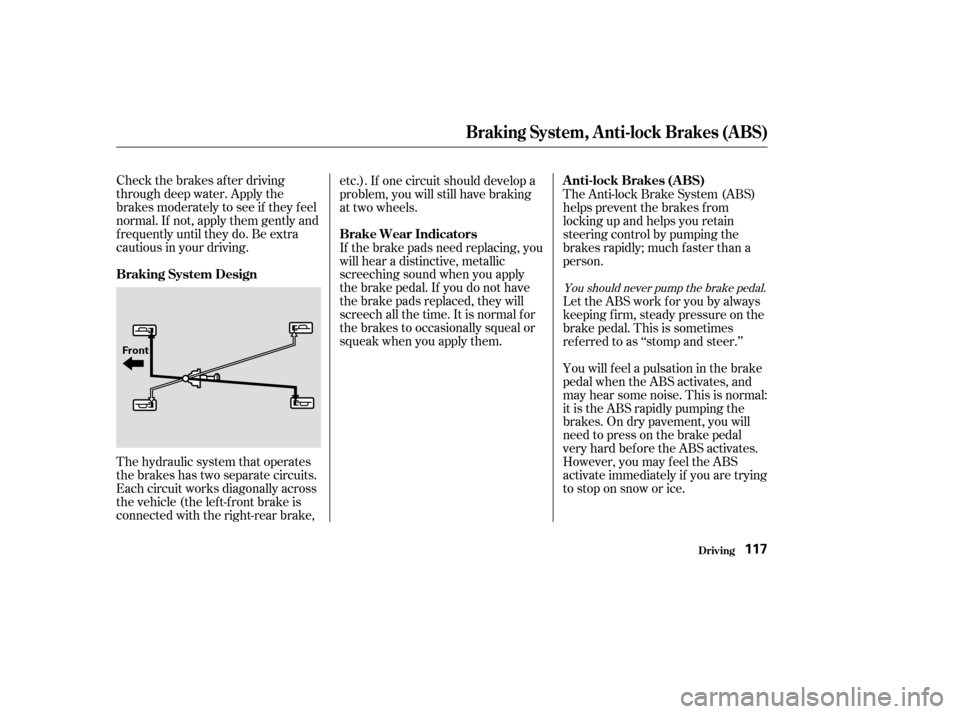
The hydraulic system that operates
the brakes has two separate circuits.
Each circuit works diagonally across
the vehicle (the lef t-f ront brake is
connected with the right-rear brake,etc.). If one circuit should develop a
problem, you will still have braking
at two wheels.
If the brake pads need replacing, you
will hear a distinctive, metallic
screeching sound when you apply
the brake pedal. If you do not have
the brake pads replaced, they will
screech all the time. It is normal f or
the brakes to occasionally squeal or
squeak when you apply them.
The Anti-lock Brake System (ABS)
helps prevent the brakes f rom
locking up and helps you retain
steering control by pumping the
brakes rapidly; much f aster than a
person.
Let the ABS work f or you by always
keeping f irm, steady pressure on the
brake pedal. This is sometimes
ref erred to as ‘‘stomp and steer.’’
You will f eel a pulsation in the brake
pedal when the ABS activates, and
may hear some noise. This is normal:
it is the ABS rapidly pumping the
brakes. On dry pavement, you will
need to press on the brake pedal
very hard before the ABS activates.
However, you may f eel the ABS
activate immediately if you are trying
to stop on snow or ice.
You should never pump the brake pedal.
Braking System, Anti-lock Brakes (ABS)
Braking System Design
Brake Wear IndicatorsAnti-lock Brakes (ABS)
Driving117
Front
Page 121 of 208
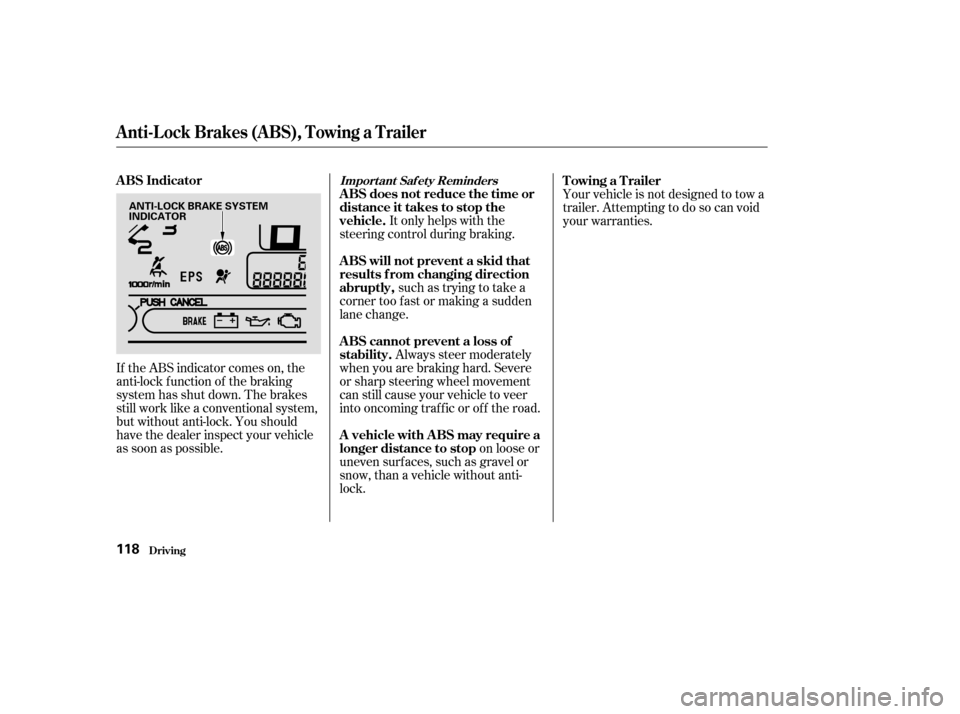
If the ABS indicator comes on, the
anti-lock f unction of the braking
system has shut down. The brakes
still work like a conventional system,
but without anti-lock. You should
have the dealer inspect your vehicle
as soon as possible.It only helps with the
steering control during braking.
such as trying to take a
corner too f ast or making a sudden
lane change.
Always steer moderately
when you are braking hard. Severe
or sharp steering wheel movement
can still cause your vehicle to veer
into oncoming traffic or off the road.
on loose or
uneven surf aces, such as gravel or
snow, than a vehicle without anti-
lock. Your vehicle is not designed to tow a
trailer. Attempting to do so can void
your warranties.
Anti-Lock Brakes (ABS), Towing a Trailer
ABS Indicator
A BS does not reduce the time or
distance it takes to stop the
vehicle.
A BS will not prevent a skid that
results f rom changing direction
abruptly,
A BS cannot prevent a loss of
stability.
A vehicle with A BS may require a
longer distance to stopTowing a TrailerImport ant Saf et y Reminders
Driving118
ANTI-LOCK BRAKE SYSTEM
INDICATOR
Page 142 of 208
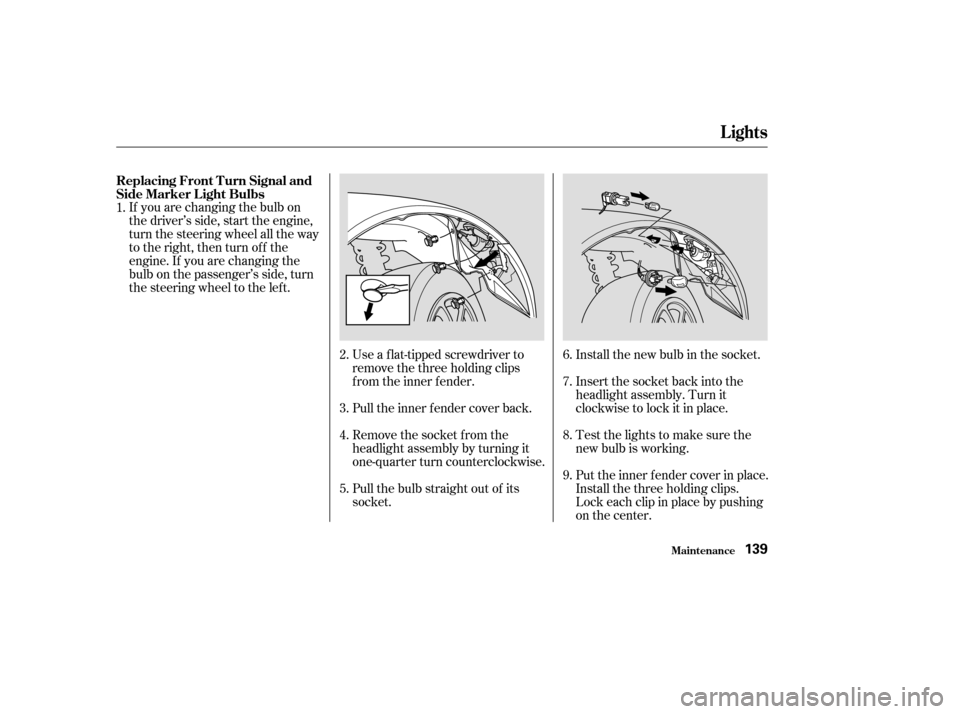
If you are changing the bulb on
the driver’s side, start the engine,
turn the steering wheel all the way
to the right, then turn off the
engine. If you are changing the
bulb on the passenger’s side, turn
the steering wheel to the left.Use a f lat-tipped screwdriver to
remove the three holding clips
f rom the inner f ender.
Pull the inner f ender cover back.
Remove the socket from the
headlight assembly by turning it
one-quarter turn counterclockwise.
Pull the bulb straight out of its
socket.Insert the socket back into the
headlight assembly. Turn it
clockwise to lock it in place. Install the new bulb in the socket.
Put the inner f ender cover in place.
Install the three holding clips.
Lock each clip in place by pushing
on the center. Testthelightstomakesurethe
new bulb is working.
1.
2.
3.
4.
5.6.
7.
8.
9.
Replacing Front Turn Signal and
Side Marker L ight Bulbs
Lights
Maint enance139
Page 151 of 208

In addition to proper inf lation,
correct wheel alignment helps to
decrease tire wear. If you f ind a tire
is worn unevenly, have your dealer
check the wheel alignment.
Have your dealer check the tires if
you f eel a consistent vibration while
driving. A tire should always be
rebalanced if it is removed f rom the
wheel. When you have new tires
installed, make sure they are
balanced. This increases riding
comf ort and tire lif e. For best results,
have the installer perform a dynamic
balance.You should not rotate your Honda’s
tires. The f ront and rear tires are
dif f erent sizes, so they cannot be
rotated f ront-to-rear. The original-
equipment tires on your Honda have
a unidirectional tread pattern, so
they cannot be rotated side-to-side.
The tires that came on your vehicle
were designed and constructed to
provide superior grip during
acceleration, braking, and cornering.
As a trade-of f , they will wear more
rapidly than tires used on ordinary
passenger vehicles. Because of the
vehicle’s weight distribution, and the
f act that they are the driving wheels,
you may expect the rear tires to wear
more rapidly than the f ront tires.Replace your tires with radial tires of
the same size, load range, speed
rating, and maximum cold tire
pressure rating (as shown on the
tire’s sidewall). Mixing radial and
bias-ply tires on your vehicle can
reduce braking ability, traction, and
steering accuracy. Using tires of a
dif f erent size or construction can
cause the ABS to work inconsistently.
It is best to replace all f our tires at
thesametime.If thatisnotpossible
or necessary, replace the two f ront
tires or two rear tires as a pair.
Replacing just one tire can seriously
af f ect your vehicle’s handling.
If you ever replace a wheel, make
sure that the wheel’s specif ications
match those of the original wheels.
Tires
Maint enance
T ire Maintenance
T ire Rotation
Tire Wear Replacing T ires
148
NOTICE:
Improper wheel weights can
damage your vehicle’s aluminum
wheels. Use only genuine Honda wheel
weights f or balancing.
Page 205 of 208

Replacement Inf ormation................
Engine Oil and Filter . 130
..........................................
Fuses .170
................................
Light Bulbs .137
....................................
Schedule .121
...........................................
Tires .148
.............................
Wiper Blades .144
Replacing Seat Belts Af ter a ............................................
Crash .17
...............................
Restraint, Child .22
................................
Rotation, Tire .148
........................................
Saf ety Belts .8
............
Safety Defects, Reporting . 194
.............
Saf ety Labels, Location of . 35
...............................
Saf ety Messages .ii
..................................
Satellite Radio .88
...........................................
Seat Belts .8
...............
Additional Information . 15
.....
Advice f or Pregnant Women . 14
.....................................
Cleaning .143
......................
Lap/Shoulder Belt .16
................................
Maintenance .17
......
Reminder Light and Beeper . 40...................
System Components . 15
...............
Use During Pregnancy . 14
........................
Seats, Adjusting the .58
...............................
Serial Number .178
...........................
Service Intervals .121
.............................
Service Manual .195
.........
Service Station Procedures . 101
Shif ting The 6-speed Manual
.........................
Transmission .114
Side Turn Signal, Bulb .........................
Replacement in .140
...............................
Signaling Turns .48
6-speed Manual Transmission ...............
Checking Fluid Level . 134
................................
Shif ting the .114
.....................................
Snow Tires .149
..................................
Sound System .78
Spare Tire ......................................
Inf lating .154
............................
Specif ications .181
....................
Specif ications Charts . 180
..................................
Speed Control .95
...................................
Speedometer .44
..........
SRS, Additional Inf ormation . 18
...
Additional Safety Precautions . 21....................
Airbag Components . 18
.............................
Airbag Service .21
How the SRS Indicator .......................................
Works .20
...........
How Your Airbags Work . 18
..................
SRS Indicator Light . 20,41
.......................
Starting the Engine .113
................
With a Dead Battery . 162
..............
State Emissions Testing . 188
........
Steam Coming f rom Engine . 163
Steering Wheel .............
Anti-theft Column Lock . 53
.....................
Stereo Sound System .78
....................
Storing Your Vehicle .152
................................
Stuck Vehicle .174
Supplemental Restraint System ......................................
Servicing .21
.........................
SRS Indicator .20 ,41
...............
Tensioners, Seat Belts . 16
.....................................
Tachometer .44
......
Taillights, Changing Bulbs in . 141
.
Taking Care of the Unexpected . 153
Index
S
T
VI