seats HUMMER H2 2006 User Guide
[x] Cancel search | Manufacturer: HUMMER, Model Year: 2006, Model line: H2, Model: HUMMER H2 2006Pages: 502, PDF Size: 3.35 MB
Page 35 of 502
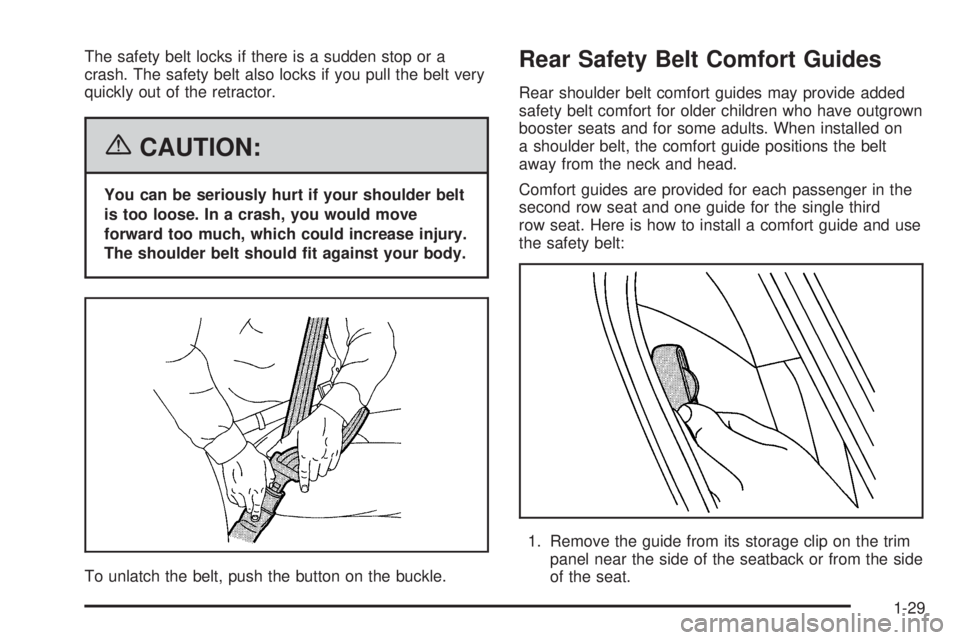
The safety belt locks if there is a sudden stop or a
crash. The safety belt also locks if you pull the belt very
quickly out of the retractor.
{CAUTION:
You can be seriously hurt if your shoulder belt
is too loose. In a crash, you would move
forward too much, which could increase injury.
The shoulder belt should t against your body.
To unlatch the belt, push the button on the buckle.
Rear Safety Belt Comfort Guides
Rear shoulder belt comfort guides may provide added
safety belt comfort for older children who have outgrown
booster seats and for some adults. When installed on
a shoulder belt, the comfort guide positions the belt
away from the neck and head.
Comfort guides are provided for each passenger in the
second row seat and one guide for the single third
row seat. Here is how to install a comfort guide and use
the safety belt:
1. Remove the guide from its storage clip on the trim
panel near the side of the seatback or from the side
of the seat.
1-29
Page 37 of 502
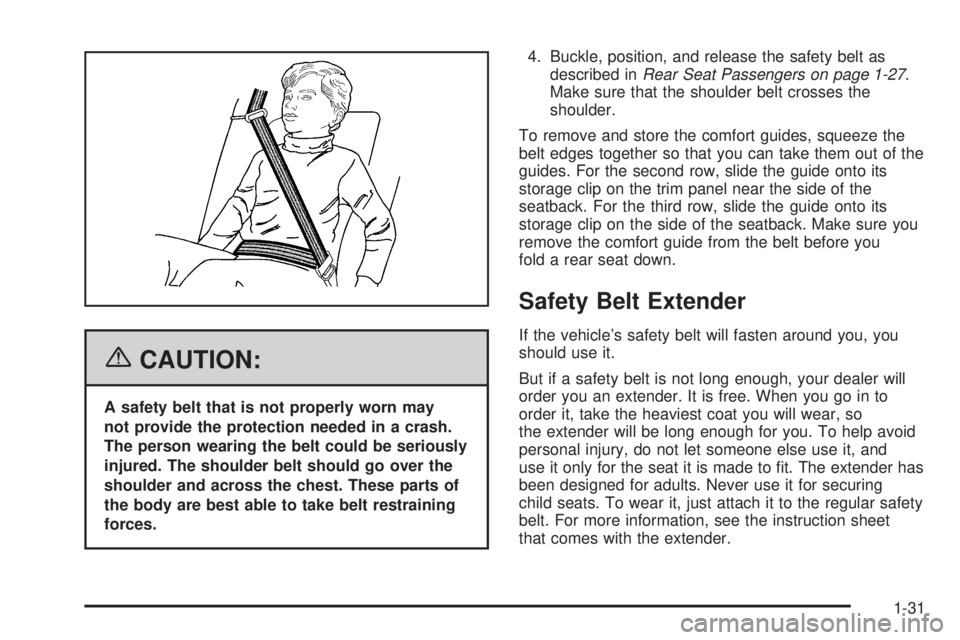
{CAUTION:
A safety belt that is not properly worn may
not provide the protection needed in a crash.
The person wearing the belt could be seriously
injured. The shoulder belt should go over the
shoulder and across the chest. These parts of
the body are best able to take belt restraining
forces.4. Buckle, position, and release the safety belt as
described inRear Seat Passengers on page 1-27.
Make sure that the shoulder belt crosses the
shoulder.
To remove and store the comfort guides, squeeze the
belt edges together so that you can take them out of the
guides. For the second row, slide the guide onto its
storage clip on the trim panel near the side of the
seatback. For the third row, slide the guide onto its
storage clip on the side of the seatback. Make sure you
remove the comfort guide from the belt before you
fold a rear seat down.
Safety Belt Extender
If the vehicle’s safety belt will fasten around you, you
should use it.
But if a safety belt is not long enough, your dealer will
order you an extender. It is free. When you go in to
order it, take the heaviest coat you will wear, so
the extender will be long enough for you. To help avoid
personal injury, do not let someone else use it, and
use it only for the seat it is made to t. The extender has
been designed for adults. Never use it for securing
child seats. To wear it, just attach it to the regular safety
belt. For more information, see the instruction sheet
that comes with the extender.
1-31
Page 38 of 502
Child Restraints
Older Children
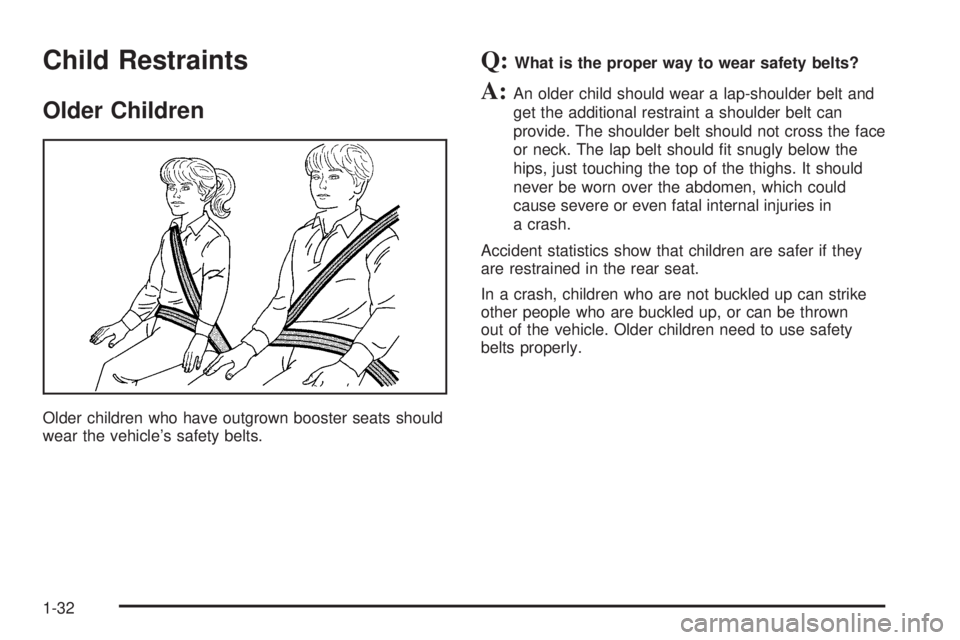
Older children who have outgrown booster seats should
wear the vehicle’s safety belts.
Q:What is the proper way to wear safety belts?
A:An older child should wear a lap-shoulder belt and
get the additional restraint a shoulder belt can
provide. The shoulder belt should not cross the face
or neck. The lap belt should t snugly below the
hips, just touching the top of the thighs. It should
never be worn over the abdomen, which could
cause severe or even fatal internal injuries in
a crash.
Accident statistics show that children are safer if they
are restrained in the rear seat.
In a crash, children who are not buckled up can strike
other people who are buckled up, or can be thrown
out of the vehicle. Older children need to use safety
belts properly.
1-32
Page 45 of 502
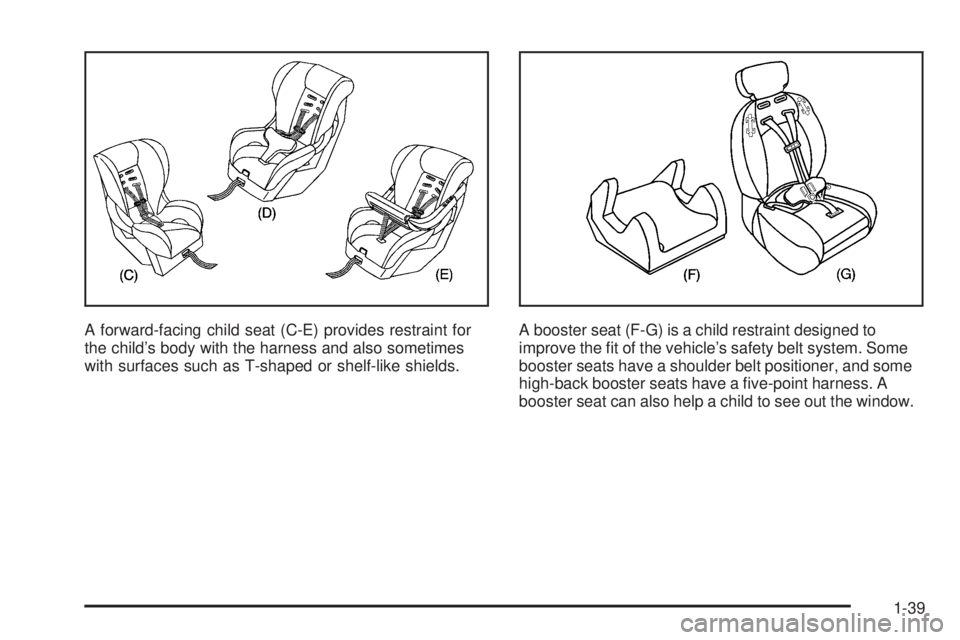
A forward-facing child seat (C-E) provides restraint for
the child’s body with the harness and also sometimes
with surfaces such as T-shaped or shelf-like shields.A booster seat (F-G) is a child restraint designed to
improve the t of the vehicle’s safety belt system. Some
booster seats have a shoulder belt positioner, and some
high-back booster seats have a ve-point harness. A
booster seat can also help a child to see out the window.
1-39
Page 46 of 502
Q:How Should I Use a Child Restraint?
A:A child restraint system is any device designed for
use in a motor vehicle to restrain, seat, or position
children. A built-in child restraint system is a
permanent part of the motor vehicle. An add-on
child restraint system is a portable one, which
is purchased by the vehicle’s owner. To help reduce
injuries, an add-on child restraint must be secured
in the vehicle. With built-in or add-on child
restraints, the child has to be secured within the
child restraint.
When choosing an add-on child restraint, be sure
the child restraint is designed to be used in a
vehicle. If it is, it will have a label saying that it
meets federal motor vehicle safety standards. Then
follow the instructions for the restraint. You may
nd these instructions on the restraint itself or in a
booklet, or both.
Securing an Add-on Child Restraint in
the Vehicle
{CAUTION:
A child can be seriously injured or killed in a
crash if the child restraint is not properly
secured in the vehicle. Make sure the child
restraint is properly installed in the vehicle
using the vehicle’s safety belt or LATCH
system, following the instructions that came
with that restraint, and also the instructions in
this manual.
To help reduce the chance of injury, the child restraint
must be secured in the vehicle. Child restraint systems
must be secured in vehicle seats by lap belts or the
lap belt portion of a lap-shoulder belt, or by the LATCH
system. SeeLower Anchors and Tethers for Children
(LATCH) on page 1-43for more information. A child can
be endangered in a crash if the child restraint is not
properly secured in the vehicle.
1-40
Page 51 of 502
Your child restraint may have a single tether (A) or a
dual tether (C). Either will have a single attachment (B)
to secure the top tether to the anchor.
Some top tether-equipped child restraints are designed
for use with or without the top tether being attached.
Others require the top tether always to be attached. In
Canada, the law requires that forward-facing child
restraints have a top tether, and that the tether be
attached. In the United States, some child restraints also
have a top tether. Be sure to read and follow the
instructions for your child restraint.
If the child restraint does not have a top tether, one can
be obtained, in kit form, for many child restraints. Ask
the child restraint manufacturer whether or not a kit
is available.Lower Anchor and Top Tether Anchor
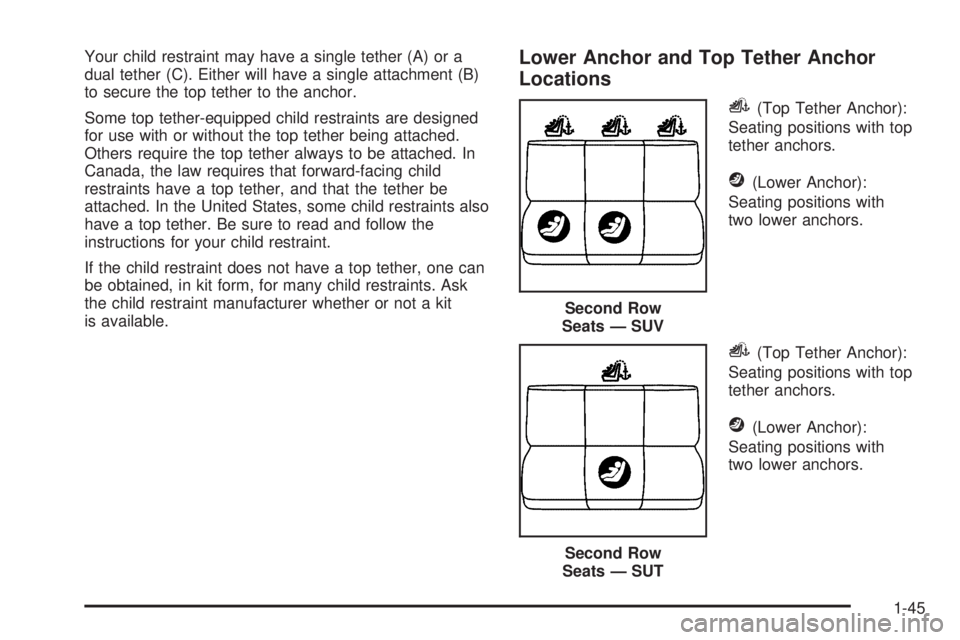
Locations
i(Top Tether Anchor):
Seating positions with top
tether anchors.
j(Lower Anchor):
Seating positions with
two lower anchors.
i(Top Tether Anchor):
Seating positions with top
tether anchors.
j(Lower Anchor):
Seating positions with
two lower anchors. Second Row
Seats — SUV
Second Row
Seats — SUT
1-45
Page 52 of 502
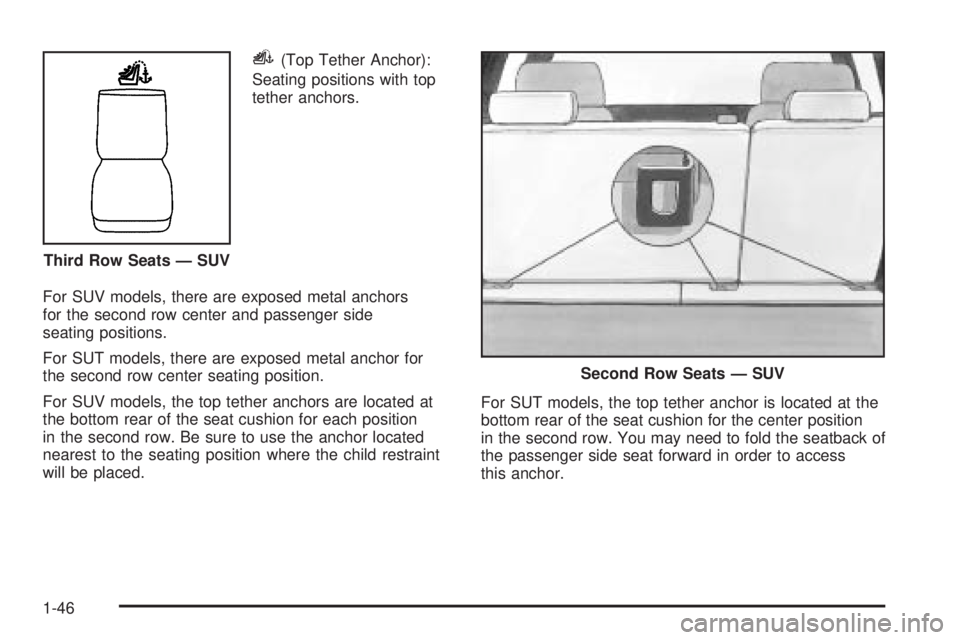
i(Top Tether Anchor):
Seating positions with top
tether anchors.
For SUV models, there are exposed metal anchors
for the second row center and passenger side
seating positions.
For SUT models, there are exposed metal anchor for
the second row center seating position.
For SUV models, the top tether anchors are located at
the bottom rear of the seat cushion for each position
in the second row. Be sure to use the anchor located
nearest to the seating position where the child restraint
will be placed.For SUT models, the top tether anchor is located at the
bottom rear of the seat cushion for the center position
in the second row. You may need to fold the seatback of
the passenger side seat forward in order to access
this anchor. Third Row Seats — SUV
Second Row Seats — SUV
1-46
Page 53 of 502
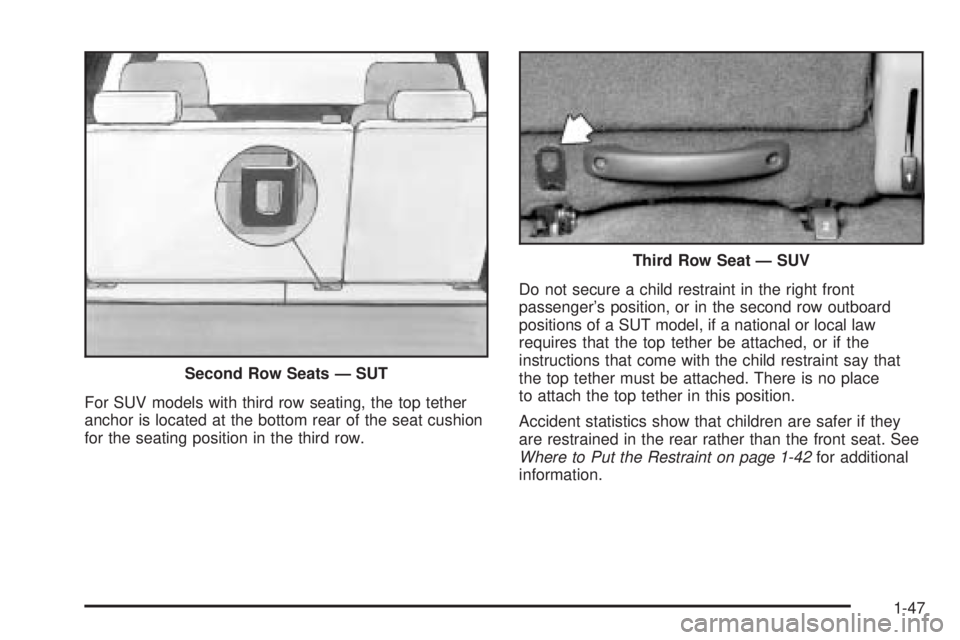
For SUV models with third row seating, the top tether
anchor is located at the bottom rear of the seat cushion
for the seating position in the third row.Do not secure a child restraint in the right front
passenger’s position, or in the second row outboard
positions of a SUT model, if a national or local law
requires that the top tether be attached, or if the
instructions that come with the child restraint say that
the top tether must be attached. There is no place
to attach the top tether in this position.
Accident statistics show that children are safer if they
are restrained in the rear rather than the front seat. See
Where to Put the Restraint on page 1-42for additional
information. Second Row Seats — SUT
Third Row Seat — SUV
1-47
Page 62 of 502
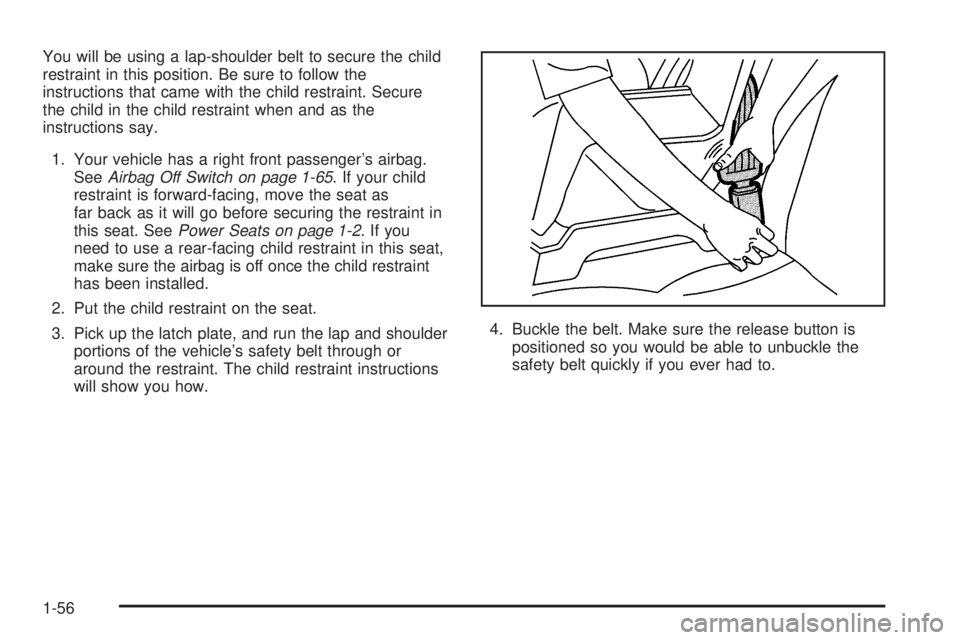
You will be using a lap-shoulder belt to secure the child
restraint in this position. Be sure to follow the
instructions that came with the child restraint. Secure
the child in the child restraint when and as the
instructions say.
1. Your vehicle has a right front passenger’s airbag.
SeeAirbag Off Switch on page 1-65. If your child
restraint is forward-facing, move the seat as
far back as it will go before securing the restraint in
this seat. SeePower Seats on page 1-2.Ifyou
need to use a rear-facing child restraint in this seat,
make sure the airbag is off once the child restraint
has been installed.
2. Put the child restraint on the seat.
3. Pick up the latch plate, and run the lap and shoulder
portions of the vehicle’s safety belt through or
around the restraint. The child restraint instructions
will show you how.4. Buckle the belt. Make sure the release button is
positioned so you would be able to unbuckle the
safety belt quickly if you ever had to.
1-56
Page 88 of 502
Midgate®(SUT)
{CAUTION:
It can be dangerous to drive with the cargo
area covered and the tailgate and the midgate®
open because carbon monoxide (CO) gas can
come into your vehicle. You can not see or
smell CO. It can cause unconsciousness and
even death. If you must drive with the cargo
covers on and the tailgate and midgate
®open
or if electrical wiring or other cable
connections must pass through the seal
between the body and the midgate
®:
Make sure all windows are shut.Turn the fan on your heating or cooling
system to its highest speed on the setting
that brings in outside air. This will force
outside air into your vehicle. SeeDual
Automatic Climate Control System on
page 3-22.
If you have air outlets on or under the
instrument panel, open them all the way.
SeeEngine Exhaust on page 2-37.
The midgate
®allows you to extend the length of your
vehicle’s cargo area into the cab.
Lowering the Midgate®
The midgate®window must be completely lowered for
the midgate®to be lowered. See “Midgate®Window”
underPower Windows on page 2-18.
Both the midgate
®and the midgate®window can be
lowered while the ignition is in either RUN or
ACCESSORY, or while in Retained Accessory Power
(RAP) mode. SeeRetained Accessory Power (RAP) on
page 2-25for more information.
To lower the midgate
®, do the following:
1. Fold the rear seats forward. See60/40 Split Bench
Seat on page 1-6. The front seats may have to be
moved forward slightly.
2.
K(Midgate®Window):Press the bottom part of
this switch to lower the midgate®window. See
Instrument Panel Overview on page 3-4for
the location of this switch. The window can also be
operated using the global express-down button.
See “Global Glass Feature” underPower Windows
on page 2-18.
2-12