wheel HUMMER H2 2007 Repair Manual
[x] Cancel search | Manufacturer: HUMMER, Model Year: 2007, Model line: H2, Model: HUMMER H2 2007Pages: 570, PDF Size: 3.34 MB
Page 358 of 570

Rocking Your Vehicle to Get It Out
First, turn the steering wheel left and right.
That will clear the area around the front wheels.
Your vehicle has a traction control system that
will activate when the system senses that
the wheels are spinning. SeeTraction Control
System (TCS) on page 309for more information.
Then, with the wheels straight ahead, shift
back and forth between REVERSE (R) and a
forward gear, spinning the wheels as little
as possible. Release the accelerator pedal while
you shift, and press lightly on the accelerator pedal
when the transmission is in gear. By slowly
spinning the wheels in the forward and reverse
directions, you will cause a rocking motion
that may free your vehicle. If that does not get
your vehicle out after a few tries, it may need to
be towed out. Or, you can use the recovery loops.
If your vehicle does need to be towed out, see
Towing Your Vehicle on page 369.
Recovery Loops
{CAUTION:
These loops, when used, are under a lot
of force. Keep people away from the
vicinity of the loops and any chains or
cables during use. Always pull the vehicle
straight out. Never pull on the loops at a
sideways angle. The loops could break off
and you or others could be injured from
the chain or cable snapping back.
Notice:Never use the recovery loops to tow
the vehicle. Your vehicle could be damaged
and it would not be covered by warranty.
358
Page 361 of 570

Never use the front mounted receiver to tow
a trailer.
You can use the front mounted receiver to tow
your vehicle behind another. SeeRecreational
Vehicle Towing on page 369.
Power Winch Platform
You can use the power winch platform
(if equipped) with an aftermarket winch.
Connect the winch to the platform and wiring to
the vehicle following the winch manufacturer’s
guidelines.
Notice:Do not use the winch platform to
winch at a tension of more than 9,000 lbs.
(4 082 kg). This would damage your vehicle’s
frame. This damage would not be covered
by your vehicle’s warranty.If you are using a winch to pull out another
vehicle, follow the winch manufacturer’s guidelines
and observe the following to prevent damage to
your vehicle:
If possible, have your vehicle anchored from
the opposite side of the winch to a solid,
immovable object.
If winching from the front, use both of the rear
recovery loops. If winching from the rear,
use both of the front recovery loops.
Put your transmission in NEUTRAL (N).
Use your regular brakes to hold your vehicle
in place and block the wheels to keep the
vehicle from moving.
Notice:Using a power winch with the
transmission in gear to pull out another vehicle
may damage the transmission. When operating
a power winch, always leave the transmission
in NEUTRAL (N).
361
Page 369 of 570

Towing
Towing Your Vehicle
Consult your dealer or a professional towing
service if you need to have your disabled vehicle
towed. SeeRoadside Assistance Program on
page 542.
If you want to tow your vehicle behind another
vehicle for recreational purposes (such as behind
a motorhome), see “Recreational Vehicle
Towing” following.
Recreational Vehicle Towing
Recreational vehicle towing means towing your
vehicle behind another vehicle – such as behind a
motorhome. The two most common types of
recreational vehicle towing are known as “dinghy
towing” (towing your vehicle with all four wheels
on the ground) and “dolly towing” (towing
your vehicle with two wheels on the ground and
two wheels up on a device known as a “dolly”).With the proper preparation and equipment, many
vehicles can be towed in these ways. See “Dinghy
Towing” and “Dolly Towing,” following.
Here are some important things to consider before
you do recreational vehicle towing:
What’s the towing capacity of the towing
vehicle? Be sure you read the tow vehicle
manufacturer’s recommendations.
How far will you tow? Some vehicles have
restrictions on how far and how long they
can tow.
Do you have the proper towing equipment?
See your dealer or trailering professional
for additional advice and equipment
recommendations.
Is your vehicle ready to be towed? Just as
you would prepare your vehicle for a long
trip, you’ll want to make sure your vehicle is
prepared to be towed. SeeBefore Leaving on
a Long Trip on page 349.
369
Page 370 of 570

Dinghy Towing
Use the following procedure to tow your vehicle:
1. Shift the transmission to PARK (P).
2. Turn the engine off, but leave the ignition in
ACCESSORY.
3. Firmly set the parking brake.
4. Securely attach the vehicle being towed to the
tow vehicle.
{CAUTION:
Shifting a full-time four-wheel-drive
vehicle’s transfer case into NEUTRAL can
cause your vehicle to roll even if the
transmission is in PARK (P). You or others
could be injured. Make sure the parking
brake is rmly set before you shift the
transfer case to NEUTRAL.
5. Shift the transfer case to NEUTRAL (N).
SeeFull-Time Four-Wheel Drive on
page 128for the proper procedure to select
the NEUTRAL position for your vehicle.6. Release the parking brake only after the
vehicle being towed is rmly attached to
the towing vehicle. You can use your vehicle’s
front mounted receiver with the proper
accessories to tow it. See “Front Mounted
Receiver” underIf Your Vehicle is Stuck
in Sand, Mud, Ice, or Snow on page 357.
7. Turn the ignition to ACCESSORY.
8. Disconnect the battery if you are going to tow
for long distances or long periods of time.
When towing your vehicle for extended periods of
time, start your vehicle as often as possible to
prevent battery drain. This should only be
done when the tow vehicle is parked.
Dolly Towing
Your vehicle cannot be dolly towed. If you must
tow your vehicle behind another, use the
dinghy towing procedure listed previously.
Notice:Dolly towing your vehicle will damage
drivetrain components. Do not dolly tow
your vehicle.
370
Page 371 of 570
Selectable Extended Rear Ride
Height
If your vehicle has this feature it comes as part
of the electronically controlled air suspension
system.
The selectable rear ride height allows you to raise
the rear of the vehicle about 2 inches (5 cm)
over the normal ride height. This can be helpful
when driving off-road where you may need
more ground clearance to clear an obstacle.
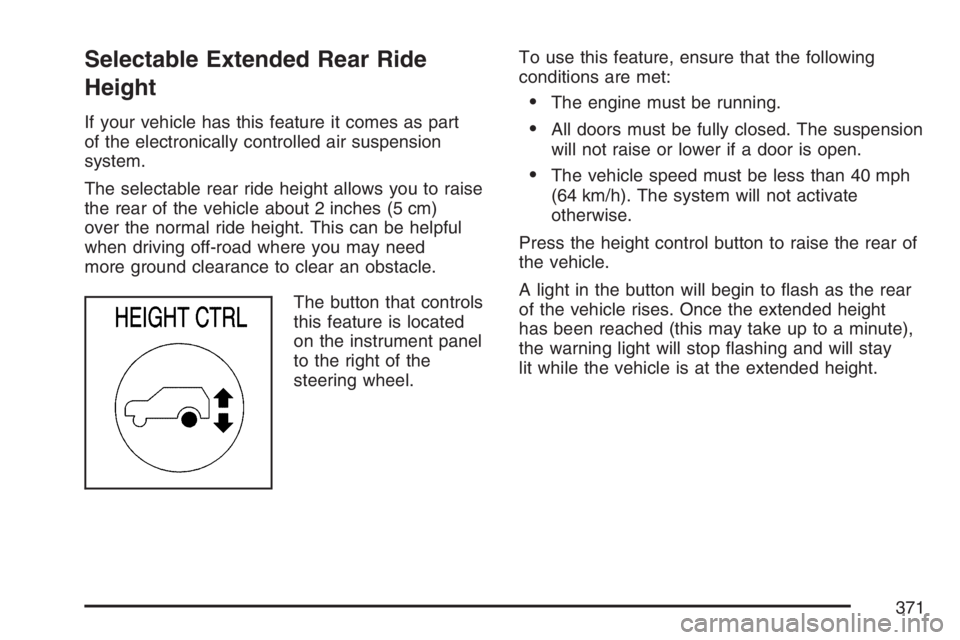
The button that controls
this feature is located
on the instrument panel
to the right of the
steering wheel.To use this feature, ensure that the following
conditions are met:
The engine must be running.
All doors must be fully closed. The suspension
will not raise or lower if a door is open.
The vehicle speed must be less than 40 mph
(64 km/h). The system will not activate
otherwise.
Press the height control button to raise the rear of
the vehicle.
A light in the button will begin to ash as the rear
of the vehicle rises. Once the extended height
has been reached (this may take up to a minute),
the warning light will stop ashing and will stay
lit while the vehicle is at the extended height.
371
Page 376 of 570

Tow/Haul Mode
Tow/haul mode is used when using your vehicle to
pull a large or heavy load or trailer. Tow/haul is
also useful while pulling a load in rolling terrain, in
stop-and-go traffic, or when you need improved
low-speed control, such as when parking.
The purpose of the tow/haul mode is to do the
following:
Reduce the frequency and improve the
predictability of transmission shifts when
pulling a heavy trailer or a large or heavy load.
Provide the same solid shift feel when pulling a
heavy trailer or a large or heavy load as when
the vehicle is unloaded.
Improve control of vehicle speed while requiring
less accelerator pedal activity when pulling a
heavy trailer or a large or heavy load.
Tow/haul mode is most effective when the vehicle
and trailer combined weight is at least 75 percent of
the vehicle’s Gross Combination Weight Rating
(GCWR). See “Weight of the Trailer” later in this
section.Press the button on the
instrument panel to the
right of the steering
wheel to enable
the tow/haul mode.
A light on the instrument
panel will illuminate to
indicate that tow/haul
mode has been
selected.
Press the button again to turn off tow/haul mode.
The indicator light on the instrument panel will
turn off. The vehicle will automatically turn
off tow/haul mode every time it is started.
Driving with tow/haul mode activated without a
heavy load or with no trailer will cause reduced
fuel economy and unpleasant engine and
transmission driving characteristics, but will not
cause damage.
376
Page 377 of 570

Weight of the Trailer
How heavy can a trailer safely be?
It depends on how you plan to use your rig.
For example, speed, altitude, road grades, outside
temperature and how much your vehicle is used
to pull a trailer are all important. It can also depend
on any special equipment that you have on your
vehicle, and the amount of tongue weight the
vehicle can carry. See “Weight of the Trailer
Tongue” later in this section for more information.Maximum trailer weight is calculated assuming
only the driver is in the tow vehicle and it has all
the required trailering equipment. The weight
of additional optional equipment, passengers and
cargo in the tow vehicle must be subtracted
from the maximum trailer weight.
Use the following chart to determine how much
your vehicle can weigh, based upon your vehicle
model and options.
Engine Axle Ratio Maximum Trailer Weight **GCWR
6000 V8 (SUV) 4.10 6,700 lbs (3 039 kg) 13,500 lbs (6 123 kg)
6000 V8 (SUT)* 4.10 6,600 lbs (2 994 kg) 13,500 lbs (6 123 kg)
**The Gross Combination Weight Rating (GCWR) in the total allowable weight of the completely loaded vehicle
and trailer including any passengers, cargo, equipment and conversions. The GCWR for your vehicle should not
be exceeded.
*Sport utility truck (SUT) models are neither designed nor intended to tow 5th wheel or gooseneck trailers.
You can ask your dealer for our trailering
information or advice, or you can write us at our
Customer Assistance Offices. SeeCustomer
Assistance Offices on page 540for more
information.
377
Page 383 of 570

Following Distance
Stay at least twice as far behind the vehicle ahead
as you would when driving your vehicle without
a trailer. This can help you avoid situations
that require heavy braking and sudden turns.
Passing
You’ll need more passing distance up ahead when
you’re towing a trailer. Because you’re a good
deal longer, you’ll need to go much farther beyond
the passed vehicle before you can return to
your lane.
Backing Up
Hold the bottom of the steering wheel with one
hand. Then, to move the trailer to the left,
just move that hand to the left. To move the trailer
to the right, move your hand to the right. Always
back up slowly and, if possible, have someone
guide you.
Making Turns
Notice:Making very sharp turns while
trailering could cause the trailer to come in
contact with the vehicle. Your vehicle could be
damaged. Avoid making very sharp turns
while trailering.
When you’re turning with a trailer, make wider
turns than normal. Do this so your trailer
won’t strike soft shoulders, curbs, road signs,
trees or other objects. Avoid jerky or sudden
maneuvers. Signal well in advance.
Turn Signals When Towing a Trailer
The arrows on your instrument panel will
ash whenever you signal a turn or lane change.
Properly hooked up, the trailer lamps will also
ash, telling other drivers you’re about to
turn, change lanes or stop.
When towing a trailer, the arrows on your
instrument panel will ash for turns even if the
bulbs on the trailer are burned out. Thus, you may
think drivers behind you are seeing your signal
when they are not. It’s important to check
occasionally to be sure the trailer bulbs are still
working.
383
Page 384 of 570
Driving On Grades
Reduce speed and shift to a lower gearbefore
you start down a long or steep downgrade. If you
don’t shift down, you might have to use your
brakes so much that they would get hot and no
longer work well.
You can tow in DRIVE (D). You may want to shift
the transmission to THIRD (3) or, if necessary,
a lower gear selection if the transmission shifts too
often (e.g., under heavy loads and/or hilly
conditions).
You may also want to activate the tow/haul mode
if the transmission shifts too often. See “Tow/Haul
Mode” earlier.
When towing at high altitude on steep uphill grades,
consider the following: Engine coolant will boil at a
lower temperature than at normal altitudes. If you
turn your engine off immediately after towing at high
altitude on steep uphill grades, your vehicle may
show signs similar to engine overheating. To avoid
this, let the engine run while parked (preferably on
level ground) with the automatic transmission in
PARK (P) for a few minutes before turning the
engine off. If you do get the overheat warning,
seeEngine Overheating on page 418.
Parking on Hills
{CAUTION:
You really should not park your
vehicle, with a trailer attached, on a hill.
If something goes wrong, your rig could
start to move. People can be injured, and
both your vehicle and the trailer can be
damaged.
But if you ever have to park your rig on a hill,
here’s how to do it:
1. Apply your regular brakes, but don’t shift into
PARK (P) yet.
2. Have someone place chocks under the trailer
wheels.
3. When the wheel chocks are in place, release
the regular brakes until the chocks absorb
the load.
4. Reapply the regular brakes. Then apply your
parking brake and shift into PARK (P).
5. Release the regular brakes.
384
Page 389 of 570

Service........................................................ 392
Accessories and Modications................... 392
California Proposition 65 Warning.............. 393
Doing Your Own Service Work.................. 393
Adding Equipment to the Outside of
Your Vehicle.......................................... 394
Fuel............................................................. 394
Gasoline Octane........................................ 394
Gasoline Specications.............................. 394
California Fuel........................................... 395
Additives................................................... 395
Fuels in Foreign Countries........................ 396
Filling the Tank......................................... 397
Filling a Portable Fuel Container............... 399
Checking Things Under the Hood.............. 400
Hood Release........................................... 400
Engine Compartment Overview.................. 402
Engine Oil................................................. 404
Engine Oil Life System.............................. 407
Engine Air Cleaner/Filter............................ 409
Automatic Transmission Fluid.................... 412
Engine Coolant.......................................... 415Coolant Surge Tank Pressure Cap............ 418
Engine Overheating................................... 418
Overheated Engine Protection
Operating Mode..................................... 420
Cooling System......................................... 420
Power Steering Fluid ................................. 425
Windshield Washer Fluid........................... 426
Brakes...................................................... 427
Battery...................................................... 431
Jump Starting............................................ 432
Rear Axle.................................................... 437
Four-Wheel Drive........................................ 438
Front Axle................................................... 440
Bulb Replacement....................................... 441
Halogen Bulbs........................................... 441
Headlamps................................................ 441
Front Turn Signal and Parking Lamps.......... 442
Daytime Running Lamps (DRL)................. 443
Roof Marker Lamps................................... 443
Taillamps, Turn Signal, Stoplamps and
Back-up Lamps...................................... 444
Replacement Bulbs................................... 446
Section 5 Service and Appearance Care
389