ignition HUMMER H2 2009 Owner's Manual
[x] Cancel search | Manufacturer: HUMMER, Model Year: 2009, Model line: H2, Model: HUMMER H2 2009Pages: 524, PDF Size: 3.1 MB
Page 112 of 524
PASS-Key®III+ Electronic
Immobilizer Operation
Your vehicle has PASS-Key®III+ (Personalized
Automotive Security System) theft-deterrent system.
PASS-Key
®III+ is a passive theft-deterrent system.
The system is automatically armed when the key
is removed from the ignition.
The system is automatically disarmed when the key
is turned to ON/RUN, ACC/ACCESSORY or START
from the LOCK/OFF position.
You do not have to manually arm or disarm the system.
The security light will come on if there is a problem
with arming or disarming the theft-deterrent system.
When the PASS-Key
®III+ system senses that someone
is using the wrong key, it prevents the vehicle from
starting. Anyone using a trial-and-error method to start
the vehicle will be discouraged because of the high
number of electrical key codes.If the engine does not start and the security light on
the instrument panel cluster comes on when trying to
start the vehicle, there may be a problem with your
theft-deterrent system. Turn the ignition off and try again.
If the engine still does not start, and the key appears to
be undamaged, try another ignition key. At this time, you
may also want to check the fuse, seeFuses and Circuit
Breakers on page 5-110. If the engine still does not start
with the other key, your vehicle needs service. If your
vehicle does start, the rst key may be faulty. See your
dealer/retailer who can service the PASS-Key
®III+
to have a new key made. In an emergency, contact
Roadside Assistance.
It is possible for the PASS-Key
®III+ decoder to learn
the transponder value of a new or replacement key.
Up to 10 keys may be programmed for the vehicle.
The following procedure is for programming additional
keys only. If all the currently programmed keys are
lost or do not operate, you must see your dealer/retailer
or a locksmith who can service PASS-Key
®III+ to
have keys made and programmed to the system.
See your dealer/retailer or a locksmith who can service
PASS-Key
®III+ to get a new key blank that is cut
exactly as the ignition key that operates the system.
2-26
Page 113 of 524
To program the new additional key:
1. Verify that the new key has a
1stamped on it.
2. Insert the original, already programmed, key in the
ignition and start the engine. If the engine will not
start, see your dealer/retailer for service.
3. After the engine has started, turn the key to
LOCK/OFF, and remove the key.
4. Insert the new key to be programmed and turn it to
the ON/RUN position within ve seconds of turning
the ignition to the LOCK/OFF position in Step 3.
The security light will turn off once the key has been
programmed.
5. Repeat Steps 1 through 4 if additional keys are to
be programmed.
If you lose or damage your PASS-Key
®III+ key, see
your dealer/retailer or a locksmith who can service
PASS-Key
®III+ to have a new key made.
Do not leave the key or device that disarms or
deactivates the theft deterrent system in the vehicle.
Starting and Operating Your
Vehicle
New Vehicle Break-In
Notice:The vehicle does not need an elaborate
break-in. But it will perform better in the long run if
you follow these guidelines:
Keep your speed at 55 mph (88 km/h) or less for
the rst 500 miles (805 km).
Do not drive at any one constant speed, fast or
slow, for the rst 500 miles (805 km). Do not
make full-throttle starts. Avoid downshifting to
brake or slow the vehicle.
Avoid making hard stops for the rst 200 miles
(322 km) or so. During this time the new brake
linings are not yet broken in. Hard stops with new
linings can mean premature wear and earlier
replacement. Follow this breaking-in guideline
every time you get new brake linings.
Do not tow a trailer during break-in. SeeTowing
a Trailer on page 4-55for the trailer towing
capabilities of the vehicle and more information.
Following break-in, engine speed and load can be
gradually increased.
2-27
Page 114 of 524

Ignition Positions
The ignition switch has
four different positions.
To shift out of P (Park), the ignition must be in ON/RUN
or ACC/ACCESSORY and the regular brake pedal
must be applied.A (LOCK/OFF):This position locks the ignition. It also
locks the transmission on automatic transmission
vehicles. The key can be removed in LOCK/OFF.
On vehicles with an automatic transmission, the shift
lever must be in P (Park) to turn the ignition switch
to LOCK/OFF.
The steering can bind with the wheels turned off center.
If this happens, move the steering wheel from right
to left while turning the key to ACC/ACCESSORY.
If this doesn’t work, then the vehicle needs service.
Notice:Using a tool to force the key to turn in
the ignition could cause damage to the switch or
break the key. Use the correct key, make sure it is
all the way in, and turn it only with your hand.
If the key cannot be turned by hand, see your
dealer/retailer.
B (ACC/ACCESSORY):This position lets things like
the radio and the windshield wipers operate while
the engine is off. Use this position if the vehicle must
be pushed or towed.
2-28
Page 115 of 524
C (ON/RUN):This position can be used to operate the
electrical accessories and to display some instrument
panel cluster warning and indicator lights. The switch
stays in this position when the engine is running.
The transmission is also unlocked in this position
on automatic transmission vehicles.
If you leave the key in the ACC/ACCESSORY or ON/
RUN position with the engine off, the battery could be
drained. You may not be able to start the vehicle if the
battery is allowed to drain for an extended period of time.
D (START):This is the position that starts the engine.
When the engine starts, release the key. The ignition
switch returns to ON/RUN for driving.
A warning tone will sound when the driver door is
opened, the ignition is in ACC/ACCESSORY or
LOCK/OFF and the key is in the ignition.Retained Accessory Power (RAP)
These vehicle accessories can be used for up to
10 minutes after the engine is turned off:
Audio System
Sunroof
Power Windows
The sunroof and power windows will continue to work
up to 10 minutes after the key is turned to LOCK/OFF
or until any door is opened. The radio will continue
to work for up to 10 minutes after the key is turned
to LOCK/OFF or until the driver door is opened.
Starting the Engine
Move the shift lever to P (Park) or N (Neutral).
The engine will not start in any other position.
To restart the engine when the vehicle is already
moving, use N (Neutral) only.
Notice:Do not try to shift to P (Park) if the
vehicle is moving. If you do, you could damage
the transmission. Shift to P (Park) only when the
vehicle is stopped.
2-29
Page 116 of 524
Starting Procedure
1. With your foot off the accelerator pedal, turn the
ignition to START. When the engine starts, let go of
the key. The idle speed will slow down as the engine
warms. Do not race the engine immediately after
starting it. Operate the engine and transmission
gently to allow the oil to warm up and lubricate all
moving parts.
The vehicle has a Computer-Controlled Cranking
System. This feature assists in starting the engine
and protects components. If the ignition key is turned
to the START position, and then released when the
engine begins cranking, the engine will continue
cranking for a few seconds or until the vehicle starts.
If the engine does not start and the key is held in
START, cranking will be stopped after 15 seconds
to prevent cranking motor damage. To prevent gear
damage, this system also prevents cranking if the
engine is already running. Engine cranking can
be stopped by turning the ignition switch to the
ACC/ACCESSORY or LOCK/OFF position.
Notice:Cranking the engine for long periods of
time, by returning the key to the START position
immediately after cranking has ended, can overheat
and damage the cranking motor, and drain the
battery. Wait at least 15 seconds between each try,
to let the cranking motor cool down.2. If the engine does not start after 5-10 seconds,
especially in very cold weather (below 0°F or−18°C),
it could be ooded with too much gasoline.
Try pushing the accelerator pedal all the way to
the oor and holding it there as you hold the key in
START for up to a maximum of 15 seconds. Wait at
least 15 seconds between each try, to allow the
cranking motor to cool down. When the engine starts,
let go of the key and accelerator. If the vehicle starts
briey but then stops again, repeat these steps.
This clears the extra gasoline from the engine.
Do not race the engine immediately after starting it.
Operate the engine and transmission gently until
the oil warms up and lubricates all moving parts.
Notice:The engine is designed to work with the
electronics in the vehicle. If you add electrical parts
or accessories, you could change the way the
engine operates. Before adding electrical equipment,
check with your dealer/retailer. If you do not, the
engine might not perform properly. Any resulting
damage would not be covered by the vehicle
warranty.
2-30
Page 118 of 524
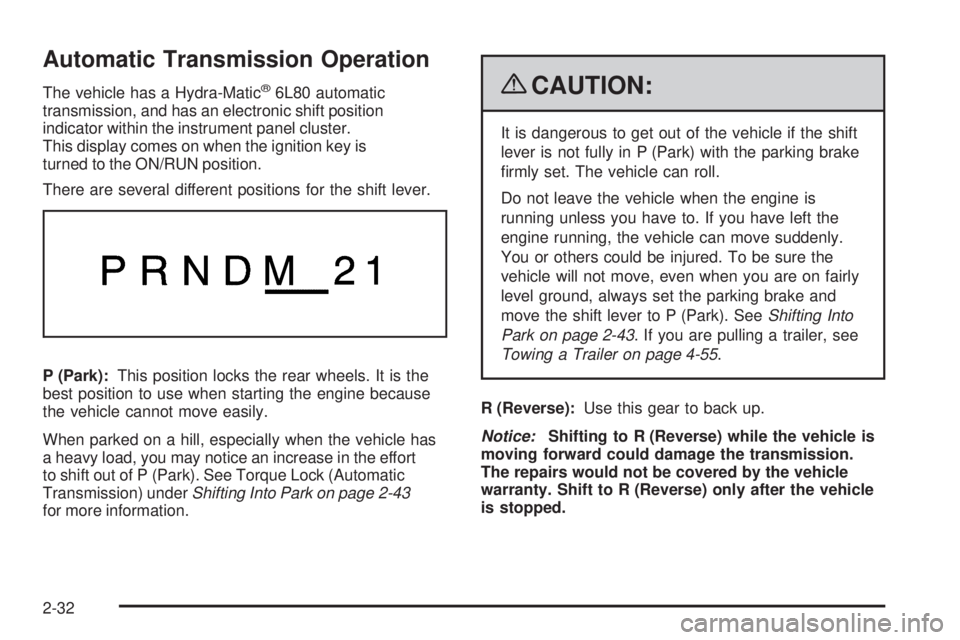
Automatic Transmission Operation
The vehicle has a Hydra-Matic®6L80 automatic
transmission, and has an electronic shift position
indicator within the instrument panel cluster.
This display comes on when the ignition key is
turned to the ON/RUN position.
There are several different positions for the shift lever.
P (Park):This position locks the rear wheels. It is the
best position to use when starting the engine because
the vehicle cannot move easily.
When parked on a hill, especially when the vehicle has
a heavy load, you may notice an increase in the effort
to shift out of P (Park). See Torque Lock (Automatic
Transmission) underShifting Into Park on page 2-43
for more information.{CAUTION:
It is dangerous to get out of the vehicle if the shift
lever is not fully in P (Park) with the parking brake
rmly set. The vehicle can roll.
Do not leave the vehicle when the engine is
running unless you have to. If you have left the
engine running, the vehicle can move suddenly.
You or others could be injured. To be sure the
vehicle will not move, even when you are on fairly
level ground, always set the parking brake and
move the shift lever to P (Park). SeeShifting Into
Park on page 2-43. If you are pulling a trailer, see
Towing a Trailer on page 4-55.
R (Reverse):Use this gear to back up.
Notice:Shifting to R (Reverse) while the vehicle is
moving forward could damage the transmission.
The repairs would not be covered by the vehicle
warranty. Shift to R (Reverse) only after the vehicle
is stopped.
2-32
Page 125 of 524
N (Neutral):Shift the transfer case to N (Neutral) only
when towing the vehicle. SeeRecreational Vehicle
Towing on page 4-50orTowing Your Vehicle on
page 4-50for more information.
Indicator lights in the dial show which mode you are in.
The indicator lights will come on briey when you turn on
the ignition and one will stay on. If the lights do not come
on, take the vehicle to your dealer/retailer for service.
An indicator light will ash while shifting the transfer case.
It will remain on when the shift is complete. If the transfer
case cannot make a requested shift, it will return to the
last chosen setting.
If the SERVICE 4WD message stays on, you should
take the vehicle to your dealer/retailer for service.
See “Service 4WD message” underDriver Information
Center (DIC) on page 3-46.
Shifting between Four-Wheel High and
Four-Wheel-High Lock
With the vehicle traveling less than 40 mph
(64 km/h), turn the dial to the Four-Wheel High or
Four-Wheel-High Lock position. The indicator light
on the dial will ash while shifting. It will remain on
when the shift is complete.
It may be necessary to drive backwards for a short
distance of 25 feet (7.5 m) to get the lock feature
to disengage.
Shifting into Four-Wheel-Low Lock
To shift into Four-Wheel-Low Lock, the ignition must be
in ON/RUN and the vehicle must be stopped or moving
less than 3 mph (5 km/h) with the transmission in
N (Neutral). The preferred method for shifting into
Four-Wheel Low Lock is to have the vehicle moving
1 to 2 mph (1.6 to 3.2 km/h). Turn the dial to the
Four-Wheel-Low Lock position. You must wait for the
Four-Wheel-Low Lock indicator light on the dial to stop
ashing and remain lit before shifting the transmission
in gear.
When the transfer case is shifted into the
Four-Wheel-Low Lock position a StabiliTrak
®indicator
light will come on to show that the system has been
turned off and a message will show in the DIC.
SeeDIC Warnings and Messages on page 3-56
for more information.
Notice:Shifting the transmission into gear before
the indicator light stops ashing could cause
damage to the transfer case. Always wait until the
indicator light stops ashing before putting the
transmission back in gear.
It is normal for the vehicle to have engagement noise
and bump when shifting between Four-Wheel Low Lock,
Full-Time Four-Wheel Drive or Four-Wheel-High Lock
ranges or from N (Neutral) with the engine running.
2-39
Page 126 of 524
If the Four-Wheel-Low Lock position is selected when
the vehicle is in gear and/or moving, the Four-Wheel
Low Lock indicator light will ash for 15 seconds and
not complete the shift unless the vehicle is moving
less than 3 mph (5 km/h) and the transmission is
in N (Neutral). After 15 seconds the transfer case
will return to the setting last chosen.
Shifting Out of Four-Wheel Low Lock
To shift from Four-Wheel-Low Lock to Full-Time
Four-Wheel Drive or Four-Wheel-High Lock, the vehicle
must be stopped or moving less than 3 mph (5 km/h)
with the transmission in N (Neutral) and the ignition in
ON/RUN. The preferred method for shifting out of
Four-Wheel-Low Lock is to have the vehicle moving
1 to 2 mph (1.6 to 3.2 km/h). Turn the dial to the
Full-Time Four-Wheel Drive or Four-Wheel-High Lock
position. You must wait for the Full-Time Four-Wheel
Drive or Four-Wheel-High Lock indicator light to stop
ashing and remain lit before shifting the transmission
into gear.It is normal for the vehicle to have engagement noise
and bump when shifting between Four-Wheel Low Lock,
Full-Time Four-Wheel Drive or Four-Wheel-High Lock
ranges or from N (Neutral) with the engine running.
If the Full-Time Four-Wheel Drive or
Four-Wheel-High Lock position is selected when
the vehicle is in gear and/or moving, the Full-Time
Four-Wheel Drive or Four-Wheel-High Lock indicator
light will ash for 30 seconds but will not complete
the shift unless the vehicle is moving less than 3 mph
(5 km/h) and the transmission is in N (Neutral).
Notice:Shifting the transmission into gear before
the indicator light stops ashing could cause
damage to the transfer case. Always wait until the
indicator light stops ashing before putting the
transmission back in gear.
2-40
Page 127 of 524
Shifting into Neutral
To shift the transfer case to N (Neutral) do the following:
1. Make sure the vehicle is parked so that it will
not roll.
2. Set the parking brake and apply the regular brake
pedal. SeeParking Brake on page 2-42.
3. Start the vehicle or turn the ignition to ON/RUN.
4. Put the transmission in N (Neutral).
5. Shift the transfer case to Full-Time Four-Wheel
Drive.
6. Turn the transfer case dial clockwise to N (Neutral)
position. The transfer case will not shift to N (Neutral)
unless this position is held for 10 seconds. The
N (Neutral) light will come on and then the dial can
be slowly released. The dial will be in the Four-Wheel
Low Lock position but the transfer case will be in
N (Neutral) with the N (Neutral) light on.
7. If the engine is running, make sure that the transfer
case is in N (Neutral) by shifting the transmission
to R (Reverse) for one second, then shift the
transmission to D (Drive) for one second.
8. Turn the ignition to ACC/ACCESSORY, which will
turn the engine off.
9. Place the transmission shift lever in P (Park).10. Release the parking brake prior to moving the
vehicle.
11. Turn the ignition to LOCK/OFF.
Shifting Out of Neutral
To shift out of N (Neutral) do the following:
1. Set the parking brake and apply the regular brake
pedal.
2. Shift the transmission to N (Neutral) and turn the
ignition to ON/RUN with the engine off.
3. Turn the transfer case dial to Full-Time Four-Wheel
Drive, Four-Wheel High Lock or Four-Wheel
Low Lock.
After the transfer case has shifted out of N (Neutral)
the N (Neutral) light will go out.
4. Release the parking brake prior to moving the
vehicle.
Notice:Shifting the transmission into gear before
the requested mode indicator light has stopped
ashing could damage the transfer case. To help
avoid damaging the vehicle, always wait for the
mode indicator lights to stop ashing before
shifting the transmission into gear.
5. Start the engine and shift the transmission to the
desired position.
2-41
Page 128 of 524
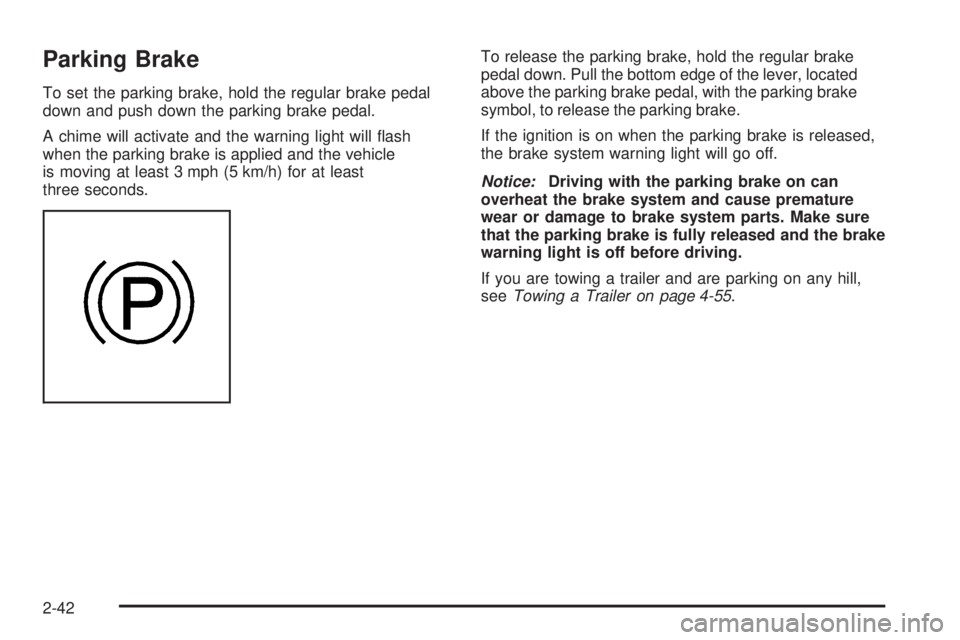
Parking Brake
To set the parking brake, hold the regular brake pedal
down and push down the parking brake pedal.
A chime will activate and the warning light will ash
when the parking brake is applied and the vehicle
is moving at least 3 mph (5 km/h) for at least
three seconds.To release the parking brake, hold the regular brake
pedal down. Pull the bottom edge of the lever, located
above the parking brake pedal, with the parking brake
symbol, to release the parking brake.
If the ignition is on when the parking brake is released,
the brake system warning light will go off.
Notice:Driving with the parking brake on can
overheat the brake system and cause premature
wear or damage to brake system parts. Make sure
that the parking brake is fully released and the brake
warning light is off before driving.
If you are towing a trailer and are parking on any hill,
seeTowing a Trailer on page 4-55.
2-42