light HUMMER H2 2009 Owner's Manual
[x] Cancel search | Manufacturer: HUMMER, Model Year: 2009, Model line: H2, Model: HUMMER H2 2009Pages: 524, PDF Size: 3.1 MB
Page 113 of 524
To program the new additional key:
1. Verify that the new key has a
1stamped on it.
2. Insert the original, already programmed, key in the
ignition and start the engine. If the engine will not
start, see your dealer/retailer for service.
3. After the engine has started, turn the key to
LOCK/OFF, and remove the key.
4. Insert the new key to be programmed and turn it to
the ON/RUN position within ve seconds of turning
the ignition to the LOCK/OFF position in Step 3.
The security light will turn off once the key has been
programmed.
5. Repeat Steps 1 through 4 if additional keys are to
be programmed.
If you lose or damage your PASS-Key
®III+ key, see
your dealer/retailer or a locksmith who can service
PASS-Key
®III+ to have a new key made.
Do not leave the key or device that disarms or
deactivates the theft deterrent system in the vehicle.
Starting and Operating Your
Vehicle
New Vehicle Break-In
Notice:The vehicle does not need an elaborate
break-in. But it will perform better in the long run if
you follow these guidelines:
Keep your speed at 55 mph (88 km/h) or less for
the rst 500 miles (805 km).
Do not drive at any one constant speed, fast or
slow, for the rst 500 miles (805 km). Do not
make full-throttle starts. Avoid downshifting to
brake or slow the vehicle.
Avoid making hard stops for the rst 200 miles
(322 km) or so. During this time the new brake
linings are not yet broken in. Hard stops with new
linings can mean premature wear and earlier
replacement. Follow this breaking-in guideline
every time you get new brake linings.
Do not tow a trailer during break-in. SeeTowing
a Trailer on page 4-55for the trailer towing
capabilities of the vehicle and more information.
Following break-in, engine speed and load can be
gradually increased.
2-27
Page 115 of 524
C (ON/RUN):This position can be used to operate the
electrical accessories and to display some instrument
panel cluster warning and indicator lights. The switch
stays in this position when the engine is running.
The transmission is also unlocked in this position
on automatic transmission vehicles.
If you leave the key in the ACC/ACCESSORY or ON/
RUN position with the engine off, the battery could be
drained. You may not be able to start the vehicle if the
battery is allowed to drain for an extended period of time.
D (START):This is the position that starts the engine.
When the engine starts, release the key. The ignition
switch returns to ON/RUN for driving.
A warning tone will sound when the driver door is
opened, the ignition is in ACC/ACCESSORY or
LOCK/OFF and the key is in the ignition.Retained Accessory Power (RAP)
These vehicle accessories can be used for up to
10 minutes after the engine is turned off:
Audio System
Sunroof
Power Windows
The sunroof and power windows will continue to work
up to 10 minutes after the key is turned to LOCK/OFF
or until any door is opened. The radio will continue
to work for up to 10 minutes after the key is turned
to LOCK/OFF or until the driver door is opened.
Starting the Engine
Move the shift lever to P (Park) or N (Neutral).
The engine will not start in any other position.
To restart the engine when the vehicle is already
moving, use N (Neutral) only.
Notice:Do not try to shift to P (Park) if the
vehicle is moving. If you do, you could damage
the transmission. Shift to P (Park) only when the
vehicle is stopped.
2-29
Page 122 of 524

Tow/Haul Mode
The vehicle has a tow/haul mode. The tow/haul mode
adjusts the transmission shift pattern to reduce shift
cycling, providing increased performance, vehicle
control, and transmission cooling while towing or
hauling heavy loads.
Press the button located on the instrument panel to the
right of the steering wheel to turn tow/haul on or off. While
tow/haul is on, a light on the instrument panel cluster
comes on.
SeeTow/Haul Mode Light on page 3-44for more
information.
Also see “Tow Haul Mode” underTowing a Trailer on
page 4-55for more information.
Grade Braking
Grade Braking is only active while the Tow/Haul Mode is
selected and you are not in the Range Selection Mode.
See “Tow/Haul Mode listed previously andAutomatic
Transmission Operation on page 2-32for more
information on the Range Selection Mode. Grade Braking
assists in maintaining desired vehicle speeds when
driving on downhill grades by automatically implementing
a shift schedule that utilizes the engine and transmission
to slow the vehicle. This reduces wear on the braking
system and increases control of the vehicle. Grade
Braking monitors vehicle speed, acceleration, engine
torque and brake pedal usage. Using this information,
it detects when the truck is on a downhill grade and the
driver desires to slow the vehicle by pressing the brake.
Also seeTowing a Trailer on page 4-55for more
information.
2-36
Page 124 of 524
Transfer Case Dial
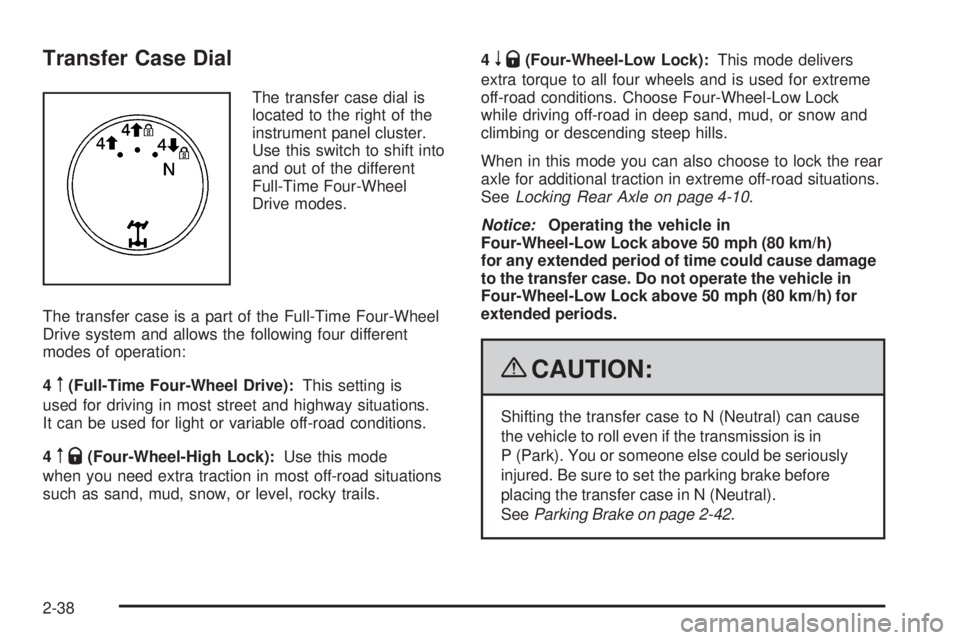
The transfer case dial is
located to the right of the
instrument panel cluster.
Use this switch to shift into
and out of the different
Full-Time Four-Wheel
Drive modes.
The transfer case is a part of the Full-Time Four-Wheel
Drive system and allows the following four different
modes of operation:
4
m(Full-Time Four-Wheel Drive):This setting is
used for driving in most street and highway situations.
It can be used for light or variable off-road conditions.
4
mQ(Four-Wheel-High Lock):Use this mode
when you need extra traction in most off-road situations
such as sand, mud, snow, or level, rocky trails.4
nQ(Four-Wheel-Low Lock):This mode delivers
extra torque to all four wheels and is used for extreme
off-road conditions. Choose Four-Wheel-Low Lock
while driving off-road in deep sand, mud, or snow and
climbing or descending steep hills.
When in this mode you can also choose to lock the rear
axle for additional traction in extreme off-road situations.
SeeLocking Rear Axle on page 4-10.
Notice:Operating the vehicle in
Four-Wheel-Low Lock above 50 mph (80 km/h)
for any extended period of time could cause damage
to the transfer case. Do not operate the vehicle in
Four-Wheel-Low Lock above 50 mph (80 km/h) for
extended periods.
{CAUTION:
Shifting the transfer case to N (Neutral) can cause
the vehicle to roll even if the transmission is in
P (Park). You or someone else could be seriously
injured. Be sure to set the parking brake before
placing the transfer case in N (Neutral).
SeeParking Brake on page 2-42.
2-38
Page 125 of 524
N (Neutral):Shift the transfer case to N (Neutral) only
when towing the vehicle. SeeRecreational Vehicle
Towing on page 4-50orTowing Your Vehicle on
page 4-50for more information.
Indicator lights in the dial show which mode you are in.
The indicator lights will come on briey when you turn on
the ignition and one will stay on. If the lights do not come
on, take the vehicle to your dealer/retailer for service.
An indicator light will ash while shifting the transfer case.
It will remain on when the shift is complete. If the transfer
case cannot make a requested shift, it will return to the
last chosen setting.
If the SERVICE 4WD message stays on, you should
take the vehicle to your dealer/retailer for service.
See “Service 4WD message” underDriver Information
Center (DIC) on page 3-46.
Shifting between Four-Wheel High and
Four-Wheel-High Lock
With the vehicle traveling less than 40 mph
(64 km/h), turn the dial to the Four-Wheel High or
Four-Wheel-High Lock position. The indicator light
on the dial will ash while shifting. It will remain on
when the shift is complete.
It may be necessary to drive backwards for a short
distance of 25 feet (7.5 m) to get the lock feature
to disengage.
Shifting into Four-Wheel-Low Lock
To shift into Four-Wheel-Low Lock, the ignition must be
in ON/RUN and the vehicle must be stopped or moving
less than 3 mph (5 km/h) with the transmission in
N (Neutral). The preferred method for shifting into
Four-Wheel Low Lock is to have the vehicle moving
1 to 2 mph (1.6 to 3.2 km/h). Turn the dial to the
Four-Wheel-Low Lock position. You must wait for the
Four-Wheel-Low Lock indicator light on the dial to stop
ashing and remain lit before shifting the transmission
in gear.
When the transfer case is shifted into the
Four-Wheel-Low Lock position a StabiliTrak
®indicator
light will come on to show that the system has been
turned off and a message will show in the DIC.
SeeDIC Warnings and Messages on page 3-56
for more information.
Notice:Shifting the transmission into gear before
the indicator light stops ashing could cause
damage to the transfer case. Always wait until the
indicator light stops ashing before putting the
transmission back in gear.
It is normal for the vehicle to have engagement noise
and bump when shifting between Four-Wheel Low Lock,
Full-Time Four-Wheel Drive or Four-Wheel-High Lock
ranges or from N (Neutral) with the engine running.
2-39
Page 126 of 524
If the Four-Wheel-Low Lock position is selected when
the vehicle is in gear and/or moving, the Four-Wheel
Low Lock indicator light will ash for 15 seconds and
not complete the shift unless the vehicle is moving
less than 3 mph (5 km/h) and the transmission is
in N (Neutral). After 15 seconds the transfer case
will return to the setting last chosen.
Shifting Out of Four-Wheel Low Lock
To shift from Four-Wheel-Low Lock to Full-Time
Four-Wheel Drive or Four-Wheel-High Lock, the vehicle
must be stopped or moving less than 3 mph (5 km/h)
with the transmission in N (Neutral) and the ignition in
ON/RUN. The preferred method for shifting out of
Four-Wheel-Low Lock is to have the vehicle moving
1 to 2 mph (1.6 to 3.2 km/h). Turn the dial to the
Full-Time Four-Wheel Drive or Four-Wheel-High Lock
position. You must wait for the Full-Time Four-Wheel
Drive or Four-Wheel-High Lock indicator light to stop
ashing and remain lit before shifting the transmission
into gear.It is normal for the vehicle to have engagement noise
and bump when shifting between Four-Wheel Low Lock,
Full-Time Four-Wheel Drive or Four-Wheel-High Lock
ranges or from N (Neutral) with the engine running.
If the Full-Time Four-Wheel Drive or
Four-Wheel-High Lock position is selected when
the vehicle is in gear and/or moving, the Full-Time
Four-Wheel Drive or Four-Wheel-High Lock indicator
light will ash for 30 seconds but will not complete
the shift unless the vehicle is moving less than 3 mph
(5 km/h) and the transmission is in N (Neutral).
Notice:Shifting the transmission into gear before
the indicator light stops ashing could cause
damage to the transfer case. Always wait until the
indicator light stops ashing before putting the
transmission back in gear.
2-40
Page 127 of 524
Shifting into Neutral
To shift the transfer case to N (Neutral) do the following:
1. Make sure the vehicle is parked so that it will
not roll.
2. Set the parking brake and apply the regular brake
pedal. SeeParking Brake on page 2-42.
3. Start the vehicle or turn the ignition to ON/RUN.
4. Put the transmission in N (Neutral).
5. Shift the transfer case to Full-Time Four-Wheel
Drive.
6. Turn the transfer case dial clockwise to N (Neutral)
position. The transfer case will not shift to N (Neutral)
unless this position is held for 10 seconds. The
N (Neutral) light will come on and then the dial can
be slowly released. The dial will be in the Four-Wheel
Low Lock position but the transfer case will be in
N (Neutral) with the N (Neutral) light on.
7. If the engine is running, make sure that the transfer
case is in N (Neutral) by shifting the transmission
to R (Reverse) for one second, then shift the
transmission to D (Drive) for one second.
8. Turn the ignition to ACC/ACCESSORY, which will
turn the engine off.
9. Place the transmission shift lever in P (Park).10. Release the parking brake prior to moving the
vehicle.
11. Turn the ignition to LOCK/OFF.
Shifting Out of Neutral
To shift out of N (Neutral) do the following:
1. Set the parking brake and apply the regular brake
pedal.
2. Shift the transmission to N (Neutral) and turn the
ignition to ON/RUN with the engine off.
3. Turn the transfer case dial to Full-Time Four-Wheel
Drive, Four-Wheel High Lock or Four-Wheel
Low Lock.
After the transfer case has shifted out of N (Neutral)
the N (Neutral) light will go out.
4. Release the parking brake prior to moving the
vehicle.
Notice:Shifting the transmission into gear before
the requested mode indicator light has stopped
ashing could damage the transfer case. To help
avoid damaging the vehicle, always wait for the
mode indicator lights to stop ashing before
shifting the transmission into gear.
5. Start the engine and shift the transmission to the
desired position.
2-41
Page 128 of 524
Parking Brake
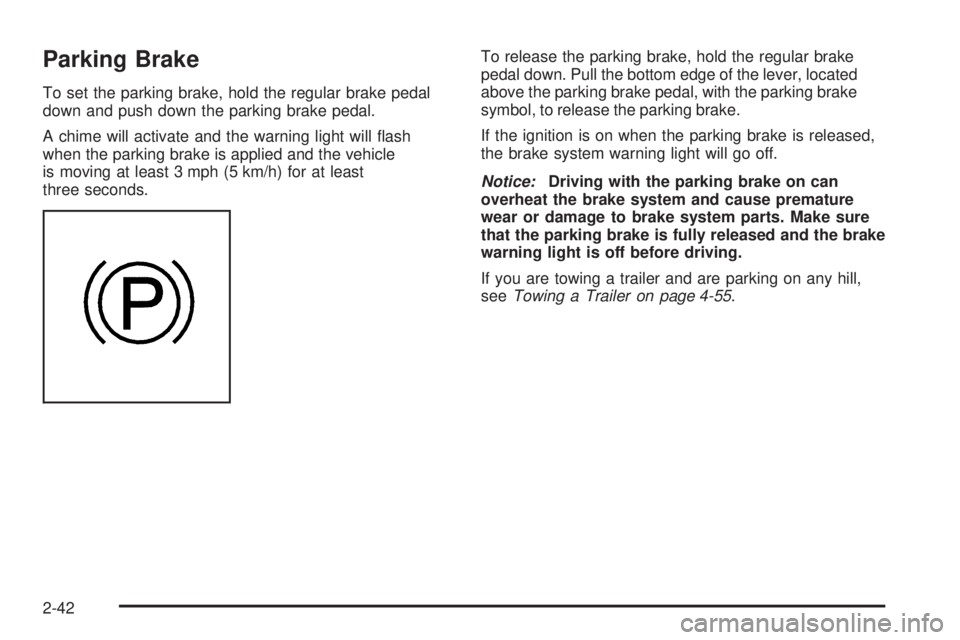
To set the parking brake, hold the regular brake pedal
down and push down the parking brake pedal.
A chime will activate and the warning light will ash
when the parking brake is applied and the vehicle
is moving at least 3 mph (5 km/h) for at least
three seconds.To release the parking brake, hold the regular brake
pedal down. Pull the bottom edge of the lever, located
above the parking brake pedal, with the parking brake
symbol, to release the parking brake.
If the ignition is on when the parking brake is released,
the brake system warning light will go off.
Notice:Driving with the parking brake on can
overheat the brake system and cause premature
wear or damage to brake system parts. Make sure
that the parking brake is fully released and the brake
warning light is off before driving.
If you are towing a trailer and are parking on any hill,
seeTowing a Trailer on page 4-55.
2-42
Page 137 of 524

Turning the Rear Vision Camera
System Off or On
To turn off the rear vision camera system, press and
hold
z, located on the inside rearview mirror, until
the left indicator light turns off. The rear camera vision
display is now disabled.
To turn the rear vision camera system on again, press
and hold
zuntil the left indicator light illuminates.
The rear vision camera system display is now enabled
and the display will appear in the mirror normally.
Vehicles With Navigation System
The rear vision camera system is designed to help the
driver when backing up by displaying a view of the area
behind the vehicle. When the driver shifts the vehicle
into R (Reverse), the video image automatically appears
on the navigation screen. Once the driver shifts out of
R (Reverse), the navigation screen will go back to the
last screen that had been displayed, after a delay.
Turning the Rear Vision Camera System
On or Off
To turn the rear vision camera system on or off:
1. Shift into P (Park).
2. Press the MENU button to enter the congure
menu options, then press the MENU hard key
to select Display or touch the Display screen button.3. Select the Rear Camera Options screen button.
The Rear Camera Options screen will display.
4. Select the Video screen button. When the Video
screen button is highlighted the RVC system is on.
The delay that is received after shifting out of
R (Reverse) is approximately 10 seconds. The delay
can be cancelled by performing one of the following:
Pressing a hard key on the navigation system.
Shifting in to P (Park).
Reach a vehicle speed of 5 mph (8 km/h).
There is a message on the rear vision camera screen
that states “Check Surroundings for Safety”.
2-51
Page 139 of 524
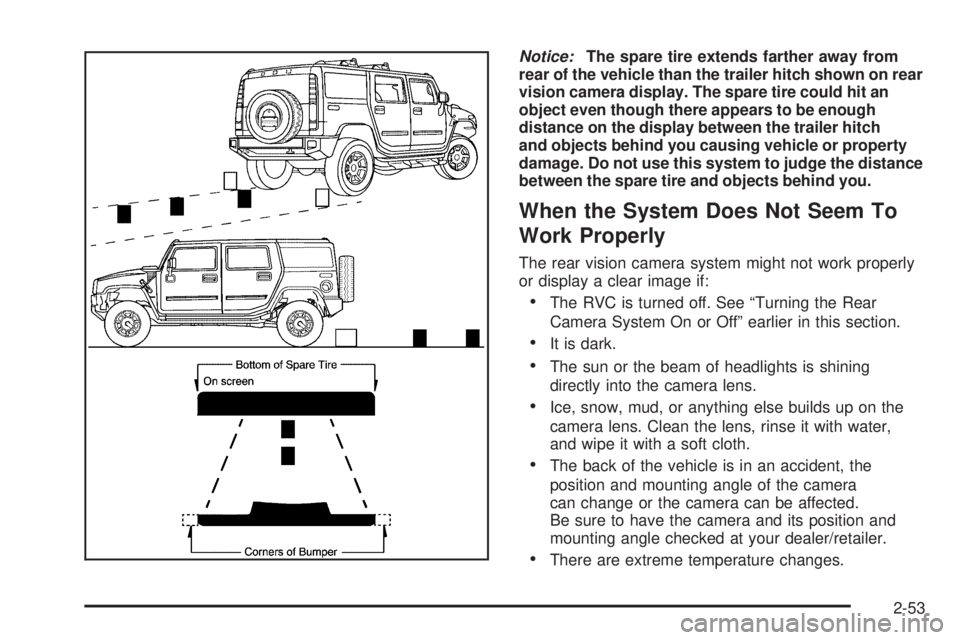
Notice:The spare tire extends farther away from
rear of the vehicle than the trailer hitch shown on rear
vision camera display. The spare tire could hit an
object even though there appears to be enough
distance on the display between the trailer hitch
and objects behind you causing vehicle or property
damage. Do not use this system to judge the distance
between the spare tire and objects behind you.
When the System Does Not Seem To
Work Properly
The rear vision camera system might not work properly
or display a clear image if:
The RVC is turned off. See “Turning the Rear
Camera System On or Off” earlier in this section.
It is dark.
The sun or the beam of headlights is shining
directly into the camera lens.
Ice, snow, mud, or anything else builds up on the
camera lens. Clean the lens, rinse it with water,
and wipe it with a soft cloth.
The back of the vehicle is in an accident, the
position and mounting angle of the camera
can change or the camera can be affected.
Be sure to have the camera and its position and
mounting angle checked at your dealer/retailer.
There are extreme temperature changes.
2-53