wheel HUMMER H2 2009 Manual PDF
[x] Cancel search | Manufacturer: HUMMER, Model Year: 2009, Model line: H2, Model: HUMMER H2 2009Pages: 524, PDF Size: 3.1 MB
Page 343 of 524

Use the following chart to determine how much the vehicle can weigh, based upon the vehicle model and options.
Engine Axle Ratio Maximum Trailer Weight **GCWR
6.2L V8 (SUV) 3.73 8,200 lbs (3 720 kg) 15,000 lbs (6 804 kg)
6.2L V8 (SUT)* 3.73 8,200 lbs (3 720 kg) 15,000 lbs (6 804 kg)
*Sport utility truck (SUT) models are neither designed nor intended to tow 5th wheel or gooseneck trailers.
**The Gross Combination Weight Rating (GCWR) in the total allowable weight of the completely loaded vehicle and
trailer including any passengers, cargo, equipment and conversions. The GCWR for the vehicle should not be
exceeded.
Ask your dealer/retailer for our trailering information or advice, or write us at our Customer Assistance Offices. See
Customer Assistance Offices on page 7-6for more information.
4-57
Page 350 of 524
Before starting, check all trailer hitch parts and
attachments, safety chains, electrical connectors, lamps,
tires and mirror adjustments. If the trailer has electric
brakes, start the vehicle and trailer moving and then
apply the trailer brake controller by hand to be sure the
brakes are working. This checks the electrical connection
at the same time.
During the trip, check occasionally to be sure that the
load is secure, and that the lamps and any trailer brakes
are still working.
Following Distance
Stay at least twice as far behind the vehicle ahead as
you would when driving the vehicle without a trailer. This
can help to avoid situations that require heavy braking
and sudden turns.
Passing
More passing distance is needed when towing a trailer.
Because the rig is longer, it is necessary to go much
farther beyond the passed vehicle before returning to
the lane.
Backing Up
Hold the bottom of the steering wheel with one hand.
Then, to move the trailer to the left, move that hand
to the left. To move the trailer to the right, move your
hand to the right. Always back up slowly and, if possible,
have someone guide you.
4-64
Page 352 of 524

Parking on Hills
{CAUTION:
Parking the vehicle on a hill with the trailer
attached can be dangerous. If something goes
wrong, the rig could start to move. People can be
injured, and both the vehicle and the trailer can be
damaged. When possible, always park the rig on a
at surface.
If parking the rig on a hill:
1. Press the brake pedal, but do not shift into P (Park)
yet. Turn the wheels into the curb if facing downhill
or into traffic if facing uphill.
2. Have someone place chocks under the trailer
wheels.
3. When the wheel chocks are in place, release the
regular brakes until the chocks absorb the load.
4. Reapply the brake pedal. Then apply the parking
brake and shift into P (Park).
5. Be sure the transfer case is in a drive gear and not
in N (Neutral).
6. Release the brake pedal.
{CAUTION:
It can be dangerous to get out of the vehicle if the
shift lever is not fully in P (Park) with the parking
brake rmly set. The vehicle can roll.
If the engine has been left running, the vehicle can
move suddenly. You or others could be injured.
To be sure the vehicle will not move, even when
on fairly level ground, use the steps that follow.
Always put the shift lever fully in P (Park) with the
parking brake rmly set.
Leaving After Parking on a Hill
1. Apply and hold the brake pedal while you:
Start the engine
Shift into a gear
Release the parking brake
2. Let up on the brake pedal.
3. Drive slowly until the trailer is clear of the chocks.
4. Stop and have someone pick up and store the
chocks.
4-66
Page 355 of 524
Service............................................................5-3
Accessories and Modications..........................5-3
California Proposition 65 Warning.....................5-4
California Perchlorate Materials Requirements.....5-4
Doing Your Own Service Work.........................5-4
Adding Equipment to the Outside of
the Vehicle.................................................5-5
Fuel................................................................5-5
Gasoline Octane............................................5-5
Gasoline Specications....................................5-5
California Fuel...............................................5-6
Additives.......................................................5-6
Fuel E85 (85% Ethanol)..................................5-7
Fuels in Foreign Countries...............................5-8
Filling the Tank..............................................5-8
Filling a Portable Fuel Container.....................5-10
Checking Things Under the Hood....................5-11
Hood Release..............................................5-12
Engine Compartment Overview.......................5-14
Engine Oil...................................................5-15
Engine Oil Life System..................................5-18
Engine Air Cleaner/Filter................................5-20
Automatic Transmission Fluid.........................5-23
Cooling System............................................5-27
Engine Coolant.............................................5-31
Engine Overheating.......................................5-33Overheated Engine Protection
Operating Mode.........................................5-35
Power Steering Fluid.....................................5-36
Windshield Washer Fluid................................5-37
Brakes........................................................5-38
Battery........................................................5-41
Jump Starting...............................................5-42
Rear Axle.......................................................5-47
Four-Wheel Drive............................................5-48
Front Axle......................................................5-49
Bulb Replacement..........................................5-50
Halogen Bulbs..............................................5-50
Headlamps..................................................5-51
Front Turn Signal and Parking Lamps..............5-52
Daytime Running Lamps (DRL).......................5-52
Roof Marker Lamps......................................5-53
Taillamps, Turn Signal, Stoplamps and
Back-up Lamps.........................................5-54
Replacement Bulbs.......................................5-55
Windshield Wiper Blade Replacement..............5-56
Tires..............................................................5-57
Tire Sidewall Labeling...................................5-58
Tire Terminology and Denitions.....................5-60
Ination - Tire Pressure.................................5-63
Tire Pressure Monitor System.........................5-64
Section 5 Service and Appearance Care
5-1
Page 356 of 524
Tire Pressure Monitor Operation.....................5-66
Tire Inspection and Rotation...........................5-69
When It Is Time for New Tires.......................5-71
Buying New Tires.........................................5-72
Different Size Tires and Wheels......................5-74
Uniform Tire Quality Grading..........................5-74
Wheel Alignment and Tire Balance..................5-76
Wheel Replacement......................................5-76
Tire Chains..................................................5-77
Accessory Inator.........................................5-78
If a Tire Goes Flat........................................5-79
Changing a Flat Tire.....................................5-80
Removing the Spare Tire and Tools (SUT).......5-82
Removing the Spare Tire and Tools (SUV).......5-86
Removing the Flat Tire and Installing the
Spare Tire................................................5-90
Storing a Flat or Spare Tire and Tools (SUT) . . .5-95
Storing a Flat or Spare Tire and Tools (SUV) . . .5-98
Spare Tire.................................................5-101
Appearance Care..........................................5-102
Interior Cleaning.........................................5-102
Fabric/Carpet..............................................5-103
Leather......................................................5-104
Instrument Panel, Vinyl, and Other Plastic
Surfaces.................................................5-104
Wood Panels..............................................5-104Speaker Covers..........................................5-105
Care of Safety Belts....................................5-105
Weatherstrips.............................................5-105
Washing Your Vehicle..................................5-105
Cleaning Exterior Lamps/Lenses....................5-106
Finish Care................................................5-106
Windshield, Backglass, and Wiper Blades.......5-107
Aluminum Wheels.......................................5-107
Tires.........................................................5-108
Sheet Metal Damage...................................5-108
Finish Damage...........................................5-108
Underbody Maintenance...............................5-108
Chemical Paint Spotting...............................5-108
Vehicle Identication.....................................5-109
Vehicle Identication Number (VIN)................5-109
Service Parts Identication Label...................5-109
Electrical System..........................................5-109
Add-On Electrical Equipment.........................5-109
Windshield Wiper Fuses...............................5-110
Power Windows and Other Power Options......5-110
Fuses and Circuit Breakers..........................5-110
Instrument Panel Fuse Block........................5-111
Center Instrument Panel Fuse Block..............5-112
Underhood Fuse Block................................5-113
Capacities and Specications........................5-117
Section 5 Service and Appearance Care
5-2
Page 394 of 524

Brake Wear
This vehicle has disc brakes. Disc brake pads have
built-in wear indicators that make a high-pitched warning
sound when the brake pads are worn and new pads
are needed. The sound can come and go or be heard all
the time the vehicle is moving, except when applying
the brake pedal rmly.
{CAUTION:
The brake wear warning sound means that soon
the brakes will not work well. That could lead to an
accident. When the brake wear warning sound is
heard, have the vehicle serviced.
Notice:Continuing to drive with worn-out brake
pads could result in costly brake repair.
Some driving conditions or climates can cause a brake
squeal when the brakes are rst applied or lightly applied.
This does not mean something is wrong with the brakes.Properly torqued wheel nuts are necessary to help
prevent brake pulsation. When tires are rotated, inspect
brake pads for wear and evenly tighten wheel nuts in
the proper sequence to torque specications in
Capacities and Specifications on page 5-117.
Brake linings should always be replaced as complete
axle sets.
Brake Pedal Travel
See your dealer/retailer if the brake pedal does not
return to normal height, or if there is a rapid increase in
pedal travel. This could be a sign that brake service
might be required.
Brake Adjustment
Every brake stop, the disc brakes adjust for wear.
5-40
Page 402 of 524
How to Check Lubricant
To get an accurate reading, the vehicle should be on a
level surface.
When the differential is cold, the proper level is from
5/8 inch to 1-5/8 inch (15 mm to 40 mm) below the
bottom of the ller plug hole, located on the rear axle.
Add only enough uid to reach the proper level.
What to Use
Refer to the Maintenance Schedule to determine what
kind of lubricant to use. SeeRecommended Fluids
and Lubricants on page 6-13.
Four-Wheel Drive
Transfer Case
It is not necessary to regularly check transfer case uid
unless you suspect there is a leak or you hear an
unusual noise. A uid loss could indicate a problem.
Have it inspected and repaired.
Refer to the Maintenance Schedule to determine how
often to change the lubricant. SeeScheduled
Maintenance on page 6-4.
5-48
Page 406 of 524
Front Turn Signal and Parking
Lamps
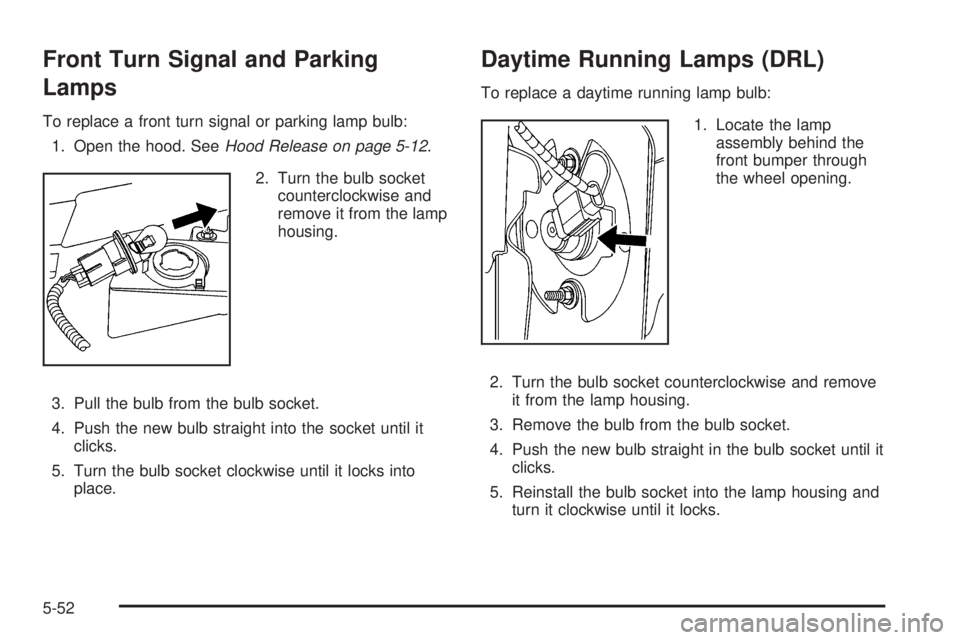
To replace a front turn signal or parking lamp bulb:
1. Open the hood. SeeHood Release on page 5-12.
2. Turn the bulb socket
counterclockwise and
remove it from the lamp
housing.
3. Pull the bulb from the bulb socket.
4. Push the new bulb straight into the socket until it
clicks.
5. Turn the bulb socket clockwise until it locks into
place.
Daytime Running Lamps (DRL)
To replace a daytime running lamp bulb:
1. Locate the lamp
assembly behind the
front bumper through
the wheel opening.
2. Turn the bulb socket counterclockwise and remove
it from the lamp housing.
3. Remove the bulb from the bulb socket.
4. Push the new bulb straight in the bulb socket until it
clicks.
5. Reinstall the bulb socket into the lamp housing and
turn it clockwise until it locks.
5-52
Page 413 of 524
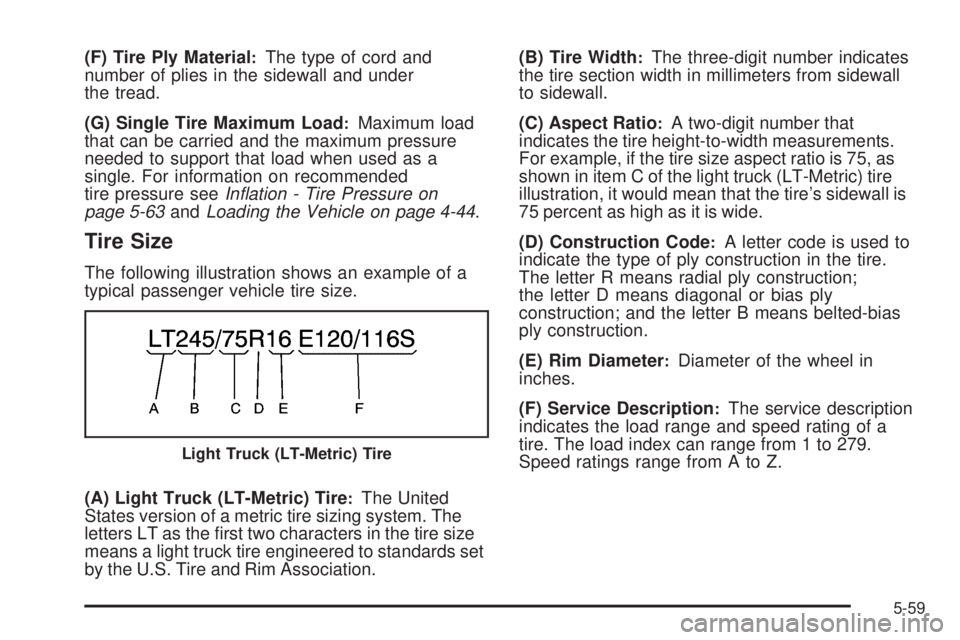
(F) Tire Ply Material:The type of cord and
number of plies in the sidewall and under
the tread.
(G) Single Tire Maximum Load
:Maximum load
that can be carried and the maximum pressure
needed to support that load when used as a
single. For information on recommended
tire pressure seeInflation - Tire Pressure on
page 5-63andLoading the Vehicle on page 4-44.
Tire Size
The following illustration shows an example of a
typical passenger vehicle tire size.
(A) Light Truck (LT-Metric) Tire
:The United
States version of a metric tire sizing system. The
letters LT as the rst two characters in the tire size
means a light truck tire engineered to standards set
by the U.S. Tire and Rim Association.(B) Tire Width
:The three-digit number indicates
the tire section width in millimeters from sidewall
to sidewall.
(C) Aspect Ratio
:A two-digit number that
indicates the tire height-to-width measurements.
For example, if the tire size aspect ratio is 75, as
shown in item C of the light truck (LT-Metric) tire
illustration, it would mean that the tire’s sidewall is
75 percent as high as it is wide.
(D) Construction Code
:A letter code is used to
indicate the type of ply construction in the tire.
The letter R means radial ply construction;
the letter D means diagonal or bias ply
construction; and the letter B means belted-bias
ply construction.
(E) Rim Diameter
:Diameter of the wheel in
inches.
(F) Service Description
:The service description
indicates the load range and speed rating of a
tire. The load index can range from 1 to 279.
Speed ratings range from A to Z.
Light Truck (LT-Metric) Tire
5-59
Page 419 of 524

Please note that the TPMS is not a substitute for proper
tire maintenance, and it is the driver’s responsibility to
maintain correct tire pressure, even if under-ination has
not reached the level to trigger illumination of the
TPMS low tire pressure telltale.
Your vehicle has also been equipped with a TPMS
malfunction indicator to indicate when the system is
not operating properly. The TPMS malfunction indicator
is combined with the low tire pressure telltale. When
the system detects a malfunction, the telltale will
ash for approximately one minute and then remain
continuously illuminated. This sequence will continue
upon subsequent vehicle start-ups as long as the
malfunction exists.
When the malfunction indicator is illuminated, the system
may not be able to detect or signal low tire pressure as
intended. TPMS malfunctions may occur for a variety of
reasons, including the installation of replacement or
alternate tires or wheels on the vehicle that prevent the
TPMS from functioning properly. Always check the TPMS
malfunction telltale after replacing one or more tires or
wheels on your vehicle to ensure that the replacement or
alternate tires and wheels allow the TPMS to continue to
function properly.
SeeTire Pressure Monitor Operation on page 5-66for
additional information.Federal Communications Commission
(FCC) and Industry and Science Canada
The Tire Pressure Monitor System (TPMS) operates on
a radio frequency and complies with Part 15 of the
FCC Rules. Operation is subject to the following two
conditions:
1. This device may not cause harmful interference.
2. This device must accept any interference received,
including interference that may cause undesired
operation.
The TPMS operates on a radio frequency and complies
with RSS-210 of Industry and Science Canada.
Operation is subject to the following two conditions:
1. This device may not cause interference.
2. This device must accept any interference received,
including interference that may cause undesired
operation of the device.
Changes or modications to this system by other than
an authorized service facility could void authorization to
use this equipment.
5-65