brake light HUMMER H3 2007 User Guide
[x] Cancel search | Manufacturer: HUMMER, Model Year: 2007, Model line: H3, Model: HUMMER H3 2007Pages: 480, PDF Size: 2.73 MB
Page 198 of 480

FUEL CAP
This message displays if the vehicle’s fuel cap is
either off or loose. Pull over as soon as possible
and check to see if the fuel cap is secure. You may
also see the check engine light on the instrument
panel cluster. If the check engine light does
come on when the fuel cap was loose, it may take
a few driving trips before the light turns off. See
Malfunction Indicator Lamp on page 186for more
information if the light still remains on. Press
and release the reset stem to acknowledge the
message and clear it from the display.
LOW FUEL
This message displays if the level of fuel in the
vehicle is low. Also check the fuel gage. See
Fuel Gage on page 191for more information.
Rell the fuel tank as soon as possible.
LOW TIRE
This message displays if a low tire pressure is
detected in any of the vehicle’s tires. Press
and release the reset stem to acknowledge the
message and clear it from the display. The
message appears at each ignition cycle until the
tires are inated to the correct ination pressure.
SeeTires on page 367andInation - Tire
Pressure on page 375for more information on
tires and the correct ination pressures.
OIL
This message displays when the oil pressure is
low. SeeOil Pressure Light on page 189and
Engine Oil on page 323for more information.
PARK BRK (Brake)
This message displays when the parking brake
is set. SeeParking Brake on page 116and
Brake System Warning Light on page 182for
more information. The message clears from the
display after the parking brake is released or
by pressing and releasing the reset stem.
198
Page 238 of 480
Control of a Vehicle
You have three systems that make your
vehicle go where you want it to go. They are
the brakes, the steering, and the accelerator.
All three systems have to do their work at
the places where the tires meet the road.
Sometimes, as when you are driving on snow
or ice, it is easy to ask more of those control
systems than the tires and road can provide.
That means you can lose control of your vehicle.
SeeTraction Control System (TCS) on page 241.
Adding non-GM accessories can affect your
vehicle’s performance. SeeAccessories and
Modications on page 314.
Braking
SeeBrake System Warning Light on page 182.
Braking action involves perception time and
reaction time.
First, you have to decide to push on the brake
pedal. That is perception time. Then you have to
bring up your foot and do it. That is reaction time.
Average reaction time is about three-fourths of a
second. But that is only an average. It might be less
with one driver and as long as two or three seconds
or more with another. Age, physical condition,
alertness, coordination, and eyesight all play a part.
So do alcohol, drugs, and frustration. But even in
three-fourths of a second, a vehicle moving at
60 mph (100 km/h) travels 66 feet (20 m). That
could be a lot of distance in an emergency, so
keeping enough space between your vehicle and
others is important.
And, of course, actual stopping distances vary
greatly with the surface of the road, whether it is
pavement or gravel; the condition of the road,
whether it is wet, dry, or icy; tire tread; the
condition of the brakes; the weight of the vehicle;
and the amount of brake force applied.
238
Page 239 of 480

Avoid needless heavy braking. Some people drive
in spurts — heavy acceleration followed by heavy
braking — rather than keeping pace with traffic.
This is a mistake. The brakes may not have time to
cool between hard stops. The brakes will wear out
much faster if you do a lot of heavy braking. If you
keep pace with the traffic and allow realistic
following distances, you will eliminate a lot of
unnecessary braking. That means better braking
and longer brake life.
If your vehicle ever loses electrical power while you
are driving, brake normally but do not pump the
brakes. If you do, the pedal may get harder to push
down. If your vehicle loses electrical power, you will
still have some power brake assist. But you will use
it when you brake. Once the power assist is used
up, it may take longer to stop, the brake pedal will
be harder to push, and you may experience longer
pedal travel.
Adding non-GM accessories can affect your
vehicle’s performance. SeeAccessories and
Modications on page 314Anti-Lock Brake System (ABS)
Your vehicle has the Anti-Lock Brake
System (ABS), an advanced electronic braking
system that will help prevent a braking skid.
When you start your engine and begin to drive
away, ABS will check itself. You may hear a
momentary motor or clicking noise while this
test is going on. This is normal.
If there is a problem
with ABS, this warning
light will stay on.
SeeAnti-Lock Brake
System Warning
Light on page 183.
239
Page 242 of 480

If your vehicle has a Driver information Center
(DIC), a TRACTION FAILED message will appear
when a Traction Control System or Anti-Lock
Brake System problem has been detected and the
vehicle needs service. SeeDIC Warnings and
Messages on page 196for more information.
When this message is on, the system will not limit
wheel spin. Adjust your driving accordingly.
The traction control system automatically comes
on whenever you start your vehicle. To limit wheel
spin, especially in slippery road conditions, you
should always leave the system on. But you
can turn the traction control system off if you
ever need to.
To turn the system off,
press and hold the TCS
button for ve seconds.This light will come
on steady when the
traction control system
has been turned off.
This light ashes
when TCS is active.
If you press and hold the TC button for
ve seconds, the traction control system will turn
off and a TRAC OFF message will appear on
the DIC. Press the TC button again to turn
the system back on. The TRAC OFF message
will then go off. The traction control system
will reset itself at each ignition cycle.
Adding non-GM accessories can affect your
vehicle’s performance. SeeAccessories and
Modications on page 314for more information.
242
Page 250 of 480
While driving on a surface with reduced traction,
try your best to avoid sudden steering, acceleration,
or braking, including reducing vehicle speed by
shifting to a lower gear. Any sudden changes could
cause the tires to slide. You may not realize the
surface is slippery until your vehicle is skidding.
Learn to recognize warning clues — such as
enough water, ice, or packed snow on the road to
make a mirrored surface — and slow down when
you have any doubt.
Remember: Any Anti-Lock Brake System (ABS)
helps avoid only the braking skid.
Off-Road Driving
This off-road guide is meant to provide advice
for when you drive your vehicle off paved roads.
Also, seeBraking on page 238.
Off-road driving can be great fun. But it does have
some denite hazards. The greatest of these is
the terrain itself.
“Off-roading” means you have left the great
North American road system behind. Traffic
lanes are not marked. Curves are not banked.There are no road signs. Surfaces can be slippery,
rough, uphill or downhill. In short, you have
gone right back to nature.
Off-road driving involves some new skills. And
that is why it is very important that you read
this guide. You will nd many driving tips and
suggestions. These will help make your off-road
driving safer and more enjoyable.
Before You Go Off-Roading
There are some things to do before you go out.
For example, be sure to have all necessary
maintenance and service work done. Check to
make sure all underbody shields are properly
attached. Make sure any equipment you
may need — rst aid kit, cell phone, ashlight,
etc. — is securely stored in the vehicle.
Be sure you read all the information about your
four-wheel-drive vehicle in this manual. Is
there enough fuel? Is the spare tire fully inated?
Are the uid levels up where they should be?
What are the local laws that apply to off-roading
where you will be driving? If you do not know, you
should check with law enforcement people in
the area. Will you be on someone’s private land?
If so, be sure to get the necessary permission.
250
Page 255 of 480
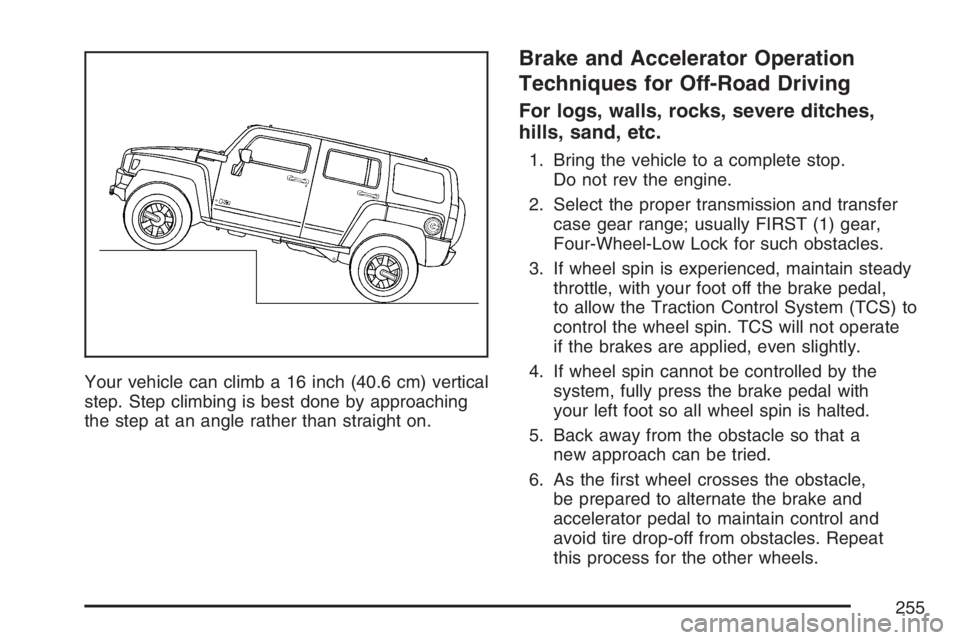
Your vehicle can climb a 16 inch (40.6 cm) vertical
step. Step climbing is best done by approaching
the step at an angle rather than straight on.
Brake and Accelerator Operation
Techniques for Off-Road Driving
For logs, walls, rocks, severe ditches,
hills, sand, etc.
1. Bring the vehicle to a complete stop.
Do not rev the engine.
2. Select the proper transmission and transfer
case gear range; usually FIRST (1) gear,
Four-Wheel-Low Lock for such obstacles.
3. If wheel spin is experienced, maintain steady
throttle, with your foot off the brake pedal,
to allow the Traction Control System (TCS) to
control the wheel spin. TCS will not operate
if the brakes are applied, even slightly.
4. If wheel spin cannot be controlled by the
system, fully press the brake pedal with
your left foot so all wheel spin is halted.
5. Back away from the obstacle so that a
new approach can be tried.
6. As the rst wheel crosses the obstacle,
be prepared to alternate the brake and
accelerator pedal to maintain control and
avoid tire drop-off from obstacles. Repeat
this process for the other wheels.
255
Page 256 of 480
For mounds, washouts, loose up-hill
slopes, ditches, etc.
When wheel spin occurs as the vehicle is moving,
the driver may notice a slight shaking or shuddering
of the vehicle. This should be stopped as soon as
possible to prevent damage to vehicle components.
This is the indication that a loss of traction is
occurring on this terrain. The operator should:
1. Reduce speed and apply the brakes.
2. Assess the terrain properly and adjust vehicle
speed and gear ranges accordingly:
Four-Wheel High position for higher speeds
and Four-Wheel-Low Lock for more torque and
lower speeds. Transmission FIRST (1) gear
is generally recommended.
3. Apply slight pressure to the brake when the
shaking or shuddering sensation is felt,
keeping the vehicle moving in a controlled
manner.
4. Be prepared to alternate between braking and
accelerating through the adverse terrain.
Getting Familiar with Off-Road Driving
It is a good idea to practice in an area that is
safe and close to home before you go into
the wilderness. Off-road driving does require some
new and different skills. Here is what we mean.
Tune your senses to different kinds of signals.
Your eyes, for example, need to constantly sweep
the terrain for unexpected obstacles. Your ears
need to listen for unusual tire or engine sounds.
With your arms, hands, feet and body, you will
need to respond to vibrations and vehicle bounce.
Controlling your vehicle is the key to successful
off-road driving. One of the best ways to control
your vehicle is to control your speed. Here are
some things to keep in mind. At higher speeds:
You approach things faster and you have
less time to scan the terrain for obstacles.
You have less time to react.
You have more vehicle bounce when you
drive over obstacles.
You will need more distance for braking,
especially since you are on an unpaved
surface.
256
Page 258 of 480
When you drive over bumps, rocks, or other
obstacles, your wheels can leave the ground.
If this happens, even with one or two wheels, you
cannot control the vehicle as well or at all.
Because you will be on an unpaved surface, it is
especially important to avoid sudden acceleration,
sudden turns, or sudden braking.
In a way, off-road driving requires a different kind
of alertness from driving on paved roads and
highways. There are no road signs, posted speed
limits, or signal lights. You have to use your
own good judgment about what is safe and
what is not.
Drinking and driving can be very dangerous on
any road. And this is certainly true for off-road
driving. At the very time you need special
alertness and driving skills, your reexes,
perceptions, and judgment can be affected by
even a small amount of alcohol. You could have
a serious — or even fatal — accident if you
drink and drive or ride with a driver who has been
drinking. SeeDrunken Driving on page 235.Crossing Obstacles
Approach Angle — a Key to Mobility
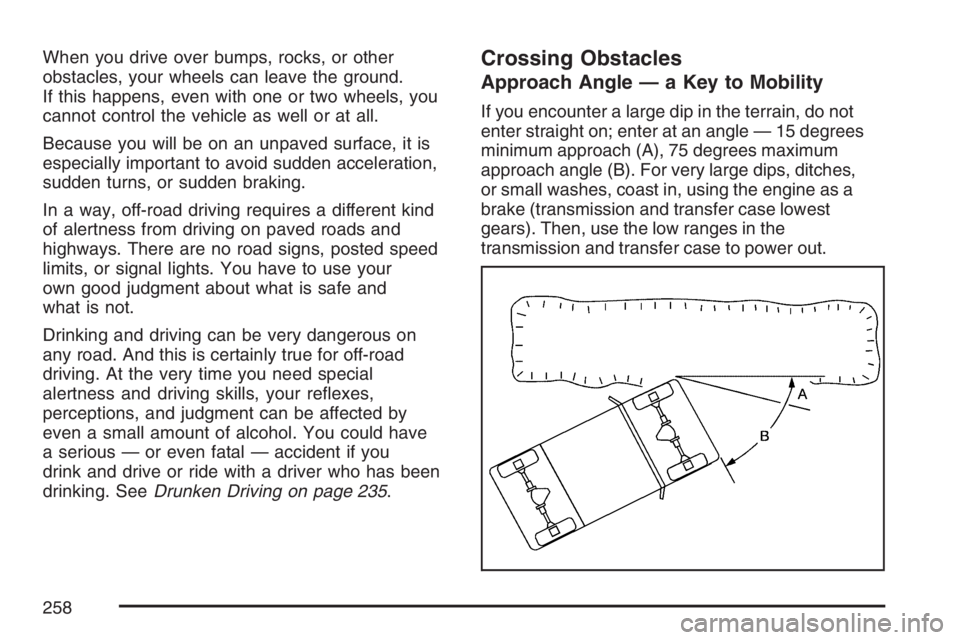
If you encounter a large dip in the terrain, do not
enter straight on; enter at an angle — 15 degrees
minimum approach (A), 75 degrees maximum
approach angle (B). For very large dips, ditches,
or small washes, coast in, using the engine as a
brake (transmission and transfer case lowest
gears). Then, use the low ranges in the
transmission and transfer case to power out.
258
Page 265 of 480

If you decide you can go down a hill safely, then
try to keep your vehicle headed straight down, and
use a low gear. This way, engine drag can help
your brakes and they will not have to do all
the work. Descend slowly, keeping your vehicle
under control at all times.
{CAUTION:
Heavy braking when going down a hill can
cause your brakes to overheat and fade.
This could cause loss of control and a
serious accident. Apply the brakes lightly
when descending a hill and use a low
gear to keep vehicle speed under control.
Q:Are there some things I should not do
when driving down a hill?
A:Yes! These are important because if you
ignore them you could lose control and
have a serious accident:
When driving downhill, avoid turns that take
you across the incline of the hill. A hill that
is not too steep to drive down may be
too steep to drive across. You could roll over
if you do not drive straight down.
Never go downhill with the transmission in
NEUTRAL (N). This is called “free-wheeling.”
Your brakes will have to do all the work
and could overheat and fade.
265
Page 274 of 480
The heavier the rain, the harder it is to see.
Even if your windshield wiper blades are in good
shape, a heavy rain can make it harder to see
road signs and traffic signals, pavement markings,
the edge of the road, and even people walking.
It is wise to keep your wiping equipment in
good shape and keep your windshield washer uid
reservoir lled with washer uid. Replace your
windshield wiper inserts when they show signs
of streaking or missing areas on the windshield,
or when strips of rubber start to separate from
the inserts.
{CAUTION:
Wet brakes can cause accidents. They
may not work as well in a quick stop and
may cause pulling to one side. You could
lose control of the vehicle.
After driving through a large puddle of
water or a car wash, apply your brake pedal
lightly until your brakes work normally.Driving too fast through large water puddles or
even going through some car washes can cause
problems, too. The water may affect your brakes.
Try to avoid puddles. But if you cannot, try to slow
down before you hit them.
Hydroplaning
Hydroplaning is dangerous. So much water can
build up under your tires that they can actually ride
on the water. This can happen if the road is wet
enough and you are going fast enough. When your
vehicle is hydroplaning, it has little or no contact
with the road.
Hydroplaning does not happen often. But it can
if your tires do not have much tread or if the
pressure in one or more is low. It can happen if
a lot of water is standing on the road. If you
can see reections from trees, telephone poles,
or other vehicles, and raindrops dimple the
water’s surface, there could be hydroplaning.
Hydroplaning usually happens at higher speeds.
There just is not a hard and fast rule about
hydroplaning. The best advice is to slow down
when it is raining.
274