brake light HUMMER H3 2007 Owner's Manual
[x] Cancel search | Manufacturer: HUMMER, Model Year: 2007, Model line: H3, Model: HUMMER H3 2007Pages: 480, PDF Size: 2.73 MB
Page 307 of 480

Maintenance When Trailer Towing
Your vehicle will need service more often when
you’re pulling a trailer. See the Maintenance
Schedule for more on this. Things that are
especially important in trailer operation are
automatic transmission uid, engine oil, axle
lubricant, belts, cooling system and brake
system. Each of these is covered in this manual,
and the Index will help you nd them quickly.
If you’re trailering, it’s a good idea to review
these sections before you start your trip.
Check periodically to see that all hitch nuts
and bolts are tight.
Trailer Wiring Harness
Light-Duty Trailer Wiring Package
If your vehicle is not equipped with a trailer
towing package, the chassis harness will
contain the following blunt cut circuits:
Yellow: Left Stop/Turn Signal
Dark Green: Right Stop/Turn Signal
White: Ground
Brown: Tail Lamps
If you want to add on a trailer tow, it should be
installed by your dealer or a qualied service
center. Also, seeAdd-On Electrical Equipment
on page 416for more information.
307
Page 308 of 480
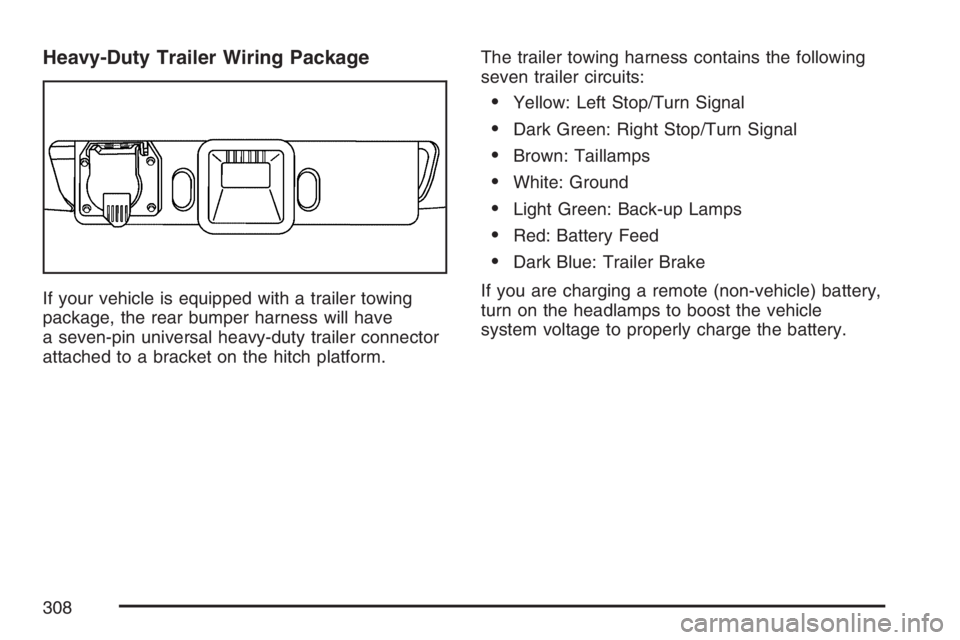
Heavy-Duty Trailer Wiring Package
If your vehicle is equipped with a trailer towing
package, the rear bumper harness will have
a seven-pin universal heavy-duty trailer connector
attached to a bracket on the hitch platform.The trailer towing harness contains the following
seven trailer circuits:
Yellow: Left Stop/Turn Signal
Dark Green: Right Stop/Turn Signal
Brown: Taillamps
White: Ground
Light Green: Back-up Lamps
Red: Battery Feed
Dark Blue: Trailer Brake
If you are charging a remote (non-vehicle) battery,
turn on the headlamps to boost the vehicle
system voltage to properly charge the battery.
308
Page 310 of 480
Trailer Brake Control Wiring Harness
The trailer brake control wiring harness is located
under the instrument panel to the right of the
steering column. The wires are taped to the
harness that goes to the courtesy light under
the instrument panel. The harness will contain
the following wires:
Red Wire: AUX B+
Black Wire: Ground
Light Blue Wire: Brake Signal
Dark Blue Wire: Trailer Brakes
Trailer Recommendations
You must subtract your hitch loads from the
Cargo Weight Rating (CWR). CWR is the
maximum weight of the load your vehicle can
carry. It doesn’t include the weight of the people
inside, but you can gure about 150 lbs. (68 kg)
for each seat. The total cargo load must not
be more than your vehicles CWR.
Weigh your vehicle with your trailer attached,
so that you won’t go over the GVWR or GAWR.
If you are using a weight-distributing hitch,
weigh the vehicle without the spring bars in place.
You’ll get the best performance if you spread
out the weight of your load the right way, and if
you choose the correct hitch and trailer brakes.
For more information seeTowing a Trailer
on page 297.
310
Page 350 of 480

Brake Wear
Your vehicle has four-wheel disc brakes.
Disc brake pads have built-in wear indicators that
make a high-pitched warning sound when the
brake pads are worn and new pads are needed.
The sound may come and go or be heard all
the time your vehicle is moving, except when you
are pushing on the brake pedal rmly.
{CAUTION:
The brake wear warning sound means that
soon the brakes will not work well. That
could lead to an accident. When you hear
the brake wear warning sound, have your
vehicle serviced.
Notice:Continuing to drive with worn-out
brake pads could result in costly brake repair.
Some driving conditions or climates may cause
a brake squeal when the brakes are rst applied or
lightly applied. This does not mean something is
wrong with your brakes.Properly torqued wheel nuts are necessary to help
prevent brake pulsation. When tires are rotated,
inspect brake pads for wear and evenly tighten
wheel nuts in the proper sequence to GM torque
specications.
Brake linings should always be replaced as
complete axle sets.
Brake Pedal Travel
See your dealer if the brake pedal does not
return to normal height, or if there is a rapid
increase in pedal travel. This could be a sign
of brake trouble.
Brake Adjustment
Every time you make a brake stop, your disc
brakes adjust for wear.
350
Page 353 of 480
Notice:If the other vehicle’s system is not a
12-volt system with a negative ground,
both vehicles can be damaged. Only use
vehicles with 12-volt systems with negative
grounds to jump start your vehicle.
2. Get the vehicles close enough so the jumper
cables can reach, but be sure the vehicles are
not touching each other. If they are, it could
cause a ground connection you do not
want. You would not be able to start your
vehicle, and the bad grounding could damage
the electrical systems.
To avoid the possibility of the vehicles rolling,
set the parking brake rmly on both vehicles
involved in the jump start procedure. Put
an automatic transmission in PARK (P) or a
manual transmission in NEUTRAL before
setting the parking brake. If you have a
four-wheel-drive vehicle, be sure the transfer
case is not in NEUTRAL.Notice:If you leave your radio or other
accessories on during the jump starting
procedure, they could be damaged. The repairs
would not be covered by your warranty.
Always turn off your radio and other
accessories when jump starting your vehicle.
3. Turn off the ignition on both vehicles.
Unplug unnecessary accessories plugged into
the cigarette lighter or the accessory power
outlets. Turn off the radio and all lamps
that are not needed. This will avoid sparks
and help save both batteries. And it could
save the radio!
353
Page 379 of 480
TPMS Sensor Identication Codes
Each TPMS sensor has a unique identication
code. Any time you replace one or more of
the TPMS sensors, install the spare tire onto your
vehicle, or rotate your vehicle’s tires, the
identication codes will need to be matched to the
new tire/wheel position. The sensors are
matched to the tire/wheel positions in the following
order: driver’s side front tire, passenger’s side
front tire, passenger’s side rear tire, and driver’s
side rear tire using a TPMS diagnostic tool.
See your dealer for service.
The TPMS sensors may also be matched to each
tire/wheel position by increasing or decreasing
the tire’s air pressure. If increasing the tire’s
air pressure, do not exceed the maximum ination
pressure indicated on the tire’s sidewall.
You will have one minute to match the rst
tire/wheel position, and ve minutes overall, to
match all four tire/wheel positions.If it takes longer than one minute, to match the
rst tire and wheel, or more than ve minutes
to match all four tire and wheel positions
the matching process stops and you will need to
start over.
The TPMS sensor matching procedure is
outlined below:
1. Set the parking brake.
2. Turn the ignition switch to ON with the
engine off.
3. Turn the exterior lamp switch from AUTO to
ON four times within three seconds. A double
horn chirp will sound and the TPMS low
tire warning light will begin to ash. The
double horn chirp and ashing TPMS warning
light indicates the TPMS matching process
has started. The TPMS warning light should
continue ashing throughout the matching
procedure. The SERV TPM message will be
displayed on the Driver Information
Center (DIC).
4. Start with the driver’s side front tire.
379
Page 467 of 480
A
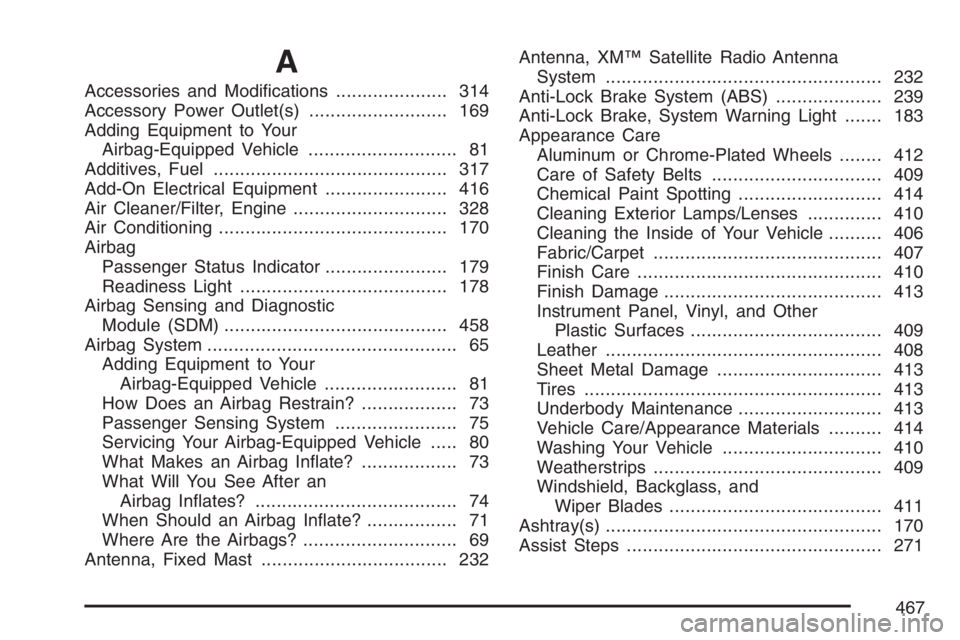
Accessories and Modications..................... 314
Accessory Power Outlet(s).......................... 169
Adding Equipment to Your
Airbag-Equipped Vehicle............................ 81
Additives, Fuel............................................ 317
Add-On Electrical Equipment....................... 416
Air Cleaner/Filter, Engine............................. 328
Air Conditioning........................................... 170
Airbag
Passenger Status Indicator....................... 179
Readiness Light....................................... 178
Airbag Sensing and Diagnostic
Module (SDM).......................................... 458
Airbag System............................................... 65
Adding Equipment to Your
Airbag-Equipped Vehicle......................... 81
How Does an Airbag Restrain?.................. 73
Passenger Sensing System....................... 75
Servicing Your Airbag-Equipped Vehicle..... 80
What Makes an Airbag Inate?.................. 73
What Will You See After an
Airbag Inates?...................................... 74
When Should an Airbag Inate?................. 71
Where Are the Airbags?............................. 69
Antenna, Fixed Mast................................... 232Antenna, XM™ Satellite Radio Antenna
System.................................................... 232
Anti-Lock Brake System (ABS).................... 239
Anti-Lock Brake, System Warning Light....... 183
Appearance Care
Aluminum or Chrome-Plated Wheels........ 412
Care of Safety Belts................................ 409
Chemical Paint Spotting........................... 414
Cleaning Exterior Lamps/Lenses.............. 410
Cleaning the Inside of Your Vehicle.......... 406
Fabric/Carpet........................................... 407
Finish Care.............................................. 410
Finish Damage......................................... 413
Instrument Panel, Vinyl, and Other
Plastic Surfaces.................................... 409
Leather.................................................... 408
Sheet Metal Damage............................... 413
Tires........................................................ 413
Underbody Maintenance........................... 413
Vehicle Care/Appearance Materials.......... 414
Washing Your Vehicle .............................. 410
Weatherstrips........................................... 409
Windshield, Backglass, and
Wiper Blades........................................ 411
Ashtray(s).................................................... 170
Assist Steps................................................ 271
467
Page 468 of 480
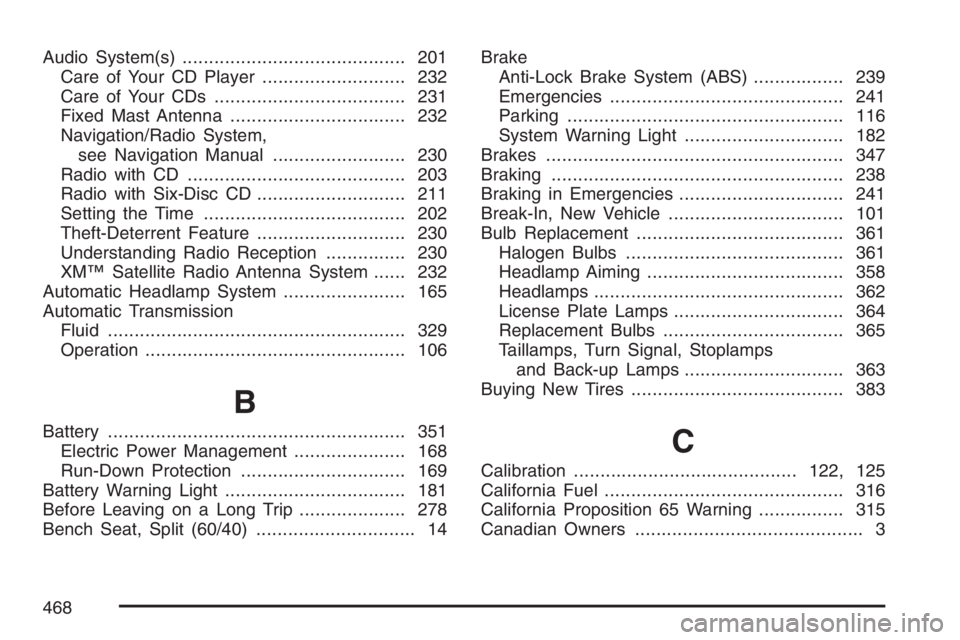
Audio System(s).......................................... 201
Care of Your CD Player........................... 232
Care of Your CDs.................................... 231
Fixed Mast Antenna................................. 232
Navigation/Radio System,
see Navigation Manual......................... 230
Radio with CD......................................... 203
Radio with Six-Disc CD............................ 211
Setting the Time...................................... 202
Theft-Deterrent Feature............................ 230
Understanding Radio Reception............... 230
XM™ Satellite Radio Antenna System...... 232
Automatic Headlamp System....................... 165
Automatic Transmission
Fluid........................................................ 329
Operation................................................. 106
B
Battery........................................................ 351
Electric Power Management..................... 168
Run-Down Protection............................... 169
Battery Warning Light.................................. 181
Before Leaving on a Long Trip.................... 278
Bench Seat, Split (60/40).............................. 14Brake
Anti-Lock Brake System (ABS)................. 239
Emergencies............................................ 241
Parking.................................................... 116
System Warning Light.............................. 182
Brakes........................................................ 347
Braking....................................................... 238
Braking in Emergencies............................... 241
Break-In, New Vehicle................................. 101
Bulb Replacement....................................... 361
Halogen Bulbs......................................... 361
Headlamp Aiming..................................... 358
Headlamps............................................... 362
License Plate Lamps................................ 364
Replacement Bulbs.................................. 365
Taillamps, Turn Signal, Stoplamps
and Back-up Lamps.............................. 363
Buying New Tires........................................ 383C
Calibration..........................................122, 125
California Fuel............................................. 316
California Proposition 65 Warning................ 315
Canadian Owners........................................... 3
468
Page 473 of 480
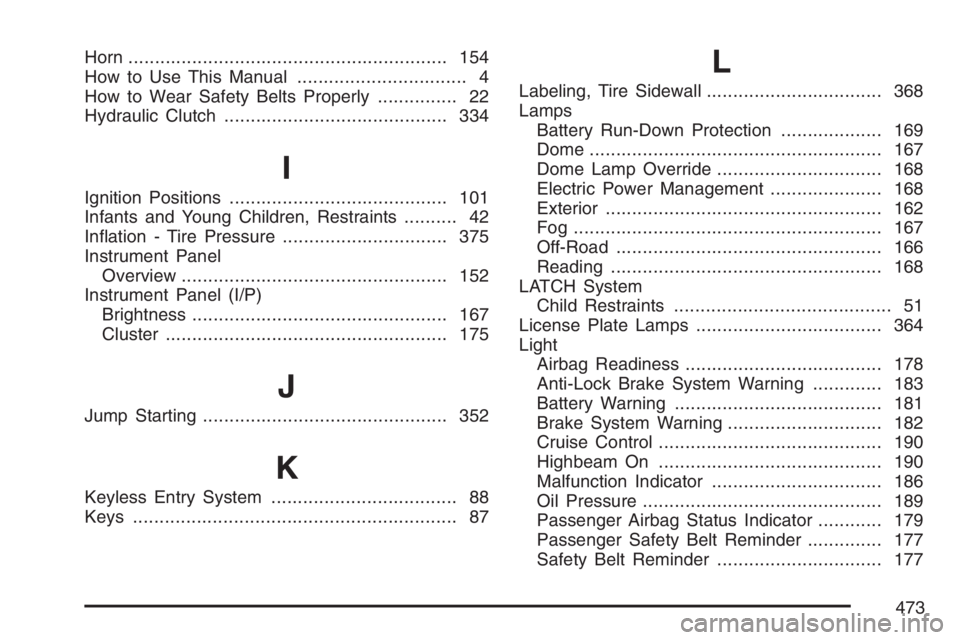
Horn............................................................ 154
How to Use This Manual................................ 4
How to Wear Safety Belts Properly............... 22
Hydraulic Clutch.......................................... 334
I
Ignition Positions......................................... 101
Infants and Young Children, Restraints.......... 42
Ination - Tire Pressure............................... 375
Instrument Panel
Overview.................................................. 152
Instrument Panel (I/P)
Brightness................................................ 167
Cluster..................................................... 175
J
Jump Starting.............................................. 352
K
Keyless Entry System................................... 88
Keys............................................................. 87
L
Labeling, Tire Sidewall................................. 368
Lamps
Battery Run-Down Protection................... 169
Dome....................................................... 167
Dome Lamp Override............................... 168
Electric Power Management..................... 168
Exterior.................................................... 162
Fog .......................................................... 167
Off-Road.................................................. 166
Reading................................................... 168
LATCH System
Child Restraints......................................... 51
License Plate Lamps................................... 364
Light
Airbag Readiness..................................... 178
Anti-Lock Brake System Warning............. 183
Battery Warning....................................... 181
Brake System Warning............................. 182
Cruise Control.......................................... 190
Highbeam On.......................................... 190
Malfunction Indicator................................ 186
Oil Pressure............................................. 189
Passenger Airbag Status Indicator............ 179
Passenger Safety Belt Reminder.............. 177
Safety Belt Reminder............................... 177
473
Page 475 of 480

MP3 ............................................................ 222
MyGMLink.com............................................ 451
N
Navigation/Radio System,
see Navigation Manual............................. 230
New Vehicle Break-In.................................. 101
Normal Maintenance Replacement Parts....... 442
O
Odometer.................................................... 176
Odometer, Trip............................................ 176
Off-Road Driving.......................................... 250
Off-Road Lamps.......................................... 166
Off-Road Recovery...................................... 247
Oil
Engine..................................................... 323
Pressure Light.......................................... 189
Oil, Engine Oil Life System......................... 326
Older Children, Restraints............................. 39
Online Owner Center................................... 451
OnStar
®System, see OnStar®Manual........ 129
Other Warning Devices................................ 154
Outlet Adjustment........................................ 173
Outlet(s), Accessory Power.......................... 169Outside
Convex Mirror.......................................... 128
Power Mirrors.......................................... 128
Owner Checks and Services....................... 435
Owners, Canadian.......................................... 3
P
Paint, Damage............................................ 413
Park (P)
Shifting Into............................................. 117
Shifting Out of......................................... 119
Parking
Brake....................................................... 116
Over Things That Burn............................ 119
Parking Your Vehicle................................... 119
Passenger Airbag Status Indicator............... 179
Passenger Sensing System........................... 75
Passing....................................................... 247
Passlock
®.................................................... 100
Power
Accessory Outlet(s).................................. 169
Door Locks................................................ 93
Electrical System..................................... 417
Lumbar Controls.......................................... 9
Retained Accessory (RAP)....................... 103
Seat............................................................ 9
475