warning light HUMMER H3 2007 Owner's Guide
[x] Cancel search | Manufacturer: HUMMER, Model Year: 2007, Model line: H3, Model: HUMMER H3 2007Pages: 480, PDF Size: 2.73 MB
Page 380 of 480
5. Remove the valve cap from the valve cap
stem. Activate the TPMS sensor by
increasing or decreasing the tire’s air pressure
for 10 seconds, then stop and listen for a
single horn chirp. The single horn chirp should
sound within 15 seconds, conrming that
the sensor identication code has been
matched to this tire and wheel position. If you
do not hear the conrming single horn
chirp, you will need to start over with step
number one. To let air-pressure out of a tire
you can use the pointed end of the valve cap,
a pencil-style air pressure gage, or a key.
6. Proceed to the passenger’s side front tire,
and repeat the procedure in Step 5.
7. Proceed to the passenger’s side rear tire,
and repeat the procedure in Step 5.8. Proceed to the driver’s side rear tire, and
repeat the procedure in Step 5.
9. After hearing the conrming horn chirp
for the left rear tire, check to see if
the TPMS warning light is still ashing.
If it is, turn the ignition switch to LOCK.
If the TPMS warning light is not ashing,
the ve minute time limit has passed and
you will need to start the process
over beginning with Step 1.
10. Set all four tires to the recommended air
pressure level as indicated on the Tire
and Loading Information label.
11. Put the valve caps back on the valve stems.
380
Page 386 of 480
Uniform Tire Quality Grading
Quality grades can be found where applicable
on the tire sidewall between tread shoulder
and maximum section width. For example:
Treadwear 200 Traction AA Temperature A
The following information relates to the system
developed by the United States National Highway
Traffic Safety Administration (NHTSA), which
grades tires by treadwear, traction, and
temperature performance. This applies only to
vehicles sold in the United States. The grades are
molded on the sidewalls of most passenger car
tires. The Uniform Tire Quality Grading (UTQG)
system does not apply to deep tread, winter-type
snow tires, space-saver, or temporary use
spare tires, tires with nominal rim diameters of
10 to 12 inches (25 to 30 cm), or to some
limited-production tires.
While the tires available on General Motors
passenger cars and light trucks may vary with
respect to these grades, they must also conform
to federal safety requirements and additional
General Motors Tire Performance Criteria (TPC)
standards.
Treadwear
The treadwear grade is a comparative rating
based on the wear rate of the tire when tested
under controlled conditions on a specied
government test course. For example, a tire
graded 150 would wear one and a half (1.5) times
as well on the government course as a tire
graded 100. The relative performance of tires
depends upon the actual conditions of their use,
however, and may depart signicantly from
the norm due to variations in driving habits, service
practices, and differences in road characteristics
and climate.
Traction – AA, A, B, C
The traction grades, from highest to lowest, are
AA, A, B, and C. Those grades represent the tire’s
ability to stop on wet pavement as measured
under controlled conditions on specied
government test surfaces of asphalt and concrete.
A tire marked C may have poor traction
performance.
Warning:The traction grade assigned to this tire
is based on straight-ahead braking traction
tests, and does not include acceleration, cornering,
hydroplaning, or peak traction characteristics.
386
Page 467 of 480
A
Accessories and Modications..................... 314
Accessory Power Outlet(s).......................... 169
Adding Equipment to Your
Airbag-Equipped Vehicle............................ 81
Additives, Fuel............................................ 317
Add-On Electrical Equipment....................... 416
Air Cleaner/Filter, Engine............................. 328
Air Conditioning........................................... 170
Airbag
Passenger Status Indicator....................... 179
Readiness Light....................................... 178
Airbag Sensing and Diagnostic
Module (SDM).......................................... 458
Airbag System............................................... 65
Adding Equipment to Your
Airbag-Equipped Vehicle......................... 81
How Does an Airbag Restrain?.................. 73
Passenger Sensing System....................... 75
Servicing Your Airbag-Equipped Vehicle..... 80
What Makes an Airbag Inate?.................. 73
What Will You See After an
Airbag Inates?...................................... 74
When Should an Airbag Inate?................. 71
Where Are the Airbags?............................. 69
Antenna, Fixed Mast................................... 232Antenna, XM™ Satellite Radio Antenna
System.................................................... 232
Anti-Lock Brake System (ABS).................... 239
Anti-Lock Brake, System Warning Light....... 183
Appearance Care
Aluminum or Chrome-Plated Wheels........ 412
Care of Safety Belts................................ 409
Chemical Paint Spotting........................... 414
Cleaning Exterior Lamps/Lenses.............. 410
Cleaning the Inside of Your Vehicle.......... 406
Fabric/Carpet........................................... 407
Finish Care.............................................. 410
Finish Damage......................................... 413
Instrument Panel, Vinyl, and Other
Plastic Surfaces.................................... 409
Leather.................................................... 408
Sheet Metal Damage............................... 413
Tires........................................................ 413
Underbody Maintenance........................... 413
Vehicle Care/Appearance Materials.......... 414
Washing Your Vehicle .............................. 410
Weatherstrips........................................... 409
Windshield, Backglass, and
Wiper Blades........................................ 411
Ashtray(s).................................................... 170
Assist Steps................................................ 271
467
Page 468 of 480
Audio System(s).......................................... 201
Care of Your CD Player........................... 232
Care of Your CDs.................................... 231
Fixed Mast Antenna................................. 232
Navigation/Radio System,
see Navigation Manual......................... 230
Radio with CD......................................... 203
Radio with Six-Disc CD............................ 211
Setting the Time...................................... 202
Theft-Deterrent Feature............................ 230
Understanding Radio Reception............... 230
XM™ Satellite Radio Antenna System...... 232
Automatic Headlamp System....................... 165
Automatic Transmission
Fluid........................................................ 329
Operation................................................. 106
B
Battery........................................................ 351
Electric Power Management..................... 168
Run-Down Protection............................... 169
Battery Warning Light.................................. 181
Before Leaving on a Long Trip.................... 278
Bench Seat, Split (60/40).............................. 14Brake
Anti-Lock Brake System (ABS)................. 239
Emergencies............................................ 241
Parking.................................................... 116
System Warning Light.............................. 182
Brakes........................................................ 347
Braking....................................................... 238
Braking in Emergencies............................... 241
Break-In, New Vehicle................................. 101
Bulb Replacement....................................... 361
Halogen Bulbs......................................... 361
Headlamp Aiming..................................... 358
Headlamps............................................... 362
License Plate Lamps................................ 364
Replacement Bulbs.................................. 365
Taillamps, Turn Signal, Stoplamps
and Back-up Lamps.............................. 363
Buying New Tires........................................ 383C
Calibration..........................................122, 125
California Fuel............................................. 316
California Proposition 65 Warning................ 315
Canadian Owners........................................... 3
468
Page 470 of 480
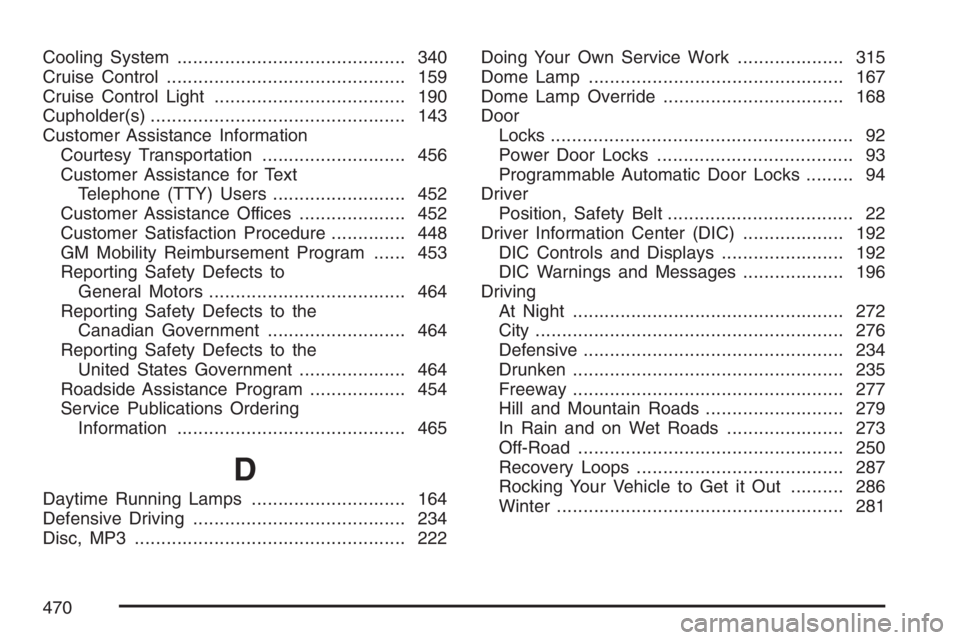
Cooling System........................................... 340
Cruise Control............................................. 159
Cruise Control Light.................................... 190
Cupholder(s)................................................ 143
Customer Assistance Information
Courtesy Transportation........................... 456
Customer Assistance for Text
Telephone (TTY) Users......................... 452
Customer Assistance Offices.................... 452
Customer Satisfaction Procedure.............. 448
GM Mobility Reimbursement Program...... 453
Reporting Safety Defects to
General Motors..................................... 464
Reporting Safety Defects to the
Canadian Government.......................... 464
Reporting Safety Defects to the
United States Government.................... 464
Roadside Assistance Program.................. 454
Service Publications Ordering
Information........................................... 465
D
Daytime Running Lamps............................. 164
Defensive Driving........................................ 234
Disc, MP3................................................... 222Doing Your Own Service Work.................... 315
Dome Lamp................................................ 167
Dome Lamp Override.................................. 168
Door
Locks......................................................... 92
Power Door Locks..................................... 93
Programmable Automatic Door Locks......... 94
Driver
Position, Safety Belt................................... 22
Driver Information Center (DIC)................... 192
DIC Controls and Displays....................... 192
DIC Warnings and Messages................... 196
Driving
At Night................................................... 272
City.......................................................... 276
Defensive................................................. 234
Drunken................................................... 235
Freeway................................................... 277
Hill and Mountain Roads.......................... 279
In Rain and on Wet Roads...................... 273
Off-Road.................................................. 250
Recovery Loops....................................... 287
Rocking Your Vehicle to Get it Out.......... 286
Winter...................................................... 281
470
Page 471 of 480

E
Electric Power Management........................ 168
Electrical System
Add-On Equipment................................... 416
Engine Compartment Fuse Block............. 418
Fuses and Circuit Breakers...................... 417
Power Windows and Other Power
Options................................................. 417
Windshield Wiper Fuses........................... 417
Engine
Air Cleaner/Filter...................................... 328
Battery..................................................... 351
Check and Service Engine Soon Light..... 186
Coolant.................................................... 335
Coolant Heater......................................... 105
Coolant Temperature Gage...................... 185
Drive Belt Routing.................................... 443
Engine Compartment Overview................ 322
Exhaust................................................... 120
Fan Noise................................................ 345
Oil ........................................................... 323
Oil Life System........................................ 326
Overheating............................................. 338
Starting.................................................... 103
Event Data Recorders (EDR)...................... 458Exit Lighting................................................ 168
Extender, Safety Belt..................................... 38
Exterior Lamps............................................ 162
F
Filter
Engine Air Cleaner................................... 328
Finish Damage............................................ 413
Fixed Mast Antenna.................................... 232
Flashers, Hazard Warning........................... 154
Flash-to-Pass.............................................. 157
Flat Tire...................................................... 390
Flat Tire, Changing...................................... 391
Flat Tire, Storing......................................... 403
Fluid
Automatic Transmission............................ 329
Manual Transmission................................ 332
Power Steering........................................ 345
Windshield Washer.................................. 346
Fog Lamps.................................................. 167
Four-Wheel Drive........................................ 358
Four-Wheel Drive, Full-Time........................ 111
Front Armrest Storage Area......................... 143
Front Axle................................................... 358
Front Seat Storage Net............................... 143
471
Page 472 of 480

Fuel............................................................ 316
Additives.................................................. 317
California Fuel.......................................... 316
Filling a Portable Fuel Container.............. 320
Filling Your Tank...................................... 318
Fuels in Foreign Countries....................... 318
Gage....................................................... 191
Gasoline Octane...................................... 316
Gasoline Specications............................ 316
Fuses
Engine Compartment Fuse Block............. 418
Fuses and Circuit Breakers...................... 417
Windshield Wiper..................................... 417
G
Gage
Engine Coolant Temperature.................... 185
Fuel......................................................... 191
Speedometer........................................... 176
Tachometer.............................................. 176
Garage Door Opener..........................132, 133
Gasoline
Octane..................................................... 316
Specications........................................... 316Glove Box................................................... 143
GM Mobility Reimbursement Program.......... 453
H
Hazard Warning Flashers............................ 154
Head Restraints............................................ 13
Headlamp
Aiming..................................................... 358
Headlamps.................................................. 362
Automatic Headlamp System.................... 165
Bulb Replacement.................................... 361
Daytime Running Lamps.......................... 164
Flash-to-Pass........................................... 157
Halogen Bulbs......................................... 361
High/Low Beam Changer ......................... 157
On Reminder........................................... 164
Heated Seats................................................ 10
Heater......................................................... 170
Highbeam On Light..................................... 190
Highway Hypnosis....................................... 279
Hill and Mountain Roads............................. 279
Hood
Checking Things Under............................ 321
Release................................................... 321
472
Page 473 of 480
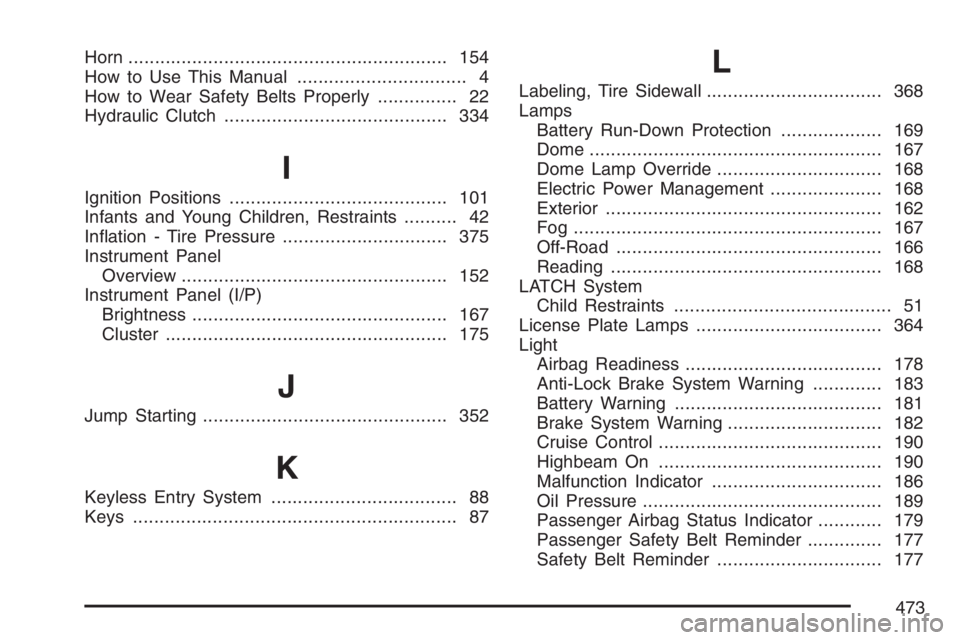
Horn............................................................ 154
How to Use This Manual................................ 4
How to Wear Safety Belts Properly............... 22
Hydraulic Clutch.......................................... 334
I
Ignition Positions......................................... 101
Infants and Young Children, Restraints.......... 42
Ination - Tire Pressure............................... 375
Instrument Panel
Overview.................................................. 152
Instrument Panel (I/P)
Brightness................................................ 167
Cluster..................................................... 175
J
Jump Starting.............................................. 352
K
Keyless Entry System................................... 88
Keys............................................................. 87
L
Labeling, Tire Sidewall................................. 368
Lamps
Battery Run-Down Protection................... 169
Dome....................................................... 167
Dome Lamp Override............................... 168
Electric Power Management..................... 168
Exterior.................................................... 162
Fog .......................................................... 167
Off-Road.................................................. 166
Reading................................................... 168
LATCH System
Child Restraints......................................... 51
License Plate Lamps................................... 364
Light
Airbag Readiness..................................... 178
Anti-Lock Brake System Warning............. 183
Battery Warning....................................... 181
Brake System Warning............................. 182
Cruise Control.......................................... 190
Highbeam On.......................................... 190
Malfunction Indicator................................ 186
Oil Pressure............................................. 189
Passenger Airbag Status Indicator............ 179
Passenger Safety Belt Reminder.............. 177
Safety Belt Reminder............................... 177
473
Page 474 of 480

Light (cont.)
Security................................................... 190
StabiliTrak
®Not Ready............................. 184
Tire Pressure........................................... 185
Traction Off.............................................. 184
Up-Shift................................................... 181
Lighting
Exit.......................................................... 168
Loading Your Vehicle................................... 289
Locking Rear Axle....................................... 243
Lockout Protection......................................... 94
Locks
Door.......................................................... 92
Lockout Protection..................................... 94
Power Door............................................... 93
Programmable Automatic Door Locks......... 94
Loss of Control........................................... 249
Luggage Carrier.......................................... 144
Lumbar
Power Controls............................................ 9
M
Maintenance Schedule
Additional Required Services.................... 432
At Each Fuel Fill...................................... 436
At Least Once a Month............................ 436
At Least Once a Year.............................. 437Maintenance Schedule (cont.)
Introduction.............................................. 426
Maintenance Footnotes............................ 433
Maintenance Record................................ 444
Maintenance Requirements...................... 426
Normal Maintenance Replacement Parts.... 442
Owner Checks and Services.................... 435
Recommended Fluids and Lubricants....... 440
Scheduled Maintenance........................... 429
Using....................................................... 427
Your Vehicle and the Environment............ 427
Malfunction Indicator Light........................... 186
Manual Seats.................................................. 8
Manual Transmission
Fluid........................................................ 332
Operation................................................. 109
Message
DIC Warnings and Messages................... 196
Mirrors
Automatic Dimming Rearview with
Compass and Temperature Display....... 125
Automatic Dimming Rearview
with OnStar
®, Compass and
Temperature Display............................. 122
Outside Convex Mirror............................. 128
Outside Power Mirrors............................. 128
474
Page 475 of 480

MP3 ............................................................ 222
MyGMLink.com............................................ 451
N
Navigation/Radio System,
see Navigation Manual............................. 230
New Vehicle Break-In.................................. 101
Normal Maintenance Replacement Parts....... 442
O
Odometer.................................................... 176
Odometer, Trip............................................ 176
Off-Road Driving.......................................... 250
Off-Road Lamps.......................................... 166
Off-Road Recovery...................................... 247
Oil
Engine..................................................... 323
Pressure Light.......................................... 189
Oil, Engine Oil Life System......................... 326
Older Children, Restraints............................. 39
Online Owner Center................................... 451
OnStar
®System, see OnStar®Manual........ 129
Other Warning Devices................................ 154
Outlet Adjustment........................................ 173
Outlet(s), Accessory Power.......................... 169Outside
Convex Mirror.......................................... 128
Power Mirrors.......................................... 128
Owner Checks and Services....................... 435
Owners, Canadian.......................................... 3
P
Paint, Damage............................................ 413
Park (P)
Shifting Into............................................. 117
Shifting Out of......................................... 119
Parking
Brake....................................................... 116
Over Things That Burn............................ 119
Parking Your Vehicle................................... 119
Passenger Airbag Status Indicator............... 179
Passenger Sensing System........................... 75
Passing....................................................... 247
Passlock
®.................................................... 100
Power
Accessory Outlet(s).................................. 169
Door Locks................................................ 93
Electrical System..................................... 417
Lumbar Controls.......................................... 9
Retained Accessory (RAP)....................... 103
Seat............................................................ 9
475