tires HUMMER H3 2007 Owners Manual
[x] Cancel search | Manufacturer: HUMMER, Model Year: 2007, Model line: H3, Model: HUMMER H3 2007Pages: 480, PDF Size: 2.73 MB
Page 2 of 480
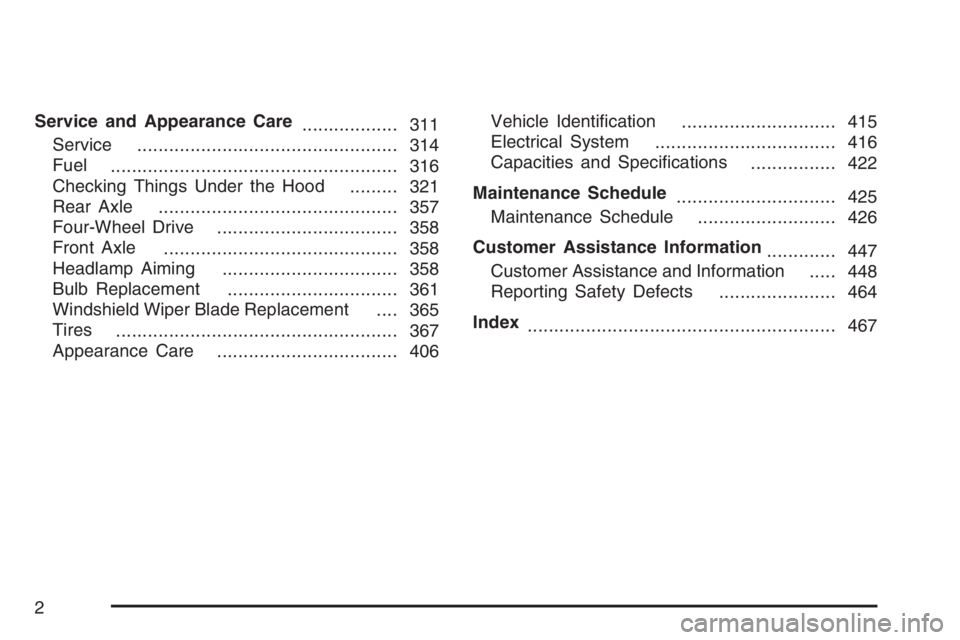
Service and Appearance Care
.................. 311
Service
................................................. 314
Fuel
...................................................... 316
Checking Things Under the Hood
......... 321
Rear Axle
............................................. 357
Four-Wheel Drive
.................................. 358
Front Axle
............................................ 358
Headlamp Aiming
................................. 358
Bulb Replacement
................................ 361
Windshield Wiper Blade Replacement
.... 365
Tires
..................................................... 367
Appearance Care
.................................. 406Vehicle Identication
............................. 415
Electrical System
.................................. 416
Capacities and Specications
................ 422
Maintenance Schedule
.............................. 425
Maintenance Schedule
.......................... 426
Customer Assistance Information
............. 447
Customer Assistance and Information
..... 448
Reporting Safety Defects
...................... 464
Index
.......................................................... 467
2
Page 108 of 480

DRIVE (D):This position is for normal driving.
It provides the best fuel economy for your vehicle.
If you need more power for passing, and you are:
Going less than about 35 mph (55 km/h), push
your accelerator pedal about halfway down.
Going about 35 mph (55 km/h) or more, push
the accelerator all the way down.
Downshifting the transmission in slippery road
conditions could result in skidding, see “Skidding”
underLoss of Control on page 249.
DRIVE (D) can be used when towing a trailer.
You may want to shift the transmission to
THIRD (3) or, if necessary, a lower gear if the
transmission shifts too often under heavy loads
and/or hilly conditions.
THIRD (3):This position is also used for normal
driving. However it reduces vehicle speed
more than DRIVE (D) without using your brakes.
You might choose THIRD (3) instead of DRIVE (D)
when driving on hilly, winding roads, when
towing a trailer, so there is less shifting between
gears and when going down a steep hill.SECOND (2): This position reduces vehicle speed
even more than THIRD (3) without using your
brakes. You can use SECOND (2) on hills. It can
help control your speed as you go down steep
mountain roads, but then you would also want to
use your brakes off and on.
FIRST (1): This position reduces vehicle speed
even more than SECOND (2) without using
your brakes. You can use it on very steep hills, or
in deep snow or mud. If the shift lever is put in
FIRST (1) while the vehicle is moving forward, the
transmission will not shift into rst gear until the
vehicle is going slowly enough.
Notice:Spinning the tires or holding the
vehicle in one place on a hill using only
the accelerator pedal may damage the
transmission. The repair will not be covered
by your warranty. If you are stuck, do not spin
the tires. When stopping on a hill, use the
brakes to hold the vehicle in place.
108
Page 111 of 480

Full-Time Four-Wheel Drive
Full-Time Four-Wheel Drive sends your engine’s
driving power to all four wheels for extra traction.
To get the most out of Full-Time Four-Wheel
Drive, you must be familiar with its operation.
Transfer Case Buttons
The transfer case buttons are located to the
right of the instrument panel cluster. Use these
switches to shift into and out of the different
Full-Time Four-Wheel Drive modes.You can choose between four modes:
4
m(Four-Wheel High):This setting is used for
driving in most street and highway situations.
You can also use this setting for light or variable
off-road conditions.
N (NEUTRAL):Shift the vehicle’s transfer case
to NEUTRAL only when towing your vehicle.
SeeRecreational Vehicle Towing on page 295
orTowing Your Vehicle on page 294for more
information.
Notice:Driving on pavement in Four-Wheel
High Lock or Four Wheel Low Lock for
extended periods may cause premature wear
on your vehicle’s powertrain and tires. Do not
drive in Four-Wheel High Lock or Four-Wheel
Low Lock on pavement for extended periods.
4
mQ(Four-Wheel-High Lock):Use this
mode when you need extra traction in most
off-road situations such as sand, mud, snow or
level, rocky trails.
111
Page 185 of 480

Engine Coolant Temperature Gage
This gage shows the engine coolant temperature.
If the gage pointer is in the shaded area of the
gage, the engine is too hot. It means that your
engine coolant has overheated. If you have been
operating your vehicle under normal driving
conditions, you should pull off the road, stop your
vehicle and turn off the engine as soon as possible.
SeeEngine Overheating on page 338for more
information.
Tire Pressure Light
This light should
come on briey
when you turn the
ignition to ON.
This light will also come on when one or more
of your tires are signicantly underinated.
A LOW TIRE message will also appear in the
Driver Information Center (DIC), seeDIC Warnings
and Messages on page 196for more information.
Stop and check your tires as soon as it is safe to do
so. If underinated, inate to the proper pressure.
SeeTires on page 367for more information.
This light will ash for 60 seconds and then turn
on solid if a problem is detected with the Tire
Pressure Monitor system. SeeTire Pressure
Monitor System on page 376for more information.
United StatesCanada
185
Page 186 of 480
Malfunction Indicator Lamp
Check Engine Light
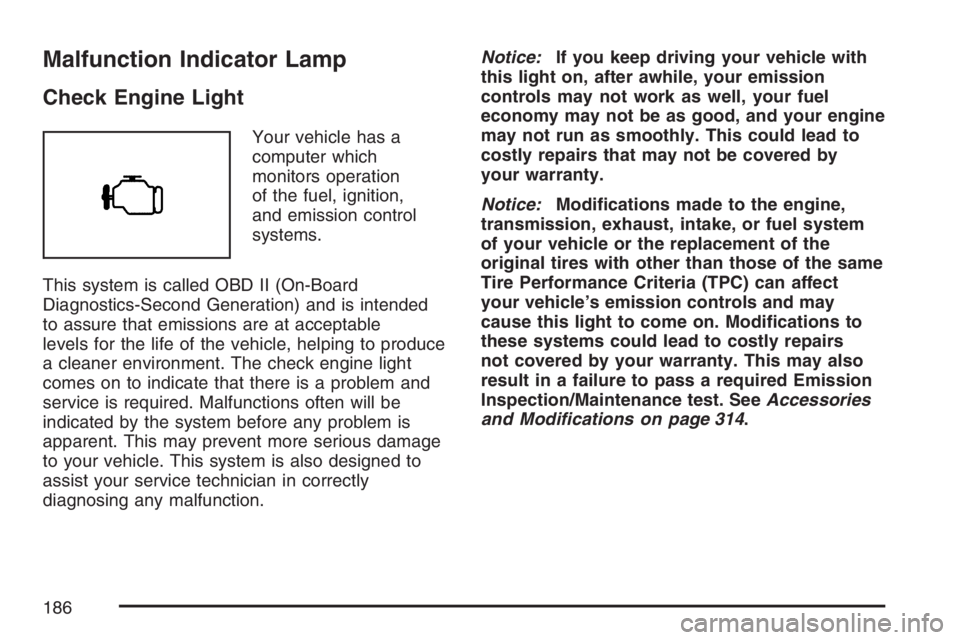
Your vehicle has a
computer which
monitors operation
of the fuel, ignition,
and emission control
systems.
This system is called OBD II (On-Board
Diagnostics-Second Generation) and is intended
to assure that emissions are at acceptable
levels for the life of the vehicle, helping to produce
a cleaner environment. The check engine light
comes on to indicate that there is a problem and
service is required. Malfunctions often will be
indicated by the system before any problem is
apparent. This may prevent more serious damage
to your vehicle. This system is also designed to
assist your service technician in correctly
diagnosing any malfunction.Notice:If you keep driving your vehicle with
this light on, after awhile, your emission
controls may not work as well, your fuel
economy may not be as good, and your engine
may not run as smoothly. This could lead to
costly repairs that may not be covered by
your warranty.
Notice:Modications made to the engine,
transmission, exhaust, intake, or fuel system
of your vehicle or the replacement of the
original tires with other than those of the same
Tire Performance Criteria (TPC) can affect
your vehicle’s emission controls and may
cause this light to come on. Modications to
these systems could lead to costly repairs
not covered by your warranty. This may also
result in a failure to pass a required Emission
Inspection/Maintenance test. SeeAccessories
and Modifications on page 314.
186
Page 198 of 480

FUEL CAP
This message displays if the vehicle’s fuel cap is
either off or loose. Pull over as soon as possible
and check to see if the fuel cap is secure. You may
also see the check engine light on the instrument
panel cluster. If the check engine light does
come on when the fuel cap was loose, it may take
a few driving trips before the light turns off. See
Malfunction Indicator Lamp on page 186for more
information if the light still remains on. Press
and release the reset stem to acknowledge the
message and clear it from the display.
LOW FUEL
This message displays if the level of fuel in the
vehicle is low. Also check the fuel gage. See
Fuel Gage on page 191for more information.
Rell the fuel tank as soon as possible.
LOW TIRE
This message displays if a low tire pressure is
detected in any of the vehicle’s tires. Press
and release the reset stem to acknowledge the
message and clear it from the display. The
message appears at each ignition cycle until the
tires are inated to the correct ination pressure.
SeeTires on page 367andInation - Tire
Pressure on page 375for more information on
tires and the correct ination pressures.
OIL
This message displays when the oil pressure is
low. SeeOil Pressure Light on page 189and
Engine Oil on page 323for more information.
PARK BRK (Brake)
This message displays when the parking brake
is set. SeeParking Brake on page 116and
Brake System Warning Light on page 182for
more information. The message clears from the
display after the parking brake is released or
by pressing and releasing the reset stem.
198
Page 238 of 480
Control of a Vehicle
You have three systems that make your
vehicle go where you want it to go. They are
the brakes, the steering, and the accelerator.
All three systems have to do their work at
the places where the tires meet the road.
Sometimes, as when you are driving on snow
or ice, it is easy to ask more of those control
systems than the tires and road can provide.
That means you can lose control of your vehicle.
SeeTraction Control System (TCS) on page 241.
Adding non-GM accessories can affect your
vehicle’s performance. SeeAccessories and
Modications on page 314.
Braking
SeeBrake System Warning Light on page 182.
Braking action involves perception time and
reaction time.
First, you have to decide to push on the brake
pedal. That is perception time. Then you have to
bring up your foot and do it. That is reaction time.
Average reaction time is about three-fourths of a
second. But that is only an average. It might be less
with one driver and as long as two or three seconds
or more with another. Age, physical condition,
alertness, coordination, and eyesight all play a part.
So do alcohol, drugs, and frustration. But even in
three-fourths of a second, a vehicle moving at
60 mph (100 km/h) travels 66 feet (20 m). That
could be a lot of distance in an emergency, so
keeping enough space between your vehicle and
others is important.
And, of course, actual stopping distances vary
greatly with the surface of the road, whether it is
pavement or gravel; the condition of the road,
whether it is wet, dry, or icy; tire tread; the
condition of the brakes; the weight of the vehicle;
and the amount of brake force applied.
238
Page 243 of 480

Locking Rear Axle
Your vehicle may have this feature. The locking
rear axle can give your vehicle additional traction
from the rear wheels when traveling in off-road
situations such as mud, snow, sand, steep
hills and uneven terrain.
The button used to turn
this feature on or off is
located to the right
of the transfer case
buttons on the center of
the instrument panel.
To lock the rear axle, do the following:
1. Place the transfer case in the 4LO Lock mode.
This is the only mode which will allow the rear
axle to lock. SeeFull-Time Four-Wheel Drive
on page 111for more information regarding
the transfer case and 4LO Lock mode.
2. Press the button with the vehicle stopped or
moving less than 2 mph (3 km/h).
You must wait for the light in the button to stop
ashing and remain illuminated before the
rear axle is locked.Notice:If you try to lock the rear axle while
your vehicle is stuck and the tires are spinning,
you could damage your vehicle’s drivetrain.
The repairs would not be covered by your
warranty. Always lock the rear axle before
attempting situations and/or navigating terrain
which could possibly cause the vehicle to
become stuck.
The locking rear axle will be disengaged when the
wheel speed is greater than 20 mph (32 km/h),
if the vehicle’s battery is low and/or the transfer
case is shifted out of 4LO Lock mode.
Notice:If you lock the rear axle while driving
on pavement, you could damage your vehicle’s
drivetrain. The repairs would not be covered by
your warranty. Do not use the locking rear axle
on pavement. If you need four-wheel drive when
traveling on pavement, use only 4HI.
243
Page 245 of 480

Steering
Power Steering
If you lose power steering assist because the
engine stops or the system is not functioning,
you can steer but it will take much more effort.
Steering Tips
It is important to take curves at a reasonable speed.
A lot of the “driver lost control” accidents mentioned
on the news happen on curves. Here is why:
Experienced driver or beginner, each of us is
subject to the same laws of physics when driving on
curves. The traction of the tires against the road
surface makes it possible for the vehicle to change
its path when you turn the front wheels. If there is
no traction, inertia will keep the vehicle going in the
same direction. If you have ever tried to steer a
vehicle on wet ice, you will understand this.
The traction you can get in a curve depends on
the condition of your tires and the road surface,
the angle at which the curve is banked, and
your speed. While you are in a curve, speed is
the one factor you can control.Suppose you are steering through a sharp curve.
Then you suddenly accelerate. Both control
systems — steering and acceleration — have to
do their work where the tires meet the road.
Adding the sudden acceleration can demand too
much of those places. You can lose control.
SeeTraction Control System (TCS) on page 241
andStabiliTrak
®System on page 244.
What should you do if this ever happens? Ease up
on the accelerator pedal, steer the vehicle the way
you want it to go, and slow down.
Speed limit signs near curves warn that you should
adjust your speed. Of course, the posted speeds are
based on good weather and road conditions. Under
less favorable conditions you will want to go slower.
If you need to reduce your speed as you approach
a curve, do it before you enter the curve, while your
front wheels are straight ahead.
Try to adjust your speed so you can “drive” through
the curve. Maintain a reasonable, steady speed.
Wait to accelerate until you are out of the curve,
and then accelerate gently into the straightaway.
Adding non-GM accessories can affect your
vehicle’s performance. SeeAccessories and
Modications on page 314.
245
Page 249 of 480

Loss of Control
Let us review what driving experts say about what
happens when the three control systems — brakes,
steering, and acceleration — do not have enough
friction where the tires meet the road to do what the
driver has asked.
In any emergency, do not give up. Keep trying
to steer and constantly seek an escape route or
area of less danger.
Skidding
In a skid, a driver can lose control of the vehicle.
Defensive drivers avoid most skids by taking
reasonable care suited to existing conditions,
and by not overdriving those conditions.
But skids are always possible.
The three types of skids correspond to your
vehicle’s three control systems. In the braking skid,
your wheels are not rolling. In the steering or
cornering skid, too much speed or steering in a
curve causes tires to slip and lose cornering force.
And in the acceleration skid, too much throttle
causes the driving wheels to spin.A cornering skid is best handled by easing your
foot off the accelerator pedal.
Remember: Any traction control system helps avoid
only the acceleration skid. If your traction system is
off, then an acceleration skid is also best handled
by easing your foot off the accelerator pedal.
SeeTraction Control System (TCS) on page 241
andStabiliTrak
®System on page 244.
If your vehicle starts to slide, ease your foot
off the accelerator pedal and quickly steer the way
you want the vehicle to go. If you start steering
quickly enough, your vehicle may straighten
out. Always be ready for a second skid if it occurs.
Of course, traction is reduced when water,
snow, ice, gravel, or other material is on the
road. For safety, you will want to slow down
and adjust your driving to these conditions.
It is important to slow down on slippery surfaces
because stopping distance will be longer and
vehicle control more limited.
249