steering HUMMER H3 2008 Owner's Guide
[x] Cancel search | Manufacturer: HUMMER, Model Year: 2008, Model line: H3, Model: HUMMER H3 2008Pages: 416, PDF Size: 5.66 MB
Page 294 of 416
Engine Fan Noise
This vehicle has a clutched engine cooling fan. When
the clutch is engaged, the fan spins faster to provide
more air to cool the engine. In most everyday driving
conditions, the clutch is not engaged. This improves fuel
economy and reduces fan noise. Under heavy vehicle
loading, trailer towing and/or high outside temperatures,
the fan speed increases when the clutch engages.
So you may hear an increase in fan noise. This
is normal and should not be mistaken as the
transmission slipping or making extra shifts. It is merely
the cooling system functioning properly. The fan will
slow down when additional cooling is not required and
the clutch disengages.
You may also hear this fan noise when you start the
engine. It will go away as the fan clutch disengages.
Power Steering Fluid
SeeEngine Compartment
Overview on page 5-12for
reservoir location.
When to Check Power Steering Fluid
It is not necessary to regularly check power steering uid
unless you suspect there is a leak in the system or
you hear an unusual noise. A uid loss in this system
could indicate a problem. Have the system inspected
and repaired.
How to Check Power Steering Fluid
1. Turn the key off and let the engine compartment
cool down.
2. Wipe the cap and the top of the reservoir clean.
3. Unscrew the cap and wipe the dipstick with a
clean rag.
5-36
Page 317 of 416
(D) Construction Code:A letter code is used to
indicate the type of ply construction in the tire.
The letter R means radial ply construction;
the letter D means diagonal or bias ply
construction; and the letter B means belted-bias
ply construction.
(E) Rim Diameter
:Diameter of the wheel in
inches.
(F) Service Description
:The service description
indicates the load range and speed rating of a
tire. The load index can range from 1 to 279.
Speed ratings range from A to Z.
Tire Terminology and Denitions
Air Pressure:The amount of air inside the
tire pressing outward on each square inch of the
tire. Air pressure is expressed in pounds per
square inch (psi) or kilopascal (kPa).
Accessory Weight
:This means the combined
weight of optional accessories. Some examples of
optional accessories are, automatic transmission,
power steering, power brakes, power windows,
power seats, and air conditioning.
Aspect Ratio
:The relationship of a tire’s height
to its width.Belt
:A rubber coated layer of cords that is
located between the plies and the tread. Cords
may be made from steel or other reinforcing
materials.
Bead
:The tire bead contains steel wires wrapped
by steel cords that hold the tire onto the rim.
Bias Ply Tire
:A pneumatic tire in which the plies
are laid at alternate angles less than 90 degrees
to the centerline of the tread.
Cold Tire Pressure
:The amount of air pressure in
a tire, measured in pounds per square inch (psi) or
kilopascals (kPa) before a tire has built up heat
from driving. SeeInflation - Tire Pressure on
page 5-62.
Curb Weight
:The weight of a motor vehicle with
standard and optional equipment including the
maximum capacity of fuel, oil, and coolant,
but without passengers and cargo.
DOT Markings
:A code molded into the sidewall
of a tire signifying that the tire is in compliance
with the U.S. Department of Transportation (DOT)
motor vehicle safety standards. The DOT code
includes the Tire Identication Number (TIN),
an alphanumeric designator which can also identify
the tire manufacturer, production plant, brand,
and date of production.
5-59
Page 336 of 416
If a Tire Goes Flat
It is unusual for a tire to blowout while you are driving,
especially if you maintain your vehicle’s tires properly.
If air goes out of a tire, it is much more likely to leak out
slowly. But if you should ever have a blowout, here
are a few tips about what to expect and what to do:
If a front tire fails, the at tire creates a drag that pulls
the vehicle toward that side. Take your foot off the
accelerator pedal and grip the steering wheel rmly.
Steer to maintain lane position, and then gently brake to
a stop well out of the traffic lane.
A rear blowout, particularly on a curve, acts much like a
skid and may require the same correction you would
use in a skid. In any rear blowout remove your foot from
the accelerator pedal. Get the vehicle under control
by steering the way you want the vehicle to go. It may
be very bumpy and noisy, but you can still steer. Gently
brake to a stop, well off the road if possible.{CAUTION:
Lifting a vehicle and getting under it to do
maintenance or repairs is dangerous without
the appropriate safety equipment and training.
The jack provided with your vehicle is
designed only for changing a at tire. If it is
used for anything else, you or others could be
badly injured or killed if the vehicle slips off
the jack. Use the jack provided with your
vehicle only for changing a at tire.
If a tire goes at, the next part shows how to use the
jacking equipment to change a at tire safely.
5-78
Page 371 of 416
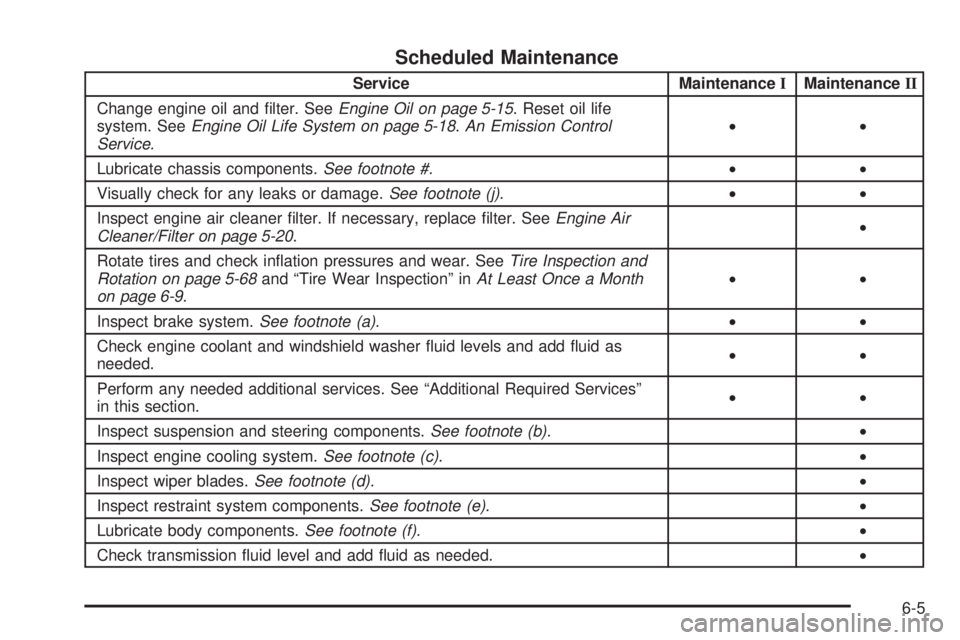
Scheduled Maintenance
Service MaintenanceIMaintenanceII
Change engine oil and lter. SeeEngine Oil on page 5-15. Reset oil life
system. SeeEngine Oil Life System on page 5-18.An Emission Control
Service.••
Lubricate chassis components.See footnote #.••
Visually check for any leaks or damage.See footnote (j).••
Inspect engine air cleaner lter. If necessary, replace lter. SeeEngine Air
Cleaner/Filter on page 5-20.•
Rotate tires and check ination pressures and wear. SeeTire Inspection and
Rotation on page 5-68and “Tire Wear Inspection” inAt Least Once a Month
on page 6-9.••
Inspect brake system.See footnote (a).••
Check engine coolant and windshield washer uid levels and add uid as
needed.••
Perform any needed additional services. See “Additional Required Services”
in this section.••
Inspect suspension and steering components.See footnote (b).•
Inspect engine cooling system.See footnote (c).•
Inspect wiper blades.See footnote (d).•
Inspect restraint system components.See footnote (e).•
Lubricate body components.See footnote (f).•
Check transmission uid level and add uid as needed.•
6-5
Page 373 of 416
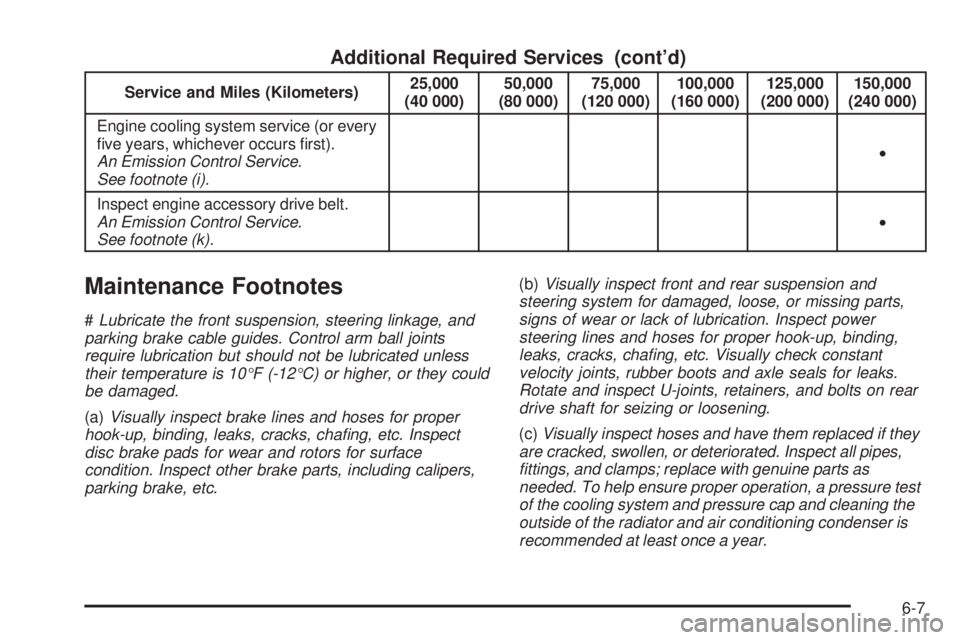
Additional Required Services (cont’d)
Service and Miles (Kilometers)25,000
(40 000)50,000
(80 000)75,000
(120 000)100,000
(160 000)125,000
(200 000)150,000
(240 000)
Engine cooling system service (or every
ve years, whichever occurs rst).
An Emission Control Service.
See footnote (i).•
Inspect engine accessory drive belt.
An Emission Control Service.
See footnote (k).•
Maintenance Footnotes
#Lubricate the front suspension, steering linkage, and
parking brake cable guides. Control arm ball joints
require lubrication but should not be lubricated unless
their temperature is 10°F (-12°C) or higher, or they could
be damaged.
(a)Visually inspect brake lines and hoses for proper
hook-up, binding, leaks, cracks, chafing, etc. Inspect
disc brake pads for wear and rotors for surface
condition. Inspect other brake parts, including calipers,
parking brake, etc.(b)Visually inspect front and rear suspension and
steering system for damaged, loose, or missing parts,
signs of wear or lack of lubrication. Inspect power
steering lines and hoses for proper hook-up, binding,
leaks, cracks, chafing, etc. Visually check constant
velocity joints, rubber boots and axle seals for leaks.
Rotate and inspect U-joints, retainers, and bolts on rear
drive shaft for seizing or loosening.
(c)Visually inspect hoses and have them replaced if they
are cracked, swollen, or deteriorated. Inspect all pipes,
fittings, and clamps; replace with genuine parts as
needed. To help ensure proper operation, a pressure test
of the cooling system and pressure cap and cleaning the
outside of the radiator and air conditioning condenser is
recommended at least once a year.
6-7
Page 378 of 416
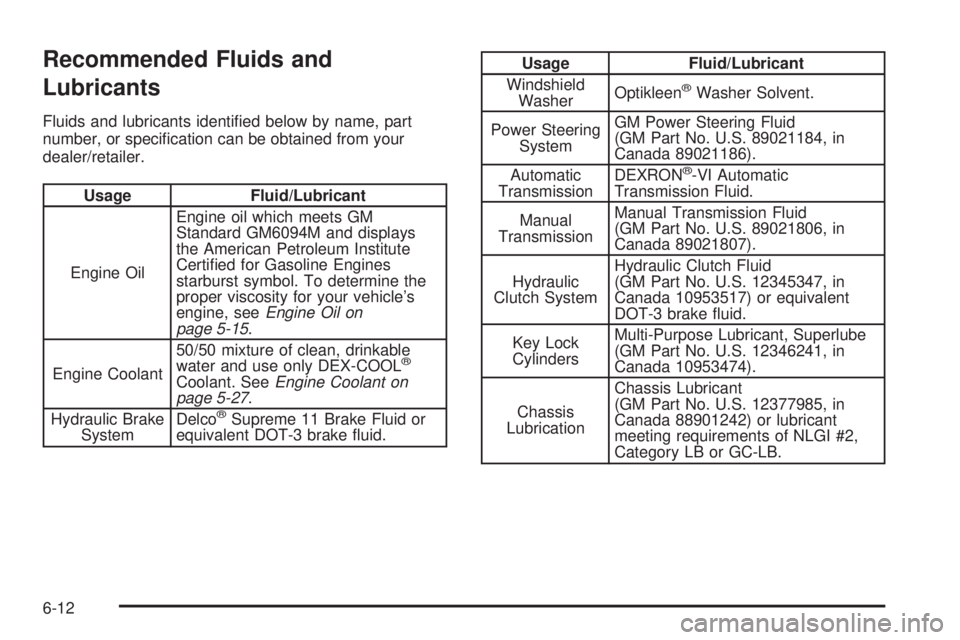
Recommended Fluids and
Lubricants
Fluids and lubricants identied below by name, part
number, or specication can be obtained from your
dealer/retailer.
Usage Fluid/Lubricant
Engine OilEngine oil which meets GM
Standard GM6094M and displays
the American Petroleum Institute
Certied for Gasoline Engines
starburst symbol. To determine the
proper viscosity for your vehicle’s
engine, seeEngine Oil on
page 5-15.
Engine Coolant50/50 mixture of clean, drinkable
water and use only DEX-COOL
®
Coolant. SeeEngine Coolant on
page 5-27.
Hydraulic Brake
SystemDelco
®Supreme 11 Brake Fluid or
equivalent DOT-3 brake uid.
Usage Fluid/Lubricant
Windshield
WasherOptikleen
®Washer Solvent.
Power Steering
SystemGM Power Steering Fluid
(GM Part No. U.S. 89021184, in
Canada 89021186).
Automatic
TransmissionDEXRON
®-VI Automatic
Transmission Fluid.
Manual
TransmissionManual Transmission Fluid
(GM Part No. U.S. 89021806, in
Canada 89021807).
Hydraulic
Clutch SystemHydraulic Clutch Fluid
(GM Part No. U.S. 12345347, in
Canada 10953517) or equivalent
DOT-3 brake uid.
Key Lock
CylindersMulti-Purpose Lubricant, Superlube
(GM Part No. U.S. 12346241, in
Canada 10953474).
Chassis
LubricationChassis Lubricant
(GM Part No. U.S. 12377985, in
Canada 88901242) or lubricant
meeting requirements of NLGI #2,
Category LB or GC-LB.
6-12
Page 399 of 416
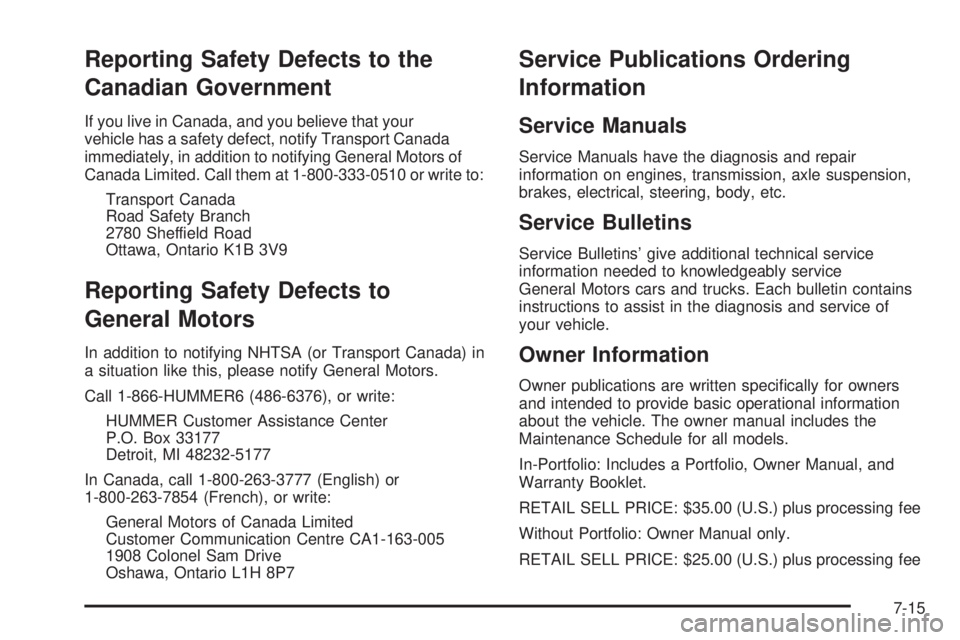
Reporting Safety Defects to the
Canadian Government
If you live in Canada, and you believe that your
vehicle has a safety defect, notify Transport Canada
immediately, in addition to notifying General Motors of
Canada Limited. Call them at 1-800-333-0510 or write to:
Transport Canada
Road Safety Branch
2780 Sheffield Road
Ottawa, Ontario K1B 3V9
Reporting Safety Defects to
General Motors
In addition to notifying NHTSA (or Transport Canada) in
a situation like this, please notify General Motors.
Call 1-866-HUMMER6 (486-6376), or write:
HUMMER Customer Assistance Center
P.O. Box 33177
Detroit, MI 48232-5177
In Canada, call 1-800-263-3777 (English) or
1-800-263-7854 (French), or write:
General Motors of Canada Limited
Customer Communication Centre CA1-163-005
1908 Colonel Sam Drive
Oshawa, Ontario L1H 8P7
Service Publications Ordering
Information
Service Manuals
Service Manuals have the diagnosis and repair
information on engines, transmission, axle suspension,
brakes, electrical, steering, body, etc.
Service Bulletins
Service Bulletins’ give additional technical service
information needed to knowledgeably service
General Motors cars and trucks. Each bulletin contains
instructions to assist in the diagnosis and service of
your vehicle.
Owner Information
Owner publications are written specically for owners
and intended to provide basic operational information
about the vehicle. The owner manual includes the
Maintenance Schedule for all models.
In-Portfolio: Includes a Portfolio, Owner Manual, and
Warranty Booklet.
RETAIL SELL PRICE: $35.00 (U.S.) plus processing fee
Without Portfolio: Owner Manual only.
RETAIL SELL PRICE: $25.00 (U.S.) plus processing fee
7-15
Page 407 of 416
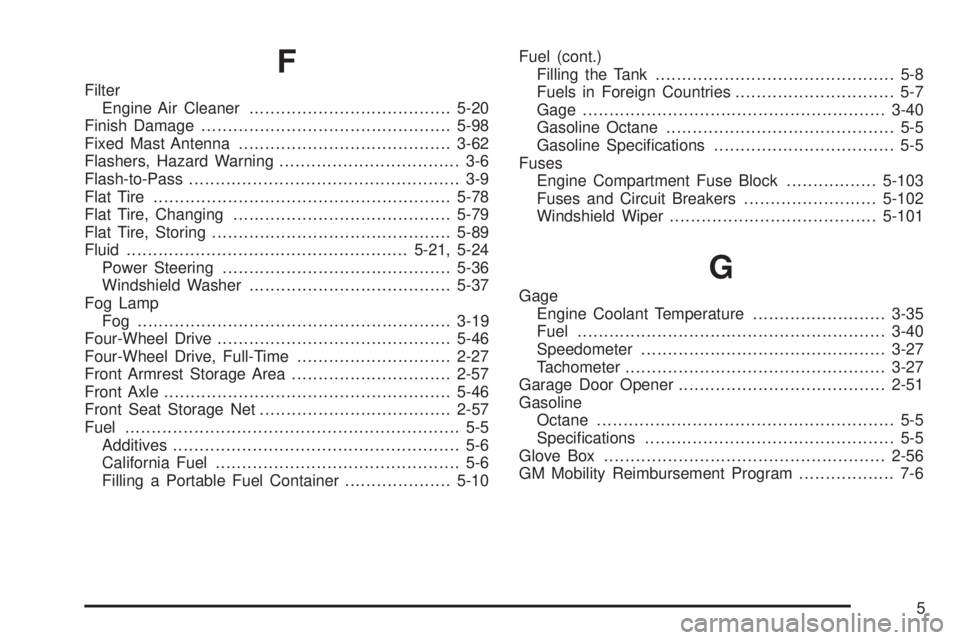
F
Filter
Engine Air Cleaner......................................5-20
Finish Damage...............................................5-98
Fixed Mast Antenna........................................3-62
Flashers, Hazard Warning.................................. 3-6
Flash-to-Pass................................................... 3-9
Flat Tire........................................................5-78
Flat Tire, Changing.........................................5-79
Flat Tire, Storing.............................................5-89
Fluid.....................................................5-21, 5-24
Power Steering...........................................5-36
Windshield Washer......................................5-37
Fog Lamp
Fog ...........................................................3-19
Four-Wheel Drive............................................5-46
Four-Wheel Drive, Full-Time.............................2-27
Front Armrest Storage Area..............................2-57
Front Axle......................................................5-46
Front Seat Storage Net....................................2-57
Fuel............................................................... 5-5
Additives...................................................... 5-6
California Fuel.............................................. 5-6
Filling a Portable Fuel Container....................5-10Fuel (cont.)
Filling the Tank............................................. 5-8
Fuels in Foreign Countries.............................. 5-7
Gage.........................................................3-40
Gasoline Octane........................................... 5-5
Gasoline Specications.................................. 5-5
Fuses
Engine Compartment Fuse Block.................5-103
Fuses and Circuit Breakers.........................5-102
Windshield Wiper.......................................5-101
G
Gage
Engine Coolant Temperature.........................3-35
Fuel..........................................................3-40
Speedometer..............................................3-27
Tachometer.................................................3-27
Garage Door Opener.......................................2-51
Gasoline
Octane........................................................ 5-5
Specications............................................... 5-5
Glove Box.....................................................2-56
GM Mobility Reimbursement Program.................. 7-6
5
Page 411 of 416
O
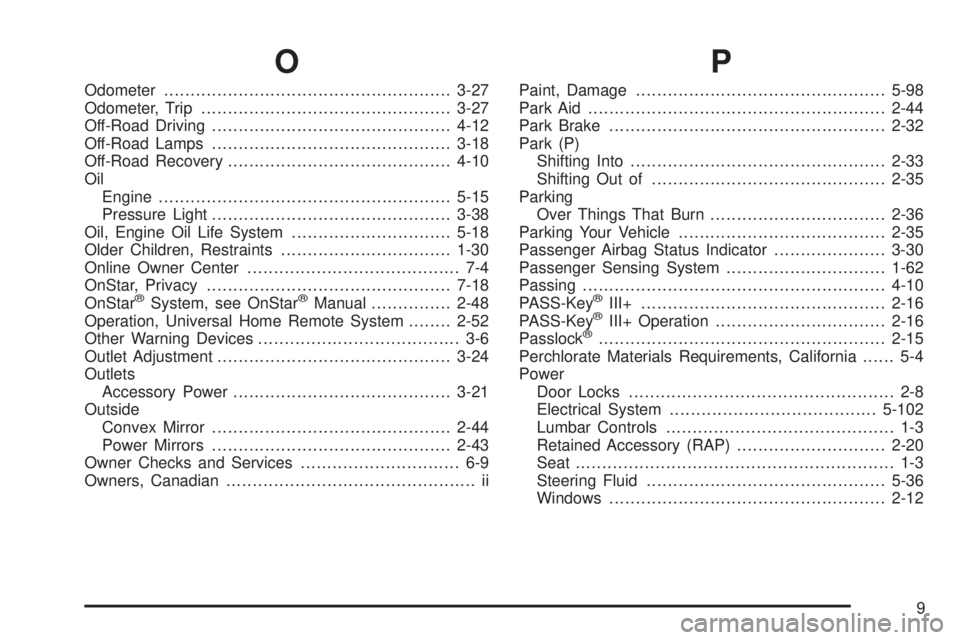
Odometer......................................................3-27
Odometer, Trip...............................................3-27
Off-Road Driving.............................................4-12
Off-Road Lamps.............................................3-18
Off-Road Recovery..........................................4-10
Oil
Engine.......................................................5-15
Pressure Light.............................................3-38
Oil, Engine Oil Life System..............................5-18
Older Children, Restraints................................1-30
Online Owner Center........................................ 7-4
OnStar, Privacy..............................................7-18
OnStar
®System, see OnStar®Manual...............2-48
Operation, Universal Home Remote System........2-52
Other Warning Devices...................................... 3-6
Outlet Adjustment............................................3-24
Outlets
Accessory Power.........................................3-21
Outside
Convex Mirror.............................................2-44
Power Mirrors.............................................2-43
Owner Checks and Services.............................. 6-9
Owners, Canadian............................................... ii
P
Paint, Damage...............................................5-98
Park Aid........................................................2-44
Park Brake....................................................2-32
Park (P)
Shifting Into................................................2-33
Shifting Out of............................................2-35
Parking
Over Things That Burn.................................2-36
Parking Your Vehicle.......................................2-35
Passenger Airbag Status Indicator.....................3-30
Passenger Sensing System..............................1-62
Passing.........................................................4-10
PASS-Key
®III+..............................................2-16
PASS-Key®III+ Operation................................2-16
Passlock®......................................................2-15
Perchlorate Materials Requirements, California...... 5-4
Power
Door Locks.................................................. 2-8
Electrical System.......................................5-102
Lumbar Controls........................................... 1-3
Retained Accessory (RAP)............................2-20
Seat............................................................ 1-3
Steering Fluid.............................................5-36
Windows....................................................2-12
9
Page 414 of 416
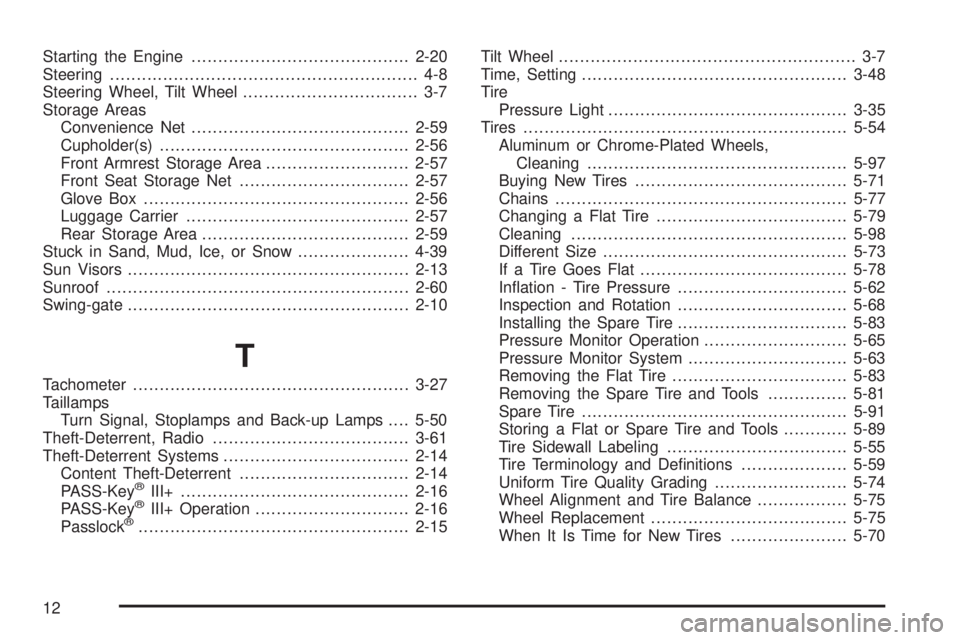
Starting the Engine.........................................2-20
Steering.......................................................... 4-8
Steering Wheel, Tilt Wheel................................. 3-7
Storage Areas
Convenience Net.........................................2-59
Cupholder(s)...............................................2-56
Front Armrest Storage Area...........................2-57
Front Seat Storage Net................................2-57
Glove Box..................................................2-56
Luggage Carrier..........................................2-57
Rear Storage Area.......................................2-59
Stuck in Sand, Mud, Ice, or Snow.....................4-39
Sun Visors.....................................................2-13
Sunroof.........................................................2-60
Swing-gate.....................................................2-10
T
Tachometer....................................................3-27
Taillamps
Turn Signal, Stoplamps and Back-up Lamps....5-50
Theft-Deterrent, Radio.....................................3-61
Theft-Deterrent Systems...................................2-14
Content Theft-Deterrent................................2-14
PASS-Key
®III+...........................................2-16
PASS-Key®III+ Operation.............................2-16
Passlock®...................................................2-15Tilt Wheel........................................................ 3-7
Time, Setting..................................................3-48
Tire
Pressure Light.............................................3-35
Tires.............................................................5-54
Aluminum or Chrome-Plated Wheels,
Cleaning.................................................5-97
Buying New Tires........................................5-71
Chains.......................................................5-77
Changing a Flat Tire....................................5-79
Cleaning....................................................5-98
Different Size..............................................5-73
If a Tire Goes Flat.......................................5-78
Ination - Tire Pressure................................5-62
Inspection and Rotation................................5-68
Installing the Spare Tire................................5-83
Pressure Monitor Operation...........................5-65
Pressure Monitor System..............................5-63
Removing the Flat Tire.................................5-83
Removing the Spare Tire and Tools...............5-81
Spare Tire..................................................5-91
Storing a Flat or Spare Tire and Tools............5-89
Tire Sidewall Labeling..................................5-55
Tire Terminology and Denitions....................5-59
Uniform Tire Quality Grading.........................5-74
Wheel Alignment and Tire Balance.................5-75
Wheel Replacement.....................................5-75
When It Is Time for New Tires......................5-70
12