lock HUMMER H3 2009 Owners Manual
[x] Cancel search | Manufacturer: HUMMER, Model Year: 2009, Model line: H3, Model: HUMMER H3 2009Pages: 382, PDF Size: 1.99 MB
Page 342 of 382
(d)Inspect wiper blades for wear,
cracking, or contamination.
Clean the windshield and wiper
blades, if contaminated. Replace
wiper blades that are worn or
damaged. See Windshield Wiper
Blade Replacement on page 5-44
and Windshield, Backglass,
and Wiper Blades on page 5-87
for more information.
(e)Make sure the safety belt
reminder light and safety belt
assemblies are working properly.
Look for any other loose or
damaged safety belt system parts.
If you see anything that might
keep a safety belt system from doing
its job, have it repaired. Have any
torn or frayed safety belts replaced.
Also see Checking the Restraint
Systems on page 1-60.
(f)Lubricate all key lock cylinders,
hood latch assembly, secondary
latch, pivots, spring anchor, release
pawl, rear compartment hinges,
outer endgate handle pivot points,
rear door detent link, rollermechanism, endgate handle pivot
points, latch bolt, fuel door hinge,
locks, and folding seat hardware.
More frequent lubrication may
be required when exposed to a
corrosive environment. Applying
silicone grease on weatherstrips
with a clean cloth will make
them last longer, seal better, and
not stick or squeak.
(g)Check vent hose at transfer
case for kinks and proper
installation.
(h)Change automatic transmission
fluid and filter if the vehicle is
mainly driven under one or more of
these conditions:
In heavy city traffic where the
outside temperature regularly
reaches 90°F (32°C) or higher.
In hilly or mountainous terrain.
When doing frequent trailer
towing.
Uses such as found in taxi,
police, or delivery service.(i)Drain, flush, and refill cooling
system. This service can be
complex; you should have your
dealer/retailer perform this service.
See Engine Coolant on page 5-23
for what to use. Inspect hoses.
Clean radiator, condenser,
pressure cap, and filler neck.
Pressure test the cooling system
and pressure cap.
(j)A fluid loss in any vehicle system
could indicate a problem. Have the
system inspected and repaired
and the fluid level checked. Add fluid
if needed.
(k)Visually inspect belt for fraying,
excessive cracks, or obvious
damage. Replace belt if necessary.
6-8 Maintenance Schedule
Page 344 of 382
At Least Once a Year
Starter Switch Check
{CAUTION
When you are doing this
inspection, the vehicle could move
suddenly. If the vehicle moves,
you or others could be injured.
1. Before starting this check, be
sure there is enough room
around the vehicle.
2. Firmly apply both the parking
brake and the regular brake.
SeeParking Brake on page 2-28.
Do not use the accelerator
pedal, and be ready to turn off
the engine immediately if it starts.3. For automatic transmission
vehicles, try to start the engine
in each gear. The vehicle
should start only in P (Park) or
N (Neutral). If the vehicle starts
in any other position, contact
your dealer/retailer for service.
For manual transmission
vehicles, put the shift lever in
Neutral, push the clutch
pedal down halfway, and try to
start the engine. The vehicle
should start only when the clutch
pedal is pushed down all the
way to the oor. If the vehicle
starts when the clutch pedal
is not pushed all the way down,
contact your dealer/retailer
for service.
Automatic Transmission Shift
Lock Control System Check
{CAUTION
When you are doing this
inspection, the vehicle could move
suddenly. If the vehicle moves,
you or others could be injured.
1. Before starting this check, be
sure there is enough room
around the vehicle. It should be
parked on a level surface.
2. Firmly apply the parking brake.
SeeParking Brake on page 2-28.
Be ready to apply the regular
brake immediately if the vehicle
begins to move.
3. With the engine off, turn the
ignition to ON/RUN, but do not
start the engine. Without applying
the regular brake, try to move
the shift lever out of P (Park) with
normal effort. If the shift lever
moves out of P (Park), contact
your dealer/retailer for service.
6-10 Maintenance Schedule
Page 345 of 382
Ignition Transmission Lock
Check
While parked, and with the parking
brake set, try to turn the ignition
to LOCK/OFF in each shift lever
position.
For automatic transmission
vehicles, the ignition should turn
to LOCK/OFF only when the
shift lever is in P (Park).
The ignition key should
come out only in LOCK/OFF.
For manual transmission
vehicles, the ignition key should
come out only in LOCK/OFF.
Contact your dealer/retailer if service
is required.
Parking Brake and Automatic
Transmission P (Park)
Mechanism Check
{CAUTION
When you are doing this check,
the vehicle could begin to move.
You or others could be injured
and property could be damaged.
Make sure there is room in front
of the vehicle in case it begins to
roll. Be ready to apply the regular
brake at once should the vehicle
begin to move.
Park on a fairly steep hill, with the
vehicle facing downhill. Keeping
your foot on the regular brake, set
the parking brake.
To check the parking brake’s
holding ability: With the engine
running and transmission in
N (Neutral), slowly remove footpressure from the regular brake
pedal. Do this until the vehicle
is held by the parking brake only.
To check the P (Park)
mechanism’s holding ability:
With the engine running, shift to
P (Park). Then release the
parking brake followed by the
regular brake.
Contact your dealer/retailer if
service is required.
Underbody Flushing Service
At least every spring, use plain
water to ush any corrosive
materials from the underbody.
Take care to clean thoroughly
any areas where mud and other
debris can collect.
Maintenance Schedule 6-11
Page 346 of 382
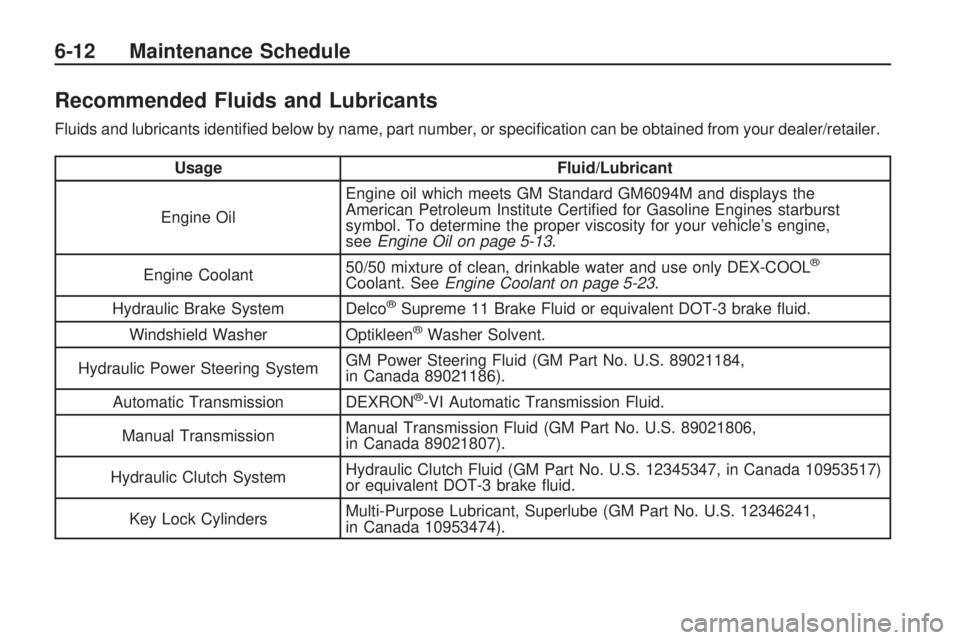
Recommended Fluids and Lubricants
Fluids and lubricants identied below by name, part number, or specication can be obtained from your dealer/retailer.
UsageFluid/Lubricant
Engine Oil Engine oil which meets GM Standard GM6094M and displays the
American Petroleum Institute Certied for Gasoline Engines starburst
symbol. To determine the proper viscosity for your vehicle’s engine,
see
Engine Oil on page 5-13 .
Engine Coolant 50/50 mixture of clean, drinkable water and use only DEX-COOL
®
Coolant. See
Engine Coolant on page 5-23 .
Hydraulic Brake System Delco
®Supreme 11 Brake Fluid or equivalent DOT-3 brake uid.
Windshield Washer Optikleen
®Washer Solvent.
Hydraulic Power Steering System GM Power Steering Fluid (GM Part No. U.S. 89021184,
in Canada 89021186).
Automatic Transmission DEXRON
®-VI Automatic Transmission Fluid.
Manual Transmission Manual Transmission Fluid (GM Part No. U.S. 89021806,
in Canada 89021807).
Hydraulic Clutch System Hydraulic Clutch Fluid (GM Part No. U.S. 12345347, in Canada 10953517)
or equivalent DOT-3 brake uid.
Key Lock Cylinders Multi-Purpose Lubricant, Superlube (GM Part No. U.S. 12346241,
in Canada 10953474).
6-12 Maintenance Schedule
Page 359 of 382
HUMMER and General Motors of
Canada Limited reserve the right to
limit services or payment to an
owner or driver if they decide the
claims are made too often, or
the same type of claim is made
many times.
Services Provided
Emergency Fuel Delivery:
Delivery of enough fuel for
the vehicle to get to the nearest
service station.
Lock-Out Service:Service is
provided to unlock the vehicle if
you are locked out. A remote
unlock may be available if you
have OnStar
®. For security
reasons, the driver must present
identication before this service is
given.
Emergency Tow From a Public
Road or Highway:Tow to the
nearest HUMMER dealer for
warranty service, or if the vehicle
was in a crash and cannot be
driven.
Flat Tire Change:Service is
provided to change a at tire with
spare tire. The spare tire, if
equipped, must be in good
condition and properly inated. It
is your responsibility for the repair
or replacement of the tire if it is
not covered by the warranty.
Battery Jump Start:Service is
provided to jump start a dead
battery.
Trip Routing Service:Detailed
maps of North America are
provided when requested either
with the most direct route or the
most scenic route. Additional
travel information is also
available. Allow three weeks
for delivery.
Trip Interruption Benets and
Assistance:If your trip is
interrupted due to a warranty
failure, incidental expenses may
be reimbursed during the 5 year/
100,000 miles (160 000 km)
Powertrain warranty period. Items
considered are hotel, meals, and
rental car.
Customer Assistance Information 7-7
Page 360 of 382
HUMMER Technician
Roadside Service (U.S. only)
HUMMER’s exceptional Roadside
Service is more than an auto club or
towing service. It provides every
HUMMER owner in the United
States with the advantage of
contacting a HUMMER advisor and,
where available, a HUMMER
trained dealer technician who can
provide on-site service.
A dealer technician will travel to your
location within a 30 mile radius of a
participating HUMMER dealership.
If beyond this radius, we will arrange
to have your vehicle towed to the
nearest HUMMER dealership. Each
technician travels with a specially
equipped service vehicle complete
with the necessary HUMMER parts
and tools required to handle most
roadside repairs.
Services Not Included in
Roadside Assistance
Impound towing caused by
violation of any laws.
Legal nes.
Mounting, dismounting or
changing of snow tires, chains,
or other traction devices.
Towing or services for vehicles
driven on a non-public road or
highway.
Services Specic to Canadian
Purchased Vehicles
Fuel delivery:Reimbursement
is approximately $5 Canadian.
Diesel fuel delivery may be
restricted. Propane and other
fuels are not provided through
this service.
Lock-Out Service:Vehicle
registration is required.
Trip Routing Service:Limit of
six requests per year.
Trip Interruption Benets and
Assistance:Pre-authorization,
original detailed receipts, and a
copy of the repair orders are
required. Once authorization has
been received, the Roadside
Assistance advisor will help you
make arrangements and explain
how to receive payment.
Alternative Service:If
assistance cannot be provided
right away, the Roadside
Assistance advisor may give you
permission to get local emergency
road service. You will receive
payment, up to $100, after
sending the original receipt to
Roadside Assistance. Mechanical
failures may be covered, however
any cost for parts and labor for
repairs not covered by the
warranty are the owner
responsibility.
7-8 Customer Assistance Information
Page 368 of 382
ORDER TOLL FREE:
1-800-551-4123 Monday-Friday
8:00 AM - 6:00 PM Eastern Time
For Credit Card Orders Only
(VISA-MasterCard-Discover), visit
Helm, Inc. on the World Wide
Web at: helminc.com
Or you can write to:
Helm, Incorporated
P.O. Box 07130
Detroit, MI 48207
Prices are subject to change without
notice and without incurring
obligation. Allow ample time for
delivery.
Note to Canadian Customers: All
listed prices are quoted in U.S.
funds. Canadian residents are to
make checks payable in U.S. funds.Vehicle Data
Recording and
Privacy
Your GM vehicle has a number of
sophisticated computers that record
information about the vehicle’s
performance and how it is driven. For
example, your vehicle uses computer
modules to monitor and control
engine and transmission
performance, to monitor the
conditions for airbag deployment and
deploy airbags in a crash and, if so
equipped, to provide antilock braking
to help the driver control the vehicle.
These modules may store data to
help your dealer/retailer technician
service your vehicle. Some modules
may also store data about how you
operate the vehicle, such as rate of
fuel consumption or average speed.
These modules may also retain the
owner’s personal preferences, such
as radio pre-sets, seat positions, and
temperature settings.
Event Data Recorders
This vehicle has an Event
Data Recorder (EDR). The main
purpose of an EDR is to record, in
certain crash or near crash-like
situations, such as an airbag
deployment or hitting a road
obstacle, data that will assist in
understanding how a vehicle’s
systems performed. The EDR is
designed to record data related to
vehicle dynamics and safety
systems for a short period of time,
typically 30 seconds or less.
The EDR in this vehicle is designed
to record such data as:
How various systems in your
vehicle were operating
Whether or not the driver and
passenger safety belts were
buckled/fastened
How far, if at all, the driver was
pressing the accelerator and/or
brake pedal
How fast the vehicle was
traveling
7-16 Customer Assistance Information
Page 369 of 382
This data can help provide a better
understanding of the circumstances
in which crashes and injuries occur.
Important:EDR data is recorded
by your vehicle only if a non-trivial
crash situation occurs; no data
is recorded by the EDR under
normal driving conditions and no
personal data (e.g., name, gender,
age, and crash location) is
recorded. However, other parties,
such as law enforcement, could
combine the EDR data with the type
of personally identifying data
routinely acquired during a crash
investigation.
To read data recorded by an EDR,
special equipment is required,
and access to the vehicle or the
EDR is needed. In addition to
the vehicle manufacturer, other
parties, such as law enforcement,
that have the special equipment, can
read the information if they have
access to the vehicle or the EDR.GM will not access this data or
share it with others except: with the
consent of the vehicle owner or,
if the vehicle is leased, with
the consent of the lessee; in
response to an official request of
police or similar government office;
as part of GM’s defense of
litigation through the discovery
process; or, as required by law. Data
that GM collects or receives may
also be used for GM research needs
or may be made available to
others for research purposes, where
a need is shown and the data is
not tied to a specic vehicle
or vehicle owner.
OnStar®
If your vehicle has OnStar and you
subscribe to the OnStar services,
please refer to the OnStar Terms and
Conditions for information on data
collection and use. See alsoOnStar
®
System on page 2-39in this manual
for more information.
Navigation System
If your vehicle has a navigation
system, use of the system may
result in the storage of destinations,
addresses, telephone numbers, and
other trip information. Refer to the
navigation system operating manual
for information on stored data and for
deletion instructions.
Radio Frequency
Identication (RFID)
RFID technology is used in some
vehicles for functions such as
tire pressure monitoring and ignition
system security, as well as in
connection with conveniences such
as key fobs for remote door
locking/unlocking and starting, and
in-vehicle transmitters for garage
door openers. RFID technology in
GM vehicles does not use or record
personal information or link with
any other GM system containing
personal information.
Customer Assistance Information 7-17
Page 371 of 382
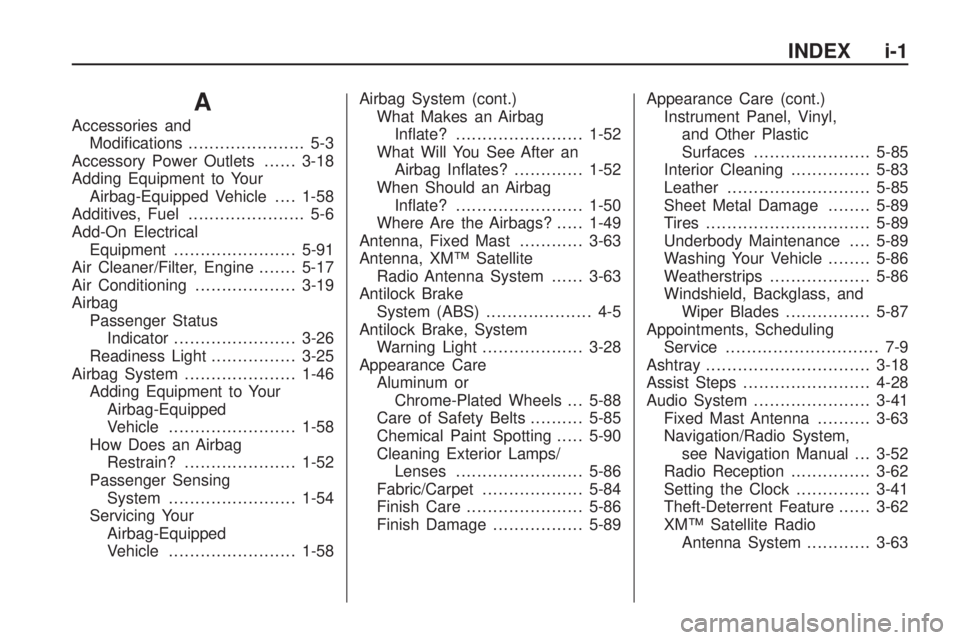
A
Accessories and
Modications...................... 5-3
Accessory Power Outlets......3-18
Adding Equipment to Your
Airbag-Equipped Vehicle....1-58
Additives, Fuel...................... 5-6
Add-On Electrical
Equipment.......................5-91
Air Cleaner/Filter, Engine.......5-17
Air Conditioning...................3-19
Airbag
Passenger Status
Indicator.......................3-26
Readiness Light................3-25
Airbag System.....................1-46
Adding Equipment to Your
Airbag-Equipped
Vehicle........................1-58
How Does an Airbag
Restrain?.....................1-52
Passenger Sensing
System........................1-54
Servicing Your
Airbag-Equipped
Vehicle........................1-58Airbag System (cont.)
What Makes an Airbag
Inate?........................1-52
What Will You See After an
Airbag Inates?.............1-52
When Should an Airbag
Inate?........................1-50
Where Are the Airbags?.....1-49
Antenna, Fixed Mast............3-63
Antenna, XM™ Satellite
Radio Antenna System......3-63
Antilock Brake
System (ABS).................... 4-5
Antilock Brake, System
Warning Light...................3-28
Appearance Care
Aluminum or
Chrome-Plated Wheels . . . 5-88
Care of Safety Belts..........5-85
Chemical Paint Spotting.....5-90
Cleaning Exterior Lamps/
Lenses........................5-86
Fabric/Carpet...................5-84
Finish Care......................5-86
Finish Damage.................5-89
Appearance Care (cont.)
Instrument Panel, Vinyl,
and Other Plastic
Surfaces......................5-85
Interior Cleaning...............5-83
Leather...........................5-85
Sheet Metal Damage........5-89
Tires...............................5-89
Underbody Maintenance....5-89
Washing Your Vehicle........5-86
Weatherstrips...................5-86
Windshield, Backglass, and
Wiper Blades................5-87
Appointments, Scheduling
Service............................. 7-9
Ashtray...............................3-18
Assist Steps........................4-28
Audio System......................3-41
Fixed Mast Antenna..........3-63
Navigation/Radio System,
see Navigation Manual . . . 3-52
Radio Reception...............3-62
Setting the Clock..............3-41
Theft-Deterrent Feature......3-62
XM™ Satellite Radio
Antenna System............3-63
INDEX i-1
Page 373 of 382
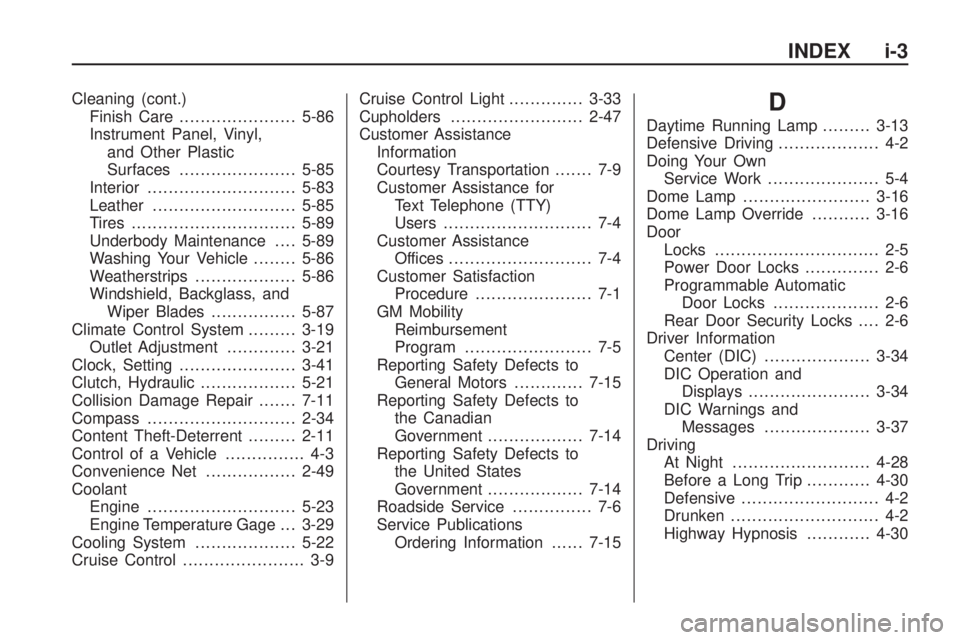
Cleaning (cont.)
Finish Care......................5-86
Instrument Panel, Vinyl,
and Other Plastic
Surfaces......................5-85
Interior............................5-83
Leather...........................5-85
Tires...............................5-89
Underbody Maintenance....5-89
Washing Your Vehicle........5-86
Weatherstrips...................5-86
Windshield, Backglass, and
Wiper Blades................5-87
Climate Control System.........3-19
Outlet Adjustment.............3-21
Clock, Setting......................3-41
Clutch, Hydraulic..................5-21
Collision Damage Repair.......7-11
Compass............................2-34
Content Theft-Deterrent.........2-11
Control of a Vehicle............... 4-3
Convenience Net.................2-49
Coolant
Engine............................5-23
Engine Temperature Gage . . . 3-29
Cooling System...................5-22
Cruise Control....................... 3-9Cruise Control Light..............3-33
Cupholders.........................2-47
Customer Assistance
Information
Courtesy Transportation....... 7-9
Customer Assistance for
Text Telephone (TTY)
Users............................ 7-4
Customer Assistance
Offices........................... 7-4
Customer Satisfaction
Procedure...................... 7-1
GM Mobility
Reimbursement
Program........................ 7-5
Reporting Safety Defects to
General Motors.............7-15
Reporting Safety Defects to
the Canadian
Government..................7-14
Reporting Safety Defects to
the United States
Government..................7-14
Roadside Service............... 7-6
Service Publications
Ordering Information......7-15
D
Daytime Running Lamp.........3-13
Defensive Driving................... 4-2
Doing Your Own
Service Work..................... 5-4
Dome Lamp ........................3-16
Dome Lamp Override...........3-16
Door
Locks............................... 2-5
Power Door Locks.............. 2-6
Programmable Automatic
Door Locks.................... 2-6
Rear Door Security Locks.... 2-6
Driver Information
Center (DIC)....................3-34
DIC Operation and
Displays.......................3-34
DIC Warnings and
Messages....................3-37
Driving
At Night..........................4-28
Before a Long Trip............4-30
Defensive.......................... 4-2
Drunken............................ 4-2
Highway Hypnosis............4-30
INDEX i-3