ESP HUMMER H3 2009 Owner's Manual
[x] Cancel search | Manufacturer: HUMMER, Model Year: 2009, Model line: H3, Model: HUMMER H3 2009Pages: 382, PDF Size: 1.99 MB
Page 194 of 382
Turn the steering wheel 3 to
5 inches, 8 to 13 cm, (about
one-eighth turn) until the right front
tire contacts the pavement edge.
Then turn the steering wheel to go
straight down the roadway.
Passing
Passing another vehicle on a
two-lane road can be dangerous. To
reduce the risk of danger while
passing:
Look down the road, to the sides,
and to crossroads for situations
that might affect a successful
pass. If in doubt, wait.
Watch for traffic signs,
pavement markings, and lines
that could indicate a turn or
an intersection. Never cross a
solid or double-solid line on your
side of the lane.
Do not get too close to the
vehicle you want to pass. Doing
so can reduce your visibility.
Wait your turn to pass a slow
vehicle.
When you are being passed,
ease to the right.
Loss of Control
Let us review what driving experts
say about what happens when
the three control systems — brakes,
steering, and acceleration — do
not have enough friction where the
tires meet the road to do what
the driver has asked.
In any emergency, do not give up.
Keep trying to steer and constantly
seek an escape route or area of
less danger.
Skidding
In a skid, a driver can lose control
of the vehicle. Defensive drivers
avoid most skids by taking
reasonable care suited to existing
conditions, and by not overdriving
those conditions. But skids are
always possible.The three types of skids
correspond to the vehicle’s three
control systems. In the braking
skid, the wheels are not rolling. In
the steering or cornering skid,
too much speed or steering in a
curve causes tires to slip and
lose cornering force. And in the
acceleration skid, too much
throttle causes the driving wheels
to spin.
Remember: Any traction control
system helps avoid only the
acceleration skid. If the traction
system is off, then an acceleration
skid is best handled by easing
your foot off the accelerator pedal.
SeeTraction Control System
(TCS) on page 4-7andStabiliTrak
®
System on page 4-6.
If the vehicle starts to slide, ease
your foot off the accelerator
pedal and quickly steer the way you
want the vehicle to go. If you
start steering quickly enough, the
vehicle may straighten out. Always
be ready for a second skid if it
occurs.
4-12 Driving Your Vehicle
Page 195 of 382
Of course, traction is reduced when
water, snow, ice, gravel, or other
material is on the road. For safety,
slow down and adjust your
driving to these conditions. It is
important to slow down on slippery
surfaces because stopping
distance will be longer and vehicle
control more limited.
While driving on a surface with
reduced traction, try your best to
avoid sudden steering, acceleration,
or braking, including reducing
vehicle speed by shifting to a lower
gear. Any sudden changes could
cause the tires to slide. You may not
realize the surface is slippery until
the vehicle is skidding. Learn to
recognize warning clues — such as
enough water, ice, or packed
snow on the road to make a
mirrored surface — and slow down
when you have any doubt.
Remember: Any Antilock Brake
System (ABS) helps avoid only the
braking skid.Off-Road Driving
The airbag system is designed to
work properly under a wide range
of conditions, including off-road
usage. Always wear your safety belt
and observe safe driving speeds,
especially on rough terrain.
Drinking and driving can be very
dangerous on any road and this is
certainly true for off-road driving.
At the very time you need special
alertness and driving skills, your
reexes, perceptions, and judgment
can be affected by even a small
amount of alcohol. You could
have a serious — or even
fatal — accident if you drink and
drive or ride with a driver who has
been drinking.Off-roading can be great fun
but has some denite hazards. The
greatest of these is the terrain
itself. When off-road driving, traffic
lanes are not marked, curves are not
banked, and there are no road
signs. Surfaces can be slippery,
rough, uphill, or downhill.
Avoid sharp turns and abrupt
maneuvers. Failure to operate the
vehicle correctly off-road could result
in loss of vehicle control or vehicle
rollover.
Off-roading involves some new
skills. That is why it is very important
that you read these driving tips
and suggestions to help make
off-road driving safer and more
enjoyable.
Driving Your Vehicle 4-13
Page 197 of 382
You will nd other important
information underLoading the
Vehicle on page 4-35andTires on
page 5-44.
Environmental Concerns
Off-road driving can provide
wholesome and satisfying
recreation. However, it also raises
environmental concerns. We
recognize these concerns and urge
every off-roader to follow these
basic rules for protecting the
environment:
Always use established trails,
roads, and areas that have
been specially set aside for public
off-road recreational driving
and obey all posted regulations.
Avoid any driving practice that
could damage shrubs, owers,
trees, or grasses or disturb
wildlife. This includes
wheel-spinning, breaking down
trees, or unnecessary driving
through streams or over
soft ground.
Always carry a litter bag and
make sure all refuse is removed
from any campsite before
leaving.
Take extreme care with open
res (where permitted), camp
stoves, and lanterns.
Never park your vehicle over dry
grass or other combustible
materials that could catch re
from the heat of the vehicle’s
exhaust system.
Traveling to Remote Areas
It makes sense to plan your
trip, especially when going to a
remote area. Know the terrain and
plan your route. Get accurate
maps of trails and terrain. Check to
see if there are any blocked or
closed roads.
It is also a good idea to travel
with at least one other vehicle in
case something happens to one
of them.
For vehicles with a winch, be sure
to read the winch instructions.
In a remote area, a winch can be
handy if you get stuck but you
will want to know how to use
it properly.
Driving Your Vehicle 4-15
Page 200 of 382
For mounds, washouts, loose
up-hill slopes, ditches, etc.
When wheel spin occurs as the
vehicle is moving, the driver may
notice a slight shaking or shuddering
of the vehicle. This should be
stopped as soon as possible to
prevent damage to vehicle
components. This is the indication
that a loss of traction is occurring on
this terrain. The operator should:
1. Reduce speed and apply
the brakes.
2. Assess the terrain properly and
adjust vehicle speed and gear
ranges accordingly: Four-Wheel
High position for higher speeds
and Four-Wheel-Low Lock
for more torque and lower
speeds. Transmission 1 (First)
gear is generally recommended.3. Apply slight pressure to the
brake when the shaking or
shuddering sensation is felt,
keeping the vehicle moving in a
controlled manner.
4. Be prepared to alternate between
braking and accelerating through
the adverse terrain.
Getting Familiar with Off-Road
Driving
It is a good idea to practice in an
area that is safe and close to home
before you go into the wilderness.
Off-roading requires some new
and different skills.
Tune your senses to different
kinds of signals. Your eyes need
to constantly sweep the terrain
for unexpected obstacles. Your ears
need to listen for unusual tire or
engine sounds. Use your arms,
hands, feet, and body to respond to
vibrations and vehicle bounce.Controlling the vehicle is the key to
successful off-road driving. One of
the best ways to control the
vehicle is to control the speed.
At higher speeds:
You approach things faster and
have less time to react.
There is less time to scan the
terrain for obstacles.
The vehicle has more bounce
when driving over obstacles.
More braking distance is needed,
especially on an unpaved surface.
{CAUTION
When you are driving off-road,
bouncing and quick changes in
direction can easily throw you
out of position. This could cause
you to lose control and crash.
So, whether you are driving
on or off the road, you and
your passengers should wear
safety belts.
4-18 Driving Your Vehicle
Page 201 of 382
Scanning the Terrain
Off-road driving can take you over
many different kinds of terrain.
Be familiar with the terrain and its
many different features.
Surface Conditions:Off-roading
surfaces can be hard-packed
dirt, gravel, rocks, grass, sand,
mud, snow, or ice. Each of these
surfaces affects the vehicle’s
steering, acceleration, and braking
in different ways. Depending on
the surface, slipping, sliding, wheel
spinning, delayed acceleration,
poor traction, and longer braking
distances can occur.
Surface Obstacles:Unseen or
hidden obstacles can be hazardous.
A rock, log, hole, rut, or bump
can startle you if you are not
prepared for them. Often these
obstacles are hidden by grass,
bushes, snow, or even the rise and
fall of the terrain itself.Some things to consider:Is the path ahead clear?
Will the surface texture change
abruptly up ahead?
Does the travel take you uphill or
downhill?
Will you have to stop suddenly or
change direction quickly?
When driving over obstacles or
rough terrain, keep a rm grip on the
steering wheel. Ruts, troughs, or
other surface features can jerk the
wheel out of your hands.
When driving over bumps, rocks, or
other obstacles, the wheels can
leave the ground. If this happens,
even with one or two wheels,
you cannot control the vehicle as
well or at all.
Because you will be on an unpaved
surface, it is especially important
to avoid sudden acceleration,
sudden turns, or sudden braking.Off-roading requires a different
kind of alertness from driving on
paved roads and highways. There
are no road signs, posted speed
limits, or signal lights. Use
good judgment about what is safe
and what is not.Crossing Obstacles
Approach Angle — a Key to
Mobility
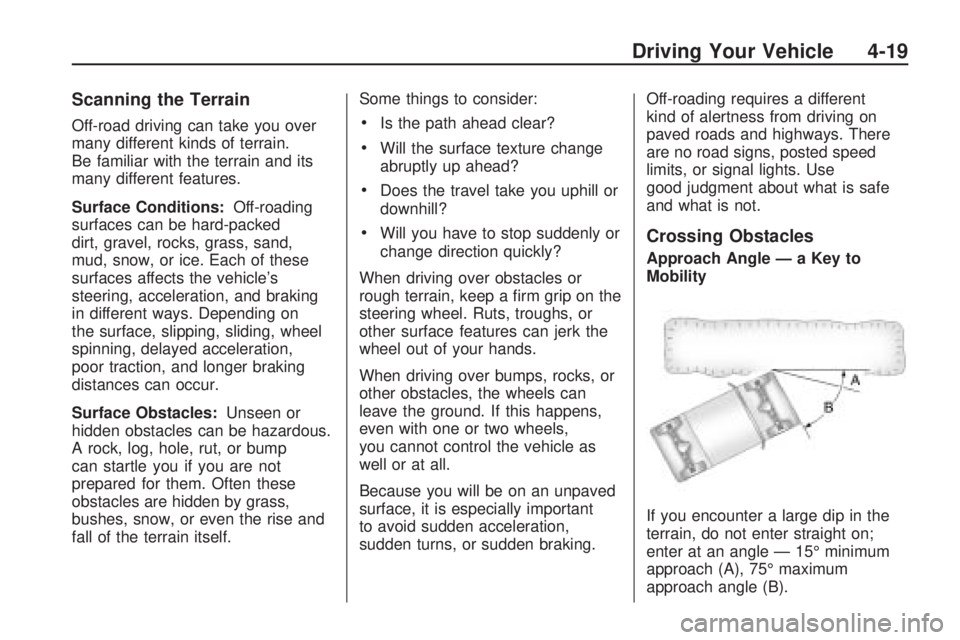
If you encounter a large dip in the
terrain, do not enter straight on;
enter at an angle — 15° minimum
approach (A), 75° maximum
approach angle (B).
Driving Your Vehicle 4-19
Page 210 of 382
Assist Steps
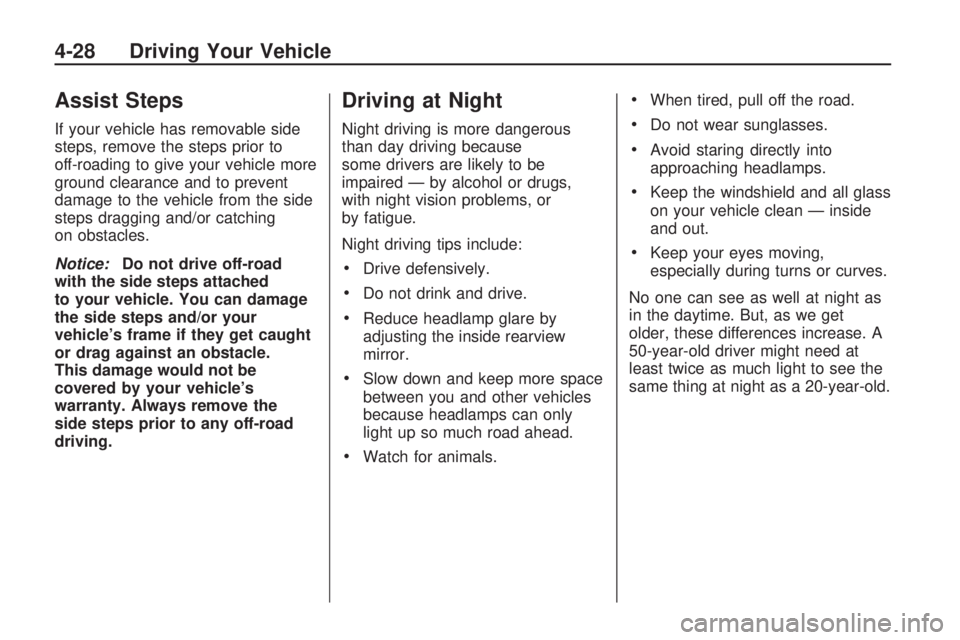
If your vehicle has removable side
steps, remove the steps prior to
off-roading to give your vehicle more
ground clearance and to prevent
damage to the vehicle from the side
steps dragging and/or catching
on obstacles.
Notice:Do not drive off-road
with the side steps attached
to your vehicle. You can damage
the side steps and/or your
vehicle’s frame if they get caught
or drag against an obstacle.
This damage would not be
covered by your vehicle’s
warranty. Always remove the
side steps prior to any off-road
driving.
Driving at Night
Night driving is more dangerous
than day driving because
some drivers are likely to be
impaired — by alcohol or drugs,
with night vision problems, or
by fatigue.
Night driving tips include:
Drive defensively.
Do not drink and drive.
Reduce headlamp glare by
adjusting the inside rearview
mirror.
Slow down and keep more space
between you and other vehicles
because headlamps can only
light up so much road ahead.
Watch for animals.
When tired, pull off the road.
Do not wear sunglasses.
Avoid staring directly into
approaching headlamps.
Keep the windshield and all glass
on your vehicle clean — inside
and out.
Keep your eyes moving,
especially during turns or curves.
No one can see as well at night as
in the daytime. But, as we get
older, these differences increase. A
50-year-old driver might need at
least twice as much light to see the
same thing at night as a 20-year-old.
4-28 Driving Your Vehicle
Page 214 of 382
Allow greater following distance on
any slippery road and watch for
slippery spots. Icy patches
can occur on otherwise clear roads
in shaded areas. The surface of
a curve or an overpass can remain
icy when the surrounding roads
are clear. Avoid sudden steering
maneuvers and braking while on ice.
Turn off cruise control, if equipped,
on slippery surfaces.
Blizzard Conditions
Being stuck in snow can be in a
serious situation. Stay with the
vehicle unless there is help nearby.
If possible, use theRoadside
Service on page 7-6. To get help
and keep everyone in the vehicle
safe:
Turn on theHazard Warning
Flashers on page 3-5.
Tie a red cloth to an outside
mirror.
{CAUTION
Snow can trap engine exhaust
under the vehicle. This may cause
exhaust gases to get inside.
Engine exhaust contains carbon
monoxide (CO) which cannot be
seen or smelled. It can cause
unconsciousness and even death.
If the vehicle is stuck in the snow:
Clear away snow from
around the base of your
vehicle, especially any that is
blocking the exhaust pipe.
Check again from time to
time to be sure snow does
not collect there.
Open a window about two
inches (5 cm) on the side of
the vehicle that is away from
the wind to bring in fresh air.
Fully open the air outlets on
or under the instrument
panel.
(Continued)
CAUTION (Continued)
Adjust the Climate Control
system to a setting that
circulates the air inside the
vehicle and set the fan speed
to the highest setting. See
Climate Control System in the
Index.
For more information about
carbon monoxide, seeEngine
Exhaust on page 2-31.
Snow can trap exhaust gases
under your vehicle. This can
cause deadly CO (carbon
monoxide) gas to get inside. CO
could overcome you and kill you.
You cannot see it or smell it, so
you might not know it is in your
vehicle. Clear away snow from
around the base of your vehicle,
especially any that is blocking the
exhaust.
4-32 Driving Your Vehicle
Page 230 of 382
Safety Chains
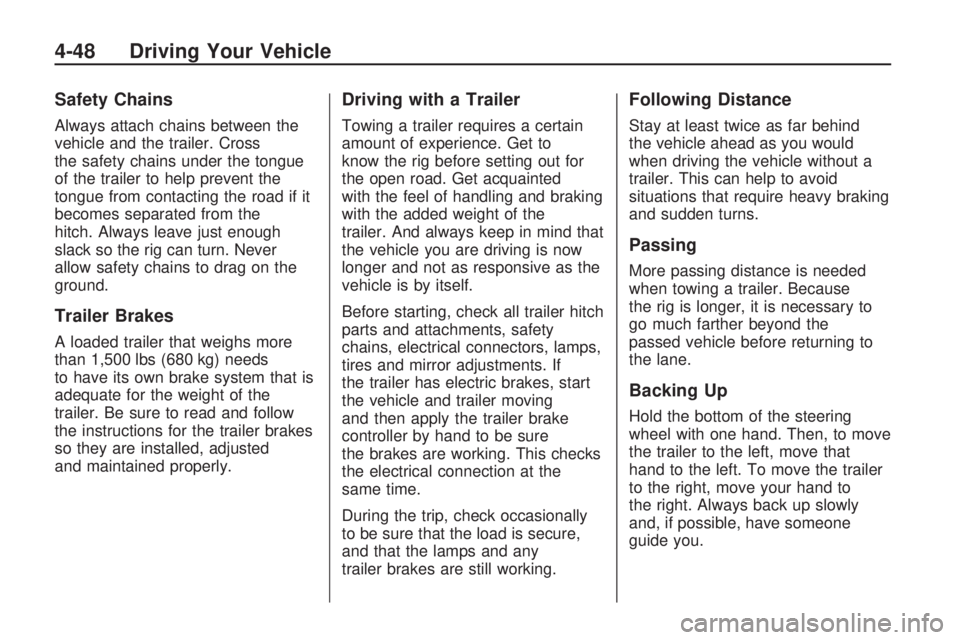
Always attach chains between the
vehicle and the trailer. Cross
the safety chains under the tongue
of the trailer to help prevent the
tongue from contacting the road if it
becomes separated from the
hitch. Always leave just enough
slack so the rig can turn. Never
allow safety chains to drag on the
ground.
Trailer Brakes
A loaded trailer that weighs more
than 1,500 lbs (680 kg) needs
to have its own brake system that is
adequate for the weight of the
trailer. Be sure to read and follow
the instructions for the trailer brakes
so they are installed, adjusted
and maintained properly.
Driving with a Trailer
Towing a trailer requires a certain
amount of experience. Get to
know the rig before setting out for
the open road. Get acquainted
with the feel of handling and braking
with the added weight of the
trailer. And always keep in mind that
the vehicle you are driving is now
longer and not as responsive as the
vehicle is by itself.
Before starting, check all trailer hitch
parts and attachments, safety
chains, electrical connectors, lamps,
tires and mirror adjustments. If
the trailer has electric brakes, start
the vehicle and trailer moving
and then apply the trailer brake
controller by hand to be sure
the brakes are working. This checks
the electrical connection at the
same time.
During the trip, check occasionally
to be sure that the load is secure,
and that the lamps and any
trailer brakes are still working.
Following Distance
Stay at least twice as far behind
the vehicle ahead as you would
when driving the vehicle without a
trailer. This can help to avoid
situations that require heavy braking
and sudden turns.
Passing
More passing distance is needed
when towing a trailer. Because
the rig is longer, it is necessary to
go much farther beyond the
passed vehicle before returning to
the lane.
Backing Up
Hold the bottom of the steering
wheel with one hand. Then, to move
the trailer to the left, move that
hand to the left. To move the trailer
to the right, move your hand to
the right. Always back up slowly
and, if possible, have someone
guide you.
4-48 Driving Your Vehicle
Page 233 of 382
Maintenance When Trailer
Towing
The vehicle needs service more
often when pulling a trailer. See this
manual’s Maintenance Schedule
or Index for more information.
Things that are especially important
in trailer operation are automatic
transmission uid, engine oil,
axle lubricant, belts, cooling system
and brake system. It is a good
idea to inspect these before and
during the trip.
Check periodically to see that all
hitch nuts and bolts are tight.
Trailer Wiring Harness
Light-Duty Trailer Wiring Package
If the vehicle does not have a
trailer towing package, the chassis
harness will contain the following
blunt cut circuits:
Yellow: Left Stop/Turn Signal
Dark Green: Right Stop/Turn
Signal
White: Ground
Brown: Tail Lamps
To add a trailer towing wiring
package, have it installed by your
dealer/retailer or a qualied
service center. Also, seeAdd-On
Electrical Equipment on page 5-91
for more information.Heavy-Duty Trailer Wiring
Package
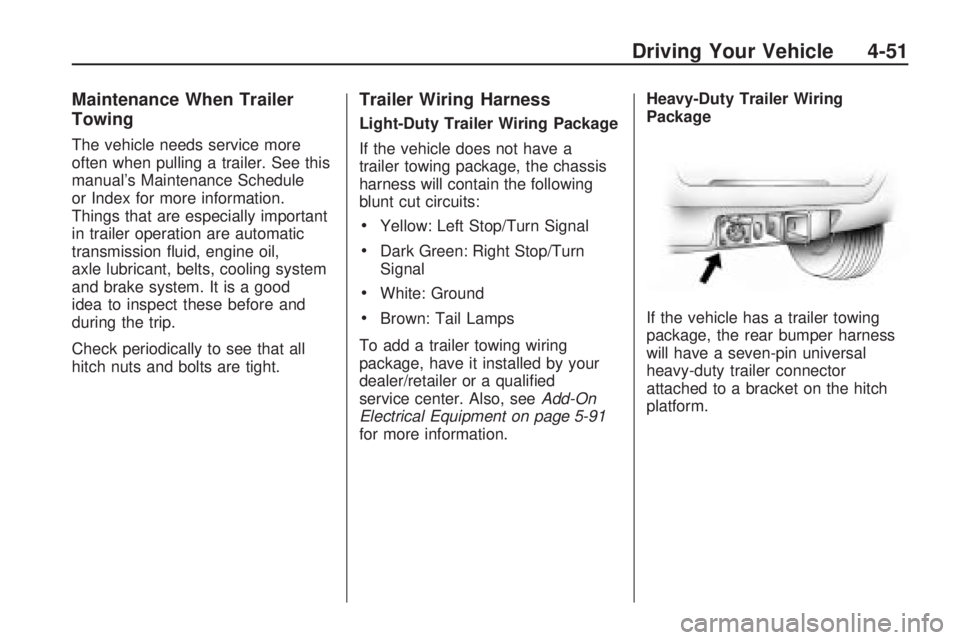
If the vehicle has a trailer towing
package, the rear bumper harness
will have a seven-pin universal
heavy-duty trailer connector
attached to a bracket on the hitch
platform.
Driving Your Vehicle 4-51
Page 254 of 382
Automatic Transmission
Fluid
When to Check and Change
Automatic Transmission Fluid
A good time to check the automatic
transmission uid level is when
the engine oil is changed.
Change the uid and lter at the
intervals listed inAdditional
Required Services on page 6-6, and
be sure to use the transmission
uid listed inRecommended Fluids
and Lubricants on page 6-12.
How to Check Automatic
Transmission Fluid
Because this operation can be a
little difficult, you may choose
to have this done at the
dealer/retailer service department.
If adding it yourself, be sure to follow
all the instructions here, or there
could be a false reading on the
dipstick.Notice:Too much or too little
uid can damage your
transmission. Too much can
mean that some of the uid could
come out and fall on hot engine
parts or exhaust system parts,
starting a re. Too little uid
could cause the transmission to
overheat. Be sure to get an
accurate reading if you check
your transmission uid.
Wait at least 30 minutes before
checking the transmission uid level
if you have been driving:
When outside temperatures are
above 90°F (32°C).
At high speed for quite a while.
In heavy traffic — especially
in hot weather.
While pulling a trailer.
To get the right reading, the uid
should be at normal operating
temperature, which is 180°F to
200°F (82°C to 93°C).Get the vehicle warmed up by
driving about 15 miles (24 km) when
outside temperatures are above
50°F (10°C). If it is colder than
50°F (10°C), drive the vehicle
in 3 (Third) until the engine
temperature gage moves and then
remains steady for 10 minutes.
A cold uid check can be made after
the vehicle has been sitting for
eight hours or more with the engine
off, but this is used only as a
reference. Let the engine run at
idle for ve minutes if outside
temperatures are 50°F (10°C) or
more. If it is colder than 50°F (10°C),
the engine might have to idle
longer. Should the uid level
be low during this cold check,
check the uid hot before adding
uid. Checking the uid hot gives
a more accurate reading of the
uid level.
5-18 Service and Appearance Care