air condition HUMMER H3 2009 Owner's Manual
[x] Cancel search | Manufacturer: HUMMER, Model Year: 2009, Model line: H3, Model: HUMMER H3 2009Pages: 382, PDF Size: 1.99 MB
Page 263 of 382
Engine Overheating
The vehicle has an indicator to warn
of engine overheating.
A coolant temperature gage is
displayed on the instrument panel.
SeeEngine Coolant Temperature
Gage on page 3-29.
You may decide not to lift the hood
when this warning appears, but
instead get service help right away.
SeeRoadside Service on page 7-6.
If you do decide to lift the hood,
make sure the vehicle is parked on
a level surface.
Then check to see if the engine
cooling fans are running. If the
engine is overheating, both fans
should be running. If they are not, do
not continue to run the engine and
have the vehicle serviced.The air conditioning might stop
working if the engine is too hot.
This is normal and helps cool the
engine.
Notice:Engine damage from
running the engine without
coolant is not covered by the
warranty.
Notice:If the engine catches re
because of being driven with
no coolant, your vehicle can be
badly damaged. The costly
repairs would not be covered by
the vehicle warranty.
If Steam Is Coming From The
Engine Compartment
{CAUTION
Steam from an overheated engine
can burn you badly, even if you
just open the hood. Stay away
from the engine if you see or hear
steam coming from it. Just turn it
off and get everyone away from
the vehicle until it cools down.
Wait until there is no sign of
steam or coolant before you
open the hood.
If you keep driving when your
engine is overheated, the liquids
in it can catch re. You or others
could be badly burned. Stop your
engine if it overheats, and get
out of the vehicle until the engine
is cool.
Service and Appearance Care 5-27
Page 264 of 382
If No Steam Is Coming From
The Engine Compartment
If an engine overheat warning is
displayed but no steam can be seen
or heard, the problem may not be
too serious. Sometimes the engine
can get a little too hot when the
vehicle:
Climbs a long hill on a hot day.
Stops after high-speed driving.
Idles for long periods in traffic.
Tows a trailer. See “Driving
on Grades” underTowing a
Trailer on page 4-42.
If the overheat warning is displayed
with no sign of steam:
1. Turn the air conditioning off.
2. Turn the heater on to the highest
temperature and to the highest
fan speed. Open the windows as
necessary.3. In heavy traffic, let the engine idle
in N (Neutral) while stopped. If it
is safe to do so, pull off the road,
shift to P (Park) or N (Neutral) and
let the engine idle.
If the temperature overheat gage is
no longer in the overheat zone
or an overheat warning no longer
displays, the vehicle can be driven.
Continue to drive the vehicle
slow for about 10 minutes. Keep a
safe vehicle distance from the
car in front of you. If the warning
does not come back on, continue to
drive normally.
If the warning continues, pull over,
stop, and park the vehicle right away.
If there is no sign of steam, idle the
engine for three minutes while
parked. If the warning is still
displayed, turn off the engine until
it cools down.
Engine Fan Noise
This vehicle has a clutched engine
cooling fan. When the clutch is
engaged, the fan spins faster
to provide more air to cool the
engine. In most everyday driving
conditions, the clutch is not
engaged. This improves fuel
economy and reduces fan noise.
Under heavy vehicle loading,
trailer towing and/or high outside
temperatures, the fan speed
increases when the clutch engages.
So you may hear an increase in
fan noise. This is normal and should
not be mistaken as the transmission
slipping or making extra shifts.
It is merely the cooling system
functioning properly. The fan will
slow down when additional cooling
is not required and the clutch
disengages.
You may also hear this fan noise
when you start the engine. It will go
away as the fan clutch disengages.
5-28 Service and Appearance Care
Page 268 of 382
Brake Wear
This vehicle has disc brakes. Disc
brake pads have built-in wear
indicators that make a high-pitched
warning sound when the brake
pads are worn and new pads are
needed. The sound can come
and go or be heard all the time the
vehicle is moving, except when
applying the brake pedal rmly.
{CAUTION
The brake wear warning sound
means that soon the brakes will
not work well. That could lead to
an accident. When the brake wear
warning sound is heard, have the
vehicle serviced.Notice:Continuing to drive with
worn-out brake pads could
result in costly brake repair.
Some driving conditions or climates
can cause a brake squeal when
the brakes are rst applied or lightly
applied. This does not mean
something is wrong with the brakes.
Properly torqued wheel nuts are
necessary to help prevent
brake pulsation. When tires are
rotated, inspect brake pads for wear
and evenly tighten wheel nuts in
the proper sequence to torque
specications inCapacities and
Specifications on page 5-96.
Brake linings should always be
replaced as complete axle sets.
Brake Pedal Travel
See your dealer/retailer if the brake
pedal does not return to normal
height, or if there is a rapid increase
in pedal travel. This could be a
sign that brake service might
be required.
Brake Adjustment
Every brake stop, the disc brakes
adjust for wear.
Replacing Brake System Parts
The braking system on a vehicle
is complex. Its many parts have
to be of top quality and work
well together if the vehicle is
to have really good braking.
The vehicle was designed and
tested with top-quality brake parts.
5-32 Service and Appearance Care
Page 284 of 382
(C) Aspect Ratio:A two-digit
number that indicates the tire
height-to-width measurements.
For example, if the tire size
aspect ratio is 75, as shown
in item C of the light truck
(LT-Metric) tire illustration,
it would mean that the tire’s
sidewall is 75 percent as high
as it is wide.
(D) Construction Code
:A letter code is used to indicate
the type of ply construction in
the tire. The letter R means
radial ply construction; the
letter D means diagonal or
bias ply construction; and the
letter B means belted-bias
ply construction.
(E) Rim Diameter
:Diameter of
the wheel in inches.
(F) Service Description
:The service description indicates
the load range and speed
rating of a tire. The load index
can range from 1 to 279. Speed
ratings range from A to Z.
Tire Terminology and
Denitions
Air Pressure:The amount of
air inside the tire pressing
outward on each square inch
of the tire. Air pressure is
expressed in pounds per square
inch (psi) or kilopascal (kPa).
Accessory Weight
:This means
the combined weight of optional
accessories. Some examples
of optional accessories are,
automatic transmission, power
steering, power brakes, power
windows, power seats, and air
conditioning.
Aspect Ratio
:The relationship
of a tire’s height to its width.
Belt
:A rubber coated layer of
cords that is located between the
plies and the tread. Cords may
be made from steel or other
reinforcing materials.Bead
:The tire bead contains
steel wires wrapped by steel
cords that hold the tire onto
the rim.
Bias Ply Tire
:A pneumatic tire
in which the plies are laid at
alternate angles less than
90 degrees to the centerline
of the tread.
Cold Tire Pressure
:The
amount of air pressure in a tire,
measured in pounds per
square inch (psi) or kilopascals
(kPa) before a tire has built
up heat from driving. See
Inflation - Tire Pressure on
page 5-51.
Curb Weight
:The weight of a
motor vehicle with standard
and optional equipment including
the maximum capacity of fuel,
oil, and coolant, but without
passengers and cargo.
5-48 Service and Appearance Care
Page 290 of 382
Tire Pressure Monitor
Operation
This vehicle may have a Tire
Pressure Monitor System (TPMS).
The TPMS is designed to warn
the driver when a low tire pressure
condition exists. TPMS sensors
are mounted onto each tire and
wheel assembly on the vehicle,
excluding the spare tire. The TPMS
sensors monitor the air pressure
in the vehicle’s tires and transmit the
tire pressure readings to a receiver
located in the vehicle.
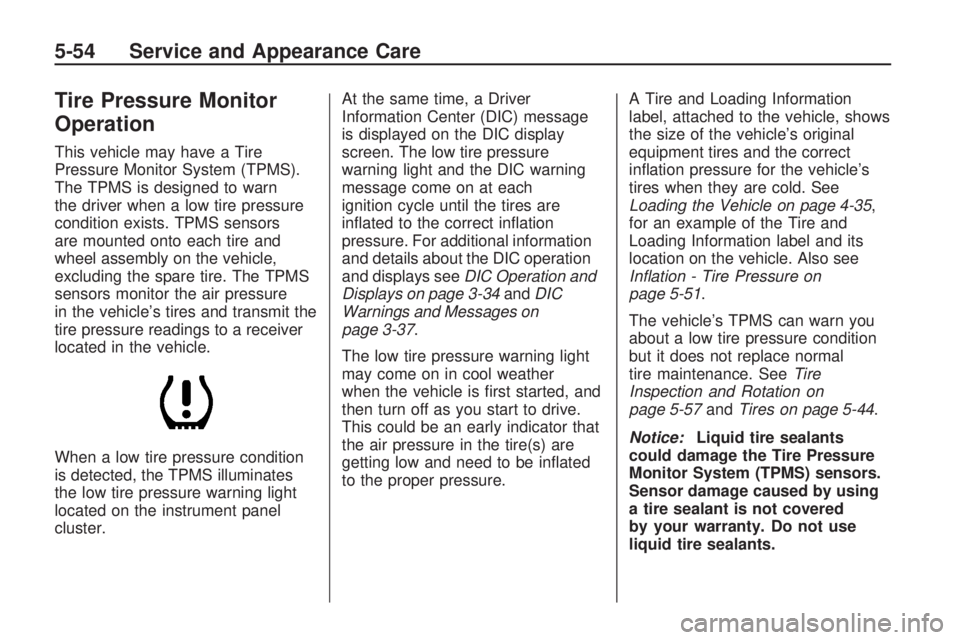
When a low tire pressure condition
is detected, the TPMS illuminates
the low tire pressure warning light
located on the instrument panel
cluster.At the same time, a Driver
Information Center (DIC) message
is displayed on the DIC display
screen. The low tire pressure
warning light and the DIC warning
message come on at each
ignition cycle until the tires are
inated to the correct ination
pressure. For additional information
and details about the DIC operation
and displays seeDIC Operation and
Displays on page 3-34andDIC
Warnings and Messages on
page 3-37.
The low tire pressure warning light
may come on in cool weather
when the vehicle is rst started, and
then turn off as you start to drive.
This could be an early indicator that
the air pressure in the tire(s) are
getting low and need to be inated
to the proper pressure.A Tire and Loading Information
label, attached to the vehicle, shows
the size of the vehicle’s original
equipment tires and the correct
ination pressure for the vehicle’s
tires when they are cold. See
Loading the Vehicle on page 4-35,
for an example of the Tire and
Loading Information label and its
location on the vehicle. Also see
Inflation - Tire Pressure on
page 5-51.
The vehicle’s TPMS can warn you
about a low tire pressure condition
but it does not replace normal
tire maintenance. SeeTire
Inspection and Rotation on
page 5-57andTires on page 5-44.
Notice:Liquid tire sealants
could damage the Tire Pressure
Monitor System (TPMS) sensors.
Sensor damage caused by using
a tire sealant is not covered
by your warranty. Do not use
liquid tire sealants.
5-54 Service and Appearance Care
Page 295 of 382
You need new tires if any of the
following statements are true:
You can see the indicators at
three or more places around
the tire.
You can see cord or fabric
showing through the tire’s rubber.
The tread or sidewall is cracked,
cut, or snagged deep enough to
show cord or fabric.
The tire has a bump, bulge,
or split.
The tire has a puncture, cut, or
other damage that cannot be
repaired well because of the size
or location of the damage.The rubber in tires degrades over
time, even if they are not being
used. This is also true for the spare
tire, if the vehicle has one. Multiple
conditions affect how fast this
aging takes place, including
temperatures, loading conditions,
and ination pressure maintenance.
With proper care and maintenance
tires typically wear out before
they degrade due to age. If you are
unsure about the need to replace
the tires as they get older, consult
the tire manufacturer for more
information.
Buying New Tires
GM has developed and matched
specic tires for your vehicle.
The original equipment tires
installed on your vehicle,
when it was new, were designed
to meet General Motors
Tire Performance Criteria
Specication (TPC spec) system
rating. If you need replacement
tires, GM strongly recommends
that you get tires with the
same TPC Spec rating. This
way, your vehicle will continue to
have tires that are designed to
give the same performance
and vehicle safety, during normal
use, as the original tires.
Service and Appearance Care 5-59
Page 300 of 382
Wheel Replacement
Replace any wheel that is bent,
cracked, or badly rusted or corroded.
If wheel nuts keep coming loose, the
wheel, wheel bolts, and wheel nuts
should be replaced. If the wheel
leaks air, replace it (except some
aluminum wheels, which can
sometimes be repaired). See your
dealer/retailer if any of these
conditions exist.
Your dealer/retailer will know the
kind of wheel you need.
Each new wheel should have the
same load-carrying capacity,
diameter, width, offset, and be
mounted the same way as the one
it replaces.If you need to replace any of your
wheels, wheel bolts, wheel nuts,
or Tire Pressure Monitor System
(TPMS) sensors, replace them only
with new GM original equipment
parts. This way, you will be sure
to have the right wheel, wheel bolts,
wheel nuts, and TPMS sensors
for your vehicle.
{CAUTION
Using the wrong replacement
wheels, wheel bolts, or wheel nuts
on your vehicle can be dangerous.
It could affect the braking and
handling of your vehicle, make
your tires lose air and make you
lose control. You could have a
collision in which you or others
could be injured. Always use the
correct wheel, wheel bolts, and
wheel nuts for replacement.Notice:The wrong wheel can
also cause problems with bearing
life, brake cooling, speedometer
or odometer calibration, headlamp
aim, bumper height, vehicle
ground clearance, and tire or tire
chain clearance to the body and
chassis.
SeeChanging a Flat Tire on
page 5-66for more information.
Used Replacement Wheels
{CAUTION
Putting a used wheel on the
vehicle is dangerous. You cannot
know how it has been used or how
far it has been driven. It could fail
suddenly and cause a crash. If you
have to replace a wheel, use a
new GM original equipment wheel.
5-64 Service and Appearance Care
Page 324 of 382
Aluminum or
Chrome-Plated Wheels
and Trim
The vehicle may have either
aluminum or chrome-plated wheels.
Keep the wheels clean using a soft
clean cloth with mild soap and water.
Rinse with clean water. After rinsing
thoroughly, dry with a soft clean
towel. A wax may then be applied.
Notice:Chrome wheels and
other chrome trim may be
damaged if the vehicle is not
washed after driving on roads
that have been sprayed with
magnesium, calcium or sodium
chloride. These chlorides are
used on roads for conditions
such as ice and dust. Always
wash the vehicle’s chrome with
soap and water after exposure.Notice:Using strong soaps,
chemicals, abrasive polishes,
cleaners, brushes, or cleaners
that contain acid on aluminum or
chrome-plated wheels, could
damage the surface of the
wheel(s). The repairs would not
be covered by the warranty.
Use only approved cleaners on
aluminum or chrome-plated
wheels.
The surface of these wheels is
similar to the painted surface of the
vehicle. Do not use strong soaps,
chemicals, abrasive polishes,
abrasive cleaners, cleaners with
acid, or abrasive cleaning brushes
on them because they could
damage the surface. Do not use
chrome polish on aluminum wheels.Notice:Using chrome polish on
aluminum wheels could damage
the wheels. The repairs would not
be covered by the warranty.
Use chrome polish on chrome
wheels only.
Use chrome polish only on
chrome-plated wheels, but avoid
any painted surface of the wheel,
and buff off immediately after
application.
Notice:Driving the vehicle
through an automatic car wash
that has silicone carbide tire
cleaning brushes, could damage
the aluminum or chrome-plated
wheels. The repairs would not be
covered by the warranty. Never
drive a vehicle equipped with
aluminum or chrome-plated
wheels through an automatic car
wash that uses silicone carbide
tire cleaning brushes.
5-88 Service and Appearance Care
Page 326 of 382
Chemical Paint Spotting
Some weather and atmospheric
conditions can create a chemical
fallout. Airborne pollutants can
fall upon and attack painted surfaces
on the vehicle. This damage can
take two forms: blotchy, ring-shaped
discolorations, and small, irregular
dark spots etched into the paint
surface.
Although no defect in the paint job
causes this, we will repair, at no
charge to the owner, the surfaces
of new vehicles damaged by this
fallout condition within 12 months
or 12,000 miles (20 000 km) of
purchase, whichever occurs rst.
Vehicle Identication
Vehicle Identication
Number (VIN)
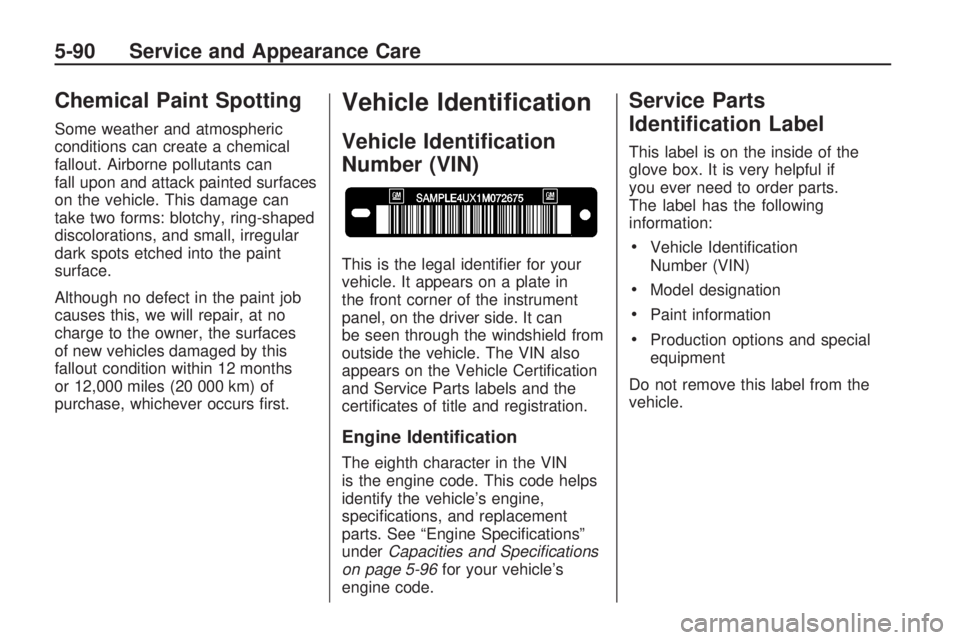
This is the legal identier for your
vehicle. It appears on a plate in
the front corner of the instrument
panel, on the driver side. It can
be seen through the windshield from
outside the vehicle. The VIN also
appears on the Vehicle Certication
and Service Parts labels and the
certicates of title and registration.
Engine Identication
The eighth character in the VIN
is the engine code. This code helps
identify the vehicle’s engine,
specications, and replacement
parts. See “Engine Specications”
underCapacities and Specifications
on page 5-96for your vehicle’s
engine code.
Service Parts
Identication Label
This label is on the inside of the
glove box. It is very helpful if
you ever need to order parts.
The label has the following
information:
Vehicle Identication
Number (VIN)
Model designation
Paint information
Production options and special
equipment
Do not remove this label from the
vehicle.
5-90 Service and Appearance Care
Page 330 of 382
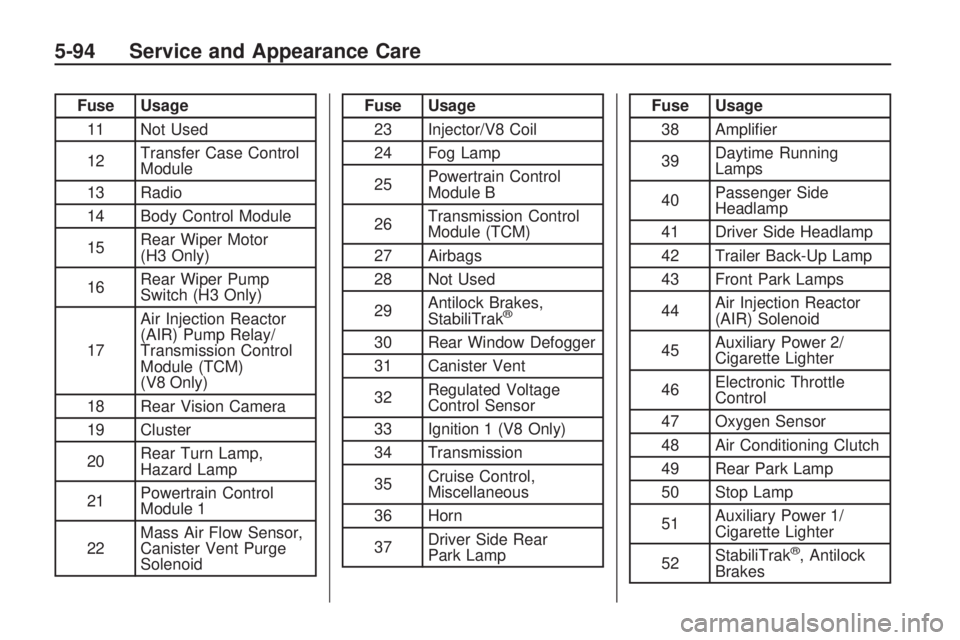
Fuse Usage
11 Not Used
12Transfer Case Control
Module
13 Radio
14 Body Control Module
15Rear Wiper Motor
(H3 Only)
16Rear Wiper Pump
Switch (H3 Only)
17Air Injection Reactor
(AIR) Pump Relay/
Transmission Control
Module (TCM)
(V8 Only)
18 Rear Vision Camera
19 Cluster
20Rear Turn Lamp,
Hazard Lamp
21Powertrain Control
Module 1
22Mass Air Flow Sensor,
Canister Vent Purge
SolenoidFuse Usage
23 Injector/V8 Coil
24 Fog Lamp
25Powertrain Control
Module B
26Transmission Control
Module (TCM)
27 Airbags
28 Not Used
29Antilock Brakes,
StabiliTrak
®
30 Rear Window Defogger
31 Canister Vent
32Regulated Voltage
Control Sensor
33 Ignition 1 (V8 Only)
34 Transmission
35Cruise Control,
Miscellaneous
36 Horn
37Driver Side Rear
Park Lamp
Fuse Usage
38 Amplier
39Daytime Running
Lamps
40Passenger Side
Headlamp
41 Driver Side Headlamp
42 Trailer Back-Up Lamp
43 Front Park Lamps
44Air Injection Reactor
(AIR) Solenoid
45Auxiliary Power 2/
Cigarette Lighter
46Electronic Throttle
Control
47 Oxygen Sensor
48 Air Conditioning Clutch
49 Rear Park Lamp
50 Stop Lamp
51Auxiliary Power 1/
Cigarette Lighter
52StabiliTrak
®, Antilock
Brakes
5-94 Service and Appearance Care