tow HUMMER H3 2009 Owner's Guide
[x] Cancel search | Manufacturer: HUMMER, Model Year: 2009, Model line: H3, Model: HUMMER H3 2009Pages: 382, PDF Size: 1.99 MB
Page 162 of 382
To set Automatic Volume:
1. Adjust the volume at the desired
level.
2. Press AUTO VOL to select LOW,
MEDIUM, or HIGH. Each higher
setting allows for more volume
compensation at faster vehicle
speeds.
To turn automatic volume off, press
AUTO VOL until AVOL OFF
displays.
Tone and Speaker Controls
To adjust all tone and speaker
controls to the center setting, press
and hold
euntil CEN or ALL
CENTERED displays and the radio
beeps once.Adjusting the Tone (Bass/Treble)
To adjust Bass/Treble:
Press and release
euntil BASS or
TREB displays.
Turneto increase or to
decrease the level.
To set the Bass or Treble to the
center setting, press and hold
e
until the radio beeps once.
Adjusting the Speakers
(Balance/Fade)
To adjust the Balance:
Press and release
euntil BAL
displays.
Turneto move the sound
toward the right or the left
speakers.
To adjust the balance to the
center setting, press and hold
e
until the radio beeps once.To adjust the Fade:
Press and release
euntil FAD or
FADE displays
Turneto move the sound
toward the front or the rear
speakers.
To set the fade to the center
setting, press and hold
e
until the radio beeps once.
Using the Radio
XM™ Satellite Radio Service
XM is a satellite radio service that is
based in the 48 contiguous United
States and 10 Canadian provinces.
XM Satellite Radio has a wide
variety of programming and
commercial-free music,
coast-to-coast, and in digital-quality
sound. During your trial or when
you subscribe, you will get unlimited
access to XM Radio Online for
when you are not in the vehicle. A
service fee is required to receive the
XM service. For more information,
3-44 Instrument Panel
Page 183 of 382
Driving Your
Vehicle
Your Driving, the Road,
and the Vehicle
Driving for Better Fuel
Economy...........................4-1
Defensive Driving................4-2
Drunk Driving.....................4-2
Control of a Vehicle............4-3
Braking...............................4-3
Antilock Brake
System (ABS)...................4-5
Braking in Emergencies......4-6
StabiliTrak®System............4-6
Traction Control
System (TCS)...................4-7
Locking Rear Axle..............4-8
Locking Front Axle..............4-9
Steering............................4-10
Off-Road Recovery............4-11
Passing.............................4-12
Loss of Control.................4-12
Off-Road Driving...............4-13
Assist Steps......................4-28
Driving at Night.................4-28
Driving in Rain and on
Wet Roads......................4-29
Before Leaving on a
Long Trip........................4-30
Highway Hypnosis.............4-30
Hill and Mountain Roads. . .4-30
Winter Driving...................4-31
If Your Vehicle is
Stuck in Sand, Mud,
Ice, or Snow
...................4-33
Rocking Your Vehicle to
Get It Out.......................4-34
Recovery Loops................4-34
Loading the Vehicle..........4-35
Truck-Camper Loading
Information......................4-39
Towing
Towing Your Vehicle.........4-40
Recreational Vehicle
Towing............................4-40
Towing a Trailer................4-42
Trailer
Recommendations...........4-53
Your Driving, the
Road, and the Vehicle
Driving for Better Fuel
Economy
Driving habits can affect fuel
mileage. Here are some driving tips
to get the best fuel economy
possible.
Avoid fast starts and accelerate
smoothly.
Brake gradually and avoid abrupt
stops.
Avoid idling the engine for long
periods of time.
When road and weather
conditions are appropriate, use
cruise control, if equipped.
Always follow posted speed limits
or drive more slowly when
conditions require.
Keep vehicle tires properly
inated.
Driving Your Vehicle 4-1
Page 216 of 382
Rocking Your Vehicle to
Get It Out
Turn the steering wheel left and
right to clear the area around
the front wheels. The traction control
system activates when the system
senses that the wheels are spinning.
Turn off any traction or stability
system. With the wheels straight
ahead, shift back and forth between
R (Reverse) and a forward gear,
or with a manual transmission,
between 1 (First) or 2 (Second) and
R (Reverse), spinning the wheels
as little as possible. To prevent
transmission wear, wait until
the wheels stop spinning before
shifting gears. Release the
accelerator pedal while shifting, and
press lightly on the accelerator
pedal when the transmission is in
gear. Slowly spinning the wheels in
the forward and reverse directions
causes a rocking motion that
could free the vehicle. If that does
not get the vehicle out after a
few tries, it might need to be towed
out. The recovery loops can beused. If the vehicle does need to be
towed out, seeTowing Your
Vehicle on page 4-40.
Recovery Loops
{CAUTION
These loops, when used, are
under a lot of force. Keep people
away from the vicinity of the loops
and any chains or cables during
use. Always pull the vehicle
straight out. Never pull on the
loops at a sideways angle. The
loops could break off and you or
others could be injured from the
chain or cable snapping back.
Notice:Never use the recovery
loops to tow the vehicle. Your
vehicle could be damaged and it
would not be covered by
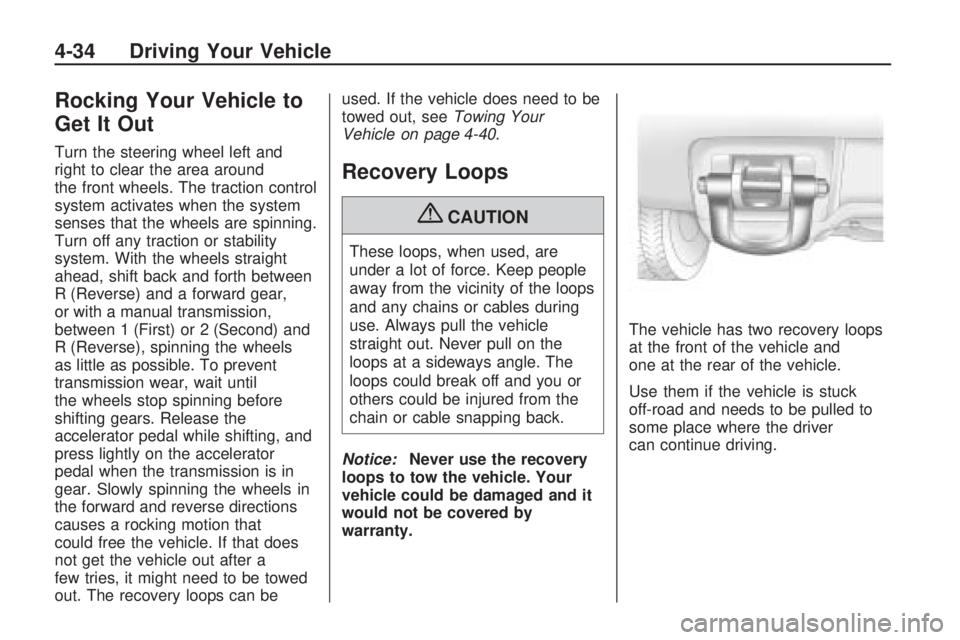
warranty.The vehicle has two recovery loops
at the front of the vehicle and
one at the rear of the vehicle.
Use them if the vehicle is stuck
off-road and needs to be pulled to
some place where the driver
can continue driving.
4-34 Driving Your Vehicle
Page 217 of 382
If the vehicle has a brush guard,
never tow or apply any loads
onto the brush guard.
Loading the Vehicle
It is very important to know how
much weight the vehicle can
carry. This weight is called the
vehicle capacity weight and
includes the weight of all
occupants, cargo and all
nonfactory-installed options.Two labels on the vehicle show
how much weight it may
properly carry, the Tire and
Loading Information label and
the Certication/Tire label.
{CAUTION
Do not load the vehicle any
heavier than the Gross Vehicle
Weight Rating (GVWR), or
either the maximum front or
rear Gross Axle Weight Rating
(GAWR). If you do, parts on
the vehicle can break, and it
can change the way your
vehicle handles. These could
cause you to lose control and
crash. Also, overloading can
shorten the life of the vehicle.
Tire and Loading Information
Label
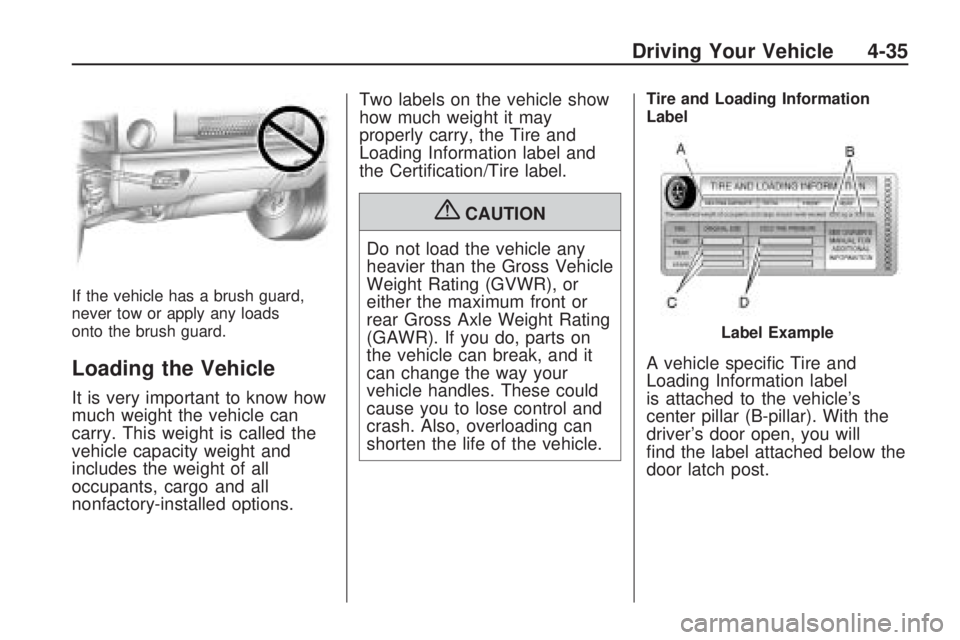
A vehicle specic Tire and
Loading Information label
is attached to the vehicle’s
center pillar (B-pillar). With the
driver’s door open, you will
nd the label attached below the
door latch post.
Label Example
Driving Your Vehicle 4-35
Page 218 of 382
The Tire and Loading
Information label shows the
number of occupant seating
positions (A), and the maximum
vehicle capacity weight (B) in
kilograms and pounds.
The Tire and Loading Information
label also shows the size of the
vehicle’s original equipment
tires (C) and the recommended
cold tire ination pressures (D).
For more information on tires and
ination seeTires on page 5-44
andInflation - Tire Pressure on
page 5-51.
There is also important
information on the
Certication/Tire label. It tells
Gross Vehicle Weight Rating
(GVWR) and the Gross
Axle Weight Rating (GAWR)
for the front and rear axles. See
“Certication/Tire Label” later
in this section.Steps for Determining Correct
Load Limit
1.
Locate the statement “The
combined weight of occupants
and cargo should never
exceed XXX kg or XXX lbs” on
your vehicle’s placard.
2.Determine the combined
weight of the driver and
passengers that will be riding
in your vehicle.
3.Subtract the combined weight
of the driver and passengers
from XXX kg or XXX lbs.
4.The resulting gure equals the
available amount of cargo and
luggage load capacity. For
example, if the “XXX” amount
equals 1400 lbs and there will
be ve 150 lb passengers in
your vehicle, the amount
of available cargo and
luggage load capacity is
650 lbs (1400−750
(5 x 150) = 650 lbs).
5.Determine the combined
weight of luggage and
cargo being loaded on the
vehicle. That weight may not
safely exceed the available
cargo and luggage load
capacity calculated in Step 4.
6.If your vehicle will be towing a
trailer, the load from your
trailer will be transferred to
your vehicle. Consult
this manual to determine how
this reduces the available
cargo and luggage load
capacity of your vehicle.
SeeTowing a Trailer
on page 4-42for important
information on towing a
trailer, towing safety, and
trailering tips.
4-36 Driving Your Vehicle
Page 222 of 382
Towing
Towing Your Vehicle
To avoid damage, the disabled
vehicle should be towed with all four
wheels off the ground. Consult
your dealer/retailer or a professional
towing service if the disabled
vehicle must be towed. See
Roadside Service on page 7-6
To tow the vehicle behind another
vehicle for recreational
purposes — such as behind a
motorhome, see “Recreational
Vehicle Towing” following.
Recreational Vehicle
Towing
Recreational vehicle towing means
towing the vehicle behind another
vehicle – such as behind a
motorhome. The two most common
types of recreational vehicle
towing are known as “dinghy
towing” — towing the vehicle with all
four wheels on the ground, and“dolly towing” — towing the vehicle
with two wheels on the ground
and two wheels up on a device
known as a “dolly”.
Here are some important things to
consider before recreational
vehicle towing:
What is the towing capacity of
the tow vehicle? Be sure to
read the tow vehicle
manufacturer’s
recommendations.
What is the distance that will be
travelled? Some vehicles have
restrictions on how far and
how long they can tow.
Is the proper towing equipment
going to be used? See your
dealer/retailer or trailering
professional for additional advice
and equipment
recommendations.
Is the vehicle ready to be towed?
Just as preparing the vehicle for
a long trip, make sure the
vehicle is prepared to be towed.
SeeBefore Leaving on a
Long Trip on page 4-30.
Dinghy Towing
This full-time four-wheel-drive
vehicle can be dinghy towed from
the front. These vehicles can also be
towed by placing them on a
platform trailer with all four wheels
off the ground. These vehicles
cannot be towed using a dolly.
4-40 Driving Your Vehicle
Page 223 of 382
Use the following procedure to tow
the vehicle:
1. Put the transmission in P (Park)
for an automatic transmission or
in 1 (First) for a manual
transmission.
2. Turn the engine off, but leave the
ignition in ACC/ACCESSORY.
3. Firmly set the parking brake.
4. Securely attach the vehicle being
towed to the tow vehicle.
{CAUTION
Shifting a full-time
four-wheel-drive vehicle’s
transfer case into N (Neutral)
can cause the vehicle to roll
even if the automatic transmission
is in P (Park) or the manual
transmission is in any gear. You
or others could be injured. Make
sure the parking brake is rmly
set before the transfer case is
shifted to N (Neutral).5. Shift the transfer case to
N (Neutral). SeeFull-Time
Four-Wheel Drive on page 2-24
for the proper procedure to
select the N (Neutral) position for
the vehicle.
6. Release the parking brake only
after the vehicle being towed is
rmly attached to the tow vehicle.
7. Make sure the ignition is in
ACC/ACCESSORY.
When towing the vehicle for
extended periods of time, start the
vehicle as often as possible to
prevent battery drain. This should
only be done when the tow
vehicle is parked.
After towing, see “Shifting Out of
NEUTRAL” underFull-Time
Four-Wheel Drive on page 2-24.
Dolly Towing
Notice:Dolly towing the vehicle
will damage drivetrain
components. Do not dolly tow the
vehicle.
The vehicle cannot be dolly towed.
If the vehicle must be towed
behind another vehicle, use the
dinghy towing procedure explained
previously.
Driving Your Vehicle 4-41
Page 224 of 382
Towing a Trailer
{CAUTION
The driver can lose control when
pulling a trailer if the correct
equipment is not used or the
vehicle is not driven properly. For
example, if the trailer is too
heavy, the brakes may not work
well — or even at all. The driver
and passengers could be
seriously injured. The vehicle may
also be damaged; the resulting
repairs would not be covered by
the vehicle warranty. Pull a trailer
only if all the steps in this section
have been followed. Ask your
dealer/retailer for advice and
information about towing a trailer
with the vehicle.Notice:Pulling a trailer
improperly can damage the
vehicle and result in costly
repairs not covered by the
vehicle warranty. To pull a trailer
correctly, follow the advice in
this section and see your
dealer/retailer for important
information about towing a trailer
with the vehicle.
To identify the trailering capacity of
the vehicle, read the information
in “Weight of the Trailer” that
appears later in this section.
Trailering is different than just
driving the vehicle by itself.
Trailering means changes in
handling, acceleration, braking,
durability and fuel economy.
Successful, safe trailering takes
correct equipment, and it has to be
used properly.The following information has many
time-tested, important trailering
tips and safety rules. Many of these
are important for your safety and
that of your passengers. So please
read this section carefully before
pulling a trailer.
Pulling A Trailer
Here are some important points:
There are many different
laws, including speed limit
restrictions, having to do with
trailering. Make sure the rig will
be legal, not only where you
live but also where you will be
driving. A good source for
this information can be state or
provincial police.
Consider using a sway control.
See “Hitches” later in this
section.
4-42 Driving Your Vehicle
Page 225 of 382
Do not tow a trailer at all during
the rst 500 miles (800 km) the
new vehicle is driven. The
engine, axle or other parts could
be damaged.
Then, during the rst 500 miles
(800 km) that a trailer is towed,
do not drive over 50 mph
(80 km/h) and do not make starts
at full throttle. This helps the
engine and other parts of
the vehicle wear in at the
heavier loads.
Vehicles with an automatic
transmissions can tow in
D (Drive). Shift the transmission
to a lower gear if the
transmission shifts too often
under heavy loads and/or hilly
conditions. For vehicles with
a manual transmission, it is better
not to use the highest gear.
This vehicle has a Hill Start
Assist feature, which may
be useful when the vehicle is
stopped on a grade. SeeBraking
on page 4-3for more information.
Three important considerations have
to do with weight:
The weight of the trailer
The weight of the trailer tongue
The weight on the vehicle’s tires
Weight of the Trailer
How heavy can a trailer safely be?
It depends on how the rig is
used. For example, speed, altitude,
road grades, outside temperature
and how much the vehicle is used to
pull a trailer are all important. It
can depend on any special
equipment on the vehicle, and the
amount of tongue weight the vehicle
can carry. See “Weight of the
Trailer Tongue” later in this section
for more information.
Driving Your Vehicle 4-43
Page 226 of 382
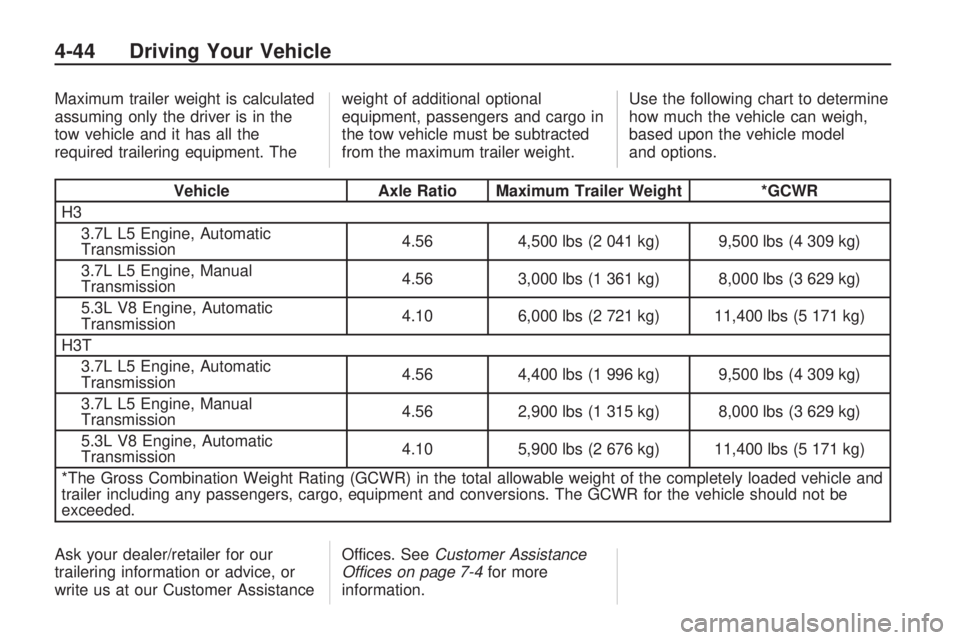
Maximum trailer weight is calculated
assuming only the driver is in the
tow vehicle and it has all the
required trailering equipment. Theweight of additional optional
equipment, passengers and cargo in
the tow vehicle must be subtracted
from the maximum trailer weight.Use the following chart to determine
how much the vehicle can weigh,
based upon the vehicle model
and options.
Vehicle
Axle Ratio Maximum Trailer Weight *GCWR
H3 3.7L L5 Engine, Automatic
Transmission 4.56
4,500 lbs (2 041 kg) 9,500 lbs (4 309 kg)
3.7L L5 Engine, Manual
Transmission 4.56
3,000 lbs (1 361 kg) 8,000 lbs (3 629 kg)
5.3L V8 Engine, Automatic
Transmission 4.10
6,000 lbs (2 721 kg) 11,400 lbs (5 171 kg)
H3T 3.7L L5 Engine, Automatic
Transmission 4.56
4,400 lbs (1 996 kg) 9,500 lbs (4 309 kg)
3.7L L5 Engine, Manual
Transmission 4.56
2,900 lbs (1 315 kg) 8,000 lbs (3 629 kg)
5.3L V8 Engine, Automatic
Transmission 4.10
5,900 lbs (2 676 kg) 11,400 lbs (5 171 kg)
*The Gross Combination Weight Rating (GCWR) in the total allowable weight of the completely loaded vehicle and
trailer including any passengers, cargo, equipment and conversions. The GCWR for the vehicle should not be
exceeded.
Ask your dealer/retailer for our
trailering information or advice, or
write us at our Customer Assistance Offices. See
Customer Assistance
Offices on page 7-4 for more
information.
4-44 Driving Your Vehicle