tow HUMMER H3 2009 Workshop Manual
[x] Cancel search | Manufacturer: HUMMER, Model Year: 2009, Model line: H3, Model: HUMMER H3 2009Pages: 382, PDF Size: 1.99 MB
Page 264 of 382
If No Steam Is Coming From
The Engine Compartment
If an engine overheat warning is
displayed but no steam can be seen
or heard, the problem may not be
too serious. Sometimes the engine
can get a little too hot when the
vehicle:
Climbs a long hill on a hot day.
Stops after high-speed driving.
Idles for long periods in traffic.
Tows a trailer. See “Driving
on Grades” underTowing a
Trailer on page 4-42.
If the overheat warning is displayed
with no sign of steam:
1. Turn the air conditioning off.
2. Turn the heater on to the highest
temperature and to the highest
fan speed. Open the windows as
necessary.3. In heavy traffic, let the engine idle
in N (Neutral) while stopped. If it
is safe to do so, pull off the road,
shift to P (Park) or N (Neutral) and
let the engine idle.
If the temperature overheat gage is
no longer in the overheat zone
or an overheat warning no longer
displays, the vehicle can be driven.
Continue to drive the vehicle
slow for about 10 minutes. Keep a
safe vehicle distance from the
car in front of you. If the warning
does not come back on, continue to
drive normally.
If the warning continues, pull over,
stop, and park the vehicle right away.
If there is no sign of steam, idle the
engine for three minutes while
parked. If the warning is still
displayed, turn off the engine until
it cools down.
Engine Fan Noise
This vehicle has a clutched engine
cooling fan. When the clutch is
engaged, the fan spins faster
to provide more air to cool the
engine. In most everyday driving
conditions, the clutch is not
engaged. This improves fuel
economy and reduces fan noise.
Under heavy vehicle loading,
trailer towing and/or high outside
temperatures, the fan speed
increases when the clutch engages.
So you may hear an increase in
fan noise. This is normal and should
not be mistaken as the transmission
slipping or making extra shifts.
It is merely the cooling system
functioning properly. The fan will
slow down when additional cooling
is not required and the clutch
disengages.
You may also hear this fan noise
when you start the engine. It will go
away as the fan clutch disengages.
5-28 Service and Appearance Care
Page 294 of 382
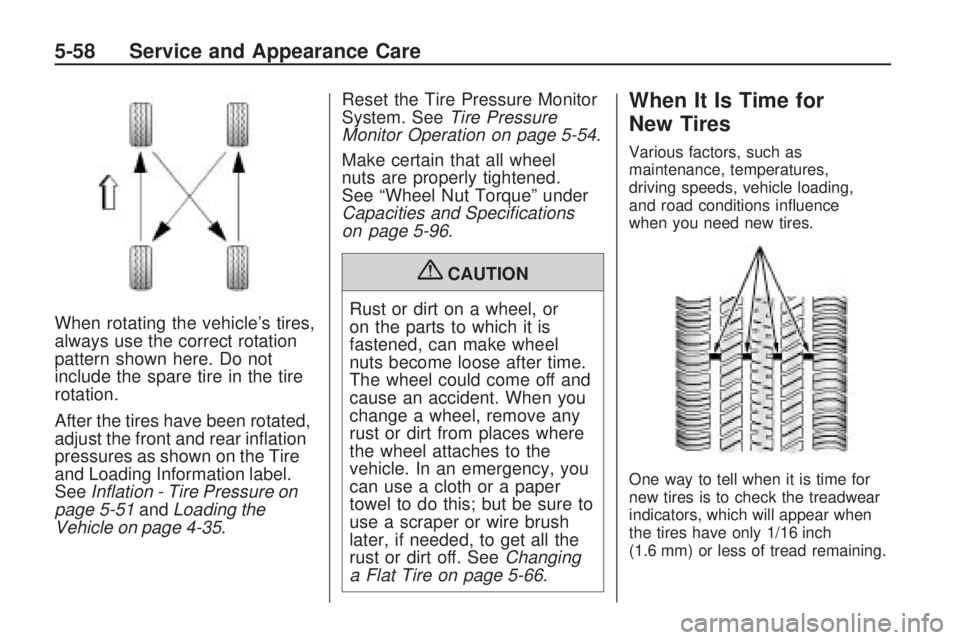
When rotating the vehicle’s tires,
always use the correct rotation
pattern shown here. Do not
include the spare tire in the tire
rotation.
After the tires have been rotated,
adjust the front and rear ination
pressures as shown on the Tire
and Loading Information label.
SeeInflation - Tire Pressure on
page 5-51andLoading the
Vehicle on page 4-35.Reset the Tire Pressure Monitor
System. SeeTire Pressure
Monitor Operation on page 5-54.
Make certain that all wheel
nuts are properly tightened.
See “Wheel Nut Torque” under
Capacities and Specifications
on page 5-96.
{CAUTION
Rust or dirt on a wheel, or
on the parts to which it is
fastened, can make wheel
nuts become loose after time.
The wheel could come off and
cause an accident. When you
change a wheel, remove any
rust or dirt from places where
the wheel attaches to the
vehicle. In an emergency, you
can use a cloth or a paper
towel to do this; but be sure to
use a scraper or wire brush
later, if needed, to get all the
rust or dirt off. SeeChanging
a Flat Tire on page 5-66.
When It Is Time for
New Tires
Various factors, such as
maintenance, temperatures,
driving speeds, vehicle loading,
and road conditions inuence
when you need new tires.
One way to tell when it is time for
new tires is to check the treadwear
indicators, which will appear when
the tires have only 1/16 inch
(1.6 mm) or less of tread remaining.
5-58 Service and Appearance Care
Page 302 of 382
If a Tire Goes Flat
It is unusual for a tire to blowout
while you are driving, especially if
you maintain your vehicle’s tires
properly. If air goes out of a tire,
it is much more likely to leak out
slowly. But if you should ever have a
blowout, here are a few tips about
what to expect and what to do:
If a front tire fails, the at tire
creates a drag that pulls the vehicle
toward that side. Take your foot
off the accelerator pedal and grip
the steering wheel rmly. Steer to
maintain lane position, and then
gently brake to a stop well out of
the traffic lane.
A rear blowout, particularly on a
curve, acts much like a skid and
may require the same correction you
would use in a skid. In any rear
blowout remove your foot from the
accelerator pedal. Get the vehicle
under control by steering the
way you want the vehicle to go.It may be very bumpy and noisy, but
you can still steer. Gently brake to a
stop, well off the road if possible.
{CAUTION
Lifting a vehicle and getting under
it to do maintenance or repairs is
dangerous without the appropriate
safety equipment and training.
If a jack is provided with the
vehicle, it is designed only for
changing a at tire. If it is used for
anything else, you or others could
be badly injured or killed if the
vehicle slips off the jack. If a jack
is provided with the vehicle, only
use it for changing a at tire.
If a tire goes at, the next part
shows how to use the jacking
equipment to change a at tire
safely.
Changing a Flat Tire
If a tire goes at, avoid further tire
and wheel damage by driving
slowly to a level place. Turn on
your hazard warning ashers.
SeeHazard Warning Flashers
on page 3-5.
{CAUTION
Changing a tire can be dangerous.
The vehicle can slip off the jack
and roll over or fall on you or other
people. You and they could be
badly injured or even killed.
Find a level place to change your
tire. To help prevent the vehicle
from moving:
1. Set the parking brake rmly.
2. Put the shift lever in
P (Park).
(Continued)
5-66 Service and Appearance Care
Page 307 of 382
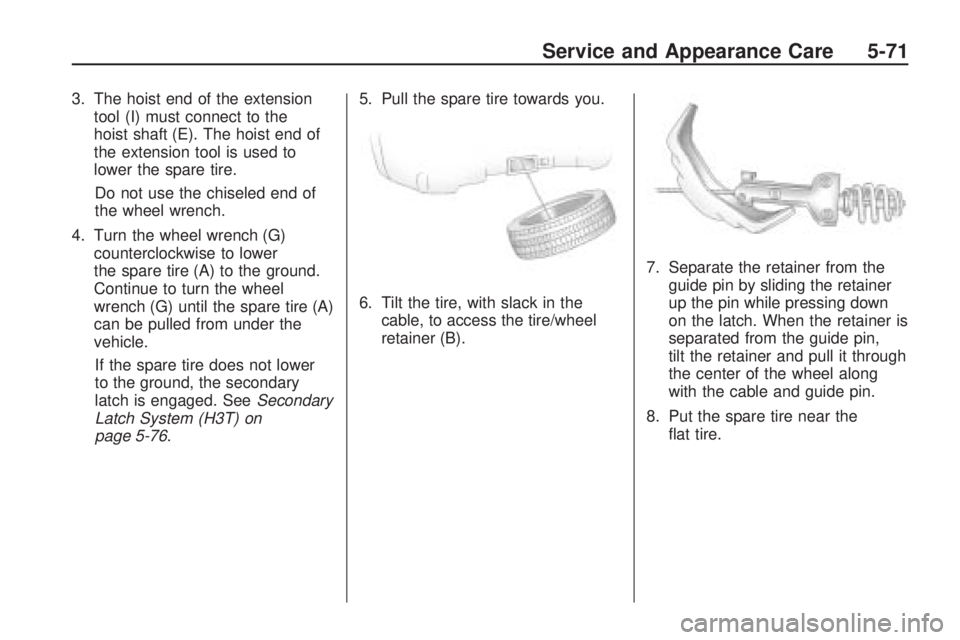
3. The hoist end of the extension
tool (I) must connect to the
hoist shaft (E). The hoist end of
the extension tool is used to
lower the spare tire.
Do not use the chiseled end of
the wheel wrench.
4. Turn the wheel wrench (G)
counterclockwise to lower
the spare tire (A) to the ground.
Continue to turn the wheel
wrench (G) until the spare tire (A)
can be pulled from under the
vehicle.
If the spare tire does not lower
to the ground, the secondary
latch is engaged. SeeSecondary
Latch System (H3T) on
page 5-76.5. Pull the spare tire towards you.
6. Tilt the tire, with slack in the
cable, to access the tire/wheel
retainer (B).7. Separate the retainer from the
guide pin by sliding the retainer
up the pin while pressing down
on the latch. When the retainer is
separated from the guide pin,
tilt the retainer and pull it through
the center of the wheel along
with the cable and guide pin.
8. Put the spare tire near the
at tire.
Service and Appearance Care 5-71
Page 310 of 382
6. Turn the wheel wrench clockwise
to raise the jack head to the
lifting point.
{CAUTION
Getting under a vehicle when it is
jacked up is dangerous. If the
vehicle slips off the jack, you
could be badly injured or killed.
Never get under a vehicle when it
is supported only by a jack.
{CAUTION
Raising your vehicle with the jack
improperly positioned can damage
the vehicle and even make the
vehicle fall. To help avoid
personal injury and vehicle
damage, be sure to t the jack lift
head into the proper location
before raising the vehicle.7. Remove all the wheel nuts and
take off the at tire.
{CAUTION
Rust or dirt on a wheel, or on the
parts to which it is fastened, can
make wheel nuts become loose
after time. The wheel could come
off and cause an accident. When
changing a wheel, remove any
rust or dirt from places where the
wheel attaches to the vehicle.
In an emergency, use a cloth or a
paper towel to do this; but be sure
to use a scraper or wire brush
later, if needed, to get all the rust
or dirt off. SeeChanging a Flat
Tire on page 5-66.8. Remove any rust or dirt from the
wheel bolts, mounting surfaces
and spare wheel.{CAUTION
Never use oil or grease on bolts
or nuts because the nuts might
come loose. The vehicle’s wheel
could fall off, causing a crash.
9. Put the spare tire on the
mounting surface.
10. Put the wheel nuts back on
with the rounded end of the
nuts toward the wheel
after mounting the spare.
5-74 Service and Appearance Care
Page 312 of 382
Secondary Latch
System (H3T)
This vehicle has an underbody
mounted tire hoist assembly that has
a secondary latch system. It is
designed to stop the spare tire from
suddenly falling off the vehicle if
the cable holding the spare tire is
damaged. For the secondary latch to
work, the tire must be stowed with
the valve stem pointing down.
SeeStoring a Flat or Spare Tire
and Tools (H3) on page 5-78
orStoring a Flat or Spare Tire and
Tools (H3T) on page 5-80for
instructions on storing the spare tire
correctly.
{CAUTION
Before beginning this procedure
read all the instructions. Failure to
read and follow the instructions
could damage the hoist assembly
and you and others could get
hurt. Read and follow the
instructions listed next.
To release the spare tire from the
secondary latch:
{CAUTION
Someone standing too close
during the procedure could be
injured by the jack. If the spare
tire does not slide off the jack
completely, make sure no one is
behind you or on either side of
you as you pull the jack out from
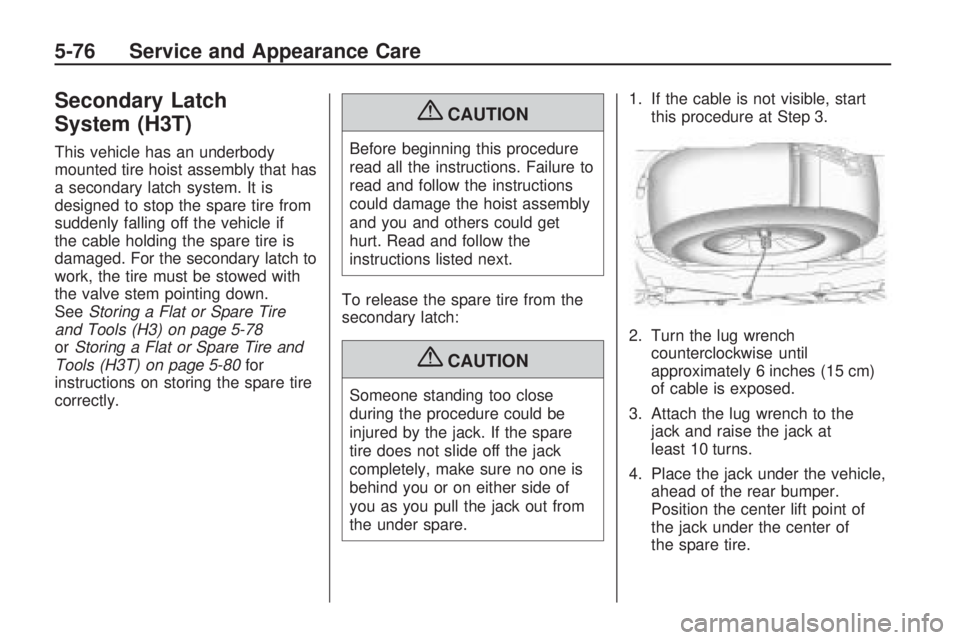
the under spare.1. If the cable is not visible, start
this procedure at Step 3.
2. Turn the lug wrench
counterclockwise until
approximately 6 inches (15 cm)
of cable is exposed.
3. Attach the lug wrench to the
jack and raise the jack at
least 10 turns.
4. Place the jack under the vehicle,
ahead of the rear bumper.
Position the center lift point of
the jack under the center of
the spare tire.
5-76 Service and Appearance Care
Page 320 of 382
Laundry detergents or
dishwashing soaps with
degreasers can leave residue
that streaks and attracts dirt.
For liquid cleaners, about
20 drops per gallon (3.78 L) of
water is a good guide. Use
only mild, neutral-pH soaps.
Too much cleaner that saturates
the upholstery.
Organic solvents such as naptha,
alcohol, etc. that can damage the
vehicle’s interior.
Fabric/Carpet
Use a vacuum cleaner with a soft
brush attachment frequently to
remove dust and loose dirt.
A canister vacuum with a beater bar
in the nozzle may only be used
on oor carpet and carpeted oor
mats. For any soil, always try
to remove it rst with plain water orclub soda. Before cleaning, gently
remove as much of the soil as
possible using one of the following
techniques:
For liquids: gently blot the
remaining soil with a paper towel.
Allow the soil to absorb into
the paper towel until no more
can be removed.
For solid dry soils: remove as
much as possible and then
vacuum.
To clean:
1. Saturate a lint-free, clean white
cloth with water or club soda.
2. Wring the cloth to remove excess
moisture.
3. Start on the outside edge of the
soil and gently rub toward the
center. Continue cleaning, using
a clean area of the cloth each
time it becomes soiled.4. Continue to gently rub the soiled
area until the cleaning cloth
remains clean.
5. If the soil is not completely
removed, use a mild soap
solution and repeat the cleaning
process that was used with
plain water.
If any of the soil remains, a
commercial fabric cleaner or spot
lifter may be necessary. When
a commercial upholstery cleaner or
spot lifter is to be used, test a
small hidden area for colorfastness
rst. If the locally cleaned area
gives any impression that a ring
formation may result, clean
the entire surface.
After the cleaning process has been
completed, a paper towel can be
used to blot excess moisture
from the fabric or carpet.
5-84 Service and Appearance Care
Page 322 of 382
Weatherstrips
Silicone grease on weatherstrips will
make them last longer, seal better,
and not stick or squeak. Apply
silicone grease with a clean cloth.
During very cold, damp weather
frequent application may be
required. SeeRecommended Fluids
and Lubricants on page 6-12.
Washing Your Vehicle
The best way to preserve the
vehicle’s nish is to keep it clean by
washing it often.
Notice:Certain cleaners contain
chemicals that can damage the
emblems or nameplates on the
vehicle. Check the cleaning
product label. If it states that it
should not be used on plastic
parts, do not use it on the vehicle
or damage may occur and it would
not be covered by the warranty.
Do not wash the vehicle in direct
sunlight. Use a car washing soap.
Do not use cleaning agents that arepetroleum based or that contain
acid or abrasives, as they can
damage the paint, metal or plastic
on the vehicle. Approved cleaning
products can be obtained from
your dealer/retailer. Follow all
manufacturers’ directions regarding
correct product usage, necessary
safety precautions and appropriate
disposal of any vehicle care product.
Rinse the vehicle well, before
washing and after to remove all
cleaning agents completely. If they
are allowed to dry on the surface,
they could stain.
Dry the nish with a soft, clean
chamois or an all-cotton towel to
avoid surface scratches and
water spotting.
High pressure car washes may
cause water to enter the vehicle.
Avoid using high pressure washes
closer than 12 inches (30 cm) to
the surface of the vehicle. Use of
power washers exceeding 1,200 psi
(8 274 kPa) can result in damage
or removal of paint and decals.
Cleaning Exterior
Lamps/Lenses
Use only lukewarm or cold water,
a soft cloth and a car washing soap
to clean exterior lamps and lenses.
Follow instructions underWashing
Your Vehicle on page 5-86.
Finish Care
Occasional waxing or mild polishing
of the vehicle by hand may be
necessary to remove residue from
the paint nish. Approved cleaning
products can be obtained from
your dealer/retailer.
If the vehicle has a basecoat/
clearcoat paint nish, the clearcoat
gives more depth and gloss to
the colored basecoat. Always use
waxes and polishes that are
non-abrasive and made for a
basecoat/clearcoat paint nish.
5-86 Service and Appearance Care
Page 323 of 382
Notice:Machine compounding
or aggressive polishing on a
basecoat/clearcoat paint nish
may damage it. Use only
non-abrasive waxes and
polishes that are made for a
basecoat/clearcoat paint nish
on the vehicle.
Foreign materials such as calcium
chloride and other salts, ice melting
agents, road oil and tar, tree sap,
bird droppings, chemicals from
industrial chimneys, etc., can
damage the vehicle’s nish if
they remain on painted surfaces.
Wash the vehicle as soon as
possible. If necessary, use
non-abrasive cleaners that are
marked safe for painted surfaces
to remove foreign matter.
Exterior painted surfaces are
subject to aging, weather and
chemical fallout that can take
their toll over a period of years.To help keep the paint nish looking
new, keep the vehicle garaged or
covered whenever possible.
Protecting Exterior Bright
Metal Parts
Bright metal parts should be
cleaned regularly to keep their
luster. Washing with water is all
that is usually needed. However,
chrome polish may be used
on chrome or stainless steel trim,
if necessary.
Use special care with aluminum
trim. To avoid damaging protective
trim, never use auto or chrome
polish, steam or caustic soap
to clean aluminum. A coating of
wax, rubbed to high polish, is
recommended for all bright
metal parts.Windshield, Backglass,
and Wiper Blades
Clean the outside of the windshield
and backglass with glass cleaner.
Clean the rubber blades using a lint
free cloth or paper towel soaked with
windshield washer uid or a mild
detergent. Wash the windshield
thoroughly when you clean the
blades. Bugs, road grime, sap and
a buildup of vehicle wash/wax
treatments may cause wiper
streaking. Replace the wiper blades
if they are worn or damaged.
Wipers can be damaged by:
Extreme dusty conditions
Sand and salt
Heat and sun
Snow and ice, without proper
removal
Service and Appearance Care 5-87
Page 324 of 382
Aluminum or
Chrome-Plated Wheels
and Trim
The vehicle may have either
aluminum or chrome-plated wheels.
Keep the wheels clean using a soft
clean cloth with mild soap and water.
Rinse with clean water. After rinsing
thoroughly, dry with a soft clean
towel. A wax may then be applied.
Notice:Chrome wheels and
other chrome trim may be
damaged if the vehicle is not
washed after driving on roads
that have been sprayed with
magnesium, calcium or sodium
chloride. These chlorides are
used on roads for conditions
such as ice and dust. Always
wash the vehicle’s chrome with
soap and water after exposure.Notice:Using strong soaps,
chemicals, abrasive polishes,
cleaners, brushes, or cleaners
that contain acid on aluminum or
chrome-plated wheels, could
damage the surface of the
wheel(s). The repairs would not
be covered by the warranty.
Use only approved cleaners on
aluminum or chrome-plated
wheels.
The surface of these wheels is
similar to the painted surface of the
vehicle. Do not use strong soaps,
chemicals, abrasive polishes,
abrasive cleaners, cleaners with
acid, or abrasive cleaning brushes
on them because they could
damage the surface. Do not use
chrome polish on aluminum wheels.Notice:Using chrome polish on
aluminum wheels could damage
the wheels. The repairs would not
be covered by the warranty.
Use chrome polish on chrome
wheels only.
Use chrome polish only on
chrome-plated wheels, but avoid
any painted surface of the wheel,
and buff off immediately after
application.
Notice:Driving the vehicle
through an automatic car wash
that has silicone carbide tire
cleaning brushes, could damage
the aluminum or chrome-plated
wheels. The repairs would not be
covered by the warranty. Never
drive a vehicle equipped with
aluminum or chrome-plated
wheels through an automatic car
wash that uses silicone carbide
tire cleaning brushes.
5-88 Service and Appearance Care