brake HUMMER H3 2009 Manual PDF
[x] Cancel search | Manufacturer: HUMMER, Model Year: 2009, Model line: H3, Model: HUMMER H3 2009Pages: 382, PDF Size: 1.99 MB
Page 300 of 382
Wheel Replacement
Replace any wheel that is bent,
cracked, or badly rusted or corroded.
If wheel nuts keep coming loose, the
wheel, wheel bolts, and wheel nuts
should be replaced. If the wheel
leaks air, replace it (except some
aluminum wheels, which can
sometimes be repaired). See your
dealer/retailer if any of these
conditions exist.
Your dealer/retailer will know the
kind of wheel you need.
Each new wheel should have the
same load-carrying capacity,
diameter, width, offset, and be
mounted the same way as the one
it replaces.If you need to replace any of your
wheels, wheel bolts, wheel nuts,
or Tire Pressure Monitor System
(TPMS) sensors, replace them only
with new GM original equipment
parts. This way, you will be sure
to have the right wheel, wheel bolts,
wheel nuts, and TPMS sensors
for your vehicle.
{CAUTION
Using the wrong replacement
wheels, wheel bolts, or wheel nuts
on your vehicle can be dangerous.
It could affect the braking and
handling of your vehicle, make
your tires lose air and make you
lose control. You could have a
collision in which you or others
could be injured. Always use the
correct wheel, wheel bolts, and
wheel nuts for replacement.Notice:The wrong wheel can
also cause problems with bearing
life, brake cooling, speedometer
or odometer calibration, headlamp
aim, bumper height, vehicle
ground clearance, and tire or tire
chain clearance to the body and
chassis.
SeeChanging a Flat Tire on
page 5-66for more information.
Used Replacement Wheels
{CAUTION
Putting a used wheel on the
vehicle is dangerous. You cannot
know how it has been used or how
far it has been driven. It could fail
suddenly and cause a crash. If you
have to replace a wheel, use a
new GM original equipment wheel.
5-64 Service and Appearance Care
Page 301 of 382
Tire Chains
{CAUTION
If your vehicle has LT285/75R16
or P265/65R18 size tires, do not
use tire chains. They can damage
your vehicle because there is not
enough clearance. Tire chains
used on a vehicle without the
proper amount of clearance can
cause damage to the brakes,
suspension, or other vehicle parts.
The area damaged by the tire
chains could cause you to lose
control of your vehicle and you or
others may be injured in a crash.
(Continued)
CAUTION (Continued)
Use another type of traction
device only if its manufacturer
recommends it for use on your
vehicle and tire size combination
and road conditions. Follow that
manufacturer’s instructions.
To help avoid damage to your
vehicle, drive slowly, readjust,
or remove the device if it is
contacting your vehicle, and do
not spin your vehicle’s wheels.
If you do nd traction devices
that will t, install them on the
rear tires.Notice:If your vehicle has a
tire size other than LT285/75R16
or P265/65R18 use tire chains
only where legal and only when
you must. Use chains that are
the proper size for your tires.
Install them on the tires of
the rear axle. Do not use chains
on the tires of the front axle.
Tighten them as tightly as
possible with the ends securely
fastened. Drive slowly and
follow the chain manufacturer’s
instructions. If you can hear
the chains contacting your
vehicle, stop and retighten them.
If the contact continues, slow
down until it stops. Driving
too fast or spinning the wheels
with chains on will damage
your vehicle.
Service and Appearance Care 5-65
Page 302 of 382
If a Tire Goes Flat
It is unusual for a tire to blowout
while you are driving, especially if
you maintain your vehicle’s tires
properly. If air goes out of a tire,
it is much more likely to leak out
slowly. But if you should ever have a
blowout, here are a few tips about
what to expect and what to do:
If a front tire fails, the at tire
creates a drag that pulls the vehicle
toward that side. Take your foot
off the accelerator pedal and grip
the steering wheel rmly. Steer to
maintain lane position, and then
gently brake to a stop well out of
the traffic lane.
A rear blowout, particularly on a
curve, acts much like a skid and
may require the same correction you
would use in a skid. In any rear
blowout remove your foot from the
accelerator pedal. Get the vehicle
under control by steering the
way you want the vehicle to go.It may be very bumpy and noisy, but
you can still steer. Gently brake to a
stop, well off the road if possible.
{CAUTION
Lifting a vehicle and getting under
it to do maintenance or repairs is
dangerous without the appropriate
safety equipment and training.
If a jack is provided with the
vehicle, it is designed only for
changing a at tire. If it is used for
anything else, you or others could
be badly injured or killed if the
vehicle slips off the jack. If a jack
is provided with the vehicle, only
use it for changing a at tire.
If a tire goes at, the next part
shows how to use the jacking
equipment to change a at tire
safely.
Changing a Flat Tire
If a tire goes at, avoid further tire
and wheel damage by driving
slowly to a level place. Turn on
your hazard warning ashers.
SeeHazard Warning Flashers
on page 3-5.
{CAUTION
Changing a tire can be dangerous.
The vehicle can slip off the jack
and roll over or fall on you or other
people. You and they could be
badly injured or even killed.
Find a level place to change your
tire. To help prevent the vehicle
from moving:
1. Set the parking brake rmly.
2. Put the shift lever in
P (Park).
(Continued)
5-66 Service and Appearance Care
Page 311 of 382
11. Tighten each wheel nut by
hand. Then use the wheel
wrench to tighten the nuts
until the wheel is held
against the hub.
12. Turn the wheel wrench
counterclockwise to lower
the vehicle. Lower the jack
completely.
{CAUTION
Incorrect or improperly tightened
wheel nuts can cause the wheel
to come loose and even come off.
This could lead to a crash. If you
have to replace them, be sure to
get new original equipment wheel
nuts. Stop somewhere as soon
as you can and have the nuts
(Continued)
CAUTION (Continued)
tightened with a torque wrench to
the proper torque specication.
SeeCapacities and Specifications
on page 5-96for wheel nut torque
specication.
Notice:Improperly tightened
wheel nuts can lead to brake
pulsation and rotor damage.
To avoid expensive brake repairs,
evenly tighten the wheel nuts
in the proper sequence and to
the proper torque specication.
SeeCapacities and Specifications
on page 5-96for the wheel nut
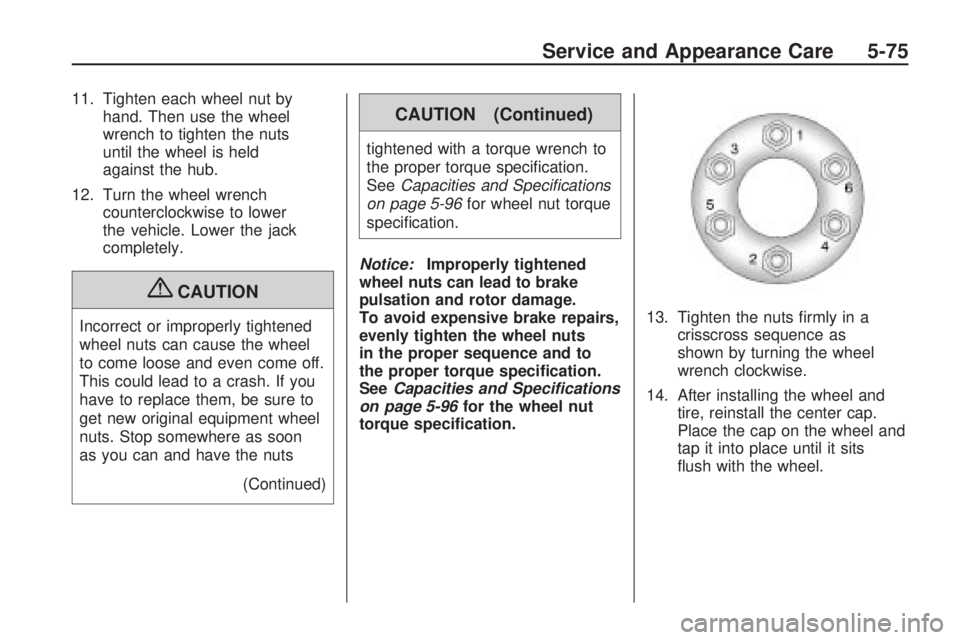
torque specication.13. Tighten the nuts rmly in a
crisscross sequence as
shown by turning the wheel
wrench clockwise.
14. After installing the wheel and
tire, reinstall the center cap.
Place the cap on the wheel and
tap it into place until it sits
ush with the wheel.
Service and Appearance Care 5-75
Page 330 of 382
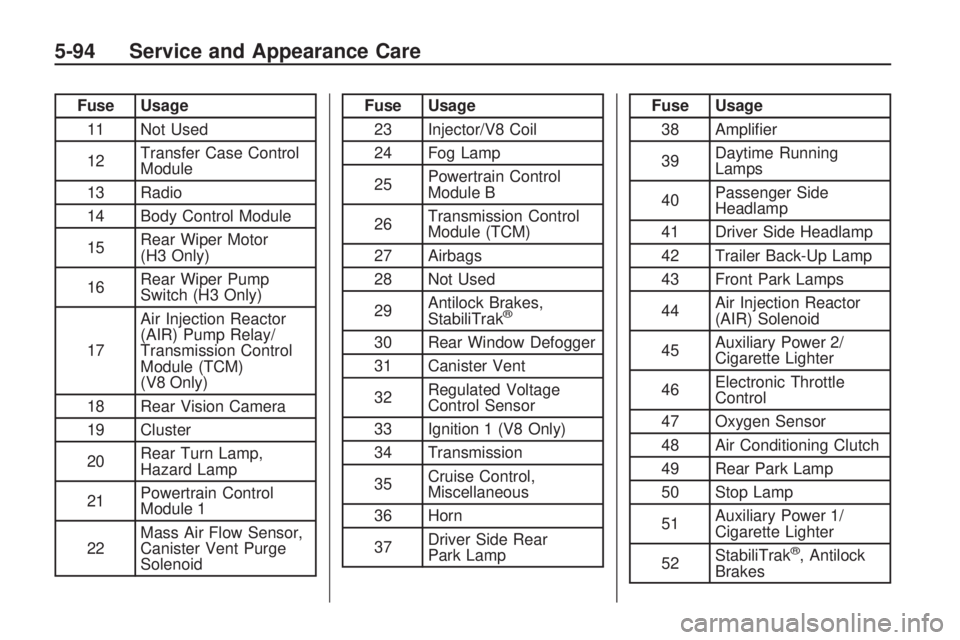
Fuse Usage
11 Not Used
12Transfer Case Control
Module
13 Radio
14 Body Control Module
15Rear Wiper Motor
(H3 Only)
16Rear Wiper Pump
Switch (H3 Only)
17Air Injection Reactor
(AIR) Pump Relay/
Transmission Control
Module (TCM)
(V8 Only)
18 Rear Vision Camera
19 Cluster
20Rear Turn Lamp,
Hazard Lamp
21Powertrain Control
Module 1
22Mass Air Flow Sensor,
Canister Vent Purge
SolenoidFuse Usage
23 Injector/V8 Coil
24 Fog Lamp
25Powertrain Control
Module B
26Transmission Control
Module (TCM)
27 Airbags
28 Not Used
29Antilock Brakes,
StabiliTrak
®
30 Rear Window Defogger
31 Canister Vent
32Regulated Voltage
Control Sensor
33 Ignition 1 (V8 Only)
34 Transmission
35Cruise Control,
Miscellaneous
36 Horn
37Driver Side Rear
Park Lamp
Fuse Usage
38 Amplier
39Daytime Running
Lamps
40Passenger Side
Headlamp
41 Driver Side Headlamp
42 Trailer Back-Up Lamp
43 Front Park Lamps
44Air Injection Reactor
(AIR) Solenoid
45Auxiliary Power 2/
Cigarette Lighter
46Electronic Throttle
Control
47 Oxygen Sensor
48 Air Conditioning Clutch
49 Rear Park Lamp
50 Stop Lamp
51Auxiliary Power 1/
Cigarette Lighter
52StabiliTrak
®, Antilock
Brakes
5-94 Service and Appearance Care
Page 331 of 382
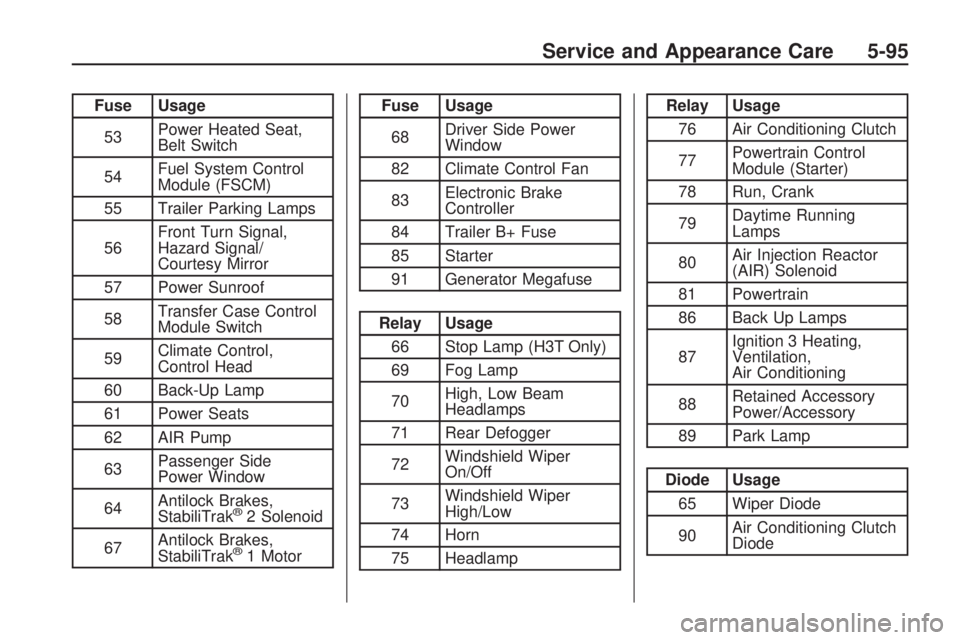
Fuse Usage
53Power Heated Seat,
Belt Switch
54Fuel System Control
Module (FSCM)
55 Trailer Parking Lamps
56Front Turn Signal,
Hazard Signal/
Courtesy Mirror
57 Power Sunroof
58Transfer Case Control
Module Switch
59Climate Control,
Control Head
60 Back-Up Lamp
61 Power Seats
62 AIR Pump
63Passenger Side
Power Window
64Antilock Brakes,
StabiliTrak
®2 Solenoid
67Antilock Brakes,
StabiliTrak
®1 Motor
Fuse Usage
68Driver Side Power
Window
82 Climate Control Fan
83Electronic Brake
Controller
84 Trailer B+ Fuse
85 Starter
91 Generator Megafuse
Relay Usage
66 Stop Lamp (H3T Only)
69 Fog Lamp
70High, Low Beam
Headlamps
71 Rear Defogger
72Windshield Wiper
On/Off
73Windshield Wiper
High/Low
74 Horn
75 Headlamp
Relay Usage
76 Air Conditioning Clutch
77Powertrain Control
Module (Starter)
78 Run, Crank
79Daytime Running
Lamps
80Air Injection Reactor
(AIR) Solenoid
81 Powertrain
86 Back Up Lamps
87Ignition 3 Heating,
Ventilation,
Air Conditioning
88Retained Accessory
Power/Accessory
89 Park Lamp
Diode Usage
65 Wiper Diode
90Air Conditioning Clutch
Diode
Service and Appearance Care 5-95
Page 339 of 382
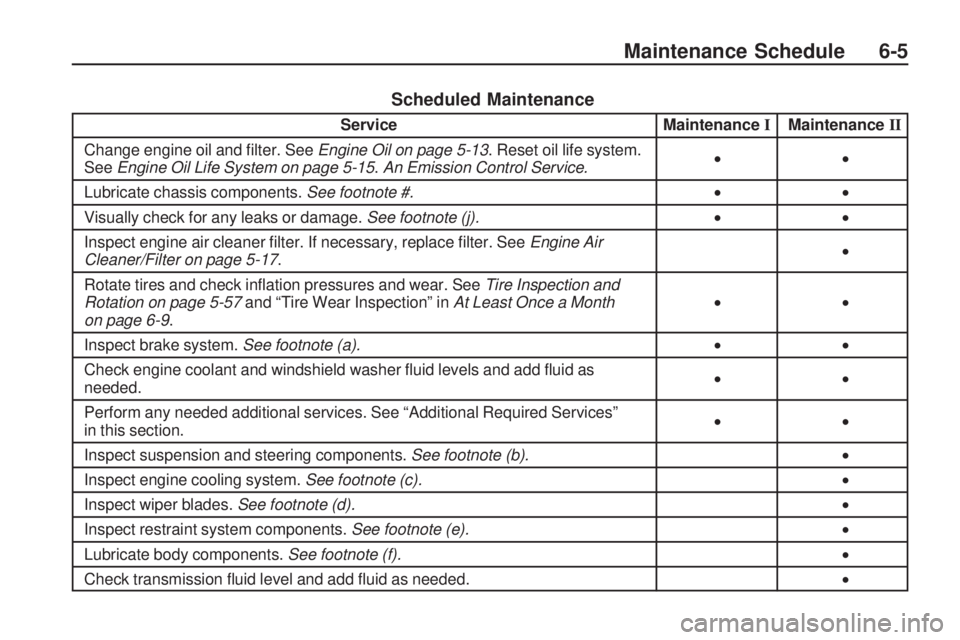
Scheduled Maintenance
ServiceMaintenanceIMaintenance II
Change engine oil and lter. See Engine Oil on page 5-13. Reset oil life system.
See Engine Oil Life System on page 5-15 .An Emission Control Service. ••
Lubricate chassis components. See footnote #. ••
Visually check for any leaks or damage. See footnote (j). ••
Inspect engine air cleaner lter. If necessary, replace lter. See Engine Air
Cleaner/Filter on page 5-17 . •
Rotate tires and check ination pressures and wear. See Tire Inspection and
Rotation on page 5-57 and “Tire Wear Inspection” in At Least Once a Month
on page 6-9. ••
Inspect brake system. See footnote (a). ••
Check engine coolant and windshield washer uid levels and add uid as
needed. ••
Perform any needed additional services. See “Additional Required Services”
in this section. ••
Inspect suspension and steering components. See footnote (b). •
Inspect engine cooling system. See footnote (c). •
Inspect wiper blades. See footnote (d). •
Inspect restraint system components. See footnote (e). •
Lubricate body components. See footnote (f). •
Check transmission uid level and add uid as needed. •
Maintenance Schedule 6-5
Page 341 of 382
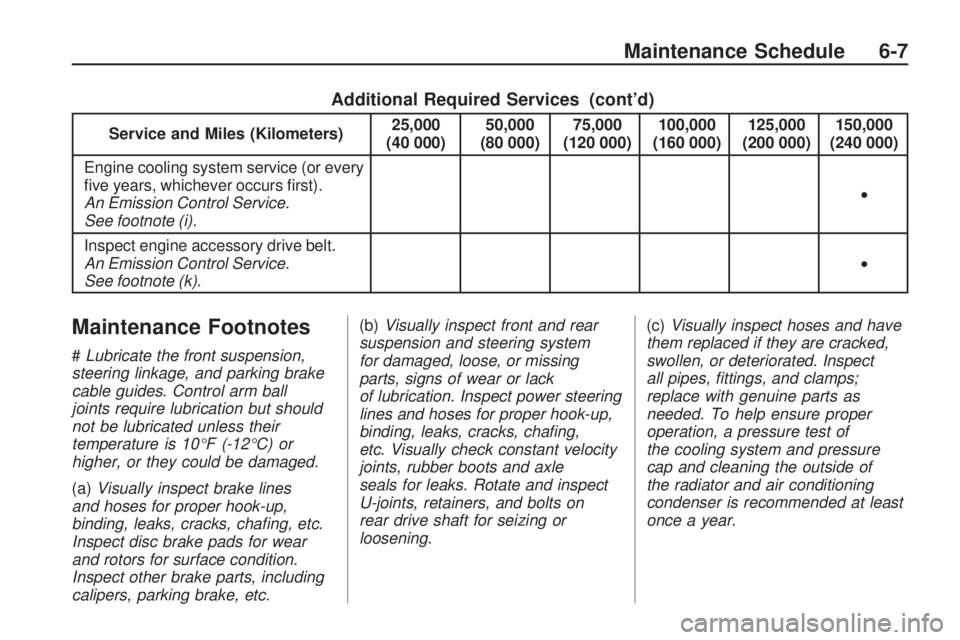
Additional Required Services (cont’d)
Service and Miles (Kilometers)25,000
(40 000) 50,000
(80 000) 75,000
(120 000) 100,000
(160 000) 125,000
(200 000) 150,000
(240 000)
Engine cooling system service (or every
ve years, whichever occurs rst).
An Emission Control Service.
See footnote (i). •
Inspect engine accessory drive belt.
An Emission Control Service.
See footnote (k). •
Maintenance Footnotes
#
Lubricate the front suspension,
steering linkage, and parking brake
cable guides. Control arm ball
joints require lubrication but should
not be lubricated unless their
temperature is 10°F (-12°C) or
higher, or they could be damaged.
(a) Visually inspect brake lines
and hoses for proper hook-up,
binding, leaks, cracks, chafing, etc.
Inspect disc brake pads for wear
and rotors for surface condition.
Inspect other brake parts, including
calipers, parking brake, etc. (b)
Visually inspect front and rear
suspension and steering system
for damaged, loose, or missing
parts, signs of wear or lack
of lubrication. Inspect power steering
lines and hoses for proper hook-up,
binding, leaks, cracks, chafing,
etc. Visually check constant velocity
joints, rubber boots and axle
seals for leaks. Rotate and inspect
U-joints, retainers, and bolts on
rear drive shaft for seizing or
loosening. (c)
Visually inspect hoses and have
them replaced if they are cracked,
swollen, or deteriorated. Inspect
all pipes, fittings, and clamps;
replace with genuine parts as
needed. To help ensure proper
operation, a pressure test of
the cooling system and pressure
cap and cleaning the outside of
the radiator and air conditioning
condenser is recommended at least
once a year.
Maintenance Schedule 6-7
Page 344 of 382
At Least Once a Year
Starter Switch Check
{CAUTION
When you are doing this
inspection, the vehicle could move
suddenly. If the vehicle moves,
you or others could be injured.
1. Before starting this check, be
sure there is enough room
around the vehicle.
2. Firmly apply both the parking
brake and the regular brake.
SeeParking Brake on page 2-28.
Do not use the accelerator
pedal, and be ready to turn off
the engine immediately if it starts.3. For automatic transmission
vehicles, try to start the engine
in each gear. The vehicle
should start only in P (Park) or
N (Neutral). If the vehicle starts
in any other position, contact
your dealer/retailer for service.
For manual transmission
vehicles, put the shift lever in
Neutral, push the clutch
pedal down halfway, and try to
start the engine. The vehicle
should start only when the clutch
pedal is pushed down all the
way to the oor. If the vehicle
starts when the clutch pedal
is not pushed all the way down,
contact your dealer/retailer
for service.
Automatic Transmission Shift
Lock Control System Check
{CAUTION
When you are doing this
inspection, the vehicle could move
suddenly. If the vehicle moves,
you or others could be injured.
1. Before starting this check, be
sure there is enough room
around the vehicle. It should be
parked on a level surface.
2. Firmly apply the parking brake.
SeeParking Brake on page 2-28.
Be ready to apply the regular
brake immediately if the vehicle
begins to move.
3. With the engine off, turn the
ignition to ON/RUN, but do not
start the engine. Without applying
the regular brake, try to move
the shift lever out of P (Park) with
normal effort. If the shift lever
moves out of P (Park), contact
your dealer/retailer for service.
6-10 Maintenance Schedule
Page 345 of 382
Ignition Transmission Lock
Check
While parked, and with the parking
brake set, try to turn the ignition
to LOCK/OFF in each shift lever
position.
For automatic transmission
vehicles, the ignition should turn
to LOCK/OFF only when the
shift lever is in P (Park).
The ignition key should
come out only in LOCK/OFF.
For manual transmission
vehicles, the ignition key should
come out only in LOCK/OFF.
Contact your dealer/retailer if service
is required.
Parking Brake and Automatic
Transmission P (Park)
Mechanism Check
{CAUTION
When you are doing this check,
the vehicle could begin to move.
You or others could be injured
and property could be damaged.
Make sure there is room in front
of the vehicle in case it begins to
roll. Be ready to apply the regular
brake at once should the vehicle
begin to move.
Park on a fairly steep hill, with the
vehicle facing downhill. Keeping
your foot on the regular brake, set
the parking brake.
To check the parking brake’s
holding ability: With the engine
running and transmission in
N (Neutral), slowly remove footpressure from the regular brake
pedal. Do this until the vehicle
is held by the parking brake only.
To check the P (Park)
mechanism’s holding ability:
With the engine running, shift to
P (Park). Then release the
parking brake followed by the
regular brake.
Contact your dealer/retailer if
service is required.
Underbody Flushing Service
At least every spring, use plain
water to ush any corrosive
materials from the underbody.
Take care to clean thoroughly
any areas where mud and other
debris can collect.
Maintenance Schedule 6-11