clock HUMMER H3 2010 User Guide
[x] Cancel search | Manufacturer: HUMMER, Model Year: 2010, Model line: H3, Model: HUMMER H3 2010Pages: 410, PDF Size: 2.24 MB
Page 252 of 410
9-68 Driving and Operating
Filling the Tank
{WARNING
Fuel vapor burns violently and a
fuel fire can cause bad injuries.
To help avoid injuries to you and
others, read and follow all the
instructions on the fuel pump
island. Turn off the engine when
refueling. Do not smoke near fuel
or when refueling the vehicle. Do
not use cellular phones. Keep
sparks, flames, and smoking
materials away from fuel. Do not
leave the fuel pump unattended
when refueling the vehicle. This is
against the law in some places.
Do not re-enter the vehicle while
pumping fuel. Keep children away
from the fuel pump; never let
children pump fuel.
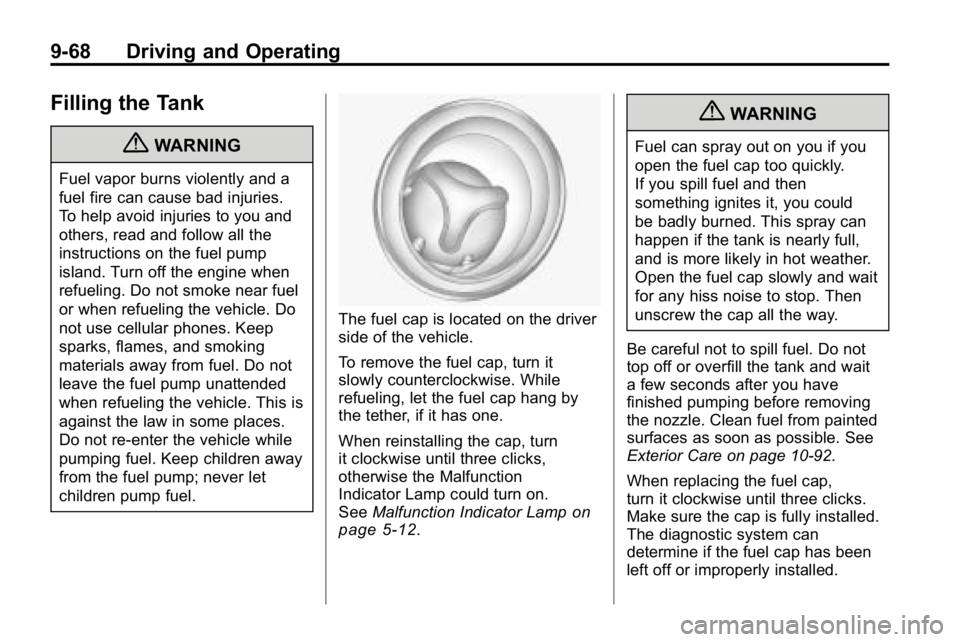
The fuel cap is located on the driver
side of the vehicle.
To remove the fuel cap, turn it
slowly counterclockwise. While
refueling, let the fuel cap hang by
the tether, if it has one.
When reinstalling the cap, turn
it clockwise until three clicks,
otherwise the Malfunction
Indicator Lamp could turn on.
SeeMalfunction Indicator Lamp
on
page 5‑12.
{WARNING
Fuel can spray out on you if you
open the fuel cap too quickly.
If you spill fuel and then
something ignites it, you could
be badly burned. This spray can
happen if the tank is nearly full,
and is more likely in hot weather.
Open the fuel cap slowly and wait
for any hiss noise to stop. Then
unscrew the cap all the way.
Be careful not to spill fuel. Do not
top off or overfill the tank and wait
a few seconds after you have
finished pumping before removing
the nozzle. Clean fuel from painted
surfaces as soon as possible. See
Exterior Care on page 10‑92.
When replacing the fuel cap,
turn it clockwise until three clicks.
Make sure the cap is fully installed.
The diagnostic system can
determine if the fuel cap has been
left off or improperly installed.
Page 287 of 410
Vehicle Care 10-21
{WARNING
Steam and scalding liquids from
a hot cooling system can blow
out and burn you badly. They
are under pressure, and if you
turn the surge tank pressure
cap—even a little —they can
come out at high speed. Never
turn the cap when the cooling
system, including the surge tank
pressure cap, is hot. Wait for the
cooling system and surge tank
pressure cap to cool if you ever
have to turn the pressure cap.
If coolant is needed, add the proper
mixture directly to the radiator, but
be sure the cooling system is cool
before this is done.
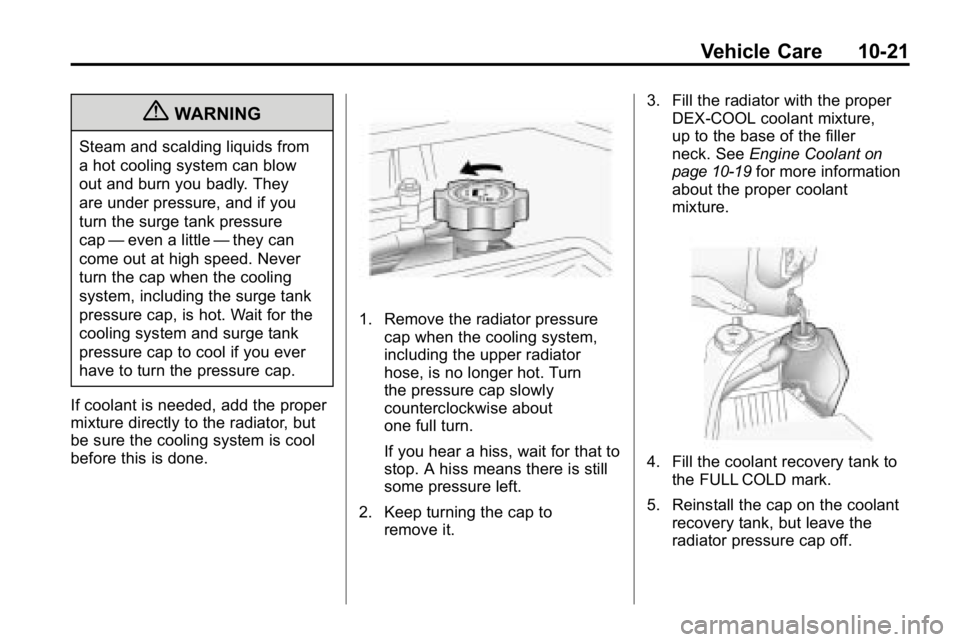
1. Remove the radiator pressure cap when the cooling system,
including the upper radiator
hose, is no longer hot. Turn
the pressure cap slowly
counterclockwise about
one full turn.
If you hear a hiss, wait for that to
stop. A hiss means there is still
some pressure left.
2. Keep turning the cap to remove it. 3. Fill the radiator with the proper
DEX‐COOL coolant mixture,
up to the base of the filler
neck. See Engine Coolant
on
page 10‑19for more information
about the proper coolant
mixture.
4. Fill the coolant recovery tank to
the FULL COLD mark.
5. Reinstall the cap on the coolant recovery tank, but leave the
radiator pressure cap off.
Page 300 of 410
10-34 Vehicle Care
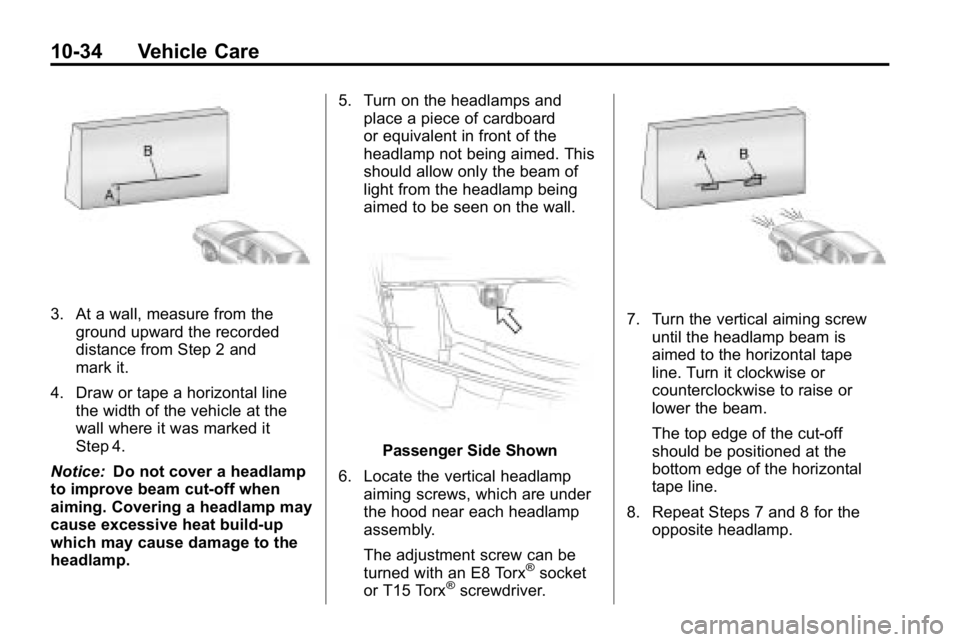
3. At a wall, measure from theground upward the recorded
distance from Step 2 and
mark it.
4. Draw or tape a horizontal line the width of the vehicle at the
wall where it was marked it
Step 4.
Notice: Do not cover a headlamp
to improve beam cut-off when
aiming. Covering a headlamp may
cause excessive heat build-up
which may cause damage to the
headlamp. 5. Turn on the headlamps and
place a piece of cardboard
or equivalent in front of the
headlamp not being aimed. This
should allow only the beam of
light from the headlamp being
aimed to be seen on the wall.
Passenger Side Shown
6. Locate the vertical headlamp aiming screws, which are under
the hood near each headlamp
assembly.
The adjustment screw can be
turned with an E8 Torx
®socket
or T15 Torx®screwdriver.
7. Turn the vertical aiming screw
until the headlamp beam is
aimed to the horizontal tape
line. Turn it clockwise or
counterclockwise to raise or
lower the beam.
The top edge of the cut-off
should be positioned at the
bottom edge of the horizontal
tape line.
8. Repeat Steps 7 and 8 for the opposite headlamp.
Page 301 of 410
Vehicle Care 10-35
Bulb Replacement
For the proper type of replacement
bulbs, seeReplacement Bulbson
page 10‑37.
For any bulb changing procedure
not listed in this section, contact
your dealer.
Halogen Bulbs
{WARNING
Halogen bulbs have pressurized
gas inside and can burst if you
drop or scratch the bulb. You or
others could be injured. Be sure
to read and follow the instructions
on the bulb package.
Headlamps
To replace a headlamp bulb:
1. Open the hood. See Hood
on
page 10‑5for more information.
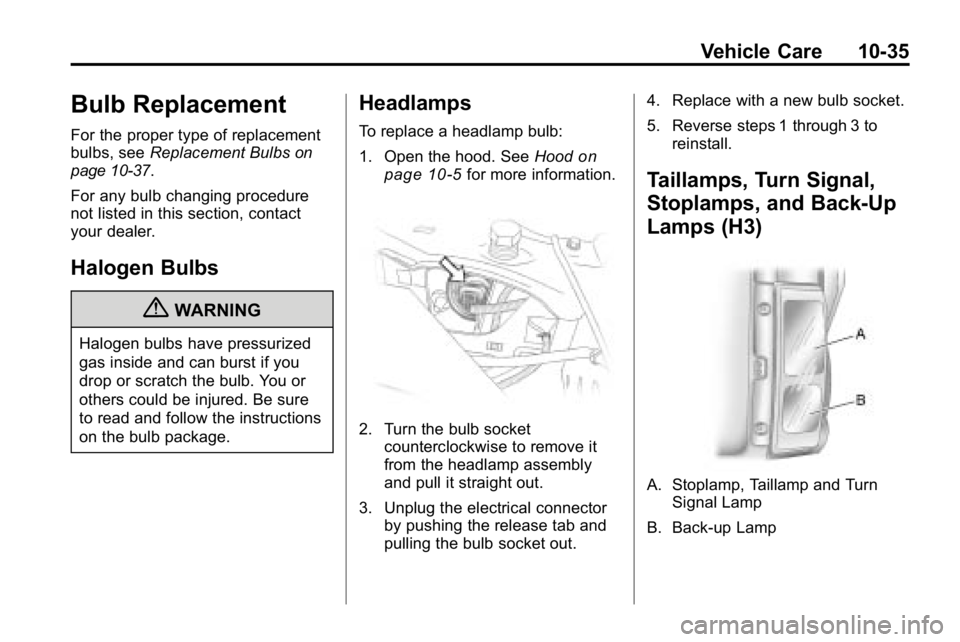
2. Turn the bulb socket counterclockwise to remove it
from the headlamp assembly
and pull it straight out.
3. Unplug the electrical connector by pushing the release tab and
pulling the bulb socket out. 4. Replace with a new bulb socket.
5. Reverse steps 1 through 3 to
reinstall.
Taillamps, Turn Signal,
Stoplamps, and Back-Up
Lamps (H3)
A. Stoplamp, Taillamp and TurnSignal Lamp
B. Back-up Lamp
Page 302 of 410
10-36 Vehicle Care
To replace one of these bulbs in the
taillamp assembly:
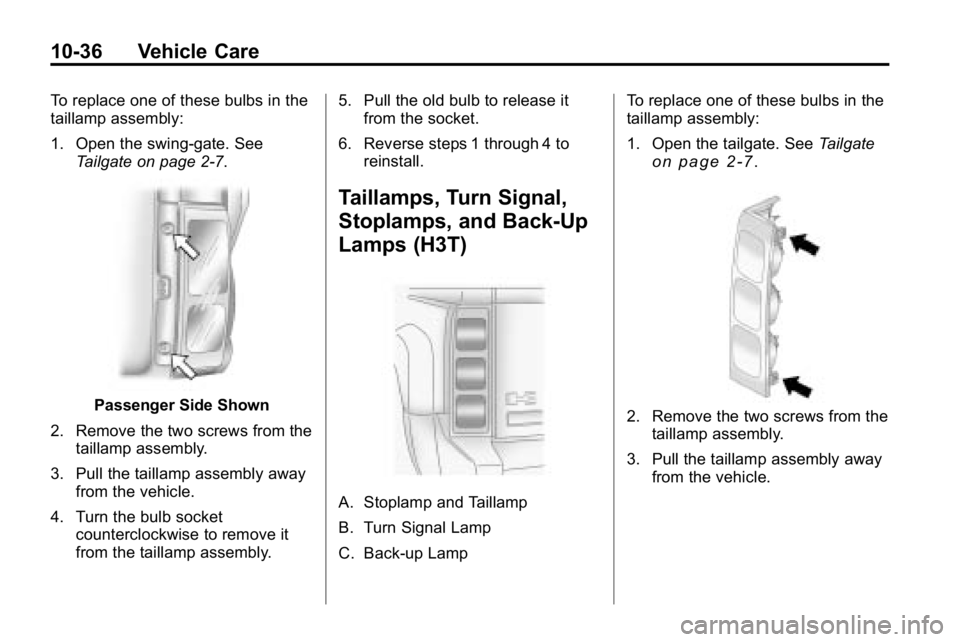
1. Open the swing-gate. SeeTailgate on page 2‑7.
Passenger Side Shown
2. Remove the two screws from the taillamp assembly.
3. Pull the taillamp assembly away from the vehicle.
4. Turn the bulb socket counterclockwise to remove it
from the taillamp assembly. 5. Pull the old bulb to release it
from the socket.
6. Reverse steps 1 through 4 to reinstall.
Taillamps, Turn Signal,
Stoplamps, and Back-Up
Lamps (H3T)
A. Stoplamp and Taillamp
B. Turn Signal Lamp
C. Back-up Lamp To replace one of these bulbs in the
taillamp assembly:
1. Open the tailgate. See
Tailgate
on page 2‑7.
2. Remove the two screws from the
taillamp assembly.
3. Pull the taillamp assembly away from the vehicle.
Page 303 of 410
Vehicle Care 10-37
4. Turn the bulb socketcounterclockwise to remove it
from the taillamp assembly.
5. Pull the old bulb to release it from the socket.
6. Turn the bulb socket clockwise to reinstall in the taillamp
assembly.
7. Reinstall the taillamp assembly making sure to line up the pins
with the vehicle.
8. Reinstall the two screws.License Plate Lamp
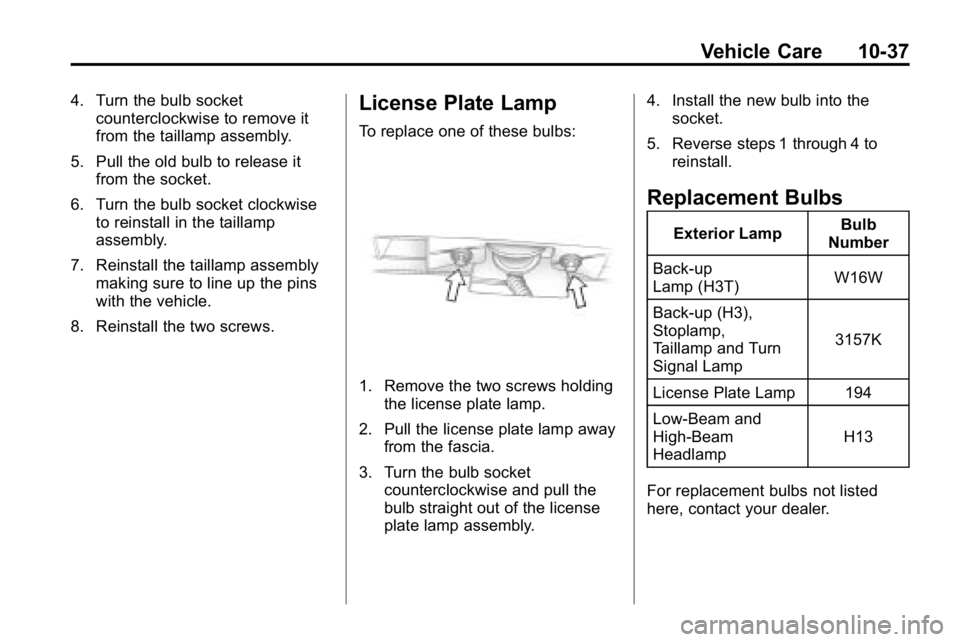
To replace one of these bulbs:
1. Remove the two screws holding the license plate lamp.
2. Pull the license plate lamp away from the fascia.
3. Turn the bulb socket counterclockwise and pull the
bulb straight out of the license
plate lamp assembly. 4. Install the new bulb into the
socket.
5. Reverse steps 1 through 4 to reinstall.
Replacement Bulbs
Exterior Lamp Bulb
Number
Back-up
Lamp (H3T) W16W
Back-up (H3),
Stoplamp,
Taillamp and Turn
Signal Lamp 3157K
License Plate Lamp 194
Low-Beam and
High-Beam
Headlamp H13
For replacement bulbs not listed
here, contact your dealer.
Page 332 of 410
10-66 Vehicle Care
SeeTire Changing (H3T)on
page 10‑66or Tire Changing (H3)on page 10‑75for more information.
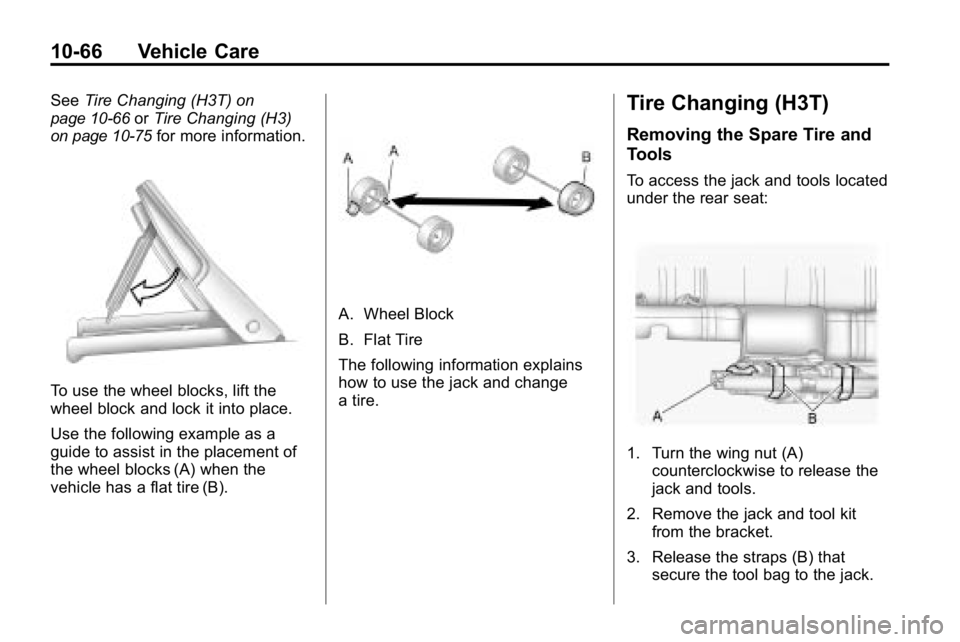
To use the wheel blocks, lift the
wheel block and lock it into place.
Use the following example as a
guide to assist in the placement of
the wheel blocks (A) when the
vehicle has a flat tire (B).
A. Wheel Block
B. Flat Tire
The following information explains
how to use the jack and change
a tire.
Tire Changing (H3T)
Removing the Spare Tire and
Tools
To access the jack and tools located
under the rear seat:
1. Turn the wing nut (A)
counterclockwise to release the
jack and tools.
2. Remove the jack and tool kit from the bracket.
3. Release the straps (B) that secure the tool bag to the jack.
Page 334 of 410
10-68 Vehicle Care
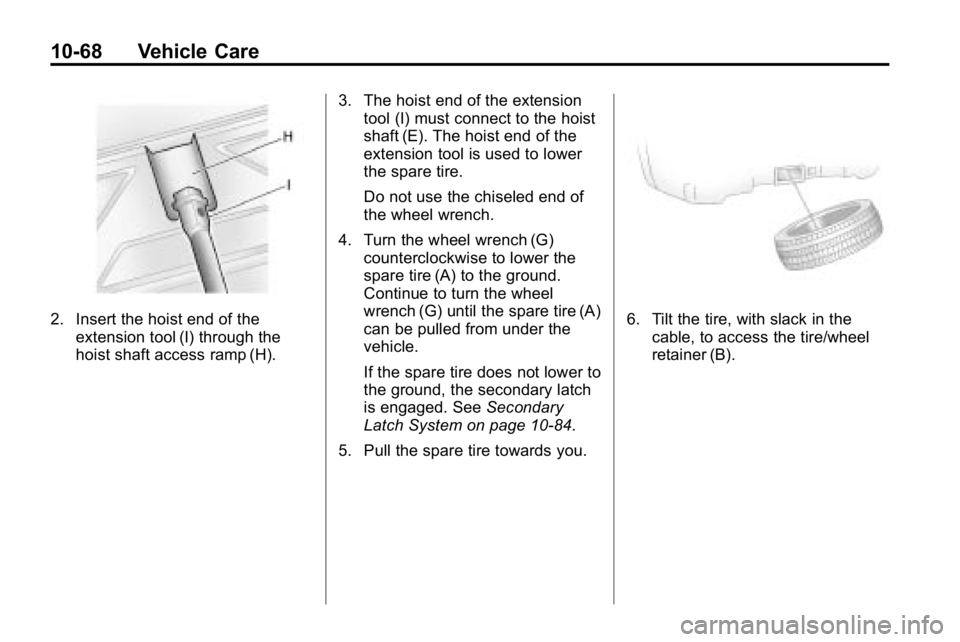
2. Insert the hoist end of theextension tool (I) through the
hoist shaft access ramp (H). 3. The hoist end of the extension
tool (I) must connect to the hoist
shaft (E). The hoist end of the
extension tool is used to lower
the spare tire.
Do not use the chiseled end of
the wheel wrench.
4. Turn the wheel wrench (G) counterclockwise to lower the
spare tire (A) to the ground.
Continue to turn the wheel
wrench (G) until the spare tire (A)
can be pulled from under the
vehicle.
If the spare tire does not lower to
the ground, the secondary latch
is engaged. See Secondary
Latch System on page 10‑84.
5. Pull the spare tire towards you.6. Tilt the tire, with slack in the cable, to access the tire/wheel
retainer (B).
Page 335 of 410
Vehicle Care 10-69
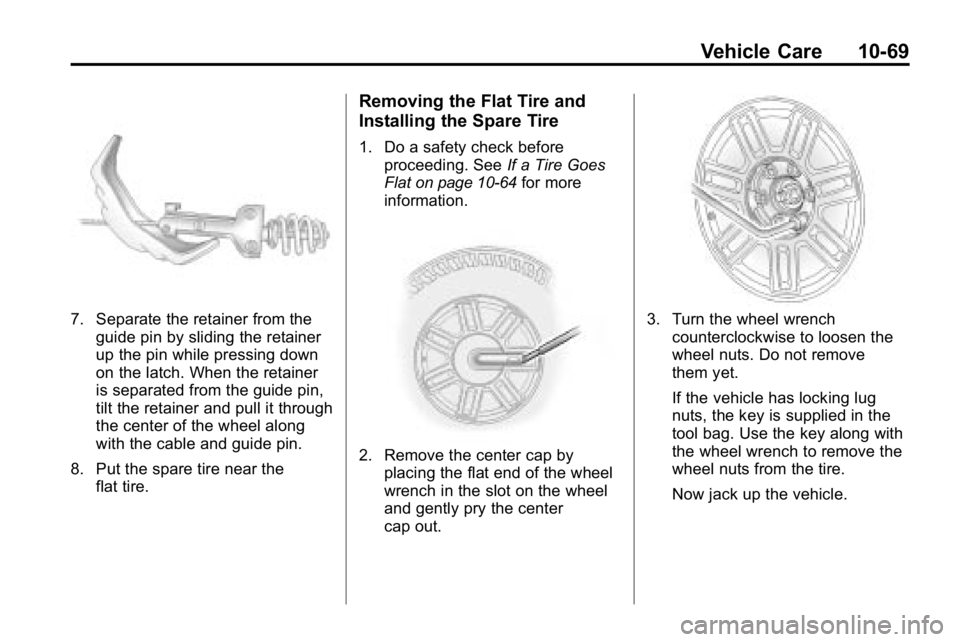
7. Separate the retainer from theguide pin by sliding the retainer
up the pin while pressing down
on the latch. When the retainer
is separated from the guide pin,
tilt the retainer and pull it through
the center of the wheel along
with the cable and guide pin.
8. Put the spare tire near the flat tire.
Removing the Flat Tire and
Installing the Spare Tire
1. Do a safety check before
proceeding. See If a Tire Goes
Flat
on page 10‑64for more
information.
2. Remove the center cap by placing the flat end of the wheel
wrench in the slot on the wheel
and gently pry the center
cap out.
3. Turn the wheel wrench
counterclockwise to loosen the
wheel nuts. Do not remove
them yet.
If the vehicle has locking lug
nuts, the key is supplied in the
tool bag. Use the key along with
the wheel wrench to remove the
wheel nuts from the tire.
Now jack up the vehicle.
Page 336 of 410
10-70 Vehicle Care
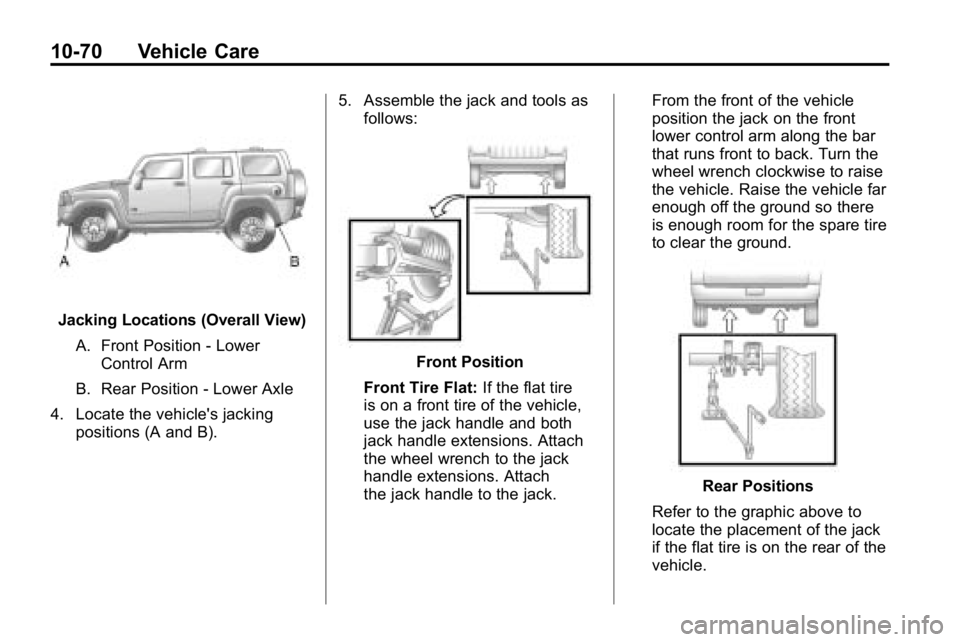
Jacking Locations (Overall View)A. Front Position - Lower Control Arm
B. Rear Position - Lower Axle
4. Locate the vehicle's jacking positions (A and B). 5. Assemble the jack and tools as
follows:
Front Position
Front Tire Flat: If the flat tire
is on a front tire of the vehicle,
use the jack handle and both
jack handle extensions. Attach
the wheel wrench to the jack
handle extensions. Attach
the jack handle to the jack. From the front of the vehicle
position the jack on the front
lower control arm along the bar
that runs front to back. Turn the
wheel wrench clockwise to raise
the vehicle. Raise the vehicle far
enough off the ground so there
is enough room for the spare tire
to clear the ground.
Rear Positions
Refer to the graphic above to
locate the placement of the jack
if the flat tire is on the rear of the
vehicle.