flat tire HUMMER H3 2010 Owner's Guide
[x] Cancel search | Manufacturer: HUMMER, Model Year: 2010, Model line: H3, Model: HUMMER H3 2010Pages: 410, PDF Size: 2.24 MB
Page 336 of 410
10-70 Vehicle Care
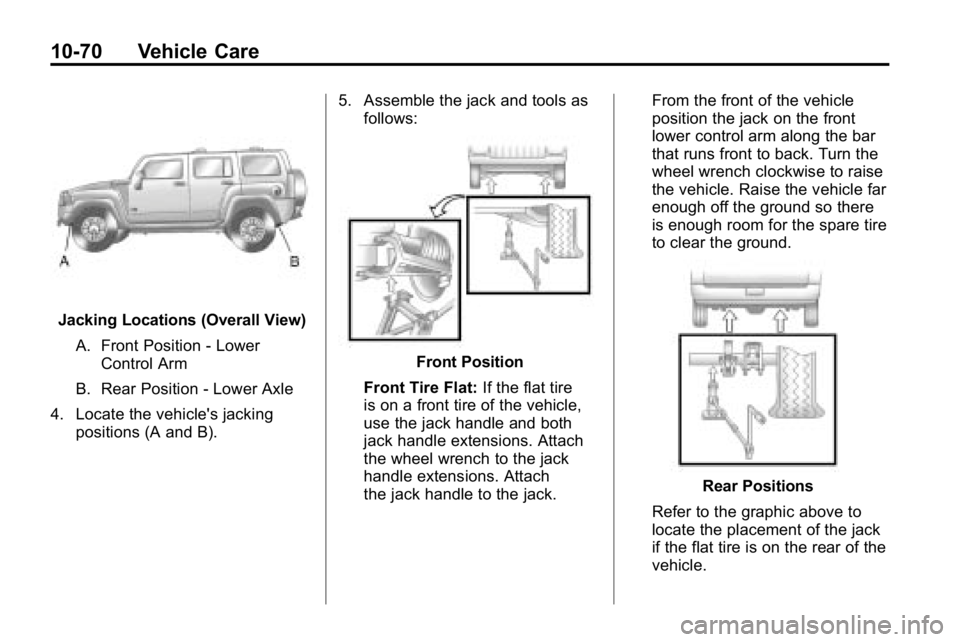
Jacking Locations (Overall View)A. Front Position - Lower Control Arm
B. Rear Position - Lower Axle
4. Locate the vehicle's jacking positions (A and B). 5. Assemble the jack and tools as
follows:
Front Position
Front Tire Flat: If the flat tire
is on a front tire of the vehicle,
use the jack handle and both
jack handle extensions. Attach
the wheel wrench to the jack
handle extensions. Attach
the jack handle to the jack. From the front of the vehicle
position the jack on the front
lower control arm along the bar
that runs front to back. Turn the
wheel wrench clockwise to raise
the vehicle. Raise the vehicle far
enough off the ground so there
is enough room for the spare tire
to clear the ground.
Rear Positions
Refer to the graphic above to
locate the placement of the jack
if the flat tire is on the rear of the
vehicle.
Page 337 of 410
Vehicle Care 10-71
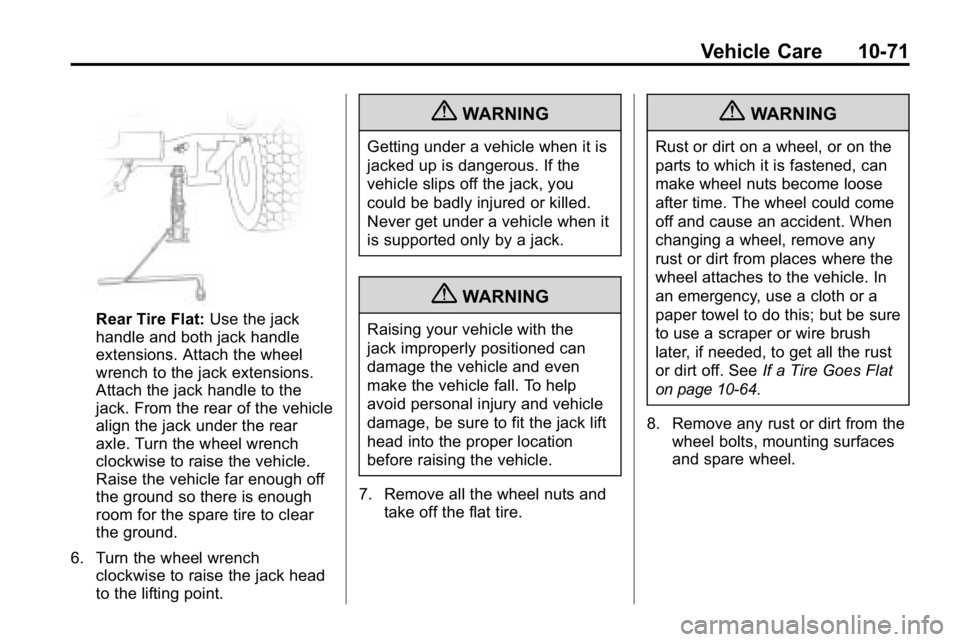
Rear Tire Flat:Use the jack
handle and both jack handle
extensions. Attach the wheel
wrench to the jack extensions.
Attach the jack handle to the
jack. From the rear of the vehicle
align the jack under the rear
axle. Turn the wheel wrench
clockwise to raise the vehicle.
Raise the vehicle far enough off
the ground so there is enough
room for the spare tire to clear
the ground.
6. Turn the wheel wrench clockwise to raise the jack head
to the lifting point.
{WARNING
Getting under a vehicle when it is
jacked up is dangerous. If the
vehicle slips off the jack, you
could be badly injured or killed.
Never get under a vehicle when it
is supported only by a jack.
{WARNING
Raising your vehicle with the
jack improperly positioned can
damage the vehicle and even
make the vehicle fall. To help
avoid personal injury and vehicle
damage, be sure to fit the jack lift
head into the proper location
before raising the vehicle.
7. Remove all the wheel nuts and take off the flat tire.
{WARNING
Rust or dirt on a wheel, or on the
parts to which it is fastened, can
make wheel nuts become loose
after time. The wheel could come
off and cause an accident. When
changing a wheel, remove any
rust or dirt from places where the
wheel attaches to the vehicle. In
an emergency, use a cloth or a
paper towel to do this; but be sure
to use a scraper or wire brush
later, if needed, to get all the rust
or dirt off. See If a Tire Goes Flat
on page 10‑64.
8. Remove any rust or dirt from the wheel bolts, mounting surfaces
and spare wheel.
Page 339 of 410
Vehicle Care 10-73
Storing a Flat or Spare Tire
and Tools
{WARNING
Storing a jack, a tire, or other
equipment in the passenger
compartment of the vehicle could
cause injury. In a sudden stop or
collision, loose equipment could
strike someone. Store all these in
the proper place.
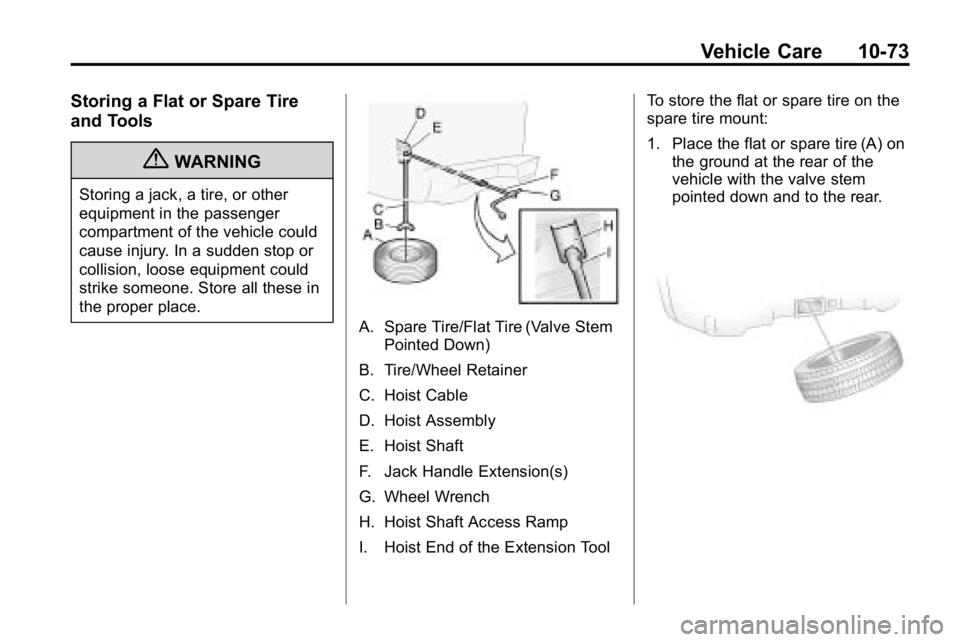
A. Spare Tire/Flat Tire (Valve StemPointed Down)
B. Tire/Wheel Retainer
C. Hoist Cable
D. Hoist Assembly
E. Hoist Shaft
F. Jack Handle Extension(s)
G. Wheel Wrench
H. Hoist Shaft Access Ramp
I. Hoist End of the Extension Tool To store the flat or spare tire on the
spare tire mount:
1. Place the flat or spare tire (A) on
the ground at the rear of the
vehicle with the valve stem
pointed down and to the rear.
Page 342 of 410
10-76 Vehicle Care
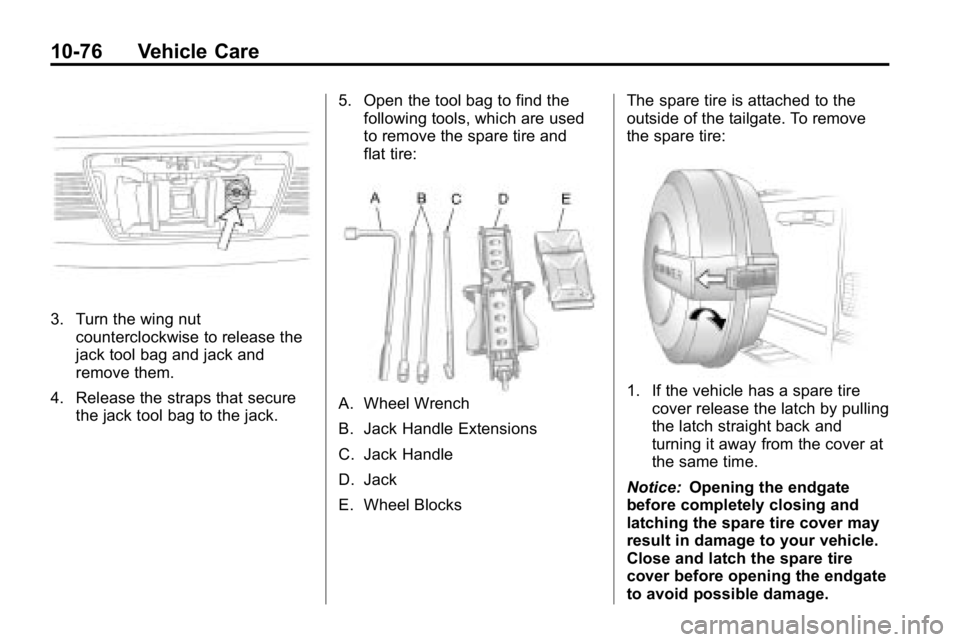
3. Turn the wing nutcounterclockwise to release the
jack tool bag and jack and
remove them.
4. Release the straps that secure the jack tool bag to the jack. 5. Open the tool bag to find the
following tools, which are used
to remove the spare tire and
flat tire:
A. Wheel Wrench
B. Jack Handle Extensions
C. Jack Handle
D. Jack
E. Wheel Blocks The spare tire is attached to the
outside of the tailgate. To remove
the spare tire:1. If the vehicle has a spare tire
cover release the latch by pulling
the latch straight back and
turning it away from the cover at
the same time.
Notice: Opening the endgate
before completely closing and
latching the spare tire cover may
result in damage to your vehicle.
Close and latch the spare tire
cover before opening the endgate
to avoid possible damage.
Page 343 of 410
Vehicle Care 10-77
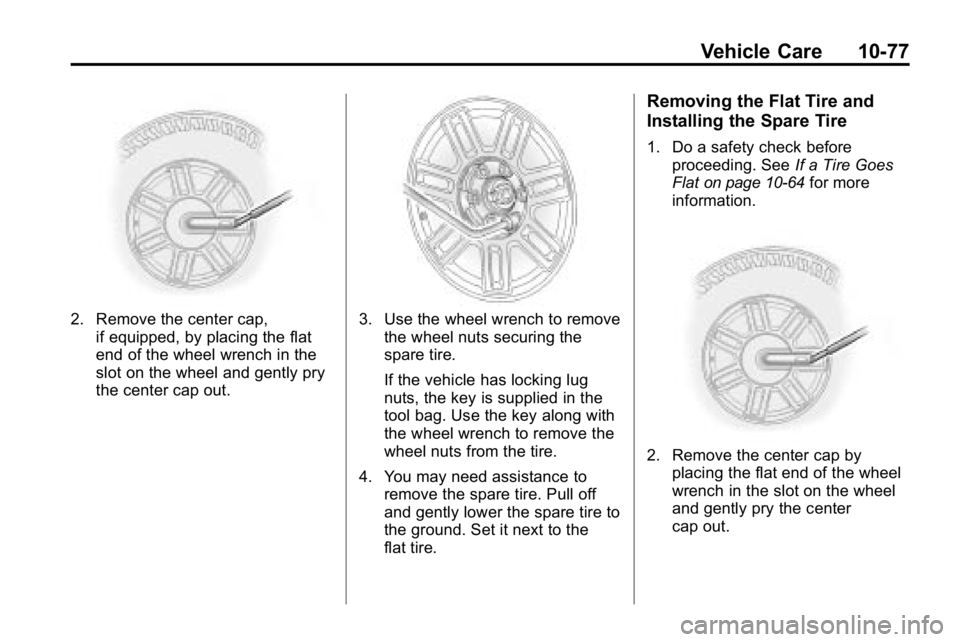
2. Remove the center cap,if equipped, by placing the flat
end of the wheel wrench in the
slot on the wheel and gently pry
the center cap out.3. Use the wheel wrench to removethe wheel nuts securing the
spare tire.
If the vehicle has locking lug
nuts, the key is supplied in the
tool bag. Use the key along with
the wheel wrench to remove the
wheel nuts from the tire.
4. You may need assistance to remove the spare tire. Pull off
and gently lower the spare tire to
the ground. Set it next to the
flat tire.
Removing the Flat Tire and
Installing the Spare Tire
1. Do a safety check before
proceeding. See If a Tire Goes
Flat
on page 10‑64for more
information.
2. Remove the center cap by placing the flat end of the wheel
wrench in the slot on the wheel
and gently pry the center
cap out.
Page 344 of 410
10-78 Vehicle Care
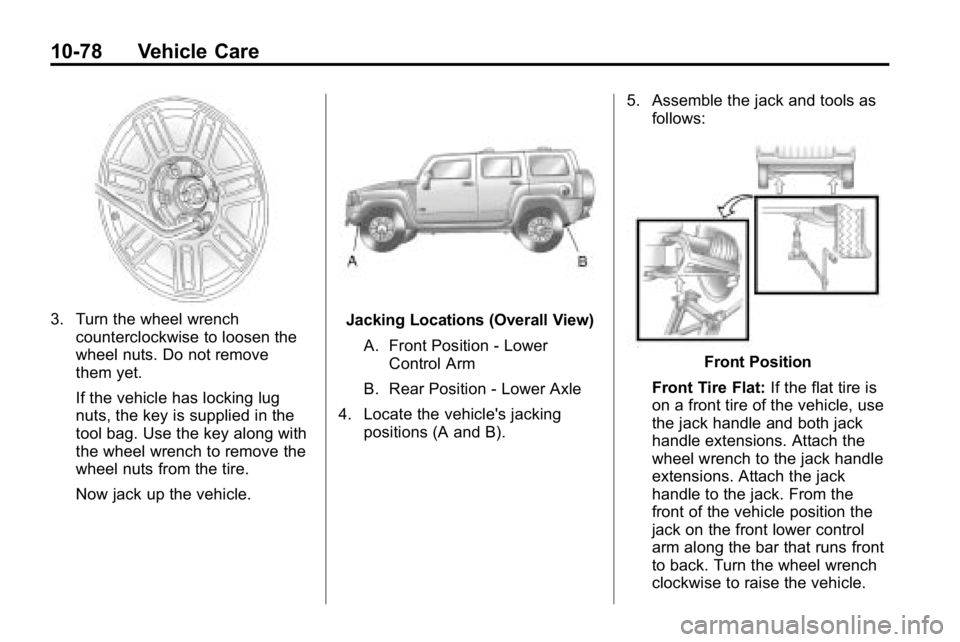
3. Turn the wheel wrenchcounterclockwise to loosen the
wheel nuts. Do not remove
them yet.
If the vehicle has locking lug
nuts, the key is supplied in the
tool bag. Use the key along with
the wheel wrench to remove the
wheel nuts from the tire.
Now jack up the vehicle.Jacking Locations (Overall View)
A. Front Position - Lower Control Arm
B. Rear Position - Lower Axle
4. Locate the vehicle's jacking positions (A and B). 5. Assemble the jack and tools as
follows:
Front Position
Front Tire Flat: If the flat tire is
on a front tire of the vehicle, use
the jack handle and both jack
handle extensions. Attach the
wheel wrench to the jack handle
extensions. Attach the jack
handle to the jack. From the
front of the vehicle position the
jack on the front lower control
arm along the bar that runs front
to back. Turn the wheel wrench
clockwise to raise the vehicle.
Page 345 of 410
Vehicle Care 10-79
Raise the vehicle far enough off
the ground so there is enough
room for the spare tire to clear
the ground.
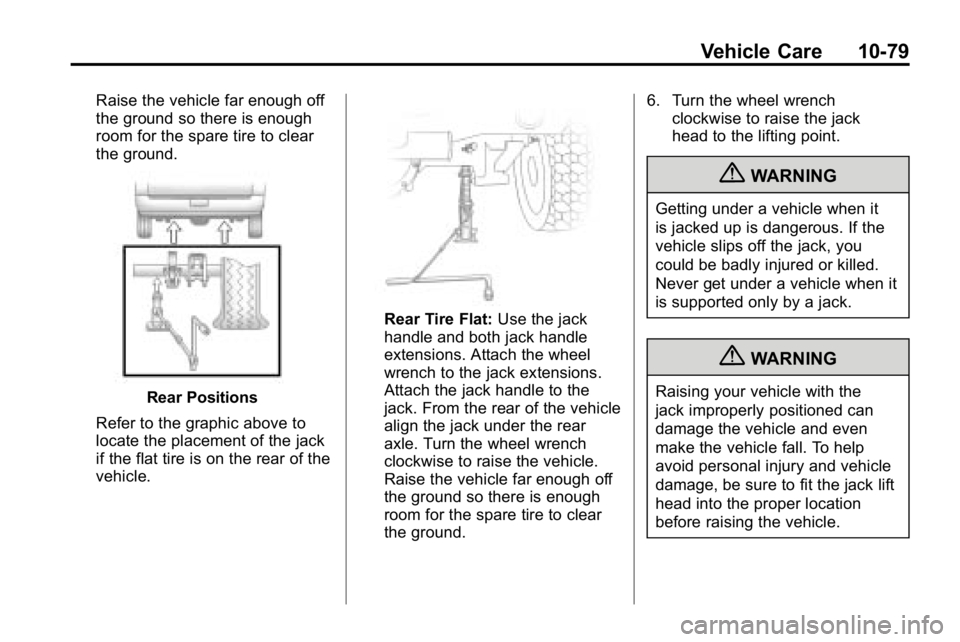
Rear Positions
Refer to the graphic above to
locate the placement of the jack
if the flat tire is on the rear of the
vehicle.
Rear Tire Flat: Use the jack
handle and both jack handle
extensions. Attach the wheel
wrench to the jack extensions.
Attach the jack handle to the
jack. From the rear of the vehicle
align the jack under the rear
axle. Turn the wheel wrench
clockwise to raise the vehicle.
Raise the vehicle far enough off
the ground so there is enough
room for the spare tire to clear
the ground. 6. Turn the wheel wrench
clockwise to raise the jack
head to the lifting point.
{WARNING
Getting under a vehicle when it
is jacked up is dangerous. If the
vehicle slips off the jack, you
could be badly injured or killed.
Never get under a vehicle when it
is supported only by a jack.
{WARNING
Raising your vehicle with the
jack improperly positioned can
damage the vehicle and even
make the vehicle fall. To help
avoid personal injury and vehicle
damage, be sure to fit the jack lift
head into the proper location
before raising the vehicle.
Page 346 of 410

10-80 Vehicle Care
7. Remove all the wheel nuts andtake off the flat tire.
{WARNING
Rust or dirt on a wheel, or on the
parts to which it is fastened, can
make wheel nuts become loose
after time. The wheel could come
off and cause an accident. When
changing a wheel, remove any
rust or dirt from places where the
wheel attaches to the vehicle. In
an emergency, use a cloth or a
paper towel to do this; but be sure
to use a scraper or wire brush
later, if needed, to get all the rust
or dirt off. See If a Tire Goes Flat
on page 10‑64. 8. Remove any rust or dirt from the
wheel bolts, mounting surfaces
and spare wheel.
{WARNING
Never use oil or grease on bolts
or nuts because the nuts might
come loose. The vehicle's wheel
could fall off, causing a crash.
9. Put the spare tire on the mounting surface.
10. Put the wheel nuts back on with the rounded end of the
nuts toward the wheel after
mounting the spare. 11. Tighten each wheel nut by
hand. Then use the wheel
wrench to tighten the nuts until
the wheel is held against
the hub.
12. Turn the wheel wrench counterclockwise to lower
the vehicle. Lower the jack
completely.
Page 348 of 410
10-82 Vehicle Care
Storing a Flat or Spare Tire
and Tools
{WARNING
Storing a jack, a tire, or other
equipment in the passenger
compartment of the vehicle could
cause injury. In a sudden stop or
collision, loose equipment could
strike someone. Store all these in
the proper place.
To store the flat or spare tire on the
spare tire mount:
1. Slide the flat or spare tire onto the swing-gate.
You may need assistance to
do this.
2. Reinstall the nuts to retain the flat or spare tire.
3. Tighten the nuts by hand.
{WARNING
Wheel nuts that are improperly or
incorrectly tightened can cause
the wheels to become loose or
come off. The wheel nuts should
be tightened with a torque wrench
to the proper torque specification
after replacing. Follow the torque
specification supplied by the
aftermarket manufacturer when
using accessory locking wheel
nuts. See Capacities and
Specifications
on page 12‑2for
original equipment wheel nut
torque specifications.
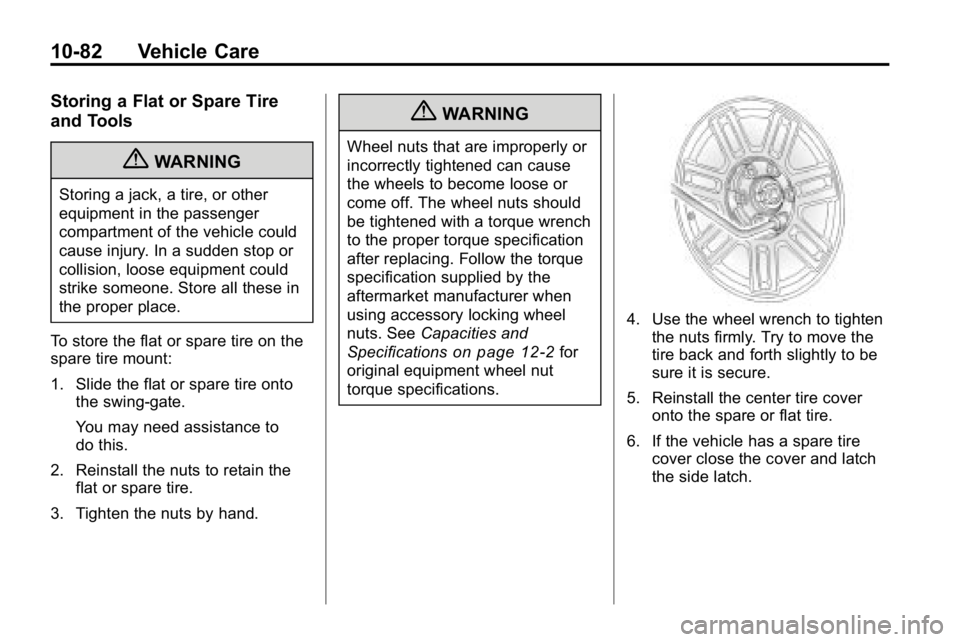
4. Use the wheel wrench to tighten the nuts firmly. Try to move the
tire back and forth slightly to be
sure it is secure.
5. Reinstall the center tire cover onto the spare or flat tire.
6. If the vehicle has a spare tire cover close the cover and latch
the side latch.
Page 351 of 410
Vehicle Care 10-85
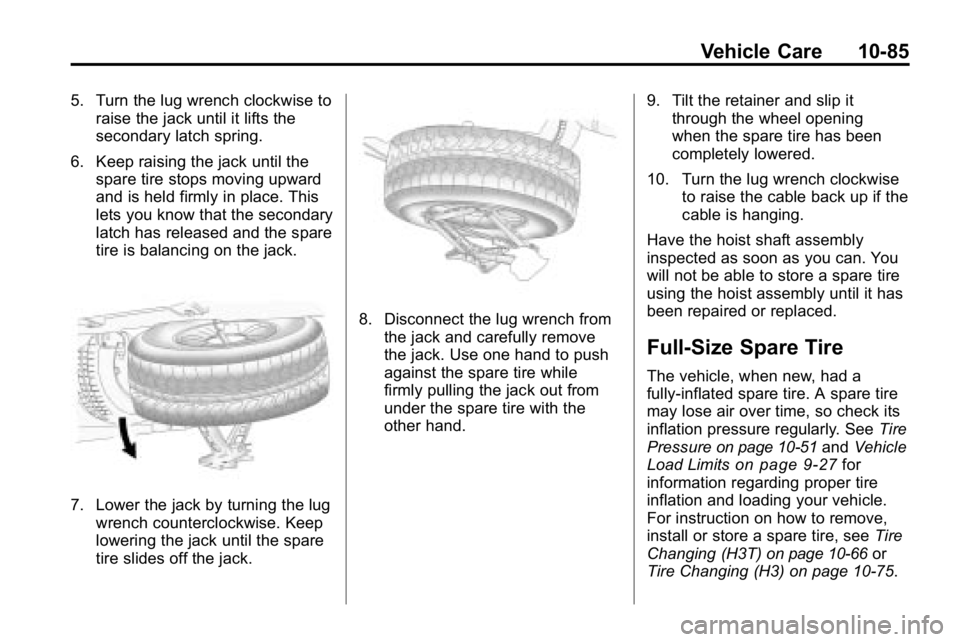
5. Turn the lug wrench clockwise toraise the jack until it lifts the
secondary latch spring.
6. Keep raising the jack until the spare tire stops moving upward
and is held firmly in place. This
lets you know that the secondary
latch has released and the spare
tire is balancing on the jack.
7. Lower the jack by turning the lugwrench counterclockwise. Keep
lowering the jack until the spare
tire slides off the jack.
8. Disconnect the lug wrench fromthe jack and carefully remove
the jack. Use one hand to push
against the spare tire while
firmly pulling the jack out from
under the spare tire with the
other hand. 9. Tilt the retainer and slip it
through the wheel opening
when the spare tire has been
completely lowered.
10. Turn the lug wrench clockwise to raise the cable back up if the
cable is hanging.
Have the hoist shaft assembly
inspected as soon as you can. You
will not be able to store a spare tire
using the hoist assembly until it has
been repaired or replaced.
Full-Size Spare Tire
The vehicle, when new, had a
fully-inflated spare tire. A spare tire
may lose air over time, so check its
inflation pressure regularly. See Tire
Pressure
on page 10‑51and Vehicle
Load Limitson page 9‑27for
information regarding proper tire
inflation and loading your vehicle.
For instruction on how to remove,
install or store a spare tire, see Tire
Changing (H3T)
on page 10‑66or
Tire Changing (H3) on page 10‑75.