service HUMMER H3 2010 Manual PDF
[x] Cancel search | Manufacturer: HUMMER, Model Year: 2010, Model line: H3, Model: HUMMER H3 2010Pages: 410, PDF Size: 2.24 MB
Page 355 of 410
Vehicle Care 10-89
10. Now start the vehicle with thegood battery and run the
engine for a while.
11. Try to start the vehicle that had the dead battery. If it will
not start after a few tries, it
probably needs service.
Notice: If the jumper cables are
connected or removed in the
wrong order, electrical shorting
may occur and damage the
vehicle. The repairs would not be
covered by the vehicle warranty.
Always connect and remove the
jumper cables in the correct
order, making sure that the
cables do not touch each other
or other metal.
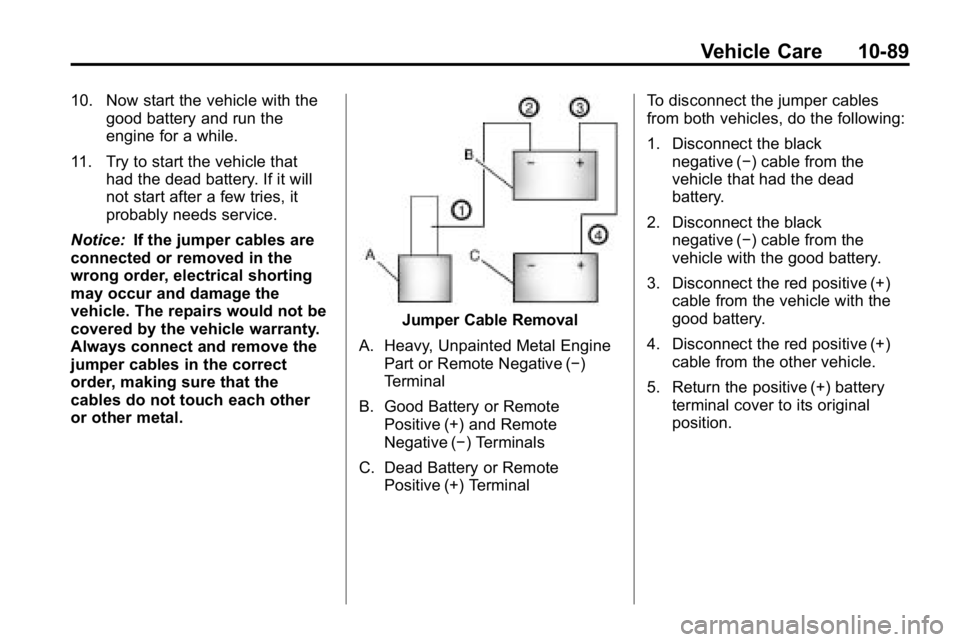
Jumper Cable Removal
A. Heavy, Unpainted Metal Engine Part or Remote Negative (−)
Terminal
B. Good Battery or Remote Positive (+) and Remote
Negative (−) Terminals
C. Dead Battery or Remote Positive (+) Terminal To disconnect the jumper cables
from both vehicles, do the following:
1. Disconnect the black
negative (−) cable from the
vehicle that had the dead
battery.
2. Disconnect the black negative (−) cable from the
vehicle with the good battery.
3. Disconnect the red positive (+) cable from the vehicle with the
good battery.
4. Disconnect the red positive (+) cable from the other vehicle.
5. Return the positive (+) battery terminal cover to its original
position.
Page 356 of 410
10-90 Vehicle Care
Towing
Towing the Vehicle
To avoid damage, the disabled
vehicle should be towed with all
four wheels off the ground. Consult
your dealer or a professional towing
service if the disabled vehicle must
be towed. SeeRoadside Service
on
page 13‑5.
To tow the vehicle behind
another vehicle for recreational
purposes —such as behind a
motorhome, see “Recreational
Vehicle Towing” following.
Recreational Vehicle
Towing
Recreational vehicle towing
means towing the vehicle behind
another vehicle–such as behind
a motorhome. The two most
common types of recreational
vehicle towing are known as “dinghy
towing” — towing the vehicle with
all four wheels on the ground, and “dolly towing” —
towing the vehicle
with two wheels on the ground and
two wheels up on a device known
as a “dolly”.
Here are some important things to
consider before recreational vehicle
towing:
.What is the towing capacity of
the tow vehicle? Be sure to read
the tow vehicle manufacturer's
recommendations.
.What is the distance that will be
travelled? Some vehicles have
restrictions on how far and how
long they can tow.
.Is the proper towing equipment
going to be used? See your
dealer or trailering professional
for additional advice and
equipment recommendations.
.Is the vehicle ready to be
towed? Just as preparing the
vehicle for a long trip, make sure
the vehicle is prepared to be
towed.
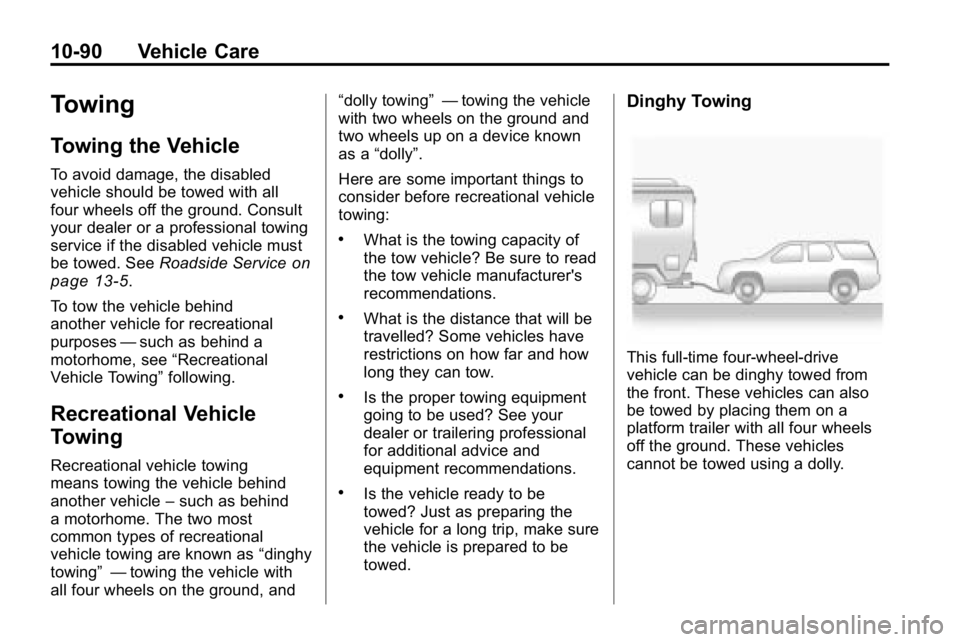
Dinghy Towing
This full‐time four‐wheel‐drive
vehicle can be dinghy towed from
the front. These vehicles can also
be towed by placing them on a
platform trailer with all four wheels
off the ground. These vehicles
cannot be towed using a dolly.
Page 365 of 410
Service and Maintenance 11-1
Service and
Maintenance
General Information
General Information . . . . . . . . . . 11-1
Scheduled Maintenance
Scheduled Maintenance . . . . . 11-2
Recommended Fluids,
Lubricants, and Parts
Recommended Fluids andLubricants . . . . . . . . . . . . . . . . . . 11-8
Maintenance Replacement Parts . . . . . . . . . . . . . . . . . . . . . . 11-10
Maintenance Records
Maintenance Records . . . . . . 11-11
General Information
Notice: Maintenance
intervals, checks, inspections,
recommended fluids, and
lubricants are necessary to keep
this vehicle in good working
condition. Damage caused by
failure to follow scheduled
maintenance might not be
covered by the vehicle warranty.
As the vehicle owner, you are
responsible for the scheduled
maintenance in this section. We
recommend having your dealer/
retailer perform these services.
Proper vehicle maintenance helps to
keep the vehicle in good working
condition, improves fuel economy,
and reduces vehicle emissions for
better air quality. Because of all the different ways
people use vehicles, maintenance
needs vary. The vehicle might need
more frequent checks and services.
Please read the information under
Scheduled Maintenance. To keep
the vehicle in good condition, see
your dealer/retailer.
The maintenance schedule is for
vehicles that:
.Carry passengers and cargo
within recommended limits on
the Tire and Loading Information
label. See
Vehicle Load Limits
on page 9‑27.
.Are driven on reasonable road
surfaces within legal driving
limits.
Page 366 of 410
11-2 Service and Maintenance
.Are driven off-road in the
recommended manner. See
Off-Road Driving on page 9‑7.
.Use the recommended fuel.
SeeRecommended Fuelon
page 9‑64.
{WARNING
Performing maintenance work can
be dangerous. Some jobs can
cause serious injury. Perform
maintenance work only if you
have the required know-how and
the proper tools and equipment.
If in doubt, see your dealer to
have a qualified technician do
the work. See Doing Your Own
Service Work on page 10‑4.
At your dealer/retailer, you can be
certain that you will receive the
highest level of service available. Your dealer/retailer has specially
trained service technicians, uses
genuine replacement parts, as
well as, up to date tools and
equipment to ensure fast and
accurate diagnostics.
The proper replacement parts,
fluids, and lubricants to use
are listed in
Recommended Fluids
and Lubricantson page 11‑8and
Maintenance Replacement Partson
page 11‑10. We recommend the
use of genuine parts from your
dealer/retailer.
Rotation of New Tires
To maintain ride, handling, and
performance of the vehicle, it is
important that the first rotation
service for new tires be performed
when they have 8 000 to 13 000 km
(5,000 to 8,000 miles). See Tire
Rotation on page 10‑57.
Scheduled
Maintenance
When the Change Oil Message
Displays
Change engine oil and filter. See
Engine Oilon page 10‑9. An
Emission Control Service.
When the “Change Oil” message
displays, service is required for
the vehicle as soon as possible,
within the next 1 000 km/600 miles.
If driving under the best conditions,
the engine oil life system might not
indicate the need for vehicle service
for more than a year. The engine
oil and filter must be changed at
least once a year and the oil life
system must be reset. Your dealer
has trained service technicians who
will perform this work and reset the
system. If the engine oil life system
is reset accidentally, service the
vehicle within 5 000 km/3,000 miles
since the last service. Reset the oil
Page 367 of 410
Service and Maintenance 11-3
life system whenever the oil is
changed. SeeEngine Oil Life
System on page 10‑11.
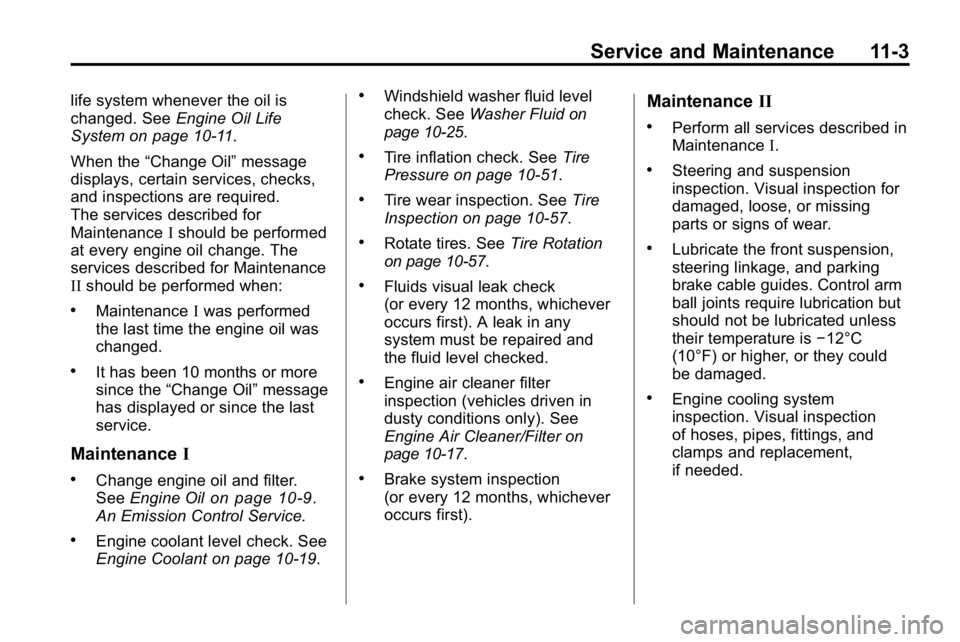
When the “Change Oil” message
displays, certain services, checks,
and inspections are required.
The services described for
Maintenance Ishould be performed
at every engine oil change. The
services described for Maintenance
II should be performed when:
.Maintenance Iwas performed
the last time the engine oil was
changed.
.It has been 10 months or more
since the “Change Oil” message
has displayed or since the last
service.
Maintenance I
.Change engine oil and filter.
SeeEngine Oilon page 10‑9.
An Emission Control Service.
.Engine coolant level check. See
Engine Coolant on page 10‑19.
.Windshield washer fluid level
check. See Washer Fluidon
page 10‑25.
.Tire inflation check. See Tire
Pressure on page 10‑51.
.Tire wear inspection. See Tire
Inspection on page 10‑57.
.Rotate tires. See Tire Rotationon page 10‑57.
.Fluids visual leak check
(or every 12 months, whichever
occurs first). A leak in any
system must be repaired and
the fluid level checked.
.Engine air cleaner filter
inspection (vehicles driven in
dusty conditions only). See
Engine Air Cleaner/Filter
on
page 10‑17.
.Brake system inspection
(or every 12 months, whichever
occurs first).
Maintenance II
.Perform all services described in
MaintenanceI.
.Steering and suspension
inspection. Visual inspection for
damaged, loose, or missing
parts or signs of wear.
.Lubricate the front suspension,
steering linkage, and parking
brake cable guides. Control arm
ball joints require lubrication but
should not be lubricated unless
their temperature is −12°C
(10°F) or higher, or they could
be damaged.
.Engine cooling system
inspection. Visual inspection
of hoses, pipes, fittings, and
clamps and replacement,
if needed.
Page 368 of 410

11-4 Service and Maintenance
.Windshield wiper blade
inspection for wear, cracking,
or contamination and windshield
and wiper blade cleaning,
if contaminated. SeeExterior
Care
on page 10‑92. Worn
or damaged wiper blade
replacement. See Wiper Blade
Replacement on page 10‑32.
.Body hinges and latches, key
lock cylinders, folding seat
hardware, and rear compartment
hinges, linkage, and handle
pivot points lubrication. See
Recommended Fluids and
Lubricants
on page 11‑8.
More frequent lubrication may
be required when vehicle
is exposed to a corrosive
environment. Applying silicone
grease on weatherstrips with a
clean cloth makes them last
longer, seal better, and not stick
or squeak.
.Restraint system component
check. See Safety System
Check on page 3‑26.
.Automatic transmission fluid
level check and adding fluid,
if needed. See Automatic
Transmission Fluid
on
page 10‑12.
.Four‐wheel drive vehicles:
Transfer case fluid level check
and adding fluid, if needed.
.Engine air cleaner filter
inspection. See Engine Air
Cleaner/Filter on page 10‑17.
Additional Required Services
At Each Fuel Stop
.Engine oil level check. See
Engine Oil on page 10‑9.
.Engine coolant level check. See
Engine Coolant on page 10‑19.
.Windshield washer fluid level
check. See Washer Fluidon
page 10‑25. Once a Month
.Tire inflation check. See
Tire
Pressure on page 10‑51.
.Tire wear inspection. See Tire
Inspection on page 10‑57.
Once a Year
.See Starter Switch Checkon
page 10‑30.
.See Automatic Transmission
Shift Lock Control System
Check on page 10‑30.
.See Ignition Transmission Lock
Check on page 10‑31.
.See Park Brake and P (Park)
Mechanism Checkon
page 10‑31.
.Engine cooling system and
pressure cap pressure check.
Radiator and air conditioning
condenser outside cleaning. See
Cooling System on page 10‑18.
Page 369 of 410

Service and Maintenance 11-5
.Exhaust system and nearby heat
shields inspection for loose or
damaged components.
.Accelerator pedal check for
damage, high effort, or binding.
Replace if needed.
First Engine Oil Change After
Every 40 000 km/25,000 Miles
.Fuel system inspection for
damage or leaks.
First Engine Oil Change After
Every 80 000 km/50,000 Miles
.Engine air cleaner filter
replacement. See Engine Air
Cleaner/Filter on page 10‑17.
.Automatic transmission fluid
change (severe service) for
vehicles mainly driven in heavy
city traffic in hot weather, in
hilly or mountainous terrain,
when frequently towing a
trailer, or used for taxi, police,
or delivery service. See
Automatic Transmission Fluid
on
page 10‑12.
.Four‐wheel drive only: Transfer
case fluid change. Check vent
hose at transfer case for kinks
and proper installation. Check
to be sure vent hose is
unobstructed, clear, and free of
debris. During any maintenance,
if a power washer is used to
clean mud and dirt from the
underbody, care should be taken
to not directly spray the transfer
case output seals. High pressure
water can overcome the seals
and contaminate the transfer
case fluid. Contaminated fluid
will decrease the life of the
transfer case and should be
replaced.
First Engine Oil Change After
Every 160 000 km/100,000 Miles
.Automatic transmission fluid
change (normal service).
See Automatic Transmission
Fluid on page 10‑12.
.Rear axle fluid change (normal
service). See Rear Axleon
page 10‑29.
.Spark plug replacement and
spark plug wires inspection.
An Emission Control Service.
First Engine Oil Change After
Every 240 000 km/150,000 Miles
.Engine cooling system drain,
flush, and refill, cooling system
and cap pressure check, and
cleaning of outside of radiator
and air conditioning condenser
(or every 5 years, whichever
occurs first). See Cooling
System
on page 10‑18. An
Emission Control Service.
.Engine accessory drive belt
inspection for fraying, excessive
cracks, or obvious damage
and replacement, if needed.
An Emission Control Service.
Page 370 of 410
11-6 Service and Maintenance
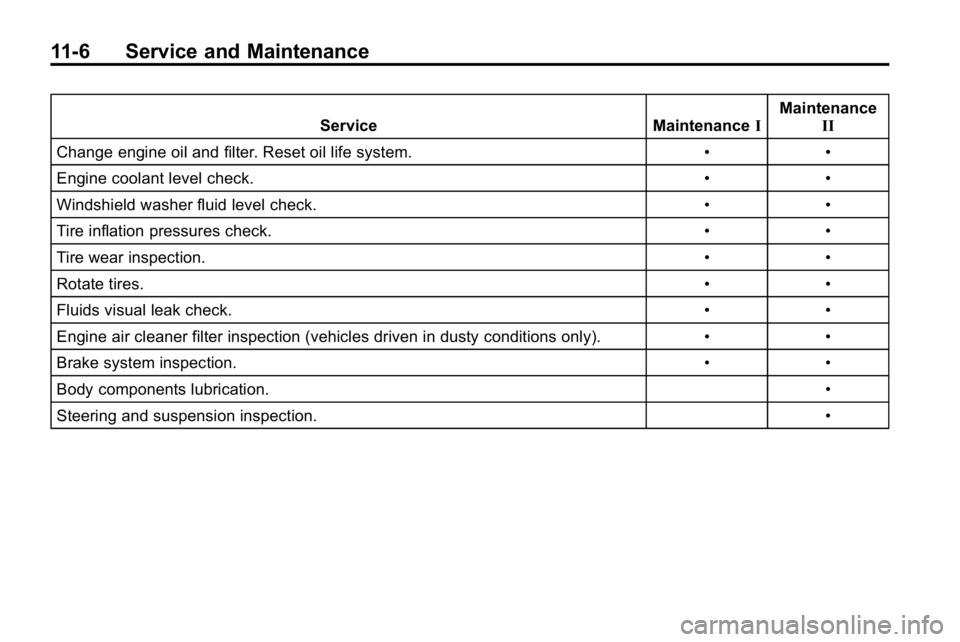
ServiceMaintenanceIMaintenance
II
Change engine oil and filter. Reset oil life system. ••
Engine coolant level check. ••
Windshield washer fluid level check. ••
Tire inflation pressures check. ••
Tire wear inspection. ••
Rotate tires. ••
Fluids visual leak check. ••
Engine air cleaner filter inspection (vehicles driven in dusty conditions only). ••
Brake system inspection. ••
Body components lubrication. •
Steering and suspension inspection. •
Page 371 of 410

Service and Maintenance 11-7
ServiceMaintenanceIMaintenance
II
Chassis components lubrication. •
Engine cooling system inspection. •
Windshield wiper blades inspection. •
Body components lubrication. •
Restraint system components check. •
Automatic transmission fluid level check. •
Four‐wheel drive only: Transfer case fluid level check. •
Engine air cleaner filter inspection (vehicles not driven in dusty conditions). •
Page 372 of 410
11-8 Service and Maintenance
Recommended Fluids, Lubricants, and Parts
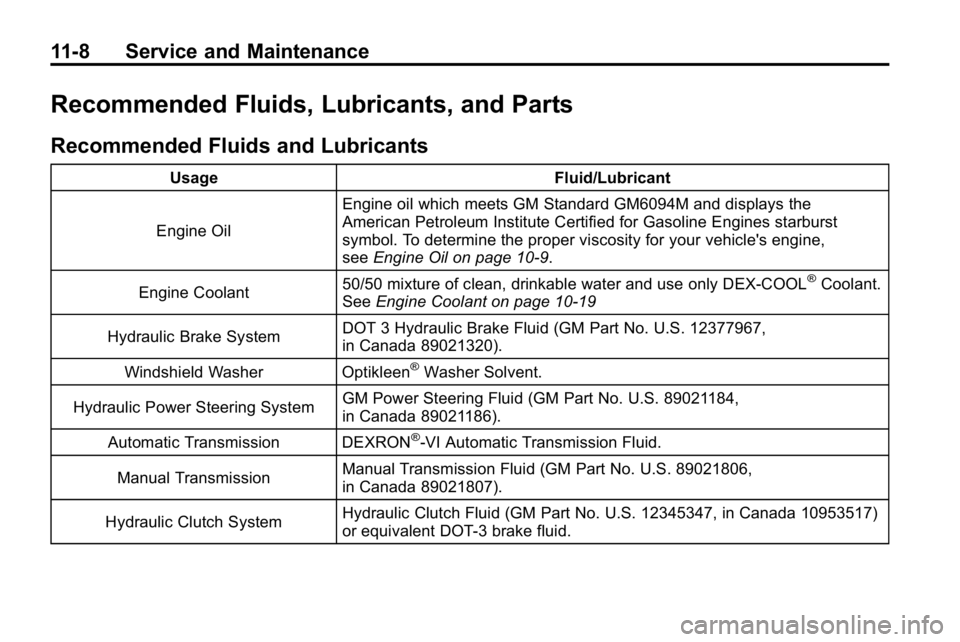
Recommended Fluids and Lubricants
UsageFluid/Lubricant
Engine Oil Engine oil which meets GM Standard GM6094M and displays the
American Petroleum Institute Certified for Gasoline Engines starburst
symbol. To determine the proper viscosity for your vehicle's engine,
see
Engine Oil on page 10‑9.
Engine Coolant 50/50 mixture of clean, drinkable water and use only DEX-COOL
®Coolant.
See Engine Coolant on page 10‑19
Hydraulic Brake System DOT 3 Hydraulic Brake Fluid (GM Part No. U.S. 12377967,
in Canada 89021320).
Windshield Washer Optikleen
®Washer Solvent.
Hydraulic Power Steering System GM Power Steering Fluid (GM Part No. U.S. 89021184,
in Canada 89021186).
Automatic Transmission DEXRON
®‐VI Automatic Transmission Fluid.
Manual Transmission Manual Transmission Fluid (GM Part No. U.S. 89021806,
in Canada 89021807).
Hydraulic Clutch System Hydraulic Clutch Fluid (GM Part No. U.S. 12345347, in Canada 10953517)
or equivalent DOT-3 brake fluid.