fuel pressure HUMMER H3 2010 Owners Manual
[x] Cancel search | Manufacturer: HUMMER, Model Year: 2010, Model line: H3, Model: HUMMER H3 2010Pages: 410, PDF Size: 2.24 MB
Page 4 of 410
iv Introduction
{WARNING
These mean there is something
that could hurt you or other
people.
Notice: This means there is
something that could result in
property or vehicle damage.
This would not be covered by
the vehicle's warranty.
A circle with a slash through it
is a safety symbol which means
“Do Not,” “Do not do this” or
“Do not let this happen.”
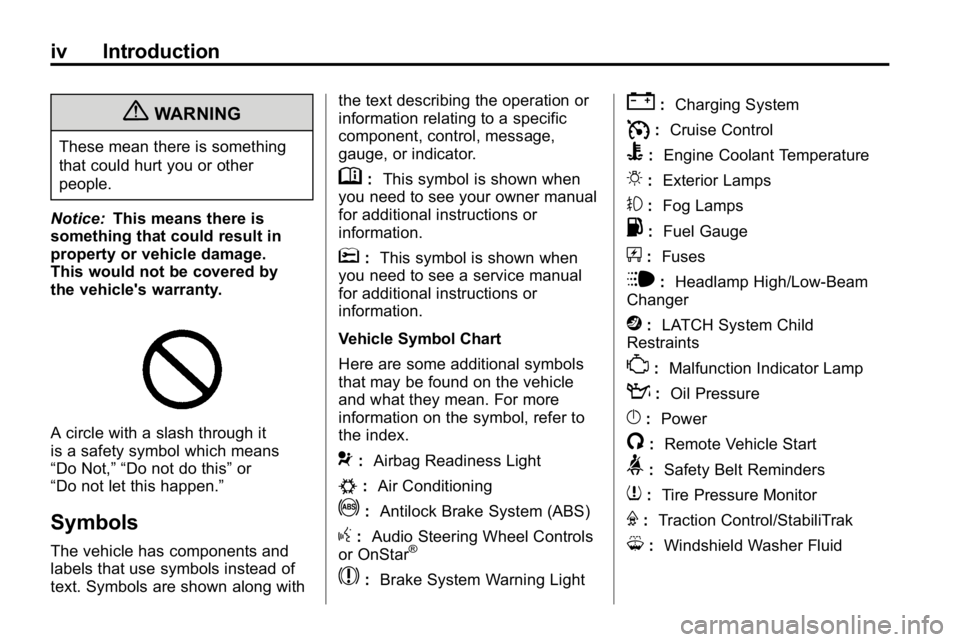
Symbols
The vehicle has components and
labels that use symbols instead of
text. Symbols are shown along with the text describing the operation or
information relating to a specific
component, control, message,
gauge, or indicator.
M:
This symbol is shown when
you need to see your owner manual
for additional instructions or
information.
*: This symbol is shown when
you need to see a service manual
for additional instructions or
information.
Vehicle Symbol Chart
Here are some additional symbols
that may be found on the vehicle
and what they mean. For more
information on the symbol, refer to
the index.
9: Airbag Readiness Light
#:Air Conditioning
!:Antilock Brake System (ABS)
g:Audio Steering Wheel Controls
or OnStar®
$: Brake System Warning Light
":Charging System
I:Cruise Control
B: Engine Coolant Temperature
O:Exterior Lamps
#:Fog Lamps
.: Fuel Gauge
+:Fuses
i: Headlamp High/Low-Beam
Changer
j: LATCH System Child
Restraints
*: Malfunction Indicator Lamp
::Oil Pressure
}:Power
/:Remote Vehicle Start
>:Safety Belt Reminders
7:Tire Pressure Monitor
F:Traction Control/StabiliTrak
M:Windshield Washer Fluid
Page 5 of 410
In Brief 1-1
In Brief
Instrument Panel
Instrument Panel . . . . . . . . . . . . . . 1-2
Initial Drive Information
Initial Drive Information . . . . . . . . 1-3
Remote Keyless Entry (RKE)System . . . . . . . . . . . . . . . . . . . . . . 1-4
Door Locks . . . . . . . . . . . . . . . . . . . 1-4
Tailgate . . . . . . . . . . . . . . . . . . . . . . . 1-5
Windows . . . . . . . . . . . . . . . . . . . . . . 1-6
Seat Adjustment . . . . . . . . . . . . . . 1-7
Heated Seats . . . . . . . . . . . . . . . . . 1-8
Head Restraint Adjustment . . . . 1-8
Safety Belt . . . . . . . . . . . . . . . . . . . . 1-8
Sensing System for Passenger Airbag . . . . . . . . . . . . . . . . . . . . . . . 1-9 Mirror Adjustment . . . . . . . . . . . . . 1-9
Steering Wheel
Adjustment . . . . . . . . . . . . . . . . . 1-10
Interior Lighting . . . . . . . . . . . . . . 1-10
Exterior Lighting . . . . . . . . . . . . . 1-11
Washer and Wiper Systems . . . . . . . . . . . . . . . . . . . . 1-11
Climate Controls . . . . . . . . . . . . . 1-12
Transmission . . . . . . . . . . . . . . . . 1-12
Vehicle Features
Radio(s) . . . . . . . . . . . . . . . . . . . . . 1-13
Satellite Radio . . . . . . . . . . . . . . . 1-14
Bluetooth
®. . . . . . . . . . . . . . . . . . . 1-15
Navigation System . . . . . . . . . . . 1-15
Cruise Control . . . . . . . . . . . . . . . 1-15
Storage Compartments . . . . . . 1-15
Power Outlets . . . . . . . . . . . . . . . 1-16
Sunroof . . . . . . . . . . . . . . . . . . . . . . 1-16
Performance and Maintenance
Traction Control System (TCS) . . . . . . . . . . . . . . 1-16
StabiliTrak
®. . . . . . . . . . . . . . . . . . 1-17
Tire Pressure Monitor . . . . . . . . 1-17
Engine Oil Life System . . . . . . 1-18
Fuel E85 (85% Ethanol) . . . . . 1-18
Driving for Better Fuel Economy . . . . . . . . . . . . . . . . . . . 1-18
Roadside Service . . . . . . . . . . . . 1-19
OnStar
®. . . . . . . . . . . . . . . . . . . . . 1-19
Page 115 of 410
Instruments and Controls 5-1
Instruments and
Controls
Controls
Steering Wheel Adjustment . . . 5-2
Horn . . . . . . . . . . . . . . . . . . . . . . . . . . 5-2
Windshield Wiper/Washer . . . . . 5-2
Rear Window Wiper/Washer . . . . . . . . . . . . . . . . . . . . . . 5-3
Compass . . . . . . . . . . . . . . . . . . . . . 5-3
Clock . . . . . . . . . . . . . . . . . . . . . . . . . 5-4
Power Outlets . . . . . . . . . . . . . . . . . 5-5
Cigarette Lighter . . . . . . . . . . . . . . 5-5
Ashtrays . . . . . . . . . . . . . . . . . . . . . . 5-6
Warning Lights, Gauges, and
Indicators
Warning Lights, Gauges, and Indicators . . . . . . . . . . . . . . . . . . . . 5-6
Instrument Cluster . . . . . . . . . . . . 5-7
Speedometer . . . . . . . . . . . . . . . . . 5-8
Odometer . . . . . . . . . . . . . . . . . . . . . 5-8
Trip Odometer . . . . . . . . . . . . . . . . . 5-8 Tachometer . . . . . . . . . . . . . . . . . . . 5-8
Fuel Gauge . . . . . . . . . . . . . . . . . . . 5-8
Engine Coolant Temperature
Gauge . . . . . . . . . . . . . . . . . . . . . . . 5-9
Safety Belt Reminders . . . . . . . . 5-9
Airbag Readiness Light . . . . . . 5-10
Passenger Airbag Status
Indicator . . . . . . . . . . . . . . . . . . . . 5-11
Charging System Light . . . . . . . 5-11
Malfunction Indicator Lamp . . . . . . . . . . . . . 5-12
Brake System Warning Light . . . . . . . . . . . . . . . . . . . . . . . 5-14
Antilock Brake System (ABS) Warning Light . . . . . . . . . . . . . . 5-15
Up-Shift Light . . . . . . . . . . . . . . . . 5-15
Traction Control System (TCS)/StabiliTrak
®Light . . . . 5-16
Tire Pressure Light . . . . . . . . . . 5-16
Engine Oil Pressure Light . . . . 5-17
Security Light . . . . . . . . . . . . . . . . 5-17
High-Beam on Light . . . . . . . . . 5-17
Cruise Control Light . . . . . . . . . 5-18
Information Displays
Driver Information Center (DIC) . . . . . . . . . . . . . . . 5-18
Vehicle Messages
Vehicle Messages . . . . . . . . . . . 5-21
Battery Voltage and ChargingMessages . . . . . . . . . . . . . . . . . . 5-21
Brake System Messages . . . . 5-22
Door Ajar Messages . . . . . . . . . 5-22
Engine Cooling System Messages . . . . . . . . . . . . . . . . . . 5-23
Engine Oil Messages . . . . . . . . 5-23
Engine Power Messages . . . . 5-23
Fuel System Messages . . . . . . 5-24
Lamp Messages . . . . . . . . . . . . . 5-24
Ride Control System Messages . . . . . . . . . . . . . . . . . . 5-24
Service Vehicle Messages . . . 5-25
Tire Messages . . . . . . . . . . . . . . . 5-25
Transmission Messages . . . . . 5-25
Universal Remote System
Universal Remote System . . . 5-26
Universal Remote System Programming . . . . . . . . . . . . . . . 5-26
Universal Remote System Operation . . . . . . . . . . . . . . . . . . 5-30
Page 275 of 410
Vehicle Care 10-9
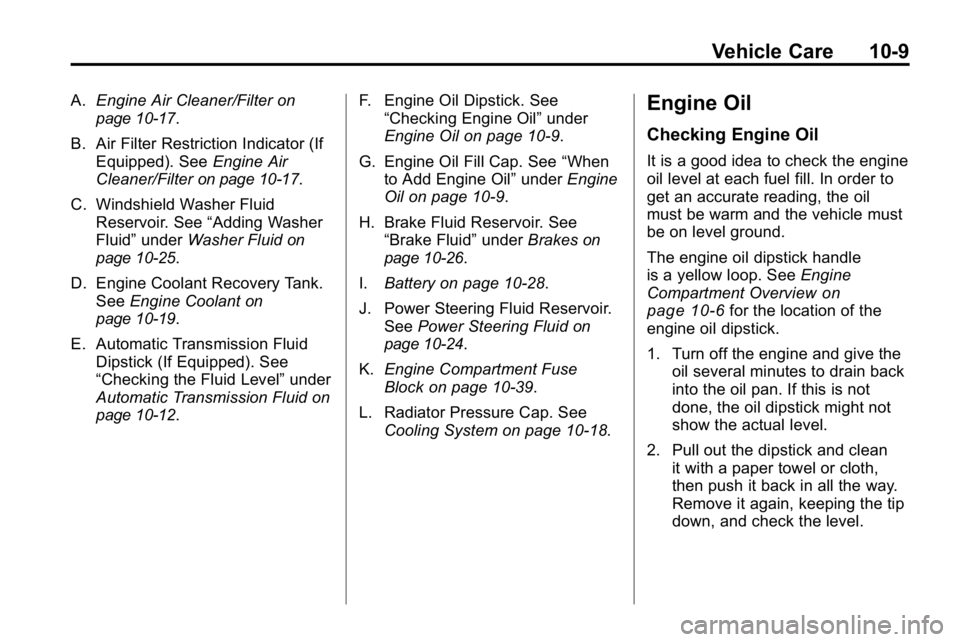
A.Engine Air Cleaner/Filteron
page 10‑17.
B. Air Filter Restriction Indicator (If Equipped). See Engine Air
Cleaner/Filter
on page 10‑17.
C. Windshield Washer Fluid Reservoir. See “Adding Washer
Fluid” under Washer Fluid
on
page 10‑25.
D. Engine Coolant Recovery Tank. See Engine Coolant
on
page 10‑19.
E. Automatic Transmission Fluid Dipstick (If Equipped). See
“Checking the Fluid Level” under
Automatic Transmission Fluid
on
page 10‑12. F. Engine Oil Dipstick. See
“Checking Engine Oil” under
Engine Oil on page 10‑9.
G. Engine Oil Fill Cap. See “When
to Add Engine Oil” underEngine
Oil on page 10‑9.
H. Brake Fluid Reservoir. See “Brake Fluid” underBrakes
on
page 10‑26.
I. Battery on page 10‑28.
J. Power Steering Fluid Reservoir. See Power Steering Fluid
on
page 10‑24.
K. Engine Compartment Fuse
Block on page 10‑39.
L. Radiator Pressure Cap. See Cooling System on page 10‑18.
Engine Oil
Checking Engine Oil
It is a good idea to check the engine
oil level at each fuel fill. In order to
get an accurate reading, the oil
must be warm and the vehicle must
be on level ground.
The engine oil dipstick handle
is a yellow loop. See Engine
Compartment Overview
on
page 10‑6for the location of the
engine oil dipstick.
1. Turn off the engine and give the oil several minutes to drain back
into the oil pan. If this is not
done, the oil dipstick might not
show the actual level.
2. Pull out the dipstick and clean it with a paper towel or cloth,
then push it back in all the way.
Remove it again, keeping the tip
down, and check the level.
Page 314 of 410
10-48 Vehicle Care
(E) Rim Diameter:Diameter of
the wheel in inches.
(F) Load Range
:Load Range.
(G) Service Description
:The
service description indicates the
load index and speed rating of a
tire. If two numbers are given as
in the example, 120/116, then
this represents the load index for
single versus dual wheel usage
(single/dual). The speed rating is
the maximum speed a tire is
certified to carry a load.
Tire Terminology and
Definitions
Air Pressure:The amount
of air inside the tire pressing
outward on each square inch
of the tire. Air pressure is
expressed in psi (pounds per
square inch) or kPa (kilopascal). Accessory Weight
:This
means the combined weight
of optional accessories.
Some examples of optional
accessories are, automatic
transmission, power steering,
power brakes, power windows,
power seats, and air
conditioning.
Aspect Ratio
:The relationship
of a tire's height to its width.
Belt
:A rubber coated layer of
cords that is located between
the plies and the tread. Cords
may be made from steel or other
reinforcing materials.
Bead
:The tire bead contains
steel wires wrapped by steel
cords that hold the tire onto
the rim. Bias Ply Tire
:A pneumatic tire
in which the plies are laid at
alternate angles less than
90 degrees to the centerline of
the tread.
Cold Tire Pressure
:The
amount of air pressure in a tire,
measured in psi (pounds per
square inch) or kPa (kilopascal)
before a tire has built up heat
from driving. See Tire Pressure
on page 10‑51.
Curb Weight
:The weight of a
motor vehicle with standard and
optional equipment including
the maximum capacity of fuel,
oil, and coolant, but without
passengers and cargo.
Page 317 of 410
Vehicle Care 10-51
Vehicle Placard:A label
permanently attached to a
vehicle showing the vehicle's
capacity weight and the
original equipment tire size
and recommended inflation
pressure. See “Tire and Loading
Information Label” underVehicle
Load Limits
on page 9‑27.
Tire Pressure
Tires need the correct amount
of air pressure to operate
effectively.
Notice:Do not let anyone tell
you that under‐inflation or
over‐inflation is all right. It is
not. If your tires do not have
enough air (under‐inflation),
you can get the following:
.Too much flexing
.Too much heat
.Tire overloading
.Premature or
irregular wear
.Poor handling
.Reduced fuel economy
If your tires have too much air
(over‐inflation), you can get
the following:
.Unusual wear
.Poor handling
.Rough ride
.Needless damage from
road hazards
A vehicle specific Tire and
Loading Information label is
attached to your vehicle. This
label shows your vehicle's
original equipment tires and the
correct inflation pressures for
your tires when they are cold.
The recommended cold tire
inflation pressure, shown on the
label, is the minimum amount of air pressure needed to support
your vehicle's maximum load
carrying capacity.
For additional information
regarding how much weight
your vehicle can carry, and an
example of the Tire and Loading
Information label, see
Vehicle
Load Limits
on page 9‑27.
How you load your vehicle
affects vehicle handling and ride
comfort. Never load your vehicle
with more weight than it was
designed to carry.
When to Check
Check your tires once a month
or more. Also check the tire
pressure of the spare tire. If your
vehicle has a compact spare
tire, it should be at 60 psi
(420 kPa). See Full-Size Spare
Tire
on page 10‑85for additional
information.
Page 318 of 410

10-52 Vehicle Care
How to Check
Use a good quality pocket-type
gauge to check tire pressure.
You cannot tell if your tires are
properly inflated simply by
looking at them. Radial tires may
look properly inflated even when
they are underinflated. Check
the tire's inflation pressure when
the tires are cold. Cold means
your vehicle has been sitting for
at least three hours or driven no
more than 1 mile (1.6 km).
Remove the valve cap from the
tire valve stem. Press the tire
gauge firmly onto the valve to
get a pressure measurement.
If the cold tire inflation pressure
matches the recommended
pressure on the Tire and
Loading Information label, no
further adjustment is necessary.
If the inflation pressure is low,
add air until you reach the
recommended amount.If you overfill the tire, release air
by pushing on the metal stem
in the center of the tire valve.
Recheck the tire pressure with
the tire gauge.
Be sure to put the valve caps
back on the valve stems. They
help prevent leaks by keeping
out dirt and moisture.
Tire Pressure Monitor
System
The Tire Pressure Monitor System
(TPMS) uses radio and sensor
technology to check tire pressure
levels. The TPMS sensors monitor
the air pressure in your vehicle's
tires and transmit tire pressure
readings to a receiver located in the
vehicle.
Each tire, including the spare
(if provided), should be checked
monthly when cold and inflated to
the inflation pressure recommended
by the vehicle manufacturer on the vehicle placard or tire inflation
pressure label. (If your vehicle has
tires of a different size than the size
indicated on the vehicle placard or
tire inflation pressure label, you
should determine the proper tire
inflation pressure for those tires.)
As an added safety feature, your
vehicle has been equipped with a
tire pressure monitoring system
(TPMS) that illuminates a low tire
pressure telltale when one or
more of your tires is significantly
under‐inflated.
Accordingly, when the low tire
pressure telltale illuminates, you
should stop and check your tires as
soon as possible, and inflate them
to the proper pressure. Driving on
a significantly under‐inflated tire
causes the tire to overheat and can
lead to tire failure. Under‐inflation
also reduces fuel efficiency and
tire tread life, and may affect the
vehicle's handling and stopping
ability.
Page 368 of 410

11-4 Service and Maintenance
.Windshield wiper blade
inspection for wear, cracking,
or contamination and windshield
and wiper blade cleaning,
if contaminated. SeeExterior
Care
on page 10‑92. Worn
or damaged wiper blade
replacement. See Wiper Blade
Replacement on page 10‑32.
.Body hinges and latches, key
lock cylinders, folding seat
hardware, and rear compartment
hinges, linkage, and handle
pivot points lubrication. See
Recommended Fluids and
Lubricants
on page 11‑8.
More frequent lubrication may
be required when vehicle
is exposed to a corrosive
environment. Applying silicone
grease on weatherstrips with a
clean cloth makes them last
longer, seal better, and not stick
or squeak.
.Restraint system component
check. See Safety System
Check on page 3‑26.
.Automatic transmission fluid
level check and adding fluid,
if needed. See Automatic
Transmission Fluid
on
page 10‑12.
.Four‐wheel drive vehicles:
Transfer case fluid level check
and adding fluid, if needed.
.Engine air cleaner filter
inspection. See Engine Air
Cleaner/Filter on page 10‑17.
Additional Required Services
At Each Fuel Stop
.Engine oil level check. See
Engine Oil on page 10‑9.
.Engine coolant level check. See
Engine Coolant on page 10‑19.
.Windshield washer fluid level
check. See Washer Fluidon
page 10‑25. Once a Month
.Tire inflation check. See
Tire
Pressure on page 10‑51.
.Tire wear inspection. See Tire
Inspection on page 10‑57.
Once a Year
.See Starter Switch Checkon
page 10‑30.
.See Automatic Transmission
Shift Lock Control System
Check on page 10‑30.
.See Ignition Transmission Lock
Check on page 10‑31.
.See Park Brake and P (Park)
Mechanism Checkon
page 10‑31.
.Engine cooling system and
pressure cap pressure check.
Radiator and air conditioning
condenser outside cleaning. See
Cooling System on page 10‑18.
Page 369 of 410

Service and Maintenance 11-5
.Exhaust system and nearby heat
shields inspection for loose or
damaged components.
.Accelerator pedal check for
damage, high effort, or binding.
Replace if needed.
First Engine Oil Change After
Every 40 000 km/25,000 Miles
.Fuel system inspection for
damage or leaks.
First Engine Oil Change After
Every 80 000 km/50,000 Miles
.Engine air cleaner filter
replacement. See Engine Air
Cleaner/Filter on page 10‑17.
.Automatic transmission fluid
change (severe service) for
vehicles mainly driven in heavy
city traffic in hot weather, in
hilly or mountainous terrain,
when frequently towing a
trailer, or used for taxi, police,
or delivery service. See
Automatic Transmission Fluid
on
page 10‑12.
.Four‐wheel drive only: Transfer
case fluid change. Check vent
hose at transfer case for kinks
and proper installation. Check
to be sure vent hose is
unobstructed, clear, and free of
debris. During any maintenance,
if a power washer is used to
clean mud and dirt from the
underbody, care should be taken
to not directly spray the transfer
case output seals. High pressure
water can overcome the seals
and contaminate the transfer
case fluid. Contaminated fluid
will decrease the life of the
transfer case and should be
replaced.
First Engine Oil Change After
Every 160 000 km/100,000 Miles
.Automatic transmission fluid
change (normal service).
See Automatic Transmission
Fluid on page 10‑12.
.Rear axle fluid change (normal
service). See Rear Axleon
page 10‑29.
.Spark plug replacement and
spark plug wires inspection.
An Emission Control Service.
First Engine Oil Change After
Every 240 000 km/150,000 Miles
.Engine cooling system drain,
flush, and refill, cooling system
and cap pressure check, and
cleaning of outside of radiator
and air conditioning condenser
(or every 5 years, whichever
occurs first). See Cooling
System
on page 10‑18. An
Emission Control Service.
.Engine accessory drive belt
inspection for fraying, excessive
cracks, or obvious damage
and replacement, if needed.
An Emission Control Service.
Page 402 of 410

i-4 INDEX
E
E85 Fuel . . . . . . . . . . . . . . . . . . . . . . . 9-66
Electrical Equipment,Add-On . . . . . . . . . . . . . . . . . . . . . . 9-81
Electrical System Engine CompartmentFuse Block . . . . . . . . . . . . . . . . 10-39
Fuses and Circuit Breakers . . . . . . . . . . . . . . . . . . 10-39
Overload . . . . . . . . . . . . . . . . . . . 10-38
Engine
Air Cleaner/Filter . . . . . . . . . . . 10-17
Check and Service EngineSoon Lamp . . . . . . . . . . . . . . . . . . 5-12
Compartment Overview . . . . . . . 10-6
Coolant . . . . . . . . . . . . . . . . . . . . . 10-19
Coolant Heater . . . . . . . . . . . . . . . 9-36
Coolant Temperature Gauge . . . 5-9
Cooling System . . . . . . . . . . . . . 10-18
Cooling System Messages . . . 5-23
Drive Belt Routing . . . . . . . . . . . . 12-4
Exhaust . . . . . . . . . . . . . . . . . . . . . . 9-40
Fan . . . . . . . . . . . . . . . . . . . . . . . . . 10-24 Engine (cont.)
Overheating . . . . . . . . . . . . . . . . 10-22
Power Messages . . . . . . . . . . . . . 5-23
Pressure Light . . . . . . . . . . . . . . . . 5-17
Running While Parked . . . . . . . . 9-41
Starting . . . . . . . . . . . . . . . . . . . . . . . 9-35
Engine Oil Life System . . . . . . . . . . . . . . . . . .10-11
Messages . . . . . . . . . . . . . . . . . . . . 5-23
Equipment, Towing . . . . . . . . . . . . 9-78
Event Data Recorders . . . . . . . . 13-15
Exit Lighting . . . . . . . . . . . . . . . . . . . . 6-8
Extender, Safety Belt . . . . . . . . . . 3-26
Exterior Lamp Controls . . . . . . . . . 6-1
Exterior Lamps Off Reminder . . . 6-3
F
Fan Engine . . . . . . . . . . . . . . . . . . . . . . 10-24
Filter
Engine Air Cleaner . . . . . . . . . 10-17
Flash-to-Pass . . . . . . . . . . . . . . . . . . . 6-3
Flashers, Hazard Warning . . . . . . 6-5
Flat Tire . . . . . . . . . . . . . . . . . . . . . . 10-64
Flat Tire, Changing . . . .10-66, 10-75 Fluid
Automatic Transmission . . . . 10-12
Brakes . . . . . . . . . . . . . . . . . . . . . . 10-27
Four-Wheel Drive
Transfer Case . . . . . . . . . . . . . . . 9-46
Power Steering . . . . . . . . . . . . . 10-24
Washer . . . . . . . . . . . . . . . . . . . . . 10-25
Fog Lamps Bulb Replacement . . . . . . . . . . . . . 6-6
Folding Mirrors . . . . . . . . . . . . . . . . 2-13
Four-Wheel Drive . . . . . . . 10-29, 9-46
Front Axle . . . . . . . . . . . . . . . . . . . . 10-29 Locking . . . . . . . . . . . . . . . . . . . . . . . 9-55
Front Seats Adjustment . . . . . . . . . . . . . . . . . . . . 3-3
Heated . . . . . . . . . . . . . . . . . . . . . . . . 3-6
Front Storage . . . . . . . . . . . . . . . . . . . 4-1
Fuel . . . . . . . . . . . . . . . . . . . . . . . . . . . 9-64 Additives . . . . . . . . . . . . . . . . . . . . . 9-65
E85 (85% Ethanol) . . . . . . . . . . . 9-66
Filling a Portable FuelContainer . . . . . . . . . . . . . . . . . . . 9-69
Filling the Tank . . . . . . . . . . . . . . . 9-68